HAL Id: hal-02306476
https://hal.archives-ouvertes.fr/hal-02306476
Submitted on 5 Oct 2019
HAL is a multi-disciplinary open access
archive for the deposit and dissemination of sci-entific research documents, whether they are pub-lished or not. The documents may come from teaching and research institutions in France or abroad, or from public or private research centers.
L’archive ouverte pluridisciplinaire HAL, est destinée au dépôt et à la diffusion de documents scientifiques de niveau recherche, publiés ou non, émanant des établissements d’enseignement et de recherche français ou étrangers, des laboratoires publics ou privés.
Interaction of pyrene fluoroprobe with natural and
synthetic humic substances: Examining the local
molecular organization from photophysical and
interfacial processes
A.-V. Jung, C. Frochot, F. Villiéras, B.S. Lartiges, S. Parant, M.-L. Viriot,
J.-L. Bersillon
To cite this version:
A.-V. Jung, C. Frochot, F. Villiéras, B.S. Lartiges, S. Parant, et al.. Interaction of pyrene flu-oroprobe with natural and synthetic humic substances: Examining the local molecular organiza-tion from photophysical and interfacial processes. Chemosphere, Elsevier, 2010, 80 (3), pp.228-234. �10.1016/j.chemosphere.2010.04.035�. �hal-02306476�
Interaction of pyrene fluoroprobe with natural and synthetic humic substances: Examining the local molecular organization from photophysical and interfacial
processes
JUNG A.-V.*1, FROCHOT C.2, VILLIERAS F.3, LARTIGES B.S.3, PARANT S.4,
VIRIOT M.-L.2, BERSILLON J.-L.3
*1Corresponding author, Ecole des Métiers de l’Environnement (EME), Campus de Ker Lann, Avenue
Schuman, 35170 Bruz, France, [email protected], tel (+33) 2 99 05 88 00, fax (+33) 2 99 05 88 09
2
Nancy-University CNRS-INPL-ENSIC UMR 7630 Département de Chimie Physique des Réactions (DCPR), 1 rue Grandville, BP 20451, 54000 Nancy, France
3Nancy-University CNRS-INPL-ENSG UMR 7569 Laboratoire Environnement et Minéralurgie (LEM), 15
avenue du Charmois, BP 40, 54501 Vandœuvre-lès-Nancy, France
4Nancy-University CNRS-UHP UMR 7565 Laboratoire de Structure et Réactivité des Systèmes
Moléculaires Complexes (SRSMC), 54500 Vandœuvre-lès-Nancy, France
Abstract
The direct and indirect interaction mechanisms of pyrene with (i) various
molecular weight fractions of a synthetic humic-like substance (SyHA) and (ii) extracts
of natural humic acids (NHA) from Moselle River suspended matter, were investigated
using quenching fluorescence and surface tension measurements. Humic materials were
characterized in a previous study. The Stern-Volmer associative constants were
determined from the quenching technique. Surface tension measurements revealed an
increase in surface activity as a function of concentration for each humic fraction
independently of the pyrene presence in solution, even during the formation of humic
micelles. The results obtained suggest the possibility of specific intermolecular
interactions occurring during pyrene entrapment within humic acids. In addition, we
show that molecular weight, aliphatic chains (especially those containing nitrogen
groups) and acidity are determinant characteristics for pollutant entrapment capacity at
concentrations below the critical micellar concentration (CMC) of humic substances.
Key words: natural - synthetic humic substances - fluorescence quenching - pyrene -
Introduction
Understanding the fate and the transport of anthropic contaminants in natural
aquatic systems is of a primary importance for water resources management and
treatment optimization. Among them, polycyclic aromatic hydrocarbons (PAHs) are
ubiquitous in the environment and have been identified in a number of soils, effluents,
river sediments, as well as in the colloidal compartment of surface waters (Bouloubassi
and Saliot, 1991; Countway et al., 2003). Although PAHs also occur naturally, high
levels of those molecules in the environment are usually attributed to point and
non-point pollution sources such as oil spills, automobile exhaust fumes, and coal refining
processes (Achten and Hofmann, 2009; Short et al., 2007). According to eco- and
human toxicity exposure tests (Hua et al., 2009; Jeffrey et al., 1977), mutagenic or
carcinogenic effects of PAHs can be expected in the natural environment.
It has long been recognized that natural organic matter (NOM) has an
indisputable role in the sorption and leaching of hazardous organic chemicals such as
PAHs in the environment (Chin et al., 1997; Countway et al., 2003; Gauthier et al.,
1987; Peuravuori, 2001). Various techniques have been used to examine the binding
capacities of NOM towards PAHs such as adsorption, Nuclear Magnetic resonance
(NMR), chromatography, and fluorescence methods (Ghosh et al., 2000; Hur et al.,
2009; Nakashima et al., 2007; Pan et al., 2006). Most of these classical approaches
require the determination of free pollutant concentrations, before and after their binding
with dissolved natural organic matter. However, the necessary separation steps often
lead to a poor quantitative estimate of binding capacity. On the other hand, a
fluorescence quenching technique does not require such a separation step. Therefore,
fluorescence spectroscopy offers unique advantages in the study of contaminant binding
Humic substances represent a predominant component of natural organic matter.
They are commonly described as amphilic heterogeneous compounds of about 1-2 nm
in size (Sieliechi et al. 2008). The organization of humic substances, either polymeric or
supramolecular assembly, remains a debated issue. Their molecular size has been shown
to strongly influence the binding capacity and the environmental transport of both
non-polar (Chin and Weber, 1989; Chiou et al., 1987) and non-polar organic contaminants such
as pesticides (Piccolo et al., 1996, 1998). The polarity of humic material could also
affect pollution transport. Previous reports have suggested either a partition of
contaminants between water and micelle-like structures of humic substances and/or
binding to well-defined sorption sites of the humic substances (Engebretson and
Wandruska, 1994; Sierra et al., 2005). Therefore, a better understanding of the humic
substance building blocks and structure can certainly be attained by relating their
sorption properties with their chemical characteristics. One approach is to correlate the
“binding” coefficients determined by quenching measurements with others hydrophobic
experimentally determined parameters. Indeed, this kind of analysis based on
pseudo-micellar behaviour (Engebretson and Wandruska, 1994; Sierra et al., 2005) revealed
that an increase in pyrene fluorescence with temperature in natural organic matter
(NOM) solution could be related to the decrease in dielectric constant of water, or to a
reduction of pyrene binding to NOM. Besides, as water becomes a poorer solvent,
humic polymers are thought to coil up and “squeeze” out the solvating water. Such
dehydration phenomenon has been offered in explanation of the well-known
cloud-point behaviour of non-ionic surfactants (Myers, 1992). The increased pyrene
fluorescence intensity with an increased temperature in the presence of some humic
acids may thus be ascribed to a pyrene incorporation into the micelle. Since the
collisional in nature, it could be referred to as “dynamic quenching”. The excitation
energy is transferred to the quencher and usually nonradiatively dissipated.
Alternatively, the fluorophore and the quencher may associate in the ground state,
leading to species that lacks the original fluorescence characteristics. This is termed
“static quenching”. Therefore, understanding that pyrene binding enthalpy is negative is
not enough to explain the rise of pyrene fluorescence in DOM solutions with
temperature.
Until now, the pyrene fluorescence spectrum has mainly been used to determine
solubility values and binding constants of non-polar organic compounds to different
sorbents. Thus, this hydrophobic probe turned out to be a very useful in situ tool for
determining the polarity of natural organic matter fractions (Engebretson and
Wandruska, 1994).
Recent research (Quagliotto et al., 2006) tends to build on such concepts and views
natural organic matter (NOM) as “a competitive low-cost biosurfactant”. From process
cost and environmental impact points of view, the bio-surfactant has the advantages of
operating at much lower additive concentrations and should be available at significantly
lower cost than the synthetic surfactants. However, the mechanistic basis for identifying
the interactions between polycyclic aromatic hydrocarbons (PAHs) and natural organic
matter (NOM) is not yet sufficiently clarified to predict sorption coefficients. One
approach to circumvent the intrinsic complexity of humic substances consists in
synthesizing functionally well-defined polymers integrating the main characteristics of
amino-phenolic humic-like molecules (Jung et al., 2005). A comparison of the interaction
of pyrene with (i) synthetic humic-like substances (SyHA) of different molecular weights
made from the oxidation of catechol/glycine (CGHA) or catechol/triglycine (CTHA)
River water (France), was explored in the present paper. The amount of pollutant bound to
each of the synthetic and natural humic acid fractions was correlated with their chemical
characteristics.
This paper attempts to clarify the formation of micellar aggregates between
pyrene and humic acids. The aim is to detect whether an interfacial modification could
explain the pyrene entrapment in micellar-like domains, and finally whether the pyrene
has an effect on the formation of humic substances micelles-like.
Experimental section Humic substances
Synthetic humic-like substances (SyHA) were prepared with catechol and glycine
or triglycine as reactants, thus representing two different nitrogen sources in distinct
syntheses. Two molecular weight synthetic humic-like substance (SyHA) fractions (1-3.5
kDa and > 8 kDa, respectively CTHA1 and CTHA2) were obtained for the
catechol/triglycine synthesis. A greater than 8 kDa catechol/glycine synthetic humic-like
substance (SyHA) fraction was also collected (CGHA). Andreux et al., (1980)
polymerization protocol was used. Catechol (6.6 g) was dissolved in 500mL of a solution
of sodium phosphate buffer NaH2PO4/Na2HPO4 at pH 8 to obtain a 0.03M catechol
solution. This was then mixed with an equal volume of buffered glycine or triglycine
0.03M solution. The resulting mixture was then allowed to react in a 2 L flask in the dark
at 25 °C and under pure oxygen constant pressure (0.9 bar) for 5 days. After dialysis,
(Spectra/Por 7 membrane- 1, 3.5 and 8 kDa molecular weight cuts-off-Roth-Sochiel
Lauterbourg, France), the synthetic materials in a sodium form were freeze-dried and
stored at 4 °C in the dark. Monitoring of the synthesis has been described elsewhere (Jung
Natural organic matter (NOM) designates natural humic acids extracted from
suspended matter taken from the Moselle river at Messein (France). The extraction was
performed according to the International Humic Substances Society (IHSS) standard
procedure (Thurman and Malcolm, 1981). Sodium saturated humic substances having a
greater than 8 kDa molecular weight were dialyzed to remove excess salt and then
freeze-dried. All natural and synthetic humic substances were collected under their
sodium form. Two natural humic extracts corresponding to two different field sampling
campaigns were obtained. Natural humic acids (NHA1 and NHA2) extractions were
performed during the summer and autumn seasons, respectively.
Preparation of Pyrene-Humic substances solutions
Pyrene (99+%) was purchased from Sigma-Aldrich Chemicals (Lyon, France)
and carefully stored at 4 °C in the dark. Crystals were dissolved in ethanol (99.5+%
spectrograde, Carlo Erba) to make a stock solution of 10-3 M.
Solutions of 10, 5 and 0.1 g.L-1 of synthetic humic-like substance (SyHA) and
natural humic acids (NHA) were first prepared in deionized ultra-pure Milli-Q water
(Millipore). Dilutions of these solutions were made to obtain humic substances (HS)
concentration ranging from 0.1 to 30 mg.L-1 for fluorescence measurements and from
0.1 to 1 g.L-1 for surface tension measurements. 20 mL aliquots of Synthetic humic-like
substance (SyHA) and NHA solutions were then placed in glass beakers and mixed with
the pyrene stock solution (10-3 M in ethanol) to obtain final concentrations of 10-6 M of
pyrene. The volumetric content of ethanol introduced in the samples for fluorescence
measurements did not exceed 0.1% and was thus considered negligible with respect to
the solubility of pyrene in the samples. The pyrene-synthetic humic-like substance
under stirring with dropwise addition of 0.1 M HCl. The pyrene-SyHA and pyrene-
NHA solutions were allowed to equilibrate for one hour. Prior to fluorescence
measurements, the samples were homogeneized by stirring.
Surface tension measurements
Surface tension measurements were carried out with solutions prepared similarly
as for the fluorescence measurements. The surface tensions (γs) were determined at pH
8 using the Wilhelmy plate technique both for humic materials alone and in presence of
pyrene at 10-6 M. The measurements were performed with glass plates carefully cleaned
with sulfochromic acid, rinsed with Milli-Q ultra-pure water, and then heated in a
Bunsen burner flame to avoid organic contaminant traces. γs values were obtained at 25
+/- 0.1 °C, using a KSV Sigma-70 tensiomat model (Cahn, Texas, USA) and performed
with a constant solution volume of 20 mL. The accuracy of measurements was +/- 0.1
mN.m-1. The surface tension of each solution was calculated from the average of two
immersion/emersion cycles using the linear intercept at the origin of the receding
branch. The average standard errors between measurements for synthetic humic-like
substance (SyHA) fractions and natural extracts were 0.2 mN.m-1 and 0.35 mN.m-1,
respectively. All experimental errors were found below 1 mN.m-1 (the maximum
difference between two immersion/emersion cycles measurements and taking into
account the experimental deviation). Critical micellar concentration (CMC) of humic
substances have been determined from the break points of surface tension versus
logarithm of humic acid concentration straight lines. The second horizontal line was
plotted using the first γ stabilization value, that is to say when the difference between two γ mean measurements was at maximum three times the average standard error determined for the fractions.
Fluorescence measurements
Steady-state fluorescence measurements were performed on a Spex Fluorolog-3
spectrofluorometer (Jobin-Yvon, Stanmore, UK) using 0.5 mm slits for the excitation
and emission monochromators. The instrument was equipped with a 450 W Xenon lamp
(Jobin-Yvon). The sample temperature was maintained to 25.0 +/- 0.1 °C by a LTD6G
temperature control unit (Grant, Sarose, UK). In order to compare the fluorescence
intensities of all fluorescence spectra and to avoid time apparatus drift, the fluorescence
was normalized with a 0.16 mg.L-1 fluoresceine solution buffered at pH 10. Auger’s
correction (Auger et al., 1995) was used to correct the DOM absorption. Absorbance
was measured by means of a Perkin Elmer (Boston, USA) Lambda-2
spectrophotometer. The synthetic humic-like substance (SyHA) and natural humic acids
(NHA) intrinsic fluorescence were corrected by subtracting the emission intensities of
Determination of binding constants by fluorescence
Fluorescence quenching identifies an interaction between the fluorophore and
another species leading to a diminution or even an extinction of the fluorescence signal.
This interaction may take place in the excited state of the fluorescence compound and
may be collisional in nature, in which case it is referred to as “dynamic quenching”. The
excitation energy transferred to the quencher, is usually dissipated non-radiatively.
Alternatively, the fluorophore and the quencher may associate in the ground state, thus
leading to species that lack the original fluorescence characteristics. In that case, it is
termed “static quenching”.
Quenching interactions are described by the Stern-Volmer equation (Gauthier et
al., 1986). The equation holds for both dynamic and static quenching, provided that only
one type of quenching is operative and that the fluorophore is present as a single
population. A linearisable Stern-Volmer plot (Io/I vs [Q]0) is then obtained, where I0 and
I are respectively the fluorescence intensity in the absence and in the presence of
quencher, KSV the Stern-Volmer quenching constant (slope), and [Q]0 the quencher
initial concentration.
The pyrene fluorescence spectrum exhibits five main emission vibronic bands
called I1, I2, I3, I4 and I5 respectively at 372, 377, 382, 390 and 395 nm in ethanol after
excitation at 332 nm (Kalyanasundaram and Thomas, 1977). For quenching
measurements, the I0/I2 ratio was calculated, with I2 and I0 designating the pyrene
fluorescence intensities at 377 nm in emission for a 332 nm excitation wavelength with
and without humic substances, respectively.
Three replicates were run for each sample and for each quenching measurements
Results and Discussion
Synthetic humic-like substance (SyHA) and natural humic acids (NHA) characterizations
The main characteristics of both synthetic and natural humic materials have been
presented in a previous paper using a multi-analytical technique approach (Jung et al.,
2005). A summary of those properties (elemental analysis, hydrophobic indices) is
given in Table 1. The nitrogen contents for synthetic humic-like substance (SyHA) were
found to be approximatively three times higher in CTHA (1-3.5 kDa and > 8 kDa,
respectively CTHA1 and CTHA2 obtained with catechol/triglycine) than in CGHA (> 8
kDa with catechol/glycine). The higher nitrogen content of NHA1 (natural humic acid
summer extract) compared with NHA2 (autumn extract) may be explained by microbial
decomposition by-products. H/C atomic ratio is a useful qualitative parameter when
comparing the aromaticity and the hydrophobicity of humic substances (Chen et al.,
1977; Thurman, 1985). The aromaticity increases with a decrease in H/C, and thus,
CGHA is more aromatic than CTHA2 and eventually than CTHA1. Natural humic acids
(NHA) were found more aliphatic than synthetic humic-like substance (SyHA) based on
elemental analysis and on Fourier Transform InfraRed (FTIR) spectroscopy results
(Jung et al., 2005). CTHA fractions are also presumed to possess more “labile” peptidic
bonds and to present a lower aromaticity degree than that of catechol glycine humic
acid. Finally, a great difference between natural and synthetic humic-like substance
concerning both aromatic and peptidic structures is revealed by the elemental
Surface tension measurements at the air/water interface
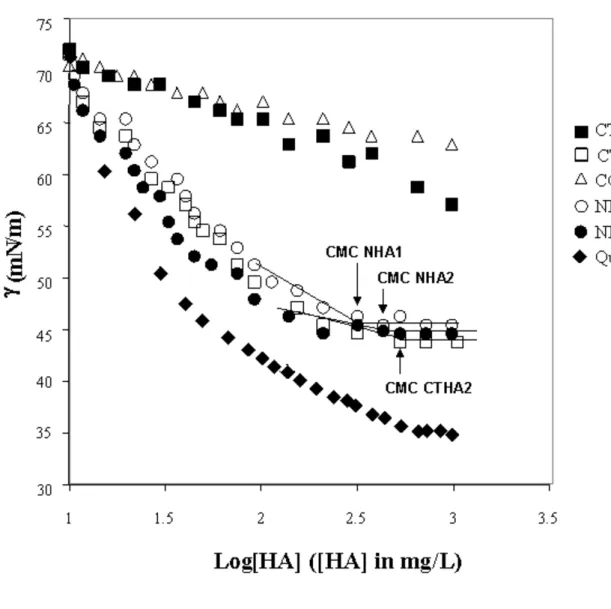
As illustrated in Figure 1, the surface tensions of all humic substances decrease
with an increase in humic substances (HS) concentration. No significant differences
between solutions of humic acid alone and humic acid and pyrene could be detected
(data not shown).
Catechol triglycine low-molecular weight humic acid (CTHA1) and
catechol-glycine humic acids (CGHA) solutions present a decrease of surface tension as a
function of the logarithm of the concentration, that is reminiscent of those of natural soil
and leaf humic acids extracts (Chin et al., 1996; Quagliotto et al., 2006; Tuckermann
and Cammenga, 2004). On the other hand, the two natural humic acids extracts (NHA1
and NHA2) and catechol triglycine high-molecular weight humic acid (CTHA2) show
hyperbolic curves that resemble some determined in the literature and reported on
Figure 1 (Quagliotto et al., 2006). These different behaviours suggest that natural humic
acids and CTHA higher molecular weight fraction (CTHA2) likely present a molecular
crowding at the interface, whereas synthetic CGHA and CTHA1 seem to behave like
less charged entities concerning the acidity view: they can deliver less protons in the
solution than the other fractions (Table 1). The critical micellar concentration (CMC)
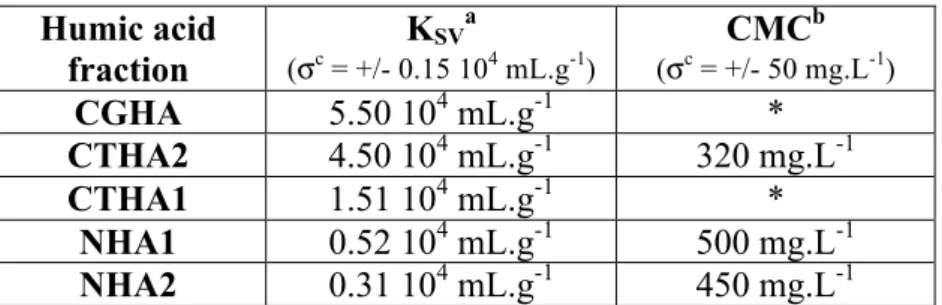
values are reported in Table 2. The CMC of our natural extracts are twice lower than
those determined in the literature for humic substances extracted from marine sediments
(typically close to 1 g.L-1 according to Shinozuka and Lee, 1991) but close to those of
compost humic acid-like (typically 403 mg.L-1 according to Quagliotto et al., 2006). The
two natural extracts (summer, NHA1 and autumnal, NHA2) possess a similar critical
micellar concentration (CMC) (with respect to experimental accuracy). Among
synthetic fractions, CTHA2 is the only material that shows a true CMC. It can also be
should present a good balance between functional groups (especially protein-like, when
comparing results from CTHA to CGHA) and high molecular weight (comparing
CTHA2 with CTHA1).
Stern-Volmer plots
The I0/I2 versus synthetic humic-like substance (SyHA) and natural humic acid
(NHA) concentration plots are shown in Figure 2. For all humic fractions, the
quenching plots present a linearisable evolution in the range of concentrations
investigated. Moreover, the evolution of the quenched fluorescence in solution is very
similar to other authors studies, especially for CTHA1 fraction (Peuravuori, 2001,
presented on Figure 2). The slopes of Stern-Volmer plots decrease from synthetic
catechol-glycine humic acid (CGHA), the two catechol-triglycine humic acid (CTHA2
and CTHA1) to natural NHA1 and NHA2.
It has been established (Gauthier et al., 1987; Lakowicz, 1999) that two distinct
kinds of fluorophore can exist in solution, i.e., some molecules are bound to the
humic-like material whereas others remain free in solution. The first group has a totally
quenched fluorescence (this mechanism is usually called “static quenching”) whereas
the second group shows no interaction with the humic matrix, but remains sensitive to
other types of quenching (this mechanism is usually called “dynamic quenching”). Both
quenchings (static and dynamic) can be observed by linearisable Stern-Volmer plots at
concentrations generally below 20-30 mg.L-1.
Since no significant change in interfacial tension was observed when adding the
pyrene to the suspension of humic material, we can assume that the obtained values are
association between the fluorophore and the quencher attributed to an association of the
former into hydrophobic pockets.
The binding constants (KSV) obtained for our systems (Table 2) are in good
agreement with the range found in the literature for different polycyclic aromatic
hydrocarbons (PAHs) complexed with natural organic matter (Borisover et al., 2006;
Gauthier et al., 1986; Peuravuori, 2001). For both natural and synthetic humic-like
substance, we can conclude that pyrene is incorporated into the hydrophobic sites of
humic substances.
The much higher KSV values for catechol-glycine humic acid (CGHA) may be
explained by the differences in elemental analysis reported in Table 1. The H/C atomic
ratio, which could provide an estimation of the aromaticity degree (Chen et al., 1977;
Thurman, 1985), is substantially lower (greater aromaticity) for this humic substance.
The greater aromaticity could also be responsible for an increase of van der Waals
forces due to π bonding interactions between the aromatic structure of the pyrene and the aromatic moieties of the synthetic humic-like substance (SyHA) and natural humic
acid (NHA) (Chin et al., 1997). Besides, the hydrophobic indices (HI in Table 1)
calculated by reversed-phase high liquid chromatography in a water/acetonitrile elution
gradient (Jung et al., 2005) for the different fractions show good correlation with the
Stern-Volmer constants determined (Table 2). These results suggest that the more
hydrophobic the humic substances at the local scale, the more effective the quenching
fluorescence of pyrene. A previous work (Jung et al., 2005) has shown that
catechol-glycine humic acid (CGHA) presents the most condensed aromatic structure. It can then
be concluded that the more condensed the humic substance, the more efficiently
quenched pyrene fluorescence. Moreover, the binding constants could be discussed with
pyrene could be associated with, whatever kind of acidity is concerned. Indeed, a
previous study (Jung et al., 2005) showed that carboxylic groups are more abundant in
the synthetic polymers whereas phenolic groups are ten times more numerous in natural
substances. These results suggest that phenolic or carboxylic groups are repulsive for
pyrene association with humic substances.
The very slight difference in the Stern-Volmer slopes relative to catechol
triglycine higher molecular-weight humic acid (CTHA2) and catechol-glycine humic
acid (CGHA) suggests that peptidic bonds do not significantly contribute during the
first step of the interaction mechanism (static quenching). Other molecular parts of
natural humic acid (summer extract, NHA1) not identified in this study, could be
responsible for other complex photophysical electron charge transfer, which should then
lead to higher I0/I2 values.
Moreover, our results showed that KSV values obtained for synthetical humic
acids are at least three times higher than those for natural ones. We can assume that
synthetic humic-like substance (SyHA) hydrophobic domains are more tightly
structured than those of natural humic acids (NHA). Pyrene also shows more significant
diffusional freedom with NHA and a lesser tendency to be captured by humic acids.
Summarizing our results, there are two main domains for pyrene-humic acids
(HA) associations with increasing HA concentrations:
(i) a low-concentration region in the 0-30 mg.L-1 range, where molecular
photophysical “weak-adsorption” interactions between the fluoroprobe “pyrene” and the
most hydrophobic HA sites take place.This region allows to determine the
Stern-Volmer binding constants between pyrene and HA molecules;
(ii) a high-concentration region at least greater than 250 mg.L-1 corresponding to a
that organic matter micellar-like behaviour is independent from pyrene entrapment
capacity. In accordance with previous literature (Peuravuori, 2001; Borisover, 2005;
Nakashima, 2007), these results confirm that a true entrapment in a micellar phase is not a
prerequisite to the quenching process. Morover, the presence of pyrene seems to have no
effect on a humic micelle formation. Considering our aqueous pyrene concentration (0.2
mg.L-1) and the mean binding constant of 104 determined in this study, we can expect the
pyrene concentration in a micelle about 2000 mg.kg-1. Such result is particularly
meaningful for drinking water treatment, since pyrene could be entrapped in organic micelles contained in the raw surface water to be treated. Due to the coagulation process (such as charge destabilization), the pyrene could then be released at high coagulant
concentration in the treated water.
Conclusion
Hydrophobic characteristics responsible for pyrene entrapment in humic
structures are mainly due to first polarity (que veux tu dire par first polarity ??)and
polarizability, both correlated with the aromaticity and the presence of aliphatic chains
in humic acids, molecular weight, nitrogen nature and/or content and finally total
acidity of the substances.
The comparison of natural and synthetic humic acid interfacial and
Stern-Volmer analysis suggests that the hydrophobic interactions are responsible for the
organization of the aggregates, regardless of HA origin. Therefore, even if the
hydrophobic characteristics of humic acid are well correlated with the pyrene quenching
capacity, the specific interactions with aromatic molecular sites depend on the whole
Surface tension measurements revealed an increase in surface activity as a function
of concentration for each humic fraction independently of pyrene presence in solution.
Those results confirm the possibility of specific intermolecular interactions occurring
during pyrene entrapment within humic acids. From the comparison of SyHA and NHA,
we showed that the presence of pyrene had no effect on humic micelle formation. The
pyrene fluorescence quenching study pointed out the capacity of HA to incorporate large
hydrophobic molecules into its micellar core, without change of its CMC value determined
in the absence of other organic molecules.
Acknowledgments
This work was carried out within the framework of the programme “Zone Atelier
du bassin de la Moselle” with grants from Région Lorraine and CNRS. The
field-centrifuge provided by Agence de l’Eau Rhin-Meuse for natural extracts sampling is
gratefully acknowledged.
Appendix
γs: surface tension
[Q]0: quencher initial concentration
CGHA: catechol/glycine humic acid
CMC: critical micellar concentration
CTHA: catechol/triglycine humic acid
CTHA1: CTHA having a 1-3.5 kDa mean molecular weight
FTIR: Fourier Transform InfraRed
HI: hydrophobic indice
HS: humic susbtances
I: fluorescence intensity in the presence of quencher
I0: fluorescence intensity in the absence of quencher
I1, I2, I3, I4, I5: pyrene fluorescence intensity respectively at 372, 377, 382, 390 and 395 nm
(in ethanol after excitation at 332 nm)
IHSS: International Humic Substances Society
KSV: Stern-Volmer quenching constant
NHA: natural humic acids
NHA1: NHA extracted during the summer season
NHA2: NHA extracted during the autumn season
NOM: natural organic matter
PAH: polycyclic aromatic hydrocarbon
SyHA: synthetic humic-like substance
References
Achten, C., Hofmann, T., 2009. Native polycyclic aromatic hydrocarbons (PAH) in coals - a hardly recognized source of environment contamination. Sci. Total Environ. 407, 2461-2473.
Agence de l’Eau Rhin-Meuse, http://www.eau-rhin-meuse.fr/Berm/htm
Andreux, F., Golebiowska, D., Metche, M., 1980. Oxydative polymerization of O-diphenols in presence or absence of amino-acids. Topics on (catechol-glycocolle) and (catecholdiglycylglycine). General Assembly of Polyphenols Group Report, Logrono, Spain, Bulletin 9, 178-188.
Auger, R.L., Jacobson, A.M., Domach, M.M., 1995. Aqueous Phase Fluorescence Quenching Technique for Measuring Naphtalene Partition Coefficients in Nonionic Surfactant Micelles. Environ. Sci. Technol. 29, 1273-1278.
Borisover, M., Laor, Y., Bukhanovsky, N., Saadi, I., 2006. Fluorescence-based evidence for adsorptive binding of pyrene to effluent dissolved organic matter. Chemosphere 65, 1925-1934.
Bouloubassi, I., Saliot, A., 1991. Composition and sources of dissolved and particulate PAH in surface waters from the Rhone Delta (NW Mediterranean). Mar. Pollut. Bull. 22, 588-594.
Chen, Y., Senesi, N., Schnitzer, M., 1977. Information provided on humic substances by E4/46 ratios. Soil Sci. Soc. Am. J. 41, 352-358.
Chin, Y.P., Aiken, G.R., Danielsen, K.M., 1997. Binding of pyrene to aquatic and commercial humic substances: the role of molecular weight and aromaticity. Environ. Sci. Technol. 31, 1630-1635.
Chin, Y.P., Buterbaugh, J.M., Gustafson, T.J., Traina, S.J., Danielsen, K.M., 1996. Response to Comment on “Solubility enhancement and fluorescence quenching of pyrene by humic substances”. Environ. Sci. Technol. 30, 1409-1411.
Chin, Y.P., Weber, W.J., Jr., 1989. Estimating the effects of dispersed organic polymers on the sorption of contaminants by natural solids I: A predictive thermodynamic humic acid-organic solute interaction model. Environ. Sci. Technol. 23, 978-985.
Chiou, C.T., Kile, D.E., Brinton, T.I., Malcolm, R.L., Leenheer, J.A., Mac Carthy, P., 1987. A comparison of water solubility enhancements of organic solutes by aquatic humic materials and commercial humic acids. Environ. Sci. Technol. 21, 1231-1234.
Countway, R.E., Dickhut, R.M., Canuel, E.A., 2003. Polycyclic aromatic hydrocarbon (PAH) distributions and associations with organic matter in surface waters of the York River, VA Estuary. Org. Geochem. 34, 209-224.
Engebretson, R.R., von Wandruska, R., 1994. Microorganization in dissolved humic acids. Environ. Sci. Technol. 28, 1934-1941.
Gauthier, T.D., Seitz, W.R., Grant, C.L., 1987. Effects of structural and compositional variations of dissolved humic materials on pyrene K sub(oc) values. Environ. Sci. Technol. 21, 243-248.
Gauthier, T.D., Syhane, E.C., Guerin, W.R., Seitz, W.R., Grant, C.L., 1986. Fluorescence quenching method for determining equilibrium constants for polycyclic aromatic hydrocarbons binding to dissolved humic materials. Environ. Sci. Technol. 20, 1162-1166
Ghosh, U., Gillette, J.S., Richard, G.L., Zare, R.N., 2000. Microscale Location Characterization, and Association of Polycyclic Aromatic Hydrocarbons on harbour Sediment Particles. Environ. Sci. Technol. 34, 1729-1736.
Hua, G., Lyons, B., Killham, K., Singleton, I., 2009. Potential use of DNA adducts to detect mutagenic compounds in soil. Environ. Pollut. 157, 916-921.
Hur, J., Lee, D.-H., Shin, H.-S., 2009. Comparison of the structural, spectroscopic and phenanthrene binding characteristics of humic acids from soils and lake sediments. Org. Geochem. 40, 1091-1099.
Jeffrey, A.M., Weinstein, I.B., Jennette, K., Grzeskowiak, K., Nakanishi, K., Harvey, R.G., Autrup, H., Harris, C., 1977. Structures of benzo[a]pyrene nucleic acid adducts formed in human and bovine bronchial explants. Nature (London) 269, 348-350.
Jung, A.-V., Frochot, C., Parant, S., Lartiges, B.S., Selve, C., Viriot, M.-L., Bersillon, J.-L., 2005. Synthesis of amino-phenolic humic-like substances and comparison with natural aquatic humic acids: A multi-analytical techniques approach. Org. Geochem. 36, 1252-1271.
Kalyanasudaram, K., Thomas, J.K., 1977. Environmental effects on vibronic band intensities in pyrene monomer fluorescence and their application in studies of micellar systems. J. Am. Chem. Soc. 99, 2039-2044.
Lakowicz, J.R., 1999. Principles of Fluorescence Spectroscopy, second ed. Kluwer Academic/Plenum, New York.
Nakashima, K., Maki, M., Ishikawa, F.,Yoshikawa, T., Gong, Y.-K, Miyajima, T., 2007. Fluorescence studies on binding of pyrene and its derivatives to humic acid. Spectrochim. Acta, Part A 67, 930-935. Pan, B., Ying, B.S., Liu, W.X., Tao, S., Lin, X.M., Zhang, X.X.M., Zhang, Y.X., Xiao, Y., Dai, H.C., Yuan, H.S., 2006. Distribution of sorbed phenanthrene and pyrene in different humic fractions of soils and importance of humin. Environ. Pollut. 143, 24-33.
Peuravuori, J., 2001. Partition coefficients of pyrene to lake aquatic humic matter determined by fluorescence quenching and solubility enhancement. Anal. Chim. Acta 429, 65-73.
Piccolo, A., Celano, G., Conte, P.J., 1996. Adsorption of glyphosate by humic substances. J. Agr. Food Chem. 44, 2442-2246.
Piccolo, A., Conte, P., Scheunert, I., Paci, M., 1998. Atrazine Interactions with Soil Humic Substances of Different Molecular Structure. J. Environ. Qual. 27, 1324-1333.
Quagliotto, P., Montoneri, E., Tambone, F., Fabrizio, A., Gobetto, R., Viscardi, G., 2006. Chemicals from Wastes: Compost-Derived Humic Acid-like Matter as Surfactant. Environ. Sci. Technol. 40, 1686-1692. Shinozuka, N., Lee, C., 1991. Aggregate formation of humic acids from marine sediments. Mar. Chem. 33, 229-241.
Short, J.W., Irvine, G.V., Mann, D.H., Maselko, J.M., Pella, J.J., Lindeberg, M.R., 2007. Slightly weathered Exxon Valdez oil persists in Gulf of Alaska beach sediments after 16 years. Environ. Sci. Technol. 41, 1245-1250.
Sielechi, J.-M., Lartiges, B.S., Kayem, G.J., Hupont, S., Frochot, C., Thieme, J., Ghanbaja, J., d’Espinose de la Caillerie, J.B., Barres, O., Kamga, R., Levitz, P., Michot, L.J., 2008. Changes in humic acid conformation during coagulation with ferric chloride: Implications for drinking water treatment. Water Res. 42, 2111-2123.
Sierra, M.M.D., Rauen, T.G., Tormen, L., Debacher, N.A., Soriano-Sierra, E.J., 2005. Evidence from surface tension and fluorescence data of a pyrene-assisted micelle-like assemblage of humic substances. Water Res. 39, 3811-3818.
Thurman, E.M., Malcolm, R.L., 1981. Preparative isolation of aquatic humic substances. J. Am. Chem. Soc. 4, 463-466.
Thurman, E.M., 1985. Organic Geochemistry of Natural Waters, Martinus Nijhoff/Junk Publishers, Dordrecht, The Netherlands.
Tuckermann, R., Cammenga, H.K., 2004. The surface tension of aqueous solutions of some atmospheric water-soluble organic compounds. Atmos. Environ. 38, 6135-6138.
FIGURE 1. Surface tension versus humic acid (HA) concentration (mg.L-1).
FIGURE 2. Synthetical and natural Stern-Volmer plots ([HA] in mg.L-1).
Tables
TABLE 1. Humic substances under investigation (Jung et al., 2005).
TABLE 2. Stern-Volmer association constants and critical concentrations values for
humic substances.
TABLE 1 Humic
acid fraction
O/Ca H/Oa (O+N)a/Ca H/Ca Total
Acidity (meq.g-1) HIb CGHA 0.73 0.032 1.49 6.72 3.7 84.6 CTHA2 0.77 0.048 3.87 9.36 5.6 82.8 CTHA1 1.40 0.048 5.61 16.56 5.4 76.6 NHA1 0.40 0.224 2.45 22.44 13.1 51.1 NHA2 0.56 0.128 2.08 19.32 18.0 52.2
a Atomic ratio (O=100%-ΣC, H, N).
b HI : Hydrophobic Indices determined by RP-HPLC (See Jung et al., 2005).
TABLE 2 Humic acid fraction KSVa (σc = +/- 0.15 104 mL.g-1) CMC b (σc = +/- 50 mg.L-1) CGHA 5.50 104 mL.g-1 * CTHA2 4.50 104 mL.g-1 320 mg.L-1 CTHA1 1.51 104 mL.g-1 * NHA1 0.52 104 mL.g-1 500 mg.L-1 NHA2 0.31 104 mL.g-1 450 mg.L-1
a Stern-Volmer constants with 10-6 M pyrene, [HA] 1-30 mg.L-1, pH 8.
b Critical micellar concentration values determined as HA first concentration for γ stabilization value (* no
stabilization value obtained).
![FIGURE 2. Synthetical and natural Stern-Volmer plots ([HA] in mg.L -1 ).](https://thumb-eu.123doks.com/thumbv2/123doknet/14793636.602581/22.892.107.867.136.613/figure-synthetical-natural-stern-volmer-plots-ha-mg.webp)