HAL Id: hal-01349346
https://hal.archives-ouvertes.fr/hal-01349346
Submitted on 27 Sep 2016
HAL is a multi-disciplinary open access
archive for the deposit and dissemination of
sci-entific research documents, whether they are
pub-lished or not. The documents may come from
teaching and research institutions in France or
abroad, or from public or private research centers.
L’archive ouverte pluridisciplinaire HAL, est
destinée au dépôt et à la diffusion de documents
scientifiques de niveau recherche, publiés ou non,
émanant des établissements d’enseignement et de
recherche français ou étrangers, des laboratoires
publics ou privés.
On two-phase flow solvers in irregular domains with
contact line
Mathieu Lepilliez, Elena Roxana Popescu, Frédéric Gibou, Sébastien Tanguy
To cite this version:
Mathieu Lepilliez, Elena Roxana Popescu, Frédéric Gibou, Sébastien Tanguy. On two-phase flow
solvers in irregular domains with contact line. Journal of Computational Physics, Elsevier, 2016, 321,
pp.1217-1251. �10.1016/j.jcp.2016.06.013�. �hal-01349346�
O
pen
A
rchive
T
OULOUSE
A
rchive
O
uverte (
OATAO
)
OATAO is an open access repository that collects the work of Toulouse researchers and
makes it freely available over the web where possible.
This is an author-deposited version published in:
http://oatao.univ-toulouse.fr/
Eprints ID : 16005
To link to this article :
DOI:10.1016/j.jcp.2016.06.013
URL : http://dx.doi.org/10.1016/j.jcp.2016.06.013
To cite this version :
Lepilliez, Mathieu and Popescu, Elena Roxana and Gibou, Frédéric
and Tanguy, Sébastien On two-phase flow solvers in irregular
domains with contact line. (2016) Journal of Computational Physics,
vol. 321. pp. 1217-1251. ISSN 0021-9991
Any correspondence concerning this service should be sent to the repository
administrator:
[email protected]
On
two-phase
flow
solvers
in
irregular
domains
with
contact
line
Mathieu Lepilliez
a,b,c,
Elena
Roxana Popescu
a,
Frederic Gibou
d,e,
Sébastien Tanguy
a,∗aInstitutdeMécaniquedesFluidesdeToulouse,2bisalléeduProfesseurCamilleSoula,31400Toulouse,France bCentreNationald’EtudesSpatiales,18AvenueEdouardBelin,31401ToulouseCedex9,France
cAirbusDéfence& Space,31AvenuedesCosmonautes,31402ToulouseCedex4,France
dDepartmentofMechanicalEngineering,UniversityofCalifornia,SantaBarbara,CA93106-5070,UnitedStates eDepartmentofComputerScience,UniversityofCalifornia,SantaBarbara,CA93106-5110,UnitedStates
Keywords:
Sharpinterfacemethods Irregulardomains Implicitviscosity Contactlines Levelsetmethod Ghost-FluidMethod
Wepresentnumericalmethods thatenablethedirect numericalsimulationoftwo-phase flowsinirregulardomains.Amethodispresentedtoaccountforsurfacetensioneffectsin ameshcellcontainingatriplelinebetweentheliquid,gasandsolidphases.Ournumerical methodis based onthelevel-set method tocapture theliquid–gasinterfaceand onthe single-phaseNavier–Stokessolverinirregulardomainproposedin[35]toimposethesolid boundaryinanEulerianframework.Wealsopresentastrategyfortheimplicittreatment oftheviscoustermandhowtoimposebothaNeumannboundaryconditionandajump conditionwhensolving for thepressure field. Special careisgiven on howto takeinto accountthe contactangle, the no-slipboundary condition for thevelocity fieldand the volumeforces.Finally,we presentnumericalresults intwoandthreespatialdimensions evaluatingoursimulationswithseveralbenchmarks.
1. Introduction
Multiphaseflows areubiquitous inmostmodern processing technologyand arecritical to theunderstandingofawide range of physical and biological phenomena. Consequently, the design of numerical methods enabling the simulation of multiphaseflowsisthesubjectofintenseresearch.Whenconsideringsolidboundaries,explicitdescriptionsofthegeometry have demonstratedresults ofsuperior accuracy inthecaseofone-phaseflows,whencompared toimplicitrepresentations ofthegeometry.Indeed, body-fittedgridscanbeconstructedtoenabletheaccuratetreatmentofboundaryconditionsand to capture the rapid variations of the solution near walls, e.g. the turbulent boundary layer in high speed flows. In the caseofmultiphaseflows, however, body-fittedapproachesareless practicalsinceconformingmeshmustbereconstructed several time duringthe courseofa simulation.This is,for example, thecase ofthe simulationofbubbly flows or sprays, where the fluid interface can be strongly deformed and stretched. The automatic meshing necessary in such cases is a difficulttaskandinturn,theresulting meshcouldlackthequalityneeded toguaranteeaccuratenumericalresults.
Since the pioneer work of Peskin [38], introducing the immersed boundary method, an important research effort has been devotedtothedevelopment ofEulerianfluidsolversinirregulardomains.Thesemethodshavetheadvantagethatno
remeshingisnecessaryduringthecourseofasimulationinthecaseofuniformgrids.Ifadaptive gridsareemployed,then the remeshingisstraightforward sincethe free boundaryis embeddedinthe grid. Twoclasses ofmethodshave emerged in the Eulerian framework: ‘delta’ formulations, where the Dirac distribution representing surface forces is approximated by a regularized function [54] (and the references therein) and ‘sharp’ approaches, where jump conditions at the free boundaryareenforcedatthediscretelevel [15,19,22,32,40,43,52,53,64,66](andthereferencestherein).Formulationsbased onregularizedDiracdistributionsprovideapathwaytoeasilyextendsingle-phasetomultiphasesolvers[8,49].Ontheother hand, these methods sufferfromdrawbacks that limittheir useinsome applications due totheinherent smearingofthe solution near interfaces. Althoughefficient adaptive meshrefinement techniques [2,20] can help reduce the extent ofthe smearingbyimposingincreasedresolutionwhereneeded, ‘sharp’numericalmethodsarestilldesired insome applications. Thesemethods,however,aredifficulttodesign duetothedifficultyofimposingboundaryconditionsimplicitly.
While several works have been presented in thelast decade on immersed boundarymethods for incompressible one-phase flows [4,25,31,33–35,56,57,59,63,65], only afew [29,36,58] have been dedicatedto incompressible two-phase flows, especially inthecase whereacontact lineoftheliquid–gasinterface isformedon theembedded solidboundary. Insuch a situation, two different interfaces must bemanaged in a computational cell, and the numerical solver for the pressure mustimpose botha jumpconditionbetween theliquidandthegasto accountfor surfacetensioneffects and aNeumann boundarycondition betweenthefluidand thesolidphasetoimposetheno-slip boundarycondition.
An attractive immersed boundary method for one-phase flows, based on a finite volume discretization of the Laplace operator, has been proposed in [35]. Itenables to impose solid boundary conditions on the pressure and on thevelocity with a second-order spatial accuracy and to maintain the symmetric definite positiveness of the resulting linear system. Consequently, standardmethodssuch asthepreconditionedconjugategradient can beused toinvertefficiently thelinear system.
Inthispaper,we proposeto extendtheworkof[35]to themorecomplex situation oftwo-phaseflows.Indeed, toour knowledge, only a few methods are dedicated to thenumerical simulation of multiphase flows in irregular domains. As two-phase flows are involved, surface tension has to be accounted for, even in the case where solid, liquid and gas are present in thesame computationalcell. To that extent, we have developed a newnumerical scheme to account for both a pressure jumpcondition due tothesurface tensionand aNeumanncondition on thesoliddomain inthesamecells,as described in section 3.2. This spatialdiscretization enables thetreatment of volume forces inside themesh cells that are crossedbythecontactline.Insection3.3,specificdetailsaregivenonhowtoperformanimplicittemporaldiscretizationof theviscoustermswithacoupledlinearsysteminvolvingallthevelocitycomponents,whileimposingthejumpconditionon viscosity.Insection3.4,wedescribehowtoenforcetheDirichletboundaryconditiononthevelocityfieldincomputational cells crossed by the solid boundary, in order to ensure the no-slip boundary condition. To our knowledge, solving such a coupled system with an immersed boundary condition has never been addressed in the existing literature. Finally, we discuss insection 3.5howtoimposetheappropriatecontactanglebyextrapolatingtheliquid–gaslevel-setfunctioninside thesoliddomainwithaniterativePDE.
Severalbenchmarksareproposedinsection4.Inthefirstpartofsection4,one-phaseflow simulationsarepresentedin order to compare twopossible approachesto compute theviscous terms intwo and threespatial dimensions.Next, test-cases involvingtwo-phaseflows in acomplex geometry(dropletdeposited on aslanted wall, half-filled rotatingspherical tank) are presented and compared to theoretical solutions in order to highlight the behavior of the proposed numerical methods for thecomputation of the surface tensionand the volume forcesin the grid cellsthat areboth crossed bythe liquid–gas interface and the solid boundary. Orders of accuracy are difficult to determine for such simulations, however grid sensitivitystudiesarepresentedforallthebenchmarksinordertoascertainthatallthecomputationsconvergetothe correct solution.
2. Equationsandstandardprojectionmethods
The Navier–Stokes equations describe the motion of fluids at the continuum level. However, their formulations and approximations depend on how surface forcesare represented. Nevertheless, standard state-of-the-art numerical approxi-mationsarebasedontheprojectionmethodforsingle-phaseflows,introducedbyChorin[11].
2.1. Single-phaseflows
Consider a domain Ä= Äl∪ Äs with boundary ∂Ä. The regions Äl and Äs represent the fluidand solid regions,
re-spectively. Theboundarybetweenthefluidand thesolidisdenotedbyŴs.Theincompressible Navier–Stokesequationsfor
one-phaseNewtonianflowsarewrittenas:
∇ ·
u=
0 inÄ
l,
ρ
µ ∂
u∂
t+ (
u· ∇)
u
= −∇
p+
µ
1
u+
ρg
inÄ
l,
where t theistime,
ρ
thefluiddensity,u= (u,v,w) thevelocity field,µ
theviscosity assumed constant, p the pressure and g theaccelerationduetogravity.Fig. 1. The computational domain in the case of two-phase flows in irregular domains.
Inthecaseofsingle-phaseflows,ChorinusedtheHodgedecompositionofvectorfields,todesignathree-stageprojection method to solvetheNavier–Stokes equations[11]:first, given a velocity un at timetn=n1t,anintermediate velocity u∗
canbecomputedforatimestep1t withoutconsideringthepressurecomponent: u∗
=
un− 1
tµ
¡
un· ∇
¢
un−
µ
1
u nρ
−
g
.
Second,thepressurefield pn+1 servesasthescalarfunctionoftheHodgedecomposition, satisfying:
∇ ·
µ ∇
p n+1ρ

=
∇ ·
u ∗1
t,
(1)withhomogeneousNeumannboundaryconditionson ∂Äandnon-homogeneousNeumannboundaryconditionon Ŵs:
ns
·
∇
pρ
¯
¯
¯
¯
Ŵ s=
ns·
¡
u∗−
us¢¯
¯
Ŵs,
where us is thespecifiedvelocity fieldon thesolid’sboundary. Finally, thefluidvelocity un+1 isdefined at thenewtime
steptn+1 astheprojectionofu∗ ontothedivergence-freespace:
un+1
=
u∗− 1
t∇
pn+1
ρ
.
2.2. Two-phaseflows
Consideracomputationaldomain,Ä,thatcontainssolid,liquidandgasregionsdenotedbyÄs,Äl andÄg,respectively1
(see Fig. 1).We call Ŵ theliquid’s boundary and n its outwardnormal. Likewise, we callŴs thesolid’s boundary and ns
its outward normal. Finally, ∂Ä denotes the boundary of Ä. The incompressible Navier–Stokes equations for Newtonian two-phase flowscanbedescribed differently, whetherthejump conditionsareconsidered asfunctionsin theentire com-putational domain,orassharpjumpconditionslocallyappliedtothedensity,viscosityand pressurefield.Inwhatfollows, we brieflypresentthemainformulationsthat areused, keepinginmindthatanimplicitformulationoftheviscous terms must be favored to perform computations on irregular domains because an immersed Dirichlet boundary condition has to beimposed on thevelocity field. Indeed, asasubcell resolution isused to compute thisboundary condition, temporal stabilityofthecomputationcannotbeachievedbyusinganexplicittemporaldiscretization,see[18]formoredetails.
2.2.1. The“delta”formulation
The“delta”formulation[44,49]writestheNavier–Stokesequationsfortwo-phaseflowsas:
∇ ·
u=
0,
ρ
µ ∂
u∂
t+ (
u· ∇)
u
= −∇
p+
ρg
+ ∇ ·
³
2µD´
+
σ κn
δ
Ŵ,
where
σ
isthesurface tension,κ
is theinterfacelocalmeancurvature, δŴ amultidimensionalDirac distributionlocalizedattheinterface,and D therate-of-deformationtensordefinedas:
D
=
∇
u+ ∇
uT
2
.
Thedensityand theviscosityarepiecewiseconstantandonlyvaryacross theinterface.Theycanthenbedefinedas:
ρ
=
ρ
l+
HŴ(
ρ
g−
ρ
l),
µ
=
µ
l+
HŴ(
µ
g−
µ
l),
with HŴ denotingtheHeaviside distribution,equalto 1in theliquidand 0inthegasphase, withthefollowingdefinition
fordensity andviscosityjumpconditions:
[
ρ
] =
ρ
l−
ρ
g,
[
µ
] =
µ
l−
µ
g.
When applying a projection method to the “delta” formulation, one obtains thefollowing explicit discretization: first, solveforanintermediatevelocity fieldu∗1 with
u∗1
=
un− 1
t
¡
un· ∇
¢
un−
∇ ·
³
2µn+1Dn´
ρ
n+1−
σ κ
n+1ρ
n+1 nδ
Ŵ−
g
.
In therestof thepaper,we omitthe subscriptson
κ
andµ
, whichare alwaysestimatedattn+1.Second, solveaPoisson equationtodetermine theHodgefield:∇ ·
µ ∇
p n+1ρ
n+1
=
∇ ·
u ∗ 11
t.
And finallyproject u∗
1 ontothedivergence-freevelocityfield: un+1
=
u∗1− 1
t∇
pn+1
ρ
n+1.
ThisnumericalschemeisusuallyusedintheframeworkoftheContinuumSurfaceForce(CSF)model,whichrequiresthe definitionofsmoothedfunctionsδǫ and Hǫ toapproximate theDirac andHeavisidedistributions.Theease of
implementa-tionofthismethodcomes withdrawbackofartificiallythickeningtheinterface.UnliketheCSFmodel,the“sharp”interface approach[24,39,50]buildsasharpdiscretizationofsingularsourceterms,avoidingtheintroductionofafictitiousinterface thickness.Some detailsonthetheoreticalequivalencebetween thejumpcondition formulationand the“delta”formulation isdetailedin[26,27].
2.2.2. TheGhost-FluidPrimitiveviscousMethod
Asplittingontheviscous-stresstensorcanbeapplied:
∇ ·
³
2µD´
=
2µ∇ ·
³
D´
+
2[
µ
]
∂
un∂
nδ
Ŵn=
µ
1
u+
2[
µ
]
³
nT· ∇
u·
n´
δ
Ŵn.
(2)
Thisleadstoanewpossibledescriptionoftheintermediatevelocity,whereajumpcondition intheviscoustermhastobe imposed.Thereadermayfindadetaileddemonstrationofequation(2)inAppendix A.
In[24],theauthorsproposedasharpinterfacemethodforincompressibletwo-phaseflowsbasedontheprinciplesofthe Ghost-FluidMethod[15,28].Thisapproachiswidelyused intheliterature,eventhoughitisfirst-orderaccurateforsolving the Poisson equation withjump conditions. In [21], asecond-order approachhas been developed, but notyet applied to Navier–Stokes equations.TheGhost-FluidMethodintroducedin[24]canbedescribedbrieflyasproposedin[26]:first,the intermediatevelocity u∗ 2 isupdatedwith u∗2
=
un− 1
tµ
¡
un· ∇
¢
un−
µ
1
u ∗ρ
n+1−
g
.
Next, thePoissonequationforthepressureissolvedwiththeappropriatejumpcondition:
∇ ·
µ ∇
p n+1ρ
n+1
=
∇ ·
u ∗ 21
t+ ∇ ·
Ã
σ κ
+
2[
µ
]
¡
nT· ∇
u·
n¢
nρ
n+1δ
Ŵn!
.
un+1
=
u∗2−
1
tρ
n+1Ã
∇
pn+1−
µ
σ κ
+
2[
µ
]
³
nT· ∇
u·
n´
n
nδ
Ŵ!
.
Thismethodhas beendubbedtheGhost-FluidPrimitiveviscous Method(GFPM)in[26].In thisframework,the compu-tation oftheviscousterms requiresto determineexplicitly thejump conditionon theprojected viscousstresses. As these jumpconditionsdependonthenumericalsolution,achievingafullyimplicittemporaldiscretizationoftheviscoustermsis notastraightforwardtaskinthecaseoftheGFPM.Dependingon whethertheCSFformulationortheGFPM formulationis used, theintermediatevelocity inthepredictionstepisdifferent.Even thoughthesetwo methodsareformallyequivalent, theyleadtodifferentdefinitionsofthepredictedvelocityfieldintheprojectionstep.
2.2.3. TheGhost-FluidConservativeviscousMethod
In[50],Sussmanetal.introducedanotherformulationfor theintermediatevelocityfield,which refersto asthe Ghost-FluidConservativeviscousMethod(GFCM)in[26].Inthiscase,theintermediatevelocity u∗
3 isobtainedas: u∗3
=
un− 1
tµ
¡
un· ∇
¢
un−
1ρ
n+1∇ ·
³
2µDn´
−
g
.
Next, thePoissonequationissolvedtodeterminethepressure field:
∇ ·
µ ∇
p n+1ρ
n+1
=
∇ ·
u ∗ 31
t+ ∇ ·
µ
σ κn
δ
Ŵρ
n+1
.
Finallyinthecorrectionstep,thephysicalvelocity fieldcanbedeterminedwiththepressurefieldpreviouslycomputed: un+1
=
u∗3−
1
tρ
n+1(
∇
pn+1
−
σ κn
δ
Ŵ).
In order to remove the O¡1x2¢
time step restriction incurred by the viscosity term, the following implicit temporal discretization isused, referred toin thispaperasthe Ghost-FluidConservativeMethod withan Implicitscheme(GFCMI): theintermediatevelocityu∗
4isupdatedas:
ρ
n+1u∗4− 1
t∇ ·
³
2µD∗´
=
ρ
n+1¡
un
− 1
t¡¡
un
· ∇
¢
un
−
g¢¢ ,
(3)which leadstoalargelinearsystemwherethethreevelocitycomponentsarecoupled.Thesubsequentstepsaresimilarto theoneusedinGFCM,withthecomputationofthepressurefield:
∇ ·
µ ∇
p n+1ρ
n+1
=
∇ ·
u ∗ 41
t+ ∇ ·
µ
σ κn
δ
Ŵρ
n+1
,
followed bythecorrectionstep: un+1
=
u∗4−
1
tρ
n+1(
∇
pn+1
−
σ κn
δ
Ŵ).
2.2.4. TheGhost-FluidSemi-ConservativeMethod
Finallyin[26]theauthorsproposedasemi-conservativeformulationfordiscretizingtheviscousterm,referredtointhis paperastheGhost-FluidSemi-Conservative MethodwithanImplicitscheme(GFSCMI).Startingwiththesplitting:
∇ · (
2µD)
= ∇ · (
µ
∇
u+
µ
∇
Tu)
=∇ · (
µ
∇
u)
+ ∇ · (
µ
∇
Tu)
=∇ · (
µ
∇
u)
+ ∇
Tu· ∇
µ
+
µ
∇ · (∇
Tu)
=∇ · (
µ
∇
u)
+ [
µ
]∇
Tu·
nδ
Ŵ,
where ∇ · (
µ
∇u) isaformalequivalentoftheone-phaseflow formulationofviscouseffects. Thereforeeachcomponent is solved independently fromthe others,asthe cross-termsofthe viscousterm in [µ
]∇Tu·nδŴ are enforcedexplicitly asa
jumpcondition.Thepredictionstepis:
ρ
n+1u∗5− 1
t∇ ·
³
µ
∇
u∗5´
=
ρ
n+1Ã
un− 1
tµ
¡
un· ∇
¢
un−
g
!
.
∇ ·
µ ∇
p n+1ρ
n+1
=
∇ ·
u ∗ 51
t+ ∇ ·
à ¡
σ κ
+ [
µ
]
¡
nT· ∇
u·
n¢
n¢
ρ
n+1 nδ
Ŵ!
.
(4)Finally, thecorrectionsteptocomputethedivergencefree velocityis:
un+1
=
u∗5−
1
tρ
n+1Ã
∇
pn+1−
µ
σ κ
+ [
µ
]
¡
nT· ∇
u·
n¢
n
nδ
Ŵ!
.
(5)Remark.Theimplementationofanimplicittemporaldiscretizationoftheviscoustermsiseasierwiththismethod(GFSCMI) than GFCMI.Indeed if GFSCMIisused,eachvelocity componentcan becomputedbysolvingasimple linearsystem (sym-metricdefinitepositive)thatdoesnottreatcross-derivativesimplicitly.However,eventhoughGFCMItreatscross-derivatives implicitly, afew iterations ofGauss–Seidel suffice forconvergence and theresults are superior toGFSCMI. Thesemethods are compared in section 3.4 to offer some insight on how velocity boundary conditions should be enforced on irregular domains.
2.2.5. Anoteonthetimestepconstraint
Letusremarkthat,unlikeGFCMI,GFSCMIdoesnotfullyremovethestabilityconstraintonthetimestepduetoviscosity, sinceanexplicitpartdependingontheviscosityjumpconditionremainsinequation(5).Therefore,asithasbeendiscussed in[26],astabilityconstraintdependingontheviscosityjumpconditionmustbeimposedtoensurestabilityofthemethod. Specifically,thefollowingstandardtimestepconstraintsfortheconvectionandthesurfacetensioneffects,mustbeimposed toensurethetemporalstabilityofthecomputation:
1
tconv=
1
x max|
u|
,
1
tsurf_tens=
1 2r
ρ
lσ
1
x 3/2,
foraglobaltimesteprestriction of: 1
1
t=
11
tconv+
11
tsurf_tens.
(6)IfGFSCMIisused,thefollowingconstraintmustbeaddedtoaccountforthejumpconditiononviscosityinequation(5):
1
tvisc=
ρ
[
µ
]
1
x2
,
where
ρ
istheaveragedensity ofthetwophases.Thisleadstoanewglobaltimesteprestriction givenby: 11
t=
11
tconv+
11
tsurf_tens+
11
tvisc.
2.3. Anoteonsolid’sboundaryconditionsformultiphaseflows
As stated earlier, when irregular domains are handled, Neumann boundary conditions on the domain boundaries are enforcedonŴs thefluid–solidinterfaceforthepressurefield.ItleadstothefollowingrelationforGFCMI:
ns
·
∇
pρ
¯
¯
¯
¯
Ŵs=
ns·
¡
u∗−
us+
σ κn
δ
Ŵ¢¯
¯
Ŵs,
and forGFSCMIas:
ns
·
∇
pρ
¯
¯
¯
¯
Ŵs=
ns·
Ã
u∗−
us+
³
σ κ
+ [
µ
]
¡
nT· ∇
u·
n¢
n´
nδ
Ŵ!¯
¯
¯
¯
¯
Ŵ s.
Onecannoticethatjumpconditionshavetobetakenintoaccountontheirregulardomainaswell.Section3willdiscuss thenumericaldiscretizationofthese boundaryconditions.
3. Numericalmethods
Inthissection,weprovidethedetailsofthenumericalmethodsusedinourtwo-phaseflowsolverinirregulardomains. First, we present the level-set method and the spatial discretizations of the two different projection methods that we consider forirregular domains.Wethenprovidethedetailsoftheimplicitdiscretizationoftheviscoustermsand howthe level-set functioniscomputedinthesoliddomaininordertoimposethecontactangle.
Fig. 2. StandardMACgridconfiguration:thescalarvariablesaresampledatthecells’centers(circles),thex-componentofthevelocityfieldissampled ontheverticalfaces(bluetriangles),andthey-componentofthevelocityfieldissampledonthehorizontalfaces(redtriangles).Theirregulardomain isrepresentedbytheshadedareaÄs.(Forinterpretationofthereferencestocolorinthisfigurelegend,thereaderisreferredtothewebversionofthis
article.)
3.1. Capturingthemovinginterface
Inthiswork, weusethelevel-setmethod ofOsherand Sethian [37]torepresent theinterfacebetween thetwofluids. A signedand continuouslevel-set functionφ isdefined in adomain Ä suchasÄ−= {x: φ(x)<0}, Ä+{x: φ(x)>0} and
Ŵ= {x: φ(x)=0} whereŴ representstheinterfacecapturedbythefollowingtransportequation:
∂φ
∂
t+
u· ∇φ =
0.
(7)Oneofthebenefitsforusingthelevel-setfunctionisitsregularpropertyinthewholedomain.Sussmanetal.[49] devel-opedanalgorithmallowingtomaintainthispropertybyre-initializingthelevel-set functionwiththefollowingequation:
∂
d∂
τ
=
Sign
(φ) (
1− |∇
d|),
(8)where Sign(φ) is a regularized signed functiondefined by Sussman et al. in [49] and d the update of the function φ. Equation (8) iterates for a few fictitious time step
τ
to finally converge to a continuous signed distance function in the whole domain.Thus,geometricpropertiessuchasn theoutwardunitnormalvectortotheinterfaceandκ
thelocalmean curvaturecanbeaccuratelycomputed:n
=
∇φ
|∇φ|
,
andκ
(φ)
= ∇ ·
n.
Spatialderivativesinequations(7)and(8)arecomputedwiththeWENO-Zscheme[5],andthetemporalderivativewith athirdorderTVDRunge–Kuttascheme.Letusnoticethat thetemporalintegrationisfully coupledwiththeNavier–Stokes solver[24].
3.2. Discretizationoftheprojectionmethodinirregulardomains
The method developed in this study to solve thePoisson equation (4) on irregular domains is based on Ng, Min and Gibou’salgorithm [35]. Thisnumericalmethodpresentsseveral attractivefeatures.Indeedthespatialdiscretization forthe pressure Poisson equation is second order, for all computationalnodes, includingthe irregular domain nodes crossed by thesolid–fluid interfacewhere theembeddedNeumannBoundary conditionis enforced.Moreover,theresulting matrix of thelinearsystemisstillsymmetricdefinitepositivewhichallowsusingaclassicalPreconditioned ConjugateGradient.More efficientsolvers,astheBlackBoxMultiGrid[13],canalsobeusedtospeed-upsimulations.
Consideravectorfieldu∗ inthedomainÄ,separatedbytheinterfaceŴs intotwodistinctsubdomainsÄf andÄs,such
as Ä= Äf ∪ Äs. As Äs would correspond to a solid media, weonly solvethe Navier–Stokes equations in Äf. Let φs be
another level-setfunctionsuch asÄs= {x: φs(x)>0},Äf{x: φs(x)<0} and Ŵs= {x: φs(x)=0}. Weconsider aMAC grid
configuration and a cell Ci,j= [i−1/2,i+1/2]× [j−1/2,j+1/2], partially covered with Äf. For moreclarity we only
consider a2Dexampletoillustratethemethodwhichcanbeextendedto3D.TheconfigurationisillustratedinFig. 2. Consideringafinitevolumeapproach,weintegratethelefthandside ofequation(4)over Ci,j and applythedivergence
theorem:
Z
Ci,j∩Äf∇ ·
µ ∇
ρ
p
d A=
Z
∂(Ci,j∩Äf) n·
µ ∇
pρ

dl,
withd A anddl differentialareaandlength.Similarlyfortherighthandside:
Z
Ci,j∩Äf∇ ·
u∗d A+
Z
Ci,j∩Äf∇ ·
µ
FS Tρ

d A=
Z
∂(Ci,j∩Äf) n·
u∗dl+
Z
∂(Ci,j∩Äf) n·
µ
FS Tρ

dl,
where FS T canrepresent thesurface tensioneffects and thejump conditionsdue toviscosity depending onthe choiceof
theintermediatevelocity:
• ForGFCMI,FS T =
σ κ
nfδf. • ForGFSCMI,FS T= ³σ κ
+ [µ
]Ŵ ¡ nT· ∇u·n¢n´ nδf.Wenow onlyconsider thecontribution ofallthecomponents of∂(Ci,j∩ Äf), anddefinethelengthfractionLi,j ofthe
facecovered bytheirregular domain{x|φs(x)≤0} whichcanbelinearlyapproximatedherefor[i−12]× [j−12,j+12]by:
Li−1 2,j
=
1
yφ
i−1 2,j−12φ
i−1 2,j−12− φ
i−12,j+12 forφ
i−1 2,j−12<
0 andφ
i−12,j12>
0,
1
yφ
i− 1 2,j+12φ
i−1 2,j+12− φ
i−12,j−12 forφ
i−1 2,j−12>
0 andφ
i−12,j12<
0,
1
y forφ
i−1 2,j−12<
0 andφ
i−12,j12<
0,
0 forφ
i−1 2,j−12>
0 andφ
i−12,j12>
0.
(9)Formoreclaritythesubscript“s”isomitted,butitisthefunctionφs thatisusedtoestimatethelengthfractions. Using
thelengthfractionestablishedinequation(9),andsampledvaluesatthecenterofthecell,weobtain:
−
Z
∂(Ci,j∩Äf) n·
µ ∇
pρ

dl≃
Li −12,jρ
i−1 2,jµ
p i,j−
pi−1,j1
x
+
Li +12,jρ
i+1 2,jµ
p i,j−
pi+1,j1
x
+
Li,j−1 2ρ
i,j−1 2µ
p i,j−
pi,j−11
y
+
Li,j+1 2ρ
i,j+1 2µ
p i,j−
pi,j+11
y
−
Z
Ci,j∩Ŵ n·
µ ∇
pρ

dl,
where RCi,j∩Ŵ istheintegralover theinterfacewiththeirregular externalboundary.Similarly,weobtain:
−
Z
∂(Ci,j∩Äf) n·
u∗dl≃
Li −12,ju ∗ i−12,j−
Li+12,ju∗i+12,j+
Li,j−12v∗i,j−12−
Li,j+12v∗i,j+12−
Z
Ci,j∩Ŵ n·
u∗dl.
ForcellswherebothŴ andŴs arepresent,respectivelythefluid–fluidinterfaceandthefluid–solidinterface,the
Ghost-Fluid Method [15,28] is applied on eachpart of Ŵ:let βi,j= ρ1i
,j bea diffusion coefficient in the cell, computed with a
harmonic averageofthevalues β+ in theregion whereφ ispositive and β− for thenegativeregion, and a(xŴ)=
σ κ
thecorrespondingjumpfunctionforGFCMI.Fortheinterfacecrossingacellborderbetween xi,j and xi+1,j:
β
i+1/2,j=
β
+β
−β
+θ
+ β
−(
1− θ)
,
and a(
xŴ)
i+1/2,j=
σ κ
i,jθ
+
σ κ
i+1,j(
1− θ),
withθ
=
|φ
i+1,j|
|φ
i,j| + |φ
i+1,j|
.
Thenonecandefineg∗ i,j asin[26]: giL,j
= ±β
i−1 2,ja(
xŴ)
i−12,j g R i,j= ±β
i+12,ja(
xŴ)
i+12,j g B i,j= ±β
i,j−12a(
xŴ)
i,j−12 g T i,j= ±β
i,j+12a(
xŴ)
i,j+12and finallyobtain:
−
Z
∂(Ci,j∩Ä−) n·
µ
σ κn
fδ
fρ

dl≃
Li −12,jg L i,j+
Li+12,jg R i,j+
Li,j−12g B i,j+
Li,j+12g T i,j−
Z
Ci,j∩Ŵ n·
µ
σ κn
fδ
fρ

dl.
If GFSCMI is used, one can notice that the formulation is almost the same, except that the function a(xŴ) will be
completedwiththejumpduetotheviscousterm:
a
(
xŴ)
i+1/2,j= θ
³
σ κ
+ [
µ
]
Ŵ¡
nT· ∇
u·
n¢
n´
i,j+ (
1− θ)
³
σ κ
+ [
µ
]
Ŵ¡
nT· ∇
u·
n¢
n´
i+1,j,
and−
Z
∂(Ci,j∩Ä−) n·
³
σ κ
+ [
µ
]
Ŵ¡
nT· ∇
u·
n¢
n´
nfδ
fρ
dl≃
Li−1 2,jg L i,j+
Li+12,jgiR,j+
Li,j−12giB,j+
Li,j+12gTi,j−
Z
Ci,j∩Ŵ n·
³
σ κ
+ [
µ
]
Ŵ¡
nT· ∇
u·
n¢
n´
nfδ
fρ
dl.
Finally,oneobtainsthefollowingproblemwithNeumannboundaryconditionsontheembeddedsolidboundary:
Li −12,j
ρ
i−1 2,jµ
p i,j−
pi−1,j1
x
+
Li +12,jρ
i+1 2,jµ
p i,j−
pi+1,j1
x
+
Li,j −12ρ
i,j−1 2µ
p i,j−
pi,j−11
y
+
Li,j +12ρ
i,j+1 2µ
p i,j−
pi,j+11
y
=
Li −12,ju ∗ i−12,j−
Li +12,ju ∗ i+12,j+
Li,j −12v ∗ i,j−12−
Li,j +12v ∗ i,j+12+
Li−1 2,jg L i,j+
Li+12,jg R i,j+
Li,j−12g B i,j+
Li,j+12g T i,j.
As Ng,Minand Gibou demonstratedin[35],theabove discretizationformsa symmetricpositive definite linearsystem forthepressurefield.
3.3. Spatialdiscretizationoftheviscousterms
As illustrated inSection 2, the implementation ofthe viscosity terms dependson the formulation ofthe intermediate velocity,thusgeneratingdifferentdiscretizationsthatareformallyequivalents.TheimplicitformulationsforbothGFCMand GFSCMarethoroughlydetailedinthefollowingsection.
3.3.1. GFCMIdiscretization
Wehaveseeninsection2that theequationoftheintermediatevelocityforGFCMIis:
ρ
n+1u∗− 1
t¡∇ ·
¡
2µD∗
¢¢ =
Frhs,
(10)withFrhs theright-handsideofequation(10):
Frhs
=
ρ
n+1¡
un− 1
t¡¡
un· ∇
¢
un−
g¢¢.
(11)Inorderto computetheintermediatevelocity field,onemustcomputeallthetermsoftheright-handside ofequation (11). Theadvection termissolved withafifth orderWENO-Z scheme[5].Let usremind thestress tensorformulationfor thediscretizationoftheviscousterm:
D
=
1 2³
∇
u+ ∇
Tu´
with∇
u=
∂
u∂
x∂
u∂
y∂
v∂
x∂
v∂
y
.
The discretizationis presentedasa 2Ddiscretization, but canbeeasily extended toa 3Dformulation. Byapplying the divergence operator:
∇ ·
³
2µD´
=
∂
∂
xµ
2µ∂
u∂
x
+
∂
∂
yµ
µ
µ ∂
u∂
y+
∂
v∂
x¶¶
∂
∂
yµ
2µ∂
v∂
y
+
∂
∂
xµ
µ
µ ∂
u∂
y+
∂
v∂
x¶¶
.
Byprojectingontheex direction:
∇ ·
³
2µD´
·
ex¯
¯
¯
i +12,j=
∂
∂
xµ
2µ∂
u∂
x¶¯
¯
¯
¯
i +12,j+
∂
∂
yµ
µ
µ ∂
u∂
y+
∂
v∂
x¶¶¯
¯
¯
¯
i +12,j,
(12) with:∂
∂
xµ
2µ∂
u∂
x¶¯
¯
¯
¯
i +12,j≃
2µi+1,jÃ
u i+32j−
ui+12,j1
x!
−
2µi,jÃ
u i+12,j−
ui−12,j1
x!
1
x,
∂
∂
yµ
µ
∂
u∂
y¶¯
¯
¯
¯
i +12,j≃
µ
i+1 2,j+12Ã
u i+12,j+1−
ui+12,j1
y!
−
µ
i+1 2,j−12Ã
u i+12,j−
ui+12,j−11
y!
1
y,
and∂
∂
yµ
µ
∂
v∂
x¶¯
¯
¯
¯
i +12,j≃
µ
i+1 2,j+12Ã
v i+1,j+12−
vi,j+121
x!
−
µ
i+1 2,j−12Ã
v i+1,j−12−
vi,j−121
x!
1
y.
Likewise,byprojectingontheey|i,j+1
2 direction:
∇ ·
³
2µD´
·
ey¯
¯
¯
i ,j+12=
∂
∂
xµ
µ
µ ∂
u∂
y+
∂
v∂
x¶¶¯
¯
¯
¯
i,j +12+
∂
∂
yµ
2µ∂
v∂
y¶¯
¯
¯
¯
i,j +12,
(13) with:∂
∂
xµ
µ
∂
u∂
y¶¯
¯
¯
¯
i ,j+12≃
µ
i+1 2,j+12Ã
u i+12,j+1−
ui+12,j1
y!
−
µ
i−1 2,j+12Ã
u i−12,j+1−
ui−12,j1
y!
1
x,
∂
∂
xµ
µ
∂
v∂
x¶¯
¯
¯
¯
i,j +12≃
µ
i+1 2,j+12Ã
v i+1,j+1 2−
vi,j+121
x!
−
µ
i−1 2,j+12Ã
v i,j+1 2−
vi−1 j+121
x!
1
x,
and∂
∂
yµ
2µ∂
v∂
y¶¯
¯
¯
¯
i,j +12≃
2µi,j+1Ã
v i,j+3 2−
vi,j+121
y!
−
2µi,jÃ
v i,j+1 2−
vi,j−121
y!
1
y.
Inordertocomputerightfullytheviscoustermattheintermediatetimestep,onemustsolveacoupledlinearsystemof two matriceswith9diagonalspervelocitycomponentsas:
ai+1,ju∗i+3 2,j
+
ai,ju∗i−1 2,j+
ai+1 2,j+12u ∗ i+12,j+1+
ai+1 2,j−12u ∗ i+12,j−1+
α
u∗ i+12,j−
bi+1 2,j+12v ∗ i+1,j+12+
bi+1 2,j+12v ∗ i,j+12−
bi+1 2,j−12v ∗ i+1,j−12+
bi−1 2,j−12v ∗ i,j−12=
Fx_rhs and ci +12,j+12v ∗ i+1,j+12+
ci−12,j+12v∗i−1 j+12+
ci,j+1v∗i,j+32+
ci,jv∗i,j−12+ β
v∗i,j+12−
bi +12,j+12u ∗ i+12,j+1−
bi−12,j+12u∗i+12,j+
bi+12,j+12u∗i−12,j+1+
bi−21,j+12ui∗−12,j=
Fy_rhswith Fx_rhs and Fy_rhs the right-hand side terms from GFCMI projection method in equation (11), respectively projected onto thex- and y-directions,respectively. Thematrixcoefficientsarededucedfromequations(10),(12)and (13)as:
ai+1,j
= −
2µi+1,j1
x21
t,
bi+12,j+12=
µ
i+1 2,j+121
x1
y1
t,
ci+12,j+12= −
µ
i+1 2,j+121
x21
t,
ai,j= −
2µi,j1
x21
t,
bi+12,j−12=
µ
i+1 2,j−121
x1
y1
t,
ci−12,j+12= −
µ
i−1 2,j+121
x21
t,
ai +12,j+12= −
µ
i+1 2,j+121
y21
t,
bi−12,j+12=
µ
i−1 2,j+121
x1
y1
t,
ci,j+1= −
2µi,j+11
y21
t,
ai +12,j−12= −
µi +12,j−12 1y21
t,
bi−12,j−12=
µ
i−1 2,j−121
x1
y1
t,
ci,j= −
2µi,j1
y21
t,
(14)α
=
ρ
n+1 i+12,j−
ai+1,j−
ai,j−
ai+12,j+12−
ai+12,j−12,
(15) andβ
=
ρ
n+1 i,j+12−
ci+12,j+12−
ci−12,j+12−
ci,j+1−
ci,j.
(16)Since the linear system is diagonally dominant,2 it can be solved efficiently with a few Gauss–Seidel iterations (<20 iterationsfortypicalmultiphaseflowconfigurations,suchasthebenchmarksofsection4).Fora3Dsystem,athirdcoupled matrix hastobeaccountedfor, resultingina15-diagonalmatrixpervelocitycomponents.
3.3.2. GFSCMIdiscretization
GFSCMI projection proposed in [26] enables an easier implementation for an implicit temporal discretization of the viscousterms,albeitsemi-implicit:
ρ
n+1u∗ 5− 1
t∇ ·
¡
µ
∇
u∗5¢ =
Frhs=
ρ
n+1µ
un− 1
t¡ ¡
un.
∇
¢
un−
g¢

.
(17)Theviscoustermcanbecomputedas:
∇. (
µ
∇
u)
=
∂
∂
xµ
µ
∂
u∂
x
+
∂
∂
yµ
µ
∂
u∂
y
∂
∂
xµ
µ
∂
v∂
x
+
∂
∂
yµ
µ
∂
v∂
y
.
Byprojectinginthex-direction:
∇ · (
µ
∇
u)
·
ex|
i+1 2,j=
∂
∂
xµ
µ
∂
u∂
x¶¯
¯
¯
¯
i +12,j+
∂
∂
yµ
µ
∂
u∂
y¶¯
¯
¯
¯
i +12,j,
(18) with:∂
∂
xµ
µ
∂
u∂
x¶¯
¯
¯
¯
i +12,j≃
µ
i+1,jÃ
u i+32j−
ui+12,j1
x!
−
µ
i,jÃ
u i+12,j−
ui−12,j1
x!
1
x,
and∂
∂
yµ
µ
∂
u∂
y¶¯
¯
¯
¯
i +12,j≃
µ
i+1 2,j+12Ã
u i+12,j+1−
ui+12,j1
y!
−
µ
i+1 2,j−12Ã
u i+12,j−
ui+12,j−11
y!
1
y.
Likewise,byprojectinginthe y-direction:
∇ · (
µ
∇
u)
·
ey¯
¯
i ,j+12=
∂
∂
xµ
µ
∂
v∂
x¶¯
¯
¯
¯
i ,j+12+
∂
∂
yµ
µ
∂
v∂
y¶¯
¯
¯
¯
i ,j+12,
(19)2 Depending onthetime stepconstraint,ifρ>> 6a
i j, thenthesystemisdiagonallydominant,whichisalwaysthecase in ourconfigurations, cf.
with:
∂
∂
xµ
µ
∂
v∂
x¶¯
¯
¯
¯
i ,j+12≃
µ
i+1 2,j+12Ã
v i+1,j+12−
vi,j+121
x!
−
µ
i−1 2,j+12Ã
v i,j+12−
vi−1 j+121
x!
1
x,
and∂
∂
yµ
µ
∂
v∂
y¶¯
¯
¯
¯
i,j +12≃
µ
i,j+1Ã
v i,j+32−
vi,j+121
y!
−
µ
i,jÃ
v i,j+12−
vi,j−121
y!
1
y.
Inordertosolvefortheviscoustermintheintermediatetimestep,onemustsolvealinearsystemineachdirection:
ai+1,ju∗i +32j
+
ai,ju∗i −12,j+
ai +12,j+12u ∗ i+12,j+1+
ai+12,j−12ui∗+12,j−1+
α
u∗i+12,j=
Fx_rhs,
and ci +12,j+12v ∗ i+1,j+12+
ci −12,j+12v ∗ i−1 j+12+
ci,j+1v∗i,j+3 2+
ci,jv∗i,j−1 2+ β
v∗ i,j+12=
Fy_rhs,
with Fx_rhsand Fy_rhstheright-handsidetermsfromGFSCMIprojectionmethodinEq.(17),respectivelyprojectedontothe
x- and y-direction.Thecoefficients abovearegivenbyequations(14),(15)and(16).
As explained before, this formulation is quite straightforward as each component is decoupled from the others. This section is concluded by some comments on how to define the density
ρ
n+1i,j+1 2
and
ρ
n+1i+1 2,j
, as well as all the viscosity constants
µ
i±12j±12.The definitionsmustbecompatible withthecomputationofthecorrectionstep,which itselfrelieson
the way the density is computed when the Poisson equation for the pressure is solved. We use the computation of the harmonicaveragewhengridcellsarecrossedbythefluid–fluidinterface,asproposedin[24,28]:
1
ρ
n+1=
1ρ
+ρ
− 1ρ
+θ
+
1ρ
−(
1− θ)
=
ρ
− 1θ
+
ρ
+(
1− θ)
.
3.4. Velocityboundaryconditions
On thesolid–fluidinterface,we imposethefollowingDirichlet boundarycondition toenforcethesolid’svelocity us on
thefluidtoensuretheno-slipcondition: u
|
Ŵs=
us.
In[18],theauthorsintroducedasecond-orderaccuratenumericalschemetoenforceaDirichletboundaryconditionforthe Poissonequationinirregulardomains.Wefollowthisapproachtoimplicitlyimposetheno-slipconditionwhenconsidering theviscousterm,i.e.inthecaseofthelinearsystemsforbothGFCMIandGFSCMIgiveninsection3.3.2.
Theprojectiononthex-directionofthestresstensorinthecaseofGFCMIgives:
∇ ·
³
2µD´
·
ex¯
¯
¯
i +12,j=
∂
∂
xµ
2µ∂
u∂
x¶¯
¯
¯
¯
i +12,j+
∂
∂
yµ
µ
µ ∂
u∂
y+
∂
v∂
x¶¶¯
¯
¯
¯
i +12,j.
(20)Thediscretizationofequation(20)gives:
∇ ·
³
2µD´
·
ex|
i+1 2,j≃
2µi+1 jµ ∂
u∂
x
i+1,j−
2µi,jµ ∂
u∂
x
i,j1
x+
µ
i+1 2j+12µ ∂
u∂
y
i+12,j+12−
µ
i+1 2j−12µ ∂
u∂
y
i+12,j−121
y+
µ
i+1 2j+12µ ∂
v∂
x
i+12,j+12−
µ
i+1 2j−12µ ∂
u∂
x
i+12,j−121
y.
Eachtermisdiscretizedasfollows: • Discretizationof ∂u ∂x ¯ ¯ ¯ ¯ i+1,j : Ifφi+1 2,jφi+32j>0,thecell h
i+12,i+32i×[ j] isentirelycoveredwithfluid.Inthiscase,theapproximationis:
∂
u∂
x¯
¯
¯
¯
i +1,j=
ui +32j−
ui+12,j1
x.
Ifφi +12,jφi+ 3 2j≤0,therearetwopossiblesituations:eitherthecellpoint³i+12,j´isinthesoliddomain,whichmeans that ui
+12,j=0,orthecellpoint ³
i+ 32,j´isinthesoliddomain.Inthisscenario, themethodof[18]isapplied,giving:
∂
u∂
x¯
¯
¯
¯
i +1,j=
uŴ−
ui+1 2,jθ 1
x,
withuŴ thevelocityboundaryconditionandθ 1x thelengthfractionofthecellcoveredbythefluid,hence:
θ
=
|φ
i+1 2,j
|
|φ
i+12,j| + |φ
i+32j|
.
Theinterpolatedlengthfractioniscomputedonastaggeredcellpointinordertokeepsecond-orderaccuracy with:
φ
i+1 2,j=
φ
i+1,j+ φ
i,j 2 andφ
i+32,j=
φ
i+2,j+ φ
i+1,j 2.
• Discretizationof ∂u ∂x ¯ ¯ ¯ ¯ i,j : Ifφi+1 2,jφi−12,j>0 thecell hi−12,i+12i×[ j] isentirelycoveredwithfluid.Inthiscase,theapproximationis:
∂
u∂
x¯
¯
¯
¯
i ,j=
ui+1 2,j−
ui−12,j1
x.
Ifφi+12,jφi−12,j≤0,therearetwopossiblesituations:eitherthecellpoint ³
i+12,j´isinthesoliddomain,whichmeans that ui
+12,j=0,orthecellpoint ³
i− 12,j´isinthesoliddomain.Inthiscase,themethodof[18]isapplied,giving:
∂
u∂
x¯
¯
¯
¯
i,j=
ui+1 2,j−
uŴθ 1
x,
withθ
=
|φ
i+12,j|
|φ
i+12,j| + |φ
i−12,j|
.
• Discretizationof ∂u ∂y ¯ ¯ ¯ ¯ i+1 2,j+12 : Ifφi+1 2,j+1φi+12,j>0,thecell hi+12i×[ j,j+1] isentirelycoveredwithfluid.Inthiscase,theapproximationis:
∂
u∂
y¯
¯
¯
¯
i +12,j+12=
ui +12,j+1−
ui+12,j1
y.
If φi+12,j+1φi+12,j≤0, there are two possible situations: either the cell point ³
i+12,j´ is in the solid domain, which means that ui
+12,j=0, orthe cellpoint ³
i+12,j+1´ isin thesolid domain.In thiscase, themethodof [18]is applied, giving:



![Fig. 4. Streamline representation and vorticity contours (s − 1 ) [− 5 ; . 5 ; 5 ] for Case A (a, c) and B (b, d).](https://thumb-eu.123doks.com/thumbv2/123doknet/14434966.515825/19.892.208.683.107.467/fig-streamline-representation-vorticity-contours-s-case-b.webp)
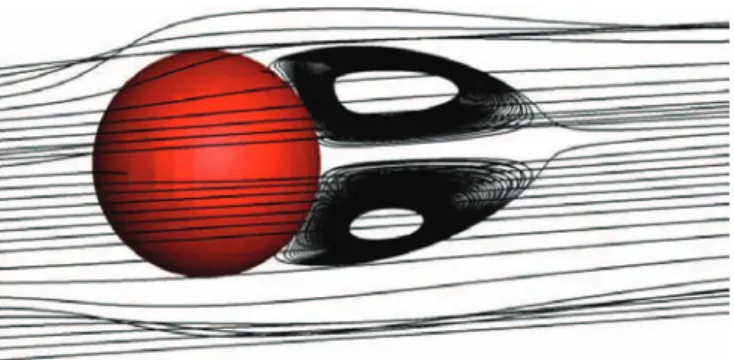
![Fig. 5. (a) Vorticity contours [− 4 : . 15 : 4 ] for Case C. (b) and (c) represent the evolution of the drag and lift coefficients through time.](https://thumb-eu.123doks.com/thumbv2/123doknet/14434966.515825/20.892.77.825.105.661/fig-vorticity-contours-case-represent-evolution-drag-coefficients.webp)


![Fig. 12. Illustration of streamlines for a flow past a sphere at Re = 250. On the left present results and on the right corresponding results from [23].](https://thumb-eu.123doks.com/thumbv2/123doknet/14434966.515825/24.892.112.784.111.485/illustration-streamlines-sphere-present-results-right-corresponding-results.webp)