Publisher’s version / Version de l'éditeur:
Vous avez des questions? Nous pouvons vous aider. Pour communiquer directement avec un auteur, consultez la
première page de la revue dans laquelle son article a été publié afin de trouver ses coordonnées. Si vous n’arrivez
pas à les repérer, communiquez avec nous à [email protected].
Questions? Contact the NRC Publications Archive team at
[email protected]. If you wish to email the authors directly, please see the
first page of the publication for their contact information.
https://publications-cnrc.canada.ca/fra/droits
L’accès à ce site Web et l’utilisation de son contenu sont assujettis aux conditions présentées dans le site
LISEZ CES CONDITIONS ATTENTIVEMENT AVANT D’UTILISER CE SITE WEB.
Proceedings: Permafrost International Conference, pp. 477-480, 1966-10-01
READ THESE TERMS AND CONDITIONS CAREFULLY BEFORE USING THIS WEBSITE.
https://nrc-publications.canada.ca/eng/copyright
NRC Publications Archive Record / Notice des Archives des publications du CNRC :
https://nrc-publications.canada.ca/eng/view/object/?id=c3d38a2d-b2b7-4323-b9b7-5e0a5ac5ba9b
https://publications-cnrc.canada.ca/fra/voir/objet/?id=c3d38a2d-b2b7-4323-b9b7-5e0a5ac5ba9b
NRC Publications Archive
Archives des publications du CNRC
This publication could be one of several versions: author’s original, accepted manuscript or the publisher’s version. /
La version de cette publication peut être l’une des suivantes : la version prépublication de l’auteur, la version
acceptée du manuscrit ou la version de l’éditeur.
Access and use of this website and the material on it are subject to the Terms and Conditions set forth at
Pile construction in permafrost
Johnston, G. H.
;
THl
N2ft2
no. 233
e . 2
.-ry;
4o
3ffF
Nnc sCee
INnroruer ReselncH CouNcrL
CANADA
Coxser Nnnoruel
DE Rrcnrncnrs
PILE CONSTRUCTION
IN PERMAFROST
BY
G. H. JOHNSTON
A N A L Y Z E D
R E P R I N T E D F R O M
P R O C E E D I N G S : P E R M A F R O S T I N T E R N A T I O N A L
C O N F E R E N C E
N O V E M B E R 1 9 6 A
P. 477 - 4AO
Sdsra
TECHNICAL PAPER NO. 243
O F T H ED I V I S I O N O F B U I L D I N G R E S E A R C H
OTTAWA
ocToBER t966
PRICE IO CENTS
36,5xA&
Reprinted from the PROCEEDINGS: PEWATROST INTERNATIONAL CONFERSNCE, NAS.NRC, Publicatlon I287
P I L E C O N S T R U C T I O N
I N P E R M A F R O S T
G . H . JOHNSTON, Division of Building Research, NRC, Canada Permafrost underlies approximately 20% of the land area of the world, Its extensive occurrence in northem regions, includ-i n g a l m o s t o n e - h a l f o f t h e U S S R a n d C a n a d a a n d m u c h o f A l a s k a , i s o f c o n s i d e r a b l e c o n c e r n t o e n g i n e e r s p a r t i c u l a r l y with regard to the foundations for various structures. Although permafrost provides excellent bearing for a structure, it may lose its strength to such an extent when t}awed that it will n o t s u p p o r t e v e n l i g h t l o a d s . S u b s t a n t i a l s e t t l e m e n t c a n o c c u r when these frozen materials thaw, and differential movements usually result in serious damage or even complete failure of the structure.
Prior to the Iast war, construction in the Canadian North m a i n l y i n v o l v e d t h e e r e c t i o n o f i s o l a t e d s m a l l b u i l d i n g s a n d Iimited engineering facilities. Most structures were supported by foundations which extended to or slightly into permafrost o r w e r e p l a c e d o n t h e g r o u n d s u r f a c e I t l . S o m e m o v e m e n t h a d to be tolerated, therefore, due to frost action and thawing of the frozen ground. Increased northern development in recent years has required the construction of more extensive facili-t i e s facili-t h a facili-t m a d e p r e v i o u s l y u s e d f o u n d a facili-t i o n d e s i g n s u n s u i facili-t a b l e .
Present construction techniques for large structures favor t h e u s e o f f o u n d a t i o n s , s u c h a s p i l e s , w h i c h a r e e m b e d d e d i n permafrost. They are particularly useful, and may be the only type of foundation suitable, for sites underlain by materials containing large quantities of ice. Piles are anchored in permafrost thus providing resistance to frost action forces. In addition, because they are well embedded, some thawing of the frozen ground can occur without detriment to the foundation or structure.
Several accounts describing the design and performance of p i l e foundations in permafrost areas have been published [ 2, 3,4] . Studies have a.lso been conducted to determine factors a f f e c t i n g t h e u s e a n d d e s i g n o f p i l e s i n f r o z e n g r o u n d [ 5 , 6 , 7 , 8 ] . t h e r e i s a g r e a t n e e d , h o w e v e r , f o r a d d i t i o n a l i n f o r m a t i o n o n t h e d e s i g n o f p i l e f o u n d a t i o n s .
The development of the new townsite of Inuvik, NWT, in an area of continuous perrnafrost offered a unique opportunity for members of the Division of Building Research, National Re-s e a r c h C o u n c i l , C a n a d a , t o c o n d u c t Re-s t u d i e Re-s o f m a n y a Re-s p e c t Re-s of construction.on permafrost. Pile foundations were used extensively at Inuvik and the experience gained and some observations on their use are reported'
HISTORY
The development of the new townsite of Inuvik near the mouth o f t h e M a c k e n z i e R i v e r ( 6 8 o 2 1 ' N , I 3 3 o 4 4 ' W ) r e s u l t e d f r o m a d e c i s i o n o f t h e C a n a d i a n G o v e r n m e n t i n I 9 5 3 t o c o n c e n t r a t e and enlarge its educational and administrative facilities for the Northwestern Arctic at or near the old settlement of Aklavik located in the Mackenzie River Delta. Aklavik was not a suitable location for the expansion proposed for several r e a s o n s i n c l u d i n g p o o r s u b s u r f a c e c o n d i t i o n s [ 9 ] . D u r i n g 1954, therefore, potential sites for a new town were surveyed I t O ] . t t r e m o s t f a v o r a b l e s i t e , o r i g i n a l l y k n o w n a s E a s t T h r e e b u t o f f i c i a l l y n a m e d I n u v i k i n July 1958, was recom-mended; by a decision of the Federal Cabinet ln November 1954, development of the new townsite was approved.
D u r i n g 1 9 5 5 a n d 1 9 5 6 , c o n s t r u c t i o n a c t i v i t y w a s l i m i t e d t o site preparation (building access roads. hand clearing of brush, stripping of borrow pits), stockpiling materials and the erection of a Iarge equipment maintenance garage, some ware-h o u s e s , a n d a w ware-h a r f . T h e m a i n c o n s t r u c t i o n p e r i o d w a s f r o m early 1957 to the late faII of 1960 when all major contract w o r k w a s c o m p l e t e d I r t ] . a t t m a j o r b u l l c t i n g s ( i n c l u d i n g m o s t housing) and engineering facilities such as heated oil tanks and utilidors are supported by pile foundations (Fig. 1). Afl pile foundations were placed, ln advance of building construc-tion, by the Federal Department of Public Works.
F i g . 1 . A i r v i e w o f I n u v i k u n d e r c o n s t r u c t i o n , J u n e 1 9 5 9
DESCRIPTION OF SITE
I n u v i k i s I o c a t e d o n a t e r r a c e i m m e d i a t e l y a d j a c e n t t o t h e E a s t Channel which forms the eastern boundary of the Mackenzie Delta I I 2 ] . The relief of the area is one of flats at varying e l e v a t i o n s , g e n t l e u n d u l a t i o n s s e p e r a t e d b y s h a l l o w s w a l e s , r o u n d e d k n o l l s , h u m m o c k y h i l l s , a n d r i d g e s o f v a r y i n g h e i g h t s and Iengths. Spruce and birch are the dominant tree types wlth secondary stands of willow and alder' The ground is generally hummocky and covered everywhere with moss from 4 t o 6 i n . t h i c k .
Below the living moss cover a brown to black peat (average depth about 2 ft) occurs over much of the site. At a few loca-t i o n s i loca-t m a y b e a s d e e p a s 1 3 f loca-t . U n d e r l y i n g loca-t h e p e a loca-t loca-t h e r e i s u s u a l l y a b r o w n Eravel with sand or silt which varies in thick-n e s s f r o m I t o 1 4 f t , T h i s m a t e r i a l i s , i thick-n t u r thick-n , u thick-n d e r l a i thick-n b y a g r e y g r a v e l w i t h sand, silt or clay. Granular deposits are u n d e r l a i n b y v a r i o u s c o m b i n a t i o n s o f g r e y , f i n e - g r a i n e d s o i l s ' m o s t l y s i l t s i z e . A t y p i c a l s e q u e n c e o f s u b s u r f a c e m a t e r i a l s f o u n d a t t h e I n u v i k t o w n s i t e i s s h o w n i n F i g . 2 ' I c e s e g r e g a t i o n v a r i e s c o n s i d e r a b l y o v e r t h e s i t e b u t h a s b e e n o b s e r v e d i n a l l s o i l s , r a n g i n g f r o m f i n e - h a i r l i n e I e n s e s o r c o a t i n g s o n p a r t i c l e s t o m a s s i v e i c e c o n c e n t r a t i o n s s e v e r a l feet thick. The higher ice contents occur in the peat and the f i n e g r a i n e d s o i l s , g e n e r a l l y i n t h e f o r m o f t h i n l e n s e s . I h e l a r g e r i c e m a s s e s a r e a l s o c h i e f l y a s s o c i a t e d w i t h p e a t a n d fine{rained soils although some have been observed in g r a n u l a r materials (fig. g).
Permafrost occurs everywhere under the ground surface at Inuvik to depths exceeding 300 ft. The mean annual ground temperature at depths of from 15 to I00 ft is approximately 26oF, The maximum depth of thaw observed in the Iate summer of 1954 (durlng the site survey) , i. e. , prior to occupation and d i s t u r b a n c e o f t h e a r e a , a v e r a g e d 1 . 5 t o 2 f t , r a n g i n g f r o m I ft in peat to about 4 ft in gravel having a 4 in. moss cover. FOUNDATION SELECTION
It was realized that because of the variable soil and perma-frost conditions at Inuvik, every precaution would have to be taken to prevent thawing of the underlying permafrost, or at Ieast to keep thawing to an absolute minimum. In addition, the erection of several very Iarge buildings and important facl-lities at the site made foundation deslgn particularly critical i the selection of one foundation type that would serve all or
s 0
r L
L I V I N G M O S S---T--
C O V E R I B L A C K T O B R O W N P E A T M o r o b s e r v e d T h i c k n e s s 1 5 F e e l EROWN GRAVEL W I T H S A N D O R S I L T M o r 0 b s e r v e d ness 14 Feelt c E
N O T G E N E R A L L Y V I S I B L E B U T E X T R E M E L Y H I G H I C E C O N T E N T . O C C A S I O N A L L A Y E R O F C L E A R I C E U P T O O N E F O O T T H IC K G E N E R A L L Y V I S I B L E A S T H I N C O A T I N G S O N M R T I C L E S S O M E V E R Y T H I N I C E L E N S E S I N F I N E S G E N E R A L L Y V I S I B L E A S T H I N C O A T I N G S O N P A R T I C L E S S O M E V E R Y T H I N I C E L E N S E S I N F I N E S E X T R E M E L Y H I G H I C E C O N C E N T R A T I O N S I N T H E F O R M O F L E N S E S L E S S T H A N I I N C H T H I C K W H I C H A T T I M E S M E R G E I N T O I C E U P T O 2 F E E T T H I C K \t --_T-G R E Y G R A V E L W I T H S A N D S I L T O R C L A Y Mor observed ness ,9 Fe€t-f_-F i g . 2 . Typical sequence of subsurface materials at Inuvik, NWT
most structures was most desirable. Under these circum-stances it was decided to place all structures on pile f o u n d a t i o n s .
Five maJor factors had to be considered with regard to the use of piles in permafrost at Inuvik. These were: Site prep-a r prep-a t i o n , t y p e o f p i l e , p i l e p l prep-a c e m e n t methods, depth of e m b e d m e n t , a n d r e f r e e z i n g characteristics.
PILE FOUNDATIONS Site Preparation
It was imperative that inciividual construction sites as weII a s t h e a r e a a s a w h o l e b e d i s t u r b e d as little as possible in order to maintain the frozen ground condition. Under no cir-cumstances was the insulatlng moss cover to be disturbed and therefore movement of construction equipment and clearing of brush was under strict control, Any necessary clearing of trees and undergrowth was done by hand methods.
At each construction site a gravel pad ficm 18 to 24 in. t h i c k w a s l a i d o v e r the whole area. For access the pad was connected to an adjacent main road by a gravel filt. Heavy equipment thus moved easily about the site and construction materials were stockpiled on the gravel pads with little d i s t u r b a n c e o f t h e m o s s cover.
Type of Pile
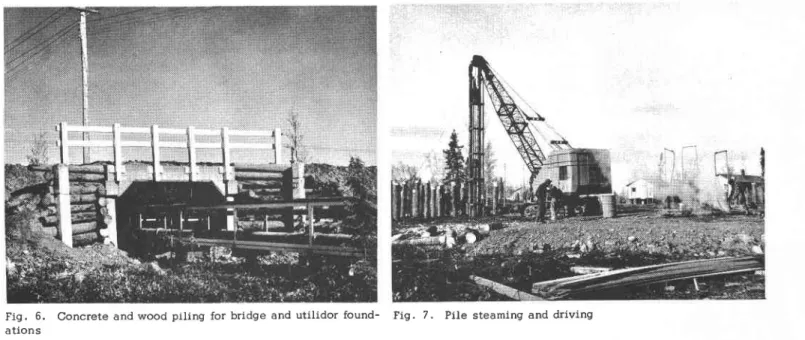
M o r e t h a n 2 0 , 0 0 0 p i l e s w e r e p l a c e d for the foundations of b u i l d i n g s ( F i g s . 4 , 5 ) , utilidors, oil tanks, and road bridges (Fig. 6). Because spruce timber was available from the adjacent delta area and thus would affect a substantial saving in cost over material brought in, wood piles were used for the majority ctf the foundations. Although some timber in 24 and 3 0 f t l e n g t h s w a s available in the delta, most of the spruce p i l e s obtained locally had a maximum length of 20 to 22 It with a minimum diameter of 6 in. About 800 pressure-creosoted
Douglas Fir piles (30 to 40 ft long), were brought in from Edmonton, Alta., for the foundations for the powerhouse and t h e t w o 3 5 , 0 0 0 - b a r r e l h e a t e d oil storage tanks. Some 200 re-inforced concrete piles (about 20 ft long and 15 in. square) were cast on the site and used for road bridges over the u t i l i d o r l i n e s . A p p r o x i m a t e l y 3 0 0 steel piles were used, primarily for corners and anchor points along the utilidor lines. S o m e o f t h e s e p i l e s w e r e 9 i n . d i a . p i p e and others were wide 4 7 8
F i g . 3 . M a s s i v e i c e deposit in gravel
F i g . 4 . P i i e f o u n d a t i o n s f o r h o u s e
F i g . 5 . P i l e f o u n d a t i o n s f o r h o s t e . l . N o t e a i r s p a c e , f a l s e floor, and crawl space
G R E Y F I N E G R A I N E D P R E D O M I N A N T L Y
S I L T Mor 0bserved Thick
Fig. 6. Concrete and wood piling for bridge and utilidor found-a t i o n s
f l a n g e b e a m s ( a p p r o x i m a t e l y I 2 b y 1 5 i n . ) a b o u t 2 4 f . t I o n g . Preservative treatment of wood piles is necessary to prevent deterioration of the upper portion of the pile which is in t h a w e d s o i l . A I I w o o d e n p i l e s , e x c e p t t h e p r e s s u r e - c r e o s o t e d ones, were treated at the site using a diffusion process. The bark was stripped from the top 6 to t0 ft of each pile, although initially the first few hundred piles were treated for their full length, and the preservative applied by brush to the timber in the form of a paste.
P i l e P l a c e m e n t
Satisfactory performance of pile foundations depends upon adequate anchorage of the pile in permafrost. The method by which plles are placed in the ground can have an appreciable effect on refreezing conditions and ultimately on their perform-ance. Normal procedures entail either steam thawing or dril-ling a hole into which the pile can be driven. At Inuvik, steam thawing of pile locations was used for virtually all foundations. For the two large oil storage tanks and the powerhouse, however, where the piles were closely spaced b e c a u s e o f t h e h e a v y I o a d s , t h e p i l e s w e r e p l a c e d i n d r i l l e d hole s .
Drilling- At the location of the structures previously noted a t r u c k - m o u n t e d s e i s m i c " s h o t - h o l e " r i g w a s u s e d t o d r i l l p i l e holes. The gravel pad and active layer were penetrated with a 2 4 i n . a u g e r , a n d a c a s i n g , r n a d e o f 4 5 g a l g a s d r u m s , placed in the hole. From the permafrost table, holes were b o r e d w i t h 1 8 i n , d i a . a u g e r s , h a v i n g s p e c i a l , h a r d m e t a l -faced cutting edges, to depths of about 30 ft. Frozen fine-gralned soils and ice were readily penetrated by the augers ( e . 9 . , 23 ft in I.5 to 2 hours) but at many Iocations concen-t r a concen-t i o n s o f b o u l d e r s a n d , a concen-t concen-t h e 2 3 f concen-t d e p concen-t h , a c e m e n concen-t e d l a y e r ot gravel, prevented, or caused very slow, penetration. vtrhen
stones were encountered, carefully controlled steaming'(10 to 20 psil was used in order to enlarge the hole so that the stones could be pushed to the side and thus allow passage of the auger.
S t e a m i n g A l I o t h e r p i l i n g , e . 9 . , u t i l i d o r a n d b u i l d i n g f o u n d -a i i o n s , w e r e p l -a c e d i n s t e -a m - t h -a w e d h o l e s ( r i g . z ) . A 5 0 h p oil-fired portable boiler supplied steam to as many as five 0 . 7 5 i n . j e t t i n g p i p e s , B o i l e r g a g e p r e s s u r e v a r i e d f r o m I 0 0 t o 1 3 0 p s i b u t w a s u s u a l l y m a i n t a l n e d a t a b o u t I I 5 t o I 2 0 p s i . Pile locations were steamed from l0 to 20 ft in depth and averaged about 14 ft. The depth and rate of penetration of the steam jets varied considerably and were directly dependant on soil type. Organic material or massive ice was penetrated so
rapidly that the jets had to be held up until the hole exceeded the pile in diameter. In granular materials , which contained many stones, and dense sandy silt the Jets had to be forced into the ground. At times stones prevented iet penetration to the depth desired. In these cases a new hole was started im-mediately adjacent to the old location, or the pile was driven to the depth steamed if the hole was considered deep enough. In some townsite areas, gravels were cemented, at a depth of I to l0 ft, by an iron oxide coating which made steaming very difficult.
The difficult steaming conditions encountered in the gravels often resulted in excessive steaming of pile locations at some sites. This oversteaming substantially enlarged the pile holes near the surface (as well as at depth) and caused subsidence of the ground surface due to the thawing of massive ice depos-its. The thawed zone surrounding each pile varied, but generally was from 2 Io 4 ft in diameter.
Very stony soils also caused trouble during pile driving. Stones were frequently Ioosened by pile driving and these deflected the pile out of line (as much as 3 ft). In some cases stones were forced to the bottom of the hole so that the pile could not be driven to full depth. A steaming technique was developed by which the steam jet was Ieft at the bottom of the hole to "bell out" orenlarge a thawed area into which stones and boulders could be pushed by the pile as it was driven'
Steaming intervals varied widely over the townsite and even from one pile Iocation to another at one construction site. Observations of steaming intervals, including the time taken for the jet to penetrate to the hole bottom ("sinking" tlme), the "belling-out'r time and the total time, were made during the construction period, Total steaming times for a 14 ft hole ranged from about I hour under good steaming conditions in finegrained soils to about 8 hours at a few locations where steaming was most difficult because of heavy concentrations o f s t o n e s . I n t h e l a t t e r c a s e , b e c a u s e o f t h e e x c e s s i v e steaming, the jet pipe was pulled to the surface without t'belling out" the bottom of the hole' Some of the steel piles for utilidor corners and anchor points were placed to a depth of 20 ft and these holes generally required steaming for 4 to 6 h o u r s ,
Driving-At the powerhouse and the heated oil storage tanks where holes were drilled, the piles were simply dropped into the hole and a silt- and sand-slurry backfill placed around the p i l e . At steamed locations a 2000 lb drop hammer was used t o d r i v e p i l e s . I n m o s t c a s e s t h e h a m m e r w e i g h t w a s s u f -ficient to force the pile to a depth of from 4 to I ft in the s t e a m e d h o l e , a n d t h e p i l e w a s t h e n d r i v e n t o r e f u s a l . A s t h e DiIe was driven, the soil slurry resulting from the steam
thaw-479
ing was forced to the surface. Those piles deflected by stones during drlving (some more than 12 in.) had to be realigned.
The "straightening" operation consisted of resteaming the hole
beside the pile, pulling the pile into line with a winch and then inserting Iong wooden wedges beside the pile to hold it in position until refrozen (fig. g) ' Although many piles were re-a l i g n e d i m m e d i re-a t e l y re-a f t e r p l re-a c e m e n t , s o m e p i l e s h re-a d t o b e straightened from 2 to 4 weeks after the pile had been driven,
because wedging was ineffective, until the large thawed zone
surrounding the pile at the surface had refrozen.
In an attempt to provide additional anchorage against frost-heave, piles were driven butt-end down for the foundaflons of
the first structures erected' Great difficulty was experienced
in driving because the loca] timber tapered greatly from butt to Up, and stones in the hole wall prevented penetration of t h e p i l e . C o n s e q u e n t l y , e x c e p t f o r a b o u t 2 0 0 p i l e s , a I I p i l e s were driven tip down.
Depth of Embedment
OnIy limited information is available with regard to the
re-quired depth of embedment of a pile ln permafrost. Although
some of the load on the pile may be taken by end bearing, it is believed that when the pile is completely frozen into the surrounding soil much of the load is transferred to the perma-frost by the tangential adfreezing strength developed between
the soil and the surface of the pile. Not only does the
ad-freezing bond distribute the load to the permafrost but it must
also resist frost-heave forces in the active layer. Two factors
influence the embedment depth: The depth of the active layer resulting from the presence of the structure over a period of years and the adfreezing strength that will be mobilized by
surrounding frozen soil. Because of the information lack on
these factors the following "rule of thumb'r for embedment of piles in permafrost has generally been followed: "Piles should be embedded in permafrost to a depth equal to at least twice the depth of seasonal freezing and thawing during the life of t h e b u i l d i n g " I I 3 ] .
OnIy a qualitatlve assessment of the potential depth of
expected thaw under a building at Inuvik could be made' For
d e s i g n p u r p o s e s , t h e r e f o r e , s o m e i n c r e a s e d t h a w i n g w a s assumed that would result in a maximum depth of thaw of
between 4 and 5 ft over a period of years. Thus, using the
r r r u l e of thumb,r' piles should be anchored at least l0 ft in p e r m a f r o s u i . e . , p l a c e d t o a m i n i m u m d e p t h o f a b o u t 1 5 f t below ground surface.
For most buildings, holes were steamed to a depth of
about 15 ft and the piles were generally driven to wlthin I ft
of the steamed depth' Steel anchor piles for the utilidors
were placed to depths of l5 to 24 ft in steamed holes. Wood
piles for oil tanks and powerhouse were placed to a minimum depth of 25 ft in drilled holes.
Pile Refreezlng
The refreezing period required for piles placed in permafrost is of utmost importance to a construction schedule. Superstjuc-tures cannot be erected until the foundations are adequately
anchored in permafrost. Refreezlng of piles is dependant on
many variables, including the Ume of year when piles are
placed, steamtng interval, ground temperatures, soil type,
and soil moisture content. Of these, perhaps the most
important factor is the steaminq interval'
Refreezing observations made at Aklavik in I953 and at Inuvik in 1955 [2] indicated that, with average or moderate steaming, piles would be refrozen at the 20 ft depth within a few days and at the 10 to 14 ft depths within one month. Shallower depths normally took longer than one month to
re-freeze depending on the time of year' Excessive steaming
pro-Ionged the refreezing period considerably-by as much as
several weeks. The need for carefully controlled steaming was
tierefore emphasized.
Observations made at Inuvik during the construcuon period showed that piles should not be loaded for from 2 to 6 months,
or longer, depending on the time of year they were placed' In
particular, a full winter period (at Ieast 6 months) was
4 8 0
F i g . 8 . S t r a i g h t e n e d p i l e s . N o t e v a r i a b i l i t y o f d r i v e n d e p t h , w e d g e s , a n d g r o u n d s u b s i d e n c e
required to ensure that piles placed in the faII were adequately anchored and free of movements caused by freezing of the a c t i v e l a y e r '
C O N C L U S I O N
Pile foundations have Iong been used with great success in temperate climates to provide support for structures located on materials that are relatlvely unstable or have low bearing
capacity. They have also had considerable application in
permafrost areas where they are used to transfer building Ioads through the unstable active layer to the more suitable a n d s t a b l e p e r m a f r o s t . C e r t a i n a s p e c t s o f p i l e p l a c e m e n t techniques and design criteria differ considerably for foundations in permafrost however.
M e t h o d s o f p l a c i n g p i l e s i n p e r m a f r o s t ( e . s . , b y s t e a m i n g or drilling holes) can have an appreciable effect on their
performance. Maror design considerations include predicting
the effect, with respect to thawing, that a structure will have on permafrost and determining what tangential adfreezing
strength can be assumed for distributing the load to
perrna-frost and resisting perrna-frost-heaving forces. Factors considered
in the use of pile foundations at Inuvik, NWT, have been described as an example of the approach taken at that Iocation '
PiIe foundations at lhuvik have performed exceedingly weII
to date, Observations on pile-placing techniques and
refreez-ing characteristics have shown that careful steaming control,
partlcularly during the latter part of the year, is required
be-cause of difficult soil conditions. Excessive steaming of pile
locations can result in greatly increased refreezing times' P i l e s p l a c e d e a r l y i n t h e y e a r ( J a n u a r y t o M a 9 c a n u s u a l l y b e
loaded within 2 to 3 months. Those placed later in the year
may not be adequately anchored (to resist frost-heave occurring in ihe active layer during the late fail and winter) for periods of six months or more, depending on steaming conditions and
refreezing characteristics of the soils encountered.
The large construction program recently completed at Inuvik has shown the success of preplanning the time of found-ation placement so as to allow time for refreezing of piles
before the superstructure is erected' Construction schedules
were rarely disrupted by pile foundations not being ready for l o a d i n g .
T h e s e l e c t i o n a n d u s e o f p i l e s a s t h e m o s t s u i t a b l e f o u n d -ation type for the majority of the buildings and facilities
erected at Inuvik has been justified. Obsen,ations are