MARCH 1984
LIDS-P-1382
This paper has been accepted for the American Control Conference, June 1984,
San Diego, California
ADAPTIVE CONTROL WITH VARIABLE DEAD-ZONE NONLINEARITIES*
by
D. Orlicki, L. Valavani, M. Athans and G. Stein
Laboratory for Information and Decision Systems, M.I.T. Cambridge, Massachusetts 02139
parameters to drift from their "desired" values.
Abstract Consequently then, the zero tracking error
requirement must be suitably relaxed. The ration-It has been found that fixed error dead-zones ale is that no parameter adjustment should take as defined in the existing literature result in place when the output error(s) are due to disturb-serious degradation of performance, due to the con- ances and/or unmodeled dynamics. This can be servativeness which characterizes the determination achieved on an existing algorithm by a dead-zone of their width. In the present paper, variable nonlinearity, in the parameter adjustment law, width dead-zones are derived for the adaptive con- whose width depends on the contribution of the
trol of plants with unmodeled dynamics. The der- disturbances and/or unmodeled dynamics to the out-ivation makes use of information available about put error.
the unmodeled dynamics both a priori as well as The idea of a dead-zone nonlinearity in the during the adaptation process, so as to stabilize parameter update law to avoid the effect of disturb-the adaptive loop and at disturb-the same time overcome disturb-the ances on adaptation was first introduced for in-conservativeness and performance limitations of direct adaptive algorithms by Egardt in 1980 [2) fixed-dead zone adaptive or fixed gain controllers. and was later amplified by Samson [3]. Also, in
1982 Peterson and Narendra used a dead-zone non-1. INTRODUCTION linearity to prove stability for a class of direct
algorithms in the presence of bounded disturbances Research in recent years has shown that adap- with no unmodeled dynamics [4]. However, the width tive control algorithms which, under ideal assump- of the dead zone was chosen to be constant and had tions, have been proven globally asymptotically to be based on a very conservative bound so that it stable, indeed exhibit unstable behavior in cir- yielded only marginally stable systems with ex-cumstances under which those assumptions are even tremely poor model tracking as the examples in [4) slightly violated. Of the two instability mech- seem to suggest.
anisms identified for these algorithms, -commonly Consequently, obtaining non-fixed accurate referred to as "gain" and "phase" instability mech- bounds for the disturbance and high-frequency anisms [1],- the former is more unavoidable and is dynamics contributions to the output error is cru-. triggered by the controller parameter cial to overcoming the conservativeness of the drift which occurs as a result of nonzero output dead-zone width which they define. This depends on errors. These are a consequence of the fact that, the ability to translate frequency domain
in the presence of unmodeled dynamics and/or magnitude bounds, most naturally expressed by (persistent) disturbances there can be no perfect 2
(transfer function) matching between the compensated
L
norms into time-domain magnitude bounds plant and the reference model over all frequencies, of instantaneously measured quantities, mostnat-even if "sufficiency of excitation" for the "nom- urally expressed by L - or, for our purposes, L inal" model order is guaranteed. norms which are much less conservative than L
Perfect matching, on the other hand, translates norms.
into zero output (tracking) error, under ideal as- This paper discusses the use of a deadzone, sumptions, and has been the basis for the parameter whose width is adjustable on line, to adaptively adjustment laws; only when the output error is zero control a plant with unmodeled dynamics, with the
does adaptation stop. Clearly, then, by design, objective of maintaining its stability and minimi-any nonzero output error is instantaneously attrib- zing the adverse effects of a conservative dead-uted to parameter errors. Furthermore, there is zone width to its performance. Due to space consid-nothing in the mathematics of the adjustment mech- erations we do not treat the case of output distntob-anisms, as they currently stand, to prevent gain ances here; also, the topic of disturbances addi-drift due to error sources other than parameters, tionallv includes a fixed disturbances rejection as for example happens even in cases of "exact mechanism that introduces a modification in the bas-modeling", with "sufficiency of excitation", where ic structure of the MRAC system so is to merit convergence to the "desired" parameter values has separate attention.
been achieved momentarily; extraneous Section 2 of this paper contains a generic norm disturbances entering at that point can cause the translation problem and develops a set of tools
*Research supported by ONR/N00014-82-K-0582(NR 606-003). NSF/ECS-8210960 and NASA Ames and Langley Research Centers under grant NASA/NGL-22-009-124.
---required for its solution. Section 3 applies the the actual transfer function of a plant with feed-results of the previous section to the familiar NLV back, designed to follow a reference model which is algorithm of the Model Reference type. Other algo- prescribed by the transfer function M(s). In the rithms can be treated similarly. Section 4 discus- absence of unmodeled dynamics, i(s), perfect match-ses the stability of the variable width dead-zone ing is possible.
adaptive system and, finally, Section 5 contains When k(s)#O, the stability of G(e,s) can be the concluding remarks. ensured by (requiring) enforcing the condition
2. MATHEMATICAL PRELIMINARIES i+A(8, jw)
[l+
(jw)]O (3)In this section we develop the necessary tools This condition is satisfied if, for all 8 in the for the definition of the variable width dead zone. space of admissible parameters the following is As was already pointed out in the introduction, the true:
objective is to find satisfactory bounds for the
contribution of the unmodeled dynamics to the out-
II (jw)
I_< I_
(w) < 1+IIA-l
(,jw) I
(4)
put of the adaptively controlled process, so that
an "accurate" error dead-zone can be defined. Assuming this condition is true, we proceed The process, complete with unmodeled dynamics to derive an upper bound on I IG(, jw)
I I,
para-is assumed to be of the Doyle-Stein type, with the metrized by IIM(jW)1I. From ecn. (2),high frequency dynamics entering multiplicatively;
i.e. G (8, jw) =M (jw) { (j) (5)
-e D (D(6,jw)+Z(jw)A(8,jw) g(s) = gp(s)(l+1(s))
where D(8,jw) l+A(e,jw) where g(s) is the actual plant transfer function,
g (s)its modeled part and I(s) the unmodeled dynam- Next, representing I(jw), D(_,jw) and A(e,jw) ics. Typically, a bound on the magnitude of 1(s) in polar form,
is assumed to be negligible for frequencies below
crossover, becoming only appreciable for higher e jG(8,jw) <1 M( |
I)(j)i
e
frequencies; no phase information can be assumed.
i(',jW
i+II
M (8)The problem is then to find a bound for the output
I
JD(jw)Je
D
of the adaptively controlled process due to L(s). j(A
(e)+
This
is achieved in two stages, as the following
i(jw)A(e,jw)e
subsections indicate. We further remark here that,due to feedback in the adaptive loop, the unmodeled dynamics indirectly influence all the state
var-iables of the nominal adaptive loop, with the mag- An upper bound for G(6,jw) can be found by maximizing and minimizing respectively the values nitude of their contribution depending on the nature maximizing and minimiing respectively the values of the numerator and denominator terms in (6). The denominator achieves its smallest value if the vectors Z(jw)A(e,jn) and D(O,jw) are oppositely 2.1 Transfer Function Magnitude Bounding aligned and, in- adition,
ITi(jw)JI
achieves itsmaximum allowable value for the 9-interval of in-In this subsection we will derive a bound ¢(w)
terest. The above two conditions are satisfied if on the magnitude of the frequency response of a the phase angles are such that
(
()+special class-of transfer functions, that typically Z A - D
-arise in MRAC systems. Consider an LTI transfer and
j
i(jw)
j
j=
(w). Note that condition (4) for function G(8,s) of the form-function of the form
G(,s)
the stability of G(e,s) ensures thatP. (s) (2a)
I
((jw)A(6,jw)Il<i
iD(e,jw)I
and, indeed, the G(e,s) = M(s) { 1+a(O,s)[l+5(s)]G(-1s) N~s)
{
l+A(8,s)El+£(s)3 choicej
l|(jw)ll = o(u) guarantees minimization of wherethe denominator of G(e,jw) with stability maintained. M(s) is a completely known stable LTI transfer Unlike the denominator, the numerator magnitiud
function is independent of 0,, and is directly maximized by
l+A(_,s) =
n(sPi()
(2b) choosing jI(jw)|!=I (U) and p appropriately to_
0
i=l satisfy the denominator phase angle condition.
Consequently, from eqm;. (6) we can now write an up-8 < 8 < 8
-Q - - -
-u per bound for G(8,jw) as follows:8
unknown constant parameter vector with _ (W)specified bounds (2c) JIG(e,jW) I1=1M(jw)
iI
D
(8)< i=l ... n (2d)
II(jw)<i[_
I o(w) for known £ (w)> 0 (2e) Finally, we may search the space of allowable values of 8 to determine the desired transfer functionbound Note that when L(s)=O, G(e,s)=M(s), and therefore
stable. In the context of MURAS, G(8,s) represents (w) max
IG(ejW)
(8)In the following subsection we will use O(M) in
order to bound the output of G(e,jw), in an ab-t)<
dIG(,(j
(14)solute value sense, given an input x(t).
-
-2.2 Absolute Value Output Bounding But from the previous subsection (w) was
deter-mined such that
Consider the system shown in figure 1 with
input x(t), output y(t) and G(e,s) as defined ¢(X)>
HIG(e_,jw)H
(15) beforeHence, (14) becomes,
X(t) y(t) y(t) < d (W)
I
X(j~W)Ii
y(t) (16)G(8,s)=
g(8,
t)
-"which admittedly represents a looser bound on the absolute value of y(t) than eqn. (14). However, the bound y(t) can be calculated more readily. The
inequality (16) has the following interpretation. Given a bound on the frequency response of a sys-tem, a bound on the magnitude of its output due to an input x(t) can be calculated at any instant of
Figure 1: time by using the time history of the system input
up to and including that instant of time. We note By taking the inverse Laplace transfer of G(8,s), here again the time dependence of X(jw) according
we obtain to eqn. (12).
-l{G(8,s)} = g(8,t) (9) 3. MRAC WITH RELAXED TRACKING ERROR CRITERION Furthermore, since g
(,t)
represents alinear-time-invariant system, by definition of G(6,s), the In this section we employ the results of section output y(t) is given by 2 to derive a variable dead-zone width for the
parameter update of the N-L-V algorithm, which
y(t) = g(8,t)* x(t) = overcomes the conservativeness of the fixed width
Peterson-Narendra scheme [4]. Before we proceed,
t we briefly review the concept of parameter update
=-
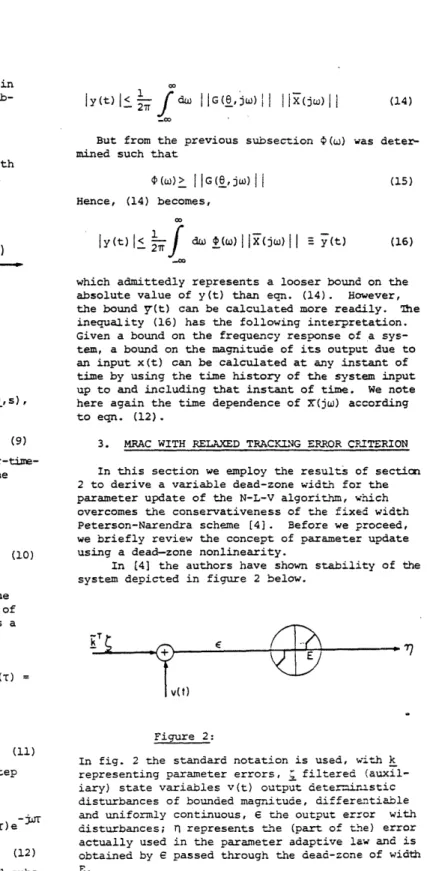
dT g(6,t-T)x(T) (10) using a dead-zone nonlinearity.?_~ -- In [4] the authors have shown stability of the system depicted in figure 2 below.
Substituting now in (10) for g(8,t-T) the expression for the inverse Laplace transform of G(8,s) and recalling, further, that G(6,s) is a
stable transfer function, we can write
-r
y(t) = dT 2-- ds G(e,s)e x(T) =
t
=d ( j)Jt
I
dT X(T)e-jWTJ
dw G(e,jw)eJ
dT x(T)e Figure 2:*m -m (11)
In fig. 2 the standard notation is used, with k Next, with U(t) representing the unit step representing parameter errors, , filtered
(auxil-function we have iary) state variables v(t) output deter-mir-stic
disturbances of bounded magnitude, differentiable t and uniformly continuous,
e
the output error with F {x(t) .'(-t= dT x(T)U(-T)e d e disturbances;n
represents thne (part of the) error actually used in the parameter adaptive law and is (12) obtained by 6 passed through the dead-zone of width Define F{x(t)U(-T)} with the symbol X(jw) and subs- E.titute in (11).
Then
It is not our purpose here to present the
details of how the above error system as shown infig. 2, is arrived at. The reader is instead t) - ( j )Wt (13) referred to [41 for those as well as the stability
y 2,t _, - proof of that modified algorithm. We simply present here the parameter adaptive laws, with the dead-By the Cauchy-Schwartz inequality it follows from zone nonlinearity in their simplest form, for the
(13) that sake of completing the probiam descript on which
forms the basis for the develozrents in the present
paper. The parameter adjustment is as described for P(e,s). That is, the designer knows
by eqns. (17) below. (i) an upper bound on the relative degree n* of
P (e_,s)
(ii) an upper bound on the degree n of P(8,s) k(t) = -(t) = >O (iii) that P(e,s) is minimum phase
1+a T(t)4(t) (17a) (iv) the sign of the high frequency gain of P(e,s) with n(t) = te ( t) Ie(t) I>E The 2(s) part of the plant represents the
(multi-plicative) uncertainty associated with the nominal
0
°
e(t)
I<E (17b) plant P(e,s). This uncertainty is due to highfre-quency dynamics, which are assumed of unspecified
where E represents the width of the dead-zero.
structure but satisfy a magnitude constraint
wII(jw)ll< z (w), as already mentioned. Further, Although in [4] the discussion is not particularly a
enlightening as to how exactly the magnitude E is we note that the "actual" plant representation decided upon, it is the present authors' P(6,s) [l+i(s)] will not in general satisfy any of
conclusion that most likely, in [4] the four standard assumptions listed above. This fact becomes pivotal in the inability of the
adap-E >
[jv(t)II
=malXV(t)l
(18)
tive controller to achieve transfer function
match-ing between the compensated plant and the reference model. As a result, it becomes impossible for and, therefore, is very conservative as the same general inputs to drive the tracking (output) er-authors have pointed out in [5]. We next proceed ror to zero. However, one may expect the trackingto analyze the original NLV Model'Reference algo- error to be small, if the plant is excited by sig-rithm, as represented in Fig. 3, with the plant nals with dominant low frequency content over the dynamics now replaced by the actual plant range where P(e,s) is a good approximation to the
P(8,s) [l+z(s)]. actual plant transfer function.
In what follows we will next show that the error system underlying the structure in figure 3 differs from that of the same structure, as shown M M in fig. 2, where Z(s)=0, only by an additive
per-turbation term in the output. This term can be
r -' e uf bounded using the results of Section 2 and a
var-u'rk-w iable width dead-zone can be defined for the
adap-rF---- YP-tation mechanism. Stability of the scheme is
I~~
~
+ P(,S)[l subsequently discussed in Section 5.+
l
,
We start by considering first the case where
| (s)=O in Figure 3*. in this case the standard
MRAC
assumptions about the plant are true.
There
Ar - .. ___ .exists a vector k*(e) of fixed gains which, when [ m ~k ', t- 7-- ~ -__+| Is :applied to the system, results in matching of the
L_ _ :l~ S ~ ... xf ] compensated plant transfer function with that of
I, *l ltk Xthe model. We adoot the shorthand notation C (8)
: 2 1
and C.(8) to indicate the LTI transfer functions
Cziz(e).k$l()31
ffs:,k
C (k (e)) and C2(k*(9),k*(e))
respectively.
Now
L----1 --- -
2
--3
assuming Z(s)#O but maintaining the same
defini-tions of Cl(k*(e) = C (e)
and C (k*(e),k
3(e)),
kT
,
--- ]
C2(8) based on thne reduced model, we may derive-IW
Hr Man expression for the error system as follows,
-- where for convenience, the argument's' has been
suppressed throughout. Y C1 (6)P(e) [l+Z] R 1i+C1 () C2 (6)P(6) [1+k] Figure 3:
C
1()P(6)
c
(e)P(e)
+C1(e) (8)P () l+C () (e) P ()1+C
i(9)c (_)P(e)
[l+l]
(1°)
The component P(e,s) incorporates the designer'sknowledge of the dominant, low frequency response By definition of C1(e) and C2(e) we have
of the plant, including a vector e of uncertain
parameters, known only within precomputable bounds. C,(S)P(_)
The standard MPAC assumptions about the plant hold +C ()c M (20)
2
-Using this fact and introducing the notation X
A(e) _ C1(e)C 2(8)P(6) we can write eqn. (19) in a(t)
f
+
2n-l}
(24)more compact form as _}- i Il
where eqn. (12) has been used for calculation of YP = M+M - (21) the transforms U(jw) and W. (jw) for the input u(t)
R 1+A(_) [1+2)]
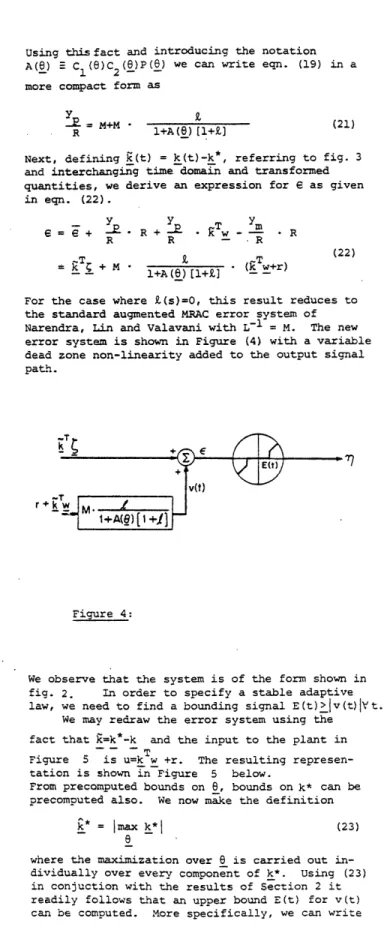
and signals wi (t) respectively. An adaptation law Next, defining k(t) = k(t)-k*, referring to fig. 3 of the form described in eqn. (17) can then be and interchanging time domain and transformed employed with the width of the dead zone defined quantities, we derive an expression for e as given by eqn. (24). The resulting scheme is stable and
in eqn. (22). an outline of its stability proof is given in the
following section.
eteR
'a. R+-R R 5. STABILITY
~~~~~~T
Q _T~
(22)= k B
+ M **_(k _w+r) The stability proof of the proposed algorithm
---
k
+ [ A 1 -- l+A(e)l[+9] -(8 (Tw+r)+ ) ~](k
- with variable dead-zone follows along very similar lines for the most part with that in [4]. However, For the case where d(s)=O, this result reduces to in the present case it is additionally conditioned the standard augmented MRAC error system of on the reference model definition and the admissibleNarendra, Lin and Valavani with L
-= M. The new
parameter set, as eqn. (4)
of section 2.1 implies.
error system is shown in Figure (4) with a variable More specifically, the space of admissible para-dead zone non-linearity added to the output signal meters is implicitly defined through the referencepath. model by eqn. (4), in conjunction with condition
(2c) and is such that the desired (class of) ref-erence model(s) remains stable in the presence of the unmodeled dynamics L(s) of the plant. This is a standard and reasonable assumption made in the
~'_T5
< design of all fixed parameter controllers as well. ++k - Due to space considerations we will not elaborate'~t) xl , on this further but will instead refer the reader to [6] for more details.
Consequently, given eqn. (4), which is fun-r~k
M. + -V damental even for a non-adaptive design, the effect
l+A(8)[[] _ of unmodeled dynamics can be represented as an
out-put perturbation v(t) as suggested in eqn. (22) and depicted in fig. 4. v(t) is the output of a stable linear system which is bounded for bounded inputs. We next proceed to outline the steps for proving boundedness of R,u,,,w and the output error e.
The boundedness of
k
follows directly fromFigure 4: the standard Lyapunov function definition
(V(k) = 1 (K.T) and the adaptation law (17a) in conjunction with eqn. (22) where E(t) is defined. Also, from the definition of the dead-zone, the We observe that the system is of the form shown in T
fig. 2. In order to specify a stable adaptive term
1
k can be bounded above and below by bounds law, we need to find a bounding signal E(t)>lv(t)Vlt. of the formWe may redraw the error system using the vt ,T
f [ E ( t ) ] +v(t)< '
<
f[E(t)]lj+v(t) fact that k=k*-k and the input to the plant in -- . . . 2 . .- - - T (25)
Figure 5 is u=k w +r. The resulting represen- where f (-) and f (.) are continuous functions
tation is shown in Figure 5 below. 1 2
From precomputed bounds on 8, bounds on k* can be of E(t).
precomputed also. we now make the definition Next, by the definition of the Lyapunov func-tion, its time derivative, in conjunction with the * = ax km * (23) adaptation law given by eqn. (12a), can be written
8_ · as T
where the maximization over e is carried out in- T = (26)
dividually over every component of k*. Using (23) -T in conjuction with the results of Section 2 it
readily follows that an upper bound E(t) for v(t) From the fact that can be computed. More specifically, we can write
' %T)dT <t 0
and eqns. (25) and (26), it is straightforward to 3. C. Samson, "Stability Analysis of Adaptively
conclude that Controlled Systems Subject to Bounded
Disturb-ances," Automatica, Vol. 19, No.1, pp. 81-86,
k(t)e
L
(27) 1983.From-this- pointon, te prof uss stadard4. B.B. Peterson and K.S. Narendra, "Bounded Error From this point on, the proof uses standard Adaptive Control," IEEE Trans. on Aut. Control,
arguments, for the boundedness of u,w,5, as they
Vol. AC-27
No. 6, Dec. 1982, pp. 1161-1168.
first appeared in [7] and outlined in [4]. We only 5. D. Orlicki, L. Valavani, and M. Athans," Comments remark here that, in our case, Iv(t)I<IE(t)
and, on Bounded Error Adaptive Control," to appear in furthermore, v(t)=0[supI w(T) ,l, as follows from IEEE Trans. on Autom. Control, Oct. 1984.t>t 6. D. Orlicki, Model Reference Adaptive Control
eqn. (22) and fig. 4. The reader is again referred Systems Using a Dead-Zone Nonlinearity, Ph.D. to [6] for all the details of the stability Dissertation, Dept. of EECS, Laboratory for
arguments. Information and Decision Systems, M.I.T.,
Cambridge, MA, May 1984.
7. K.S. Narendra, Y.H. Lin, and L.S. Valavani, "Stable Adaptive Controller Design, Part II: Proof of Stability," IEEE Trans. Automat. Contr.,
~kT~+ 6 E Vol. AC-25, pp. 440-448, June 1980.
E(t)
'7
8. P.A. Ioannou and P.V. Kokotovic, Adaptive Systems with Reduced Models, Springer-VerlagV(t) Series, Lecture Notes in Control and
Informa-ffi - i ) tion Sciences, 1983.
e 1A(8)[1 +I { e
Figure 5:
Figure
5-6. CONCLUSIONS
A variable dead-zone nonlinearity was introduced in a standard model reference adaptive control algorithm to maintain its stability in the presence of unmodeled dynamics. The variable width dead-zone is determined on-line on the basis of prior information about plant parameter bounds and un-modeled dynamics as well as about information ob-tained during adaptation. Besides maintaining stability, the algorithm is able to overcome the conservativeness of fixed dead-zone on exponential forgetting factor adaptation mechanisms [4], [8], as simulation results show. Due to space limitations, those are deferred until the conference presenta-tion of the paper.
REFERENCES
1. C.E. Rohrs, L. Valavani, M. Athans and G. Stein, "Robustness of Adaptive Control Algorithms in the Presence of Unmodeled Dynamics," Proc. 21st. IEEE Conf. on Decision and Control, Orlando, Fla., Dec. 1982, pp. 3-11.
2. B. Egardt, "Stability Analysis of Adaptive Con-trol Systems with Disturbances," Proc. Joint Automatic Control Conference, San Francisco, CA, Aug. 1980.