Derivation of a Queuing Network Model for
Structured P2P Architectures
Zouweyna MORDJI LaMOS research unit Faculty of Exact Sciences
University of B ´ejaia 06000 B ´ejaia, Algeria [email protected]
Mourad AMAD LaMOS research unit Faculty of Exact Sciences
University of B ´ejaia 06000 B ´ejaia, Algeria [email protected]
Djamil A¨ISSANI LaMOS research unit Faculty of Exact Sciences
University of B ´ejaia 06000 B ´ejaia, Algeria [email protected]
Peer to peer (P2P) networks have using commonly used for tasks such as file sharing or file distribution, and for building distributed applications in large scale network. Their performance measures are generally based on simulation methods software such as NS-2, P2PSim, OpenNet, etc. Hence, the absence of a validation of the simulation model is a critical issue. In this paper, we propose a new analytical model derived from (8), to evaluate the performance of HPM protocol (hierarchical Peer-to-Peer model). Performance is done principally in terms of total download time of requested resources in the P2P network, and then we analyze the impact of various parameters associated with the heterogeneity of nodes.
P2P, Performance evaluation, Analytical model, HPM, Queuing model. 1. INTRODUCTION
The P2P paradigm has emerged as a solution to some limitations of the classical methods of resource sharing based on the paradigm Client / Server. It is a distributed system without or with minimal central authority and with varying computational power at each machine. Its applications are varied, we cite as an example: the multicast application, parallel com-puting, file sharing, IP telephony, instant messaging, search engines, etc. This type of network is generally characterized by a good scalability (scaling) and a very high dynamic (churn rate), for more details about this topic see (1).
P2P networks have seen an unprecedented develop-ment that was accompanied by a significant increase in their complexity. So, we focus in this paper on analytical models, because of the interest in their high speed resolution. Indeed, when considering making a change to the system, decisions will lead to very high cost, and it is very useful to have an-alytical solution with their much reduced computing time. Analytical and mathematical frameworks let us to model and study the performance of the P2P networks, and several models have been proposed in order to investigate the dynamics of this kind of systems, many researches are focused on the Markov chain based modeling , (7), (3),(4), (10), and recently the researchers exploit the queuing model for performance evaluation of the of P2P networks
(8), (9), (2). In this paper, we follow mostly the approaches put forward in (8).
The goal of this paper is to propose an analytical model for evaluating the performance of the HPM (hi-erarchical Peer-to-Peer model) (13). Our proposed model is different from those explored in (8), in their work, the structured P2P systems have not been addressed. Our work is then to complete the analytical model proposed in (8).
We interest about structured P2P architecture, be-cause it is more efficient in terms of lookup and download resources, and more complicated to im-plement. For this, the analytical model is slightly more interesting to take into account the system characteristics and evaluate the performance of the corresponding architecture in a very short time, and give a good insight into the operation of the systems under study at low cost, compared to other perfor-mance evaluation techniques of P2P networks like measurement and simulation approaches. Analytical models are least expensive and give the modeler deep insight into the main characteristics of the system.
In this work, we want, exactly, to answer the ques-tion: using the HPM, how long does it take a re-quested resource to lookup and download? To an-swer this question, we use a queuing model with structured P2P system, we consider two types of nodes, the relay and the end peer nodes as de-scribed in HPM, we use also a single class open
queuing network to evaluates the delays in a relay nodes, we model each relay node as G/G/1 queue (13) and the end peers as M/G/1/K processor shar-ing queues.
The rest of this paper is organized as follows: next section gives a background and related work on Peer to Peer networks and existing performances evaluation methods, we describe and analysis the proposed models existing in the literature. Section 3 describes our proposed model. In section 4, we validate our model; finally, we conclude and give some perspectives.
2. BACKGROUND AND RELATED WORK
In this section we give a brief description of P2P network and different classes of associated mathematical models.
2.1. Background
P2P Systems offer an important opportunity for a large number (hundreds of thousands) of nodes to cooperate in order to share resources via a widely distributed network. Nodes of the network, are an equal participant, and there are no nodes with special facilitating or administrative roles. Since the service is distributed to all participating nodes, the system is expected to scale well even when the network is very large. Avoiding bottlenecks and likely with good fault tolerance, the P2P paradigm is suitable for large-scale distributed environments where nodes (called also peers) can share their resources (eg. computing power, storage capacity,
bandwidth) as an autonomous and decentralized.
Due to its advantages, several areas have already taken advantage of this paradigm (eg. file sharing,
sharing computing capacity and exchange instant messages). A peer can play the role of client
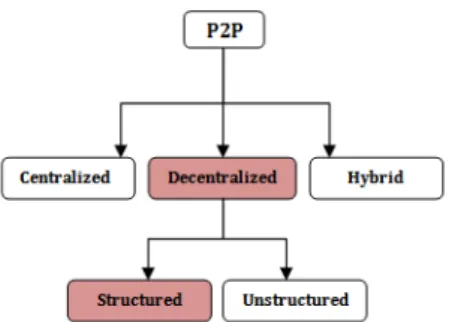
when it consuming resources, and the role of server when it offered resources, router when it spreads requests received from other nodes in the system, and host data source when sharing their data with other peers. There are many different P2P systems, each one with various advantages and disadvantages. They differ both in their object query mechanism and in their logical topology, we therefore distinguish three families of P2P systems: centralized systems,decentralized (structured and
unstructured ) systems, and hybrid systems.
Figure 1: Classification of P2P systems
Centralized Systems (CSy): consists of a single
server that is responsible to relate directly all connected peers and to identify the files offered by different clients. The advantage of this technique lies in the centralized indexing all directories and titles of shared files by the subscribers in the network. Clients send queries to the server, and it returns a list of peers currently connected to the service and who’s shared the desired files. The file transfer will be done between final users and not by the server. Under these conditions and at any time, files are found stored on the central server. Such centralized approach does not scale well and have a single point of failure, (e.g., Napster ).
Decentralized Unstructured Systems (DUSy): it
is called also the pure P2P systems in which all nodes play equivalent roles, there are no servers or nodes privileged, each node has high degree of autonomy. Nodes are organized arbitrarily using flooding (broadcast or random walks) for the content discovery. To find a resource, a request will be sent from a peer to another until it reaches the client that has the desired object. To avoid flooding the network for too long, the system associates each request a timer TTL ”Time To Live”, the value assigned to the TTL is usually 7 (as in Http). When it reaches zero, the query is not returned. The major disadvantage of this mechanism comes from the expiration of TTL before the course of the entire network, which can lead to failure of research although the desired file is available on the P2P network, and usually, these networks do not scale well, because of the high amount of signaling traffic. On the other hand, they present a very high level of anonymity. The most known examples of these networks are Gnutella and FreeNet .
Decentralized Structured Systems (DSSy): the
emergence of structured P2P systems is due to the problem of large number of messages exchanged in unstructured P2P systems. Nodes should be structured in a precise geometrical form, and in general, they consist in some variant of a Distributed Hash Table (DHT) technology. These networks are
constructed in a structured overlay where each node maintains a specific set of contents (or a set of
content location indexes), this information is often
used to guide the routing of the requests / messages in the system. Therefore, the content searches are deterministic and efficient. As examples of their systems, we can cote: Chord, HPM (11).
Hybrid Systems (HSy): hybrid P2P network is
more complex to implement, as it combines both centralized and distributed network. A network of this type is based on a set of servers managing a group of users according to the centralized architecture. Each server is then connected to other servers according to the distributed architecture.
In this way, if a user searched a file that is not indexed by the server to which it is attached, it then forwards the request to another server. This architecture can benefit from better bandwidth while reducing the query traffic.
In this paper, we are interested in the structured P2P architecture in general and particularly HPM (11). HPM is composed of a set of hierarchical rings, which consist of the nodes that are neighboring in terms of physically proximity, without distinction between nodes in different levels, and it is based on a hash function and cryptographic for the identifiers of resources, the IP address and port number for the identifiers of nodes. HPM routing objectives are: provides the discovery/localization service, based on a complete decentralized architecture, by determining with efficiency the node responsible for storing the requested key’s value.
One of the main characteristics of HPM is the routing optimization at IP level, as it takes into consideration the physical proximity while minimizing the number of hops for lookup process (cost lookup). The authors evaluated the performance of HPM with simulation, the metric they are taken: cost lookup, size of data structure, number of rings at each level and the number of rings and level for HPM with IPv6 and IPv4 address format. However, in our work, we evaluate the system with analytical model in term of total download time of requested resource, and capture the impact of nodes level characteristics on the performance of HPM.
Mathematical models can be used to predict system behavior. Among both techniques: simulation and analytic modeling that can be used at the design stage, this one is much less expensive. Also, with the availability of very powerful and effective general purpose modeling tools, analytic models are becoming increasingly more cost effective than simulation. Many researches are focused on this modeling method for evaluating the performance of P2P systems; the most significant classification of the modeling techniques we found in the literature, they are classified into four models: Markov chain
models, fluid flow models, and queuing network models. In most cases, these models are used to describe the performance of the whole system and stochastic characteristics of a peer, they are clearly able to reflect the effect of different parameters on P2P systems performance, they permit efficient and detailed exploration of the parameter space to evaluate the effect of not just only single parameter, but also the combined effect of variation of several parameters. However, many of these models are based on unrealistic assumption like peers having global information about the state of all peers, simplifying assumption on the underlying network topology, and on the arrivals and departures of peers.
2.2. Related Work
In the following, we present the different analytical models used to evaluate the performance of P2P networks:
Fluid Flow Model: An homogenous branching
process is used to study the service capacity of BitTorrent-like P2P file sharing network in the transient regime and a simple Markovian Model is presented in (3) to study the steady-state properties. They found that the capacity of such systems grows exponentially in transient and stabilizes at steady state. Various techniques are studied that might help to improve P2P performance. Multi-part combined with parallel uploading when properly optimized will generally improve system performance, particularly when peers exit in the system at a high rate. The above work is extended in (4) where simple deterministic Fluid Model is derived from Markovian model proposed in (3), in order to study peer number temporal evolution and average downloading time in BitTorrent-like file sharing systems. Furthermore, other features of BitTorrent networks such as downloading efficiency and incentives are discussed.
In (6), the authors develop an analytical model allowing to study the effect of network characteristics on P2P file sharing system performance. Particularly, they have focused on access link capacity and heterogeneity. In (5), a simple fluid model, (an extension of (4)) is proposed, the authors analyze the effect of bandwidth heterogeneity on file transfer dynamics and content diffusion process in detail. They compare the performance of heterogeneous networks and the equivalent homogeneous networks under different conditions of equivalence. Their results show that heterogeneity bandwidth can have a positive effect on content propagation.
Markov Chain Model: Birth and Death Markov
studied on (7). The result shows that the structured peer-to-peer network is very suitable for networks with low dynamicity. The authors in (? ) study the dynamic and robustness properties of large-scale peer-to-peer systems. They propose an analytical model of the local behavior of clusters, based on Markov chains to evaluate the impact of malicious behaviors on the correctness of the system, and analytically evaluation of the performance of the global system, allowing to characterize the global behavior of the system with respect to its dynamics and to the presence of malicious nodes. The focus of these studies is primarily on the evolutionary dynamic of the system. These studies also do not account for queuing effects and heterogeneities in hosts and the network.
Queuing Network Model: the famous model
of P2P file sharing systems is presented in (2), in which a multiple class Closed Queuing Model was proposed to capture distinguishing characteristics of P2P file sharing systems, This model is applied in three different types of architecture (Centralized
Indexing: CIA, Distributed Indexing with Flooded queries : DIF, and Distributed Indexing with Hashing directed queries: DIHA), and it is used for analyzing
important aspects regarding performance like system scaling, freeloaders, file popularity and availability. This model does not capture the significance of the physical underlying topology of the considered P2P network. In (8), an analytic framework to evaluate the performance of peer to peer networks is proposed. The authors used as a metric: a time to download or replicate an arbitrary file. Their proposed model captures the impact of various networks and peer level characteristics on the performance of P2P network, and they propose a queuing model which evaluates the delay of routers using a single class open queuing network and the peers as M/G/1/K processor sharing queues. An important abstraction unaddressed in is the availability, and dynamism of nodes in term or churn rate (disconnection/connection) for P2P network, which can influence on total network latency. In (9), the same authors evaluate the file transfer delay at the peers, and contributed more compared to their previous work in (8), the case of online-offline transition of peers and gives the total peer latency. In this work, we are interested to apply the proposed analytical model (8) in order to give performance evaluation of structured P2P systems, a case study concerns HPM protocol (11). In table 1, we summarized the work discussed in this section, we gave the focus of analyses and result, and the weak point of each work.
3. PROPOSITION
In this section we develop our proposition model, which consists of modeling the HPM structured P2P system, and evaluate its performances with an analytical method. This work is an extension of (8). The authors of (8) did not evaluate withe their analytical models the performance of structured P2P systems, so we want to complement their work and study case not treated. For this, we use a queuing model to model and evaluate the HPM. As described in HPM architecture, two types of nodes is considered, the relay and the end peer, the relay node represents a gateway between rings. We use a single class open queuing network to model and evaluate the delays in relay nodes, we model each relay node as a GI/G/1 queue like in (13) and the end peers as M/G/1/K processor sharing queues.
3.1. Functional Principal
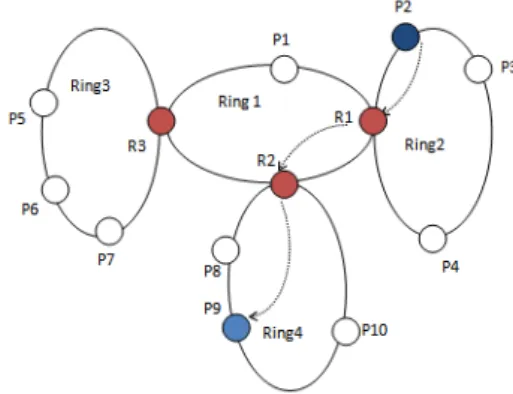
HPM is organized as a set of hierarchical rings composed of nodes, we interested in two types of nodes: relays and peers nodes. Each relay acts as a gateway to one or more rings, and peers are the nodes residing in the various ring. We take as example the scenario below: three relays (R1,
R2 and R3) and four rings as shown in figure 2.
When a peer P2 in ring 2 searches a file that is on peer P9 in ring4, the request (packet) should be transferred through the R1 and R2 relays to get the file that on P9, (the principal detailed of the lookup
and download of resources in HPM is described in (11)), so, how long does it take to lookup and
download a requested resource?, : to answer this question, we must first get query search time, the transmission time of the file being downloaded, and queuing delay at the intermediate relay, the sum of the three quantities provides us the total resource transfer time. For this, in next section, we studied and analyzed each point separately, and we use a queuing model to model relays and the peers and evaluate the total delay to download a requested resource in the HPM architecture.
We use the notations bellow:
• n : number of internal relays in the network. for
each j, j = 1,...,n
• λ0j : expected external arrival rate at relay j
λ0j= [1/E(A0j)]
• C0
a0j : squared coefficient of variation (scv) or variability of external interarrival time at relay j:
C2
a0j = [V ar(A0j)]/[E(A0j) 2]
• µj : expected service rate at relay j: µj =
1/E(Sj)
• C0
S0j: scv or variability of service time at relay
j, C0
S0j = [V arSj]/[E(Sj) 2]
• pij : for each pair (i,j), probability of a packet
going to relay j after completing service at relay i
3.2. Analytical Model of HPM
We focus on the network queuing delays and the delays at the end peers, using a queuing model. We break up the system into two components: the relay nodes, modeled with single class open network, GI/G/1 OQNS, and the end peers modeled with M/G/1/K Processor Shared.
3.2.1. Relay Network Model
In our proposition, we use a decomposition method (13),(14), that consists of decomposing a network relay nodes into smaller sub-networks and then analyzing each sub-network separately which it consist of individual queues. In this approach, a network is approximated as a set of individual isolated GI/G/1 queues. Performance metrics at each queue are computed using approximation formulas for the GI/G/1 queue.
We model each relay nodes by a GI/G/1 to allow for arbitrary arrival and service time distribution. Traffic to a network relay can be rather irregular and does not necessarily follow a Poissonien distribution (15),(16), and may vary from network to another. Given this, we model our network with generalized inter-arrival (GI) process.
To find the relay network delay, we should pass through three steps:
Step 1. Analysis of interaction between relays of the networks,
Step 2. Evaluation of performance measures at each relay,
Step 3. Evaluation of performance measures for the whole network.
Step 1. Analysis of interaction between relays of the networks
Determine two parameters for each relay j:
(i) the arrival rate λjcan be obtained from the traffic
rate equations: λj= λ0j+ n ∑ i=1 λij, f orj = 1, ..n, (1)
where λij = pijλi, is the expected arrival rate at
station j from station i. We also get :
ρj = λj/µj, 0≤ ρj≤ 1, (2)
(ii)the squared coefficient of variation (scv) for the arrival process or variability of interarrival time. The expected (external) departure rate to station 0 from station j is given by :
λ0j= λj+ (1− n
∑
i=1
pij). (3)
Throughput or total external rate of traffic into the relays : λ0= n ∑ j=1 λ0jor n ∑ j=1 λj0 (4) .
The expected number of visits
vj = E(Kj) = λj/λ0. (5)
The s.c.v. of arrival time can be approximated by Traffic variability equation (8):
Caj2 = wj n ∑ i=0 λij λj Cai2 + 1− wj (6) , where wj= 1 1 + 4(1− ρj)2(xj− 1) , and xj = 1 ∑n i=0( λij λj) 2.
Step 2. Evaluation of performance measures at each relay
The expected number of packets in the jth relay,
including one in service, is given by using Little’s law:
E[NCj] = ρj+ λjE[WQj] (7)
The expected waiting time at the jthrelay is given by
E(wj) = ρj(Ca2j + C 2 Sj)g(ρj, Ca2j, C 2 Sj) 2µj(1− ρj) (8) where g(ρj, Ca2j, C 2 Sj) = exp { −2(1+ρj)(1−C2 aj)2 3ρj(Caj2 −CSj)2 } , Caj2 > 1), 1, C2 aj ≥ 1
Step 3. Evaluation of performance measures for the whole network
The total number of packets in the network is:
NC= n
∑
i=1
NCi. (9)
The relay delay per packet:
E[TN r] =
NC
λ0
(10)
3.2.2 The End Peers
The HPM architecture is composed of peers and relays, each relay is attached to a number of rings; in turn harbor the end peer. In the previous section, we provided a queuing delay at the intermediate relay, and in this subsection, we give and develop a queuing model for the end peer and provide expression of the expected time takes to service a requesting resource. We model each end peer as M/G/1/m Processor sharing. The choice of this last is motivated by the fact that, the service time depends on the size of the resource being downloaded and resource size distribution is typically heavy-tailed, so the service time cannot be modeled as an exponential process. For this, we are motivated to choice an arbitrary distributions for the time services and taking generalized model for resource size, and the arrival process follows the Poisson process with rate λdi, since the SCV of the arrival process at the
end peers equals 1, the demonstration of this result is given in (8).
State probabilities pkare given by:
pk= ρ k(1−ρ)
1−ρm+1, Pl= ρ m(1−ρ)
1−ρm+1, ρ = λdiX,ˆ (11)
for k = 0, 1, ..., m. where Pl is the loss probability,
and ˆXis the average service time per request. Using Little’s Law, the expected service time that a user encounters can be expressed as:
E[Np] = λp(1− Pl)E[wp],
E[wp] =
E[Np]
λp(1− Pl)
(12)
E[Np] represent the expected number of resource
transfers in progress at the end peer at any given time, it is given by:
E[Np] = ∞
∑
i=1
ipi (13)
3.2.3. Query Search Time
The expression of query search time is the time taken for the entire search process to terminate; it differs from one architecture to another, depending on the research technique used. In this work, we consider a structured architecture to evaluate this parameter, which is the HPM, so, the neighbor relationship between peers and data locations is strictly defined. Searching in such systems is therefore determined by the particular network architecture. The search technique employed to lookup the requesting resource in this architecture is defined as follow:
Each ring k at level i, used the ith part of data key
for the lookup process, when a peer in ring k if the requestor node belongs to, the request succeeds on this ring k, if the resource does not exist on the active covered ring, the search is done on ring level i + 1, or
i−1, in a deterministic manner the cost of the search
process is O(∑mi=1log2(ni)), where, niis the number
of nodes on the covered ring at level i on which the request succeeded.
The query process terminates when the last of the responses finds it’s way back to the source. The expected time elapsed between the query generation and termination is thus:
E[TQS] = [2C∗ d N
∑
i
(E[WQi] + τi)]/NR, (14)
where [∑Ni (E[WQi] + τi)]/NRrepresent the average
queuing delay at a relay, and [WQi] is given
previously in Eq.(14)
The factor of 2 comes in since the query response traces the same forward path back to the query originator.
C is the cost of the lookup in HPM architecture, and is given by: C = O( m ∑ i=1 log2(ni),
d give the approximate distance for random graph, it represent the shortest path between two random chosen nodes on the relay graph:
d = ln(NR− 1)(ˆz2− ˆz1)− ln(ˆz
2 1) (ln(ˆz2/ˆz1))
,
where ˆzi is the average number of i hop neighbors
graph: ˆ z1= [ NR ∑ i,j=1 Aij]/NR, ˆz2= [ NR ∑ i,j=1,i̸=j IAˆ(i, j)]/NR
Ais the relay adjacency matrix, ˆA = A2and I
A(i, j) defined as: IAˆ(i, j) = { 1, if ˆAij > 0, 0, otherwise
3.2.4. Expected Download Time
We arrived at the expression that gives the total download time of resource, which is the time elapsed from when the query was generated until the entire resource is downloaded, with O(i) copies of the resource in the network, which is generated by the Zipf’s Law :
O(i) = Von/iθHθ(V ),
where Hθ(V ), is the harmonic number of order θ of
V and defined as:
Hθ(V ) = V
∑
i=1
1/iθ.
The given formula in Section 3.2.1. gives us the total time it takes a packet takes to get the customer
E[TN R], so the download time is determined by the
time spent by the last packet sent by the slower peer to reach the destination.
The time when the last packet reaches the edge of the network is when the slower peer is done transmitting it’s allocated resource part i.e. after
E[TW P]seconds. The packet, then spends a further
E[TN R]in the network.
The expected service time for data transfer at the slower peer is:
E[TW P] =
B/O(i) C/E[NW P]
(15)
Bis the total file size,
O(i)number of copies of the resource in the network
E[NW P] is the expected number of files serving at
any point in time
E[NW P] = ∞ ∑ j=0 [ j ∑ i=0 i∗ p(i)]P (m = j) (16)
Thus, the total download time, E[TD], is given by:
E[TD] = E[TW P] + E[TNR] (17)
The final expression for the overall waiting time,
E[T ], gives :
E[T ] = E[TD] + E[TQS] (18)
4. CONCLUSION AND FUTURE WORK
In this paper, we have presented the performance evaluation models for P2P systems, which of these P2P overlay networks is best suited depends on the application and its required functionalities and performance metrics (e.g. scalability, network routing
performance, location service, file sharing, content distribution, and so on).
We have summarized various recent works on performance modeling of such systems that have been proposed in the literature, offering an insightful and useful overview of system properties, focus of analyses and results of each work studying.
A novel analytical model derived from work in (8) is proposed in this paper, it consist of evaluating the performance of structured P2P network, we have take as an example the HPM architecture and as performance metrics the total download time of requested resources.
As future work, we envision to take into account the behavior of nodes and we will study the online-offline transition, which may influence the performance of the system, and especially on the download time of a resource.
Ref. Analytical Method
Architecture Focus of Analyses and Re-sults
Weak points (2) CQMo CIA,DIFA,DIHA Generality, flexibility of
mod-eling,analyze the effect of freeloaders, files and user be-havior.
Not capture the effect of the differences in the file size of different request on the sys performance, access rate and varying load on different peer not modeled, ignore the effect of the network topology. (3) MMo,Bpr DUSy
(BitTor-rent)
Study service capacity and fairness. P2P system achieves favorable scaling in terms of average download delay with increasing load.
Performance of individual user not degrades significantly, the average delays scale well in the offered load Not account for queuing effects and hetero-geneities in the network.
(4) FMo
HFflow
DUSy (BitTorrent-like)
Study the scalability and in-centive mechanism, The sys-tem scales well with the num-ber of peers, the incentive mechanisms are efficient, op-timistic unlocking may encour-age free-riders.
Not account for queuing ef-fects in the network, and heterogeneities in hosts and the network. The assumption about global knowledge of all peers for peer selection
(5) HFMo DSSy
(BitTorrent-like)
Effect of Bandwidth Hetero-geneity on download perfor-mance. Heterogeneity band-width can have a positive ef-fect on content propagation.
Not account for queuing ef-fects in the network.
(8) QMo(OQN) CSy,DUsy,HSy Evaluate the expected time to download a file, accounts for a host of network and peer level characteristics, interplay among various critical pa-rameters (external traffic rate, service variability, file popu-larity...). queue type: router: GI/G/1, Peer M/G/1/K
Do not capture all aforemen-tioned phases of the sharing process, namely flash crowd, steady state. Not account the query search time (propaga-tion delay), not treated the structured architecture.
Table 1: comparative table of various work performance evaluation of P2P systems
REFERENCES
[1] : M. Amad, A. Meddahi, D. A¨ıssani, ”P2P Networks Management Survey”, International Journal of Computer Sciences Issues (IJCSI), Vol. 9, Issue 1, No 3, pp.193 148, January 2012. [2] : Z. Ge, D. Figueiredo, S. Jaiswal, J. Kurose, D. Towsley, ”Modeling peer-peer file sharing systems”, in Proceedings of IEEE INFOCOM, pp. 2188 2198, 2003.
[3] : X. Yang, G. de Veciana, ”Service Capacity of Peer to Peer Networks”, in Proceedings of IEEE INFOCOM, vol. 04, pp. 2242 2252, 2004. [4] : D. Qiu, R. Srikant, ”Modeling and
Perfor-mance Analysis of BitTorrent-Like Peer-to-Peer Networks”, in Proceedings of ACM SIGCOMM, Portland, OR, pp. 367 378, August 2004.
[5] : F. Lo Piccolo, G. Neglia, G. Bianchi, ”The Effect of Heterogeneou Link Capacities in BitTorrent-like File Sharing Systems”, International Work-shop on Hot Topics in P2P Systems, pp. 40 47 , 2004.
[6] : F. Lo Piccolo, G. Neglia, G. Bianchi, ”Perfor-mance evaluation of Peer-to-Peer file sharing systems: analytical models and simulation tools”, Bianchi Infocom 2005 Student Workshop, Miami, FL, USA, March 2005.
[7] : HAN Li, LEI Zhen-ming, ”Modeling structured peer to peer systems”, The journal of China Universities of posts and Telecommunications, Volume 13, Issue 3, pp 76 80, September 2006. [8] : Krishna K. Ramachandran and Biplab Sikdar,
Peer Networks”, in Proceedings of INFOCOM. pp. 215 9 2169, 2005.
[9] : Krishna K. Ramachandran and Biplab Sikdar, ”A Queuing Model for Evaluating the Transfer La-tency of Peer-to-Peer Systems”, in Proceedings of IEEE Transaction on parallel and Distributed Systems, VOL. 21, NO. 3, pp 367 378, March 2010.
[10] : F. Clevenot and P. Nain, ”A simple model for the analysis of the Squirrel peer-to-peer caching system,” Proceedings of IEEE INFOCOM, Hong Kong, China, March 2004.
[11] : M. Amad, ,A. Meddahi, D. A¨ıssani, , Z. Zhangb, ”HPM: A novel hierarchical Peer-to-Peer model for lookup acceleration with provision of physical proximity”, Journal of Network and Computer Applications , vol. 35, Issue 6, pp. 1818 1830, November 2012.
[12] : E. Anceaume, R. Ludinard, B.Sericola, ”Performance Evaluation of Large scale Dynamic Systems”, ACM SIGMETRICS Performance Evaluation Review , vol. 39 Issue 4, pp. 108 117, 2012.
[13] : W. Whitt, ”The Queuing Network Analyzer,” The Bell Systems Technical Journal, 2779-2815, 1983.
[14] : W. Whitt, ”Performance of the Queueing Net-work Analyzer”, Bell System Technical Journal, vol. 62, no. 9, pp 2817-2843, Nov. 1983.
[15] : W. E. Leland, M. S. Taqqu, W. Willinger and D. V. Wilson, ”On the self-similar nature of Ethernet traffic (Extended Version),” IEEE/ACM Trans. on Networking, vol. 2, no. 1, pp. 1-15, Feb 1994. [16] : V. Paxson and S. Floyd, ”Wide area traffic: The
failure of Poisson modeling,” IEEE/ACM Trans. on Networking, vol. 3, no. 3, pp. 226-244, June 1995.