H»'"
Digitized
by
the
Internet
Archive
in
2011
with
funding
from
HB31
.M415
|J><
oi-Ml
Massachusetts
Institute
of
Technology
Department
of
Economics
Working
Paper
Series
THE
COSTS
OF
WRONGFUL-DISCHARGE
LAWS
David
H.
Autor
John
J.Donohue
IIIStewart
J.Schwab
Working
Paper
02-41
November
18,2002
Room
E52-251
50
Memorial
Drive
Cambridge,
MA
02142
This
paper
can
be downloaded
without
charge from
the
Social
Science
Research Network
Paper
Collection
atThe
Costs of
Wrongful-Discharge
Laws
David
H.
Autor
MIT
Department
ofEconomics
and
NBER
John
J.Donohue
IIIStanford
Law
School
and
NBER
Stewart
J.Schwab*
Cornell
Law
School
November
18,2002
Revised
from
July
200
1
Abstract
We
estimate the effectson
employment
and
wages
of
wrongful-discharge protectionsin theUnited States.Over
thelastthreedecades,most
U.S.statecourtshave
adoptedoneormore
common
law
wrongful-dischargedoctrinesthat limitemployers' discretiontoterminateworkersat-will.
Using
thiscross-statevariationwith a difference-in-difference
framework,
we
findrobustevidenceofamodest
negativeimpact(-0.8to-1.6 percentagepoints)of
one
wrongful-dischargedoctrine,the implied-contract exception,on
employment
topopulation rates in statelabormarkets.The
short-term impactismost pronounced
forfemale,younger,
and
less-skilledworkers,whilethelonger termcostsappeartobebome
by
olderandmore-educated workers
-
thosemost
likely tolitigateunderthis doctrine.We
findno
robustemployment
orwage
effectsoftwo
otherwidely recognized wrongful-dischargelaws: thepublic -policyand
good-faithexceptions.Publishedfindingsintheliteraturerange
from
no
effect toverylargenegativeeffects.We
reanalyzethe
two
leading studiesand
findthediscrepanciescan be explainedby
methodological shortcomings inthe onecaseand
limitations inthecodingof key
courtdecisionsinthe other.We
areindebtedtoJoshuaAngrist,DavidCard,LawrenceKatz,AlanKrueger,Thomas
Miles,Andrew
Morrissandseminarparticipantsatthe
NBER
LaborStudiesSummer
Institute,UC
Berkeley,NYU
Law
School, StanfordLaw
School,andtheAmerican
Law
andEconomicsAssociationforexcellentsuggestions.We
gratefullyacknowledgetheexcellentresearch assistanceof Rashida
Adams,
Michael Anderson,SimoneBerkowitz, SarahBernett,DouglasBosley,CraigEstes, RoseFrancis, ScottHemphill, Carolyn
Heyman,
Joshua Linn,JoshuaMayes,Marci Reichbach,What
isthe priceofprotection?Thispaperestimates thesocial costs, in termsofpotentially loweremployment
and
wages,ofcommon
law
effortstoprotectAmerican workers from
wrongful-discharge.The
costof
employment
protectionisa controversial issue. Itisvirtuallyreceivedwisdom
thatthe stagnantemployment
performance ofmany
European economies
duringthe 1980sand
1990s-
'Eurosclerosis'-
canbe
attributed tothe significantemployment
protectiongivenEuropean workers
(cf,Lazear, 1991;Blanchard
and
Wolfers, 1999).According
to this argument,employment
protectionisa double-edgedsword. Itprovides
employment
securitytoincumbent
workersbutmakes
employersreluctanttohire,leadingtoa stagnant labor
market
withpotentially loweremployment
and
wage
levels.Among
theobstaclestotesting thishypothesis isthedifficulty inobtaininghighqualitydata forcross-country
comparisons.
Inthispaper,
we
studytheimpactsof
employment
protection in theU.S. setting. Several scholarshave
examined
the effectsofAmerican
federalemployment
lawson
employment
and
unemployment.
Acemoglu
and
Angrist (2001)and DeLeire
(2000)presentevidencethattheAmericans
withDisabilitiesAct
decreasedemployment
ofdisabled persons.Oyer
and
Schaefer(2000, 2002) concludethatthe federal CivilRightsAct
of
1991 increased thefrequencyofmass
layoffsand
raised the returnstoexperienceforworkerswho
have
adownward
sloping'age-litigation' profile.Harm, Todd,
andvan
derKlaauw
(2001)also evaluatethe costsof
federalanti-discriminationlaws.A
major
hurdleforeach ofthese studies isthatthe federal statutesatissueapplyall atoncetotheentirecountry. Itisdifficulttoseparate theeffects
of
thestatutefrom
all otherchangesoccurringatthattime(cf,
Donohue,
1998;Donohue
and
Heckman,
1991).Thispaper
overcomes
some
ofthesemethodological challengesby
evaluatingemployment
protectionsthat arise invariousU.S.statesatvarious times, thusprovidinggreater variationwith
which
tomore
accurately establish causalrelationships.
The
UnitedStates,uniquely intheindustrialized world,has longhad
alegal presumptionthatworkers can be fired "atwill"-
thatis, forany
timeand
forany
reason,good
or bad. Inthelast
two
tothreedecades,however,most
state courtshave
adoptedone
ormore
common
law'wrongful-discharge' protectionsthat
weaken
theemployment-at-will presumption. Statesvarygreatlyinand
Rhode
Island-
have
neveralteredtheemployment
atwill doctrine.Ten
statesnow
recognize eachof
threebroadclassesof exception totheat-will doctrine:theImplied-contract, Public-policy,
and
Good-faithexceptions(theirprecise
meaning
isdefined below).A
few
stateshave
rejected prioradoptions(seeAppendix
Table 1). Thisvariability inthe extentand timing ofstates'recognition of wrongful-dischargelaws allows forempiricaltestingoftheirimpacts
on
employment
and
wages.We
arenot thefirsttoexploretheseeffects.In a widelycited lineofresearch, Dertouzosand
Karoly(1992
and
1993) used aninstrumental variablesframework
totestwhether
wrongful- discharge lawsaffected state-level
employment.
They
found
surprisingly large impacts.Dertouzosand Karoly
estimatethatstatesadoptinga tort-based causeofaction(thatis,
one
inwhich
plaintiffsmay
sueemployers
forpunitivedamages)
suffered a 3 percent reduction inaggregate stateemployment
-
roughlyequivalenttoa10
percentemployer
sidetaxon
wages
-
with anadditional 1 or2percentemployment
declinefor states alsoadoptinga contract-based protection(that is,
one
inwhich
plaintiffsmay
sue onlyforeconomic
losses).2
These
findings
have
notgone
unchallenged.Morriss (1995)criticized Dertouzosand
Karoly's legal variables.More
recently,Thomas
Miles (2000) used adifferences-in-differences approachtoestimate theimpactof
thewrongful- dischargedoctrines.
He
reports"no
statisticallysignificant effectson
eitheremployment
orunemployment,"
butdoes notcomment
on
thesourceof
the discrepancybetween
hisfindingsandthoseof
Dertouzos
and
Karoly.3Our
paperjoinsthisdebateattwo
points.First,we
provide acomprehensive
reevaluationoftheimpacts1
To
date,onlyMontana
(in 1987) has passeda statuteestablishingagood-causestandardforallemploymentterminations. All otheremploymentatwillexceptionsare
common
lawdoctrines,i.e.,case law. In 1991, theUniformLaw
Commissioners proposedaModel
Employment
TerminationActsimilartotheMontana
statute,butnostatehasyetadoptedit. In 1996, theArizonalegislaturepassed astatuteaffirmingemploymentatwill. Krueger(1991) provides
aperceptiveeconometric study oftheconsiderationof exceptionstothe doctrineofemploymentat willbystate legislatures.
2
Dertouzos and Karoly (1988)earlierexaminedthedirectcostsof wrongful-dischargelitigation inCalifornia.They
foundthesedirectcoststobemodest,amountingtosome $100per termination.SeealsoDertouzosand Karoly (1992;
p. xi)(presenting findingsof 1988study). 3
Inrelatedwork,Kugler andSaint-Paul(forthcoming)findthat a state'sadoptionof wrongful-dischargedoctrines significantlyslowsthejob-to-jobflows ofunemployedrelative toemployedworkers.Autor(2003 forthcoming)and
Miles (2000)findthatemployersincreased
demand
fortemporary helpagencyemploymentwhen
states adoptedof
wrongful-dischargedoctrineson
employment
and
wages
usingricher dataand
(we
believe) amore
complete coding ofthe case
law
than previouswork. Second,we
evaluatewhy
the leading paperson
thistopic
have
reachedopposing conclusions-
rangingfrom
no
effect tovery largenegativeeffects-
and
provide a reconciliationofthese findings.
As
withthe Milesand Dertouzos
and
Karolystudies,ourkey
explanatoryvariables are theprecedentsetting casesthatestablish thewrongful-discharge laws recognizedineachstate
and
timeperiod.We
differfrom
previousstudies, however,by
usinglegaland
employment
dataobservedatmonthly
intervals,by
measuring
wage
aswell asemployment
impacts,and
by
exploringtheseimpactsseparatelyby
educationand
genderdemographic
subgroups overthenearand
longerterm.We
applyrobustestimationtechniquesthroughout
and
testtheconsistencyand
generalityof ourfindings across specificationsand
timeperiods.Although
we
had
anticipatedthatourreanalysiswould
reconfirmthenullhypothesis acceptedby
Thomas
Miles,we
instead findamodest
but robustlynegativeimpactof one
wrongful-dischargedoctrine-the Implied-contractexception
-
on
theemployment
topopulationrate in statelabormarkets. Thisimpact,which
averages-0.8to-1.6percent,ispresentforal educationand
gendergroups,andis detectableamong
statesadoptingatseveral timeintervalsduringthesample.
The
shortterm impactismost pronounced
forfemales,and
younger and
less-educatedworkers.In thelongterm,however,the costs ofimplied-contractprotection appeartobe borne
by
olderand
more-educatedworkers
-
thosemost
likelytolitigate.We
alsofindsome
evidencethattheGood-faith exceptionreducedstateemployment
levelsby
asimilarmagnitude,butthis evidenceisfar lessrobust. Finally,
we
findthatbothdoctrines (Implied-contractand
Good-faith)
have
aweakly
positive associationwithwages
-
thatis,observedwages
ofemployed
workerstendtorise
by
0.5to 1.5percentagepointsafteradoption ofthese doctrines.One
interpretationof
thisfindingisthat
employment
protection strengthensworker
bargaining power, leadingtohigherwages
and
lower
employment
levels(cf.,Blanchard
andPortugal, 2000).However,
amore
parsimonious explanationthat
we
favor-
and
providesome
evidencetosupport)-
isthatthe negativeemployment
impactsof
thewrongful-discharge lawsareborne
by
thelowest-wage workerswithingivendemographic
groups, leadingTo
reconcile thesubstantialdiscrepanciesbetween
ourfindingsand
the priorliterature,we
reanalyzethe
work
ofDertouzos andKaroly
(1992)and
Miles (2000).We
find thattheexceedinglylargedisemployment
effectsestimatedby
Dertouzosand Karoly
-
threeto fivetimesthemagnitude
of ourestimates
-
appeardrivenby
problematicinstrumental variablesthatare spuriously correlatedwithregionalemployment
trendsthat substantiallypredate states' adoptionof
wrongful-dischargelaws.By
contrast,thedifferences
between
ourfindings andthoseof
themethodologicallysimilarMiles'sstudyareprimarilyexplained
by
discrepanciesinthecoding ofkey
courtcases.By
making
warranted modificationstotheseanalyses,
we
demonstratethatthese priorresultsmay
bereconciledwith ourown.
I.
Wrongful-discharge
laws
A.
Common
law
exceptionstoemployment
atwill:Definitionand
legal significanceSincethe
heyday
ofemployment
atwill inthe early partof
the20
thcentury,legislaturesand
courtshave
restrictedemployers' discretiontoterminate
workers
at-willinseveralways.Broad
federal statutesprohibitemployers
from
firingworkerson
the basisof
unionactivity,race, color, religion, sex, nationalorigin,age,ordisability. Specific federal
and
statestatutespreventemployers
from
terminatingworkersfora varietyofpreciselydefined impermissiblereasons, suchastoavoidpensionbenefits
from
accruing, orto retaliatebecause a
worker
reportedoccupationalsafetyand
health violations orservedasajuror.5Inadditiontothese statutoryrestrictions, statecourts
have
overthelast30
years substantiallymodifiedthe
employment
at-willdoctrine.These
modifications,which
we
refer toaswrongful-dischargelaws, arecommonly
classified inthree categories: (1)thetortof wrongful-dischargeinviolationofpublic -policy('Public-policy exception'); (2)theimplied-in-factcontractnottoterminatewithout
good
cause(Tmplied-contract exception');
and
(3)theimpliedcovenanttoterminateonlyingood-faithand
fairdealing('Good-National LaborRelationsAct§ 8(a)(3),29U.S.C. §158(a)(3)(enacted 1935)(prohibitingdiscriminationonthe basis
ofunionstatus); TitleVIIofthe CivilRightsAct of1964,42U.S.C. §§2000e to2000e-17 (prohibitingdiscrimination
onthe basisofrace,color, sex, religion,ornationalorigin);
Age
DiscriminationinEmployment
Actof1967,29U.S.C.§§621-634;AmericanswithDisabilitiesActof 1990,42U.S.C. §§ 12101
-
12213.EmployeeRetirementIncomeSecurityActof1974 § 510,29U.S.C.§ 1140(prohibiting discriminationagainst
employeesbecause theymightobtain benefitsinapensionorwelfareplan);OccupationalSafetyand HealthActof
1970§ 11,29U.S.C. 660(c) (prohibiting discrimination againstemployeesexercisingrightsunder
OSHA);
New
Yorkfaith exception').
We
define these inturnanddiscusstheirsignificance.As
of1999,allbutsevenstatesrecognized thetortof wrongful-discharge inviolation ofpublic-policy.Classic violationsofthis 'retaliatorydischarge' doctrine includefiringaworkerforrefusingtoperform an
illegal act, suchas perjuringhimself
on
behalfof
thecompany;
forexercising a statutoryright, suchasfilingaworkers'
compensation
claim; orforperforming a public obligation,suchas servingon
ajury.As
Schwab
(1996)discusses, courtstendtoapply thisexceptiontotheat-will doctrinewhen
theterminationclearlyaffects third parties,therebyjustifyingthe judicial interferencewiththeat-will
employment
contract.Successfulplaintiffscan recover
compensatory
damages
for lostearnings, aswell asdamages
forpainand
suffering,
and
punitivedamages
inappropriate cases.Because
thepublic -policyexceptioniswidely recognized (43 states)and
providesforfullcompensatory
andpunitivedamages, itissometimes
viewed
as themost
significantexception tothe at-willdoctrine. Inpointoffact,however,successful public-policy
cases-
particularlythose withmulti-million-dollar
judgments
-
arerare, albeithighly publicized.The
reasonfor their rarityis thatcourtshave
typicallylimited thescopeofpublic -policycasestoclear violations of expresslegislative
commands
(e.g., thedutytoperform juryservice, theright to fileaworkers'
compensation
claim) ratherthanviolationsofavaguersenseofpublic interest.
Some
legal scholarshave
argued accordinglythatthe attention giventhisdoctrineinthepopular
and
businesspressexceedsitslegaland
economic
significance (seeEdelman
et al 1992).Only
1 1 statesnow
recognize aseconddoctrine,thecovenant ofgood-faithand
fairdealing.6A
classicillustration ofthis exception isthecase of
Fortune
v.NationalCash
Register Co. inwhich
theemployer
firedasalesperson
who
had
completed a substantial salejustbeforehiscommission
was
due.The
courtruledthatthe
employer
had
deprived theplaintiffof
the"benefitofhisbargain"inbad
faith. Likethepublic-policyexception, the good-faith doctrine
could have sweeping employer
consequences. Initsbroadestform,thisexceptioncan beread as a general prohibition againstterminating
any worker
forany
reasonotherthan 'justcause'
-
thatis,economic
necessity orpoor performance.Most
courts,however,have
limited application ofthegood-faith exceptiontogrossly unfair 'timing' casessuch asFortune,where
thetermination deprives the
worker
ofaspecificpromised
benefitsuchasasalescommission
oranimminently-vestingpension.
Hence,
the onusof
thisdoctrineisprobablysomewhat
lessthanwas
originally anticipated
by employers and
legal scholars.Finally,43 statesrecognize athirdexception to
employment
atwill,theimplied-contract doctrine. Thisexceptionarises
when,
throughwords
oractions, anemployer
implicitlypromises nottoterminate aworker
without
good
cause.A
landmark
decisionestablishingthisexceptionwas
the1980
caseof Toussaintv. BlueCross
&
BlueShield, inwhich
theMichigan
Supreme
Court heldthatan
employer'sindirectstatementsaboutthe
manner
inwhich
itmade
termination decisionscancreatelegallybindingemployment
contracts9InToussaint, theplaintiffsuccessfullysuedforbreach ofcontract
by
citinganinternalpersonnelpolicyhandbook
indicating thatitwas
Blue
Cross'spolicytoterminateemployees
onlyfor justcause.Although
Toussaint
was
unaware
ofthehandbook
when
hired,thecourtheldthatthehandbook
impliedabindingcontract. Courtsin
23
otherstatesissued similardecisionsoverthenext5 years.An
equallyinfluential 1981 Californiacase,Pugh
v.See'sCandies, furtherexpanded
theimplied-contractnotion
by
findingthatworkersareentitledtoongoing
employment
evenintheabsenceof
writtenstatementsifcontractualrights areimplied infactthroughthecontextofthe
employment
relationship.10Thiscontext
may
include longevity ofservice,a history ofpromotion
orsalary increases, generalcompany
policies asexemplified
by
treatmentof
otheremployees,or typical industrypractices. Cumulatively, thesecourt decisionsgeneratedsubstantialuncertaintysurroundingtermination, resultingin
numerous
cases7
364 N.E.2d 1251 (Mass. 1977). 8
WhileFortunedidnotreachtheissue,
some
statecourtsallowtortdamages(including punitive) forbreachesofthegood-faithcovenantinemploymentcontracts.Duringour period ofstudy,Californiarecognizedabroadersetof
good-faithobligationsthatishardtodistinguishfromageneral obligationnottofirewithoutgoodcause.Theleading CaliforniacaseisFoleyv.InteractiveDataCorp.,765P.2d373 (Cal. 1988),inwhichabank employee wasfiredfor reporting toupper
management
thattheFBI wasinvestigatinghisimmediatesupervisorforembezzlement fromaprioremployer.Thecourt declaredthesefactscouldamountto abreachofthecovenantof good-faith andfairdealing, but
heldthatonlycontractdamages,notfulltortdamages,wererecoverable. In
Guz
v.BechtelNational,Inc., 8P.3d 1089(Cal.2000),afterourperiodofstudy, thecourt restrictedgood-faithclaimstothoseliketheFortunecase.
9
292 N.W.2d. 880(Mich. 1980).
10
where
courtsfoundthatemployees
heldimplied-contractualemployment
rights thatemployershad
notsubjectivelyintendedto offer.
The
employer
costsofthe implied-contractexception are difficult to assess,however. Sinceimplied-contractcases leadonlytocontractual
damages
(e.g.,punitivedamages
are excluded), thethreatofaspectacularjury
award
islow. In addition, anemployer
canpotentially insulateitselffrom
implied-contractclaims
by
rewritingemployment
contractsand
handbooks
toclearly state thatallemployment
contracts areat will.
'
'
However,
unlike thepublic-policyand
good-faithdoctrines,which
penalize individual instances ofunethical
employer
behavior, theimplied-contract doctrinecan pervasivelyaffectan employer's personnelpractices.
By
imbuing employer
handbooks
withthestatusoflegal contracts,theimplied-contract doctrinehasthe potentialto reclassifyan employer's entireworkforceas notatwill,causingthe
employer
to alterhow
ithandles allhiringand
firingdecisions.Unfortunately,
no comprehensive
dataexist onthenumber
oroutcome of
wrongful-discharge casesunder
these three doctrines.Two
findings intheliteraturesuggest,however,
thattheimplied-contractexception
may
havealteredemployers' hiring practices (leaving asidetemporarilythe Dertouzosand
Karoly
analysis, towhich
we
returnbelow). First,Miles (2000)and
Autor
(2003)findthatemployerssubstantiallyincreasedtheiruse
of temporary
helpagency
workersshortlyafter theirstatesadoptedimplied-contract exceptions.Second,
Kugler
and
SaintPaul(forthcoming)findthatthe hiringodds ofunemployed
workers declinedaftercourtsintheir statesrecognizedtheimplied-contract exception.Though
neither
of
theseresultsspeakstothecoreof ouranalysis-
theimpactof
these doctrineson
employment
and
wages
levels-
theydo
indicatethatemployers
were aware
oftheimplied-contractexception(ataminimum)
and
took stepstomitigatelitigationrisks. 13Itremainsacomplexlegalquestion,however,whether anemployerthatonceissuedahandbookorotherpromise of
jobsecuritycanmodifyittocreateat-willemployment. Several courtshaveheldthatsuchunilateralchangesbythe
employerarenotbindingonincumbentemployeesthathave previously received promises of jobsecurity.
Nor
wouldthiscaseloaddataprovideacompletemeasureoftheeconomiccosts of wrongful-discharge lawssincetheobserved caseloadisanequilibriumfunctionofemployerdecisionstoavertorsettlesuits(supply)andemployee
incentivestofilesuits(demand).
We
attemptedtotestwhether adoption ofawrongful-discharge exceptionbyastateincreased thenumberoflawB.
Hypothesized
effectson
thelabor
market
As
discussedby
Lazear (1991)and
Blanchard andKatz
(1997), thetheoretical impact offiringrestrictions
on
employment
levelsisambiguous.
Ina frictionless labormarket withcostless courts,theCoase theorem
applies. Impositionof employer-sidefiringcosts arefullyundone by
efficientworker-firmbargains, suchas the posting
by
workersof
abond
equal to firing costs.Where
theCoasean
resultdoesnothold,firingrestrictionsreduceemployers' incentivesboth to hire
new
workersand
fireincumbent
workers(Donohue,
1989). Accordingly,firingrestrictionsdampen employment
fluctuations,which
may
raiseorlower
employment
levels intheshortterm.Over
thelonger term,ifemployment
protectionraisesemployment
costswithoutyielding correspondingproductivity increases,employment
levelsand/orwages
arelikely to fall. Thisisparticularlytrueifwrongful-dischargelaws encouragerent-seekingbehavior
by
employees
orinduce employersto retainunproductive workersdue
to fearoflitigation.Not
all (non-Coasean)employment
protectionadverselyimpactslabormarket
efficiency,however.Employment
protectioncan beusefullyviewed
asamandated
employment
benefitthat,while costlyforemployerstoprovide,isalsovalued
by
employees (Summers,
1989).By
raisingemployer
costs,mandated
employment
protectionshiftslabordemand
inward.But
tothedegree thatworkers
valuethemandated
benefit,laborsupply simultaneouslyshiftsoutward,
muting
theadverseemployment
impact. Ifemployees
valuethe benefitatitsfullmarginalcost,wages
will intheoryfall tocoverthe costof providing the benefitand
employment
levels will beunaffected(see, forexample, Gruber, 1994).While
the overallimpact oferosionsoftheat-willdoctrineon
employment
orunemployment
isnotclear apriori,existingevidence suggeststhattheimpact
may
differfor differentgroupsof workers. SeveralBecause
much
ofthese datahadtobe hand-coded,we
wereonly abletoobtain dataonthreeyears(1979, 1985,and1992-93).
We
foundthattheadoptionofthegood-faithexceptionbyCaliforniaandMontana,generallyregardedas thetwostatesmostaggressivelyerodingemploymentatwillduringthisperiod, significantly increased the shareofemploymentspecialtiesinthosestatesrelative tobothallpracticesandtotaxspecialities. Perhaps because ofthe crudityofthemeasuresandthefewyears,
we
wereunabletodetectconsistent patternsinotherstatesorforthetortor implied-contract exceptions. Detailsandtables areavailablefromtheauthorsuponrequest.Moreover,asseveralauthorshaveargued, thepresenceof adverseselection inthelabormarket
may
causeemployerstoprovideinefficientlylowlevels ofjobsecurity(Aghionand Hermalin, 1990; Levine, 1991).Imposition
offiringrestrictionscouldthereforeraiseemploymentwhilereducing wages. Thiswouldcorrespondto acasewhere
authorsfind thatthe
employment
of younger, less-educatedworkers
appearsmost
likely tobeharmed
bywrongful-dischargeprotections, whileolderand
more-educated
workers appeartobenefit(OECD,
1999,Chapter2; Jolls,2000; Bertola,
Blau
and
Kahn,
2002).We
examine
these disparateimpactsindepthbelow
and
findimportant differencesby demographic group which depend on
thetime horizon examined.II.
Data
sources
and model
specification
A.
Data
sourcesTo
measure
employment
andearnings,we
draw on
thecompleteCPS
monthly
filesfortheyears 1978to 1999.
These
files provideindividual labor-forcedata forapproximately 100,000adultspersurveymonth
and
alsocontainwage
data forone-quarteroftheemployed
sub-sample beginningin 1979.'5
We
calculatethe
employment
topopulationratio (oritslog)andmedian
loghourlyorfull-timeweekly
wages
of
currently
employed
workers foreightdemographic
groupsineachstateand timeperiod:two
genders,two
education groups (highschoolorless,
some
college ormore), andtwo
age groups(18-
39,40
-
64).16
To
maximize
usable variationinthetimingofthe adoptionof wrongful- dischargelaws,we
code
thelegal
and
employment
variables atmonthly
frequency, aswas
done
by
Morriss(1995).Hence,
iftwo
statesadopta wrongful-dischargedoctrine 11
months
apartwithinthesame
calendaryear,ourestimatesaccurately accountfor thissubstantial differenceintiming.
Because
theoutcome
data areobservedathighfrequency, serial correlationis a
major
concern.Followingtherecommendations
ofBertrand,Duflo
and
Mullainathan(2002),
we
applyHuber-White
robust standarderrorsclusteredby
statethroughout.17These
allowfor arbitrary errorcorrelations
among
observationswithin states, bothover timeand
among
demographic
groups.For
ourlegalvariables,we
developedataxonomy
of wrongful-discharge lawprevailingineachstateIndividuals
may
appearuptofourtimesinone calendar yearintheemploymentsample(notthewage
sample),thoughtheirlabor forcestatus
may
differoneachoccasion.Our
estimationproceduretakesaccountofpotentialserialcorrelation
among
observations withineachstatesample.Becausethewage sampleislessthanonequarter thesizeoftheemploymentsample,
we
usemedian wagestoreducetheinfluenceofoutliers.Resultsusing
mean
wagesinsteadare,however,quitesimilar.Except inTable4, inwhich
we
provide disaggregatedestimatesbyadoptercohorts,inwhichcasethere arerelativelyfewstateclusters.Here,
we
cluster thestandard errorsbystatefor contiguous time periodsbutassumeand
month-
yearforthetwo-decadeperiodfrom
1978to 1999.As
Morriss (1995)discusses, itisnot alwayseasytodate
when
astatehasadopteda particularat-will exception.Our
objective is easily stated,however.We
envisionmanagement-side
employment
lawyers readingtheadvance
sheets andwritingawarenesslettersto their clients
when
major
changes occurinthecommon
law. Thus,we
are interested inthefirstcourtdecisionin astatethat
would
triggeraclientletterwarning
aboutalaw
change. Inpractice, ourindependentassessmentofthelegal doctrinesin this areaforthe
50
states largelyagreeswith Morriss's listof
relevantcases,althoughwe
had
toupdatethelistthroughthe 1990s.18
InSection
V,
we
testthesensitivityof our conclusions
by employing
classificationsdevelopedby
Dertouzosand Karoly
(1992),Morriss(1995), and
Walsh
and Schwarz
(1996)-
thelastusedby
Miles(2000).B.
Model
specificationBecause
thecommon-law
wrongful-dischargedoctrineswere
adopted indifferentmonths and
yearsby
most
U.S.states duringthe1980s
and
1990s,we
have
potentiallymany
'experiments'to exploit.Our
empirical approachistocontrastthe
change
inemployment
and
wages
ofdemographic
subgroups withinstatesadoptingagiven wrongful- dischargedoctrineina given periodto statesnotadopting
any
doctrineduringthe
same
timeperiod.To
implement
thisdifference-in-difference design,we
needtoselecta'before'and
'after'period forpre-postcomparisons.
Although
we
could usetheentire 1978-
1999
panel tocalculatethese contrasts foreachstate,thisapproach has
two
disadvantages.First, becausestatesadopted exceptionsasearlyas1979
and
as lateas 1998, thelong panel approachimpliesthatforsome
states,observationsfrom
19yearsbeforeorafteradoption
would
be usedtoform
apre/postcontrast.Thisisunappealing. Second,thelong panelapproachexacerbates the serialcorrelation issuenoted above.
To
mitigate these issues,we
primarilyuseafive-year pre-post
window.
The
24
calendarmonths
priortoadoptionof
a doctrine aredesignatedasthepre-period;
months
13 to36
following adoptionare designatedas the post-period;and
thefirst 12months
immediately following adoptionare excluded
from
thesample,toallowforan adjustmentinterval.We
Although
we
usethe three-partdivisionoftheat-willexceptionsinthebodyof ouranalysis,we
exploredtheexplore thesensitivity of ourresults to this setof choices below.
To
form
acontrolsample
of non-adoptingstates,we
include themaximal
setof state-monthobservationsforcorresponding calendar
months
(roundedtothenearestcalendaryear) for states thatdidnotadopt
any
ofthe three doctrines duringthe relevant pre/post treatmenttime interval.Note
that thisdesignimplies
some
statesserve as treatmentstates inone
periodand
controlstates inanother, althoughneverwithin a five-year
window
surroundingtreatment.The
basiceconometricmodel
thatwe
estimateis(1)
Y
a=a
+
P,L
s+
P
2Post„+
y
Postsl -Ls+
es,,where
Y
sl isemployment
or earnings forademographic
groupin state 5and
timeperiod t,L
tisa
time-invariant
dummy
variableequal tooneifa statewill adopta given exceptionduringthe pre/postsample
interval
and
Posta is adummy
variableequal toone
inmonths
13 to36 followingadoption.The
coefficientofinterest, y,is anestimate
of
thepre-postchange
intheoutcome
variableinadoptingstatesrelativeto thecorresponding
change
innon-adoptingstates. All estimates areweighted by
thesum
of sample weightsin the state-year-month-demographiccell,reflectingtheestimatedcountof U.S. residentsoremployed
personsinthecell foremployment
and
earningsrespectively.We
enrichthisbasicmodel
inthree ways.First,inplaceofthecommon
main
effectand
pre-treatmentindicators
(a and
L
s),
we
add
main
effectsforeachstateand
their interactionswithatreatment indicator variable. Second,tonon-parametricallyaccountforcommon
national shockstoemployment
overalland
by demographic
group,we
also includedummy
variablesforeachmonthly
calendartimeperiod interactedwithindicatorvariables foreachoftheeight
demographic
groupsin thesample.20Finally,to accountforcommon
regionalshockstoemployment,
we
alsoestimatemodels
thatinclude interactionsbetween
calendar-year
dummies
and
indicator variablesdenotingthenineCensus
geographic regions.With
theserelevant or empirically robust. Supplementaltables are availablefromtheauthorsonrequest.
Ifa stateservesinboththecontrolandtreatmentgroupsin agiven model,
we
alsoincludea statextreatmentdummy
equaltooneinthe24monthsimmediately precedingtreatment.regioncontrols included, the parameter
y
isidentified onlyby
thecontemporaneous
contrastinemployment
orwage
outcomes
in adoptingversusnon-adoptingstates located inthesame
geographicregions.
III.
Impacts
on
employment and
earningsBeforeestimatingequation(1),
we
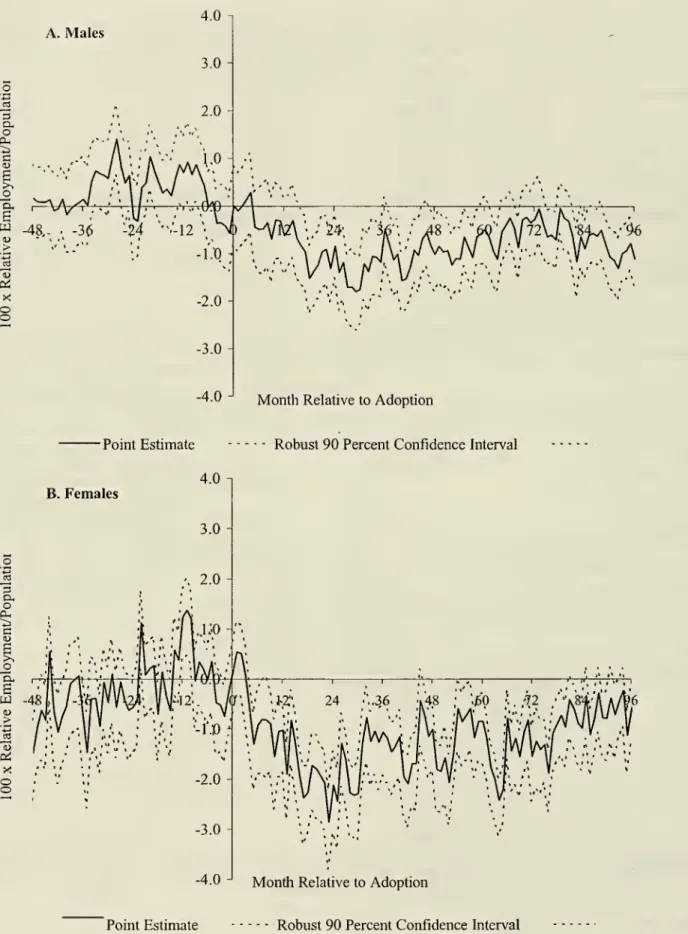
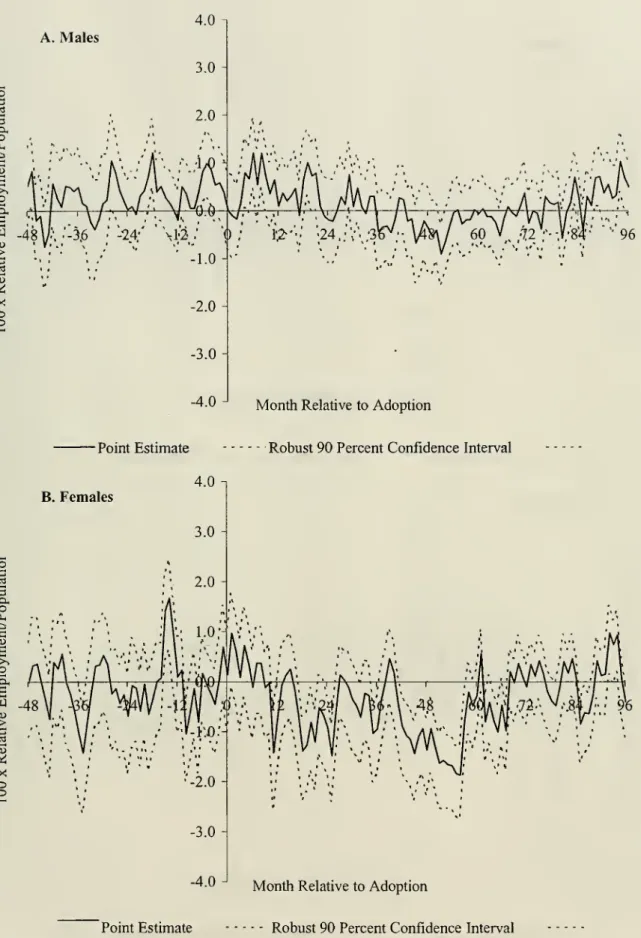
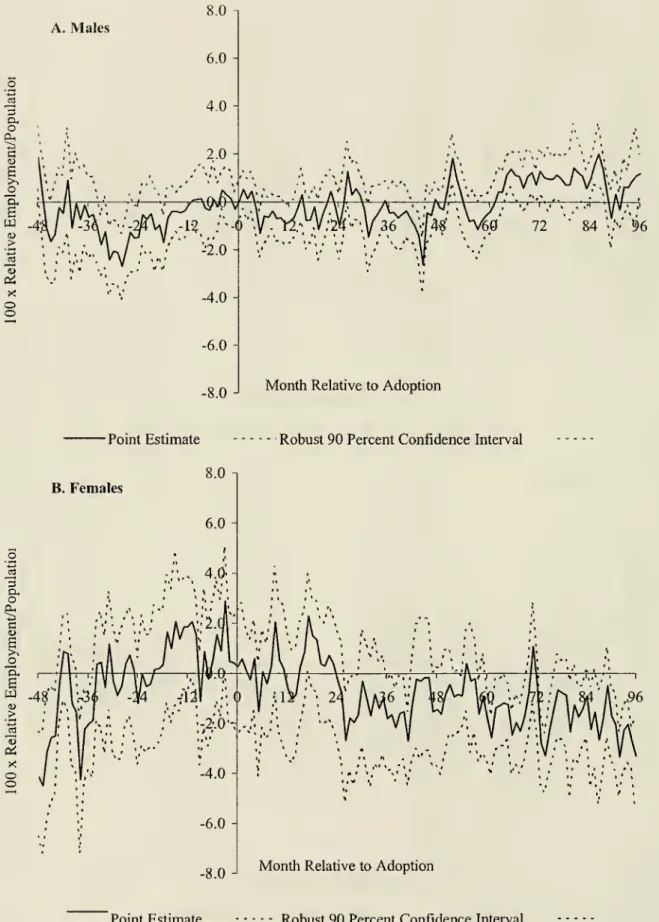
providea visualsummary
of
thedatainFigures 1 through6.These
depictestimatedlog
employment
topopulationrates(Figures 1-
3)andlogmedian
wage
levels(Figures4
-
6)in adoptingrelative tonon-adoptingstatesatmonthly
intervals inthe48
months
priorthrough96
months
following adoptionof eachdoctrine.Wage
and
employment
levels inthefirstfullmonth
followingadoptionare normalizedatzero. 21
The
dashed
lines ineach figurerepresentrobust90
percentconfidenceintervaIsforeach
monthly
point estimate.These
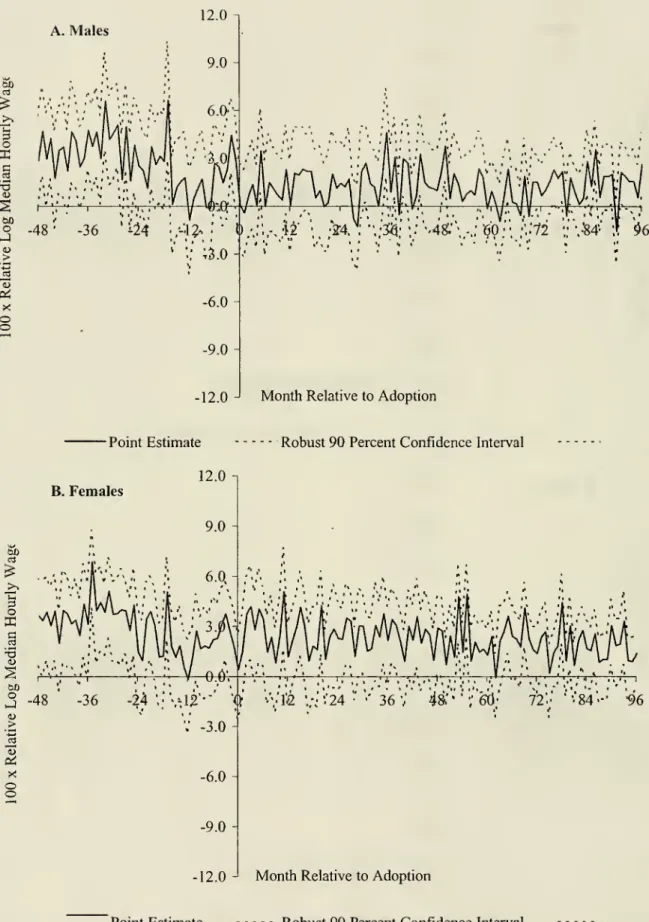
figuresprovideinitial evidencethatone
wrongful-dischargedoctrine, theimplied-contractexception,didindeed affect state
employment
levels.As
isvisible inFigure 1,relative(log)employment
topopulationratesforbothmales
and
femalesdipby
approximately 1.5to2percentoverthe2yearsfollowing adoption
of
theimplied-contractexception,reaching anadirafterapproximately30
months.By
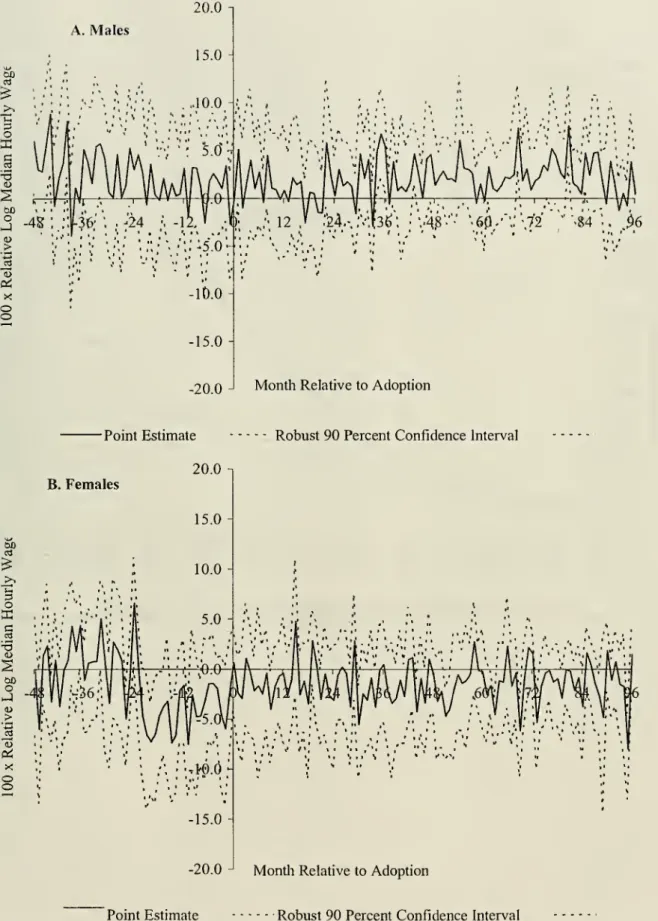
contrast,Figures2
and
3providelittleevidencethatthe public -policy or good-faithexceptionsaffectedemployment.
One
cannotmake
stronginferencesfrom
thesefigures,however.As
isvisiblefrom
thewide
standard-errorbands, the
monthly
point estimates arerelativelynoisy. Inaddition,thesemodels do
notinchde
thefullsetofcontrolsthatwe
(later)useforestimatingequation (1).Nevertheless, theformalanalysis
of
employment
below
largelybearsout theimpression givenby
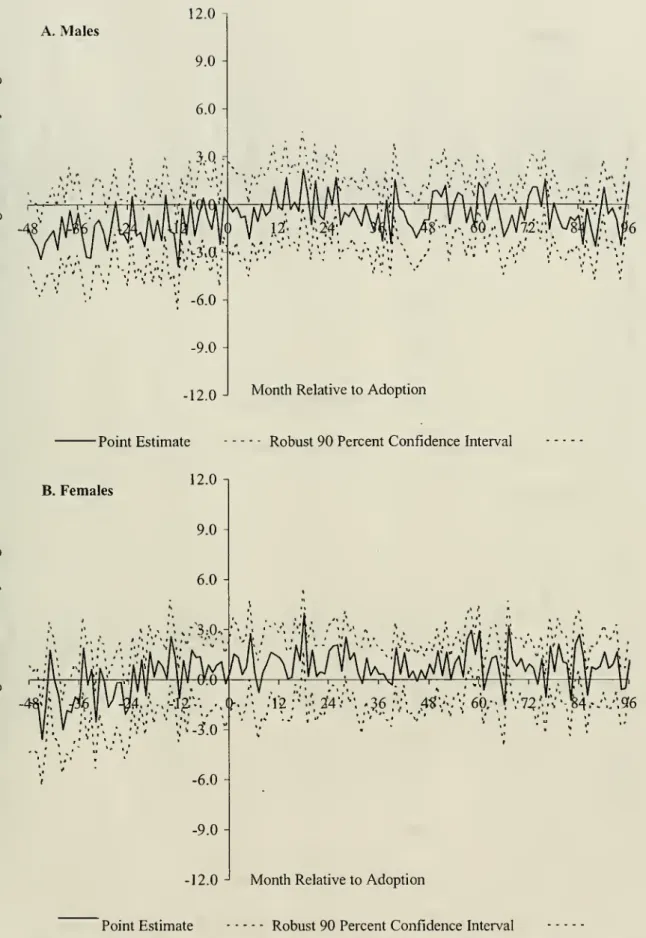
thefigures.Figures4 through 6repeatthisexercise for
median
logweekly
earningsoffull-timeworkers.Because
21
Thesefiguresplotthe coefficientand90percentconfidencebands fromestimatesof parameters y
r from the followingequation: 96 r=-48 where,asabove, Y
s:j,istheoutcomevariable foragivendemographicgroup,state,and timeperiod,
5
,<pl
and
n
.are vectorsofstate,time,anddemographic groupmaineffects,and L
sl is
a
dummy
variablethatassumesthevalueofone(only)inthemonththat a stateadoptsagivendoctrine(theimpactof eachdoctrineisestimatedsimultaneously).
thesamplesusedforthese estimates arelessthan
one
-fourth as large as theemployment
estimates,thereisagreat deal
more
variability in these observations.These
figuresprovidelittleprima
facie evidencethatwrongful-discharge doctrines affected
wage
levelsofemployed
workers.A. Initialestimates:
Employment
and
Wages
Table 1 presents estimatesof equation (1)for
employment
and
wages.What
emerges
clearlyfrom
theestimatesin thistable isthatadoption oftheimplied-contractexceptionisassociatedwitha
modest
butmeaningfulreductionin
employment.
Incolumn
1 of Panel A,we
estimatethat adoption oftheimplied-contract doctrinereducesoverall
employment
topopulationby
2.0percentinthesecondand
thirdyearsfollowing adoption (t
=
4.1).When
controls areadded
tothemodel
toabsorb region-by-yearemployment
shocks
(column
2),thepointestimateand
itsstandarderrorare bothreducedby
approximatelyhalf,indicatingthattheimplied-contract doctrine
was
typicallyadoptedwhen
employment
conditionswere
atslightlyabove-averagelevels (a factalsosuggestedinFigure 1).
The employment
impactis estimatedat-1.0percentagepoints,
which
ishighly significant(t=
3.2).The
nexttwo rows
ofthetablerepeat these estimatesforthepublic -policyand
good-faith doctrines.The
public-policy doctrine isassociatedwitha smallreductioninemployment,
butthese reductions areneversignificant.
The
point estimates forthegood-faithdoctrine areof approximatelyequalmagnitude
tothoseforthe implied-contract association.
These
coefficientsaremarginallysignificantand
arenot typicallyrobusttoinclusion ofregion-by-yearcontrols. Sincetherearefewergood-faithadoptions than forother
doctrines (13 forgood-faithversus43
and 34
forimplied-contractandpublic-policy),theremay
be
inadequatestatistical
power
toreliablydetectitsimpacts.As
one
specificationcheck,columns
3and
4 of Table 1 replace the logemployment-to-populationratiomeasure
withitslevel.The
outcome
variableisnow
thepercentagepointchange
inemployment
toemployment
topopulationareveryslightly smaller, whilestatisticalsignificanceisunaffected.22Panel
B
of Table 1 presentscomparable
estimatesforbothmedian
loghourly andfull-timeweekly
wages. In
no
case arethepoint estimates statisticallysignificant.However,
a notable patternisthatdoctrinesthatappeartoreduce
employment
(implied-contractand,toa lesserdegree, good-faith) areassociatedwitha
modest
increaseinmedian wages
ofemployed
workers.One
explanationforthispatternisthat
workers
whose employment
isreducedby
adoptionof
a wrongful-dischargelaw
are typicallybelow
the
median
earnersin their state-demographic
cell.Hence,
theirremoval
from
theobservedearningssample
raisesthe
median
wage
slightly.We
provide furtherevidenceon
therelevance ofthisexplanationbelow.B.
Does
the specificdoctrinematter?
Given
the generallynegative estimatedemployment
impactof
each category ofdoctrine,one
potentialinterpretationoftheseresults isthatitisnotthespecificdoctrinethatmattersbutsimplythefact that
any
wrongful-dischargedoctrinehas
been
adopted.To
examine
thisissue,we
estimateinTable 2 asetof
models
thatcompare
theimpactsof an 'anydoctrine' variableagainstadisaggregatedsetofthreedoctrinevariables.
As
withtheprevious models,we
specify the two-year periodpriortolawchange
as thepre-treatmentperiod
and
thetwo-year periodcommencing
one
yearafterlaw change
asthepost-treatmentperiod.23
The
firsttwo columns of
Table 2 confirmthat,on
average,adoptingany
doctrineappearstoloweremployment by
between
0.5and
1.0percent, withthesmaller point estimatecorrespondingtothemodel
inwhich
regionby
timeeffectsare controlled. In additiontothe any-doctrinedummy,
Columns
3and
4add
22
We
alsoestimatedTable1 without usingtheCPS
sampling weights,whichyieldedcomparableresults,asshown
inAppendixTable2.
By
comparisonwiththeweightedestimates,thistableshows: 1)thepointestimatesforthe Implied-contractexceptionareabout2/3rdsas largeinabsolutemagnitudeforemploymentandstillhighly significant; 2)thePublic -policyand Good-faith exceptionsarealsonegativeand marginallybut not robustly significant; 3)thewage
estimates aresimilar;and4) theR-squaredsare lower, consistentwiththeinefficiencyoftheweighting(orlackthereof).
23
An
additionalwrinkleinthisspecificationisthatseveralstatesadoptmultiple doctrines withina fiveyearwindow
and hencethepre-andpost-periodsarenot unique.In estimating thesemodels,
we
includeallrelevantpre-andpost-treatment observationsforagivenstate- meaningthatsometreatmentandcontrolperiodsoverlap -andinclude,as in
equation(1),treatmentand treatmentx post effectsforeach doctrine.Controlobservations are selected identically to
anindicatorvariableforeach ofthe threedoctrines.Notably,the any-doctrine
dummy
ispositiveinthesespecificationswhile each
of
the three individual doctrinedummies
isnegative and, inmost
cases,significant.Thissuggeststhatitis notsimply thepresence
of any
doctrinethatreducesemployment
levels;thespecificdoctrinedoesmatter.
Because
the neteffectofa doctrineincolumns
3and
4isthesum
ofitsindividualdummy
and
theany-doctrine
dummy,
itis useful toeliminate theany-doctrinedummy
toget a clearerpicture. Thisisdone
incolumns
5 and6.When
theimpactofalldoctrines isestimatedjointly,theimplied-contractdoctrineremainsrobustly negative
and
similarinmagnitude
tothe Table 1 estimates.The
good-faith doctrine againproves non-robusttoinclusion
of
region-by-yearcontrols.Panel
B
of
thetableperformsthesame
exerciseforwage
outcomes.As
above, the any-doctrinedummy
doesnot survive inclusionofindividual doctrine controls.
The
dataagain providemodest
evidence of apositive
wage
impactof
theimplied-contract and,more
sizably, thegood-faith doctrine.C.
Checking
forcomposition
bias in thewage
estimatesEstimates
of
theimpactof wrongful-dischargelawson wages
may
sufferfrom
composition bias: sincewages
areonlyobservedforcurrentlyemployed
workers, wrongful-discharge lawswill raiseobservedwages
iftheydifferentiallyreduceemployment
oflow -wage
workers.One
means
totesttherelevanceof
thisexplanationis toadjust
wage
observations for sele ctivewithdrawal.We
do
this followingChandra
(2002)
by
estimatingmedian
wages
within state-year-month-demographiccellsacross allpotentialworkers-
employed
andnon-employed
-
and
assigning awage
of
zerotonon-employed.
This 'inclusivemedian'approachstands incontrasttothe standard 'exclusivemedian' calculationsused above,
which
removed
non-employed from
the samples.Because
theinclusivemedian
implicitlyassumes
thatnon-employed
workers
would
earnbelow
themedian
wage
intheirrespective state-time-demographicgroup
cell, itplacestheestimated
median
lowerinthedistributionofcellwages.One
shortcoming withthisapproachisthatif50-pluspercentofpotentialworkers ina cellare non-employed,the
median
cellwage
will be zero andhence
thecellmust
bediscarded,which
excludesmost
femalecellsas well ascellswith highparticipationsame
cellexclusionstoboththe exclusiveand
inclusivemedians.Panel
A
of Table3 presents difference-in-differencewage
estimatesforconventionalexclusivehourlywage
medians
akintoTables 1 and2.These
estimatesecho
theearlierfindingthatobservedwages
risesignificantlyafteradoptionofawrongful- dischargedoctrine,particularlythe implied-contractexception
(see
column
6). PanelB
presentscomparable
models
forthe inclusivemedians.These
estimates effectivelyreverse the positive
wage
finding. Inmany
cases,the point estimatesfortheimpactof adoptionof
awrongful-discharge
law on wages
arenow
negative. Inno
caseare theestimates significantlypositive.Thisset
of
resultssuggeststhatemployment
declines associatedwith adoptionof a wrongful-dischargelaw
couldpotentially generatesignificantupward
compositionbiasin observed wages.Given
thesensitivityofthe
wage
estimatestocomposition bias,we
focustheremainder ofthe analysison
employment.
D.
Cohort
effectsinadoption?
The
precedingestimatespool all yearsofdatatoincrease the precisionofthe estimates.The
costof
thisapproachis thatit
masks
any
temporalheterogeneityintheeconomic
impactofthe doctrines. Table4studiesthispotentialheterogeneity
by
tabulating theeffectof each exceptionon
employment
and
earningsforthefollowing adoption 'cohorts':
1980
to 1983,1984
to 1987, 1988to 1992,and
1993to 1998.24The
15statesthatadoptedtheimplied-contractexception during1980
to 1983 experienceda declineof-0.5to-1.9percentin
employment
duringmonths
13 through36
following adoption(thesmaller estimatecorrespondingtothe
model
with regionby
yearcontrols).The
18 statesthatadoptedthisexceptionbetween
1984
and
1987also experiencedsimilarly largeemployment
declines.By
contrast,we
do
notfindrobustevidencethatthefinalset
of
10statesthatadoptedthedoctrinebetween
1988and
1992 experiencedany
negativeeffect
on employment,
althoughthe directionisgenerally negative.The
nextfourcolumns
of Table 4repeatthese estimatesfor statesadoptingthepublic -policyand
good-faithexceptions.
These
estimates giverisetowidely varyingsignsand magnitudesforeachdoctrineand
Adoptioncohortdates refertotheyearawrongful-dischargedoctrineisenacted; the pre-andpost-periodsusedto
formtheemploymentcontrast are aswithpriorestimates thesurroundingfiveyears (2 priortoadoption,3post adoption,withthefirstomitted).
We
donotstudy adoptionspriorto 1980toallowforthetwoyearpre-treatment period.No
implied-contract or public-policyexceptionswereadoptedafter1992.time period,andare quitesensitive totheinclusion ofregion
by
yearcontrols.Thissetoffindingsreducesour confidencethatthe good-faithexception adversely affected
employment
levels,exceptperhapsfortheinitialcohortof adoptingstatesin theearly 1980s.
An
interestingpattern thatemerges
from
Table4
is thattheimplied-contractand
good-faith doctrinesappearto
have
had
smaller(orzero)employment
impactsamong
lateradoptingstates.One
explanationforthispatternis thatearlyadoptingstates
may
have been
thosethatwere most
aggressiveintheirpursuitofemployee
rightsand
thusexperiencedgreaternegativeeffects onemployment.
Another
explanation isthatemployersinlateradoptingstatesanticipatedthe eventualadoption ofthe doctrines
and
hence largelyresponded in advance, therebycausingtheregression estimatesforthelateadoptionstounderstate thetotal
effect.
A
thirdpossibilityisthatthestate level impact ofthelaw
differswhen
few
stateshave
previouslyadoptedtheexception than
when
most
stateshave
alreadydone
so.Employment
declines foundfor earlyadopters
may
partly reflect decisionsby employers
tolocateinotherstates,apossibility thatislargelyforeclosed
when
most
stateshave
alreadyadoptedanexception.The
diminishingeffectsalsosuggestafourthexplanationoffered
by Edelman,
Abraham
and
Erlanger(1992).These
authors arguethatprofessional(non-academic)
law
journalsand
personneljournals overstated thethreatposed
by
theimplied-contract doctrine,leadingtoexcessive
management
changes. Benefitingfrom
the experienceofthese earlyadopters,
employers
in lateradopting statesmight have
reactedlessseverelytoadoptionofwrongful-discharge doctrines.25
E.
Longer
term
impacts
and
alternativetiming assumptions
Inourbaselinespecification,
we
usethe24 months
priortoadoption
as ourpre-treatmentperiodandthemonths
13 to36
following adoptionasthepost-treatment period. InTable5,we
measure
longertermimpacts
of
thewrongful-dischargedoctrinesand
additionally explore thesensitivityof
ourfindingstoalternative choices
of
pre-andpost periods.For example, Business
Week
inJuly 1985ranaratheralarming coverarticleon"TheRevolutioninEmployeeRights"that stated,"To minimizeliability,corporationshaveto treateachdismissalasthoughitwereundera 'just
The
firstcolumn
of Table5 repeatsourbaseline specification foremployment from
Table 1.Columns
2through 6 ofthetable
move
thepost-adoptiontreatmentwindow
closertothepointof adoptionby
1 year(i.e.,immediatelythereafter)
and
thenoutward
by
1,2, 4,and 6 yearsrespectively.In thefinal column,column
6,the post-treatmentperiodisyears7and
8 followingadoption.These
estimates indicatethattheemployment
effectofthe implied-contract doctrinereaches amaximum
inthetwo
yearsfollowingadoption,
and
thisimpact appearstograduallydiminishthereafter.By
years7and
8,the estimatedemployment
reduction isconsiderably smaller thanthe baselineand
isinsignificant (apattern alsosuggested
by
Figure 1).By
contrast,theestimated negativeeffectof
thegood-faith doctrine increaseswithtime,butthiseffectisneversignificant.
To
testthesensitivity oftheresultstothe selectionofthe /?re-rreatmentperiod,columns
7and
8 ofthetable adjustthe pre-treatmentinterval
outward
by
1and
2 years respectively (using the baselinepost-treatmentperiod ofyears 1
and
2 followingadoption).Column
7compares
employment
in years 2and
3priortoadoptionto
employment
inyears 1and
2 followingadoption,and
column
8 performsthiscomparison
foryears4and
3 priortoadoption.Changing
thepre-treatmentwindow
doesnot greatlyaffectthe patternofresultsbutdoes reduce the precisionofthe estimates.
When
regionby
yeardummies
areincluded, the implied-contract doctrine
no
longer has asignificantemployment
effect.IV.
Are
allworkers
equally
affected?
Liketheir
European
counterparts,U.S. wrongful- dischargelawsdisproportionately protectworkers
with longer tenure andhigherwages.Long-tenureworkers are typicallyableto
make
aprima
faciecasethattheirjobs provided anexpectation
of
ongoing
employment
(inthecase ofthe implied-contractdoctrine),oranexpectation offuturebenefitsforcurrent service (good-faithdoctrine). In addition, court
awards
tendtobe roughly proportional topriorearnings
-
particularly in implied-contractcases-
and hence highwage
workers havea greaterincentivetolitigate.
26
Sincetheprotectionsoffered
by
wrongful- discharge doctrinesThisisparticularlytruebecauseattorneys' fees are usuallyarrangedonacontingencybasis;theattorney receivesa
percentage oftheaward ifthecaseissuccessfulandtypicallyno paymentotherwise. Consistentwiththesefacts,
are notequally distributed
among
worker
groups, it isuseful toaskwhether
theemployment
impactsalsodiffer
among
demographic
subgroups.We
explorethispossibility inTable 6by examining
the relationshipbetween
theadoptionofwrongful-discharge lawsandthe
employment
rateof
each ofthe 8demographic
groupsthatwere
pooled intheabove
analysis. Consistentwiththeabove,theresults inTable 6 confirmthatthe implied-contract doctrine lowers
employment
rates across the board.But
thesizeofthe impactdifferssubstantiallyby demographic
group.The
largestimpacts areuniformlyfound
forfemale, less-educated (high school orless), andyounger
(underage 40) workers.
These
impactsare intherange of -1.0to-2.7 percentage points.Young,
less-educatedfemalesfare worstofall.Notably,the
one demographic group
forwhom
thereisno
evidenceof anemployment
impact(for eithergender) isolder,more-educated workers.We
also findmodestlyrobustevidence(largepoint estimates, large standarderrors)
of
anegativeimpactof
thegood-faithexceptionon
employment
rates.But
this impactisonlydetected forwomen
and younger,less-educatedmen.
As
agroup,theTable6 resultsappearconsistentwithanumber
ofOECD
studiesthatfindthatemployment
protectionstendto differentiallyharm
employment
offemales, less-experiencedworkersand
less-skilledworkers(Bertola,
Blau
and
Khan,
2002;OECD,
1999). Yet, intheU.S.context, theseresultsappear
something
ofa puzzle.U.S.wrongful-dischargedoctrinesincrease the expectedcostofemploying
high-tenure, high-
wage
workers.These
highercosts shouldlowertheemployment
and
earningsof
thesegroups
and
raisedemand
forworkers
who
areclosesubstitutes-
low-wage and
short-tenureemployees
who
areunlikelyto(successfully)litigate.27
Yet,thisisoppositeto
what
we
find.Why
do
wrongful-discharge laws
harm
theemployment
rates oflessprotectedworkers?Two
rationales arefoundin theliterature.One
isthat less protectedgroups-
females, less-educated,and
younger
workers-
have greateropportunitycostsofwork
(i.e.,better opportunities inhome
production,school enrollment,
and
leisure)and
accordinglytheirlaborsupply isrelatively elastic. Ifemployment
hold executiveormanagerialpositions (53 percent),have 6ormoreyearsoftenure (48 percent),and
eam
considerablyabovethemedianwage.
This
may
indeed bewhatoccurredwiththesurgeindemand
fortemporary helpemploymentafteradoption ofprotection ischosen to
maximize worker
welfare,itwill optimally pricemany
oftheseworkersoutofthelabormarket,raisingtheir
wages
and
reducingtheiremployment
(Bertola,Blau
and
Khan,
2002).An
alternative explanation offered
by Lindbeck and
Snower
(1988)and
SaintPaul (2002)isthatemployment
protection istypicallyadopted toprotect
incumbent
('insider') workerswho, on
average,are likely tobeolder,more-skilled males.
These
protectionsreduceproductivityand
generate rents forincumbents,whileweakening
earningsand
employment
prospectsforyounger, less-skilled,and
lessattached labor forceparticipants('outsiders').
Both
theoriestherefore offerarationale forwhy
women,
younger and
less-skilledworkers
areharmed
by
employment
protection.Do
theyfittheU.S. facts?Incase ofthe firsttheory,the intervening
mechanism
by which
employment
protectionlowersemployment
of'more
elastic' workersisby
raising their relativewages. Thispredictiondoesnotseem
tofittheU.S. case. Inparticular,itisunclear
howU.S.
wrongful-discharge laws coulddisproportionatelyraiseemployment
costs forthe'elastic' groupssincetheseworkersareprovidedrelatively lessemployment
protection.
And
while ourdata offersome weak
evidencethatthewages
ofelasticgroupsdo
increaseafteradoption
of
wrongful-dischargedoctrines,we
view
thisevidenceasprimarily drivenby
selectionoflow-wage
workersintonon-employment. Hence,
inour view,thefirstexplanationdoesnotappearviable.The
second, 'insider-outsider' explanationismore
promising. Ifwrongful-dischargelawssuccessfullydeter
employers
from
terminatinghigherwage
and
longertenureworkers
('insiders')and
furtheremployers
arenot abletoreducethe
wages of
protectedgroupsinthe short run,employerswillpresumably
need
toreducehiring of
some
worker
groupstomaintainemployment
levels. Inthiscase, wrongful-discharge lawswillprotect thejobs of
more
seniorworkersbut the costwillbe borneby younger
workerswho
arenothiredin theirplace.Thisisroughlythe
mechanism
positedby
the insider/outsidermodels.Over
the longer term,however, employers shouldprefertoreduceemployment
ofseniorworkersrelative to lessexpensivealternatives.
Although
this longer runoutcome
ispresumably
difficulttomeasure
More
generally,ifadoptionof wrongful-discharge laws inducesanygeneralemployerreluctanceto hirenew
workers,thisimpactwillfirstbevisible in adeclineintheemploymentratesof high turnoverworkergroups
inaggregate data,
we
make
apreliminaryeffortinTable7. Here,we
estimatelong-rundifference-in-difference
models
for state levelemployment
by demographic group where
we
contrast thechange
inemployment
in adoptingversusnon-adoptingstates in years fiveandsix followinglaw
adoptionrelative toyears
two
and onepriortoadoption.As
would
be expected, the point estimatesin thistable arenotprecisely estimated.Nevertheless, anoteworthypatternisthattheestimated long-run negativeeffectsofthe
implied-contract doctrine
on
theemployment
ofolderand more-educated
workersaregenerally larger thanthosefor younger,less-educated
worker
(andinmany
cases, largerthantheshort-runestimatesfrom
Table6). Similarly,thelong-run estimatesfor
younger
and
less-educatedworkersaregenerally substantiallysmallerthan the shortrunestimates,
and
insome
casesweakly
positive. 30Innet,ourestimatesconfirmpatterns
from
theOECD
thatemployment
protectiondoes
reduceemployment
oflessprotectedworker
groups-
females,and younger and
less-educated individuals-
atleastinthe shortrun.
While
less decisive, ourlongerterm evidence suggeststhattheharms
intermsof
reducedemployment
tendtoaccruetotheworkers
whose
expectedemployment
costs are raisedby
thesedoctrines.Thisresult
may
suggestan importantdifferencebetween
employment
protectionsprovidedintheOECD
and
UnitedStates.Whereas
OECD
employment
protections typically bar terminationsofseniorworkersexceptunder very limitedcircumstances,thewrongful-dischargedoctrinesrecognizedintheUnited States
provide
no
such formalemployment
security.Rather, theymake
itfeasible for certainworkerstolitigateafterterminationatconsiderable
monetary
and psychiccost,and
withlimited certaintyofredress.By
raisingexpected
employment
costsofseniorworkers without providingthem
formaljobsecurity,U.S.wrongful-discharge laws
may
make
itmore
likelythatemployment
of
protectedgroups isultimatelyreduced.
disproportionate shareoftheunemployed,thisexplanationisconsistentwithKuglerandSaintPaul's(forthcoming)
findingthat exit ratesfrom unemploymentslowafterstatesadoptedimplied-contract doctrines.
Hence,these specificationsareidenticaltocolumn 5of Table5but areestimatedseparatelybydemographicgroup.
Estimatesusing an alternativelong-runpost-periodofyears7and 8following adoptionproducedqualitatively similar
resultsandareavailableonrequest.
The
exceptiontotheclaims ofthelasttwosentencesiscausedbythe relatively largenegative(albeit statisticallyinsignificant) long-termeffectfromthe implied-contractexceptionforyoung, low-education males(column 2of Table
V.
Reconciling
with previous
studies
Our
findingthatunjust-dismissal laws-
theimplied-contractexception in particular-
havehad
amodest
buteconomicallymeaningful adverse impacton
stateemployment
ratesstands incontrasttotwo
publishedpapers exploringthe
same
questions.The
first,awidely citedstudyby
Dertouzosand Karoly
(1992
and
1993,D&K
hereafter),found
that states' adoptionof
exceptionstoemployment
atwill over1980
to 1987 reduced aggregate state
employment
by 4
to5 percentagepoints,witheven
largerreductionsinemployment
inthe serviceand
financialsectors.The
magnitude
ofthese estimates,roughlythreeto fivetimesas large asourestimates,garneredconsiderableattention in
academic
journalsand
policy debates.31More
recently,Thomas
Miles(2000),using amethodology
more
comparabletoourown,
foundno
effectof
unjust-dismissal doctrines
on
aggregateemployment
orunemployment.
To
understandthesourceofthediscrepancies
between
thesetwo
studiesand
ourown
findings,we
reanalyzed both papers.A.
The
Dertouzos
and
Karoly study
Our
difference-in-differencemethodology
estimates theimpacts of wrongful-dischargedoctrinesby
contrasting
contemporaneous
employment
and
wage
changesinadoptingversusnon-adoptingstates.D&K
eschew
this source ofvariation,arguingthatthe adoptionofstatelawsmay
bedrivenby
the 'supplyand
demand'
for legal doctrines.To
correctfor this postulatedendogeneity,D&K
employ
asetofinstrumentalvariablestopredictstates' adoption
of
wrongful-dischargedoctrinesand
thenusethese predicted valuesinplace
of
the actual laws.Specifically,
D&K
estimatean equationoftheform
(2)
\n(emp
a)=a+Y-L
jl +<ps+d,+e
st ,where
Inemp
sl islog total
employment
in state sand
year t,andL
j: isthepredicted probabilityofthe presenceof
each doctrineinthestateand
year.Thispredicted probability isestimatedfrom
a logodds
regressionoftheobserved
law
variables,L
Jt ,on
asetofinstrumentalvariables,Z
sl,
and
vectorof
yearForexample, duringhisgubernatorial carrpaign, CaliforniaGovernorPeteWilsonprominentlycitedDertouzos and
dummies
S
I .
(3)
Pr[Z„=l]
=
Pr[Z;,/3+
<5,>-eJ.
The
instrumentsusedby
D&K
inestimatingequation (3) includewhether
a statehad
aRepublicangovernor, thestate's level and change inunion
membership,
thestate'schange
inlawyers percapita,thefractionof borderingstatesrecognizinga similardoctrine,and anindicatorfor
whether
astatehad
arighttowork
law
in 1980.As
D&K's
estimatesof
equation(3) indicate, these lattertwo
variables are indeed highlycorrelatedwithstates' propensitytoadopt
common
law
exceptions.A
potentialconfound,however, isthatboth
measures
are alsolikely tohaveadirectcorrelationwithemployment
levels thatdoes notemanate
from
their influenceon law
adoption.The
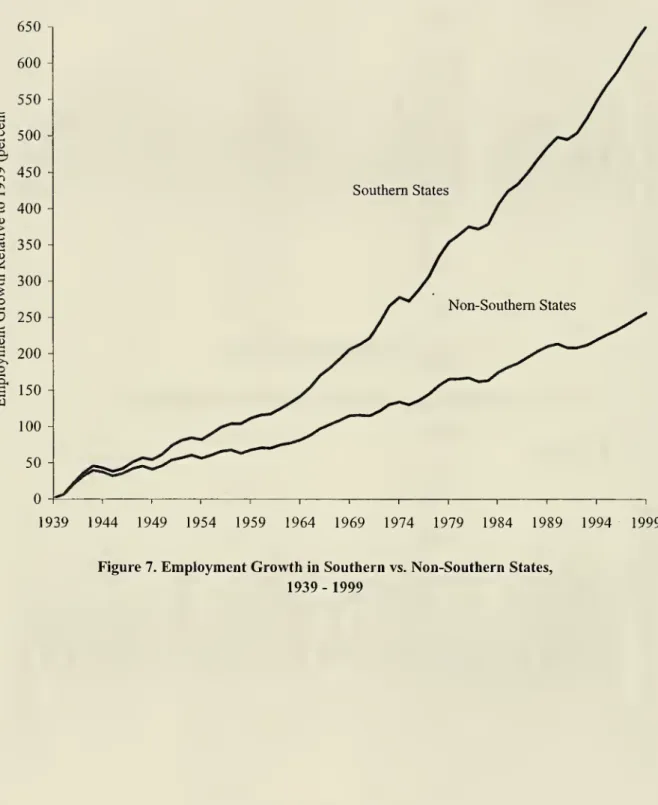
source of our concernisvisible in Figures7 and 8.As
notedby
Blanchardand
Katz
(1992) anddepictedinFigure 7,
employment growth
inthe South has exceededthat inthenon-South
forthe pastsixdecades.Thistrend substantiallypredates theadoptionofunjust dismissal laws
and
likelystemsfrom
factors including theadventofairconditioning(whichincreasedhabitability
and
manufacturingproductivity intheSouth,
most
notably intobaccoandprinting),and civil-rights-eralegislation thatincreased
wages
and
employment
of Southernblacks (Arsenault, 1984;Donohue
and
Heckman,
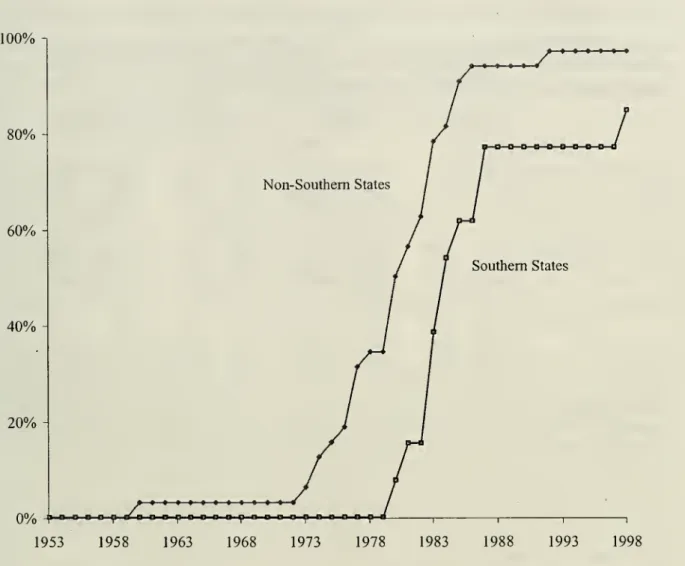
1991).32Moreover, asis
shown
inFigure 8, Southern stateswere
lastand
leastlikely to adopt wrongful-dischargedoctrines,
meaning
that theirfractionof borderingstatesadopting exceptionswas
alsomuch
lower.Furthermore, 85percentof Southernstates
had
aright-to-work
law
in 1980 versus only25
percentof
non-Southem
states.33
Given
the positive correlationbetween
Southernregionand employment growth and
thenegativecorrelation
between
Southernregionand
adoptionof wrongful-dischargedoctrines,it isa near certainty thatThereisnoformalagreement onwhichare theSouthernstates.
We
useAlabama,Arizona,Florida,Georgia,Kentucky, Louisiana, Mississippi,
New
Mexico, Northand SouthCarolina,Tennessee, Texas,andVirginia.Non-SouthernstatesincludeallotherU.S.statesexceptfor
DC
and,duetolackofemploymentdataextendingto1939,Alaska, Hawaii,Illinois,Michigan,and Minnesota.GrowthratescalculatedinFigure7useeachstate'sshareofSouth