What would be the added values to guide the
course of project management towards an IPMA
D certification for the IBM program?
Bachelor Project submitted for the Bachelor of Science HES in Business Administration with a major in International Management
Olivia LAFFELY
Bachelor Project Advisor:
Xavier BURDET, Responsible of the education’s coordination and of international relationship
Carouge, 04 July 2014
Haute école de gestion de Genève (HEG-GE) Économie d’entreprise (International Management)
Declaration
This Bachelor Project is submitted as part of the final examination requirements of the Geneva School of Business Administration, for obtaining the Bachelor of Science HES-SO in Business Administration, with major in International Management. The student accepts the terms of the confidentiality agreement if one has been signed. The use of any conclusions or recommendations made in the Bachelor Project, with no prejudice to their value, engages neither the responsibility of the author, nor the adviser to the Bachelor Project, nor the jury members nor the HEG.
“I attest that I have personally completed this work without using any sources other than those quoted in the bibliography.”
Carouge, 4th July 2014
Acknowledgements
I would like to thanks first of all my advisor, Mister Xavier Burdet for being my advisor and to have shown interest in my project.
Second of all I want to thanks Madam Véronique Hermanjat (EIT), Madam Manuella Müller (VZPM), Mister Alain Dorat (HEC), Mister Philippe Merlier (HEG) and Madame Nathalie Junod (HEG) for their time spent in order to answer my questions and for our great and interesting conversations.
A special thank to Mister Thierry Bonjour (VZPM) for all his insights and his help. I want to thanks as well Mélanie Stauffer, my partner in each work during those four years at the HEG, including the repeating one, to motivate me, support me and for this friendship that is the most valuable outcome of those four years.
A big thank to my family, Anthony, Sophie, Bastien and Martine Laffely for supporting me. An “ironic” thank to Anthony and Sophie Laffely for asking me to organise their wedding one week before the bachelor work deadline and a thank to my friends Angélique Limat, Marie-Laure Gremion, Alizé Kobel and Sara Palma for changing my mind when I could not go ahead anymore.
The last but not the least, thanks to my boyfriend Oliver Gübeli for all his support, for all the time spent to try to calm me down in “panic time” and for all his encouragement.
Executive Summary
The objective of this bachelor work is to point out the added value to certify students in project management in the IBM program of the HEG Geneva.
The principle finding is that it is really valuable for students to do a certification. It can bring more opportunity in the research of a job and gives as well some helpful tools and thoughts for their daily business organisation.
The second finding is that the IPMA level D certification would suit the best the HEG strategy and the students through its learning process and its origin.
I would recommend to the HEG to create a new minor in the third year, which would go deeper in the project management domain, in order to target students who are really interested in it, and to propose in this minor the certification in order to foster the employability of the students.
Here is an illustration of the topics that I went through during my bachelor work.
HEG
Other
organism
VZPM
IPMA/PMI
ISO Norms
Certifications
Contents
Declaration... i
Acknowledgements ... ii
Executive Summary ... iii
Contents ... iv
List of Tables ... vi
List of Figures ... vi
Introduction ... 7
1. Certification of person vs. academic certification ... 9
2. ISO Norms ... 10
2.1 ISO/IEC 17024:2012 ... 10
2.2 ISO 21500:2012 ... 10
3. Institutes ... 12
3.1 The International Project Management Association (IPMA) ... 12
3.1.1 IPMA in Switzerland ...12
3.1.2 Project management certifications by IPMA ...13
3.1.3 Consulting in project management certifications ...15
3.1.4 IPMA Delta ...16
3.1.5 Recertification process...16
3.1.6 IPMA Competence Baseline ...16
3.2 Countries’ ranking ... 19
3.3 The Project Management Institute (PMI) ... 20
3.3.1 Project management certifications by PMI ...20
3.3.2 Recertification process...22
3.4 PMI CAPM vs IPMA Level D ... 24
...25
3.5 Differences in the business model: ... 27
4. Selection of a certification ... 28
5. IPMA in the world ... 29
5.1 Germany ... 29
5.2 Austria ... 29
6. Interview of schools that certify their students in project management ... 31
6.1 Ecole supérieur de Tourisme, ... 31
Ecole de commerce Hôtellerie Tourisme ... 31
6.2 University of Geneva: département des hautes études commerciales33 6.3 Haute école de Gestion Geneva : Certificate of Advanced Studies “Management de projet appliqué” ... 34
7. Development of various training’s solutions ... 35
7.1 Blended learning: confederation’s model ... 35
7.2 Modular ... 36
7.3 Concept EIT- Experience ... 37
7.4 Theoretical knowledge transfer ... 38
7.5 Preferences ‘matrix ... 39
7.6 Multi-criteria analysis ... 40
7.7 Application of the solution ... 42
8. Conclusion ... 43
9. Bibliography ... 44
10. Appendix ... 46
10.1 List of abbreviation ... 46
10.2 Description in details of the modules (WBT) e-learning ... 47
10.3 Survey from EIT’s students ... 50
10.4 Testimony of one students ... 51
List of Tables
Tableau 1: PMI CAPM vs IPMA Level D ...24
Tableau 2: Matrix of preferences ...39
Tableau 3: Multi-criteria analysis ...41
Tableau 4: Abbreviation's list ...46
List of Figures
Figure 1 : Member association location ...12Figure 2 : Certification in 4 levels ...13
Figure 3: Certification in Consulting ...15
Figure 4: Eye of Competences ...17
Figure 5: Evolution of the certification in the five continents over the last five years ....18
Figure 6: Evolution of the certifications in Switzerland over the last six years ...19
Figure 7: Countries’ ranking regarding the number of IPMA certifications ...19
Figure 8: Source: Dr. Markus A. Zoller, 2014 Assessors Workshop (PPT) ...19
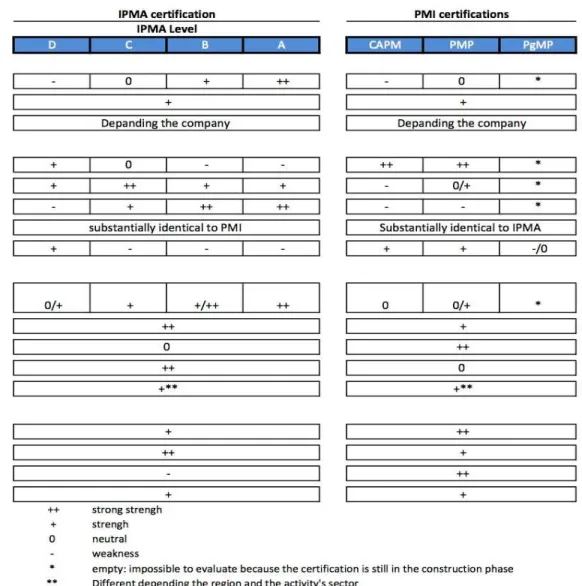
Figure 9: Comparison table IPMA - PMI certifications ...25
Introduction
When we talk about projects, people think that it is a very professional topic and do not realize that they manage project all along their life. The definition of a project is, according to WBT project management (p46) “a project is an activity that distinguish itself by a unique and temporary aspect in a context and in specific conditions. The most important are:
• Establishment of objectives
• Conditions regarding finance and time
• A specific delimitation with other activities and other projects • A specific organisation for the project “
From our personal life to our professional life, nowadays everybody needs to organise and manage small, medium or big projects. It can go from a wedding to a group work at school or to a professional project. The biggest one that we are facing in the school is the bachelor work.
According to IPMA (International project management association), managing project is not a profession in itself but a function that anybody can have in its professional life.
Regarding a study done by the “Institut für Organisation und Personal” (IOP), from the University of Bern (Norbert Thom, Stephan Odermatt, p.6, 2007), the world of project management is constantly growing. A rapid industrialisation that opened all the markets at a fast speed or Internet that increased the rapidity of transactions around the world could be an explanation for this growth. More and more organisations are facing complexity and uncertainty. In order to decrease this complexity and to manage the uncertainty, organisations can use standardized methods. Henceforth formations and certifications are essential for a career in this domain.
Project management is used, according to the 10th anniversary booklet of the association for the certification in project management (p 5, 7), by companies, governments and other
In Switzerland we could observe a medium/high demand of the basic level’s certification in schools (Diploma/DAS/MAS/CAS) for example in the HEC, HEG or “Ecole supérieure de Tourisme (Lausanne), that want to prepare a ground base, for their students, to better manage their project. With this increase of interest for this domain, I had the idea to show what would be the added values to give the opportunity to the HEG students, to get certified in project management.
In this work there will be a comparison between different certifications, in order to find the one that would fit the most to the HEG strategy, a comparison with the state of art in other countries and finally different propositions of how we could implement the certification in the IBM program, in the HEG Geneva.
1. Certification of person vs. academic certification
Before to start any analysis, it is important to know the difference between two types of certification.
• The certification of person • The academic certification
I would define a certification of person, as a certification of competences. According to the Codinorm website, a certification of person is an official recognition of competences of an individual, after evaluation, with certain criteria regarding a specific job.
I did not find any precise definition of the academic certificate, but for me it is the certificate that you receive after a few years of formation in a specific domain, which is more oriented on theory and that last for your whole life.
It is important to clarify that a certification of person is not for ever, basically (depending on the certification) you need to get re-certified. In the opposite, an academic certification, you have it for life even though you did not practice at all the job.
This is the value added of the certification of person because as an employer or constituent, you know that the person with that kind of certification are always up-do-date, with practical knowledge and experiences. If you compare for example with a doctor, even though he/she did not practice, he/she will still be a doctor and maybe it is surer when he/she would have to do a certification every 5 years to demonstrate his/her competences.
2. ISO Norms
The next important point to know is that, certifications are normally based on norms. It is the International Organisation for Standardization (ISO) that issues those international standards. According to their website, “it helps to make the industry more efficient and effective”.
The main goal of ISO is to reduce the number of standards and to have the same in most countries. They try basically to harmonize the world of normalisation.
In this work, two norms are concerned, the ISO 17024 and the ISO 21500.
2.1 ISO/IEC 17024:2012
ISO 17024 “Evaluation of the conformity – General requirement for the certification’s organisms that proceed to certification of person”.
According to the norm (p.v), it specifies the requirement that insure a homogenous, comparable and reliable function of organisms of certification of person. Those requirement that organisms need to be aligned with, are general. It includes as well the requirement that the market and government impose or ask for.
The norm was created to promote the reference at an international level for the organisms of certification. It was as well created to avoid impartiality and to diminish the risk of conflict of interest by adding some supplementary requirements.
Here are two example of certification of persons: anaesthetist nurse or dangerous products truck driver.
2.2 ISO 21500:2012
The ISO 21500:2012 “Guidance in project management”. According to their website, this norm is the guideline for project management and is addressed to all types of organisms and projects. It is an explanation of how to manage projects and to reach the final goal in practice. Still according the ISO website, this norm brings some advantages:
• “Encourage transfer of knowledge between projects and organizations for improved project delivery”
• “Facilitate efficient tendering processes through the use of consistent project management terminology”
• “Enable the flexibility of project management employees and their ability to work on international projects”
• “Provide universal project management principles and processes”
The norm was established to be aligning with other international standards like “Quality management system – Guidelines for quality management in project (ISO 10006:2003)” or “risk management – Principles and guidelines (ISO 31000:2009)”.
It is really important nowadays to have norms in order to have a common language and a common understanding. Not everything can be normalized because of the culture differences, but in most case it is beneficial. It is because of those norms that today we can have, for example, the same plug in different countries. It is a way to simplify the use of different things and it is good that we can as well apply it to services.
3. Institutes
At the international level, there are two main institutes that certify persons in project management.
3.1 The International Project Management Association (IPMA)
The IPMA (first called INTERNET then changed to IPMA in the 70’s) was founded in 1965. It is a Federation of more than 55 Member Associations (MAs), which collaborate to improve project management and business success. It is a membership-driven federation and has, as you can see on the map, MAs in each continent, more precisely in North America, South America, Australia, Asia, Europe, Africa and Middle-west.
Source: Thierry Bonjour, 2014, Certificats IPMA, Les certificats de compétences de réputation internationale, (PPT)
3.1.1 IPMA in Switzerland
The IPMA certifications in Switzerland are delivered by only one body, which is the “association for the certification in project management” VZPM (Verein zur Zertifizierung von Personen im Management). It organises several “public” sessions open to everybody (after subscription) and organises as well some private sessions for different organism like for the State, for example, that proposes course in project management for unemployed people with a certification at the end or the confederation that chooses to certify all its collaborators.
Member association location
The VZPM was created in 1996 by the “Schweizerische Gesellschaft für Organisation und Management” (SGO) and the “Schweizerische Gesellschaft für Projektmanagement” (SPM). Joined by the Swiss project management (SMP) in 2001 and by the “Association Suisse d’organisation et de Management” (ASO) five years ago. Between 1996 and 2004, the VZPM implemented step by step 4 levels of certification in Switzerland within the agreement they have with IPMA.
It has as an objective to promote and to acknowledge the required competences in project management in the society and the economy. Its goal is to organise international certification that are recognised in project management and in process management. It integrates new knowledge in the certification requirement profiles.
Its organisational and administrative activities are made by the secretary based in Glattbrugg(ZH) and there is a representation in the Swiss French part that plan and realize all certifications in French.
3.1.2 Project management certifications by IPMA
Source: Thierry Bonjour, 2014, Certificats IPMA, Les certificats de compétences de réputation internationale, (PPT)
The D certification is the entry level that does not require any experience in project management. It shows that the person is able to apply its knowledge within a project. It is based on a three hours exam (100 MCQ questions and 9 open questions). Some classes are proposed in different organisms in order to learn the basics but it is not mandatory to follow them.
Certification in 4 levels
The level C requires knowledge and at least three years of experience in managing project. Within those three years, three need to be in project conducting and two of conducting complex project. You have a three hours written exam (MCQ and open questions) then you need to write a project report and you will be evaluated by two assessors.
The level B requires five years of experience. At least three years as a function of responsible director in complex projects and two years of practical experience in other functions in project management. It shows that the person is able to conduct a complex project being assisted by under-project manager, which is the case in complex project. You do not have any written exam to undertake. Basically you need to write a description of a project and a report and two assessors will evaluate you.
The level A requires at least five years of experience in project management portfolio, program or projects with strategic importance. At least three years of experience as a function of direction in the portfolio, projects or program management or of a company of strategic importance and at least two years of practical experience of multiple projects, programs or important projects. It requires a high level of knowledge and experiences. It shows that a person is able to manage an important portfolio of project, which needs the use of methods or tools. For this level you do not have any written exam to undertake. Basically you need to write a description of a portfolio and a report and two assessors will evaluate you.
3.1.3 Consulting in project management certifications Figure 3: Certification in Consulting
Source: Thierry Bonjour, 2014, Certificats IPMA, Les certificats de compétences de réputation internationale, (PPT)
According to their “IPMA international certification of consulting in project management” booklet, there are two levels in consulting certification regarding the domain and the activity. The first one is regarding consulting of a person or a team linked to an issue faced in a project and the second one is the consulting in form of coaching or mentoring.
The two certifications are called “Certified Programme and Portfolio Management consultant”(PPMC) and “Certified Project Management Consultant”(PMC).
The PPMC certifies that a person is able to face missions of consulting in a strategic environment. You need to have at least five years of board experience in project management consulting (within the last eight years) and at least three years (within the last twenty years) of experience in managing complex projects
The PMC certifies that a person is able to face missions of consulting at a project level and in the project environment. You need to have at least three years (within the last eight years) of board experience at the PMC Level and have at least three years of experience (within the last twenty years) of managing projects.
Those certifications are important because nowadays people tend to say that they are consultant without any proper recognition. It is something that proves to employers and companies that you are able to help in projects through your experiences. As it is evaluated by a third party it is really valuable, they have an international recognition and increase the employability of a person.
3.1.4 IPMA Delta
This is a system of certification that allow organisms that want to prove their maturity level in terms of project management, to do it according to a known referential.
3.1.5 Recertification process
The IPMA certification is valid for five years. In order to keep the certification, candidates need to pass through a re-certification process.
For the level A, B and C you need to prove an activity of project director, project manager or project responsible and that you followed a certain number of hours of formation.
For the D level, basically you need to provide a file that contains the history of the last five years of what you did in project management (formations, projects etc.).
3.1.6 IPMA Competence Baseline
All the IPMA certifications are based upon criteria that are referenced in the IPMA Competence Baseline (ICB). For Switzerland it is the Swiss National Competence Baseline (NCB). It is the common document that all certifications’ organisms of IPMA need to follow in order to grant the application of norms. It gives information about:
• Terms • Missions • Practices • Competences • Functions • Management of processes • Management’s methods • Management’s technics • Management tools
Figure 4: Eye of Competences
Source: NCB Swiss national competences baseline version 3,
The integration of management elements are done in the “Eye of Competence” of the NCB through the three domains of the project management, the technical competences: the contextual competences and the behavioural competences.
Moreover the certification’s criteria go through three additional competences, which are the methodology, the socio-communicative and the directional one.
This is a real good point in this certification because in general you learn the theory and need to reproduce it. In this certification it takes into consideration different aspects that can have a big influence in different situations. It is really important as well to take into account the person. Not everybody will act or react in the same way regarding, for example, issues or conflicts faced in a project.
Figure 5: Evolution of the certification in the five continents over the last five years
Source: Adapted from certificats IPMA, les certificats de compétences de réputation internationale, slide 13
This graph represents the number of certification done between 2007 and 2012 in the four levels. We can see that the numbers are slightly but constantly increasing as more as the certifications are being known.
The most visible increase is regarding the Level D certification, which increase of almost five thousand. 0 1000 2000 3000 4000 5000 6000 7000 8000 9000 10000 11000 12000 13000 14000 15000 2007 2008 2009 2010 2011 2012 Level A Level B Level C Level D
Figure 6: Evolution of the certifications in Switzerland over the last six years
Source: Adapted from certificats IPMA, les certificats de compétences de réputation internationale, slide 14
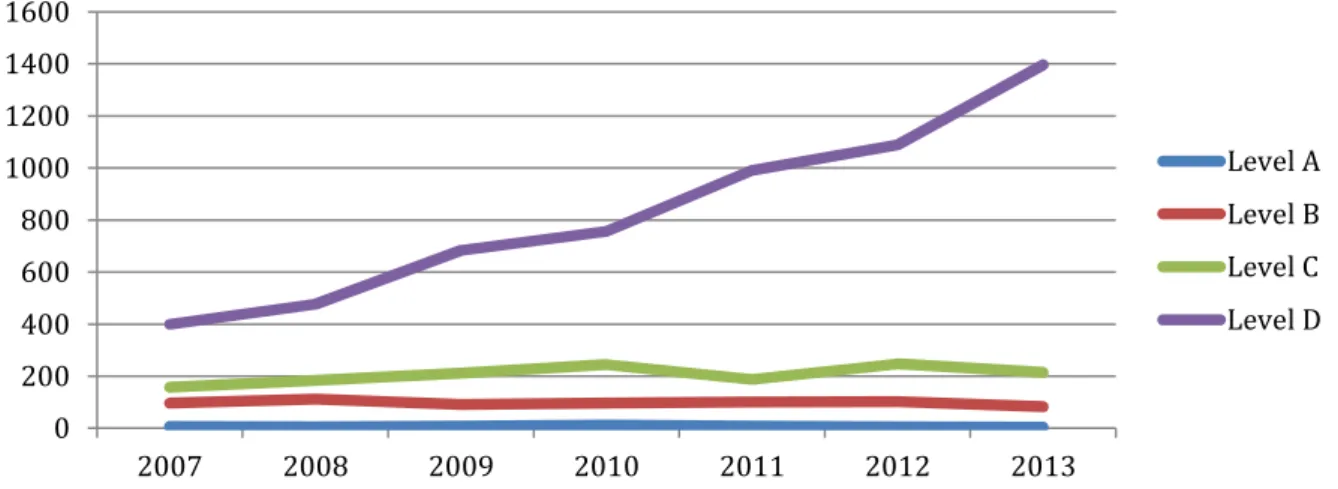
In this comparative graph we can see the highest increase is regarding the certification level D. It increased of a thousand certifications in six years.
This is mainly due to the strategy of the VZPM. In the last years they targeted a lot students and unemployed people. I guess that if you target those people at the beginning, they will stay in the IPMA world and will evolve within the certifications. I think this is their way they compete with PMI.
3.2 Countries’ ranking
Figure 7: Countries’ ranking regarding the number of IPMA certifications
Figure 8: Source: Dr. Markus A. Zoller, 2014 Assessors Workshop (PPT)
0 200 400 600 800 1000 1200 1400 1600 2007 2008 2009 2010 2011 2012 2013 Level A Level B Level C Level D
3.3 The Project Management Institute (PMI)
According to their website, the project management institute is a non-profit association founded in 1969, which delivers value in almost every country in the world. PMI has recognised standards, certifications, resources, tools, academic research, publications, professional development courses and networking. PMI offers certification for all education and skill levels. There are more than 460,000 PMI credential holders around the world in the healthcare, telecommunication, finance, IT and construction industry.
3.3.1 Project management certifications by PMI
• Certified Associate in Project Management (CAPM) • Project Management Professional (PMP)
• Program Management Professional (PgMP) • Portfolio Management Professional (PfMP) • PMI Agile Certified Practitioner (PMI-ACP) • PMI Risk Management Professional (PMI-RMP) • PMI Scheduling Professional (PMI-SP)
Certified Associate in Project Management (CAPM)
This certification corresponds approximately to the level of the IPMA D certification. It certifies that you understand the fundamental knowledge, terminology and processes of project management. You need to have a secondary degree and at least 1,500 hours of project experience or 23 hours of project management education.
Project Management Professional (PMP)
This certification corresponds approximately to the level of the IPMA C certification. It certifies that you have experience, education and competency in leading projects. You need to have at least five years of experience with 7,500 hours of leading and directing project plus 35 hours in project management education or a four-year degree, as a bachelor for example, and three years of project management experience with 4,500 hours of leading and directing projects and 35 hours of project management education.
Program Management Professional (PgMP)
This certification corresponds approximately to the level of the IPMA A certification. It certifies your competency in overseeing many projects that are related and the resources to achieve strategic goals. You need to have at least four years of experience (6,000 hours) of
project management and seven years (10,500 hours) of program management experience or a four-year degree, as a bachelor for example, with at least four years (6,000 hours) of project management experience and four years (6,000 hours) of program management experience.
Portfolio Management Professional (PfMP)
This certification proves that you are able to coordinate the management of one or more portfolio in order to achieve organisational objectives. You need to have at least seven years (10,500 hours) of portfolio management experience within the past consecutive years or a four-year degree, as a bachelor for example, with at least four year (6,000 hours) of portfolio management experience as well within the last past consecutive 15 years. And moreover you need to have at least eight years (96 months) of professional business experience.
PMI Agile Certified Practitioner (PMI-ACP)
This certification corresponds approximately to the level of the IPMA C certification. It certifies your knowledge and your commitment to project management through agile principles, practices, tools and techniques across agile methodologies.
PMI Risk Management Professional (PMI-RMP)
This certification assesses your competences and expertise in identifying project risks, mitigating threats and capitalizing opportunities and shows your knowledge and practical application in all domain of project management. You need to have at least 4,500 hours of project risk management experience and 40 hours of project risk management education or a four-year degree, as a bachelor for example, with at least 3,000 hours of project risk management experience and 30 hours of project risk management education.
PMI Scheduling Professional (PMI-SP)
This certification demonstrates your expertise and your competences to develop and maintain project schedules and shows your knowledge in all domain of project management. You need to have at least 5,000 hours of project scheduling experience and 40 hours of scheduling education or a four-year degree, as a bachelor for example, with at least 3,500 hours of project scheduling experience and 30 hours of project scheduling education.
Certification process
The examination of the PMI certifications is basically based on a MCQ done in a computer and for different certification you need as well to write a description of your projects that will be inspected.
The base for the MCQ questions is the PMbok. This is basically the PMI method and standards to manage project. You need to learn this book by heart and then to reproduce what you have learned through the MCQ.
3.3.2 Recertification process
In order to get re-certified, PMI people need to earn PDUs (Professional Development Units). Those are, according to the PMI website, « units that track the career development and continuing education of PMI certification holders. They are used to quantify approved learning and professional service activities. » You have to get PDUs (certain number) and to report them during the three-year certification cycle to get re-certified. You can earn those PDUs under those categories:
• Education
o Courses from PMI’s Registered Education Providers (R.E.P) o Continuing education, courses offered by universities for example o Self-directed learning
• Giving Back
o Creating new project Management Knowledge o Volunteer service
o Working as a professional in project management For each hour spent for the activity, PMI people earn one PDU.
Here are some examples of activities that can give PDUs: • Take a course
• Attend a seminar
• Participate in company-sponsored training
• Get involved with PMI chapter and communities of practice activities • Take an e-learning course
• Volunteer for a charity or community organisation • Present or speak at a conference
• Write articles for peer-reviewed or non-peer-reviewed publications
Once PMI people have earned all the PDUs required they need to « renew the certification » on the website. They need to complete an online form, to re-agree with the code of ethics, professional conduct and the certification agreement. Then they need to submit the renewal fee and then their status will be updated.
Concerning the figures of the PMI certifications I did not find any. I guess that PMI is not publishing figures by certifications. I asked other people involved in PMI and they gave me the same answer.
The level that can be applied in schools, for students without experience in project management, like the HEG, would be for PMI, the CAPM and for IPMA, the level D. The next part of my work will compare those two certifications on different criteria, in order to define which one would suit better the HEG.
3.4 PMI CAPM vs IPMA Level D
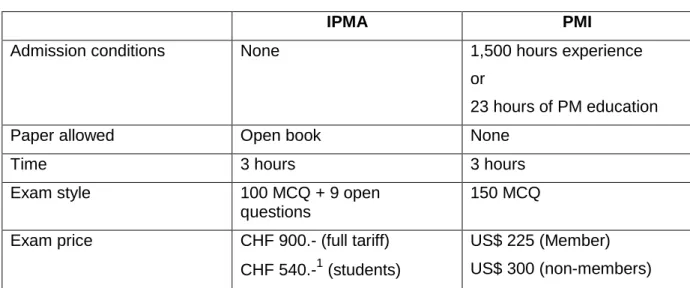
In the following table there is a comparison between the two certifications regarding a target like students of the HEG.
Tableau 1: PMI CAPM vs IPMA Level D
IPMA PMI
Admission conditions None 1,500 hours experience
or
23 hours of PM education
Paper allowed Open book None
Time 3 hours 3 hours
Exam style 100 MCQ + 9 open
questions
150 MCQ Exam price CHF 900.- (full tariff)
CHF 540.-1 (students)
US$ 225 (Member) US$ 300 (non-members)
According to this comparison, I can say that the IPMA certification has less requirement, which would be easier to target students in schools but the PMI examination would be easier to be done and is less demanding in the level of learning, organisation and correction. In that case the choice of the certification is really depending on the schools’ objectives, on the time allocation (for learning process) and on the finance.
1
In this table we can basically see that there are no big differences between the two certifications. We cannot say that one is better that the other. One is more oriented international and the other more multi-national. The PMI is based on “memorize & reproduce” and the IPMA is based on “cultural specificity and human competences plus an evaluation of the level of experience”.
But the comparison goes beyond those basic facts. There are mainly two big differences between the IPMA and the PMI:
• Philosophical • And cultural
PMI is American based and standardizes each process. If for example they want to change something in their methods, then everybody need to get align with the change. In one sense it is pretty easy because you do not really need to think, you just need to apply. But in the other hand it is not really flexible. Another good advantage of this certification is for the realisation of the course because it is easier for the speaker to make candidates learn a book by heart for the exam.
In the opposite, IPMA is an association between 55 countries so when you have a change, it goes slower because all the countries need to agree together on the change. But in the other hand, that brings its main value because it will respect the culture of each country and will be translated in each language. Moreover it takes more into consideration the human competences, the qualified experience and the competences to think “out of the box” of a person through it assessment, which is really important nowadays.
In General PMI and IPMA are beyond concurrent (just not in Switzerland where IPMA is having app. 90%2 of the market and where PMI is an insignificant competitors). I would rather say, that they are complementary. Few people tend to say that if one day those two organisms could let fall their differences due to their origins, they would do a perfect alliance. In Switzerland we can see a difference in the sectors. For example the bank, informatics, communication and federal administration are more IPMA oriented and the sector of chemical and pharmaceutical are more PMI oriented.
Their different approach of the certification cannot define a general recommendation of which certification for a candidate. People would need to analyse their objectives and if it is for a specific job, they would need to know which certification is needed.
2
3.5 Differences in the business model:
Another difference is in their business model. PMI create associations in countries that are promoting PMI. Those associations do not receive any money, and all what they generate goes back to PMI, nothing stays in the country of the association.
Concerning IPMA, each country is responsible to promote it. Countries are paying royalties and a part of what they have generated stays in the country. In general what is received at the IPMA is reinvested in innovation.
In order to propose various solutions on implementation, and for the aim of this work, I decided to pick the most suitable certification.
4. Selection of a certification
After all my researches and discussions with people involved in project management, the IPMA D certification would fit better the HEG strategy. In the next paragraphs, I will expose you my arguments.
First of all, I consider that the HEG is multi-national oriented through its exchange program that allow students from all over the world to come and do semesters in Geneva. By working with them through our different classes, we need to be able to adapt to different cultures and different methods. It would not bring a huge value to have a method that they would not be able to implement in their countries because it is too much oriented on an American spirit. Second of all, the HEG is based on “students thought”. It is more “learning by doing” than “memorizing and reproducing”. We learn concepts that we need to apply through projects that we have all along our bachelor.
A last argument concerning the school is that if after implementing the certification in the IBM program there is a large demand of the students to do a certification in project management, and the school decides to implement it as well in the “Economie d’entreprise” the IPMA certification can as well be done in French. In the opposite the PMI certification is only done in English. Moreover I think that for the school it is better to have the same certification for the project management class in both IBM and “Economie d’entreprise”.
From an external point of view, all the biggest Swiss companies (Regie) like Swisscom, CFF, Ruag, and the confederation are IPMA based. They are big employers in Switzerland and having a certification that corresponds to them would be an advantage in order to find a job. The confederation employs around 24,000 people.
Another practical point is that it is easier to pass from the IPMA certification to a PMI than the opposite.
Finally, we do have a lot of contact with teachers and speakers, which show that human contacts and competences are important for the HEG and this is the main added value of the IPMA certifications.
5. IPMA in the world
After having chosen the IPMA certification, I decided to look around the world and especially around Switzerland, how the certification is implemented in other schools.
During the project management congress in Lausanne, I had the opportunity to speak with different people involved in the IPMA certification in other countries.
5.1 Germany
My first comparison is with Germany. The organism that is in charge of the IPMA certification is the GPM “Deutsche Gesellschaft für Projektmanagement e.V.”
In this country there are no school that have implemented the IPMA certifications in their courses. I think that this is due to the process of certification. Basically, in order to have the IPMA Level D, you need to create a project (fake or personal project like a wedding for example), to write a report on it and assessors will evaluate you. Moreover you have to undertake an exam of two hours.
As the process is really demanding, there are basically just people who really wants to get involved in project management that are doing this certification. Moreover it might be a too hard work to ask in addition of the normal courses.
Germany is speaking to create a new level in their country in order to target people without any experience and just with an examination part, as per the D level in Switzerland. I guess this is in order to have more students’ certifications in order to catch them early in the IPMA world and this is a way they can compete with PMI.
5.2 Austria
The second comparison will be with the University of Applied Sciences BFI Vienna, Austria. They have a bachelor in « Project management and information technology ». In this context they propose a project management course based on « planning, controlling and organizing » and propose as well the IPMA level D certification.
Basically they introduced the certification after the demand of their students that were saying that it is important for their job research. Until now they implemented the IPMA certification
They propose the certification two times per year and they have in general thirty to forty candidates per year. In the last past four semesters, every student passed the certification. Their project management course is oriented towards the IPMA and the PMI certification. This was done in order to propose both certifications.
In the next part of my work, I will show you the findings of three interview that I had with organisms that propose the IPMA D certification to their students in Switzerland.
6. Interview of schools that certify their students in project
management
6.1 Ecole supérieur de Tourisme,
Ecole de commerce Hôtellerie Tourisme
The «Ecole supérieur de Tourisme, Ecole de commerce Hôtellerie Tourisme » in Lausanne, certifies their students in IPMA D, in the context of their project management class. Madam Hermanjat, director of the school in the French part of Switzerland, gave me an interview to answer questions.
Madam Hermanjat opened the school, in the French part of Switzerland, in 2008 and started the project management class in 2010. The class was directly guided towards the IPMA D criteria. Basically she took the class plan of the school of Zürich and adapted it to the criteria. This school has a special concept of class, which promote the practical side more than the theoretical one.
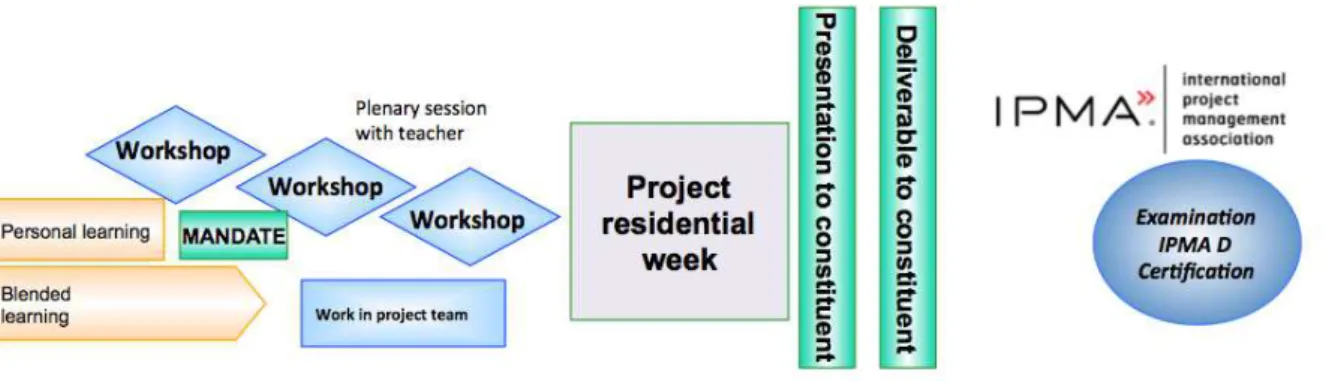
Source: Véronique Hermanjat, presentation of the EIT School, (PPT)
Basically this is not an ex-cathedra class. The concept is based on few workshops, on a project, on an e-learning module and lasts for 3 months. Madam Hermanjat preferred to reduce the cost of having a teacher on each class in order to pay a part of the e-learning to each students and as well in order to have a class based on practice through a mandate rather than on simple Power Point explanations. Before the beginning of the semester, the
need to finalize the project and to present it to the constituent. Few weeks later they have their examination for the IPMA D certification. In her school, the certification is mandatory. Since the implementation of the certification in 2011, the percentage of success at the exam from the students is equal to ~70% (45 subscriptions and 33 successes). The figures are not big because the EIT have two classes per year (part-time and full-time) and the volume of students is lower than the HEG for example.
This concept is “learning by doing”, which is really important for people who never did project management before. It is a good way to show a concrete project, which can be really vague in theory.
Madam Hermanjat thinks that the certification is a real plus for students, both on the professional side and on the academic one. Students are facing projects all along their life, with group work or a bachelor/diploma work, and the way to conduct a project that they have learned is helpful. On the professional side, to have a certification in addition to the academic one is an advantage. She even said, as an employer that she would privilege more somebody with a certification IPMA D than one without. It is like for example if you have the choice between two candidates, one has the “advance Cambridge certification” and one has good grade in English. You would employ the one with the certification. It is like a warranty that the candidate has an amount of knowledge, which was evaluated by third party. She said as well that it gives the international dimension to their program. A bachelor/diploma is a valuable paper but at an international level it is not necessarily recognized in each organism, so this certification gives the validation to an international company that the person has the knowledge that they need.
Madam Hermanjat knows well the PMI certification and thinks that there are differences with the IPMA one. The PMI is to learn a book by heart, and the IPMA is more “how you would act” in a situation, it takes more the behaviour side of candidates and not how the book says to react in the PMI.
Madam Hermanjat conducted a survey3 within the old students of her school, to know if the certification was useful in the professional side of the students. In average most of them find it valuable and good in their resume but not all of them could see a direct feedback regarding jobs opportunities for example. This survey does not have a huge volume because since the introduction of the certification 45 students applied to pass it and the survey was started this year.
3
One student of the EIT, found her dreamed job, a lot because of the IPMA certification. She is now employed by the ICRC (Red Cross), as an assistant in the juridical section. In a report4 she mentioned that her certification opened her the doors of the ICRC and the working world because she was working on a project and that her knowledge in project management helped her a lot. Finally she says that her acquired knowledge, help her a lot in her daily business and that projects are all around us. So it is important to know how to manage them.
6.2 University of Geneva: département des hautes études
commerciales
I had the opportunity to interview Mr. Dorat from the HEC Geneva. They are certifying their students in the context of the DAS in project management. The program is consisting in 12 modules and the certification is done after the three first modules (“introduction to management”, “planning” and “economic approach of projects”). The certification is on the side of the DAS, it is not the final exam. They propose as well the IPMA level C for those who already conducted project.
They implemented the IPMA D certification around ten years ago. They wanted to differentiate themselves from the PMI certification that was done only in English at that time. As the IPMA is international, it gives a common base to their program. M. Dorat thinks that it could be helpful for job recruitment but only if you want to work in project management. He is as well thinking that it could decrease the value of this certification if many school are doing it. It can show that it is an easy certification. Moreover, he said that some people do the DAS to have the knowledge about project management but the certification has not a real value in certain domains.
What I could take out of those two interviews is that it is important to get certified before a specialisation (within the main general studies). It gives a plus in order to have the first job and helps to differentiate from other applicants. After if students decide to go in the direction of project management they have the opportunity to get recertified just with their experiences in this domain and to evolve in the next level. Moreover it gives a big first network, which is quite complicated to build when you enter in the active life. Because when you enter into the IPMA world you have connection with people from other levels that can be really useful.
6.3 Haute école de Gestion Geneva : Certificate of Advanced Studies
“Management de projet appliqué”
At the “haute école de Gestion” in Geneva, there is a CAS in “management de projet appliqué” that enables students to get certified with the IPMA D certification. The course is oriented towards both IPMA and PMI certifications.
This CAS is based on the following modules:
• Project management, structuring and project organisation
• Planning and problems solbing technics, costs estimation and management
• Risks and quality management, communication and projects, purchase management methods and HERMES, agile management
• Project manager leadership, change and team management, negotiation and conflicts This CAS is proposed over 22 days which correspond to 15 credits and cost CHF 6,700.-. The students that are following this CAS finished their formation with a specific certificate. In addition the HEG proposes to its CAS participants to get certified in IPMA D. If participants have a special background in project management, they can also do the Level C. This is in order to add an international dimension and to give an international recognition.
The HEG tried to implement as well a certification in PMI in order to have several certifications to propose, but until now, PMI did not want to do it.
After a discussion with Madam Junod, responsible of the continuous formation at the HEG, the implementation of the certification at a bachelor level would be an advantage for the students.
She agreed that the IPMA certification would suit better the HEG culture and maybe it would be useful and better to propose different certification after a few years of application of the IPMA one, in order to answer better the demand of the students and of companies.
She thought about few constrains. The first one is that maybe the students do not have the level of maturity needed to put themselves in a place of managers in the second year. The second one would be about the time and the finance. The project management class is two hours per week, which is quite short and the exam has a certain cost.
In the next part of my work, I will propose you various solutions of implementation of this certification in the new IBM program.
7. Development of various training’s solutions
After having interviewed Mister Thierry Bonjour, VZPM, we found out different solutions regarding how to give class on project management and to prepare students for the certification. In this chapter, there are the description of each solution with their main advantages and disadvantages and their characteristics.
7.1 Blended learning: confederation’s model
Concept:
This training solution proposes that students take part to four workshops of preparation to the exam and in parallel they follow fourteen modules of formation “at home” with a computer and an Internet connection.
Characteristics:
• Good mix between theory by e-learning and practice by workshop • Content of the e-learning is covering 90% of the IPMA D criteria
• Workshop are realised on the basis of practice exercises and on blank test of IPMA D • This solution is used by the Swiss Confederation since the years 2010
Advantages:
• Reduce the number of hours in class
• Proven preparation to the level D exam (around 100% of success at the Swiss Confederation)
• Flexibility of learning the theory (on Internet and individual)
• The e-learning is delivered with a book that contains all explanation of the data given in the learning software
Disadvantages:
• Participants need to have an informatics materials (computer, Internet, speakers) • The speaker needs to be himself/herself IPMA certified because he/she needs to
debrief on the answers of the blank exam
7.2 Modular
Concept:
This solution consists on giving two modules of three days, which correspond to six day (48 periods). Participants have a theory book and need to follow the class with the explanation of the speaker. This formation is constituted of 50% of theory of the speaker and 50% of practice exercises to do individually or in groups.
Characteristics:
• During those six days, the exercises can create the “red line” for the participants and allow them to take part in a part of the life cycle of a project
• The repartition between the theory and the practice is balanced, which helps to create dynamism in the class
• The choice of the book is preponderant, it is on this one that participants base their knowledge for the certification
Advantages:
• Big proactivity of the participants
• Two times three days are often more easy to plan in a long course • Uses the usual teaching infrastructure
Disadvantages:
• No preparation to the IPMA exam in class because of a lack of time
• Need a hard work from the speaker for the preparation and the conceptualization of exercises and solutions
7.3 Concept EIT- Experience
Concept:
This concept is different of the “blended learning” by the fact that the school is mandated by a real client for a part of a project. The e-learning is on the same principle as the solution one, fourteen modules to do outside the class. The workshops are dedicated to the development of the project. Finally students and speaker participate to a six days week on site of the client to finish the project and the last day is dedicated to the presentation of the final result to the public and to the client.
Characteristics:
• This solution is based on a real practical case
• It gives to students, without any experience in project management, the opportunity to be confronted to the expectations of a client, to the constraints of stakeholders and to the obligation of a result. In the case, proven by the EIT in page 33, 34, a big effort is given on communication in the newspaper5, which gives good arguments for students towards their future employers.
• This solution puts a big pressure on students because they need to respect deadlines and a high risk for the school, which has signed the contract
Advantages:
• This solution is operational since 2011 by an ES active in the tourism domain • All the work done by students is directly usable by the client
• The experience lived by students is most probably the first one in project management and this improves their employability
• This solution put in place is part of a real project. Students are aware of the utility of their work. Some of them have been hired at the end of their study in order to realise the solution imagined in class
Disadvantages:
• The speaker need to have qualities in project management and in coaching the project manager
• A high risk is taken by the school
• Requires a high organisational effort from the client because he needs to have the infrastructure for the project week, to accommodate approximately 20 students • Students need to give a lot of their time
• The preparation of the IPMA exam is individual
7.4 Theoretical knowledge transfer
Concept:
This solution is the most seen one inside schools. It is planned during two periods per week and is well insert between other courses.
Characteristics:
• The formation is given on the bases of a speaker/teacher, on a support (PPT) and on personal lectures and exercises to do outside the course schedule.
Advantages:
• Fit harmoniously in a planning of a long course • The speaker/teacher is easily commutable
• Reduce the incertitude of students because they are used to this kind of teaching
Disadvantages:
• The topics are treated only in a theoretical way and is not confronted to practice • Lack of exchange/experience
7.5 Preferences ‘matrix
In order to do a multi-criteria analysis, in the next point, there is an analysis of the importance of the objectives chosen.
The analysis of the objectives was done towards the school interest. It helps to give an accurate weight to objectives.
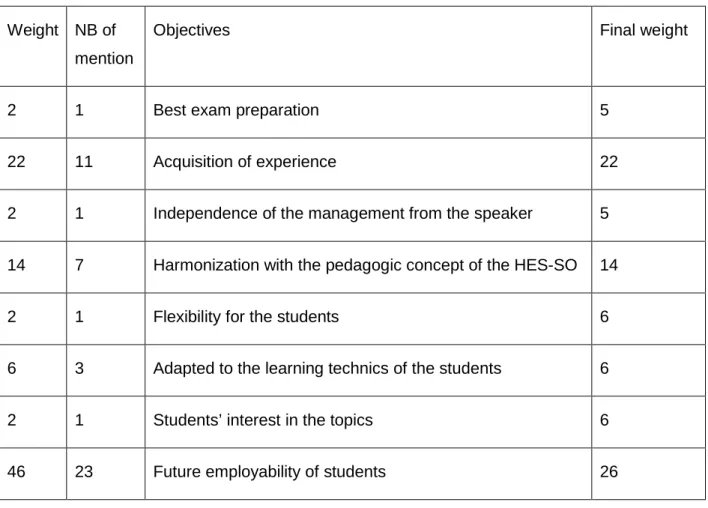
Basically you need to confront all the objectives with the others. Then you count the number of time that the objectives were mentioned and then with a calculation it gives the weight. This are the results obtained after having done the matrix of preferences. I realise at first that there are big differences between objectives. Some are really important and some are less. According to the “method and technics in organisation (MTO) from D. Götz Schmidt, p.44, I decided to change certain weight to diminish the importance of high objectives in order to be more accurate.
I decided to take out 20 points to the objective “Future employability of students” and redevised them between the lower weight objectives. The final results are the following:
Tableau 2: Matrix of preferences Weight NB of
mention
Objectives Final weight
2 1 Best exam preparation 5
22 11 Acquisition of experience 22
2 1 Independence of the management from the speaker 5
14 7 Harmonization with the pedagogic concept of the HES-SO 14
2 1 Flexibility for the students 6
2 1 Recycling of actual concept 5
2 1 Simplicity of the organisation and formation 5
100 50 Total 100
7.6 Multi-criteria analysis
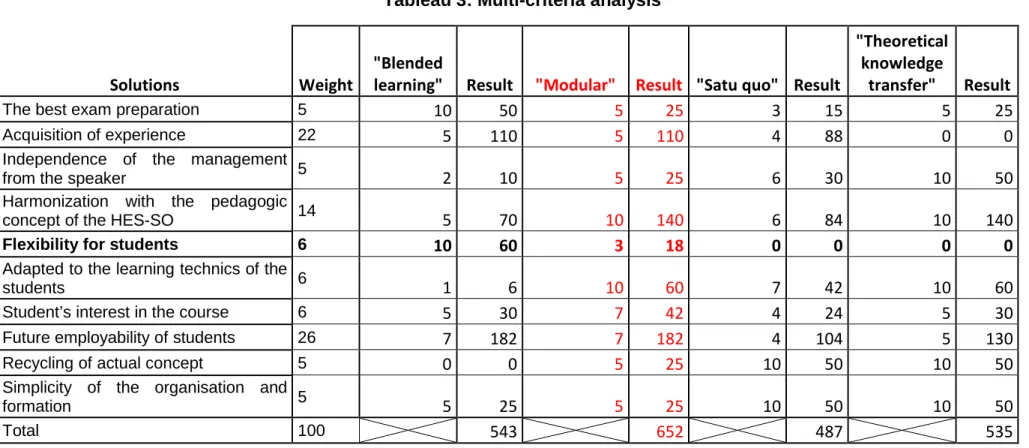
The following table is a multi-criteria analysis, which confronts all the solutions to the objectives cited in the previous part.
In order to complete this analysis, we could create a group in which all stakeholders like students, teachers and school management for example, in order to have the opinion of each side. But for now, I tried to put me in each position in order to be the most accurate.
Basically you take the previous objectives and take the weight that was established by the preferences’ matrix. Then you evaluate each solution in comparison of the objectives and gave it a grade in the sense of “how much from 0 to 10 this solution fulfills the objective” knowing that 0 is “not fulfilling at all the objective” and 10 is “fulfilling the best the objective”. Then I added all the points obtained by the solutions and the higher score would be the best solution.
Before to do the analysis, I decided to reject the solution “Experience” because I think that this solution would not be realizable in the context of the HEG. First of all because we have two kind of classes the part-time and the full-time. For the part-time they have responsibility in their work and towards their employer. I guess that it might be difficult for them to take a week off in order to do the project.
Second of all it means that during this project week, all other classes need to be cancelled or postponed and this might be difficult to re-plan all courses.
Third of all it would give a high importance to this class and the program regarding time allocation and credit allocation would have to be changed as well. We cannot do a huge project and give only two credits for that.
Finally the solution “statu quo” is added which mean that we would let the class as it is been done right now.
Tableau 3: Multi-criteria analysis
Solutions Weight
"Blended
learning" Result "Modular" Result "Satu quo" Result
"Theoretical knowledge
transfer" Result
The best exam preparation 5 10 50 5 25 3 15 5 25
Acquisition of experience 22 5 110 5 110 4 88 0 0
Independence of the management
from the speaker 5 2 10 5 25 6 30 10 50
Harmonization with the pedagogic
concept of the HES-SO 14 5 70 10 140 6 84 10 140
Flexibility for students 6 10 60 3 18 0 0 0 0
Adapted to the learning technics of the
students 6 1 6 10 60 7 42 10 60
Student’s interest in the course 6 5 30 7 42 4 24 5 30
Future employability of students 26 7 182 7 182 4 104 5 130
Recycling of actual concept 5 0 0 5 25 10 50 10 50
Simplicity of the organisation and
formation 5 5 25 5 25 10 50 10 50
Total 100 543 652 487 535
Explanation of the grading of the objectives:
In order to understand the points given to the objectives, here is an example of the reasoning regarding the objective “flexibility for students”. “Blended learning” is the solution that suits the best students’ flexibility because basically they are free to learn where and when they want. They can manage their time at their convenience so that is why a 10 is given. The “statu quo” and the “Theoretical knowledge transfer”
The best solution, which coming out of this analysis, is the “Modular” solution. It is the one that fulfill the most objectives and that correspond to the HEG culture and system.
After few discussions with Mister Merlier and Madam Junod, a good solution of application came out.
7.7 Application of the solution
In the second year, there are a lot of students in classes, which reduce the possibility of personal coaching on exercises and on preparation to the exam. Moreover students have a lot of exams at this period and might have to do a choice in which exam they will work more, so they would not put all their effort in this class. Another point is that in the second year students would maybe not be enough mature to put themselves in a manager position in order to do a project or exercises.
If the HEG put in place this new concept with the certification, students may not take this opportunity because of lack of time, lack of recourses, and this would be really a pity.
In order to counter those facts, we could have a final solution. We would still have the project management class in the second year but we could add a minor in the third year that would go deeper in the subject of project management. This would allow more time for practice and would target only the students that are really interested in project management. This minor would prepare as well the students for the IPMA D certification and an external session can be open for those who want to have it. It would be a session where any student can participate, even the one that followed the second year class. The exam would be organised once a year.
8. Conclusion
To conclude this bachelor work I can say, based on the previous findings, that the certifications in project management are a good plus in order to find a job and in order to get better in our daily business. It is not something that is mandatory but it can really help. It gives a great recognition of competences and knowledge by a third party. Nowadays this is important and it is what futures employers are looking for. Moreover this is an international certification and this is something that becomes more and more required in companies. Certification of person is a trend and it is growing. Organisms of certification are doing more and more advertising and companies are asking for those certifications. People want to have a proof of their knowledge.
The IPMA certification is the one that suite the most the HEG’s culture by is competences focus and by its way of doing. But by guiding the courses towards both certifications, IPMA and PMI, we would maybe be able, in foreseeable years, to propose both certifications to students in order to let them choose which one they want to do. As I think that they are complementary, this would give a great overview of the project management domain and this would allow students that want to work in a specific area to target the right certification. If the HEG want to be part of the “pioneers” in the Swiss French part regarding the project management, they should implement the IPMA level D certification in the program of IBM. Because of the two main constraints of “time” and “finance”, I would not implement the certification in the second year “project management” class but I would rather create a new minor for the third year students and go deeper in project management domain. This will allow the HEG to target the interested students that may want to work in this domain later on and as well allow the teacher to spend more time in private coaching, because the class would count less students than in the second year.
9. Bibliography
Chambres de métiers et de l’Artisanat, MA, (viewed on 1st April 2014), http://212.43.237.181/normalisation/Fiche.aspx?chapitre_id=2&fiche_id=16
CODINORM côte d’Ivoir – Normalisation, codinorm, (viewed on 7th may 2014) ;http://www.codinorm.org/certification/certification-de-personne
University of applied sciences BFI Vienna, fh-vie (viewed on the 11th may 2014) http://www.fh-vie.ac.at/en/Degree-Programmes/Bachelor/Project-Management-and-IT
International project management association, 2014, ipma (viewed on 15th April 2014), http://ipma.ch
Project management institute, 2014, pmi (viewed on 20th April 2014), http://www.pmi.org Verein zur Zertifiezierung von Personen im Management, 2014, vzpm, (viewed on 22nd April 2014), http://www.vzpm.ch/fr/
Schweizerische Gesellschaft für Organisation und Management, 2014, SGO (viewed on 2nd April 2014), http://www.sgo.ch
Société Suisse de management de projet, 2012, SMP (viewed on 2nd April 2014), http://www.project-management.ch/portail/
Schweizerische Gesellschaft für Projektmanagement, spm (viewed on 2nd April 2014), http://www.spm.ch/home/
Association Suisse d’organisation et de Managament, ASO (viewed on 2nd April 2014), http://www.aso-organisation.ch
GPM Deutsche Gesellschaft für Projekt management e. V., GPM, (viewed on April 2014), http://www.gpm-ipma.de/startseite.html
ISO, iso, (viewed on 25th April 2014),
http://www.iso.org/iso/home/news_index/news_archive/news.htm?refid=Ref1662
ORGANISATION INTERNATIONAL DE NORMALISATION ,2012. Evaluation de la conformité – Exigences generals pour les organisms de certification procédant à la certification de personnes. Second ed. 2012-09. ISO/IEC 17024:2012
ORGANISATION INTERNATIONAL DE NORMALISATION 2012. Lignes directrices sur le management de projet. First ed. 2012-09. ISO 21500:2012
THIERRY BONJOUR, 2014, certificats IPMA, les certificats de comptétence de réputation internationale, (PPT), Association pour la certification de personnes en management VZPM, 20.02.2014
DR. MARKUS A. ZOLLER, 2014, Workshop des assesseurs 2014, (PPT), Association pour la certification de personnes en management VZPM, Internal documents, 24.05.2014
PR DR H. C. MULT. NORBERT THOM, STEPHAN ODERMATT, 2007, Rapport d’expertise sur les procédures de certification en management de projet, Association pour la certification de personnes en management VZPM
DR. CORNELIA BACHMANN, MARTINA BIELER, Prouver sa compétence et son expérience – Certification internationale en management de projet et de processus, Association pour la certification de personnes en management VZPM
PAUL J. ZIMMERMANN, DANIEL T. BAUMANN, MANUEL JAKOB, ADRIAN EBENBERGER, 2006, Association pour la certification en management de projet, 1996-2006 10e anniversaire, Association pour la certification en management VZPM
2013, Compétence de conseil reconnue mondialement – IPMA – Certification international de consulting en management de projet, Association pour la certification en management VZPM
GÖTZ SCHMIDT, 2003, Méthode et techniques de l’organisation, Société Suisse d’organisation et de Management, august 2003, SGO, EAN13 :9783908026228
Guntern + Partner, WBT Management de projet, Manuel WBT management de projet, ConPlus Guntern + Partner