HAL Id: hal-02436427
https://hal.archives-ouvertes.fr/hal-02436427
Submitted on 13 Jan 2020HAL is a multi-disciplinary open access archive for the deposit and dissemination of sci-entific research documents, whether they are pub-lished or not. The documents may come from teaching and research institutions in France or abroad, or from public or private research centers.
L’archive ouverte pluridisciplinaire HAL, est destinée au dépôt et à la diffusion de documents scientifiques de niveau recherche, publiés ou non, émanant des établissements d’enseignement et de recherche français ou étrangers, des laboratoires publics ou privés.
Syntax-based identification of light-verb constructions
Silvio Cordeiro, Marie Candito
To cite this version:
Silvio Cordeiro, Marie Candito. Syntax-based identification of light-verb constructions. The 22nd Nordic Conference on Computational Linguistics (NoDaLiDa 2019), Sep 2019, Turku, Finland. �hal-02436427�
Syntax-based identification of light-verb constructions
Silvio Ricardo Cordeiro LLF, Université Paris Diderot
Paris, France
Marie Candito LLF, Université Paris Diderot
Paris, France
Abstract
This paper analyzes results on light-verb construction identification, distinguishing between known cases that could be di-rectly learned from training data from un-known cases that require an extra level of semantic processing. We propose a simple baseline that beats the best results of the PARSEME 1.1 shared task (Savary et al., 2018) for the known cases, and couple it with another simple baseline to handle the unknown cases. We additionally present two other classifiers based on a richer set of features, with results surpassing these best results by 7 percentage points.
1 Introduction
Light-verb constructions (LVCs), such as the ex-pression pay visit, are a linguistic phenomenon coupling a verb and a stative or eventive noun, in which the verb itself is only needed for mor-phosyntactic purposes, its syntactic dependents being semantically related to the noun. For in-stance in the sentence John paid me a visit, the subject and object of paid play the roles of the vis-itor and the visited. The verb’s semantics is either bleached or redundant with that of the noun (as in commit crime) (Savary et al., 2018).
This mismatch between syntax and semantics has to be taken care of for semantically-oriented tasks to recover the full predicate-argument structure of the noun, since at least one of its semantic argu-ments of the noun is generally attached to the verb in plain syntactic treebanks.1 Moreover, the fact
1
For instance, Nivre and Vincze (2015) report that for the majority of the 18 UD languages at that time, in a structure like X takes a photo of Y in English, X is attached to the verb, but the Y argument is attached to the noun. In some annotation schemes, the Y would be attached to the verb too. Note though that some treebanks do annotate the LVC status (e.g. in Hungarian). Additional semantic annotation of LVC can be found e.g. in propbank (Bonial and Palmer, 2016).
that the verb choice is conventionalized and se-mantically bleached makes LVC identification an important requirement in semantic tasks such as machine translation (Cap et al., 2015).
Because of their syntactico-semantic charac-teristics, LVCs are generally considered diffi-cult to circumscribe and annotate consistently (Bonial and Palmer, 2016). Yet recently, the PARSEME 2018 shared-task has brought forth a collection of corpora containing verbal multiword expression (VMWE) annotations across 19 lan-guages (Ramisch et al., 2018), including LVCs. The reported inter-annotator agreement is variable across languages, but the macro-averaged chance-corrected kappa is overall 0.69, which is generally considered to denote a good agreement. In the an-notated corpora, the category of LVCs2accounted for a third of all expressions (Savary et al., 2018). The annotation was performed in a separate layer, largely independent from the underlying syntactic framework, and relied on semantic properties of the verb (bleached or redundant in the given con-text) and both semantic and syntactic properties of the noun: it should be stative or eventive and take at least one semantic argument, and it should be possible to have all the syntactic arguments of the verb realized within a NP headed by the noun (for instance out of John paid me a visit, one can create the NP John’s visit to me).
A total of 13 systems participated in the PARSEME shared-task, predicting VMWEs oc-currence in the test corpora. Results for each sys-tem varied across different syssys-tems and target lan-guages, in which expressions that had been seen in the test corpus were predicted with variable ac-curacy. However, expressions that had never been seen in the test corpus were hardly ever predicted by most systems (the best F-score on
unseen-2Unless otherwise stated, this paper refers to the 1.1
edition of the PARSEME shared task, and to the category LVC.full (as opposed to LVC.cause).
in-train expressions in the closed track is below 20%).
In this paper, we investigate the task of LVC identification in running text. The main contribu-tions of this paper are: (1) we propose handling the task of LVC identification differently depend-ing on whether it was seen in the traindepend-ing corpus; (2) we present a simple baseline that surpasses all systems for seen LVCs; (3) we propose and eval-uate different techniques for the prediction of un-seen LVCs, which we then compare to the state of the art.
The remainder of this paper is structured as fol-lows: Section 2 presents the related work; Sec-tion 3 describes the methodology that will be em-ployed; Section 4 describes the results; and finally, Section 5 presents our conclusions.
2 Related Work
LVC identification may follow one of two strate-gies: (a) LVC candidates are initially proposed based on lexicosyntactic patterns, and are then classified as LVC or non-LVC based on other cri-teria; (b) a variant of the BIO scheme (Ramshaw and Marcus, 1999) is employed so as to directly classify each token as belonging or not to an LVC. The former method allows the use of features that encompass the LVC as a whole, while the latter can be more easily implemented in the framework of some machine learning algorithms.
Most works in the literature concerning LVC identification focus on annotations in a particu-lar language, often with a language-specific under-standing of LVCs. Vincze et al. (2013) adapt a de-pendency parser so as to identify Hungarian LVC candidates as a byproduct of parsing, which they then evaluate on the Szeged Dependency Treebank with LVC annotations. Nagy T. et al. (2013) ex-tract English LVC candidates involving a verb and a dependent noun with a specific dependency la-bel. A J48 and an SVM classifier are then consid-ered, using lexical and morphosyntactic features from the corpus, as well as semantic features from WordNet. The latter was found to contribute to better results when compared to earlier works that relied purely on morphosyntactic and statistical features (Tu and Roth, 2011). Chen et al. (2015) detect English LVCs in the BNC and OntoNotes corpora, using the PropBank layer to select LVC candidates composed of an eventive noun linked one of 6 known light verbs. The candidates are
then filtered based on semantic features, including WordNet synsets and hypernym relations.
More recently, the PARSEME shared-task saw 13 system submissions that tried to predict LVCs along with other VMWEs for annotated corpora in 19 languages (Ramisch et al., 2018). Over-all, the best F1 scores across all languages in the
open track were obtained by the SHOMA system, which employed a pipeline of CNNs, a Bi-LSTM, and and optional CRF layer (Taslimipoor and Ro-hanian, 2018). MWE prediction followed a variant of the BIO scheme that allowed multiple tags per token, with input features including a set of pre-trained embeddings (leading the system to com-pete in the open track category), POS tags, and a set of word-shape features.
In the closed track, the TRAVERSAL system obtained the best overall results for MWEs in gen-eral as well as for LVCs. It uses a syntax-based ap-proach, in which each node in the syntax tree was classified as part of an MWE or not (Waszczuk, 2018). The classifier resembles a second-order CRF, but rather than considering the previous 2 to-kens at each point, it considers the parent and left-sibling. Features included the lemma, POS tag and dependency relation.
Rather than predicting each token as being part of an LVC or not, the varIDE system use a Naive Bayes classifier to tag LVC candidates (Pasquer et al., 2018). These were extracted based on all possible token combinations whole multi-set of lemmas corresponded to an LVC that had been seen in the training corpus (no attempts were made at predicting unseen LVCs). Classifier features in-cluded POS tags and morphological information.
Graph convolutional neural networks have also been used in the identification of VMWE can-didates for subsequent classification (Rohanian et al., 2019). In this work, the network is com-bined with an attention mechanism so as to im-prove the accuracy of long-range predictions, and a Bi-LSTM layer is used to classify these predic-tions and produce the final output. The system uses contextualized embeddings (ELMo) and out-performs the state of the art for the four languages for which results are reported.
3 Methods and materials
Our LVC identification technique consists of two main stages: (1) extraction of LVC candidates based on syntactic patterns; and (2) classification
of candidates based on a set of lexical, morpholog-ical, syntactic and semantic features, concerning both the candidate as a whole and its components. 3.1 Extraction of candidates
The first step of LVC identification in a target cor-pus is to identify candidates. While LVCs are commonly thought of as a combination of a verb and noun acting as its direct object, other configu-rations can be attested in the PARSEME corpora. This may be due to morphosyntactic variations (e.g. passive voice), the presence of more com-plex noun phrases (instead of a single noun), non-standard analyses (e.g. verbs that are tagged as ad-jectives) or other language-specific idiosyncrasies. A robust candidate extraction method should han-dle this variation, and we do so by using the mor-phosyntactic patterns of the LVCs in the training corpora, using the provided UD parses.
So we start by extracting language-specific mor-phosyntactic patterns from the training LVCs. More specifically, for each LVC annotated in a training corpus, we retain a representation involv-ing the POS tag and the syntactic relation be-tween components (henceforth referred to as a “pattern”). If the LVC does not form a con-nected tree (e.g. to give a series of lectures), the pattern will additionally include the minimum number of nodes that makes the tree connected (if two nodes are only connected by the root node, we discard the occurrence instead). In the example above, the extracted pattern would be: VERB1
obj
−−→(NOUN2)−−→NOUNnmod 3(the components of the LVC being those not within brackets).
The number of extracted patterns ranges from 14 (Slovene) to 185 (Farsi), with an average of 90 patterns per language. We then sort the pat-terns based on how many occurrences of LVCs led to each pattern. As expected, the patterns fol-low a Zipfian distribution. For example, for the French training data, the most common pattern is VERB1
obj
−−→NOUN2with 977 occurrences; the second
is NOUN1 acl
−−→VERB2with 150 occurrences (as in for instance a picture taken yesterday); the third is VERB1
nsubj:pass
−−−−−−→NOUN2 with 58 occurrences (as in this picture was taken yesterday); and so on3.
The most common patterns are then used to identify LVC candidates in the train, development
3Note that the majority of LVCs has two components only,
but some do contain additional components, such as preposi-tions when they are required to connect the verb and the noun.
and test data, using the Grew tool (Bonfante et al., 2018). Obviously, using unlexicalized patterns results in getting a vast majority of candidates that are not LVCs, and this is even more true for rare patterns. We experimented with two pat-tern selecting stategies: topN, in which we take the N most common patterns (we considered val-ues of N ∈ {1, 5, 10, 20, 50} ); and atleastNoc-curs, in which we take all patterns that originated from at least N occurrences in the training cor-pus (we considered N ∈ {2, 5, 10, 50}). More-over, for each pattern p containing −−−→NOUNlabel i,
we add a pattern p0 replacing this subpattern by
label
−−−→(NOUNj) conj
−−→NOUNi4.
Using the selected patterns, we identify LVC candidates in the development and test corpora, but also in the training corpora, so as to obtain pos-itive and negative LVC candidates to train a binary classifier. For each identified candidate, we pro-duce a set of features which may be related either to the whole LVC, or to its components.5
3.2 Features
The PARSEME 1.1 data contains
test/development and training data for 19 languages. The training data contained an average of 1171 LVCs per language (σ=948, ranging from 78 for English to 2952 for Turkish). Most corpora contain morphosyntactic information (in most cases obtained by an external parser, and in most cases representing data using the POS and dependency tagsets recommended by UD).
For a given candidate c, we first extract the verb component v and predicative noun component n. This is in general trivial, but in order to cover all cases, v is taken to be the leftmost token that has POS tag VERB, or the leftmost AUX, or the leftmost ADJ, or the leftmost token in c, while n is the left-most NOUN, leftleft-most PROPN, or leftleft-most token that is not v. In all the features, we use the lemmas of v and n. We then extract the following features:
• F1: One-hot representing the pattern used to
predict the candidate (see Section 3.1). • F2: Fraction of true LVCs among all candi-4This alternative pattern would cover the expression make
adjustmentin make an effort and an adjustment, for which two occurrences of LVCs would be annotated according the PARSEME guidelines.
5For the training data, we take the union of gold LVCs and
LVC candidates identified through syntactic patterns, since the patterns do not cover all gold LVCs.
BG DE EL ES EU FA FR HE HR HU IT PL PT RO SL TR µAvg %seen 60 26 50 48 86 61 68 45 29 75 71 66 74 90 57 44 62 Coverage (seen) 98 100 100 95 94 91 99 82 93 86 90 97 95 96 100 98 95 Coverage (unseen) 73 84 91 98 98 90 91 78 96 86 72 90 93 33 92 95 90
Table 1: Fraction of LVC annotations that were seen in train, and LVC candidate coverage (highest recall achievable, if all candidates are predicted as LVC) — evaluated on the development sets.
dates in train that have the same pattern and lexical items (lemma-wise comparison) as c (-1 if unseen in train).
• F3: POS tag of v and n.
• F4: Dependency relation between v and n
(NONE if not directly connected).
• F5: One-hot for the number of components
of c (with the rationale that LVCs of length higher than 2 may display more non-standard behavior due to the additionally lexicalized words).
• F6: One-hot for the number of gaps
(extra-neous words that do not belong to the LVC), between the leftmost and rightmost compo-nents of c, in the underlying sentence. • FC: Binary contextual features from the
un-derlying UD parses. Features are defined for every observed hkey, valuei pair in the mor-phological CoNLLU column (e.g. hTense, Pasti), as well as every observed hcolumn, valuei pair for the UD columns FORM, LEMMA, XPOS, UPOS and DEPREL (e.g. hFORM, tooki, hLEMMA, picturei, hPOS, NOUNi). These features are binary in value, and indicate whether the hkey, valuei pair is present for c. A feature is considered present if it appears in at least one of the direct de-pendents of n or v. We consider only the top t features with the highest mutual informa-tion and whose underlying pairs appear in at least ` LVCs.
While it is clear that LVC identification would greatly benefit from fine-grained semantic clues such as noun predicativeness, such information is not readily available for most languages under study. We consider instead on a set of unsuper-vised features that can be constructed for all lan-guages based on distributional semantic models. In particular, we consider the fasttext (Bojanowski et al., 2017) set of pretrained word embeddings
(which is also used by the SHOMA system) as a basis for semantic features.
• FE: Word embeddings for the lemma of the
verb and noun (300 dimensions each). • F1k : k-nearest neighbors of the underlying
noun n. Considered neighbors are all nouns that are paired up with the underlying verb v in at least one LVC candidate in the train-ing set, whether true LVC or not. We select the top k neighbors whose embedding has highest cosine against n’s embedding. Each neighbor is either seen-in-LVC (it is part of at least one true LVC) or an unseen-in-LVC (it is part of false positives only). The final value of the feature is the sum of the scores of the k neighbors, where a seen-in-LVC neighbor has score +1 and an unseen-in-LVC neigh-bor has score −1.
• Fck: Same as F1k, but each neighbor’s score that is being summed up is additionally weighted by the underlying cosine.
3.3 LVC classifiers
We present below two LVC candidate binary clas-sifiers based on the features above: SVM and FFN. We compare them against two simple baselines: Majority, which only predicts LVCs seen in train, and kNN, which we use either for all LVCs or for those unseen in train, in combination with Major-ity for the seen LVCs. Note we consider a pre-dicted or gold LVC to be seen in train when the training corpus contains at least one gold LVC with same lemmas, in whatever order and with whatever syntactic pattern.
• Majority baseline: Predict a candidate as LVC if and only if it has been annotated more often than not in the training corpus (i.e. the value of feature F2is greater than 0.5).
• kNN baseline: Predict a candidate as LVC if and only if the value of feature Fckis positive,
Configuration BG DE EL ES EU FA FR HE HR HU IT PL PT RO SL TR µAvg Maj (seen) 72 84 76 89 81 83 93 68 91 91 87 92 86 90 70 38 81 kNN (seen) 62 84 76 89 79 81 92 66 91 91 83 89 82 37 60 46 78 FFN (seen) 74 78 82 94 87 87 94 67 92 92 86 90 88 87 68 71 85 SVM (seen) 70 74 84 86 86 89 93 64 91 91 84 89 90 72 76 57 84 kNN (unseen) 08 08 24 22 32 30 30 04 13 13 11 20 32 00 04 24 22 FFN (unseen) 15 18 27 29 22 55 31 05 21 33 12 22 25 00 08 27 28 SVM (unseen) 15 15 33 20 42 63 37 02 24 46 10 31 45 00 10 34 34
Table 2: F1 scores on Majority and kNN baselines (Fckwith k = 2) , along with the best configuration
for the SVM and FFN classifiers — on the development sets.
meaning that within the k nominal neigh-bors of the noun n of the candidate, the total cosine of seen-in-LVC surpasses that of the unseen-in-LVC neighbors.
• SVM: Support vector machine with RBF ker-nel. Positive and negative examples are bal-anced through compensating class weights. We use a 3-fold grid-search to select for the best combination of classifier hyperpa-rameters for each language; we consider the values C ∈ {1, 10, 20, 50, 100} and γ ∈ {0.5, 0.1, 0.05, 0.01}.
• FFN: Feed-forward network with a 100-neuron hidden layer, using tanh as an acti-vation function and 50% dropout. The net-work uses an SGD optimizer6 and negative log-likelihood loss. Positive training exam-ples are duplicated as much as needed so as to be balanced against negative examples. The final list of examples is shuffled, and fed into the classifier in batches of size B ∈ {1, 2, 4, 8, 16}. Training is performed for a number e of epochs, such that epoch e + 1 would have had higher loss on the valida-tion set (10% of train). One-hot features are implemented as a layer of trainable embed-dings instead (300 dimensions for lemmas; 5 dimensions for dependency relations, for F5
and F6).
3.4 Evaluation
We explore hyperparameters on the 16 languages that contained a development set, and evaluate the final systems on the test set for all 19 languages (using both training and development set for train-ing). Evaluation of LVC predictions for each lan-guage uses the MWE-based F1 score from of the
PARSEME shared task (Ramisch et al., 2018). We modified its evaluation script so as to output scores
6Basic tuning of the learning rate led us to use 0.01.
for seen and unseen LVCs: it first labels a LVC (whether gold or predicted) as "seen" if there ex-ists at least one gold LVC occurrence with the same set of lemmas in the training set, and unseen otherwise. The two labels are then evaluated sep-arately.
We also present a micro-average score (µAvg), in which the F1 scores of all languages are
av-eraged with a weight that is proportional to the number of LVCs in that languages test (or devel-opment) set.7On test sets, we compare our results with SHOMA and TRAVERSAL, the two highest-scoring systems in the shared-task.8
4 Results
Table 1 presents the fraction of LVCs in the de-velopment set that can also be seen in the training set. In the lower end, German dev LVCs were only seen in train 26% of the time, mostly due to the small training set in this language. In the higher end, 90% of Romanian LVCs had a counterpart in the training set, suggesting that a simple baseline focusing on seen LVCs should already yield good results for this language.
The last two rows in Table 1 present the cov-erage (i.e. recall) in the initial step of LVC can-didate extraction, for the strategy atleastNoccurs with N = 2. This strategy was found to yield the best results in both SVM and FFN settings dur-ing early experiments. It can be seen that, despite variation across languages, mainly due to training corpus size differences, the micro-averaged cover-age is 95% for dev LVCs seen in train, and slightly
7
We chose to use micro-average, since the test sets across languages don’t have the same number of sentences, for rea-sons that are independent of the linguistic properties of each.
8
We used the predicted test sets of all participat-ing systems (made available by the shared task organiz-ers at https://gitlab.com/parseme/sharedtask-data/ tree/master/1.1/system-results), filtering them to con-sider LVCs only. The best systems in open and closed tracks (SHOMA and TRAVERSAL) are the same when considering all verbal MWEs or LVCs only.
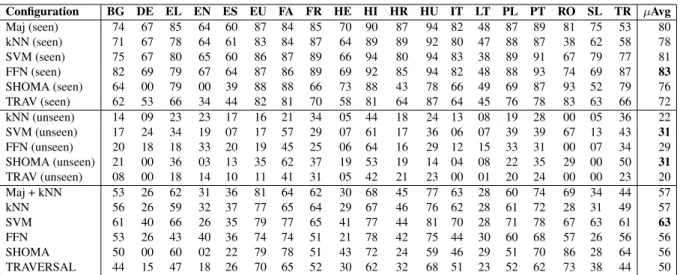
Configuration BG DE EL EN ES EU FA FR HE HI HR HU IT LT PL PT RO SL TR µAvg Maj (seen) 74 67 85 64 60 87 84 85 70 90 87 94 82 48 87 89 81 75 53 80 kNN (seen) 71 67 78 64 61 83 84 87 64 89 89 92 80 47 88 87 38 62 58 78 SVM (seen) 75 67 80 65 60 86 87 89 66 94 80 94 83 38 89 91 67 79 77 81 FFN (seen) 82 69 79 67 64 87 86 89 69 92 85 94 82 48 88 93 74 69 87 83 SHOMA (seen) 64 00 79 00 39 88 88 66 73 88 43 78 66 49 69 87 93 52 79 76 TRAV (seen) 62 53 66 34 44 82 81 70 58 81 64 87 64 45 76 78 83 63 66 72 kNN (unseen) 14 09 23 23 17 16 21 34 05 44 18 24 13 08 19 28 00 05 36 22 SVM (unseen) 17 24 34 19 07 17 57 29 07 61 17 36 06 07 39 39 67 13 43 31 FFN (unseen) 20 18 18 33 20 19 45 25 06 64 16 29 12 15 33 31 00 07 34 29 SHOMA (unseen) 21 00 36 03 13 35 62 37 19 53 19 14 04 08 22 35 29 00 50 31 TRAV (unseen) 08 00 18 14 10 11 41 31 05 42 21 23 00 01 20 24 00 00 23 20 Maj + kNN 53 26 62 31 36 81 64 62 30 68 45 77 63 28 60 74 69 34 44 57 kNN 56 26 59 32 37 77 65 64 29 67 46 76 62 28 61 72 28 31 49 57 SVM 61 40 66 26 35 79 77 65 41 77 44 81 70 28 71 78 67 63 61 63 FFN 53 26 43 40 36 74 74 51 21 78 42 75 44 30 60 68 57 26 56 56 SHOMA 50 00 60 02 22 79 78 51 43 72 24 59 46 29 51 70 86 28 64 56 TRAVERSAL 44 15 47 18 26 70 65 52 30 62 32 68 51 23 52 62 73 38 44 50
Table 3: F1scores (split for seen LVCs, unseen LVCs and overall) for the Majority and kNN baselines,
the best configuration of our SVM and FFN classifiers, and the highest-scoring systems in the shared-task (SHOMA and TRAV(ERSAL)) — evaluated on the test sets.
lower (90%) for unseen ones.
We tuned the hyperparameters on the develop-ment sets. For every system, the same configura-tion is used for all languages. The best kNN con-figuration is Fckwith k=2; the best SVM and FFN configurations are both F1..6, FC(t=30, `=30), FE.
Table 2 presents the scores obtained by these best configurations on the development sets. Across seen LVCs, both the Majority and kNN baselines have considerably high scores (F1=81
and 78 respectively, but the highest results are ob-tained by FFN and SVM (F1=85 and 84). For the
unseen LVCs, results are quite lower, and there is a bigger gap between the kNN baseline (F1=0.22)
and the best system on unseen, namely the SVM (F1=0.34).
Table 3 presents system results for the same configurations when evaluated against the test sets. On seen LVCs here again, the Majority baseline is slightly higher than the kNN baseline. How-ever, both baselines beat the best systems from the shared-task (that we recomputed for LVCs only). Results for SVM (F1=81) are comparable to the
Majority baseline (F1=81) while FFN obtains the
highest score (F1=83).
When we consider LVCs that were not seen in training data, results are much lower. The kNN baseline obtains an F1=0.22, while SHOMA
obtains F1=0.31, as does our SVM, while
re-sults for FFN are slightly weaker. When predic-tions for both seen and unseen LVCs are taken together, FFN and SHOMA have comparable scores (F1=56), while the baselines (either
Major-ity+kNN or kNN alone) is slightly higher. The best system overall is the SVM (F1=63).
5 Conclusion
In this paper, we considered the task of iden-tifying LVCs in running text. We propose to use data-driven language-specific syntactic pat-terns for the extraction of LVC candidates out of syntactic parses, followed by a binary classifica-tion of the candidates into LVC or not.
We proposed a strong baseline combining dif-ferent methods for LVC candidates depending on whether they were seen in the training set or not (“seen” meaning a LVC with same lemmas is an-notated at least once in the training set). The base-line for seen cases tags a candidate as LVC if the training occurrences with same lemmas are more often tagged as LVC than not. The baseline for unseen cases uses the similarity of the predicative noun with the nouns of the training candidates, in a distributional semantic model. We also proposed supervised classifiers (a SVM and a feed-forward neural network) trained using internal and contex-tual morphosyntactic and semantic features, and working independently of the seen/unseen status.
Overall the SVM system is our best one, sur-passing the best shared task system on LVCs (SHOMA, (Taslimipoor and Rohanian, 2018)) by 7 percentage points. When evaluating perfor-mance separately on seen and unseen LVCs, the feed-forward network performs a little better on seen LVCs, but less well on unseen ones. It
also appears that our results for seen LVCs sur-pass the best shared-task results even in the case of the baseline, in spite of a much simpler tech-nique of supervised learning. For unseen LVCs, results are globally quite lower. The best perfor-mance is F1=31%, achieved both by the SHOMA
system and our SVM. Our kNN-inspired baseline achieves F1=22% only, a performance that would
rank second for unseen LVCs in the shared task. Given the quality of predictions for seen LVCs, future works should focus on improving predic-tion for the unseen expressions. Such task could be achieved through an evaluation of different types of neural network. Other semantically-motivated language-independent features should also be considered, so as to estimate the candi-date noun’s abstractness and predicativeness, as well as the level of semantic bleaching in the use of the verb. Finally, future works should investi-gate using a model for contextualized word em-beddings such as BERT (Devlin et al., 2018)), de-spite the difficulty of covering the 19 languages of the PARSEME datasets.
Acknowledgements
We would like to thank Bruno Guillaume for ad-vice in using Grew. This work was partially funded by the French National Research Agency (PARSEME-FR ANR-14-CERA-0001).
References
Piotr Bojanowski, Edouard Grave, Armand Joulin, and Tomas Mikolov. 2017. Enriching word vectors with subword information. Transactions of the Associa-tion for ComputaAssocia-tional Linguistics, 5:135–146. Guillaume Bonfante, Bruno Guillaume, and Guy
Per-rier. 2018. Application of Graph Rewriting to Natu-ral Language Processing. Wiley Online Library. Claire Bonial and Martha Palmer. 2016.
Comprehen-sive and consistent propbank light verb annotation. In LREC.
Fabienne Cap, Manju Nirmal, Marion Weller, and Sabine Schulte im Walde. 2015. How to account for idiomatic German support verb constructions in
statistical machine translation. In Proceedings of
the 11th Workshop on Multiword Expressions, pages 19–28, Denver, Colorado. Association for Computa-tional Linguistics.
Wei-Te Chen, Claire Bonial, and Martha Palmer. 2015. English light verb construction identification using
lexical knowledge. In Proceedings of the Twenty-Ninth AAAI Conference on Artificial Intelligence, AAAI’15, pages 2375–2381. AAAI Press.
Jacob Devlin, Ming-Wei Chang, Kenton Lee, and
Kristina Toutanova. 2018. BERT: pre-training of
deep bidirectional transformers for language under-standing. CoRR, abs/1810.04805.
István Nagy T., Veronika Vincze, and Richárd Farkas. 2013. Full-coverage identification of English light verb constructions. In Proceedings of the Sixth In-ternational Joint Conference on Natural Language Processing, pages 329–337, Nagoya, Japan. Asian Federation of Natural Language Processing. Joakim Nivre and Veronika Vincze. 2015. Light verb
constructions in universal dependencies. In Poster at the 5th PARSEME meeting, Iasi, Romania. Caroline Pasquer, Carlos Ramisch, Agata Savary, and
Jean-Yves Antoine. 2018. VarIDE at PARSEME shared task 2018: Are variants really as alike as two peas in a pod? In Proceedings of the Joint Workshop on Linguistic Annotation, Multiword Expressions and Constructions (LAW-MWE-CxG-2018), Santa Fe, New Mexico, USA. Association for Computa-tional Linguistics.
Carlos Ramisch, Silvio Ricardo Cordeiro, Agata Savary, Veronika Vincze, Verginica Barbu Mititelu, Archna Bhatia, Maja Buljan, Marie Candito, Polona Gantar, Voula Giouli, Tunga Güngör, Abdelati Hawwari, Uxoa Iñurrieta, Jolanta Kovalevskait˙e, Si-mon Krek, Timm Lichte, Chaya Liebeskind, Jo-hanna Monti, Carla Parra Escartín, Behrang Qasemi-Zadeh, Renata Ramisch, Nathan Schneider, Ivelina Stoyanova, Ashwini Vaidya, and Abigail Walsh. 2018. Edition 1.1 of the PARSEME shared task on automatic identification of verbal multiword expres-sions. In Proceedings of the Joint Workshop on Lin-guistic Annotation, Multiword Expressions and Con-structions (LAW-MWE-CxG-2018), pages 222–240, Santa Fe, New Mexico, USA. Association for Com-putational Linguistics.
Lance A Ramshaw and Mitchell P Marcus. 1999. Text chunking using transformation-based learning. In Natural language processing using very large cor-pora, pages 157–176. Springer.
Omid Rohanian, Shiva Taslimipoor, Samaneh
Kouchaki, Le An Ha, and Ruslan Mitkov. 2019. Bridging the gap: Attending to discontinuity in
identification of multiword expressions. In
Pro-ceedings of the 2019 Conference of the North American Chapter of the Association for Computa-tional Linguistics: Human Language Technologies, Volume 1 (Long and Short Papers), pages 2692– 2698, Minneapolis, Minnesota. Association for Computational Linguistics.
Agata Savary, Marie Candito, Verginica Barbu Mi-titelu, Eduard Bejˇcek, Fabienne Cap, Slavomír
ˇ
Céplö, Silvio Ricardo Cordeiro, Gül¸sen
Ce-biro˘glu Eryi˘git, Voula Giouli, Maarten Van Gompel, Yaakov HaCohen-Kerner, Jolanta Kovalevskait˙e, Simon Krek, Chaya Liebeskind, Johanna Monti,
Carla Parra Escartín, Lonneke Der, Behrang
Qasemi Zadeh, Carlos Ramisch, and Veronika
Vincze. 2018. PARSEME multilingual corpus of
verbal multiword expressions. Berlin: Language
Science Press.
Shiva Taslimipoor and Omid Rohanian. 2018.
SHOMA at PARSEME Shared Task on automatic identification of VMWEs: Neural multiword
ex-pression tagging with high generalisation. arXiv
preprint arXiv:1809.03056.
Yuancheng Tu and Dan Roth. 2011. Learning English light verb constructions: contextual or statistical. In Proceedings of the Workshop on Multiword Ex-pressions: from Parsing and Generation to the Real World, pages 31–39. Association for Computational Linguistics.
Veronika Vincze, János Zsibrita, and István Nagy T.
2013. Dependency parsing for identifying
Hun-garian light verb constructions. In Proceedings of the Sixth International Joint Conference on Natu-ral Language Processing, pages 207–215, Nagoya, Japan. Asian Federation of Natural Language Pro-cessing.
Jakub Waszczuk. 2018. TRAVERSAL at PARSEME Shared Task 2018: Identification of verbal mul-tiword expressions using a discriminative tree-structured model. In Joint Workshop on Linguistic Annotation, Multiword Expressions and Construc-tions (LAW-MWE-CxG-2018).