Publisher’s version / Version de l'éditeur:
Canadian Fire Alarm Association Newsletter, Sept., pp. 7-11, 1993-09
READ THESE TERMS AND CONDITIONS CAREFULLY BEFORE USING THIS WEBSITE. https://nrc-publications.canada.ca/eng/copyright
Questions? Contact the NRC Publications Archive team at
[email protected]. If you wish to email the authors directly, please see the
NRC Publications Archive
Archives des publications du CNRC
This publication could be one of several versions: author’s original, accepted manuscript or the publisher’s version. / La version de cette publication peut être l’une des suivantes : la version prépublication de l’auteur, la version acceptée du manuscrit ou la version de l’éditeur.
Access and use of this website and the material on it are subject to the Terms and Conditions set forth at
Effects of automatic sprinkler protection on a smoke control system
Mawhinney, J. R.
https://publications-cnrc.canada.ca/fra/droits
L’accès à ce site Web et l’utilisation de son contenu sont assujettis aux conditions présentées dans le site LISEZ CES CONDITIONS ATTENTIVEMENT AVANT D’UTILISER CE SITE WEB.
NRC Publications Record / Notice d'Archives des publications de CNRC: https://nrc-publications.canada.ca/eng/view/object/?id=981bd0bf-89de-4d54-bf79-19d3d438c761 https://publications-cnrc.canada.ca/fra/voir/objet/?id=981bd0bf-89de-4d54-bf79-19d3d438c761
Effe c t s of a ut om a t ic sprink le r prot e c t ion on a sm ok e c ont rol syst e m
R N R C C - 3 6 9 9 3
M a w h i n n e y , J . R .
S e p t e m b e r 1 9 9 3
A version of this document is published in / Une version de ce document se trouve dans: Canadian Fire Alarm Association Newsletter, Sept. 1993, pp. 7-11
http://www.nrc-cnrc.gc.ca/irc
The material in this document is covered by the provisions of the Copyright Act, by Canadian laws, policies, regulations and international agreements. Such provisions serve to identify the information source and, in specific instances, to prohibit reproduction of materials without written permission. For more information visit http://laws.justice.gc.ca/en/showtdm/cs/C-42
Les renseignements dans ce document sont protégés par la Loi sur le droit d'auteur, par les lois, les politiques et les règlements du Canada et des accords internationaux. Ces dispositions permettent d'identifier la source de l'information et, dans certains cas, d'interdire la copie de documents sans permission écrite. Pour obtenir de plus amples renseignements : http://lois.justice.gc.ca/fr/showtdm/cs/C-42
EFFECTS OF AUTOMATIC
SPRINKLER PROTECTION ON A
SMOKE CONTROL SYSTEM
by J.R. Mawhinney, P.Eng.
Smoke from shielded, sprinkleredfires will spread through a building
if
no measures are taken to stop it ·A series of experiments at the National Fire Laboratory (NFL), measured the effects of water spray from automatic sprinklers on the temperature, pressure, oxygen, carbon
dioxide and carbon monoxide levels in a building under fire conditions. The project was . jointly funded by the American Society of Heating, Refrigerating and Air Conditioning Engineers, Inc.(ASHRAE) and the National Research Council of Canada.
Sprinklers act quickly to extinguish fires before they become large enough to create dangerous smoke conditions in a building. In these tests, however, particular attention was paid to shielded fires, in which an obstacle prevented water spray from extinguishing the burning fuel. In an office occupancy, for example, shielded fires could develop in combustible materials stored under a table or in a closet, or in compact mobile shelving units for paper files. In shielded fires, sprinklers restrain the burning rate, prevent fire spread and reduce temperatures, but are not able to eliminate the smoke hazard in the building.
Testing involved two phases. In the first phase, wood cribs were burned in a one-story test room 6 m x 6 m x 3.6 m high. The second phase involved creating wood crib fires on the 7th floor of the NFL's I 0-storey experimental tower; the fire floor was mechanically exhausted, while air was supplied to pressurize the floors above and below the fire floor. The stair shaft was not actively pressurized. The presence of carbon dioxide (C02) in concentrations greater than normal ambient levels, at any location outside the fire floor, was interpreted as evidence of 'smoke' spread.
The fire intensity was varied by reducing or increasing the sprinkler spray density so that the effects of hotter or cooler fires on the building could be assessed. The supply of combustion air to the fires was limited to less than what the fire would need for fully unconfined burning.
The 10-storey building was pressurized as a zoned smoke control system, in conformance with the recommendations in the ASHRAE Smoke Control Design Manual. Three levels of design pressure difference between zones (DP design) were tested: DP design= 25 Pa, 12.5 Pa and 0. The last case presented no
ウセッォ・@
control other than the sprinklers, and corresponded roughly to "Measure A- fully sprinklered building" in the National Building Code of Canada. Doors to the stair shaft were opened in various sequences to increase or decrease the likelihood of smoke spreading into the stair shaft.1300
Unsprlnklered 545 kg wood cribs
1800
'
59 kg!m' fuel load1200 , . Unsprinklered fire 295 kg Wood cribs 1100
'
32 kg/m2 fuel load'
100C
セ@ 1600
' '
Sprinklered セ@ 900.'
'
' Sprinklered shielded firesi 1400 ' ,...--!shielded fires
セ@
800Gセ@
e
j
1200 100C,.
,.,
,,
,.
I'
700!
800 セ@ 500 I Y ' ' 1\i m J: 800 y yiY'
Sprinkle red'
unshielded 600 I'
lire (peak) 400 NFPA 13 1',
セ@
minimum design 200 density I y"'
1\i £ 0 0 2 3 4 5 6 7 8 9 10Sprinkler spray density 4>mlm2
Figure I Effect of sprinklers on heat release rate,
one storey test room
Heat Release Rate
400 I "Y,
NFPA 13 I
'
300
'
200 density minimum design II .,. Unshielded
100 fire (peak)
ッlMセMlMMセセMlセMMセセセ@
0 2 3 4 5 6 7 6 8
Sprinkler spray densi1y 4>mlm"
Figure
2 Effect of sprinklers on heat
release rate, ten storey tower
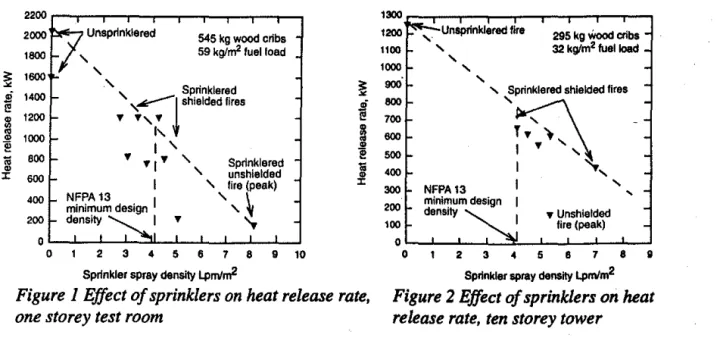
Figures 1 and 2 show the effects of sprinklers on heat release rate (HRR) for the one-storey and 1 0-one-storey tower tests. A sprinkler spray density of 0 Lpmlrn2 represented an unsprinklered fire. The HRR of the unsprinklered one-storey crib fires was about twice the rate of the tower fires, due to the difference in size of the cribs.
In
both cases, increasing the sprinkler spray density reduced the burning rate. For spray densitiesaround 4.1 Lprnlrn2, the minimum acceptable by the sprinkler design standard (NFPA 13) for light hazard fuel arrays, the HRR was reduced to about 50% of its unsprinklered value, although the fires continued to generate smoke. The unshielded wood crib fires were extinguished within a few minutes of sprinkler operation. Sprinklers operating near minimum densities are able to restrain the HRR to about 50% of an unsprinklered fire. NFP A 13 recognizes control of HRR and reduced temperatures as acceptable fire suppression performance of a sprinkler system. However, from the point of view of smoke control systems, continued burning of the shielded fire results in a significant smoke hazard in the building.
Radiant Heat Flux and Temperatures
Sprinkler spray was very effective at reducing the radiant heat from these fires. At even very low spray densities, a dramatic reduction in radiant flux to the walls was recorded. One significant benefit of reduced radiant heat is the reduced likelihood of windows breaking. From the point of view of smoke control then, sprinklers improve confidence that the integrity of the fire compartment will be maintained, even with only marginal sprinkler performance.
Figure 3 shows that sprinklers were very effective in reducing room temperatures, even when the spray density was too low to significantly reduc.e the heat release rate. Without sprinklers, temperatures exceeded
soo•c
throughout the room. With sprinklers, average temperatures were reduced to less than 150°C, and even peak ceiling temperatures never exceeded 210• C. Only two sprinklers were used in these tests.In
a fully sprinklered building, hot gases leaving the zone of influence of the first two sprinklers would activate additional sprinklers, which would bring about more cooling.Buoyancy Pressures
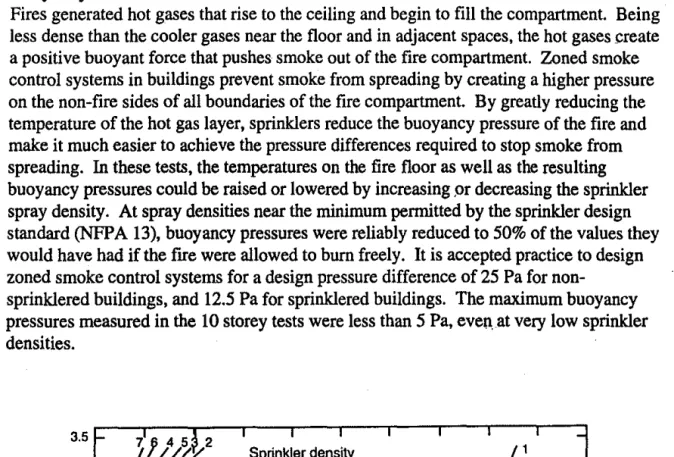
Fires generated hot gases that rise to the ceiling and begin to fill the compartment. Being less dense than the cooler gases near the floor and in adjacent spaces, the hot gases create a positive buoyant force that pushes smoke out of the fire compartment. Zoned smoke control systems in buildings prevent smoke from spreading by creating a higher pressure on the non-fire sides of all boundaries of the fire compartment. By greatly reducing the temperature of the hot gas layer, sprinklers reduce the buoyancy pressure of the fire and make it much easier to achieve the pressure differences required to stop smoke from spreading. In these tests, the temperatures on the fire floor as well as the resulting buoyancy pressures could be raised or lowered by increasing ,or decreasing the sprinkler spray density. At spray densities near the minimum permitted by the sprinkler design standard (NFPA 13), buoyancy pressures were reliably reduced to 50% of the values they would have had if the fire were allowed to burn freely. It is accepted practice to design zoned smoke control systems for a design pressure difference of 25 Pa for
non-sprinklered buildings, and 12.5 Pa for non-sprinklered buildings. The maximum buoyancy pressures measured in the 10 storey tests were less than 5 Pa, even. at very low sprinkler densities.
Figure 3 Temperature profiles, one storey test room, for different spray application rates Gas Concentrations
Sprinklers quickly extinguish an unshielded fire, so that smoke production ceases. Once combustion is stopped, the production of C02 and CO stops, and any that was produced begins to decrease in concentration. Two tests with unshielded wood cribs confirmed that when the fire was quickly extinguished by the sprinklers, CO and C02 production was negligible, and what was produced was rapidly purged from the building.
For the shielded wood cribs, however, the total smoke production over the duration of the fires, and the concentrations of CO and C02, were very high. With heat release rates between 400 and 800 kW, very limited air supply and wet, cool conditions, CO
concentrations of more than 10,000 ppm were recorded. These high concentrations were primarily due to poor ventilation on the fire floor, but also to the inefficiency of
combustion under wet conditions. Such high concentrations would result in death or incapacitation of occupants within a very few minutes. The CO concentration in smoke that spread beyond the fire floor would be lower, but could still pose a serious threat to life.
Performance of the Zoned Smoke Control System
Three design pressure conditions were tested in the 10-storey tower; 25, 12.5 and) Pa. For the first two cases, smoke was confined to the fire floor, so long as the door to the stair shaft remained closed. As soon as the door was opened, however, smoke spread into the stair shaft. Once in the stair shaft, it rose to the upper portions of the building, where it leaked into the non-pressurized floors. The spread of smoke into the stairs was
prevented, however, by pre-pressurizing the stair shaft and providing a source of free-moving air by opening, and keeping open, a door to one of the pressurized zones prior to opening the door to the fire floor.
Under the third pressure condition of 0 Pa, smoke spread into the upper floors of the building via leakage openings between floors, and through the door to the stair shaft after it was opened. This condition was equivalent to Measure A in the National Building Code of Canada, i.e., a fully sprinklered building, where the sprinklers are considered to be the smoke control measure. These tests demonstrated that, in the case of a shielded fire which is controlled but not extinguished, the fire will continue to produce smoke with low temperature but high toxicity, which will spread through the building under stack action and its own low buoyancy pressure unless specific measures are taken to stop it. Heat release rate, radiant heat, room temperatures and buoyancy pressures caused by fires in shielded wood cribs were reduced significantly by the sprinklers. Despite the
shielding, the sprinklers achieved "control" of the fire, as defined by the sprinkler system design standard NFP A 13. Fire-induced buoyancy pressures, for example, were in the rate of 2 to 3 Pa, or about one quarter the pressure difference recommended by the
ASHRAE Smoke Control Manual for sprinklered buildings. The tests also demonstrated, however, that shielded, sprinklered fires can burn for extended period of time and
produce large quantities of smoke. Concentrations of carbon monoxide in the smoke may be very high, depending on ventilation conditions of the fire. Although the zoned smoke control system prevented smoke spread to adjacent pressurized floors, it did not prevent smoke spread into the stair shaft after the door to the fire floor was opened, unless the stair shaft had been pre-pressurized by prior opening of other doors.
Smoke from shielded, sprinklered fires will spread through a building if no measures are . taken to stop it. A zoned smoke control system conforming to current design practice will prevent smoke spread into zones protected by positive pressurization. Current practice, however, allows the designer to rely on mechanical exhaust of the fire zone to protect the stair shaft from smoke contamination. Under those conditions, when the door to the stair shaft was opened, the stair shaft was rapidly contaminated. The stairshaft needs to be independently pressurized, and provided with a source of free-flowing air to develop a counter-flow through the doorway to the fire zone.
Note: Both the final experiment report and a technical paper discussing the implications of this research have been submitted to ASHRAE. The Technical Paper, authored by
J.R.
Mawhinney and G.T. Tamura, will be presented at an ASHRAE symposium in the near future.
•••
National Research COuocii CanadaCOnsei1 national de rechercheS
,.,...
Institute for' ャョウエセオエ@ de
ResearCh In Construction fecherche en construdion
LE'ITERliYFAX
To:Canadjao Am Alaan Mw;fgtion
cto Johnson Conrmts I.Jd Tomntg Attcotion:Dmgts Wehr! PmsJdMt From: rg RicbanWm
Subject Contdhnrion tp NFL Rer.ean;:b
Dear Dennis:
lihJRMlWnu M43·12-18
Dale: 1921-06.08
FAJC Number 416-474-5394 No. of Pages: ..____ _ _ _ _
Pleasu accept my hearcfclt thanks forCFAA's contribution to the NFL's rcsearc:h in shielded sprinklered fires and amoke conlrol. We in1Cnd to put It to good use to extend
Ibis wort and fully evaluate the Issue.
. C'AA lw shown signltlcant leadership in the Canadian lire safety community and
I sincerely hope Chal, despite these tough economic times, your investment in msearcb will
laad to improved. safety for Canadian., and improved financi.ll1 conditions for your
companies.
Again, Dennis, thank you ror your extremely generous contribution.
Best regards,