Publisher’s version / Version de l'éditeur:
Construction Technology Update, 2001-06-01
READ THESE TERMS AND CONDITIONS CAREFULLY BEFORE USING THIS WEBSITE. https://nrc-publications.canada.ca/eng/copyright
Vous avez des questions? Nous pouvons vous aider. Pour communiquer directement avec un auteur, consultez la
première page de la revue dans laquelle son article a été publié afin de trouver ses coordonnées. Si vous n’arrivez pas à les repérer, communiquez avec nous à [email protected].
Questions? Contact the NRC Publications Archive team at
[email protected]. If you wish to email the authors directly, please see the first page of the publication for their contact information.
NRC Publications Archive
Archives des publications du CNRC
Access and use of this website and the material on it are subject to the Terms and Conditions set forth at
Specifying acoustical criteria for buildings
Warnock, A. C. C.
https://publications-cnrc.canada.ca/fra/droits
L’accès à ce site Web et l’utilisation de son contenu sont assujettis aux conditions présentées dans le site LISEZ CES CONDITIONS ATTENTIVEMENT AVANT D’UTILISER CE SITE WEB.
NRC Publications Record / Notice d'Archives des publications de CNRC:
https://nrc-publications.canada.ca/eng/view/object/?id=5c67a4e3-5278-4584-8e00-6e0c0e22dcb8 https://publications-cnrc.canada.ca/fra/voir/objet/?id=5c67a4e3-5278-4584-8e00-6e0c0e22dcb8C o n s t r u c t i o n T e c h n o l o g y U p d a t e N o . 5 0
Successful building design depends as much on acoustical performance as it does on lighting and ventilation. Rooms where occupants cannot hear conversation because there is too much background noise or too much reverberation are failures. So too are rooms where occupants are distracted by intrusive sound from elsewhere.
Intrusive sound in multi-family homes (music, TV, voices, footsteps) needs to be attenuated by the building structure. In the workplace, intrusive sound, usually speech, distracts people with a consequent loss of efficiency; attenuation is needed there as well.
If a building is to provide acceptable acoustical conditions, then acoustical criteria must be set for the completed building. These criteria must apply to complete rooms, not just to the elements comprising the structure. By focusing on the performance expected from the system as a whole — walls, floors, and their connections — problems may be identified and avoided at the outset. Optimum design of the connections
between the walls and floors is the key to deriving maximum acoustical benefit from the materials used. Even then, problems that defy economical solutions may arise; in this case, a different basic design will need to be selected. This approach is preferable to making expensive repairs in an occupied building.
A consequence of this systems approach to design is that tests may occasionally need to be conducted in the completed building to verify that criteria have been met.
Basic Acoustical Properties of Rooms
Three basic acoustical properties1of rooms determine in large measure whether a room will function properly:
• the attenuation of sound propagating between the room and adjoining spaces; • the background noise level in the room
due to air-handling, plumbing and mechanical systems; and
• the reverberation of sounds within the room.
Sound attenuation
Building components (walls, floors, etc.) are ranked according to their ability to stop air-borne noise using the sound transmission class (STC) [ASTM* E413]; the higher the STC rating, the greater the sound attenuation. Sound transmission class for components is measured in a laboratory [ASTM E90].
Building codes commonly specify the minimum STC for building components only, not the sound isolation for complete room pairs. While selecting components is an essential part of design, ultimately the goal is to have a “system” that provides the required composite attenuation between rooms. The walls, floors and other elements that make
This Update discusses the quantities that should be specified to ensure
successful acoustics for complete rooms in buildings.
By A.C.C. Warnock
Specifying Acoustical
Criteria for Buildings
Several collections of sound transmission data for walls, floors and windows can be found at www.nrc.ca/irc/publications.html.
* ASTM standards are referred to only by number. Complete titles can be found at www.astm.org.
2
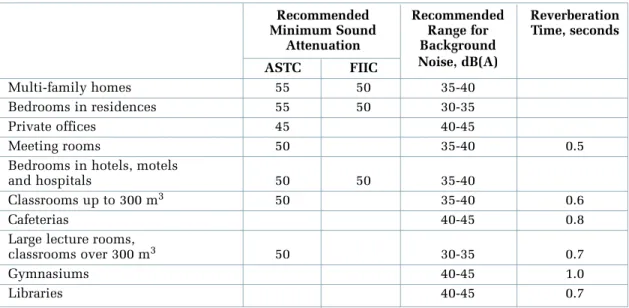
Recommended Recommended Reverberation Minimum Sound Range for Time, seconds
Attenuation Background ASTC FIIC Noise, dB(A)
Multi-family homes 55 50 35-40 Bedrooms in residences 55 50 30-35
Private offices 45 40-45
Meeting rooms 50 35-40 0.5
Bedrooms in hotels, motels
and hospitals 50 50 35-40
Classrooms up to 300 m3 50 35-40 0.6
Cafeterias 40-45 0.8
Large lecture rooms,
classrooms over 300 m3 50 30-35 0.7
Gymnasiums 40-45 1.0
Libraries 40-45 0.7
Table 1. Suggested acoustical criteria for some occupancies
up a building all allow sound to propagate between adjacent rooms, often causing the actual sound attenuation to be less than expected.
To ensure that a desired sound attenuation between rooms is achieved, designers should specify the apparent sound transmission class (ASTC). The ASTC represents the attenuation due to the combination of all sound paths between the rooms in the fin-ished construction, not just the attenuation due to the primary partition. To determine ASTC, measurements are made according to ASTM E336, but no steps of any kind are taken to reduce flanking sound transmis-sion2,3or to correct construction errors; the rooms are tested exactly as found.
Meeting a specification for ASTC requires informed selection of components, carefully designed connections between walls and floors, attention to detail during construction, and preferably testing of the completed assembly to confirm that the specifications have been met. Testing is best conducted before construction is complete to reduce the cost of correcting any errors detected.
Impact sound insulation. This term refers
to the degree of protection against impacts on the floor surface provided in the room by a floor/ceiling assembly. The standard tests for impact sound insulation [ASTM E492 in laboratories and ASTM E1007 in buildings] specify a tapping machine with five steel-faced hammers as the source. The single-number rating generated is the impact insu-lation class (IIC) or the field impact insula-tion class (FIIC) [ASTM E989]. The E1007 field test procedure automatically takes into account the effect of any flanking transmission or construction errors in the measurement.
For a given floor type, IIC depends strongly on the floor covering used. For example, a 150-mm concrete slab finished with ceramic tiles will have an IIC of about 30; finished with a carpet and underpad the IIC will be over 80. The harder the surface of the floor, the lower the IIC. This topic is discussed in CTU 35.4
There are no impact sound criteria sug-gested in the National Building Code but it would be foolish to ignore impact sound insulation when designing homes that are intended to have good acoustical properties.
Sound attenuation criteria. Ideally, sound
attenuation criteria for buildings would be set using average values of music, TV and speech levels, footstep and other impact noise levels, average background noise levels and estimates of the tolerance of the occu-pants in each situation. With this kind of information it would be a simple task to select a sound attenuation criterion and know what percentage of the population would be disturbed. Only a limited
amount5of such information is available for residences, so criteria are usually based on experience and economical considerations. Table 1 suggests ASTC and FIIC criteria for different occupancies.
If higher acoustical ratings are deemed necessary, the attenuations in Table 1 can be increased in steps of 5. An increment of 5 dB is commonly used between one level of sound insulation or noise and the next; changes of 5 dB correspond to easily noticeable changes in sound insulation or sound pressure level. A recent analysis of survey data6suggests that a change of 1 dB in a sound insulation rating corresponds to
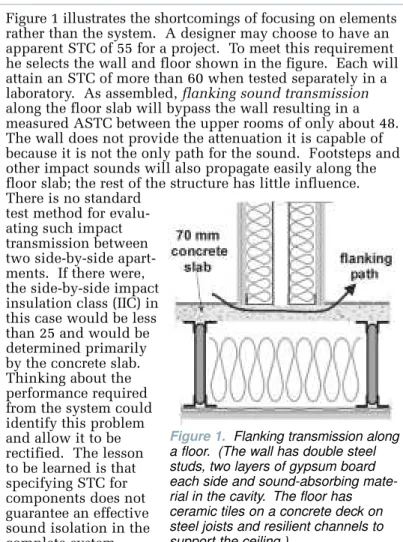
Figure 1 illustrates the shortcomings of focusing on elements rather than the system. A designer may choose to have an apparent STC of 55 for a project. To meet this requirement he selects the wall and floor shown in the figure. Each will attain an STC of more than 60 when tested separately in a laboratory. As assembled, flanking sound transmission along the floor slab will bypass the wall resulting in a measured ASTC between the upper rooms of only about 48. The wall does not provide the attenuation it is capable of because it is not the only path for the sound. Footsteps and other impact sounds will also propagate easily along the floor slab; the rest of the structure has little influence. There is no standard
test method for evalu-ating such impact transmission between two side-by-side apart-ments. If there were, the side-by-side impact insulation class (IIC) in this case would be less than 25 and would be determined primarily by the concrete slab. Thinking about the performance required from the system could identify this problem and allow it to be rectified. The lesson to be learned is that specifying STC for components does not guarantee an effective sound isolation in the complete system.
3 a change of about 4% in the percentage of
people disturbed by intruding noise.
Background Noise Levels
In most rooms there is usually some com-bined level of noise from various sources, such as traffic, HVAC equipment, plumbing, or machinery. This background sound should not be so loud that it interferes with the normal activities in the room, such as conversation or concentration. Conversely, it should not be so low that very weak, intrusive sounds become annoying, like a dripping faucet heard in a bedroom.
There are several ways of specifying acceptable background noise levels. None is completely satisfactory. A simple approach specifying only the A-weighted level of sound is preferred.* A specification for background noise in a room might read:
The average sound level in the room shall be in the range 30 to 35 dB(A). The average level shall be measured with all mechanical or plumbing equipment in the room, or serving it, in normal operation. The background noise criterion selected for each space depends on the normal activity there. Background noise levels recommended for bedrooms are based on studies of how noise interferes with sleep. For living rooms where people try to relax or in offices where a calm environment is needed to support concentrated mental effort, noise levels are still important but can be less stringent than those for sleeping accommodation.
The level of background noise is particu-larly important in meeting rooms, class-rooms, courtrooms and lecture theatres, where speech communication is the domi-nant activity.7 In far too many such rooms, it is difficult to hear because of excessive noise from a variety of sources. Individuals who suffer from hearing loss are especially affected. School classrooms are also critical spaces. If speech cannot be understood, students must guess the meaning of some words from the context of the sentence. This is very difficult for young children, those with hearing problems, and those for whom the language of instruction is unfamiliar.
Table 1 suggests ranges of background noise for different types of occupancies.
Reverberation
When a sound stops abruptly, the sound level in the room takes some time to drop to background levels. The harder the room surfaces, the longer the time for the sound to decay and the more reverberant the room.
In rooms that are excessively reverberant, it is more difficult to understand speech from someone not close by. Noise levels in the room are also greater because there is little to absorb the sound. Thus it is impor-tant to control reverberation.
The time it would take for sound to drop in level by 60 decibels — the reverberation time (RT) — is frequently specified for rooms.8 Although reverberation time in a room is usually measured at several
frequencies, often only the value at 1000 Hz is specified. A specification for reverbera-tion time might read:
The average reverberation time in the room at 1000 Hz shall be 0.7 seconds ± 20%.
* The type of sound can be important. For exam-ple, excessive rumble, hiss or a repetitive noise can be annoying in itself beyond what might be expected from the level alone. Such noise prob-lems usually surface after construction is com-plete and require expert remediation.
Figure 1. Flanking transmission along a floor. (The wall has double steel studs, two layers of gypsum board each side and sound-absorbing mate-rial in the cavity. The floor has ceramic tiles on a concrete deck on steel joists and resilient channels to support the ceiling.)
“Construction Technology Updates” is a series of technical articles containing practical information distilled from recent construction research.
For more information, contact Institute for Research in Construction, National Research Council of Canada, Ottawa K1A 0R6
Telephone: (613) 993-2607; Facsimile: (613) 952-7673; Internet: http://www.nrc.ca/irc
© 2001
National Research Council of Canada June 2001
ISSN 1206-1220
2. Warnock, A.C.C. Acoustics in practice. Building Science Insight 1985,
Institute for Research in Construction, National Research Council of Canada, NRCC 27844, pp. 39–51.
http://www.nrc.ca/irc/bsi/85-4_E.html 3. Nightingale, T.R.T. and Sultan, M.A.
Sound isolation and fire resistance of assemblies with firestops. Construction Technology Update No. 16, Institute for Research in Construction, National Research Council of Canada, 1998. 4. Warnock, A.C.C. Controlling the
trans-mission of impact sound through floors. Construction Technology Update No. 35, Institute for Research in Construction, National Research Council of Canada, 1999. 5. Bradley, J.S. Subjective rating of party
walls. Canadian Acoustics, Vol. 11, Oct. 1983, p. 37. See also Deriving acceptable values for party wall sound insulation from survey results. Inter-Noise 2001 (International Congress on Noise Control Engineering), The Hague, The Netherlands. 6. Rindel, J.H. The relationship between
sound insulation and acoustic quality in dwellings, presented at Inter-Noise 98, Christchurch, New Zealand, 1998. 7. Bradley, J.S. Uniform derivation of
optimum conditions for speech in rooms. BRN 239, Institute for Research in Construction, National Research Council of Canada, November 1985.
8. Bradley, J.S. Sound in rooms. Building Science Insight 1985, Institute for Research in Construction, National Research Council of Canada, NRCC 27844, pp. 13–22. http://www.nrc.ca/irc/bsi/85-2_E.html 9. Warnock, A.C.C. Reverberant noise
control in rooms using sound absorbing materials. Institute for Research in Construction, National Research Council of Canada, BRN 163, June 1980.
Dr. A.C.C. Warnock is a senior research officer in
the Indoor Environment Program of the National Research Council’s Institute for Research in Construction.
Reverberation times are suggested in Table 1 for those occupancies where it is important yet often overlooked.
Sound absorption. To reduce reverberation,
sound-absorbing materials are placed in the room or on its surfaces. Typical materials that absorb sound are carpets, ceiling tiles and soft furnishings. Calculating reverbera-tion time for an ordinary room from the sound absorptions of the materials placed in it is a comparatively simple procedure.9 However, in many rooms (classrooms, meeting rooms, etc.) the placement of the material is important. Special spaces, such as open-plan offices, concert halls and drama theatres need expert consideration of how sound propagates in the space and the correct positioning of sound-reflecting and sound-absorbing materials.
The rating used to rank sound absorbing materials is the sound absorption average (SAA)* [ASTM C423]. The same material with different air cavities behind it can provide quite different SAA values, so a method of installation for testing must be specified [ASTM E795] that is similar to the intended final installation.
Summary
To achieve an acoustically successful design, performance criteria should be set for the completed construction. To satisfy these criteria, building elements, materials and components, mechanical systems, and specific construction details must be selected. The designer may choose to undertake these often-complex tasks or delegate them to an acoustical expert who can more readily deal with the complexities. While some of the detail work may be delegated, there still remains the essential co-ordination among the various disciplines.
References
1. Quirouette, R.L. and Warnock, A.C.C. Basics of noise control. From the seminar series Building Science Insight 1985, Noise Control in Buildings, Institute for Research in Construction, National Research Council of Canada, NRCC 27844, pp. 3–11. http://www.nrc.ca/irc/bsi/85-1_E.html
* An earlier rating system, the noise reduction coefficient (NRC), is now obsolete and should not be used. Usually the numerical value of NRC is almost the same as that for SAA.