Publisher’s version / Version de l'éditeur:
Handbook of Research on Emerging Rule-Based Languages and Technologies: Open Solutions and Approaches, 2009-01-01
READ THESE TERMS AND CONDITIONS CAREFULLY BEFORE USING THIS WEBSITE. https://nrc-publications.canada.ca/eng/copyright
Vous avez des questions? Nous pouvons vous aider. Pour communiquer directement avec un auteur, consultez la première page de la revue dans laquelle son article a été publié afin de trouver ses coordonnées. Si vous n’arrivez pas à les repérer, communiquez avec nous à [email protected].
Questions? Contact the NRC Publications Archive team at
[email protected]. If you wish to email the authors directly, please see the first page of the publication for their contact information.
Archives des publications du CNRC
Access and use of this website and the material on it are subject to the Terms and Conditions set forth at
Rules Capturing Events and Reactivity Paschke, Adrian; Boley, Harold
https://publications-cnrc.canada.ca/fra/droits
L’accès à ce site Web et l’utilisation de son contenu sont assujettis aux conditions présentées dans le site
LISEZ CES CONDITIONS ATTENTIVEMENT AVANT D’UTILISER CE SITE WEB.
NRC Publications Record / Notice d'Archives des publications de CNRC:
https://nrc-publications.canada.ca/eng/view/object/?id=9212ddc0-c08d-494c-a52c-4482d4e547d6 https://publications-cnrc.canada.ca/fra/voir/objet/?id=9212ddc0-c08d-494c-a52c-4482d4e547d6
Rules Capturing Events and Reactivity.*
Paschke, A., and Boley, H. 2009
* Published at the Handbook of Research on Emerging Rule-Based Languages and Technologies: Open Solutions and Approaches.
Copyright 2009 by
National Research Council of Canada
Permission is granted to quote short excerpts and to reproduce figures and tables from this report, provided that the source of such material is fully acknowledged.
RULES CAPTURING EVENTS AND REACTIVITY
Adrian Paschke
Harold Boley
Free University Berlin, Germany
National Research Council Canada
ABSTRACT
Event-driven reactive functionalities are urgently needed in present-day distributed systems and dynamic Web-based environments. Reaction rules constitute a promising approach to specify and program such reactive systems in a declarative manner. In particular, they provide the ability to reason over events, actions and their effects, and allow detecting events and responding to them automatically. Various reaction rule approaches have been developed, which for the most part have been advanced separately, hence led to different views and terminologies. This chapter surveys and classifies the wide variety of rule-based calculi approaches, engines and languages for event, action and state processing, and describes their main features. Founded on the original formalisms, major lines of development are traced to the present and extrapolated to the future.
INTRODUCTION AND MOTIVATION
Event-driven applications based on reactive rules and in particular ECA rules, which trigger actions in response to the detection of events, have been extensively studied during the 1990s. Originating from the early days of programming language where system events were used for interrupt and exception handling, active event-driven rules have received great attention in different areas such as active databases, which started in the late 1980s (Paton, 1999) (Widom and Ceri, 1996), real-time applications, and system and network management tools which emerged in the early 1990s, as well as publish-subscribe systems, which appeared in the late 1990s (Baldoni et al, 2003). Recently, a strong demand for reactive functionalities has come from the Web community, where data sources are enriched with reactive behavior to make them active and allow dynamic behavior (as opposed to the conventional query-driven passive Web).
Additionally, there is an increased interest in industry and academia in event-driven mechanisms such as Complex Event Processing (CEP) (Luckham 2002) and high-level Event-Driven Architectures (EDA) (Chandy, 2006) . (Pro-)active real-time and just-in-time reactions to events and relevant situations are a key factor in upcoming agile and flexible IT infrastructures and distributed service oriented environments. Among many other industry developments, Real-Time Enterprise (RTE), Business Activity Management
(BAM) and Business Performance Management, as well as closely related areas such as IT Service Level Management (SLM) (Paschke, 2007a), are business drivers for this renewed interest.
A great variety of approaches have been developed for reaction rules, which have for the most part evolved separately in their respective domains, and which have led to different views and terminologies. Some detect events as they occur and directly react to them, as e.g. in active databases or implicitly in production rule systems which are fired by changing conditions in the working memory. Others, e.g., KR event / action logics, focus on the development of axioms to formalize the notions of actions and causality, and on the inferences that can be made from the fact that certain events are known to have occurred or are planned to happen in future.
This chapter defines the basic concepts of reaction rules and event processing technologies. It introduces a general multi-dimensional classification scheme for the major families of reaction rule languages, with the four dimensions event, condition, action, and processing and reasoning for the classification of the space of (possible) language features. It also gives a survey of the major lines of reaction rule approaches and
systems of the past decades. The objectives are:
• to provide a common set of foundational terms and definitions;
• to classify and survey the wide variety of reaction rule languages and event, action and state processing approaches;
• to provide a common vocabulary to describe the language features of different reaction rule languages.
• to provide a common frame of reference as a basis for understanding and analyzing the core properties of a reaction rule language and a rule-based reactive system architecture;
• to support the selection of an appropriate reaction rule approach and language for engineering a rule-based system in a particular application domain.
This chapter is structured as follows: Sections 2 and 3 introduce foundational definitions and a multi-dimensional classification scheme for the major families of reaction rule languages. The central section 4 gives a survey of the main families of reaction rule languages, their core properties and features, and the major developments in each field in the past decades till now. Section 5 highlights future trends in event processing and reaction rule technology. Finally, section 6 concludes this chapter.
FOUNDATIONAL DEFINITIONS
This section introduces the foundational notions and definitions of the reaction rule and rule-based event processing technology.1
Atomic Event
An atomic event (also raw event or primitive event) is defined as an instantaneous (at a specific point in time), significant (relates to a context), indivisible (cannot be further decomposed and happens completely or not at all) occurrence of a happening.
1
Complex Event
A complex event is composed (composite event) or derived (derived event) from occurred atomic or other complex event instances, as described, e.g., according to the operators of an event algebra or as a result of applying an algorithmic function or process to one or more other events. The included events are called components while the resulting complex event is the parent event. The first event instance contributing to the detection of a complex event is called initiator, where the last is the terminator; all other components are called interiors. Often complex events occur in a temporal, spatial, state or semantic context that is often relevant to the execution of the other parts of the reaction rule.
Event Pattern
An event pattern (also event class, event definition, event schema, or event type) classifies the structure and properties of an (atomic or complex) event. It describes, on an abstract level, the essential factors that uniquely identify the occurrence of an event of that type, i.e. its detection condition(s) and its properties with respect to instantiation, selection and consumption.
Event Instance
A concrete instantiation of an event pattern is a specific event instance (also event object or event individual). This can be, e.g., a particular fact becoming true, an external event in a monitored system, a communication event message within a conversation, a state transition such as a knowledge update, a transaction (e.g., begin, commit, abort, rollback), a temporal event (e.g., an alarm raised at 6 p.m., every 10 minutes), etc.
Situation
A situation (aka as fluent or state in KR event/action logics) is initiated and possibly terminated by one or more (complex) events (+ context), and typically holds over a certain time interval, but might also be unbounded. Situation detection in event processing means detecting transitions in the universe of interest that require action, either “reactive” or “proactive”, so that actions can be triggered as a consequence of the detected situation.
Situation Individuals
Situation individuals are discrete individuals of situations with a fixed context allocation of time, date, location, participant, etc. They are not repeatable and are temporally connected. Reification of these
situation individuals is possible. Situation individuals relate to complex event instances, i.e. they relate to a state which holds between one or more complex event instances.
Situation Descriptions
Situation descriptions assign content and temporal properties to situation individuals, e.g. dating of
They might be based on differences between situation individuals (sorting, e.g. sequential order of individuals) or based on the differences between situation types with respect to their interaction with the time structure (monotonicty, homogeneity). Different situations might have corresponding properties.
Situation Types
Situation types might have several context allocations (validity intervals) and can be repeated. Validity intervals might not necessarily be sequential and eventually unbounded.
Complex Action
A complex action consists of atomic actions or other complex actions. A complex action might be transactional, i.e. is executed completely (effects are committed) or effects need to be rolled-back.
Action Type
An action type (also action class, action definition, action schema) describes the structure and properties (e.g. transactional) of an (atomic or complex) action, .e.g. the flow of atomic actions of a complex action.
Action Instance
A concrete execution of an action type is a specific action instance (also action object) (whose effects might be rolled-back in case of a transactional action).
Reaction Rule
A reaction rule consists of parts for event/situation processing (e.g. detection, computation), condition verification, action invocation, and post-condition verification, where the condition and (especially) the post-condition parts are optional. The event/situation part can also specialize to the detection of changing conditions, as in a production rule. Accordingly, the most general form of a reaction rule consists of the following parts: on [event] if [condition] then [conclusion ] do [action] after [post-condition]
else [else conclusion]
elseDo [else/alternative action]
According to the selected and omitted rule parts, a rule specializes, e.g., to a trigger rule (on-do), a
production rule (if-do), an ECA rule (on-if-do) and special cases such as ECAP rule (on-if-do-after) or rules with alternative actions or failure compensating actions such as (if-do-elseDo), e.g., to send an event message (e.g. to a log system) in case the action execution fails.
Example “Book Flight” Reaction Rule:
“On an incoming request by a customer to book a flight to a certain destination (event), a database look-up
tries to select a non-empty list of all flights to this destination (condition), and attempts to book the first flight (action). In case this action fails, the system will backtrack and book the next flight in the list, etc.; otherwise it succeeds (post-condition cut), sending a “flight successfully booked” notification. If no flight can be found or booked to this destination, i.e. the condition or all actions fail, a “no flight could be booked” notification is sent to the customer (else action).”
A reaction rule is triggered when a (complex) event is detected or computed (e.g. a timer which triggers the reaction rule) and/or when a state changes (e.g. in production rules when a new condition is added to the working memory leading to a new state which triggers the rule) and is fired when all rule conditions can be verified, but is rolled-back when any post-condition after the action execution cannot be verified. Typically a reaction rule has an action part, but special forms are also possible, e.g. messaging reaction rules which receive event messages or event calculi formalisms which decouple the axioms which formalize the event occurrence from the axioms describing their effects on the changeable state / situation (see e.g. Event Calculus formalism). Reaction rule languages focusing on processing for the detection of (complex) events are also called rule-based Event Processing Languages (rule-based EPLs).
A MULTI-DIMENSIONAL CLASSIFICATION SCHEME FOR
REACTION RULE LANGUAGES
This section introduces a multi-dimensional classification scheme for the major families of reaction rule languages, namely
1. (Temporal) KR event/action logics
• Members e.g. Event, Situation, Fluent Calculus, variants based e.g. on Interval Caclulus, TAL, etc. • Actions with effects on changeable properties / states / fluents, i.e. actions are treated similar as events • Focus: reasoning on effects of events/actions on knowledge states and properties
2. KR evolutionary transaction, update, state transition logics
• Members e.g. transaction logics, dynamic LPs, LP update logics, transition logics, • Knowledge self-updates of extensional KB (facts / data) and intensional KB (rules)
• Transactional updates possibly safeguarded by post-conditional integrity constraints / tests • Complex actions (sequences of actions)
• Focus: declarative semantics for internal transactional knowledge self-update sequences (dynamic programs)
3. Process Calculi, Event Messaging and distributed rule-based Complex Event Processing
• Members, e.g. process calculi (CSP, CCS, pi-calculus, join-calculus), event/action messaging reaction rules (inbound / outbound messages), rule-based intelligent CEP with rule-based Event Processing Languages (e.g. Prova, Reaction RuleML, AMIT, Rule Core)
• Focus: process calculi focus on the actions, event messaging and CEP on the detection of complex events; often follow some workflow pattern, protocol (negotiation and coordination protocols) or CEP pattern
4. Condition-Action / Production rules
• Members, e.g. OPS5, Clips, Jess, JBoss Rules/Drools, Fair Isaac Blaze Advisor, ILog Rules, CA Aion, Haley, ESI Logist, Reaction RuleML (including Production RuleML)
• Mostly forward-directed committed-choice / ("don't care") non-deterministic operational semantics for Condition-Action rules
• Focus: primitive actions (assert, retract) and other update actions (assignment etc.), interpreted as implicit events, lead to changing conditions which trigger further actions, themselves leading to sequences of triggering production rules
5. Active Database ECA rules
• Members, e.g. ACCOOD, Chimera, ADL, COMPOSE, NAOS, HiPac, Reaction RuleML, Prova, XChange
• ECA paradigm: “on Event if Condition do Action”; mostly operational semantics • Instantaneous, transient events and actions detected according to their detection time
• Focus: Complex events: event algebra (e.g. Snoop, SAMOS, COMPOSE) and active rules (sequences of self-triggering ECA rules)
For the classification of the space of possible reaction rule language features the scheme defines the five dimensions general, event, condition, action, and processing and reasoning.
I) General
• Homogenous vs. heterogeneous language: same language for all components (event, condition, action) of a rule or different languages
• Separation of concerns: different rule parts (event, condition, action) are clearly separated or not (e.g. no explicit distinction between events and actions)
• Fixed order vs. arbitrary combinations of event, condition, action rule parts, e.g. ECA rules with fixed event-condition-action paradigm, or messaging reaction rules with arbitrary combinations of inbound events and outbound action messages and intermediate conditions
• Rules representation language and representation level: logic base (e.g. propositional, attributive logic, first-order logic, Datalog-like flat logic) vs. operational, procedural vs. process and transition calculi based
• Variables in the event and condition can be used in the action part including possible backtracking to different variable bindings
II) Classification of the Event Space
1. Processing
• Atomic vs. complex event processing: only support for atomic events or computation of complex events
• A-priory know event patterns vs. unknown event patterns: detection and computation of complex event according to known event patterns or detection of unknown event patterns from occurred (complex) events
• Short term vs. long term:
• Short term- immediate reaction: transient, non-persistent, real-time selection and consumption
of events (e.g. triggers, ECA rules)
• Long term- retrospective, deferred, or prospective: Persistent events, typically processed in
retrospective e.g. via KR event calculi reasoning or event algebra computations on an event instance history; but also proactive detection, e.g. aspects of KR abductive planning
• Real-time vs. any-time: Real-time reaction rules systems respond to events within stringent timing constraints, where any-time rule systems impose no constraints on the reaction time wrt to the processed events. Often rule-based intelligent CEP systems are real-time reaction rule systems. • Qualitative (e.g. James Allen's interval calculus) vs. quantitative representations of time • Separation of event definition, selection and consumption:
• Event definition: algebraic, temporal logic, event/action calculus, Petri nets, etc. • Event selection (from instance sequence): first, last, all, etc.
• Event consumption: consume once, do not consume, etc.
• Deterministic vs. non-deterministic: simultaneous occurred events trigger one rule (deterministic) or more than one rule (non-deterministic), giving rise to only one model ("don't care" non-deterministic, e.g. by priority-based selection of rules) or two or more models ("don't know" non-deterministic) • Active vs. passive: actively query / compute / reason / detect events (e.g. via monitoring, querying /
sensing akin to periodic pull model or on-demand retrieve queries) vs. passively listen / wait for incoming events or internal changes (akin to push models e.g. publish-subscribe)
• Local vs. global: events are processed locally within a context (e.g. a process, conversation, branch) or globally (apply global on all rules)
2. Type
• Flat vs. semi-structured compound data structure/type, e.g. simple flat representations (e.g. propositional) or complex objects with or without attributes, functions and variables
• Primitive vs. complex, e.g. atomic, raw event types or complex event types • Homogenous vs. heterogeneous Sub events are different from the complex event • Temporal:
• absolute (e.g. calendar dates, clock times), • relative/delayed (e.g. 5 minutes after …), • durable (occurs within an interval),
• durable with continuous, gradual change (e.g. clocks, countdowns, flows) • State or Situation:
• without explicit boundaries
• Situation State (e.g. “the fire alarm stopped”): selective or interval-oriented relating to point or period; homogenous (the state holds in all subintervals and points), without dynamic change
• Process (e.g. “he runs”): interval-oriented, restricted homogenous (the process is executed in subintervals), continuous dynamic change
• Iterative event (e.g. “the alarm rings again and again”): selective or interval-oriented, homogenous
• with explicit boundaries
• dynamic change (e.g. the light changes the colour) • interval-based (within the next 5 minutes)
• frequency (e.g. the telephone rung three times)
• Spatial / Location: durable with continuous, gradual change (approaching an object, e.g. 5 meters before wall, “bottle half empty” )
• Knowledge Producing: changes agents/systems knowledge/belief and not the state of the external world, e.g. look at the schedule Æ internal effect, e.g. belief update and revision
3. Source
• Implicit (changing conditions according to self-updates) vs. explicit events (e.g. production rules vs. ECA rules)
• By request (query on database/knowledge base or call to external system) vs. by trigger (e.g. incoming event message, publish-subscribe, agent protocol / coordination)
• Internal database, KB update events (e.g. add, remove, update, retrieve) or external explicit events (inbound event messages, events detected at external entities)
• Generated, produced (e.g. "spontaneous" phenomenon, derived action effect) vs. occurred (e.g. detected or received event)
III) Classification of the Condition Space
• Logical conditions vs. pattern-based test constraints:
• logical conditions act as goals on complex conditional logic represented using (derivation) rules as in, e.g., backward-reasoning logic programming; might support, e.g., variables (new free and bound event variables) + backtracking over different variable bindings, logical connectives (conjunction, disjunction and negations)
• ground pattern tests, e.g. on changed conditions (~ implicit events in production rules), and pattern matching tests
• Conditions on the state before/during/after the action change
• Scoped conditions: a scoped condition is evaluated only with respect to an explicitly defined scope (e.g. part of the knowledge base, e.g. a module) or working memory
• External data integration: conditions can define constructive views (queries) over external data sources and assign values/objects to variables
IV) Classification of the Action Space
1. Processing
• Atomic vs. complex action processing: only support for atomic actions or execution of complex actions (e.g. complex workflows, execution paths)
• Transactional vs. non-transactional processing: Transactional complex actions possibly
safeguarded by post-conditional integrity constraints / test case tests might be rolled-back in case of failures, or might be committed
• Hypothetical vs. real execution: actions have a real effect on the internal (e.g. add new fact) or external world, or are performed hypothetically, i.e. the effect is derived or computed implicitly • Concurrent vs. sequential execution: actions can be processed concurrently (e.g. in parallel
branches / threads) or sequentially
• Local vs. global execution: actions are executed in a global context or locally in a (workflow) process, scope or conversation state (e.g. outbound action messages in conversations).
• Variable iteration: actions iterate over variable bindings of event and conditional variables, possibly by backtracking over binding variants
2. Type
• Internal knowledge self-update actions with internal effects on extensional KB or working memory (update facts / data) and intensional KB / rule base (update rules)
• State actions with effects on changeable properties / states / fluents, often actions directly relate to events and are treated similarly (as e.g. in KR event and fluent calculi)
• External actions with side effects on external systems via calls (by procedural attachments), outbound messages, triggering/effecting
• Messaging actions: outbound action messages, usually in a conversational context
• Process actions: process calculi and workflow pattern style actions such as join, merge, split, etc. • Complex actions (e.g. delayed reactions, actions with duration, sequences of bulk updates,
concurrent actions, sequences of actions) modelled by e.g. action algebras (~event algebras) or process calculi
V) Classification of the Event / Action / State Processing and Reasoning Space
1. Event/Action Definition Phase
• Definition of event/action patterns by event algebra
• Based on declarative formalization or procedural implementation
• Defined over an atomic instant or an interval of time or situation context
2. Event/Action Selection Phase
• Defines selection function to select, e.g. “first”, “last”, event from several occurred events (stored in an event instance sequence e.g. in memory, database/KB, queue) of a particular type
information, e.g. different message payloads or sensing information
• KR view: Derivation over event/action history of happened or future planned events/actions
3. Event/Action Consumption / Execution Phase
• Defines which events are consumed after the detection of a complex event
• An event may contribute to the detection of several complex events, if it is not consumed • Distinction in event messaging between “multiple receive” and “single receive”
• Events which can no longer contribute, e.g. have outdated timestamps, should be removed • KR view: events/actions are not consumed but persist in the fact base
4. State / Transition Processing
• Actions might have an internal effect i.e. change the knowledge state leading to state transition from (pre-)condition state to post-condition state.
• The effect might be hypothetical (e.g. a hypothetical state via a computation) or persistent (update of the knowledge base),
• Actions might have an external side effect
• Inactive partially executed complex actions should be removed
Remark: The separation of these phases is crucial for the outcome of a reaction rule based system since typically events occur in a context and interchange context data to the condition and action (e.g. via variables, data fields). Declarative configuration and semantics of different selection and consumption policies is desirable.
SURVEY OF REACTION RULE LANGUAGES AND RULE-BASED
EVENT, ACTION AND STATE PROCESSING APPROACHES
This section surveys the major fields of reaction rule approaches and discusses the main properties and contributions.
Event/Action Logics, Transition Logics and Process Calculi
Reasoning about events, actions and change is a fundamental area of research in artificial intelligence since the events/actions are pervasive aspects of the world in which agents / systems operate enabling
retrospective reasoning but also prospective planning. A large number of knowledge representation (KR) formalisms (event logics, action logics, transition logics) for deductive reasoning but also planning and abductive reasoning about events, actions and change (state transitions) have been developed. The focus of these formalisms is on the development of axioms to formalize the notions of actions as well as events and causality, where events are characterized in terms of necessary and sufficient conditions for their
occurrences and where events/actions have an effect on the actual knowledge states, i.e. they transit states into other states and initiate / terminate changeable properties called fluents. Instead of detecting and consuming events as they occur, as e.g. in the active database domain as triggers, the KR approach to events/actions focuses on the inferences that can be made from the fact that certain events are known to have occurred or are planned to happen in future.
The common denominator of all these formalisms and systems is the notion of states, also known as fluents, which are changed or transit due to occurred or planned events/actions. That is, by executing actions (respectively by events that happen) the state of the knowledge changes. Among them are e.g. the event calculus (Kowalski and Sergot, 1986) and variants, the situation calculus (McCarthy and Hayes, 1969) , features and fluents (Sandewall, 1989), various (temporal) action languages (TAL) (Gelfond and Lifschitz, 1993) (Fikes and Nilsson, 1971) (Giunchiglia and Lifschitz, 1999) (Giunchiglia and Lifschitz, 199) (Doherty, 1998), fluent calculi (Hölldobler and Schneeberger, 1990) (Thielscher, 1999) and versatile event logics (Bennett and Galton, 2004). The formalisms differ in:
• How to describe the qualification of events / actions (Qualification) • How to describe the effects of actions / events (Transitions)
• How to describe indirect effects and interdependencies between fluents (Ramification) • How to describe which fluents remain unchanged over a transition (Frame Problem)
They also differ in the expressive features they provide such as continuous time, branching states/time, continuous change, causal constraints, concurrent events, durational fluents, events/actions with duration, functional fluents, inertial fluents, state constraints, etc.
Related and also based on the notion of (complex) events, actions (e.g. interaction, communication, and synchronization actions/events) and (process) states, with abstract models for transitions and parallel
execution processes, are various process calculi like TCC (Saraswat and Gupta, 1996), CSS (Milner, 1989), ACP (Baeten abd Weijland, 1990) and CSP (Hoare, 1985), as well as more recent approaches such as π-calculus (Sangiorgi and Walker, 2001), the ambient π-calculus (Cardelli and Gordon, 1998), PEPA (Hillston, 1996), fusion calculus (Björn and Parrow, 1998), join calculus (Fournet and Gonthier, 2000), (labeled) transition logics (LTL), and (action) computation tree logics (ACTL) (Meolic, 2000) (Meolic, 2003). In contrast to the event / action logics, the process calculi typically have a focus on the formal modelling of concurrent communicating systems instead of specifying the effects of events/actions on the knowledge state. For instance, action process algebras typically elude the frame problem 1rather than solving it and have no explicit representation of "situation states" (changeable context-dependent properties of the world) which are initiated or terminated by (complex) events following the "law of inertia".
In the following, the two major event logics namely the Situation Calculus (McCarthy and Hayes, 1969) and the Event Calculus (Kowalski and Sergot, 1986) are described.
The Situation Calculus (SC) (McCarthy and Hayes, 1969) is one of the first KR approaches for formalizing actions and state transitions. It is basically a first-order formalism for describing the world as a sequence of
situation changes caused by actions: if an action A occurs in a situation S, a new situation result(A, S) results in which a property P will be true, holds(P,S), (respectively false, not holds(P,S)) if A in S initates P,
initates(A,S,P) (respectively, terminates(A,S,P)). The frame axioms of the SC are (stated as a simplified
Logic Programming formulation):
holds(P,s0) :- initially (P).
holds(P, result(A,S)) :- initiates(A,S,P).
holds(P, result(A,S)) :- holds(P,S), not ( terminates(A,S,P)).
The SC might be comparable to the Event Calculus (EC); however, unlike the EC, the SC has no notion of an explicit linear time line which in many event-driven systems is crucial, e.g. to define timestamps, timeout/deadline principles, temporal constraints, or time-based context definitions. The major differences between the SC and the EC are:
• branching time in SC vs. linear time in EC
• explicit notion of previous state of the world/situation in SC • state transitions are functions in SC
Kowalski and Sergot’s EC (Kowalski and Sergot, 1986) is a formalism for temporal reasoning about events and their effects on a logic programming system as a computation of earlier events (long-term "historical" perspective). It defines a model of change in which events happen at time points and initiate and/or
terminate time intervals over which certain properties (time-varying fluents) of the world hold. Time points are unique points in time at which events take place instantaneously. The basic idea is to state that fluents are true at particular time points if they have been initiated by an event at some earlier time point and not terminated by another event in the meantime. Conversely, a fluent is false at a particular time point, if it has been (never initiated or) previously terminated and not initiated in the meantime. That is, the EC embodies a notion of default persistence according to which fluents are assumed to persist until an event occurs which terminates them. This principle follows the axiom of inertia first proposed by McCarthy and Hayes which says: "Things normally tend to stay the same" (McCarthy and Hayes, 1969). A central feature of the EC is that it establishes or assumes a narrative time structure which is independent of any event
occurrences. The time structure is usually assumed or stated to be linear although the underlying ideas can equally be applied to other temporal notions, e.g., branching structures, i.e., event occurrences can be provided with different temporal qualifications. Variants range from the normal structures with absolute times and total ordering to loose ones with only relative times and partial ordering. Given a history of events (set of event occurrences), the EC is able to infer the set of maximal validity intervals (MVIs) over which the fluents initiated and/or terminated by the events maximally hold. Therefore, a central feature of the Event Calculus, in comparison to other formalisms such as Situation Calculus, is that an explicit linear time structure, which is independent of any events, is assumed.
The core axioms of the classical EC are:
initiates(Ev,Fl,Ti) event Ev initiates fluent Fl for all time>Ti
terminates(Ev,Fl,Ti) event Ev terminates fluent Fl for all time>Ti
holdsAt(Fl,Ti) fluent Fl holds at time point Ti
The Event Calculus was originally formulated as a logic program in (Kowalski and Sergot, 1986) and many alternative logic program formulations and extensions which also formalize non-deterministic
actions, concurrent actions, actions with delayed effects, gradual changes, actions with duration, continuous change, and non-inertial fluents have been subsequently proposed, see e.g. (Shanahan, 1990) (Denecker et al, 1992) (Kowalski, 1992) (Sadri and Kowalski, 1995) (Kakas and Miller, 1997) (Shanahan, 1997a) (Kakas and Miller, 1999). The EC has also been formulated in modal logic; see e.g. (Cervesato etl al, 1996). Extensions of the EC with time intervals and event intervals have been proposed (Paschke, 2006a). For instance, the interval algebra, proposed by J. Allen (Allen, 1983), which defines a taxonomy of relations between temporal intervals that is complete for time intervals over a linear set of time points. There are 13 possible relationships between two intervals I and J:
I during J - I starts after J, and finishes before J. I overlaps J - I starts before J, and J ends after I
I starts J - I has the same starting point as J, but ends earlier than J
I precedes J - I happens before J and there is non-empty interval separating them I meets J - I happens before J, but there is no non-empty interval between them I equals J - I and J start and end simultaneously
I finishes J - I starts after J, but has the same end point
The interval relationships are mutual exclusive
Action languages such as A (Gelfond and Lifschitz, 1993), AR (Giunchiglia and Lifschitz, 1997) , AK (Son and Baral, 2001), B, C (Giunchiglia and Lifschitz, 1998) and its successors C+ (Giunchiglia et al, 2004), K (Eiter et al, 2004) and TAL (Doherty, 1998) have been developed for declarative reasoning about action and change, used in particular planning problems.
Action language A (Gelfond and Lifschitz, 1993) provides comparable expressiveness to the
propositional fragment of planning languages such as STRIPS (Fikes and Nilsson, 1971) or ADL (Pednault, 1994) extended with conditional effects. The main axioms state that an action A is executable if the set of all conditional fluents [F1,..Fn] holds and causes a final fluent L:
executable A if [F1,..Fn]. A causes L if [F1,..Fn].
effects of actions eff(A,S), and goal conditions of the form F after A1,..,An.
The action language AR (Giunchiglia and Lifschitz, 1997) extends A by allowing modelling indirect effects and non-deterministic actions.
The language B instead of always in AR uses so called static laws, of the form l if F where a successor state is defined by a minimal consistent set of literals such that all these static laws hold.
Language AK (Son and Baral, 2001) formalizes sensing actions. It provides axioms of the form A
determines F, meaning that the value of F is determined by the execution of A.
As in B the language C (Giunchiglia and Lifschitz, 1998) distinguishes dynamic and static laws, but provides more expressiveness with respect to causation laws defined by arbitrary propositional formulae over fluent literals, constraints and qualifications, and supports explicit frame axioms.
C+ (Giunchiglia et al, 2004) additionally allows for multi-valued, additive fluents.
The temporal action logics TAL (Doherty, 1998) as descendants of the action languages and the feature and fluents framework, use different language features than the Event Calculus, but provide nearly comparable expressiveness. For instance, indirect effects in TAL are expressed by dependency constraints, whereas EC uses effect constraints and causal constraints. Non-deterministic effects in TAL are represented by
disjunctions in reassignment operators. The EC uses special determining fluents.
Process calculi (or process algebras) (Baeten, 2005) are a diverse family of related approaches to formally modelling concurrent systems. Process calculi address the study of the behavior of parallel or distributed systems by algebraic means. They provide algebraic laws that allow process descriptions to be manipulated and analysed, and permit formal reasoning about equivalences between processes. Typical laws are
structural or static laws. Atomic actions can be composed into more complicated processes by basic operators, such as + denoting alternative composition, ; denoting sequential composition and || denoting parallel composition.
The three most well-known process algebras are CSS (Milner, 1989), ACP (Baeten abd Weijland, 1990) and CSP (Hoare, 1985). Historically, CCS was the first with a complete theory. CSP adds a distinguishing equational theory. ACP emphasizes the algebraic aspect: there is an equational theory with a range of semantic models. Also, ACP has a more general communication scheme, whereas in CCS communication is combined with abstraction and in CSP communication is combined with restriction. Many other process algebras and hybrid logic calculi have been developed in the last two decades; each making its own set of choices in the different possibilities such as algebras permitting continuously changing variables other than time or involving differential algebraic equations, and connections with dynamic control theory. Such advanced process calculi are used e.g. in modern ECA rule approaches to specify complex actions
(Behrends et al, 2008) or in messaging reaction rules to model the communication behavior of inbound and outbound message links in rules (Paschke et al, 2007b) .
Dynamic Logics, Update Logics and Tansaction Logics
Dynamic Logic Programs, LP update languages, and transaction logics address updates of logic programs where the updates can be considered as actions that transit the initial program (knowledge state/base) to a
new extended or reduced state hence leading to a sequence of evolving knowledge states. The main aim of these logical update languages is to provide a declarative semantics for logic languages with update actions. Update actions have also been studied in different areas.
Several Datalog extensions such as the LDL language of Naqvi and Krishnamurthy (Naqvi and
Krishnamurthy, 1988) which extends Datalog with update operators including an operational semantics for bulk updates or the family of update language of Abiteboul and Vinau (Abiteboul and Vianu, 1991) which has a Datalog-style have been proposed. Further work has been done on adding a notion of state to Datalog programs where updates are modeled as state transitions close to situation calculus.
Reiter (Reiter, 1995) has further extended the situation calculus with an induction axiom specified in second-order logic for reasoning about action sequences. Applying this, Reiter has developed a logical theory of database evolution, where a database state is identified with a sequence of actions.
Transaction Logics (TR) (Bonner and Kifer, 1995) is a general logic of state changes that accounts for database updates and transactions supporting order of update operations, transaction abort and rollback, savepoints and dynamic constraints. It provides a logical language for programming transactions, for updating database views and for specifying active rules, also including means for procedural knowledge and object-oriented method execution with side effects. It is an extension of classical predicate calculus and comes with its own proof theory and model theory. The TR model-theoretic semantics is built on the concept of sequences of database states named paths. Like in modal logic semantics, a structure consists of a set of states and each state represents a database. However, the truths in TR are not defined on arcs between knowledge states, but on execution paths (executional entailment). The proof procedure executes logic programs and updates to databases and generates query answers, all as a result of proving theorems. TR also has a restricted serial-Horn version for Horn logic programs with update transactions.
Multi-dimensional dynamic logic programming (DyLPs) (Leite et al, 2001), LUPS (Alferes, 2002), EPI (Eiter, 2001), Kabul (Leite, 2003), and ECA-LP (Paschke, 2006b) are all update languages which enable intensional updates to rules and define a declarative and operational semantics of sequences of dynamic LPs. While LUPS and EPI support updates to derivation rules, Kabul is concerned with updates of reaction rules. ECA-LP supports a tight homogenous combination of both reaction rules and derivation rules
enabling complex (update) actions and events, transactional updates in both rule types with
post-conditional (ECAP) verification, validation, integrity tests (V&V&I) on the evolved knowledge state after the update action(s).
ECA-LP Example: eca( every10Sec(), detect(request(Customer, Destination),T), find(Destination, Flight), book(Customer, Flight), !, notify(Customer, bookedUp(Destination)
).
% time derivation rule
every10Sec() :- sysTime(T), interval( timespan(0,0,0,10),T). % event derivation rule
detect(request(Customer, FlightDestination),T):- occurs(request(Customer,FlightDestination),T), consume(request(Customer,FlightDestination)). % condition derivation rule
find(Destination,Flight) :-
on_exception(java.sql.SQLException,on_db_exception()), dbopen("flights",DB), sql_select(DB,”flights”, [flight, Flight], [where, “dest=Destination”]). % action derivation rule
book(Cust, Flight) :- flight.BookingSystem.book(Flight, Cust), notify(Cust,flightBooked(Flight)).
% alternative action derivation rule notify(Customer, Message):-
sendMessage(Customer, Message).
The example shows an ECA-LP formalization of the “Book flight” reaction rule example given in the section where the term reaction rule was introduced. The example shows how ECA-LP combines reaction rules with derivation rules. Each part in the ECA rule specifies a query on the derivation rules,
implementing the respective functionality. Accordingly, the basic declarative ECA rule syntax remains compact and enables reusing the separated, declarative rule specifications several times within different ECA rules. The example includes possible backtracking to different variable bindings. If the action succeeds further backtracking is prevented by the post-conditional cut. If no flight can be found for the customer request, the else action is executed which notifies the customer about this. The condition derivation rule accesses an external data source via an SQL query.
In summary, the update languages described in this section primarily deal with knowledge base updates and transactions but not with general event processing functionalities in the style of ECA rules such as situation detection, context testing in terms of state awareness or external inputs/outputs in terms of event/action notifications or external calls with side effects. However, their declarative semantics for internal
(transactional) updates and (knowledge) state transitions forms a basis also for more general reaction rules such as production rules and ECA rules, as implemented e.g. in ECA-LP (Paschke, 2006b).
Production Rule Systems
The classical production rules system paradigm in artificial intelligence (AI) research (Hayes-Roth,1985) and most database implementations of production rules (Declambre and Etheredge, 1988) (Sellis et al,
1993) (Widom and Finkelstein, 1990) (Hanson and Widom, 1993) specify an operational semantics or execution semantics formalizing state changes, e.g. on the basis of a transition system formalism. A
production rule is a statement of rule programming logic that specifies the execution of one or more actions in the case that its conditions are satisfied, i.e.: “if Condition do Action”.
Two approaches of the operational semantics are distinguished:
• forward-chaining order-independent execution (e.g. based on variants of the RETE algorithm (Forgy, 1982)) where each change in the conditions due to update actions such as “assert” or “retract” on the internal database is considered as an implicit event which can “fire” a production rule hence lead to further update actions etc., resulting in a cycle of firing production rules. • Procedural order-dependent sequential execution in a (compiled) execution environment (rule
engine).
There are many forward-chaining implementations in the area of deductive databases (Hanson and Widom, 1993) and many well-known forward-reasoning engines for production rules such as ILOG’s commercial jRules system, Fair Isaac/Blaze Advisor, CA Aion, Haley, and ESI Logist as well as popular open source solutions such as OPS5, CLIPS, Jess, Jeops and Drools, jRules, which are based on variants of the RETE
algorithm (Forgy, 1982), which was developed by Charles L. Forgy in the late 70s for OPS5 (Official Production System) shell. RETE matches facts against the patterns in rules to determine which rules have had their conditions satisfied. If the matching process occurs only once, the inference engine simply examines each rule and then searches the set of facts to see if the rule’s patterns have been satisfied – if so it is place on the agenda. The matching process takes place repeatedly and the fact list is modified on each cycle of the execution. Such changes can cause previously unsatisfied patterns to be satisfied or vice versa – as facts are added/removed, the set of rules must be updated/maintained. Checking rules against facts each cycle is a slow process. RETE avoids unnecessary computation by remembering what has already been matched from cycle to cycle and computing only necessary changes. The Rete algorithm uses
temporal redundancy to save the state of the matching process from cycle to cycle, recomputing changes in this state only for the change that occurred in the fact list. It also takes advantage of structural similarity in rules. In summary, the RETE algorithm keeps the derivation structure in memory and propagates changes in the fact and rule base, i.e. it stores information about the antecedents in a network. In every cycle, it only checks for changes in the networks, which greatly improves efficiency. This algorithm can be very
effective, e.g. to just find out what new facts are true or when there is a small set of initial facts and there tend to be lots of different rules which allow to draw the same conclusion. This might be one of the reasons why production rules have become very popular as a widely used technique to implement large expert systems in the 1980s for diverse domains such as troubleshooting in telecommunication networks and computer configuration systems.
While (“pure”) production rules could simulate derivation rules via asserting a conclusion as a consequence of the proved condition, i.e. “if Condition then assert Conclusion”, the classical (“full”) production rule languages such as OPS5 lack a clear logical semantics, often suffer from termination and confluence problems of their execution sequences, and typically do not support expressive non-monotonic features such as a kind of negation-as-failure, which can make it hard to express certain real life problems as production rules in a natural and simple way.
Exemplarily, we describe an abstract logical production rule system P in the following, which consists of a language L, a knowledge state Si which is knowledge base KB consisting of premises1 and conclusions2,
and a rule engine R: {Gro2006}
1. load the KB premises into the KB store which is in state Sn;
/* (first, clear the working memory and agenda;)
If it is the first time, the KB is in state S0 and later it will transit
from one state to the other*/
2. do loop {
1. pattern match;
/* with respect to (updated) working memory, i.e., find every rule instance whose LHS (left hand side) is satisfied, and that has not yet been fired. This creates an (updated) activation list. */
2. if activation list is empty, then go to step (3.) to finish up. /* begin firing process: */
3. order the agenda (using the agenda control strategy), and select an agenda-maximal activated rule instance RIn as next to fire;
/* begin firing that rule instance: */
4. add RIn’s RHS’s asserted facts as derived into the working memory;
/* A derived fact may have already been present in the working memory. If so, just keep one copy of the fact, overall. */
/* begin action launching */
5. add RIN’s RHS’s action calls to the launched-action-call store.
6. perform RIN’s RHS’s action-calls by performing the corresponding action procedural calls;
/* these have side effects */ /* end of action launching */
/* end of firing that rule instance */ 7. remove RI N from the activation list;
/* since it has now been fired */ /* end firing process */ }
3. finish up
1. return the conclusions set from the conclusions store;
/* The conclusion set includes both facts and launched-action-calls. The facts include both premise facts and derived facts. Also, the launched-action-calls when executed had side effects. */
2. stop;
1 premise facts, production rules, agenda control strategy 2 conclusion facts, launched action calls
Semantically, we define this abstract production rule system as follows:
L is used to describe the domain of interest. A state Si (of the KB) is a snapshot of the world, which is represented as a typical Herbrand interpretation of L. We assume a set of typical update actions (assert and retract) denoted by A and the set of states is denoted by S. The effect (semantics) of actions is described by
effect: A × S Æ S. A classical production rule is a rule of the form: if l1,.., ln then a, where l1,..,ln are ground
literals of L and a is an action in A. A production rule if l1,.., ln then a is applicable in state S’ iff the conditions l1,.., ln are true in Si, i.e. Si╞l1∧..∧ln.A production rule system P is a set of production rules.
An execution E of a production rule system P is a sequence S ⎯⎯→r S ...⎯⎯→rn Sn
1 0
1 , where n≥0, S
i are states, ri are production rules in P and for each i≥1, ri is applicable in Si-1 and Si = effect (A(ri), Si-1). S0 is stated as initial(E) and Sn is stated final(E), where there is no further production rule in P which is
applicable in Sn. The semantics I of a production rule system P is defined by: I(P) = {(S0 = initial(E), Sn = final(E)) | E is a complete computation of P}.
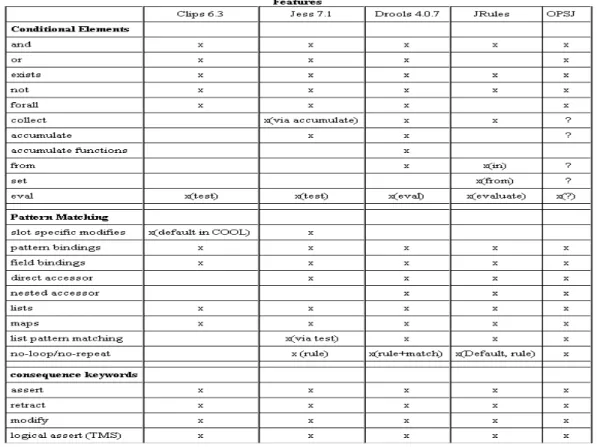
This core semantics can be further extended to consider non-ground production rule systems, where variables occurring in the rules’ conditions are replaced by the ground terms of the matching patterns (unifying conditions) in each state. Formal definitions of the Rete algorithm have been given (Fages and Lissajoux, 1992) (Cirstea et al, 2004), implementation issues related to the algorithm have been widely studied (Albert, 1989) (Tambe and Rosenbloom, 1989) (Miranker, 1990) (Ishida, 1994) ( Th´eret, 1994), and applications include, for instance, Petri Nets implementations based on the Rete algorithm (Burdescu and Brezovan, 2001). For a feature comparison of the several common production rule systems see table 1. (W3C-RIF-PRD, 2008)
Table 1: Feature comparison of Production Rule systems (W3C-RIF-PRD, 2008)
• Refraction. The essential idea of refraction is that a given instance of a rule must not be fired more
than once as long as reasons that made it eligible for firing hold. In other terms, if an instance has been fired in a given state of the system, it is no longer eligible for firing as long as it satisfies all the subsequent states of facts;
• Priority. The rule instances are ordered by priority of the instantiated rules, and only the rule
instances with the highest priority are eligible for firing;
• Recency. The rule instances are ordered by how long a rule instance has been continuously satisfied in
the previous states of facts, and only the most recent ones are eligible for firing.
Several extensions to the core production systems paradigm have been made which introduce e.g. negations (classical and negation-as-finite failure) (e.g. Dung and Mancarella, 1996). They provide (operational or formal declarative) semantics for such expressive constructs, using e.g. priorities (Agrawal et al, 1991), denotational semantics (Widom, 1992), bottom-up magic transformation (Pang, 1994), stratified production rules (Raschid, 1992), argumentation (Dung and Mancaralle, 2002), transformation of update programs into logic programs (Raschid, 1996), production logic programs (Grosof, 2005), transactional update logic (Paschke, 2006c). Closely related are also logical update languages such as transaction logics (Bonner and Kifer, 1995) and in particular serial Horn programs, where the serial Horn rule body is a sequential
execution of actions (assert/retract) in combination with standard Horn pre-/post conditions. These serial rules can be processed top-down or bottom-up and hence are closely related to the production rules style of “if condition do update action”.
Active Databases and ECA Rule Systems
Event-driven applications based on reactive rules and in particular Event-Condition-Action rules (ECA), which trigger actions as a response to the detection of events, have been extensively studied during the 1990s in active databases. (Widom and Ceri, 1996) Many commercial databases systems have been
extended to allow the user to express active rules whose execution can update the database and trigger the further execution of active rules leading to a cascading sequence of updates (often modelled in terms of execution programs). Triggers are supported by the SQL3 standard (Kulkarni et al, 1999). A trigger in SQL3 is an ECA rule that is activated by a database state transition and has an SQL3 predicate as a condition and a list of SQL3 statements as action. Triggers are supported by the major commercial
databases such as Oracle, DB2, Sybase, Informix. Active databases are also an important research topic due to the fact that they provide foundational groundwork for many modern complex event processing
technologies and find many applications in real world systems.
Active databases in their attempt to combine techniques from expert systems and databases to support automatic triggering of rules in response to events and to monitor state changes in database systems have intensively explored and developed the ECA paradigm and event algebras to compute complex events. In a nutshell, the ECA paradigm states that an ECA rule autonomously reacts according to actively or
passively detected simple or complex events by evaluating a condition or a set of conditions and by executing a reaction whenever the event happens and the condition(s) is (are) true: "On Event if Condition
do Action". Variants of ECA rules are e.g. EA rules (triggers) or ECAP rules (reactive rules with
post-conditions after action execution). Event algebras provide the operators to define complex event types. Typical event algebra operators are, e.g.:
• Sequence operator (;): the specified event instances have to occur in the order determined by this operator
• Disjunction operator ( ): at least one of the specified instances has to occur
• Conjunction operator ( ): the specified event instances can occur in any order, where the detection time is the timestamp of the latest occurred event
• Simultaneous operator (=): the specified instances have to occur simultaneously
• Negation operator (¬): the specified instance(s) are not allowed to occur in a given interval
• Quantification (Any): the complex event occurs when n events of the specified type have occurred • Aperiodic Event Operator (Ap): The aperiodic operator A allows one to express the occurrence of an
event E2 within the interval defined by two other events E1 and E3: Ap (E2, E1, E3)
• Periodic Event Operator (Per): The periodic operator Per is an event type which occurs every t time-steps in between E1 and E2
Often a distinction into the event definition, event selection, and event consumption is made (see section “Dimensions for Reaction Rule Languages”). Selection policies are, e.g., “select all events of a particular type”, “select the first”, “select the last”, which contribute to the detection of a complex event. Different consumption policies are, e.g., ”remove all events which belong to a particular type” or ”remove the first respectively the last event”, “do not consume”, etc. Similar to event algebras, action algebras provide operators to define complex actions, e.g.:
• Succession: Ordered Succession of Actions • Choice: Non-Deterministic Choice
• Flow: Parallel Flow • Loop: Loops
Several event algebras have been developed, e.g. Snoop (Chakravarthy, 1994), SAMOS (Gatziu and Dittrich, 1993), ODE (Gehani et al, 1992): The object database ODE implements event-detection
mechanism using finite state automata. SAMOS combines active and object-oriented features in a single framework using colored Petri nets. Associated with primitive event types are a number of parameter-value pairs by which events of that kind are detected. SAMOS does not allow simultaneous atomic events. Snoop is an event specification language which defines different restriction policies that can be applied to the operators of the algebra. Complex events are strictly ordered and cannot occur simultaneously. The detection mechanism is based on trees corresponding to the event expressions, where primitive event occurrences are inserted at the leaves and propagated upwards in the trees, as they cause more complex events to occur. Several papers discuss formal aspects of active databases on a more general level – see e.g. (Paton, 1995) (Zimmer and Unland, 1999).
Based on event algebras several active database systems and prototypes have been developed, e.g.
ACCOOD (Erikson, 1993), Chimera (Meo et al, 1996), ADL (Behrends, 1995) , COMPOSE (Gehani et al, 1992), EXACT (Diaz and Jaime, 1997), REACH (Zimmermann and Alejandro, 1999), ROCK&ROLL (Dinn et al, 1996), REFLEX (Naqvi and Ibrahim 1994), NAOS (Collet and Coupaye, 1996) , HiPac (Dayal et al, 1996) or JEDI (Cugola et al, 1998). Other prototypes based on interval-based event / action logics (e.g. ECA-LP (Paschke, 2006c)), functional programming (e.g. JEM (Guangtian et al, 1998)) and real time logic (RTL) (e.g. PFL (Reddi et al, 1999) ), and ADL (Behrends, 1994) exist.
models) in the area of active databases and several techniques based on syntactic (e.g. triggering graphs (Aiken et al, 1994) or activation graphs (Baralis and Widom, 1994)) and semantics analysis (e.g. (Baley, 1997) (Widom, 1992) (Paschke, 2006b)) of rules have been proposed to ensure termination of active rules (no cycles between rules) and confluence of update programs (always one unique minimal outcome). Several approaches in the active database domain also draw on transformations of active rules into LP derivation rules, in order to exploit the formal declarative semantics of LPs to overcome confluence and termination problems of active rule execution sequences. The combination of deductive and active rules has been investigated in different approaches, e.g. based on transformation or simulation of active rules by means of deductive rules (Dietrich et al, 2003) (Flesca and Greco, 1998) (Lausen et all, 1998) (Zaniolo, 1993). Moreover, there are approaches which directly combine reactive rules with deductive rules such as the Event-Condition-Action Logic Programming language (ECA-LP) which enables a homogeneous representation of ECA rules and derivation rules (Paschke, 2006c). In the following, we exemplarily introduce the ID-based transactional transition semantics of ECA-LP:
A positive (add) resp. negative (remove) ID-based update to a rule program P is a finite set } : , : { : / = rule H←B fact A←
Uoidpos neg N M , where N=0,..,n, M=0,..,m and oid denotes the label of the update, i.e. the
unique object id with which it is managed in the KB. Applying pos oid
U resp. Uoidposto P leads to the extended
knowledge state pos
oid
U P
P+= ∪ resp. reduced state P−=P\Uoidneg. Applying arbitrary sequences of positive and
negative updates leads to a sequence of program states P ,..,0 Pkwhere each state Pi is either
i pos oid i i P U P = −1∪ or 1 − = i i P
P \Uoidnegi. In other words, a program Pi, i.e. the set of all clauses in the KB at a particular knowledge state i, is decomposable in the previous knowledge state plus/minus an update, whereas the previous state consists of the state i-2 plus/minus an update and so on. Hence, each particular knowledge state can be decomposed in the initial state P0 and a sequence of updates. ECA-LP defines P0 = Ø∪U0posand U1pos={P : the set of rules and facts defined in the initial LP P}, i.e. loading the initial rule program into the KB
denotes the first update.
Based on this the semantics of updates is defined as a sequence of transitions > →< >→ >→< >→< < + A U P U U P U U P U E P n n , , .. '' , ' , '' ' , , ' ,
, 1 , where E is an initiating event which triggers the update action
U of an ECA rule (in case the ECA condition is satisfied) and transits the initial knowledge state P into P’.
The update action U might be a further sub-event in another ECA rule(s) (active rule) which triggers another update, leading to a sequence of transitions which ends with a terminating action A. A might be e.g. an update action which is not an input event for further updates or an action without an internal effect on the knowledge state, e.g. an external notification action.
To overcome arising conflicts, preserve integrity of the KB in each state and ensure a unique declarative outcome of update sequences (active rules) or complex updates ECA-LP extends the semantics of updates
to transactional updates which are safeguarded by integrity constraints (ICs). ICs are used to verify and validate the actual or any hypothetically future knowledge state. A transactional update is an update, possibly consisting of several atomic updates, i.e. a sequence of transitions, which must be executed completely or not at all. In case a transactional update fails, i.e. it is only partially executed or violates integrity, it will be rolled back otherwise it will be committed. ECA-LP defines a transactional update as
m neg pos oid neg pos oid trans oid U U C C U n & ,.. ,.., / 1 / 1
= , where Ci is the set of ICs which are used to test integrity and verify and validate the intended models of the updated clauses/modules. In short, ICs are defined as constraints on the set of possible models and describe the model(s) which should be considered as strictly conflicting. The ICs are used as post-conditions to test the updated program state transpos
oid i hypo i P U
P+1 = ∪ resp. Pihypo+1 =Pi\ Uoidtransnegand
hypo i i P
P+1= +1 in case the update preserves integrity wrt to the defined ICs. Hence, if there exists a satisfied IC
in the hypothetical/pending state hypo i
P+1 the transactional update is rolled back:
hypo i trans oid i i P U P
P+1= ∪ pos ⇒ +1 \Uoidtransposiff exists Pi+1╞ICj,j=1,..,n
i i P
P+1= \Uoidtransneg ⇒Pihypo+1 ∪Uoidtransnegiff exists Pi+1╞ICj,j=1,..,n
A commit is defined as hypo+1 ⇒ i+1
i P
P .
In contrast to event notification systems and distributed rule-based complex event processing (see next section), the ECA rules in active databases are typically defined with a global scope (global state) and react on internal events of the reactive system such as changes (updates) in the active database. The ECA view and terminologies for events and actions also differ from those of KR event/action logics. The focus in the logical formalisms is on the development of axioms to formalize the notions of actions/events and
causality, where events/actions are characterized in terms of necessary and sufficient conditions for their occurrences. In contrast, the main aim of ECA rules is immediate reactions on detected events as they occur in active databases. Events are typically handled in real-time and consumed afterwards (transient view).
Rule-based Complex Event Processing and Event Notification Systems
In distributed environments such as the Web and enterprise service networks, with independent service or agent nodes and open or closed domain boundaries, complex event processing (CEP) (Luckham 2002) is increasingly done using high-level event notification and communication mechanisms based on
middleware such as enterprise service bus (ESB), object request brokers (ORBs), and message
oriented middleware (MoM). The idea of “middleware” is to place a layer of software between the application layer and the network layer to facilitate application-to-application programming and hide the underlying networking details. In the 1970's one of the first middleware was remote procedure call (RPC). By the end of the 1980’s object request brokers (ORBs) were based upon RPC. Some years later, the message-oriented middleware (MOM) approach was introduce based upon decoupled communication by means of events using message queues (MQ) and protocols like e.g. publish-subscribe protocol for coordinating requests for service. Enterprise Service Bus (ESB) is a high level application-to-application communications bus, analogous to the hardware bus that carries signals between components in a
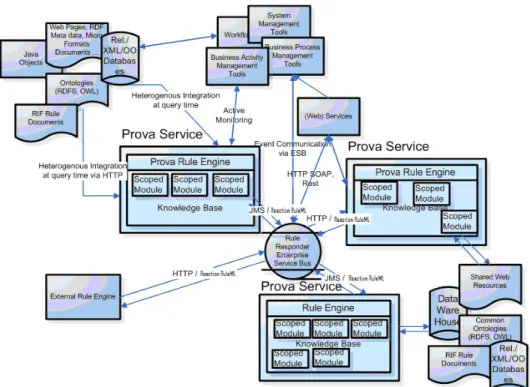
computer. Modern commercial ESBs bundle together a lot of event driven messaging, often including Web services, e.g. Rest, SOAP and XML messaging. Some ESBs go as far as to say they offer CEP in the form of event interpretation, correlation and pattern matching, and together with expressive rule-based decision and reaction layers for intelligent rule-based CEP, e.g. Rule Responder (http://responder.ruleml.org/). Much of this is playing into the currently fashionable market for event-driven BPM (EDBPM), semantic
BPM (SBPM), and service oriented architecture (SOA), with a trend towards combination with
event-driven architectures (EDA). Typically, the interest here is in the particular and complex event sequence or event processing workflow which possibly follows a certain communication or workflow-like coordination protocol (Paschke et al, 2006e), rather than in single global event occurrences which trigger immediate reactions as in the active database trigger or ECA rules. As a result, reactive rules which build on (complex) events are typically local to a particular context, e.g. within a particular conversation and coordination protocol (e.g. a workflow). That is, the communicated events contribute to the detection of a complex event situation which triggers a local reaction within a context (e.g., a conversation waiting for at