Available on-line at: www.oapub.org/edu
doi: 10.5281/zenodo.573352 Volume 3 │ Issue 4 │ 2017
THE EFFECTIVENESS OF A TRAINING PROGRAM USING
INTEGRATED EXERCISES (PHYSICAL-
SKILL) TO DEVELOP
STRENGTH, SPEED AND SOME ESSENTIAL TECHNICAL SKILLS –
A CASE STUDY ABOUT FOOTBALL PLAYERS UNDER 17 IN
MOSTAGANEM, ALGERIA
Beboucha Wahib1i, Ameur Ameur Housseyn2, Bengoua Ali3
I.EPS University of Mostaganem, Algeria
Abstract:
This research aims to propose a training program using integrated exercises (physical- skill) dedicated to develop the speed-strength and some essential technical skills to football players under 17 years old. The researcher followed the experimental method because of the relevance of the research issue. The study used a sample of the Mostaganem team under 17 years old consisting of 35 players; they were divided into two samples, the first sample consisted of (13) players a normal training program was applied with them , the second experimental group consisted of (13) players the training program applied offered by the researcher. Finally, the researcher suggests that the proposed program positively influence the development of speed-strength and some technical skills. A set of physical and skill tests were applied and after getting the results of the pre and post measurements and the statically processing of results, the researchers have concluded that integrated exercises (physical- skill) has a major impact in developing the speed-strength and some basic skills of football players under 17 years old.
Keywords: integrated exercises (physical - skill), speed-strength, technical skill
1. Introduction
In recent years we remarked that there is a clear upgrading in the level of football worldwide, which is the result of the scientific advancement of the modern sports training multi-objectives means, which is required by the world, so as to set up trainers to achieve a global level.
The goal of sports training is to attain high achievements in the sport activity; this could be achieved by raising the training situation level of the player and is composed of (physical condition - footwork case - tactical situation - cognitive status - the psychological state). Training situation is a term which means all the player’s physical capabilities and shows the readiness and efficiency of the organs of the body during training and competitions, and the training situation of an athlete depends on the degree of development of its components; whenever the level of these components increased the level of the player increased and in this case we must take into account consistency between the degree of development of these components according to the requirements of the competitive performance so that the fitness could be achieved (el Bisatti a..1998, page 18)
We can enhance the level of training process throughout the training process for the preparation of the player using a variety of exercises with different trends, which type, shape and characteristics is determined according to the different training periods with different trends, and the physical preparation is considered as one of the main setting to raise the competence of organs and systems functional body and to its goal in general to acquire the foundations of physical and functional public and private type of physical activity to build high levels and to realize an adaptation to the requirements of competitions through the same quantity and quality of the exercises that are consistent with the level of the player and his age, as well as the type of private activity and these exercises are continued throughout the whole season. (El Bisatti A. 1998, pages 21-22). The physical preparation has become one of the main aspects in the annual training plan, through its periods and different stages, and the importance of physical with the skill aspect has been scientifically and practically confirmed, thus became the physical skill aspects inseparable at any stage of the preparation as well as during competitions (Taha Ismail Abu Almagd, 1989, p. 89-93) and it can be even integrated in the same session "common physical preparation" or in the same exercise "physical integrated preparation"(Auber, Frédéric). The speed strength is considered as one of the muscle power kinds that got the attention of many researchers and specialists whom agreed on its importance to most of the sport activities and it has a growing impact on the
performance level where the capacity to compete of football players, especially the ability to overcome the repeated resistors using speed mobility as jumping high to hit the ball with the head or sudden shooting after running or attacking and changing directions. Speed-strength has a clear importance to games in general and football in particular, for its role in the acquisition and mastery of physical performance in the as soon possible with economizing in effort.
The player who has the advantage of high capacity and characterized by a large muscle strength as well as a high degree of speed and also a high degree of integration of strength with speed, and it is clear that speed-strength represents one of the physical ability components which is considered a compound product from the relationship between the strength and the physical speed which is one of the most important factors involved in the performance of various sports activities, especially football and high levels sport. (Taha Ismail Abu Almagd, 1989, p. 136-137)
2. Problem of the study
To achieve the performance and score in football, which aims to win necessitates many requirements, including a high level related and connected to the performance capabilities of physical and skill. The physical abilities are considered the essential foundation upon which the physiological side is developed (England) and skill (Brazil) and tactical (Italy) and psychological (Germany), in line with similar performance to the competitive one in football and to bring it to ideal training (Dellal, 2008, p. 09).
The re-reading of physical effort types of the players during the competition turned out to be kind of important physical effort and through which access to the result that is high and fast, which represents only 5% of the time of the game and thus it came the idea of changing the training from quantitative to qualitative (Gilles Cometti, 2005, p. 209). (Auber) states that we do not have to prepare our players to compete as much as we must prepare them for such competition (Auber, Frédéric).
In this development, coach should have to reconsider the preparation stage and he must be able to arrange his players to this effort, Using integrated exercises (physical-skill) with a "ball" to develop the physiological capacity specified for the situation of sports mainly for football players and particularly for physical abilities such as speed-strength.
Despite the importance of this integrated exercises, the analysis of the forms and the results of field observations and interviews carried out by the researcher students reached the misunderstanding of this integrated exercises sometimes for football
student to address this problem by proposing integrated exercises (physical-skill) in the development of the speed-strength and some of the basic skills.
From what we have already seen we asked the following questions:
Are the exercises (physical-skill) effective in the development of speed-strength and some of the basic skills of football players less than 17 years?
(physical-skill) have a positive effect on the development of speed-strength on the football players less than 17 years?
Do the integrated exercises (physical-skill) have a positive effect on the development of some of the basic skills of football players less than 17 years?
3. Objectives
Propose a preparation of exercises (physical-skill) to develop speed-strength and some of the basic skills of football players less than 17 years old.
Identify the effectiveness of the integrated exercises (physical-skill) in the development of speed-strength to some of the basic skills of soccer players less than 17 years.
4. Hypotheses
There are significant differences in the speed-strength in the post test between the control and experimental sample in favor of the experimental sample.
There are significant differences between the control sample and experimental in the post-test in favor of the latter in the results of basic skills in football.
5. Aims of Study
Know the effect of integrated exercises (physical-skill) based on the theoretical and scientific foundations for the development of speed-strength and some basic skills in football.
Show the importance of integrated exercise (physical-skill) limited in time and effort.
6. Glossary
A. 1.6-integrated exercises
Integrated exercises are physical exercises with the ball that allows to gain physical, skill and tactical capabilities (Dellal, 2008)
B. 2.6-distinctive speed-strength
The distinctive force means "the rapid appearance of muscle power which integrates both speed and power in a single movement." (Mufti Ibrahim Hammad, 1998)
7. Research Methodology
The choice of the appropriate research methodology to discuss the problem depends on the quality and nature of the research. So the student adopted the experimental method as it is relevant to the nature of the research problem and objectives (salary.1999).
To complete this experience, the student used a survey, because the scanning process is a general study of the phenomenon found in a particular community in a particular place, and under normal conditions.
8. Society and the research sample
The selection of the sample has a close relation with the nature of the society in where we took a sample consisting of 30 players less than 17 years old with the same specifications." (Wajih Mahjoub, 2001).
9. Research tools and materials
In order to succeed in the study in the best conditions ant to achieve the desired goals of the research and to get the proper results, the student used the following tools:
a) Arab and foreign sources and references. b) A survey (Questionnaire).
c) Personal interviews. d) Skill and physical tests:
The students used tests after their nomination by some experts "professors exceeded their experience of 10 years", it measures the physical side of speed-strength of the muscles of the legs, arms, abdomen, and the skill side by measuring the skill of running with the ball, passing, receiving and controlling the ball and hit it with the head.
10. The proposed training program
After the researcher student contacted a group of professors and other institutes and even from outside the country and employed many scientific sources and previous studies that determine the status of speed-strength in football that is developed through integrated exercises (physical - skill) as well for some basic skills.
* The scientific basis for the tests
The most important principles of tests its suitability and for a perfect application as it should consist of scientific basis which are:
A. The stability of the test
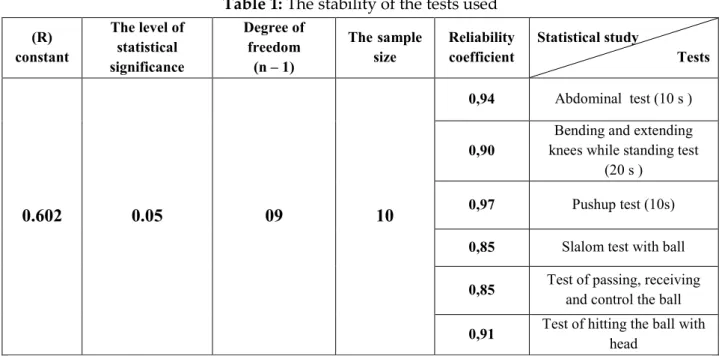
Table 1: The stability of the tests used
Statistical study Tests Reliability coefficient Thesample size Degree of freedom (n – 1) The level of statistical significance (R) constant Abdominal test (10 s ) 0,94 01 10 1010 10610
Bending and extending knees while standing test
(20 s )
0,90
Pushup test (10s)
0,97
Slalom test with ball
0,85
Test of passing, receiving and control the ball
0,85
Test of hitting the ball with head
0,91
The test is considered stable if it constantly gives the same results on the test repeatedly applied to the same subjects and under the same conditions, (Mohamed Sobhi Hassanein, 1995).
To get stability test of researcher used test method and applied the physical and skill on a sample of (10) players from Mostaganem less than 17 years old as we mentioned earlier and was keen to return it after 4 days in order to avoid the effect of the exercises and also we conducted the same first tests in time and place conditions and team work.
After ending the physical and skill tests for exploratory experience according to its specifications, the student used a statistical treatment after getting the results by using Pearson correlation coefficient and this treatment has produced a set of results approved by the student researcher.
B. Test sincerity
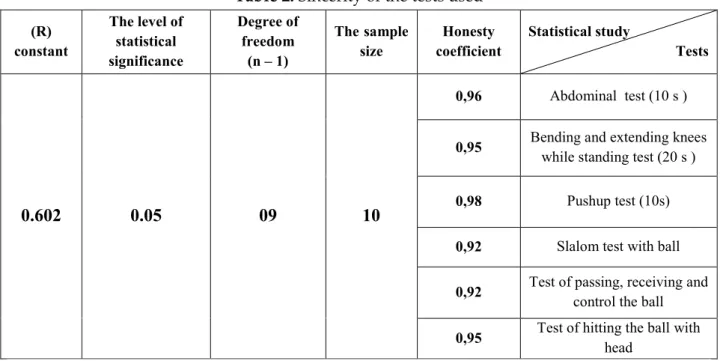
Table 2: Sincerity of the tests used
Statistical study Tests Honesty coefficient Thesample size Degree of freedom (n – 1) The level of statistical significance (R) constant Abdominal test (10 s ) 0,96 01 10 1010 10610
Bending and extending knees while standing test (20 s )
0,95
Pushup test (10s)
0,98
Slalom test with ball
0,92
Test of passing, receiving and control the ball
0,92
Test of hitting the ball with head
0,95
Test sincerity means “the test measures what was put to be measured” (Mustafa Bahi, 1999, p 23). To ensure the reliability of the tests the student researcher has first applied.
The expert’s sincerity way, it depends on the views of experts and specialists to ensure that the tests measure the phenomenon, which they were intended.
Secondly, the researcher used self-honesty as it is the most honest degree for real grades, which got rid of its measurement impurity and errors and that is measured by calculating the square root of the test stability coefficient (Hassanein, 1995.192-ibid.).
C. Tests objectivity
Objectivity means "freedom from prejudice and intolerance and exclude personal factors in the judgment of the researcher of the provisions" (Marwan Ibrahim 2000, p. 44) .And as Van Dalin refers that "The test is considered objective if it gives the same degree regardless of who correct it" (Hassanein 1995, p. 202).
11. The first exploratory study
According to the nature of the study and requirements of its field research, we have selected the most important tools that could be used in order to obtain as much information to achieve the desired purposes, and in this context, the parties that are intended to be studied are football coaches less than 17 years. In line with the requirements of the subject of research, researcher student keen to use the questionnaire which it is directed to football coaches.
And the student researcher sought to stop at the difficulties faced by the trainers in understanding the questions of the from, which is considered one of the important tools of the survey to collect data related to the topic of research and that is through the preparing a set of written questions where the respondent answer them by himself. And it included closed questions that could be answered by yes or no, and open-ended questions where the question is asked openly and leaves the questioner freedom without adhering to answer and other questions open and closed characterized by efficient to access information. Also the questioner was given the opportunity to express his opinion.
12. The second exploratory study
Through this study a set of tests has been selected (physical and skill) that is in tented to measure the stake of speed-strength and some basic skills in football, and that’s after taking off sources and scientific references and some studies and previous research and the use of the Internet, and it has been organized in the questionnaire form .
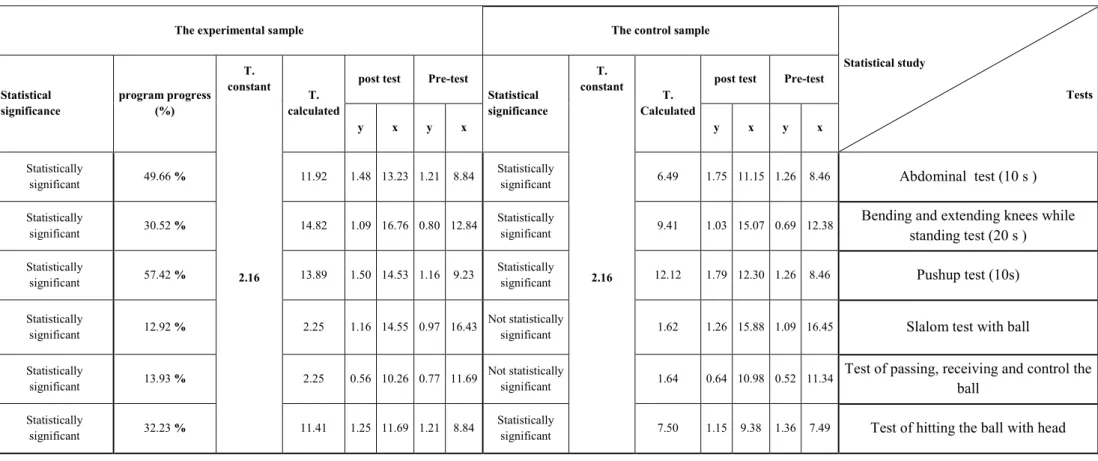
And after the use of statistical significance measures (T) STUIDENT, it shows that the value of (t) calculated for the controlling sample in physical tests and one skill test "hit the ball with head". The value of 6.49- 9.41- 12/12 to 05/07 which is greater than the value (T) with the amount of T (constant) 2.16 when the degree of freedom is 12 and the level of statistical significance is 0.05 which shows that there is statistically significant, meaning that there is a significant difference between the arithmetic average of the pre-test and post-test in these tests, as for the remaining skills test, the value of calculated (T) was up to 1.62- 1.64 and it is smaller than (T) which is 2.16 when the degree of freedom is 12 and the level of statistical significance is 0.05 which indicates that there is no statistically significant, meaning that there is no significant difference between the arithmetic average of the pre-test and post-test in these tests and for the experimental sample that have been applied on the merged exercises "physical-skill",
the value of (T) calculated for all tests is 11.92-14.82-13.89-2.25-2.25-11.41 which is greater than (T) (constant) which 2.16 at 12 degrees of freedom, at 0.05 level of statically significance which indicates that there is a significant difference, meaning that there is a significant difference between the average calculation in the pre and post-test for the experimental sample Also rate of the progress reached
Table 3: Shows the significance differences between
the pre and post result averages of the control and experimental samples
Statistical study
Tests The control sample
The experimental sample
Pre-test post test T. Calculated T. constant Statistical significance Pre-test post test T. calculated T. constant program progress (%) Statistical significance x y x y 0006 x y x y 0006 Abdominal test (10 s ) 8.46 1.26 11.15 1.75 6.49 Statistically significant 8.84 1.21 13.23 1.48 11.92 49.66 % Statistically significant
Bending and extending knees while standing test (20 s ) 12.38 0.69 15.07 1.03 9.41 Statistically significant 12.84 0.80 16.76 1.09 14.82 30.52 % Statistically significant Pushup test (10s) 8.46 1.26 12.30 1.79 12.12 Statistically significant 9.23 1.16 14.53 1.50 13.89 57.42 % Statistically significant
Slalom test with ball
16.45 1.09 15.88 1.26 1.62 Not statistically significant 16.43 0.97 14.55 1.16 2.25 12.92 % Statistically significant
Test of passing, receiving and control the ball 11.34 0.52 10.98 0.64 1.64 Not statistically significant 11.69 0.77 10.26 0.56 2.25 13.93 % Statistically significant
Test of hitting the ball with head
7.49 1.36 9.38 1.15 7.50 Statistically significant 8.84 1.21 11.69 1.25 11.41 32.23 % Statistically significant
C. Comparing the results of tests in total posttest of my sample search
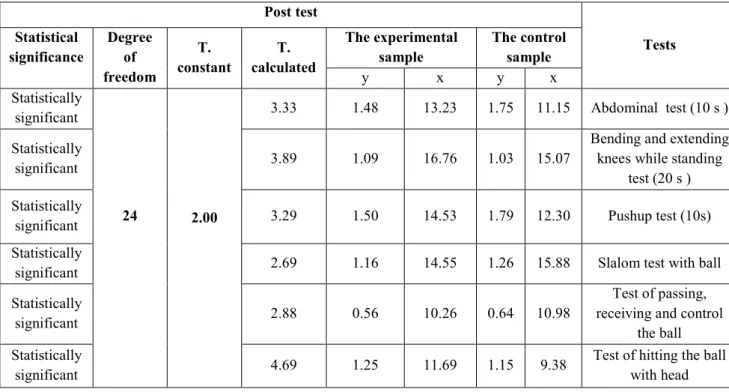
Table 4: Comparison of the results of tests in posttest of my sample search
Tests Post test The control sample The experimental sample T. calculated T. constant Degree of freedom Statistical significance x y x y Abdominal test (10 s ) 11.15 1.75 13.23 1.48 3.33 2.00 24 Statistically significant
Bending and extending knees while standing
test (20 s ) 15.07 1.03 16.76 1.09 3.89 Statistically significant Pushup test (10s) 12.30 1.79 14.53 1.50 3.29 Statistically significant
Slalom test with ball 15.88 1.26 14.55 1.16 2.69 Statistically significant Test of passing, receiving and control
the ball 10.98 0.64 10.26 0.56 2.88 Statistically significant
Test of hitting the ball with head 9.38 1.15 11.69 1.25 4.69 Statistically significant
It is noted through the results shown in the table (04) for post test of the two samples that the calculated value (T) of the two samples reached 3.33-3.89-3.29-2.69-2.88-4.69 and is bigger than the value of (T) which is 2.00 at 24 degrees of freedom and the level of 0.05 statically significance, and this shows that there are cant differences statistically significant in favor of the sample with the greatest calculated average which is applied on the integrated exercises (physical- skill).
5. Discussion of results with hypotheses
5.1 Discussion of the First Hypothesis
The first hypothesis, which was attached in the presence of statistically significant differences in the level of the speed-strength among the controlling sample and experimental sample in favor of the experimental sample, after statistical treatment (T) STUIDENT. Was used for total raw results obtained for the purpose of issuance objective judgments, does the applying the integrated exercises (physical, skill), proposed to develop a speed-strength for football players, it has been shown that the controlling sample, which was under the supervision of her coach has occurred to it on evolution in the speed-strength and to all the muscles and tested body parts (muscles of the legs, the muscles of the arms, the abdominal muscles), but slightly compared with the experimental
sample that have been applied to it integrated exercises (physical, skill), it did not achier the value of (T) calculated statistical significance in the post-test as described in the table.
Researcher student believes that the reasons for the small development in the speed-strength for the muscles of the legs, arms and abdomen of the controlling sample, is because the majority of coaches don’t give this character much importance and don’t give sufficient timing to its training, and this is due to the lack of training session for this category.
And the lack of preparation duration and prepare the players for the competition which is already longer than the period of preparation and not to keep up with advances in the use of the most suitable ways and methods to train this category (less than 17 years), where the majority of coaches, in spite of their long experience in the field of training, but they do not use exercises that use the detailed and the guided shape in the preparation of the players, it has been observed that they have a lack of understanding of the integrated physical preparation.
Unlike the experimental sample that have been applied by the proposed integrated exercises integrated (physical, skill), it is through statistical treatment which is described in the table, it shows a significant difference in the results as now of the calculated values of (T) is greater than the value (T) (constant) at the level of 0.05 and the degree of freedom 24, which confirms the effectiveness of the integrated exercises (physical, skill) which is directed to develop the distinctive speed-strength for football players less than 17 years old and this is what agrees with the study (Dellale, 2008), as he recommend «Frederic Auber», that this age group (less than 17 years) must be trained with the integrated physical preparation and that is due to the small number of training sessions.
The application of integrated exercises (physical, skill) had a significant impact on the development of speed-strength and basic skills and this is confirmed by « el Bisatti» in training mode compact through physical and skills exercises that rely in its content on acquiring and upgrading skill performance which is linked to achieving physical goals such as speed and physical ability and endurance, ... etc.
Taking into account the characteristics of each of them and technical aspects of the training and says «Wade Allen» running with the ball plays an important role in the diverse fitness training for a football player and that shows the effectiveness of the proposed training program of integrating physical and skill exercises, which led to the development of the physical qualities of the experimental group and that had a positive impact in the development of basic skills because the physical features are the foundation stone that is carried out though it the performance of the basic skills with a large degree where whenever a player had a high fitness whenever he had the ability to perform and
develop the skill well and as this physical character of speed-strength the evolved, also accompanied by the development in the featured of fitness, flexibility and speed transition which had an impact on the development of basic skills.
This is consistent with «EL WICHAHI» where it notes to the game requirements, it requires that the player is ready whenever possible in all special game aspects all together not separately, so The degree possible that could integrates physical training / physiological with skills training, or tactical ... etc. (El Wichahi 1994p507) and this emphasizes the positive impact of the proposed program and on this basis the student concluded that this hypothesis have been achieved.
5.2 Discussion of The second hypothesis
The hypothesis was based on the presence of statistically significant differences between the controlling sample and experimental in the post test in favor of the latter in the results of some basic skills in football, and on the impact of the statistical treatment of the raw group results obtained using the test of significance (T) for the purpose of issuing objective judgments about moral differences between the post-averages of the research samples experimental and control that has been applied on them integrated exercises(physical, skill), it is revealed through learned the statistical results from the table, that all occurring differences between the post-averages of the results of tests for the research samples controlling and experimental that it has statistically significant in favor of the latter as most values of (T) calculated is greater than the value (T)(constant). amounting to 2.00 when the degree of freedom of 24, and the level of significance 0.05, and thus confirmed the sincerity hypothesis put forward of the existence of significant differences in the results of the post-tests, and this is in favor of the experimental sample that has been applied on it integrated exercises (physical, skill), to develop speed-strength and some basic football skills, and this is what proves exercises privacy and quality within the energy used system, where the exercises that have been applied in the training program relied on short times (4-12 s), which the player needs significantly during his various skills and the privacy of these exercises used that are commensurate with the game's privacy and that are similar from motor route of the skill and it is, similar to the positions of play during the match, which had a positive impact on the raising the skill level, and most experts and specialists in training indicates on the principle of privacy in training, meaning the inclusion of training on similar movements in the nature of performance in sports activity practiced.
And this hypothesis agreed with the findings of the «Taha’s» study, which is the dealt of players a lot with the ball has increased the sense of the players with the ball and
their perception of (mass, shape and size), as well as the performance of these exercises daily for a month has made the players more controlling and controlling of the ball « Taha Ismail Abu Almagd (1989) », and that was the findings of the student’s study of the effectiveness of integrated exercises (physical, skill) in the development of speed-strength and some basic skills in football, and from this student researcher concludes that the hypothesis has been achieved.
6. Research findings
In light of what has been deduced from theoretical studies and measurements and tests used in the study and based on the objectives of the research and its duties, tools and research sample and what has been resulting from statistical analysis, the student was able to reach the following conclusions:
There are significant differences between the controlling and experimental sample in the post-test in favor of the latter in the results speed-strength which demonstrate the effectiveness of the compact exercise (physical, skill).
There are significant differences between the controlling and experimental sample in the post-test differences in favor of the latter in the results of the basic skills of football players.
The use of integrated training (physical, skill) generates the players with the desire and enthusiasm to perform exercises, which positively affects the development of the physical and basic skills, in particular for the players.
The intensity of training load comes hidden «discreet» as a result of the use of play and the integration of the ball in the physical side where this type of training would be favored among the players.
The low level of sports achievements for football players less than 17 years is due to the lack of attention of trainers of the higher training and not applying the theory of scientific basis.
Lack of interest in coaches of the speed-strength the basis of the most important physical attributes needed by the football player.
7. Recommendations
Based on the results concluded from the study and on the basis on what has been deduced from these results the student researcher proposes the following:
A. For scientific competencies and for the specialists:
Organize seminars for those involved in training on modern training methodology; Develop a programs and a plan by specialists in this area, flowing towards the
formation and training of coaches technically and scientifically.
Get into the career of training and work in the field in order to flourish the sportive achievement
Integrate the graduates from the institute in the profession of training sport teams at various levels and age groups.
B. For researchers
Conduct more studies in this regard to develop the physiology capacities of football players from different ages.
Conduct studies on the rationing of the training load in the merged physical preparation.
C. For Trainers
Use integrated physical exercise (physical, skill) for different age groups who are in the process of formation.
Pay attention to prepare the players properly in the integrated form. Pay attention to train and develop the speed-strength.
References
A. References in Arabic
1. Marwan Abd El Hamid (2000): the foundations of scientific research for the preparation of theses, Oman, the Ministry Foundation for Publishing and Distribution, p 44
2. Botross (1994): footballers physical and skill, Alexandria/ Knowledge House..
3. Taha Ismail Abu Almagd (1989): Football between theory and practice of physical preparation. Cairo Arab Thought House.
4. Mustafa Bahi(1999): Scientific transactions between theory and practice, Cairo, book publishing center, p23
5. Mohamed Sobhi Hassanein(1995): Measurement and evaluation in physical education and sport third Edition Cairo Arab Thought House, p186
6. Wajih Mahdjoub (2001) : The origins and methods of scientific research, AMAN, Publishing and Distribution House
7. Mouhamed ratib (1999): Scientific Research in Physical Education and sport Psychology, Arab Thought House Cairo.
8. Mouhamed zian(1983): Scientific research and its methods and techniques. University Publications Office, Algéria.
9. Moufti Hamad)8991(: Modern sports training;planning, application and leadership Arab Thought House, Cairo
10. El Bissati)8991( : Principles and rules of sports training and its applications, Alexandria
B. References in a foreign language
1. Gilles Cometti. (2005). Physical preparation in football. dijon: Faculty of Sport Sciences UFR staps.
2. Daniel D. Arneheim. (1985), Modern principles of Athletic Training. Mosby: sixth edition, times mirror.
3. David C. Laporte. Lactic Acid Department of Biochemistry. University of Minnesota.
4. A. Dellal (2008): Analyzes of the physical activity of the footballer. Strasbourg: University de Aboutoihi, 2006
5. Auber Frédéric 2000 : Pourquoi le concept de préparation physique intégrée est-il une escroquerie méthodologique .
6. Dintiman G .B., Ward r.d , Tellez t. (1997). . (1997) : Sports speed. USA: Human Kinetics.
Creative Commons licensing terms
Authors will retain the copyright of their published articles agreeing that a Creative Commons Attribution 4.0 International License (CC BY 4.0) terms will be applied to their work. Under the terms of this license, no permission is required from the author(s) or publisher for members of the community to copy, distribute, transmit or adapt the article content, providing a proper, prominent and unambiguous attribution to the authors in a manner that makes clear that the materials are being reused under permission of a Creative Commons License. Views, opinions and conclusions expressed in this research article are views, opinions and conclusions of the author(s). Open Access Publishing Group and European Journal of Physical Education and Sport Science shall not be responsible or answerable for any loss, damage or liability caused in relation to/arising out of conflict of interests, copyright violations and inappropriate or inaccurate use of any kind content related or integrated on the research work. All the published works are meeting the Open Access Publishing requirements and can be freely accessed, shared, modified, distributed and used in educational, commercial and non-commercial purposes under a