HAL Id: hal-01073529
https://hal.archives-ouvertes.fr/hal-01073529
Submitted on 10 Oct 2014HAL is a multi-disciplinary open access archive for the deposit and dissemination of sci-entific research documents, whether they are pub-lished or not. The documents may come from teaching and research institutions in France or abroad, or from public or private research centers.
L’archive ouverte pluridisciplinaire HAL, est destinée au dépôt et à la diffusion de documents scientifiques de niveau recherche, publiés ou non, émanant des établissements d’enseignement et de recherche français ou étrangers, des laboratoires publics ou privés.
How nonmagnetic particles intensify rotational diffusion
in magnetorheological fluids
Laura Rodriguez Arco, Modesto Lopez-Lopez, Pavel Kuzhir, Fernando
Gonzalez Caballero
To cite this version:
Laura Rodriguez Arco, Modesto Lopez-Lopez, Pavel Kuzhir, Fernando Gonzalez Caballero. How nonmagnetic particles intensify rotational diffusion in magnetorheological fluids. Physical Review E : Statistical, Nonlinear, and Soft Matter Physics, American Physical Society, 2014, 90, pp.012310. �10.1103/PhysRevE.90.012310�. �hal-01073529�
1
How nonmagnetic particles intensify rotational diffusion in magnetorheological fluids 1
L. Rodríguez-Arco,* † M.T. López-López,* P. Kuzhir,‡ F. González-Caballero* 2
Receipt date: 29 March 2014 3
Abstract 4
In this work we propose a mechanism to explain the enhancement of the magnetic
field-5
induced yield stress when nonmagnetic particles are added to magnetic particulate
6
suspensions –i.e., bi-component suspensions. Our main hypothesis is that the nonmagnetic
7
particles collide with the field-induced magnetic aggregates under shear flow. Consequently,
8
supplementary fluctuations of the orientations of the magnetic aggregates occur, resulting in
9
an effective rotary diffusion process, which increases the dynamic yield stress of the
10
suspension. Furthermore, the collision rate and the rotary diffusivity of the aggregates should
11
increase with the concentration of nonmagnetic particles. Rheological measurements in
plate-12
plate and cylindrical Couette geometries confirm the increase of the yield stress with the
13
volume fraction of nonmagnetic particles. In addition, such an effect appears to be more
14
important in Couette geometry, for which orientation fluctuations of the magnetic aggregates
15
play a more significant role. Finally, a theoretical model based on this rotary diffusion
16
mechanism is developed, providing with a quantitative explanation to the
experimentally-17 observed trends. 18 PACS: 66.10.C-; 47.11.-j; 83.80.Hj; 83.80.Gv. 19 20 21 22 23 24 25 26 27 28
* Departmet of Applied Physics, University of Granada, Faculty of Science, Campus de Fuentenueva, 18071 Granada, Spain.
† Corresponding author. Email address: [email protected]
‡ Laboratory of Condensed Matter Physics, University of Nice-Sophia Antipolis, CNRS, U.M.R 7336, 28 avenue Joseph Vallot, 06100 Nice, France.
2
I. INTRODUCTION 1
The fluid dynamics of particles suspended in a liquid –i.e., particulate suspensions–
2
have been extensively studied in recent decades due to their multiple applications. Special
3
attention has been paid to diffusion, the process which governs the motion of the suspended
4
particles, either by controlling the particles’ position (translational diffusion) or their
5
orientation (rotational diffusion) [1]. Typical fields where diffusion plays a crucial role are
6
self-assembly and rheology/micro-rheology of complex fluids (polymer solutions,
7
suspensions of rod-like particles or granular gases) [2-6]. A special kind of particulate
8
suspensions for which diffusion has also been studied are field-driven colloids, suspensions of
9
polarizable particles dispersed in a liquid carrier which undergo changes of their mechanical
10
properties in the presence of external fields [7-12]. Examples of these smart materials are
11
ferrofluids or electrorheological and magnetorheological (MR) fluids. In the case of MR
12
fluids, the suspended magnetizable particles build columnar-like aggregates in the direction of
13
the applied magnetic field. Such a jamming process induces a several orders of magnitude
14
increase of the MR fluid viscosity in the presence of the field, a phenomenon commonly
15
known as the MR effect [13-14].
16
The importance of rotational diffusion on the rheological (flow) properties of MR
17
fluids is clearly evidenced when comparing such properties in the available rheometry
18
configurations. In the particular case of a magnetic field applied in the direction perpendicular
19
to the walls which confine the sample –for example, in plate-plate or cone-plate geometries–
20
the magnetic aggregates span the gap between the geometry walls, hindering the rotation of
21
the upper plate/cone upon the application of a given stress. Nevertheless, there is a threshold
22
value of the stress, also known as the yield stress, for which these structures are broken, losing
23
contact with the walls, so that a practical onset of the flow takes place. Such behavior is
24
reminiscent of the Bingham plastic behavior, the yield stress being an increasing function of
25
the magnetic field [13]. On the other hand, when the magnetic field is oriented parallel to the
26
geometry walls –e.g., cylindrical Couette geometry or pressure-driven flows using coaxial
27
coils–, the aggregates are theoretically oriented along the stream-lines and have in theory an
28
infinite length due to the absence of tensile hydrodynamic forces. Consequently, the
29
suspension should not develop any yield stress and its rheological behavior should follow
30
Newton’s law of viscosity. However, experimental results show exactly the opposite effect:
31
the suspension develops a strong Bingham behavior [15-18]. In a previous work [19] we have
32
shown that the main contribution to the appearance of such a yield stress is precisely the
33
rotational diffusion of the field-induced aggregates. More specifically, stochastic rotary
34
oscillations of such aggregates increase the stress level of the suspension. These oscillations
35
are caused by many-body magnetic interactions with neighboring aggregates [19].
36
However, and to the best of our knowledge, the effect of rotational diffusion on the
37
yield stress has only been studied in the case of conventional MR fluids, that is, suspensions
38
consisting solely of micron-sized ferromagnetic particles. However, in the last decades a
39
number of methods to enhance the applicability of MR fluids –i.e., increasing the suspension
40
stability and the field-induced yield stress– have been described. One effective way to
41
improve stability is the use of nonmagnetic –i.e., diamagnetic– particles in the formulation,
42
such as clay, polymeric or silica particles [20]. Due to their lower density they contribute to a
43
reduction of particle settling without increasing the final weight of the fluid. In addition to a
44
better stability, its use results in an enhanced MR effect [21-25]. However, the physics behind
45
such an increase still remains unclear. For example, López-López et al. [21] attributed the
3
increase of the MR effect when dispersing iron and clay particles together to the combination
1
of the magnetically-induced iron chains and a clay gel. Particle-level simulations in three
2
dimensions supported the experimental enhancement of the yield stress when mixing iron
3
particles and hollow glass beads [22]. However simulations in a monolayer of particles did
4
not confirm the experimental trends. The authors themselves stated that a mechanistic
5
explanation was still lacking [22]. In a second work, new simulations suggested that the
6
nonmagnetic particles increased the size of the field-induced clusters [23].
7
In a previous work we showed that the enhancement of the MR effect in bi-component
8
suspensions could be attributed to a change in the magnetic properties of the suspension when
9
iron particles –approx. 1 µm in size–adsorbed onto a layer around poly(methylmethacrylate),
10
PMMA, spheres – of approx.10 µm of diameter. Indeed, simulations showed that suspensions
11
of such nonmagnetic-core–magnetic-shell composites would develop higher magnetic
12
permeability than those of solid magnetic particles, with the same concentration of magnetic
13
material [25]. We have given experimental evidence of such an increase in a recent work too,
14
in which the magnetic properties and the MR effect of nickel-coated ceramic particles and
15
solid-nickel particles were compared [26].
16
In this work we deal with bi-component suspensions in which adhesion between
17
PMMA and iron particles is avoided by the use of a surfactant, but still, a strong enhancement
18
of the MR effect appears. Therefore, in the present case, the explanation to the improvement
19
of the MR effect could not come from a change of the magnetic properties as in refs. [25, 26],
20
and finding an alternative explanation is the main aim of this work. Our main hypothesis is
21
based on collisions between the nonmagnetic particles and the field-induced aggregates of
22
magnetic particles under shear flow. Such collisions may impart supplementary fluctuations
23
of the positions and orientations of the magnetic aggregates. In order to prove our hypothesis,
24
we perform rheological cylindrical Couette measurements, because the effects of orientation
25
fluctuations are more clearly evidenced in this geometry. For comparison we also show the
26
results of plate-plate rheological measurements. Finally we develop a theoretical explanation
27
for the experimentally observed trends.
28
II. MATERIALS AND METHODS 29
We used spherical carbonyl iron particles (BASF, HS quality) and PMMA spheres
30
(Microbeads, Spheromers10) as magnetic and nonmagnetic particles respectively. Particle
31
diameters were 1.0 ± 0.7 μm and 9.9 ± 0.4 μm respectively. In order to hinder adsorption of
32
iron particles around PMMA spheres we first dispersed appropriate amounts of iron powder in
33
silicone oil (VWR International, Rhodorsil 47V500, dynamic viscosity at 25 °C is 480 mPa·s)
34
followed by the addition of aluminum stearate (Sigma Aldrich, technical grade), under
35
vigorous mechanical stirring. We continued stirring for several hours to promote stearate
36
adsorption onto iron, and finally added PMMA powder in appropriate amounts. The volume
37
fraction of iron, Φm, was 10 vol % for the four prepared samples. The volume fraction of
38
PMMA, Φn, ranged from 0 to 30 vol %. All the samples were degasified under vacuum for 15
39
minutes prior to rheological measurements.
40
Microscopic observations upon magnetic field application of diluted samples, prepared
41
as described above, were conducted by placing an optical microscope between two Helmholtz
42
coils that applied a homogeneous magnetic field parallel to the surfaces that confined the
4
sample. Magnetization curves of the suspensions were obtained at 20 ºC by means of a
1
vibrating sample magnetometer VSM 4500 (EG&G Princeton Applied Research, USA).
2
The rheological measurements were conducted by using a controlled-stress rotational
3
rheometer, Haake RheoStress RS 150 (Thermo Fisher Scientific, USA). We performed
4
measurements using cylindrical Couette and plate-plate geometries. Couette cell consisted of
5
an inner cylinder of diameter of 20 mm and height of 30 mm. The radial distance between the
6
surfaces of the outer and inner cylinders was 0.75 mm. We applied a uniform magnetic field
7
with the help of a coil placed coaxially with the rheometer axis and thus, in the direction
8
parallel to the suspension vorticity. The measuring protocol for Couette measurements was as
9
follows: (i) Pre-shear stage at a shear rate of 150 s-1 for 60 s in the absence of field. (ii)
10
Application of the same shear rate for 60 s upon a magnetic field of approx. 6 kA/m. (iii)
11
Sample at rest for 3 min and magnetic field application of a desired intensity (from 6 to 30.6
12
kA/m). (iv) Shear rate ramp (equivalent rheological results were obtained by ramping the
13
shear stress) from 1 to 500 s-1 upon the same field as in (iii) with duration of each step of 30 s.
14
At the end of stage (iv), the magnetic field was again readjusted to 6 kA/m, and stage (ii) was
15
repeated before a new shear rate ramp at a different –increasing– magnetic field was started.
16
Note that a magnetic field of, at least, 6 kA/m was maintained during the whole process to
17
reduce particle settling.
18
Plate-plate measurements were performed with a set of parallel plates (diameter of 35
19
mm). The gap between the two plates was 350 µm. All the quantities reported hereinafter
20
correspond to the outer radial edge of the plate. In this second case, the magnetic field was
21
applied with the same coil as for cylindrical Couette geometry. As a result, in this geometry
22
the magnetic field was aligned along the velocity gradient and perpendicular to the rheometer
23
walls. The measuring protocol consisted of three stages: (i) Pre-shear at a shear rate of 150 s-1
24
for 60 s. (ii) Sample at rest for 120 s. (iii) Shear rate ramp from 20 to 300 s-1. Each step lasted
25
30 s. The magnetic field was activated at the beginning of (ii) and was kept switched on until
26
the end of (iii).
27
III. EXPERIMENTAL RESULTS 28
First of all, and to discard the formation of nonmagnetic-core–magnetic-shell
29
composites of enhanced magnetic permeability –i.e., like those of ref. [25] – we performed
30
microscopic observations and magnetization measurements. The microscopy results obtained
31
for diluted suspensions showed that there was not adsorption of iron particles onto PMMA
32
ones. As a matter of fact, PMMA particles appeared uncovered and most of them were
33
separated from the field-induced iron aggregates upon the application of an external magnetic
34
field –Fig. 1. The thickness of these chain-like aggregates was of the same order of magnitude
35
as the diameter of PMMA particles. In addition, nonmagnetic particles were generally not
36
trapped into the aggregates of magnetic particles in contrast to the results shown in the inset
37
of Fig. 1 for which aluminum stearate was not used and consequently, a strong cohesion
38
between iron and PMMA particles existed, resulting in an increase of the MR effect with a
39
growing content of PMMA [25]. Regarding the magnetization curves, we observed that the
40
hysteresis loops for the different samples were practically superimposed, as seen in Fig. 2, and
41
therefore, the addition of PMMA particles did not affect the suspension magnetic
42
permeability. Actually, calculations of such magnetic permeability by using the ascent branch
43
of the hysteresis loops (inset of Fig. 2) revealed differences in the magnetic permeability no
44
bigger than approx. 5% for the different samples. Therefore, changes of the MR effect for
5
these bi-component suspensions could not be attributed to an enhancement of the magnetic
1
permeability because of the formation of a magnetic coating around PMMA particles.
2
FIG. 1. Microscopic picture of a suspension of 1 vol % iron and 3 vol % PMMA dispersed in silicone oil and
stabilized by the addition of aluminum stearate. A magnetic field of approx. 10 kA/m was applied in the direction indicated by the arrow; the bar length corresponds to 50 µm. PMMA particles (white spheres of 10 µm) appeared uncoated and separated from the iron chains. This situation was different to that observed in the inset for a suspension in which aluminum stearate had not been added to the suspension and in which adsorption of iron particles around PMMA particles took place with the formation of nonmagnetic-core– magnetic-shell composites. The picture from the inset is taken from ref. [25] and the bar length is 10 µm.
FIG. 2. Hysteresis loops for all the suspensions. The concentration of iron particles was 10 vol % while the
volume fraction of PMMA particles ranged from 0 to 30 vol %. All the curves were superimposed and therefore, there were no remarkable differences in the suspension magnetic permeability of the samples, calculated from the ascent branch of the inset.
However, and despite having removed the influence of an enhanced suspension
3
permeability, we observed a strong enhancement of the MR effect, which seemed to be
4
especially important in cylindrical Couette geometry. More specifically, the shear stress in the
5
flow curves – shear stress σ vs. shear rate γ&– at given values of the external magnetic field
6
and γ&, was higher when nonmagnetic particles were included in the formulation for both
7
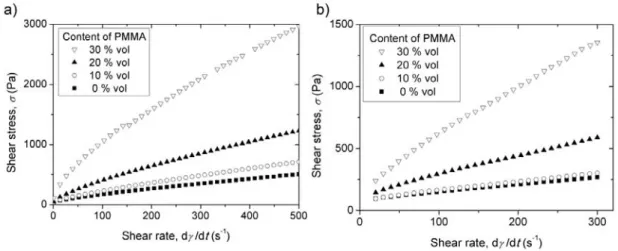
cylindrical Couette and plate-plate geometries. In addition, σ increased with the volume
6
fraction of PMMA particles Φn for a certain value of γ& –Fig. 3. Note that the values of the
1
shear stress for a particular suspension were higher when using cylindrical Couette geometry
2
in comparison with the plate-plate geometry –Fig. 3.
3
4
FIG. 3. Flow curves of the bi-component suspensions in cylindrical Couette (a) and plate-plate (b) geometries at 5
the same concentration of iron particles, Φm=0.1 and different concentrations of PMMA particles Φn. The
6
intensity of the external magnetic field was H0 = 12.2 kA/m for both geometries. As observed, the shear stress
7
increased when Φn was increased. Note that the shear stress was generally higher for cylindrical Couette
8
geometry.
9
In order to better compare both geometries and analyze the influence of the addition of
10
PMMA on the MR effect, we estimated the yield stress. Recall that the MR effect is defined
11
as the change of the rheological behavior from an almost Newtonian behavior in the absence
12
of field –characterized by the equation
σ
=η
γ
& where η is the viscosity– to a plastic behavior13
when the magnetic field is activated. A plastic fluid usually follows Bingham’s equation
14
γ η σ
σ = Y + & where σY is the dynamic yield stress [27]. We estimated the yield stress by
15
performing a linear fit of the high-shear part of the rheograms (γ&>100s-1), the yield stress
16
being the intercept of the fit with the Y-axis, i.e., zero shear rate. The fits (not shown here for
17
brevity) were reasonably good in all cases (R2 ≈ 0.99). With the aim of just comparing the
18
influence of the magnetic field between both geometries, we calculated the increment of the
19
yield stress by subtracting the yield stress at zero field to the yield stress at a given applied
20
field, and plotted it against the external magnetic field strength, H0 –Fig. 4. The so-estimated
21
increment of the yield stress increased both with H0 and Φn for plate-plate and cylindrical
22
Couette geometries. In cylindrical Couette geometry, however, both effects appeared more
23
intensified. Actually, the yield stress increment exhibited a stronger increase with the PMMA
24
concentration in cylindrical Couette geometry –3.7 times in the range 0<Φn<0.3– as compared
25
to the plate-plate geometry –1.9 times in the same range.
7
1
FIG.4. Experimental (symbols) and theoretical (lines) dependencies of the yield stress increment on the intensity 2
of the external magnetic field for the cylindrical Couette (a) and the plate-plate (b) geometries at the same
3
concentration of iron particles, Φm =0.1 and different concentrations of PMMA particles, Φn. The yield stress
4
increased with both the magnetic field strength and the volume fraction of PMMA. Both effects appeared to be
5
more pronounced in Couette rheometry. The theoretical predictions (see section IV) are obtained for values of
6
the free parameters of α1=1.5; α2=0.2 for the plate-plate geometry, and α1=0.2; α2=0.4 for the cylindrical
7
Couette geometry. The collision contribution to the rotary diffusivity α2 is thus more important in the second
8
case.
9
To be precise, the differences between the increments of the yield stress for both
10
geometries became more accentuated when the PMMA volume fraction increased. Indeed, the
11
Couette yield stress increment of the sample without PMMA was almost superimposed to the
12
equivalent plate-plate one, whereas the yield stress increment of the sample with 30 vol %
13
PMMA was much higher for cylindrical Couette geometry –Fig. 5. However, we must keep in
14
mind that because of the differences in geometry, the demagnetizing field opposed by the
15
sample was different for the cylindrical Couette and the plate-plate systems. In the Couette
16
geometry the height-to-gap ratio was very large and, as a result, the demagnetizing field along
17
the rheometer axis was negligible. Consequently the field inside the sample, the so-called
18
internal field, H, was almost equal to the external one H≈H0. On the other hand, in plate-plate 19
rheometry, the ratio of the gap height to the plate diameter was small and the resulting
20
demagnetizing field was higher. Estimations of the internal magnetic field using Eq. (A1)
21
show that for the sample without PMMA, the MR effect in plate-plate geometry was
22
considerably higher than in the case of cylindrical Couette. However, the differences between
23
both geometries diminished as the PMMA concentration increases because of the further
24
enhancement of the MR effect in bi-component suspensions for cylindrical Couette geometry
25
[28].
8
1
FIG.5. Comparison of the magnetorheological effect observed in plate-plate and cylindrical Couette geometries 2
at the same concentration of iron particles, Φm=0.1 and four different concentrations of PMMA particles, namely
3
Φn =0 (a), Φn =0.1 (b), Φn =0.2 (c) and Φn =0.3 (d). The differences between the curves of both geometries
4
increased with Φn.
5
IV. THEORY AND DISCUSSION 6
A. Qualitative interpretation 7
The analysis of the obtained experimental results allows us to formulate the two main
8
questions of the present work, namely: (a) What is the possible mechanism behind the
9
enhancement of the MR effect by the addition of nonmagnetic particles to a suspension of
10
magnetic particles? (b) Why is this enhancement appreciably higher when the magnetic field
11
is oriented along the vorticity (cylindrical Couette) rather than along the velocity gradient
12
(plate-plate)? In this section, we shall first give a qualitative answer to both questions,
13
followed by the development of a theoretical model to provide a more quantitative
14
interpretation.
15
Regarding question (a) we must keep in mind that whatever the composition of the
16
suspension–i .e. with or without nonmagnetic particles– the dynamic yield stress arises from
17
hydrodynamic dissipation on the field-induced particle aggregates upon shear [13, 15]. In
9
addition to it, magnetic interactions between aggregates may induce stochastic fluctuations of
1
their orientation and result in a supplementary contribution to the yield stress, coming from
2
stochastic interaction torques. These fluctuations may be regarded as an effective rotary
3
diffusion process, which is likely responsible for the unexpectedly high yield stress when the
4
magnetic field is parallel to either the suspension velocity or the vorticity [19, 29].
5
Our main hypothesis is that under shear flow, the nonmagnetic particles may collide
6
with the aggregates of magnetic particles and impart them supplementary fluctuations of their
7
orientations. The importance of such collisions should not be underestimated, taking into
8
account the relatively high concentrations and large size of the PMMA particles used in this
9
work –diameter of the same order of magnitude as the magnetic aggregate thickness as shown
10
in Fig. 1. Clearly, the collision rate, and consequently, the rotary diffusivity of the aggregates,
11
should be a growing function of the volume fraction of nonmagnetic particles, Φn. When Φn
12
increases, fluctuations of the aggregate orientation become stronger and two effects take
13
place: (i) The aggregates become more misaligned with the flow, which induces a stronger
14
viscous dissipation (either viscous or hydrodynamic). (ii) The stochastic torque –exerted on
15
the aggregates by multiple collisions with the nonmagnetic particles– increases, which results
16
in an increase of the respective stress contribution –the so-called “diffusion stress”. Both
17
effects contribute to the increase of the stress level in general, and both of them increase with
18
the volume fraction of PMMA, which would explain the enhancement of the MR effect in
bi-19
component suspensions.
20
Concerning question (b), we can also find an answer based on the hypothesis of
21
collisions among the magnetic aggregates and the nonmagnetic particles. In cylindrical
22
Couette geometry, the magnetic field tend to orientate the aggregates along the vorticity,
23
which minimizes the viscous dissipation. Consequently, in this particular geometry, depicted
24
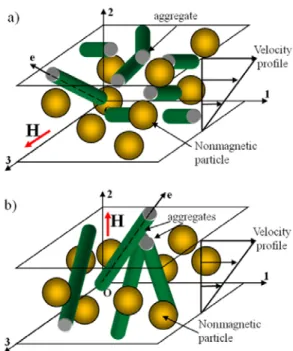
in Fig. 6(a), the aggregate orientation distribution and the yield stress are principally governed
25
by the stochastic interactions among the aggregates and the nonmagnetic particles, and among
26
the aggregates themselves. On the other hand, in plate-plate geometry, shown in Fig. 6(b), the
27
magnetic torque misaligns the aggregates from the flow direction, which increases the
28
hydrodynamic dissipation and results in a high hydrodynamic stress. In this second case,
29
stochastic interactions are expected to be only a supplementary factor affecting the aggregate
30
orientation and the suspension rheology. These are the reasons for which the effect of
31
collisions with the nonmagnetic particles on the orientation distribution and on the suspension
32
yield stress appeared to be more important in cylindrical Couette geometry rather than in
33
plate-plate one.
10
1
FIG. 6 (color online). Sketch of the problem geometry. The external magnetic field provokes the appearance of 2
aggregates of magnetic particles which are surrounded by a suspension of nonmagnetic particles in the liquid
3
carrier. The magnetic field H is oriented either parallel to the plates along the vorticity – i.e., cylindrical Couette
4
geometry (a) or perpendicularly to the plates –i.e., plate-plate geometry (b).
5
B. Stochastic interactions and rotational diffusion 6
In order to give a quantitative answer to the above stated-questions we shall provide
7
here an expression for the yield stress in bi-component suspensions which takes into account
8
the influence of collisions among the nonmagnetic particles and the magnetic aggregates that
9
result in an additional rotary diffusion process. For this purpose we consider a bi-component
10
suspension subjected to a simple shear flow between two infinite plates in the presence of an
11
external magnetic field, H0, oriented either perpendicularly to the plates –configuration 12
similar to the plate-plate geometry– or parallel to the plates along the vorticity –similarly to
13
cylindrical Couette geometry. Both possibilities are shown in the sketches of Figs. 6(a) and
14
6(b). The relationship between H0, and the internal magnetic field H, is described in the 15
Appendix. The applied magnetic field provokes the appearance of aggregates of magnetic
16
particles, which are surrounded by a suspension of nonmagnetic particles in the liquid carrier.
17
The axes of the Cartesian reference frame, “1”, “2” and “3”, are oriented along the fluid
18
velocity, the velocity gradient and the vorticity respectively. The aggregate orientation is
19
described by a unit vector e, oriented along the aggregate major axis. The orientation
20
distribution is described by second- and fourth-order tensors, e ei k and e e e ei k l m
21
respectively. These tensors are constructed by the basic projections of the vector e, and are
22
called the statistical moments of the orientation distribution function, or, briefly, statistical
23
moments.
24
As mentioned above, misalignments of a given aggregate from its equilibrium
25
orientation are induced by magnetic forces exerted by the neighboring aggregates. Since the
26
aggregates are irregularly spaced and polydisperse in size, the forces and torques (interaction
27
torques) that they exert on their neighbors vary in a stochastic manner when they displace
11
relative to each other in a shear flow. This mechanism leads to random oscillations of their
1
orientation and can be described as a rotational diffusion process with a diffusion constant,
2
Dm, defined by a random walk model as follows [1]:
3 2 2 2 int m r T D t f ω γ ∝ Δ ∝ & (1) 4 where 2 2 / 2 int r T f
ω
= is the mean square angular velocity of the aggregates performing5
stochastic angular jumps of mean duration Δ ∝ &t
γ
−1; 2int
T is the mean square value of the
6
magnetic interaction torque; 3 0
8 /(3ln )
r
f =
πη
Lξ
is the rotational friction coefficient of an7
aggregate of length 2L and radius A; η0 is the suspending liquid viscosity and ξ is the 8
dimensionless hydrodynamic screening length.
9
The neighboring aggregates moving around a given aggregate induce some stochastic
10
variation of the magnetic field at the location of a given aggregate because of irregular
11
spacing between their magnetic poles under shear flow. The stochastic field randomly
12
fluctuates during time, such that Hst =0, while its quadratic mean value is supposed to vary
13
as the square of the suspension magnetization: 2 2
st
H M . The fluctuating field induces a
14
stochastic magnetic torque whose mean square value is given by
15
[
]
2 2 2 2 0 ( / ) int a a aT = m H× st ∝ Φ Φ
μ χ
H V . Here the aggregate magnetic moment and the16
suspension magnetization are estimated as follows: m =
μ χ
0 aHVa and M = Φ Φ( / a)χ
aH17
with μ0=4π·10-7 H/m being the magnetic permeability of vacuum; χa is the aggregate 18
magnetic susceptibility, Va=2πA2L is the aggregate volume, Φ and Φa are the volume fraction
19
of particles in the suspension and the internal volume fraction of aggregates, supposed to be
20
equal to π/6 for a simple cubic structure; the ratio (Φ/Φa) stands for the concentration of
21
aggregates in the suspension. Performing the necessary substitutions we arrive to the
22
following expression for the rotary diffusivity:
23 2 2 2 0 1 0 1 a m a H D
α
μ χ
η β
γ
⎛Φ ⎞ = ⎜ ⎟ Φ ⎝ ⎠ & (2) 24 where 4 2/(3ln ) e rβ
=ξ
is the form-factor describing the hydrodynamic resistance of the25
aggregates and coming from the slender body theory [30]; re=L A/ is the aggregate aspect
26
ratio. Because we are able to estimate only the order of magnitude of the stochastic field and
27
of the interaction torque, we need to introduce a dimensionless correction factor α1 into Eq. 28
(2) which describes the intensity of the stochastic magnetic interactions between aggregates
29
and which will be taken as an adjustable parameter.
30
Note that the aggregates can be destroyed by tensile hydrodynamic forces once they
31
are misaligned from the flow or the vorticity direction. More specifically, the aggregate size,
32
and consequently its form-factor β, is defined by a compromise between the destructive
33
hydrodynamic and magnetic cohesive forces [31, 32]. By applying the force balance (whose
12
general expression is given in [19]) to both studied configurations (Figs. 6a and 6b), we arrive
1
to the following expression for the form factor:
2 2 0 4 2 3ln e a m r f β ξ η γψ Φ ≡ = & (3) 3
where ψ is a numerical factor depending on the orientation state of the suspension and equal
4
to
(
2) (
2)
3 3
1− e / 2 e for the field parallel to the vorticity (cylindrical Couette geometry, Fig.
5
6a) and 2
1 2 / 2
e e e for the field parallel to the velocity gradient (plate-plate geometry, Fig.
6
6b); fm is the magnetic force between neighboring particles constituting the aggregates, per
7
unit cross-sectional area of the particle. The magnetic force fm and the aggregate magnetic
8
susceptibility χa, intervening into Eqs. (2) and (3) are functions of the magnetic field, their
9
field dependences being given in the Appendix.
10
The above considered random fluctuations of the aggregate orientation are attributed
11
to long-range magnetic interactions between aggregates. As already stated, such a
field-12
induced diffusion may be substantially enhanced by the collisions of the magnetic aggregates
13
with the nonmagnetic particles. The diffusivity of this second collision-induced diffusion
14
mechanism, Dc, is supposed to be linear with both the concentration of nonmagnetic particles,
15
Φn, and with the collision rate, and thus, with the shear rate γ& . The approximation Dc∝ &γ
16
was introduced by Folgar and Tucker [33], and has been successfully employed up to now for
17
the description of the orientation state of nonBrownian fibers undergoing shear-induced
18
collisions. Both diffusion mechanisms are supposed to be additive, so that the effective
19
diffusion constant would be the sum of two respective diffusivities:
20 2 2 2 0 1 2 2 2 m a r m c n a m H D D D f
μ χ
α ψ
⎛ Φ ⎞γ α
γ
= + = ⎜ ⎟ + Φ Φ ⎝ ⎠ & & (4) 21The first term of Eq. (1) is obtained by replacing the form-factor β in Eq. (2) by the
22
expression (3). As in the case of magnetically induced diffusion, we are unable to provide an
23
exact relationship for the collision-induced diffusivity Dc. This quantity is therefore defined
24
up to a dimensionless phenomenological constant α2, which describes the intensity of 25
collision-induced angular fluctuations and depends on microscopic details of the process
26
discarded in the present model. This constant is taken as the second adjustable parameter of
27
the model.
28
C. Orientation distribution 29
The orientation state of the aggregates is described by the equation of evolution of the
30
second statistical moments, e ei k , which is conventionally derived by multiplying the
31
Fokker-Planck equation for the orientation distribution function by e ei k, and averaging over
32
all possible orientations. In the case of long aggregates possessing an induced magnetic
33
moment, this equation reads [19, 29, 34]:
13 2 2 0 0 2 (1 / ) 2 2 3 2 (1 / ) i k il l k i l lk il l k i l lk i k l m lm a a i l l k k l l i i k l m l m r ik i k a a d e e e e e e e e e e e e e e dt H h h e e h h e e e e e e h h D e e
ω
ω
γ
γ
γ
μ
χ
δ
η β
χ
⎡ ⎤ ⎡ ⎤ =⎣ − ⎦ ⎣+ + ⎦− − Φ Φ ⎡ ⎤ ⎡ ⎤ + ⎣ + − ⎦+ ⎣ − ⎦ + − Φ Φ (5) 1where t is the time;
γ
ik =(1/ 2) (⋅ ∂ ∂ + ∂vi/ xk vk/∂xi) andω
ik =(1/ 2) (⋅ ∂ ∂ −∂vi/ xk vk/∂xi) are2
the rate-of-strain and vorticity tensors, respectively; hi is the i-th component of the unit vector
3
horiented along the internal magnetic field H;
δ
ik is the Kronecker delta. In our case, we4
have only two nonzero components of the rate-of-strain and vorticity tensors,
5
12 21 12 21 / 2
γ
=γ
=ω
= −ω
= &γ
and the one nonzero component of the field unit vector: either6
3 1
h = for the field oriented along the vorticity (Fig. 6(a)) or h2=1 for the field oriented along
7
the velocity gradient (Fig. 6(b)).
8
The last reduces to the following system of algebraic equations for the steady state
9
upon application of the quadratic closure approximation [35], e e e ei k l m ≡ e ei k e el m , and
10
using expressions (3) and (4) for the form-factor β and the rotary diffusivity respectively:
11
(
)
(
)
(
)
(
)
(
)
(
)
(
)
2 2 2 2 1 2 1 1 2 2 1 11 1 2 1 2 2 2 2 2 1 2 2 2 22 1 2 2 2 2 2 2 3 1 2 2 3 33 1 2 3 2 2 2 2 1 2 2 1 2 12 1 2 1 2 1 3 0 1 3 0 1 3 0 2 6 0 n n n n e e e e e C e C e e e e C e C e e e e C e C e e e e C e e C e e ψ ψ ψ α ψ ψ ψ α ψ ψ ψ α ψ ψ ψ α ⎧ − − + + Φ − = ⎪ ⎪− − + + Φ − = ⎪ ⎨ − − + + Φ − = ⎪ ⎪ ⎪ − − − + Φ = ⎩ (6) 12 where 2 2 2 2 1 1 m 0 a /(2 a m) C =α ⎡⎣Φ μ χ H Φ f ⎤⎦ and 13 2 2 2 0 a (1 m/ a) /[2 a m(2 a(1 m/ a))]C =
μ χ
− Φ Φ H Φ f +χ
− Φ Φ are dimensionless factors; the14
coefficients ψik are functions of the second statistical moments and are equal to
15
[
]
2 2 2 211, 22, 33, 12 e2 , e2 1, e2 , 2 e2 1
ψ ψ ψ ψ =⎡⎣ − − ⎤⎦ for the field oriented along the velocity
16
gradient (Fig.6(b)) and
[
]
2 2 2 211, 22, 33, 12 e3 , e3 , e3 1, 2 e3
ψ ψ ψ ψ =⎡⎣ − ⎤⎦ for the field oriented
17
along the vorticity (Fig. 6(a)).
18
It is important to remark that, due to the fact that the rotary diffusivity Dr is linear in
19
the shear rate (Eq. (4)) and the form-factor β is inversely proportional to the shear rate (Eq.
20
(3)), the shear rate vanishes from equations (6) describing the statistical moments at the
21
steady-state condition; the orientation distribution is therefore independent of shear rate, at
22
least in the limit of long aggregates, r e 1 considered here. This result agrees with the
23
classical models of magnetorheology, discarding any dispersion in aggregate orientation and
24
predicting an angle between the aggregates and the flow independent of shear rate [15, 32].
25
The system of Eq. (6) is solved numerically with respect to the four unknown second
26 statistical moments, 2 1 e , 2 2 e , 2 3 e and e e1 2 . 27
14
In Fig. 7, we inspect the behavior of the second statistical moments as a function of the
1
volume fraction Φn of nonmagnetic particles at a fixed content of magnetic ones, Φm=0.1 and
2
for an intensity of the applied external magnetic field, H0=18.3 kA/m. At the considered set of 3
free parameters (chosen to provide the best fit to the experimental yield stress, cf. Figs. 4 and
4
8), the orientation state seems to be moderately influenced by collisions with nonmagnetic
5
particles but slowly evolves to an isotropic state with an increase of the concentration Φn. All
6
the statistical moments, exhibit a somewhat stronger variation for the magnetic field oriented
7
along the vorticity (in cylindrical Couette geometry) (Fig. 7(a)), as compared to the case of
8
the field oriented along the velocity gradient (plate-plate geometry) (Fig. 7(b)). This should
9
contribute to a more pronounced effect of the nonmagnetic particle content, Φn, on the stress
10
level in Couette geometry.
11
12
FIG. 7. (Color online) Theoretical dependencies of the second statistical moments on the volume fraction of 13
nonmagnetic particles for the cylindrical Couette (a) and the plate-plate (b) geometries. For both geometries, the
14
intensity of the external magnetic field is H0=18.3 kA/m and the concentration of the magnetic particles is
15
Φm=0.1. The free parameters are chosen to provide the best fit with experimental data on the suspension yield
16
stress (see Figs. 4 and 8) and are equal to α1=1.5; α2=0.2 for the plate-plate geometry and α1=0.2; α2=0.4 for the
17
cylindrical Couette geometry.
18
D. Suspension stress 19
The stress tensor developed in the nonBrownian bi-component magnetic suspension
20
can be estimated assuming that the long aggregates of magnetic particles are immersed in an
21
effective medium composed of a homogeneous suspension of nonmagnetic (PMMA) particles
22
dispersed in a suspending liquid of viscosity η0. The effective viscosity of such a medium can 23
be estimated using the Krieger-Dougherty equation for concentrated hard sphere suspensions
24 [27]: 2.5 0(1 / ) max e n max
η η
= −Φ Φ − Φ , with 0.64 maxΦ ≈ being the random close packing fraction
25
of the hard spheres. Under such condition, we may use the well-known expression for the
26
stress tensor in the semi-dilute suspensions of axisymmetric particles [36], which, being
27
applied to the case of long aggregates with induced magnetic moments, reads [20, 30]:
15 2 2 0 1 2 4 2 3 (1 / ) 3 2 (1 / ) m ik ik e ik e ik i k l m ik l m lm a m a m a m i k l m l m i l l k e r i k ik a a m a a p e e e e e e H e e e e h h h h e e D e e β σ δ η γ η γ δ γ χ μ βη δ χ Φ ⎧ ⎡ ⎤ ⎫ = − + + ⎨ + ⎢ − ⎥ ⎬+ Φ ⎩ ⎣ ⎦ ⎭ Φ − Φ Φ ⎡ ⎤ Φ ⎡ ⎤ + ⎣ − ⎦+ ⎣ − ⎦ Φ + − Φ Φ Φ (7) 1
where p is the pressure in the suspension and the solvent viscosity η0 appearing in the original 2
expression for the stress tensor has been replaced by the effective medium viscosity ηe.
3
Replacing the diffusion constant and the form-factor β by appropriate expressions (Eqs. (3)
4
and (4)), the shear rate vanishes from the last three terms of Eq. (7) and we recover the
5
Bingham rheological law for the shear stress (σ12 component of the stress tensor): 6
12 Y
σ
=σ ηγ
+ & with the plastic viscosityη η
= e(1 2+ Φ Φm/ a) . The dynamic yield stress is7
thus given by the following expression, valid for both considered geometries:
8
(
)
2 2 1 2 2 0 1 2 11 2 2 2 3 0 1 2 1 4 1 2 2 (1 / ) 2 (1 / ) 3 6 2 m a m a Y m m a a m a a m m n m a m e e f H e e H e e e e f f χ σ μ ψ ψ χ μ χ α ψ α ψ Φ − Φ Φ = Φ + ⋅ Φ + − Φ Φ Φ + + Φ Φ Φ (8) 9where the quantities e e1 2 , ψ and
ψ
11, characterizing the aggregate orientation state are10
found from solution of Eqs. (6). The first term on the right-hand side of Eq. (8) is the
11
hydrodynamic part of the aggregate stress. The second term corresponds to the external torque
12
exerted on the aggregates by the magnetic field H. The third term is the diffusion stress
13
coming from the stochastic magnetic torques exerted on the aggregates by neighboring
14
aggregates. Finally the fourth term stands for the diffusion stress coming from the collisions
15
between aggregates and nonmagnetic particles. This last component marks the contribution of
16
the nonmagnetic particles to the suspension yield stress and depends on the applied magnetic
17
field, being proportional to the magnetic force between particles fm. This is not surprising
18
because the aggregate aspect ratio is an increasing function of the applied field, 2 /
e m
r ∝ f
γ
&,19
and longer aggregates induce a stronger viscous dissipation when subjected to random
20
collisions. As a result, the collision-induced stress scales as 2 /
c r De c fm
σ
∝γ
&∝ with the21
diffusivity Dc∝ &
γ
(cf. Eq. (4)). Note that deriving Eq. (8), we did not take into account22
eventual colloidal interactions in the suspension, which result in an off-state yield stress of the
23
real suspension. Accordingly, the yield stress presented in Eq. (8) should be considered as the
24
increment of the yield stress. Finally, to explain the appearance of the yield stress in both
25
considered geometries, we must recall that the aggregate aspect ratio is a decreasing function
26
of the shear rate, 1/ 2
e
r ∝ &
γ
− (Eq. (3)) and the rotary diffusivity is proportional to the shear rate,27
r
D ∝ &
γ
(Eq. (4)). Therefore both the hydrodynamic stress, 2H re
σ
∝ &γ
, and the diffusion stress,28
2
D r De r
σ
∝ , appear to be independent of the shear rate, at least in the limit of long aggregates,29
1 e
r , not spanning the rheometer gap [15, 32]. Because of such independence, the aggregate
30
stress is considered to be the dynamic yield stress (Eq. (8)) of the suspension.
16 E. Comparison with experiments 1
Both the theoretical and experimental increments of the yield stress show a monotonic
2
growth with the field. Such effect can be attributed to increasing magnetic interactions
3
between the magnetic particles inside the aggregates –Fig. 4. Curiously, the field dependency
4
becomes sub-linear at magnetic fields H0>20 kA/m in the case of the cylindrical Couette 5
geometry (Fig. 4(a)). Such a behavior can be explained by a similar sub-linear field
6
dependency of the magnetic force fm, as inferred from finite element method simulations. This
7
effect is not observed in the plate-plate geometry at the same range of magnetic fields (Fig.
8
4(b)). This is likely because the magnetic component of the yield stress (second term in Eq.
9
(8), proportional to H2) is more important in this particular geometry than in cylindrical
10
Couette geometry, and masks the sub-linear trend of fm.
11
As expected, the theory predicts an increase of the yield stress increment with the
12
content of nonmagnetic particles for both geometries. The two free parameters α1 and α2, 13
characterizing the intensity of the field-induced and collision-induced angular fluctuations of
14
the aggregate orientation, are used to fit the theory to the experimental curves. The first
15
parameter, α1, is fitted to the experimental curve corresponding to Φn=0. The second
16
parameter, α2, is fitted to the experimental curves at Φn>0 keeping the parameter α1 fixed. The 17
best fit corresponds to the following values of the free parameters: α1=1.5; α2=0.2 for the 18
plate-plate geometry and α1=0.2; α2=0.4 for the cylindrical Couette geometry. Therefore we 19
can see that the collision contribution to the rotary diffusivity, α2, is more important in 20
Couette geometry, which explains the stronger effect of the PMMA addition in this case.
21
The effect of adding nonmagnetic particles on the suspension rheology can be better
22
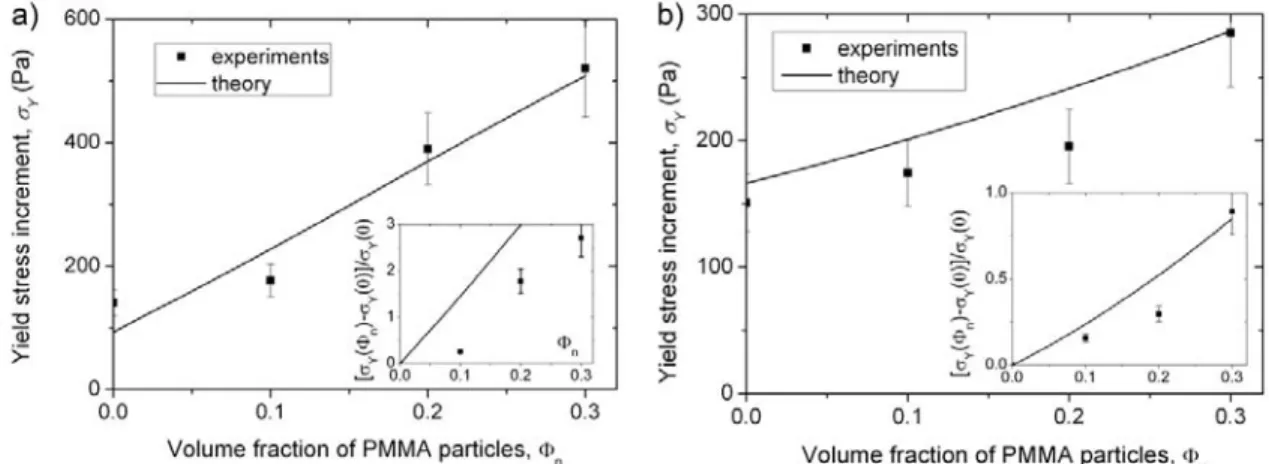
analyzed in Fig. 8 where the dependencies of the yield stress increment on the concentration
23
of nonmagnetic particles are plotted. As already noticed, the yield stress increment exhibits a
24
stronger increase with the concentration of PMMA in the cylindrical Couette geometry. An
25
alternative measure of the effect of the nonmagnetic particles on the yield stress is the
26
magnitude,
[
σ
Y(Φ −n)σ
Y(0) /]
σ
Y(0), which describes the gain of the MR effect due to the27
nonmagnetic particles, where σY(0) is the yield stress increment of the suspension without
28
PMMA. This magnitude is plotted in the insets of Fig. 8 as a function of the content of
29
nonmagnetic particles, Φn. Both experiments and theory show a monotonic increase of the
30
MR effect with Φn in both geometries. It is worth now to recall that, according to our theory,
31
the nonmagnetic particles influence the yield stress by the two following mechanisms: (a)
32
They modify the orientation distribution of the aggregates due to collisions with them (see
33
Fig. 8). (b) They cause a supplementary viscous dissipation by enhancing random fluctuations
34
of aggregate orientation –i.e., last term of Eq. (8). Analyses show that the second mechanism
35
appears to be dominant in the yield stress enhancement at the considered experimental
36
conditions.
17
1
FIG. 8. Theoretical and experimental dependencies of the yield stress increment on the concentration of the
2
nonmagnetic particles, Φn, at a fixed concentration of the magnetic ones, Φm=0.1, for cylindrical Couette (a) and
3
plate-plate (b) geometries. The external magnetic field is H0=18.3 kA/m in both cases. The free parameters are
4
α1=1.5; α2=0.2 for the plate-plate geometry and α1=0.2; α2=0.4 for the cylindrical Couette geometry. Insets of
5
both figures show the gain of the MR effect as function of the concentration of nonmagnetic particles. Similar
6
results were obtained for other fields, not shown here for simplicity.
7
Finally note that, despite its simplicity, the present model captures the enhancement of
8
the MR effect in bi-component suspensions without specific interactions between both
9
species. Because of the opacity of the suspensions, it seems to be quite difficult to verify the
10
hypothesis of the collision-induced fluctuations using classical optical microscopy. Direct
11
numerical simulations might also elucidate the role of the nonmagnetic particles on the
12
structure of the flowing suspension and give more precise expressions for the rotary
13
diffusivities as a function of the concentration and the size ratio of both species of particles.
14
Nevertheless, and in contrast to our experiments, the existing numerical results of refs. [22,
15
23] have revealed only a moderate (a few dozens of percents) enhancement of the MR effect
16
by the addition of nonmagnetic particles. This is probably because a low-shear regime was
17
considered in simulations. In this regime, the moving aggregates span the channel width,
18
which likely hinders their orientation fluctuations. In our study, we have dealt with higher
19
shear rates, where the aggregates are not-gap spanning and have more freedom for
20
interactions with their neighbors as well as with nonmagnetic particles.
21
V. CONCLUSIONS 22
In this work we have shown that bi-component suspensions consisting of magnetic –
23
iron– and nonmagnetic –poly(methylmethacrylate), PMMA– particles displayed an
24
enhancement of the magnetorheological (MR) effect with respect to a suspension of just iron
25
particles with the same volume fraction of magnetic material, both in cylindrical Couette and
26
plate-plate geometries. Such an enhancement took place even when presumably there was no
27
adhesion of iron particles onto PMMA ones, because the former particles were covered with a
28
surfactant layer. Magnetization measurements showed that the magnetic permeability was not
29
affected by the addition of PMMA which is also attributable to the absence of adsorption
30
between both types of particles. We conclude therefore that the MR effect enhancement does
18
not come from an increase of the magnetic interactions, something which would take place if
1
the iron particles formed a shell structure around the nonmagnetic PMMA particles [25].
2
We have explained the observed phenomenon under the hypothesis of collisions
3
among the nonmagnetic particles and the field-induced aggregates of magnetic particles. Such
4
collisions are supposed to give rise to an enhancement of the fluctuations of the aggregate
5
orientation that increases with the volume fraction of nonmagnetic particles. This process
6
contributes to augment the total level of stress in the suspension and therefore, the MR effect.
7
We have shown that in cylindrical Couette geometry, this mechanism is predominant in
8
comparison to the case of plate-plate geometry, in which it plays a minor role. As a result, the
9
improvement of the MR effect in bi-component suspensions is more noticeable for cylindrical
10
Couette geometry, in agreement with experiments.
11
ACKNOWLEDGEMENTS 12
We would like to acknowledge Dr. G. Bossis for helpful discussions. This work has
13
been supported by projects FIS2013-41821-R (Ministerio de Economía y Competitividad) and
14
“Factories of the Future” (Grant No. 260073, DynExpert FP7). In addition, L.
Rodríguez-15
Arco acknowledges financial support by Secretaría de Estado de Educación, Formación
16
Profesional y Universidades (MECD, Spain) through its FPU and Estancias Breves programs.
17
APPENDIX. RELATIONSHIP BETWEEN THE INTERNAL, H, AND THE 18
EXTERNAL, H0, MAGNETIC FIELDS
19
In the case of the magnetic field oriented along the vorticity (cylindrical Couette
20
geometry, Fig. 6(a)), the internal field is equal to the external applied magnetic field H0. In the 21
case of the magnetic field perpendicular to the walls (plate-plate geometry, Fig. 6(b)), the
22
internal field is related to the external field H0 through the following expression: 23
(
)
0 0 2 2 22 2 1 2 H H H e eμ
μ
μ
⊥ = = + − (A1) 24where μ22 is the diagonal component (along the field axis “2”) of the magnetic permeability 25
tensor of the suspension;
μ
= + Φ Φ1χ
a m/ a and26
(
)
(
2 a 1 m/ a)
/ 2(
a(
1 m/ a)
)
μ⊥ = +χ + Φ Φ +χ − Φ Φ are the components of the magnetic
27
permeability of the suspension whose aggregates are, respectively, aligned or perpendicular to
28
the applied field.
29
The aggregate magnetic susceptibility χa and the magnetic force fm (intervening into
30
Eqs. (3), (4) and (8)) are calculated as a function of the magnetic field H using finite element
31
simulations [18, 29] The simulation results for fm and χa, have been fitted by the following
32
expressions, valid in the range of the magnetic field intensities, 0≤H ≤30 kA/m:
33
(
4 2 3)
2 0 ( ) 6.66 10 ( / ) 6.32 10 ( / ) 168 m S S f H = ⋅ H M − ⋅ H M +μ
H and 34 2 2 ( ) 7.67 10 ( / ) 50.9( / ) 9.29 a H H MS H MSχ
= − ⋅ − + , with MS=1.36·106 A/m being the35
saturation magnetization of the carbonyl iron particles.
19 References
1
[1] G.M. Van de Ven, Colloidal hydrodynamics (Academic Press Limited, London, 1989).
2
[2] P. Heitjans and J. Kärger, Diffusion in Condensed Matter. Methods, Materials, Models
3
(Springer, Berlin, 2005).
4
[3] Z. Cheng and T.G. Mason, Phys. Rev. Lett. 90, 018304 (2003). 5
[4] V. Degiorgio and R. Piazza, Phys. Rev. E 52, 2707 (1995). 6
[5] A. Elafif, M. Grmela, and G. Lebon, J. Non-Newton. Fluid 86, 253 (1999). 7
[6] S. Jabbari-Farouji, G. H. Wegdam, and Daniel Bonn, Phys. Rev. E 86, 041401 (2012). 8
[7] B.H. Erné, K. Butter, B. W. M. Kuipers, and G. J. Vroege, Langmuir 19, 8218 (2003).
9
[8] J. M. Ginder, Phys. Rev. E 47, 5 (1993).
10
[9] A. Zubarev, Colloid J. 75, 59 (2013).
11
[10] J.C. Bacri, A. Cebers, A. Bourdon, G. Demouchy, B.M. Heegaard, B.Kashevsky, and R.
12
Perzynski, Phys. Rev. E 52, 4 (1995).
13
[11] J.E. Martin, J. Odinek, T. C. Halsey, and R. Kamien, Phys. Rev. E 57, 1 (1998).
14
[12] J.P. Segovia-Gutiérrez, J. de Vicente, R. Hidalgo-Álvarez, and A. Puertas, Soft Matter 9, 15
6970 (2013).
16
[13] G. Bossis, O. Volkova, S. Lacis, and A. Meunier, in Magnetorheology: Fluids,
17
Structures and Rheology, edited by S. Odenbach (Springer-Verlag, Berlin, 2002), p. 202. 18
[14] B.J. Park, F.F. Fang, and H.J. Choi, Soft Matter 6, 5246 (2010). 19
[15] Z.P. Shulman and W. I. Kordonsky, Magnetorheological effect (Nauka i Tehnika,
20
Minsk, 1982) (in Russian).
21
[16] J. Takimoto, H. Takeda, Y. Masubuchi, and K. Koyama, Int. J. Mod. Phys. B 13, 2028 22
(1999).
23
[17] G. Bossis, S. Lacis, A. Meunier, and O. Volkova, J. Magn. Magn. Mater. 252, 224 24
(2002).
25
[18] P. Kuzhir, G. Bossis, V. Bashtovoi, and O. Volkova, J. Rheol. 47, 1385 (2003). 26
[19] P. Kuzhir, C. Magnet, G. Bossis, A. Meunier, and V. Bashtovoi, J. Rheol. 55, 1297 27
(2011).
28
[20] M.T. López-López, J. de Vicente, F. González-Caballero, and J.D.G. Durán Colloid.
29
Surface A 264, 75 (2005). 30
[21] M.T. López-López, A. Gómez-Ramírez, J.D.G. Durán, and F. González-Caballero, 31
Langmuir 24, 7076 (2008). 32
[22] J. C. Ulicny, K. S. Snavely, M. A. Golden, and D. J. Klingenberg, Appl. Phys. Lett. 96, 33
231903 (2010).
34
[23] D.J. Klingenberg and J.C. Ulicny, Int. J. Mod. Phys. B 25, 911 (2011). 35
[24] M.L. Levin, D.E. Polesskii, and I.V. Prokhorov, J. Eng. Phys. Thermophys. 70, 769 36
(1997).
20
[25] L. Rodríguez-Arco, M.T. López-López, P. Kuzhir, and J.D.G. Durán, Soft Matter 9, 1
5726 (2013).
2
[26] L. Rodríguez-Arco, M.T. López-López, P. Kuzhir, G. Bossis, and J.D.G. Durán, ACS
3
Appl. Mater. Inter. 5, 12143 (2013). 4
[27] R. G. Larson, The Structure and Rheology of Complex Fluids (Oxford University Press,
5
New York, 1999), p. 353.
6
[28] See Supplemental Material at [URL will be inserted by publisher] for the comparison
7
between both geometries as a function of H.
8
[29] P. Kuzhir, C. Magnet, L. Rodríguez-Arco, M.T. López-López, A. Meunier, A. Zubarev,
9
and G. Bossis, J. Rheol. (submitted).
10
[30] G.K. Batchelor, J. Fluid. Mech. 46, 813 (1971). 11
[31] Z.P. Shulman, V.I. Kordonsky, E.A. Zaltsgendler, I.V. Prokhorov, B.M. Khusid, and
12
S.A. Demchuk, Int. J. Multiphase Flow 12, 935 (1986). 13
[32] J.E. Martin and R.A. Anderson, J. Chem. Phys. 104, 4814 (1996). 14
[33] F.P. Folgar and C.L. Tucker, J. Reinf. Plast. Compos. 3, 98 (1986). 15
[34] V.N. Pokrovskiy, Statistical mechanics of diluted suspensions (Nauka, Moscow, 1978).
16
[35] M. Doi and S.F. Edwards, The Theory of Polymer Dynamics (Oxford University Press,
17
New York, 1986).
18
[36] H. Brenner, Int. J. Multiphase Flow 1, 195 (1974). 19