HAL Id: hal-00700066
https://hal.inria.fr/hal-00700066v2
Submitted on 24 May 2012
HAL is a multi-disciplinary open access
archive for the deposit and dissemination of
sci-entific research documents, whether they are
pub-lished or not. The documents may come from
teaching and research institutions in France or
abroad, or from public or private research centers.
L’archive ouverte pluridisciplinaire HAL, est
destinée au dépôt et à la diffusion de documents
scientifiques de niveau recherche, publiés ou non,
émanant des établissements d’enseignement et de
recherche français ou étrangers, des laboratoires
publics ou privés.
Sparse direct solvers with accelerators over DAG
runtimes
Xavier Lacoste, Pierre Ramet, Mathieu Faverge, Yamazaki Ichitaro, Jack
Dongarra
To cite this version:
Xavier Lacoste, Pierre Ramet, Mathieu Faverge, Yamazaki Ichitaro, Jack Dongarra. Sparse direct
solvers with accelerators over DAG runtimes. [Research Report] RR-7972, INRIA. 2012, pp.11.
�hal-00700066v2�
ISSN 0249-6399 ISRN INRIA/RR--7972--FR+ENG
RESEARCH
REPORT
N° 7972
27 April 2012 Project-Team BacchusSparse direct solvers with
accelerators over DAG
runtimes
Xavier Lacoste, Pierre Ramet
INRIA
University of Bordeaux Bordeaux, France
Email : {xavier.lacoste,pierre.ramet}@inria.fr
Mathieu Faverge, Ichitaro Yamazaki, Jack Dongarra
Innovative Computing Laboratory University of Tennessee
Knoxville, Tennessee, USA
RESEARCH CENTRE BORDEAUX – SUD-OUEST
351, Cours de la Libération Bâtiment A 29
33405 Talence Cedex
Sparse direct solvers with accelerators over DAG
runtimes
Xavier Lacoste, Pierre Ramet
INRIA
University of Bordeaux Bordeaux, France
Email : {xavier.lacoste,pierre.ramet}@inria.fr
Mathieu Faverge, Ichitaro Yamazaki, Jack Dongarra
Innovative Computing Laboratory University of Tennessee Knoxville, Tennessee, USA
Email : {mfaverge,iyamazak,dongarra}@eecs.utk.edu ´
Equipe-Projet Bacchus
Rapport de recherche n° 7972 — 27 April 2012 — 11 pages
R´esum´e : Les architectures de calcul int`egrent de plus en plus de coeurs de calcul partageant une mˆeme m´emoire n´ecessairement hi´erarchique. Les algorithmes, en particulier ceux relatifs `a l’alg`ebre lin´eaire, n´ecessitent d’ˆetre adapt´es `a ces nouvelles architectures pour ˆetre efficaces. PASTIX* est un solveur
direct parall`ele pour matrices creuses qui int`egre un ordonnanceur dynamique pour des architectures hi´erarchiques de grande taille. Dans ce papier, nous ´etudions la possibilit´e de remplacer cette strat´egie interne d’ordonnancement par deux supports d’ex´ecution g´en´eriques : DAGUE† et STARPU‡. Ces
supports d’ex´ecution offrent la possibilit´e de d´erouler le graphe de tˆaches de la factorisation num´erique sur des noeuds de calcul disposant d’acc´el´erateurs. Comme pour de pr´ec´edents travaux r´ealis´es pour les noyaux denses de l’alg`ebre lin´eaire, nous pr´esentons nos noyaux, pour des structures creuses, issus de la librairie MAGMA et des algorithmes DAG utilis´es par ces deux supports d’ex´ecution. Nous pr´esentons une ´etude comparative des performances de notre solveur supernodal avec ces trois ordonnanceurs sur des architectures multicoeurs et multigpus, et en particulier les gains obtenus sur les acc´el´erateurs avec le support d’ex´ecution STARPU. Ces r´esultats montrent qu’une approche bas´ee sur un DAG offre une interface de programmation uniforme pour r´ealiser du calcul haute performance sur des probl`emes irr´eguliers comme ceux de l’alg`ebre lin´eaire creuse.
Sparse direct solvers with accelerators over DAG runtimes
Abstract: The current trend in the high performance computing shows a dramatic increase in the number of cores on the shared memory compute nodes. Algorithms, especially those related to linear algebra, need to be adapted to these new computer architectures in order to be efficient. PASTIX4 is a sparse parallel direct solver, that incorporates a dynamic scheduler for strongly hierarchical modern architectures. In this paper, we study the replacement of this internal highly integrated scheduling strategy by two generic runtime frameworks : DAGUE5 and STARPU6. Those runtimes will give the opportunity to execute
the factorization tasks graph on emerging computers equipped with accelerators. As for previous work done in dense linear algebra, we present the kernels used for GPU computations inspired by the MAGMA library and the DAG algorithm used with those two runtimes. A comparative study of the performances of the supernodal solver with the three different schedulers is performed on manycore architectures and the improvements obtained with accelerators are presented with the STARPU runtime. These results demonstrate that these DAG runtimes provide uniform programming interfaces to obtain high performance on different architectures on irregular problems as sparse direct factorizations.
Key-words: Sparse linear algebra, High performance computing, DAG, GPU
4. http ://pastix.gforge.inria.fr 5. http ://icl.cs.utk.edu/dague 6. http ://starpu.gforge.inria.fr
Sparse direct solvers with accelerators over DAG runtimes 3
I. INTRODUCTION
Solving a large sparse general or symmetric positive definite linear system of equations, Ax = b, is a crucial and time-consuming part in many scientific and engineering applica-tions. Due to their robustness, direct solvers are often used in industrial codes, despite their large memory consumption. In addition, the factorization used in the recent direct solvers can take advantage of the superscalar capabilities of the processors using blockwise algorithms and BLAS primitives. Consequently, many parallel techniques for sparse matrix fac-torization have been studied and implemented. For a complete survey on direct methods, we refer to [1]–[3]. The goal of this paper is to design algorithms that can plainly take advantage of the vast computing power found in modern heterogeneous computer architectures. In our current work, we focused on matrices with symmetric sparsity patterns (the sparsity patterns of A + AT is used for unsymmetric cases), and focused on
the factorization with static pivoting. In this context, the block structure of the factors and the numerical operations are known in advance, and consequently, we can use a static (i.e. before the actual numerical factorization) algorithm for scheduling the communication and the computational tasks.
In previous works [4], [5], we have proposed a static mapping and scheduling algorithm based on a combination of 1D and 2D block distributions for sparse supernodal factori-zation with static pivoting. This algorithm achieves very good performance by taking into account the communication and computation requirements of each factorization as well as the communication and computation capabilities of the parallel architecture. In addition, we have developed a strategy to control the memory overhead and to reduce the communication volume needed for the message buffering. In PASTIX, this buffering corresponds to the local aggregation approach in which all local contributions for the same non-local block are summed into a temporary block buffer before being sent. The new strategy improves the mechanism of this local aggregation that often lead to great reduction in the memory consumption, especially for 3D problems.
Emerging supercomputers consist of many microprocessors, each of which may have many computational cores. Hence, these emerging architectures exhibit strongly hierarchical to-pologies, both in terms of memories and processor intercon-nect. Achieving good performance requires a mapping of the algorithms on the computational resources, and scheduling algorithms specifically designed for NUMA architectures.
In PASTIX the internal data structures of the solver, as well as the communication patterns, have been modified for the dynamic scheduling on these architectures [6]. A dynamic scheduler based on a work-stealing algorithm has been also developed to fill in communication idle times while preserving a good locality for data mapping [7]. Furthermore, we have integrated the dynamic adaptation of the computational task grain to efficiently use multi-core architectures and shared memory. Experiments on several numerical test cases have been performed to prove the efficiency of these approach on
different architectures.
Modern GPUs can substantially outperform high-end multi-core CPUs both in terms of data processing rate and memory bandwidth. In the past, porting general purpose codes onto GPUs required a considerable programming effort, mostly due to the lack of tools and interfaces. However, API for GPUs such as CUDA or OpenCL have been rapidly evolving in the last few years, bringing accelerator programming into the mainstream. Hence, GPUs are becoming a more and more attractive alternative to traditional CPUs, in particular for the more interesting ratio of cost-per-flop and watts-per-flop. However, efficient GPU programming remains a laborious challenge. In this paper, in order to exploit the computing power of GPUs, we have integrated a runtime system into the sparse direct solver. We divided the algorithm into com-putational tasks, and use a Directed Acyclic Graph (DAG) to represent the dependencies between these tasks. This DAG representation of an algorithm enables a clear separation bet-ween the flow of data betbet-ween tasks and the data distribution. Then, a runtime system is used to schedule these tasks while respecting the dependencies. Since the runtime system offers a uniform programming interface for a specific subset of hardware or low-level software entities, applications can use these uniform programming interfaces in a portable manner. Furthermore, the runtime system can optimize application requests by dynamically mapping the tasks onto resources as efficiently as possible. The work presented in this paper is part of the MORSE project1 to design dense and sparse linear algebra methods that achieve the fastest possible time to an accurate solution on large-scale heterogeneous multicore systems with GPU accelerators.
Concerning accelerator-based platforms for sparse direct solvers, a lot of attention has been recently paid to design new algorithms that can exploit the huge potential of GPUs. For a multifrontal sparse direct solver, some preliminary works have been proposed in the community [8], [9], resulting in single-GPU implementations based on off-loading parts of the computations to the GPU. The main idea is to treat some parts of the task dependency graph entirely on the GPU. Therefore, the main originality of these efforts was in the methods and algorithms used to decide whether or not a task can be processed on a GPU. In most cases this was achieved through a threshold based criterion on the size of the computational tasks. From the software point of view, most of these studies have only produced software prototypes and few sparse direct solvers exploiting GPUs have been made available to the users, most of them being developed by private software companies such as MatrixPro2, Acceleware3 and
BCSLib-GPU4. As far as we know, there are no publications
nor reports where the algorithmic choices are depicted. A recent progress towards a multifrontal sparse QR factorization on GPU have been presented in [10].
1. http ://icl.eecs.utk.edu/morse 2. http://www.matrixprosoftware.com/ 3. http://www.acceleware.com/matrix-solvers 4. http://www.boeing.com/phantom/bcslib/
Sparse direct solvers with accelerators over DAG runtimes 4
The rest of the paper is organized as follows : In the next section, we present the libraries and software used for our current study. There, both DAGUE and STARPU runtimes are introduced, and we summarize the main features of the PA
S-TIX solver. Then, in Section III, we describe the algorithms and main ideas that have been implemented to optimize the task scheduling and the granularity of the sparse factorization. In Section IV, we present experiments we performed with our sparse direct solver to validate our approach on industrial challenging matrices. Finally, in Section V, we conclude with some prospects of the current work.
II. RUNTIME AND SOLVER
DAGUE [11] is a distributed runtime system designed to achieve extreme computational scalability by exploiting an algebraic representation of Direct Acyclic Graphs that effi-ciently captures the totality of tasks involved in a computation and the flow of data between them. Its primary goal is to maximize parallelism while automatically orchestrating task execution so as to minimize both communication and load imbalance. Unlike other available DAG-based runtimes, the concise symbolic representation of the algorithm that DAGUE uses minimizes the memory required to express the map of tasks ; at the same time, it provides extreme flexibility during the scheduling process. This algebraic representation allows the DAG to be traversed at very high speed, while tracking any flow of data from task to task. By combining this underlying mechanism with an understanding of the specific hardware capabilities of the target architecture, DAGUE is able to schedule tasks in ways that creatively adapt alternative work-stealing strategies to the unique features of the system. These capabilities enable DAGUE to optimize data movement between available computational resources, including both different nodes of the full system and different accelerators on the same node.
The DAGUE runtime aimed first at providing a scheduler for large distributed system of multicore nodes and is able to handle heterogeneous architectures to relocate the most compute intensive kernel on GPUs. A full description of DAGUE, and the implementation of classical linear algebra factorizations in this environment, can be found in [11], [12]. STARPU [13] is a software tool aiming to allow program-mers to exploit the computing power of the available CPUs and GPUs, while relieving them from the need to specially adapt their programs to the target machine and processing units. The STARPU run-time supports a task-based programming model. Applications submit computational tasks, with CPU and/or GPU implementations, and StarPU schedules these tasks and associated data transfers on available CPUs and GPUs. The data that a task manipulates is automatically transferred among accelerators and the main memory, so that programmers are freed from the scheduling issues and technical details asso-ciated with these transfers. STARPU takes particular care of scheduling tasks efficiently, using well-known algorithms from the literature. In addition, it allows scheduling experts, such
as compiler or computational library developers, to implement custom scheduling policies in a portable fashion.
The main differences between DAGUE and STARPU are the tasks submission process, the centralized scheduling and the data movement strategy. DAGUE uses its own parametri-zed language to describe the DAG in comparison to the simple sequential submission loops used by STARPU. Therefore STARPU relies on a centralized strategy which analyzes the dependencies between tasks and schedules these tasks on the available resources, while each computational unit of DAGUE immediately release the dependencies of the completed task solely using the local knowledge of the DAG. At last, STARPU scheduling strategy exploits cost models of the computation and data movements to schedule a task to the right resource (CPU or GPU) in order to minimize overall execution time. However it has no data movement policy on shared memory systems resulting in lower efficiencies when no GPUs are used compared to the data-reuse heuristic of DAGUE.
Hence, the research around STARPU has focused mainly on the case of an heterogeneous multicore node enhanced with multiple GPUs, while research around DAGUE has more focused on scalability issues on a large number of homogeneous nodes.
PASTIX is a scientific library that provides a high per-formance parallel direct solver for very large sparse linear systems. Numerical algorithms are implemented in single or double precision (real or complex) using LLT or LDLT fac-torizations for symmetric matrices, and LU facfac-torizations with static pivoting for non symmetric matrices having symmetric patterns. Theres is a version of PASTIX for multicore node architectures, which uses a hybrid MPI-thread programming to fully exploit the advantage of shared memory and to reduce the memory overhead. Direct methods are numerically robust methods, but very large three dimensional problems may require a large amount of memory, even with any memory optimization. For this type of problems, PASTIX provides an adaptive blockwise incomplete factorization that is much more accurate (and numerically more robust) than the scalar incomplete factorizations which are commonly used as precon-ditioner for iterative solvers. Such incomplete factorization can take advantage of the latest breakthroughs in sparse blocked direct methods, and particularly should be very competitive in CPU time (effective power used from processors and good scalability), while avoiding the memory limitation encountered by direct methods.
III. ALGORITHMS
In this paper, we study and design algorithms and parallel programming models for implementing sparse supernodal di-rect methods on an emerging computers equipped with GPU accelerators. Our ultimate goal is to release a manycores (CPU+GPU) version of the PASTIX solver [5]. In this paper, we consider the Cholesky, LDLT, and LU factorization
algorithms which are already present in PASTIX.
The task dependencies of numerical factorization can be represented by a tree whose nodes represent computational
Sparse direct solvers with accelerators over DAG runtimes 5
tasks and whose edges represent transfer of data between the tasks. The distributed memory version of PASTIX uses a right-looking formulation which, having computed the fac-torization of a column-block corresponding to a node of the tree, immediately sends the data to update the column-blocks corresponding to its ancestors in the tree. In the actual im-plementation, we locally aggregate contributions to the same block before sending the contributions. This can significantly reduce the number of messages, and is known to limit the memory overhead induced by the direct methods.
Either a static or dynamic scheduling of block computations can be used, independently from these different approaches described above. For homogeneous parallel architectures, it is useful to have an efficient static scheduling scheme. For the PASTIX solver, we have recently developed a dynamic scheduling scheme, specifically designed for modern super-computers, that have many microprocessors, each of which consists of one or many computational cores, and induces a strong hierarchical topology. To address the needs of dynamic scheduling, the data structures of the solver, as well as the patterns of communication, have been also modified [6]. Thanks to these efforts on the multicore implementation [14], we have a platform ready to deal with bigger problem sizes on today’s supercomputers.
The main contributions of our current paper can be subdi-vided into three subtasks described hereafter :
– Kernels for sparse factorization. Our first step of de-veloping a sparse direct solver for clusters of multi-GPU nodes is to develop supernodal computational kernels designed specifically for this purpose. In particular, one of the most important kernels is the matrix/matrix-product involved in the updates of the trailing matrix. In the case of supernodes, data structures can be compacted in order to improve the efficiency of the computations, but we still need to improve the matrix-add operations that correspond with each block of the sparse updates. This kernel must also prefetch the data to minimize the data transfers on the GPU devices.
– Scheduling of computations and data transfers. The main aim of this paper is to evaluate the potential of re-placing the current scheduler of PASTIX with two generic runtime frameworks DAGuE and STARPU for executing
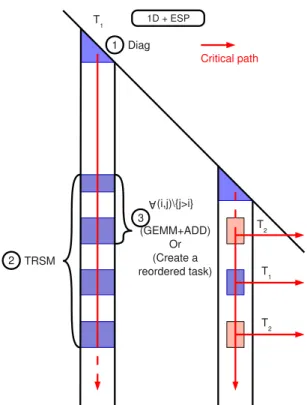
the task graph corresponding to a sparse factorization. In the current scheduling scheme of PASTIX, a task corresponds to a supernode (1D block distribution), see Fig. 1. To improve the efficiency of the sparse factori-zation on a multicore implementation, we introduced a way of controlling the granularity of the BLAS operations (referred to as an ESP option for Enhanced Sparse Paral-lelism). This functionality dynamically splits a single task of computing the contribution to the trailing submatrix, using the current panel into subtasks, so that the critical path of the algorithm can be reduced.
In this paper, for both DAGUE and STARPU scheduling, one computational task corresponds to the computation
FIGURE 1: Task graph for supernodal factorization
of the contributions to a remaining column-block using a single block in a panel. Hence, the number of tasks to schedule is equal to the number of blocks in the factored matrix.
– Sparse algorithms. In order to control the granularity of the computational tasks, the automatic criteria used to set adaptive block sizes has to be extended to heteroge-neous architectures. Some references for benchmarking dense linear algebra kernels are described in [15] and show that efficiency could be obtained on GPU devices only on relatively large blocks – that can be found on top of the elimination tree. Similarly, the amalgamation algorithm [16], reused from the implementation of an incomplete factorization, is a crucial step to obtaining larger supernodes and efficiency on GPU devices. The default parameter for amalgamation has been slightly increased ; we allow up to 12% more fill-in to build larger blocks while keeping a good a high level of parallelism.
A. SparseGEMM on GPU
Fig. 2a illustrates the data structure of PASTIX storing the sparse matrix. The nonzero entries are grouped into supernodes which are composed of several dense blocks. Each column block is stored as a dense block - represented by S1 storage
in the figure. When we update the column block S2facing the
first extradiagonal block of S1, all blocks of S1 are included
in the blocks of S2. Thus, in PASTIX, we first factorize the
diagonal block of S1, and we then update the off-diagonal
blocks of S1. Next, for each extradiagonal block Bi of S1,
we compute the contribution BkBiT to the (k, i)-th block for
Sparse direct solvers with accelerators over DAG runtimes 6
S1 storage
S1
S2
(a) Sparse structure of the matrix
shared memory
global memory
a tile
a block update
(b) Shared memory to global memory
FIGURE 2: Data management
k > i, and store the contribution in a temporary buffer. Finally, we update Si for each extradiagonal block Bi. On a GPU, the
computation is exactly the same except that our buffer is in the shared memory of the GPU.
To have an efficient usage of the GPU during sparse factorization, we wrote a new GPU kernel that takes the sparsity of our matrix into account. Our kernel is based on the framework proposed in [17], which also allows us to use an auto-tuning script to select near-optimal block sizes for the ker-nel. Specifically, this kernel computes C = αAB + βC, where C is divided into a 2D grid of tiles (see Fig. 2b), and each thread block computes a tile of the matrix-multiplication, AB, which is stored in the shared GPU memory. Each thread is in charge of computing several entries of this tile. Each of these entries is computed one by one, and to compute each entry, the corresponding row of A and the corresponding column of B are loaded into the thread registers. Once the tile is computed, it is added into C. In the supernodal solver PASTIX, C may span several discontinuous supernodal blocks in a column-block (see Fig. 2b). Hence, during the summation of αAB into βC, we use an offset that specifies the row of C, to which the computed values of αAB should be accumulated into. For this, we added two pairs of integer arrays as input arguments to the kernel, which store the first and last row indexes of each blocks of A and C.
B. DAG scheduling
In this section, we describe the different approaches used to describe the DAGs in DAGUE and STARPU. For both codes, we define two kinds of tasks in our LLT factorization :
– panel(s) : factorization of the diagonal block of the supernode s (POTRF) and update all the extradiagonal blocks of this supernode (TRSM) ;
– gemm(b,s) : perform the GEMM product of all the blocks beneath Bbin its supernode by BbT and subtract the result
from the supernode s which has its diagonal block facing Bb.
For the LU factorization, we are using the same tasks with addition of the update of U in both kernels. The panel task does one extra solve on the upper part, and the gemm task does two matrix-matrix multiplications : one for the lower part and one for the upper part. Finally, the LDLt factorization follows the same scheme as Cholesky with different kernels to integrate the storage and the computation of the diagonal. The three factorizations have then the same DAG representation with different kernels, LU having more dataflow to move the upper part.
1) JDF representation of a DAG: In DAGUE, the data distribution and dependencies are specified using the Job Data Flow (JDF) format. Fig. 3 shows our JDF representation of the sparse Cholesky factorization using the tasks panel and gemm described previously. The second one is based only on the block id parameter and computes internally the supernode (fcblk) in which to apply the update. On Line 2 of panel(j), cblknbr is the number of block columns in the Cholesky factor. Once the j-th panel is factorized, the trailing submatrix can be updated using the j-th panel. This data dependency of the submatrix update on the panel factorization is specified on Line 6, where firstblock is the block index of the j-th diagonal block, and lastblock is the block index of the last block in the j-th block column. The output dependency on Line 7 indicates that the j-th panel is written to memory at the completion of the panel factorization. The input dependency of the j-th panel factorization is specified on Lines 4 and 5, where leaf is true if the j-th panel is a leaf in the elimination-tree, and lastbrow is the index of the last block updating the j-th panel. Hence, if the j-th panel is a leaf, the panel is read from memory. Otherwise, the panel is passed in as the output of the last update on the panel.
Similarly, gemm(k) updates the fcblk-th block column
Sparse direct solvers with accelerators over DAG runtimes 7
1. panel(j) [high priority = on] 2. j = 0 .. cblknbr-1
3. ... set up parameters for the j-th task ...
4. :A(j)
5. RW A ← ( leaf ) ? A(j) : C gemm( lastbrow )
6. → A gemm(firstblock+1..lastblock)
7. → A(j)
(a) Panel factorization
1. gemm(k) 2. k = 0 .. blocknbr-1
3. ... set up parameters for the k-th task ...
4. :A(fcblk)
5. READ A ← diag ? A(fcblk) : A panel(cblk) 6. RW C ← first ? A(fcblk) : C gemm( prev )
7. → diag ? A(fcblk)
8. → (( !diag) && (next == 0)) ? A panel( fcblk )
9. → (( !diag) && (next != 0)) ? C gemm( next )
(b) Trailing submatrix update
FIGURE 3: JDF representation of Cholesky.
using the k-th block, where fcblk is the index of the block row that the k-th block belongs to, and blocknbr on Line 2 is the number of blocks in the Cholesky factor. The input dependencies of gemm are specified on Lines 4 through 6, where the cblk-th panel A is being used to update the fcblk-th column C. Specifically, on fcblk-these lines, diag is true if fcblk-the k-th block is a diagonal block, and it is false otherwise, and previs false if the k-th block is the first block in the fcblk-th block row, and it is fcblk-the index of fcblk-the block in fcblk-the block row just before the k-th block otherwise. Hence, the prev-th block updated the fcblk-th column just before the k-th block does. Hence, the data dependency of gemm(k) is resolved once the cblk-th panel is factorized, and the fcblk-th column is updated using the prev-th block. Notice that the diagonal blocks are not used to update the trailing submatrix, but it is included in the code to have a continuous space of execution for the task required by DAGUE. Finally, Lines 7 through 9 specify the output dependencies of gemm(k), where next is false if the k-th block is a diagonal block, and it is the index of the next block after the k-th block in the fcblk-th row otherwise. Hence, the completion of gemm(k) resolves the data dependency of the fcblk-th panel factorization if this is the last update on the panel, or it resolves the dependency of updating the fcblk-th block column using the next-th block otherwise.
2) STARPU tasks submission: STARPU builds its DAG following the tasks ordering provided by the user and by using data dependencies. The following pseudocode shows the STARPU tasks submission loop for the LLT decomposition.
1: for all Supernode S1 do
2: submit panel(S1) {update of the panel}
3: for all extra diagonal block bi of S1 do
4: S2← supernode in f ront of (Bi)
5: submit gemm(S1, S2) {sparse GEMM Bk,k≥i ×
BiT substracted from S2}
6: end for 7: end for
By default, STARPU generates the tasks graph following
sequential consistency (Fig. 4a). Since the order in which the facing supernode receives contribution is not relevant in our factorization, we disabled STARPU sequential consistency (Fig. 4b). Then, we notify the scheduler that a panel task
panel3
gemm2
gemm1
panel1
panel2
(a) with sequential consistency
panel3
gemm1
panel1
gemm2
panel2
(b) without sequential consistency
FIGURE 4: Task graph
depends on all the GEMM updates on the supernode and that this task triggers the GEMM on the trailling supernodes.
We are not using a reduction on the target panel, because for each update only a subarea is impacted. Moreover, a reduction requires a copy of the destination supernode on each computing device, that could represent a lot of memory overhead. This allows only an out of order execution of the updates while guarantying the mutual exclusion of the computations. DAGUE in its actual release doesn’t allow those reduction operations and keep the order defined by the dependencies. As the order of the reduction is imposed by the data dependencies, the potential concurrency is reduced but the accuracy of the numerical results is maintained between successive runs.
C. Sparse mapping
Our mapping algorithm is based on a static scheduling based on a performance model. Thus, the partitioning and mapping step generates a fully ordered schedule that can be used in the parallel factorization. This schedule aims at statically regulating all of the issues that are classically managed at runtime. To make our scheme very reliable, we estimate the workload and message passing latency by using a BLAS and communication network time model, which is automatically calibrated on the target architecture.
Unlike usual algorithms, our partitioning and distribution strategy is divided into two distinct phases. The partitioning
Sparse direct solvers with accelerators over DAG runtimes 8
algorithm is based on a recursive top-down strategy over the block elimination tree provided by block symbolic factori-zation. Pothen and Sun presented such a strategy in [18]. The partition phase splits column-blocks associated with large supernodes, and then for each column-block, it builds a set of candidate threads for its mapping. Once the partitioning step is over, the task graph is built. In this graph, each task is associated with the set of candidate threads for its column-block. The mapping and scheduling phase then try to optimally map each task onto one of these sets of threads. An important constraint is that once a task has been mapped to a thread, then all the data accessed by this thread are also mapped on the process associated with the thread. This means that an unmapped task that accesses a block that has already been mapped should be mapped on the same thread to preserve the data locality.
IV. RESULTS
To compare the factorization times of PASTIX using generic runtime systems DAGUE and STARPU, with that using the internal scheduler of PASTIX, we present experimental results on challenging matrices from industrial applications. Some properties of the three different test matrices used for our scaling studies are shown in Table I. For all three approaches, the same partitioning and mapping were used, while the fully ordered schedule was used only for experiments using the internal scheduler of PASTIX. 1 2 4 6 12 24 36 48 0 200 400 600 800 Number of Threads F actorization T ime (s) PASTIX PASTIX with STARPU PASTIX with DAGUE
FIGURE 5: LLT decomposition on Audi (double precision)
1 2 4 6 12 24 36 48 0 200 400 600 800 1,000 1,200 1,400 1,600 Number of Threads F actorization T ime (s) PASTIX PASTIX with STARPU PASTIX with DAGUE
FIGURE 6: LU decomposition on MHD (double precision)
1 2 4 6 12 24 36 48 0 10,000 20,000 30,000 40,000 Number of Threads F actorization T ime (s) PASTIX PASTIX with STARPU PASTIX with DAGUE
FIGURE 7: LDLT decomposition on 10M (double complex)
A. Experiments on multicores
The first set of experiments were conducted on the Romulus machine at the university of Tennessee. Romulus has four twelve-core AMD Opteron 6180 SE CPUs (2.5 GHz) with
Sparse direct solvers with accelerators over DAG runtimes 9
Name N NNZA Fill ratio OPC Type Factorization Source
MHD 485,597 12,359,369 61.20 9.84e+12 Real LU University of Minnesota
Audi 943,695 39,297,771 31.28 5.23e+12 Real LLT PARASOL Collection
10M 10,423737 89,072,871 75.66 1.72e+14 Complex LDLT French CEA-Cesta
TABLE I: Matrices description
1 2 4 6 12 24 36 0 100 200 300 400 500 Number of Threads F actorization T ime (s) 0 CUDA device 1 CUDA devices 2 CUDA devices
(a) Audi LLT decomposition
1 2 4 6 12 24 36 0 100 200 300 400 500 600 700 800 Number of Threads F actorization T ime (s) 0 CUDA device 1 CUDA devices 2 CUDA devices (b) MHD LU decomposition
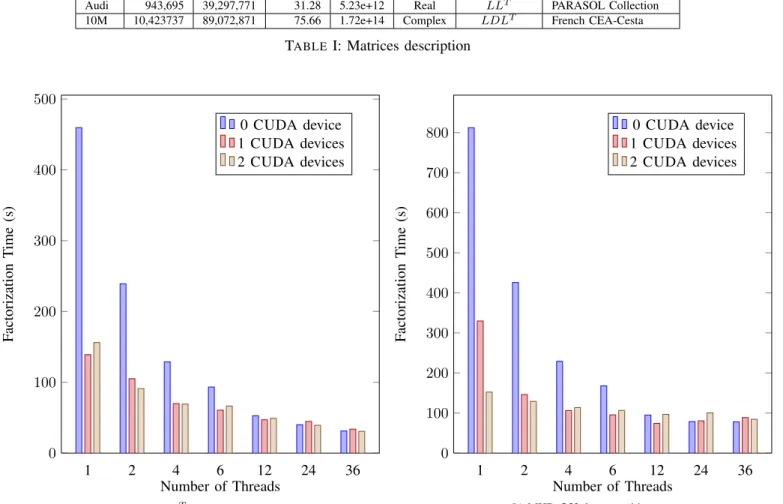
FIGURE 8: GPU results on Romulus (single precision)
256GB of total RAM, and is equipped with two Tesla T20 GPUs.
Fig. 5 and 6 compare the performance of PASTIX using DAGUE and STARPU runtimes, with PASTIX using its ori-ginal scheduler on Audi and MHD test matrices. A good scalability was obtained using all three approaches. On these two test cases, generic schedulers behaved quite well, and obtained the performances similar to the fine-tuned PASTIX scheduler. On a small number of processors, we could even obtain better results using the generic schedulers. DAGUE lost some performance when more than a socket (12 cores) was used, but recovered as soon as the computation spawned over more than 2 sockets. The DAGUE scheduler seemed to not be able to extract any performance gain between 12 and 24 cores.
With the 10 Millions test matrix (Fig. 7), the finely-tuned scheduler of PASTIX outperformed the generic runtimes.
Specifically, STARPU showed its limitation as the number of threads increased, while DAGUE maintained a good scalabi-lity. This can be explained by the fact that STARPU does not take data locality into account.
B. Experiments with GPUs
Fig. 8 and 9 show the results of using one and two GPUs. For these experiments, we did not use all 48 available cores for computation as one core was dedicated to each GPU. The CUDA kernel gave good acceleration on both single and double precision. The factorization time was reduced significantly using the first GPU when the number of cores was small. The speedups of up to 5 was obtained using one GPU. However, the second GPU was relevant only with a small number of cores (less than 4 threads in single precision (Fig. 8), and less than 12 threads in double precision (Fig. 9)). With one GPU, once the cores on a socket (12 core on Romulus, and 6 on Mirage) were fully utilized, the GPU had no effect on the factorization time.
We also conducted additional GPU experiments using a compute node of the Mirage machine from INRIA - Bordeaux. Mirage nodes are composed of 2 Hexa-core (Westmere Intel® Xeon® X5650), with 36GB of RAM. The results on Mirage (Fig. 10) were similar to the ones on Romulus.
Sparse direct solvers with accelerators over DAG runtimes 10 1 2 4 6 12 24 36 0 200 400 600 800 Number of Threads F actorization T ime (s) 0 CUDA device 1 CUDA devices 2 CUDA devices
(a) Audi LLT decomposition
1 2 4 6 12 24 36 0 200 400 600 800 1,000 1,200 1,400 1,600 Number of Threads F actorization T ime (s) 0 CUDA device 1 CUDA devices 2 CUDA devices (b) MHD LU decomposition
FIGURE 9: GPU results on Romulus (double precision)
1 2 4 8 0 100 200 300 400 500 600 Number of Threads F actorization T ime (s) 0 CUDA device 1 CUDA devices 2 CUDA devices
(a) Audi LLTdecomposition
1 2 4 8 0 200 400 600 800 1,000 1,200 Number of Threads F actorization T ime (s) 0 CUDA device 1 CUDA devices 2 CUDA devices (b) MHD LU decomposition
FIGURE 10: GPU results on Mirage (double precision)
Sparse direct solvers with accelerators over DAG runtimes 11
V. CONCLUSION
In this paper, we examined the potential benefits of using generic runtime systems, DAGUE and STARPU, in a parallel sparse direct solver PASTIX. The experimental results using up to 48 cores and two NVIDIA Tesla GPUs demonstrated the potential of this approach to design a sparse direct solver on heterogeneous manycore architectures with accelerators using a uniform interface.
Through the study presented in this paper, we have identified three potential research path, which we plan to continue to investigate in the future.
First, in order to minimize the overhead induced by the scheduler, we need to increase the granularity of the tasks at the bottom of the elimination tree. These leaves or subtrees may be merged into bigger tasks to achieve this goal.
Second, we would like to pursue a similar experiment in distributed heterogeneous environments, composed by many-cores nodes with multiGPUs. On such an platform, when a supernode update another non-local supernode, the update blocks are stored in a local extra-memory space (this is called “fan-in” approach). In order to reduce communication time overhead, we delay sending these updates until the last updates to the supernodes are accumulated, trading latency for band-width. We will study potential approaches to implement such an challenging optimization using generic runtime systems, STARPU and DAGUE.
More specifically, in the context of STARPU, for successive solution steps, the performance models used by our direct solver for the static mapping and scheduling step, could benefit from an online model refined during the execution.
Finally, the availability of extra computational resources, highlight the potential to dynamically build or rebuild the supernodal structures according to the load on the cores and the GPUs. A first approach will be to adjust the task granularity at runtime. Simultaneously, we will work on the distributed version of our solver, and on the challenging problem of defining an initial mapping of the data compatible with heterogeneous capabilities of the distributed memory architectures.
ACKNOWLEDGMENT
The authors would like to thank the DAGUE and STARPU teams for their support and assistance with this project. Special thanks also go to Sam Crawford for the valuable comments on our submitted manuscript and to Abdou Guermouche for his advice.
R ´EFERENCES´
[1] I. S. Duff, A. M. Erisman, and J. K. Reid, “Direct methods for sparse matrices,” Oxford University Press, London 1986.
[2] A. George, M. T. Heath, J. W.-H. Liu, and E. G.-Y. Ng, “Sparse Cholesky factorization on a local memory multiprocessor,” SIAM Journal on Scientific and Statistical Computing, vol. 9, pp. 327–340, 1988. [3] A. George and J. W.-H. Liu, Computer solution of large sparse positive
definite systems. Prentice Hall, 1981.
[4] P. H´enon, P. Ramet, and J. Roman, “PaStiX : A Parallel Sparse Direct Solver Based on a Static Scheduling for Mixed 1D/2D Block Distribu-tions,” in Irregular’2000, ser. LNCS, vol. 1800, Cancun, Mexique, May 2000, pp. 519–525.
[5] ——, “PaStiX : A High-Performance Parallel Direct Solver for Sparse Symmetric Definite Systems,” Parallel Computing, vol. 28, no. 2, pp. 301–321, Jan. 2002.
[6] M. Faverge and P. Ramet, “Dynamic scheduling for sparse direct solver on NUMA architectures,” in Proceedings of PARA’2008, Trondheim, Norway, May 2008.
[7] ——, “Fine grain scheduling for sparse solver on manycore architec-tures,” in 15th SIAM Conference on Parallel Processing for Scientific Computing, Savannah, USA, Feb. 2012.
[8] T. George, V. Saxena, A. Gupta, A. Singh, and A. R. Choudhury, “Multifrontal Factorization of Sparse SPD Matrices on GPUs,” 2011 IEEE International Parallel & Distributed Processing Symposium, pp. 372–383, May 2011.
[9] C. D. Yu, W. Wang, and D. Pierce, “A CPU-GPU Hybrid Approach for the Unsymmetric Multifrontal Method,” Parallel Computing, vol. 37, no. 12, pp. 759–770, Oct. 2011.
[10] T. Davis, “Multifrontal sparse qr factorization : Multicore, and gpu work in progress,” in 15th SIAM Conference on Parallel Processing for Scientific Computing, Savannah, USA, Feb. 2012.
[11] G. Bosilca, A. Bouteiller, A. Danalis, T. H´erault, P. Lemarinier, and J. Dongarra, “DAGuE : A generic distributed DAG engine for High Performance Computing,” Parallel Computing, vol. 38, no. 1-2, pp. 37– 51, 2012.
[12] G. Bosilca, A. Bouteiller, A. Danalis, M. Faverge, A. Haidar, T. Herault, J. Kurzak, J. Langou, P. Lemarinier, H. Ltaief, P. Luszczek, A. Yar-Khan, and J. Dongarra, “Flexible development of dense linear algebra algorithms on massively parallel architectures with DPLASMA,” in 12th IEEE International Workshop on Parallel and Distributed Scientific and Engineering Computing (PDSEC’11), 2011.
[13] C. Augonnet, S. Thibault, R. Namyst, and P. Wacrenier, “StarPU : A unified platform for task scheduling on heterogeneous multicore architectures,” Concurrency Computat. Pract. Exper., 2010, (to appear). [14] P. H´enon, P. Ramet, and J. Roman, “On using an hybrid MPI-Thread programming for the implementation of a parallel sparse direct solver on a network of SMP nodes,” in PPAM’05, ser. LNCS, vol. 3911, Poznan, Pologne, Sep. 2005, pp. 1050–1057.
[15] V. Volkov and J. W. Demmel, “Benchmarking GPUs to Tune Dense Linear Algebra,” in Supercomputing’08 : Proceedings of the 2008 ACM/IEEE conference on Supercomputing, no. November, 2008. [16] P. H´enon, P. Ramet, and J. Roman, “On finding approximate supernodes
for an efficient ILU(k) factorization,” Parallel Computing, vol. 34, pp. 345–362, 2008.
[17] J. Kurzak, S. Tomov, and J. Dongarra, “Autotuning gemm kernels for the fermi gpu,” IEEE Transactions on Parallel and Distributed Systems, 2011.
[18] A. Pothen and C. Sun, “A mapping algorithm for parallel sparse Cholesky factorization,” SIAM J. Sci. Comput., vol. 14(5), pp. 1253– 1257, Sep. 1993.
RESEARCH CENTRE BORDEAUX – SUD-OUEST 351, Cours de la Libération Bâtiment A 29 33405 Talence Cedex Publisher Inria
Domaine de Voluceau - Rocquencourt BP 105 - 78153 Le Chesnay Cedex inria.fr