Chemiresistive Sensor Arrays from
Conductive 2D Metal–Organic Frameworks
The MIT Faculty has made this article openly available.
Please share
how this access benefits you. Your story matters.
Citation
Campbell, Michael G. et al. “Chemiresistive Sensor Arrays from
Conductive 2D Metal–Organic Frameworks.” Journal of the
American Chemical Society 137.43 (2015): 13780–13783. © 2015
American Chemical Society
As Published
http://dx.doi.org/10.1021/jacs.5b09600
Publisher
American Chemical Society (ACS)
Version
Final published version
Citable link
http://hdl.handle.net/1721.1/110513
Terms of Use
Article is made available in accordance with the publisher's
policy and may be subject to US copyright law. Please refer to the
publisher's site for terms of use.
Chemiresistive Sensor Arrays from Conductive 2D Metal
−Organic
Frameworks
Michael G. Campbell,
‡Sophie F. Liu,
‡Timothy M. Swager, and Mircea Dincă
*
Department of Chemistry, Massachusetts Institute of Technology, 77 Massachusetts Avenue, Cambridge, Massachusetts 02139, United States
*
S Supporting InformationABSTRACT: Applications of porous metal−organic frameworks (MOFs) in electronic devices are rare, owing in large part to a lack of MOFs that display electrical conductivity. Here, we describe the use of conductive two-dimensional (2D) MOFs as a new class of materials for chemiresistive sensing of volatile organic compounds (VOCs). We demonstrate that a family of structurally analogous 2D MOFs can be used to construct a cross-reactive sensor array that allows for clear discrimination between different categories of VOCs. Experimental data show that multiple sensing mechanisms are operative with high degrees of orthogonality, establishing that the 2D MOFs used here are mechanistically unique and offer advantages relative to other known chemiresistor materials.
M
etal−organic frameworks (MOFs) that simultaneously display both porosity and electrical conductivity are an emerging family of materials1 that display promise for a wide variety of applications such as electrocatalysis, fuel cells, supercapacitors, and chemical sensing.2 The atomic-level control over molecular and supramolecular structure afforded by MOFs provides the opportunity for developing a new generation of designer materials for electronic and optoelec-tronic devices.1cHowever, despite the recent surge in MOFs that display high charge mobility and/or conductivity,3 successful demonstrations of conductive MOFs as active components in the targeted applications remain rare. Here, we report that a family of conductive 2D MOFs can be used for selective chemiresistive detection of volatile organic com-pounds (VOCs) with different functional groups with greater than 90% accuracy.Our team recently described the first example of chemi-resistive sensing using a MOF, in which a Cu-based 2D MOF was shown to display a reversible “turn-on” response to sub-ppm levels of ammonia vapor.4 The change in response was linearly proportional to ammonia concentration in the measured concentration regime, allowing for quantitative detection, and a reliable response was observed even under ambient atmosphere and high humidity conditions. Most intriguingly, our initial results showed that an isostructural MOF featuring Ni centers in place of Cu did not display the same chemiresistive response toward ammonia, indicating that controlled chemical modifications to the MOF structure could be used to alter the sensing response toward a particular analyte. We therefore sought to explore the effect of MOF
chemical structure on chemiresistive response toward a variety of analytes, with the ultimate aim of developing a MOF-based sensory device that can distinguish between different types of molecules to provide selective detection.
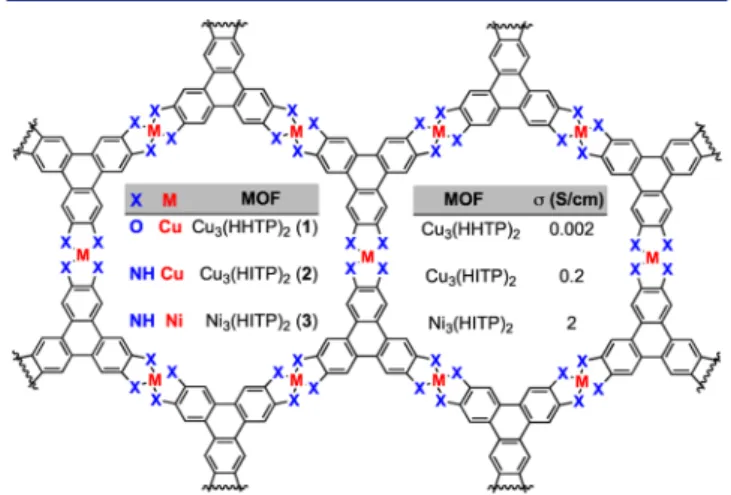
In this work, we demonstrate that a sensor array constructed from three structurally analogous, but chemically distinct, conductive 2D MOFs (Figure 1) can reliably distinguish
between five categories of VOCs based on functional group. Changes to both metal center and ligand produce changes in chemiresistive response, which provides multiple dimensions of synthetic control. These results confirm that conductive MOFs, with well-defined and tunable chemical structures, are an excellent platform for the development of a new class of sensory devices. Additionally, we provide evidence that MOF-based chemiresistors can operate via multiple, orthogonal sensing mechanisms, and may therefore find complementary uses as compared to existing categories of chemiresistors.
In order to test our hypothesis that controlled chemical modifications could be used to produce conductive MOFs with divergent sensing responses toward different types of molecules, we targeted materials that were chemically diverse but structurally analogous. Therefore, we selected a family of conductive 2D MOFs based on triphenylene-derived ligands with square planar metal centers. The three materials used in
Received: September 11, 2015
Published: October 11, 2015
Figure 1.Chemical structures of the conductive 2D MOFs used here, and their electrical conductivities (two-point-probe, pressed pellet, room temperature).
Communication
pubs.acs.org/JACS
this study feature the ligands HHTP and HITP (2,3,6,7,10,11-hexahydroxytriphenylene and 2,3,6,7,10,11-hexaimino-triphenylene, respectively), and Cu or Ni metal centers. The chemical structures of Cu3(HHTP)2(1), Cu3(HITP)2(2), and Ni3(HITP)2(3) are shown inFigure 1and consist of hexagonal
2D sheets. The synthesis and characterization of 24 and 33f have been previously reported by part of our team, and 1 has been described by the Yaghi group.5Powder X-ray diffraction (PXRD) analysis shows that 1−3 adopt analogous hexagonal structures, in which the 2D sheets stack in an eclipsed or slipped-parallel conformation (Figure S1). These stacking modes result in the formation of extended 1D pores with diameters of ∼1.5 nm. Pressed pellets of 1−3 display room temperature conductivities in the range of 0.002−2 S/cm as measured by the two-point-probe method.
To achieve selective detection of VOCs, we constructed a cross-reactive chemiresistive sensor array using MOFs 1−3 in a fashion similar to what has been performed for carbon nanotube (CNT) composites.6The precise atomic-level control over structure afforded by MOFs, as compared to CNT composites, may ultimately allow for improved access to sensor materials tailored for a particular application. Additionally, the MOFs used here have the advantage of more narrowly defined composition and structure, which is beneficial in terms of reproducibility and long-term device stability. In the array sensing process, a set of chemiresistors fabricated from MOFs 1−3 is exposed to vapors of VOCs while their responses are recorded; these conductance responses are then subjected to statistical analyses that allow for VOC classification by functional group (Figure S2).6
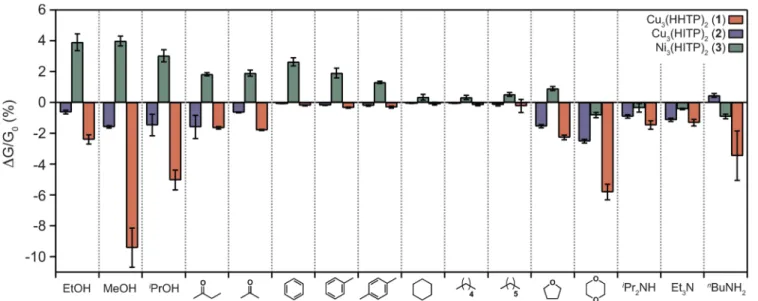
The sensor array was fabricated by drop-casting a dispersion of each MOF in acetone onto interdigitated gold electrodes, or by using a solvent-free mechanical“drawing” method onto gold electrodes on paper (Figures S3 and S4).7Figure 2shows the average responses (ΔG/G0) of the chemiresistive array’s
MOF-based devices tofive classes of VOCs (aliphatic hydrocarbons, alcohols, ketones/ethers, aromatic hydrocarbons, and amines; Figure S5), each represented by three or four distinct molecules. Even from a qualitative inspection of the data, it is clear that each MOF displays a response that varies with the
type of analyte. Additionally, for a given analyte, each MOF often displays a difference in the direction and/or the magnitude of response. In particular, Ni3(HITP)2 (3) often displays a direction of response opposite to Cu-based MOFs 1 and 2, with 1 and 2 themselves frequently showing a significantly different magnitude of response with respect to each other. MOFs 1−3 are generally responsive to VOCs with polar character, while (perhaps unsurprisingly) all three materials show no appreciable response to aliphatic hydro-carbons. As shown below, these distinct variations in chemi-resistive response between 1−3 can be exploited to allow for discrimination between different types of VOCs.
We treated the sensing data from the chemiresistive MOF array inFigure 2to two types of statistical analyses: principal component analysis (PCA) and linear discriminant analysis (LDA).8 PCA is a commonly used tool in unsupervised exploratory data analysis, which can result in grouping of data points based on their similarity without any prior knowledge of their classification.Figure 3shows the results of applying PCA to our data, which yields clear groupings of the data by functional group class, as indicated by the colored ovals superimposed onto the data.
LDA offers a more quantitative indication of the ability of the MOF-based chemiresistor array to distinguish among thefive groups of chosen VOCs. LDA is a supervised statistical analysis technique that aims to use the data associated with members of predetermined groups in order to classify new cases into those groups. The results of our LDA are shown in the jackknifed classification matrix inTable 1, demonstrating 92% accuracy in classifying 64 trials with only one amine mistaken for an alkane and four out of the 16 ketones/ethers mistaken for aromatic hydrocarbons. This analysis shows that the MOF-based sensor array can distinguish among these classes of VOCs with a high degree of confidence. This result is remarkable considering that our sensory array device is comprised of only three different MOF materials that were not explicitly designed to have specific interactions with particular types of functional groups. In comparison, previously reported CNT-based sensor arrays that can accomplish a similar VOC discrimination are typically
Figure 2.Sensing responses of the MOF array to representative examples from different categories of VOCs, where ΔG/G0is the relative response
(change in conductance) upon a 30 s exposure to 200 ppm of the VOC vapor; each response is averaged from 12 measurements (4 exposures to 3 separate devices for each MOF); error bars show one standard deviation.
Journal of the American Chemical Society Communication
DOI: 10.1021/jacs.5b09600 J. Am. Chem. Soc. 2015, 137, 13780−13783
composed of ∼10 different CNT composites that are often designed to interact with specific types of functional groups.6
A key question for the future development of MOF-based sensory devices is how changes in MOF structure cause the variations in chemiresistive responses observed here. Several common sensing mechanisms predominate in chemiresistive devices, including charge transfer,9swelling/solvation,6c,10and Schottky barrier modulation.11In the case of our MOF-based chemiresistors, several of these possibilities can be excluded: The rigid crystalline structures of the 2D MOFs used here are not susceptible to swelling effects; additionally, we observed ohmic contacts for all of our MOF devices, ruling out Schottky barrier modulation (Figure S6). The data inFigure 2show that the identity of the metal center (Ni vs Cu) has the largest impact on sensing response. Indeed, for most analytes, Ni-based MOF 3 has an opposite direction of response to Cu-based MOFs 1 and 2. These data seem most consistent with a charge transfer mechanism for sensing, in which the inherent charge density of the MOF (affected by d8NiIIversus d9CuII) would play a key role.
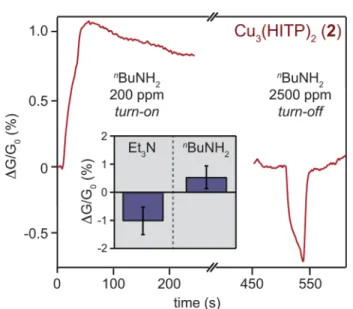
A charge transfer mechanism alone is not sufficient to account for all observations, however, and our data show that multiple mechanisms are operative. For example, devices fabricated from Cu3(HITP)2 (2) display an unusual concen-tration dependence for amine analytes such as nBuNH2: at
lower concentrations (e.g., 200 ppm) a “turn-on” response is observed, with a sluggish recovery time, whereas increasing the concentration to 2500 ppm produces an opposite “turn-off” response of similar magnitude, which recovers quickly (Figure 4). To the best of our knowledge, such a concentration-dependent switch in response has not been observed for other chemiresistor materials. Furthermore, chemiresistors fabricated from 2 display an opposite direction of response between
amines with different degrees of substitution at the same concentration (e.g., Et3N andnBuNH2,Figure 4inset). Taken
together, these data indicate that multiple competitive sensing mechanisms are operating simultaneously (see theSupporting Information for additional discussion). We postulate that, in addition to charge transfer, hydrogen bonding is a likely contributor to the observed sensing response. Overall, the behavior of the 2D MOFs used here is unique as compared to other known categories of chemiresistors.
In summary, we have described the first MOF-based chemiresistive sensor array, which is able to reliably distinguish between different categories of VOCs. The high degree of analyte discrimination observed, with relatively small chemical perturbations, suggests this approach to be attractive relative to existing technologies such as CNT and metal oxide composites. Our results establish conductive MOFs as a distinct new category of chemiresistor materials. Rational tuning of the MOF’s chemical and electronic structure may allow for future development of improved sensor materials that can exhibit selective detection and identification. Conductive MOFs will thus provide an exciting and powerful platform for the development of new sensing technologies.
■
ASSOCIATED CONTENT*
S Supporting InformationThe Supporting Information is available free of charge on the ACS Publications websiteat DOI:10.1021/jacs.5b09600.
Experimental procedures and supplementary figures (PDF)
■
AUTHOR INFORMATION Corresponding AuthorAuthor Contributions
‡M.G.C. and S.F.L. contributed equally.
Notes
The authors declare no competingfinancial interest.
Figure 3. Principal component analysis of the MOF sensor array’s responses to VOCs.
Table 1. Jack-knifed Classification Matrix of the MOF Sensor Array’s Responses to Different Classes of VOCs
-ane ROH -one/ether Ar amine correct (%)
alkane 12 0 0 0 0 100 alcohol 0 12 0 0 0 100 ketone/ether 0 0 12 4 0 75 aromatic 0 0 0 12 0 100 amine 1 0 0 0 11 92 total 13 12 12 16 11 92
Figure 4. Evidence for simultaneous operation of multiple sensing mechanisms: the direction of sensing response for Cu3(HITP)2(2)
with nBuNH
2 displays unusual concentration dependence. Inset:
opposite directions of response are also observed for 2 with primary vs tertiary amines at the same concentration (200 ppm).
■
ACKNOWLEDGMENTSWe thank Lionel C. H. Moh for helpful discussions and experimental assistance. Synthetic and characterization work was supported as part of the Center for Excitonics, an Energy Frontier Research Center funded by the U.S. Department of Energy, Office of Science, Office of Basic Energy Sciences, under award no. DE-SC0001088 (MIT). M.D. thanks the Camille and Henry Dreyfus Postdoctoral Program in Environ-mental Chemistry for support of M.G.C., and gratefully acknowledges early career support from the Sloan Foundation, the Research Corporation for Science Advancement (Cottrell Scholar), and 3M. S.F.L. and T.M.S. acknowledge support from a National Science Foundation Graduate Research Fellowship under Grant No. 1122374, as well as the Army Research Office through the Institute for Soldier Nanotechnologies.
■
REFERENCES(1) (a) D’Alessandro, D. M.; Kanga, J. R. R.; Caddy, J. S. Aust. J. Chem. 2013, 64, 718. (b) Allendorf, M. D.; Schwartzberg, A.; Stavila, V.; Talin, A. A. Chem. - Eur. J. 2011, 17, 11372. (c) Stavila, V.; Talin, A. A.; Allendorf, M. D. Chem. Soc. Rev. 2014, 43, 5994.
(2) (a) Brandon, N. P.; Brett, D. J. Philos. Trans. R. Soc., A 2006, 364, 147. (b) Simon, P.; Gogotsi, Y. Nat. Mater. 2008, 7, 845. (c) Kreno, L. E.; Leong, K.; Farha, O. K.; Allendorf, M.; Van Duyne, R. P.; Hupp, J. T. Chem. Rev. 2012, 112, 1105. (d) Bubnova, O.; Crispin, X. Energy Environ. Sci. 2012, 5, 9345. (e) Borchardt, L.; Oschatz, M.; Kaskel, S. Mater. Horiz. 2014, 1, 157. (f) Choi, K. M.; Jeong, H. M.; Park, J. H.; Zhang, Y.-B.; Kang, J. K.; Yaghi, O. M. ACS Nano 2014, 8, 7451. (g) Clough, A. J.; Yoo, J. W.; Mecklenburg, M. H.; Marinescu, S. C. J. Am. Chem. Soc. 2015, 137, 118.
(3) (a) Kobayashi, Y.; Jacobs, B.; Allendorf, M. D.; Long, J. R. Chem. Mater. 2010, 22, 4120. (b) Gándara, F.; Uribe-Romo, F. J.; Britt, D. K.; Furukawa, H.; Lei, L.; Cheng, R.; Duan, X.; O’Keeffe, M.; Yaghi, O. M. Chem. - Eur. J. 2012, 18, 10595. (c) Narayan, T. C.; Miyakai, T.; Seki, S.; Dincă, M. J. Am. Chem. Soc. 2012, 134, 12932. (d) Sun, L.; Miyakai, T.; Seki, S.; Dincă, M. J. Am. Chem. Soc. 2013, 135, 8185. (e) Talin, A. A.; Centrone, A.; Ford, A. C.; Foster, M. E.; Stavila, V.; Haney, P.; Kinney, R. A.; Szalai, V.; El Gabaly, F.; Yoon, H. P.; Léonard, F.; Allendorf, M. D. Science 2014, 343, 66. (f) Sheberla, D.; Sun, L.; Blood-Forsythe, M. A.; Er, S.; Wade, C. R.; Brozek, C. K.; Aspuru-Guzik, A.; Dincă, M. J. Am. Chem. Soc. 2014, 136, 8859. (g) Park, S. S.; Hontz, E. R.; Sun, L.; Hendon, C. H.; Walsh, A.; Van Voorhis, T.; Dincă, M. J. Am. Chem. Soc. 2015, 137, 1774. (h) Sun, L.; Hendon, C. H.; Minier, M. A.; Walsh, A.; Dincă, M. J. Am. Chem. Soc. 2015, 137, 6164.
(4) Campbell, M. G.; Sheberla, D.; Liu, S. F.; Swager, T. M.; Dincă, M. Angew. Chem., Int. Ed. 2015, 54, 4349−4352.
(5) Hmadeh, M.; Lu, Z.; Liu, Z.; Gándara, F.; Furukawa, H.; Wan, S.; Augustyn, V.; Chang, R.; Liao, L.; Zhou, F.; Perre, E.; Ozolins, V.; Suenaga, K.; Duan, X.; Dunn, B.; Yamamto, Y.; Terasaki, O.; Yaghi, O. M. Chem. Mater. 2012, 24, 3511.
(6) (a) Wang, F.; Swager, T. M. J. Am. Chem. Soc. 2011, 133, 11181. (b) Mirica, K. A.; Azzarelli, J. M.; Weis, J. G.; Schnorr, J. M.; Swager, T. M. Proc. Natl. Acad. Sci. U. S. A. 2013, 110, E3265. (c) Liu, S. F.; Moh, L. C. H.; Swager, T. M. Chem. Mater. 2015, 27, 3560.
(7) Mirica, K. A.; Weis, J. G.; Schnorr, J. M.; Esser, B.; Swager, T. M. Angew. Chem., Int. Ed. 2012, 51, 10740.
(8) Jurs, P. C.; Bakken, G. A.; McClelland, H. E. Chem. Rev. 2000, 100, 2649.
(9) Kauffman, D. R.; Star, A. Angew. Chem., Int. Ed. 2008, 47, 6550. (10) (a) Zhang, T.; Mubeen, S.; Myung, N. V.; Deshusses, M. A. Nanotechnology 2008, 19, 332001. (b) Hangarter, C. M.; Chartuprayoon, N.; Hernández, S. C.; Choa, Y.; Myung, N. V. Nano Today 2013, 8, 39.
(11) Liu, B.; Chen, L.; Liu, G.; Abbas, A. N.; Fathi, M.; Zhou, C. ACS Nano 2014, 8, 5304.
Journal of the American Chemical Society Communication
DOI: 10.1021/jacs.5b09600 J. Am. Chem. Soc. 2015, 137, 13780−13783