BARIUM UPTAKE BY MARINE DIATOMS by
Charles Melvin Libicki
B.S., Massachusetts Institute of Technology (1976)
SUBMITTED IN PARTIAL FULFILLMENT OF THE REQUIREMENTS FOR THE
DEGREE OF MASTER OF SCIENCE
at the
MASSACHUSETTS INSTITUTE OF TECHNOLOGY MAY 1978
Signature of Author ... ...J,.. .I, ... ...
/)
(^
Department of Earth and Planetary Science Certified by..._,4 1 / A I, / Thesis Supervisor Accepted by.
Chairman, Department Graduate Committee
MIT
ALI-
RABIES%
-2-ABSTRACT
BARIUM UPTAKE BY MARINE DIATOMS by
Charles Melvin Libicki
Submitted to the Department of Earth and Planetary Science
in May 1978 in partial fulfillment of the requirements for the degree of Master of Science
The marine diatoms Skeletonema costatum, Thalassiosira pseudonana, and Coscinodiscus rex were cultured in batch and chemostat in an attempt to verify that diatoms act as carriers of barium in its marine geochemical cycle. Various models of
uptake are developed. Removal in batch culture is negligible.
Removal in chemostat culture accounts for less than 10% of the ambient barium, indicating the agency of these diatoms is insufficient to explain the well-documented oceanic surface depletion and deep water enrichment of barium, according to
standard models or even according to the most generous models. Experiments to investigate the mechanism of uptake are outlined, should a barium-accumulating diatom be found.
-3-
ACKNOWLEDGEMENTS-I would like to thank all the members of the Geochemistry Collective at M.I.T., so may of whose ideas and suggestions appear in this paper that it would be impossible to sort them out and credit them individually. I would also like to thank Dr. R.R.L. Guillard and Larry Brand of the Woods Hole Ocean-ographic Institution for cultures and culturing advice and Dr. F.M.M. Morel of the M.I.T. Department of Civil Engineering for an introduction to agal culture.
~..~II- --L~I -- ~--- -^----~-.-~... ~...~- --- --- -I---- - ' ---' ~-" Y" II -gPYLY'~'L~ -;lr~- ~ Ill ly_ ~lllyr^-_lllII~L * L--~ L-~~-II~-s~L~L*^..
-4-TABLE OF CONTENTS Page Number TITLE PAGE 1 ABSTRACT 2 ACKNOWLEDGEMENTS 3 TABLE OF CONTENTS 4 LIST OF FIGURES 5 LIST OF TABLES 6 INTRODUCTION 7
MATERIALS AND METHODS 31
RESULTS AND DISCUSSION 53
REFERENCES 88
_~^.~_. ~--- -- --- --... ~--~- --- C~~ ~~ ~~'~LLI
__i-
-5-LIST OF FIGURES
Figure Page Number
1 Chemical data for Geosecs Station 13
343, 140N 1230W Easter Pacific
2 Chemical data for Geosecs Station 15
54 150S 300W Southwest Atlantic
3 Cell Division and Silica Frustule 22
Formation in Thalassiosira pseudonana
4 Chemostat assembly 37
5 Percent Opal (per dry weight) versus 57
Ambient Silicate
6 Steady-State Silicate Concentration 60
versus Flow Rate for Thalassiosira pseudonana
7 Fractional Barium Removal versus Frac- 67
tional Silica Removal for Thalassiosira
pseudonana. The a relationship
8 Barium removal versus Silica Removal 69
for Thalassiosira pseudonana.
9 Fractional Barium Removal versus Chemo- 71
stat Flow Rate for Thalassiosira pseu-donana.
10 Fractional Barium Removal versus Ambient 73
Silicate for Thalassiosira pseudonana.
..,~~-- -- --- --- I. ....~---sr-- ---~"- " ~"""~*"YL^~I~-~~'~I-_II-L~-_~-L----Lt ly-i-- ---- - -~l _~ ~ l~-~-- IIY ~-L I~-LX 11I II
-6-LIST OF TABLES
Page Number
Composition of Guillard's medium
F/2 [28]
The Upper Limit of Chelation of the Species Ba, Ca, and Mg
Dye Mixing Experiment Silicate Standard Curves
A Typical Run T13 Innoculation
11-17 13:00
Skiletohema costatum chemostat par-ticulate silicate
Chemostat silica data
Skeletonema costatum Batch Culture experiment No. 6
Thalassiosira pseudonana chemostat culture experiments 7-14
Skeletonema costatum chemostat culture experiments 5 & 6
Coscinodiscus rex chemostat culture
50
54
62
experiments 2 & 3
Particulate Barium Analysis Table
10
~CII~)(I~~I II L-ICI.i-Xr ~9~-I X--- II~IIII-~I~ XI II -I- .
75 12
-7-INTRODUCTION
The interest in the geochemical cycle of barium and the
possible role of diatoms in that cycle comes from various
sources. One is the radioactive isotope 226Ra produced in
the sediments by the decay of 2 3 0Th. Koczy [1] suggested
its use as a time-tracer of the rate of mixing processes and of water mass movements. As it is present at lower con-centrations in the surface layer than in the deep ocean, the relative concentrations compared to the decay rate ought to give the time required for mixing across the thermocline.
Al-so, since 226Ra has a bottom source whereas 14C, the other major tracer of mixing rates, has an aerial input, the two should serve as independent checks on the system. Surface
226-depletion of Ra indicated rates of mixing across the
thermo-cline that were at least an order of magnitude lower than those yielded by the 14C method. This was ascribed to unknown non-radiological processes controlling the distribution of 226Ra. In the case of 14C, non-radiologic processes influencing the distribution of carbon can be corrected for exactly, by con-sideration of the isotope 12C. Radium has no stable isotope, and so for this correction a chemical analogue must be found instead. Barium, occurring directly above radium in the alkali earth metals of the periodic table is such an analogue. Barium profiles with depth show surface depletion very similar to
2 2 6
-8-primarily responsible for the low relative concentrations of 226
Ra at the surface. The non-radiologic component accounts 226
for the lion's share of the Ra signal, and as such the
cor-rection system must be well-founded and exact. The divergence from proportionality between radium and barium, inferred to
be the radiologic component, is in fact so small that extracting time information on a large scale will have to await improve-ments in 226Ra analytical technique [2].
The phenomenon of surface depletion relative to the deep water is most strikingly apparent for the nutrients silicate,
phosphate, and nitrate, and for ECO2 and alkalinity, but the
same type of profile is observed in attenuated form for
nick-el [3], cadmium [4], and zinc [5] ,,-Brxuand,-H - as well as
for barium. Barium is the most abundant (about 40 n M/kg surface) of the trace constituents to show this relationship
(surface values for nickel, cadmium, and zinc, are 3 n M/kg, .1 n M/kg, and .2 n M/kg respectively) and so can best be in-vestigated as a model system for the other three.
For such disequilibrium between the surface and deep water to maintain itself, there must be removal at the
sur-face and production (or regeneration) at depth. This is usually taken to indicate organisms at work. Herein lies
the third interest in this work. Barium, because of its weight, among other considerations, is generally held to have no biological importance, and yet it seems to be han-dled and transported by living systems. How does an organism
-9-deal with an element that is neither useful nor toxic? Does
it pass through the system by default, or is it handled by enzymatic systems specifically designed for the safe passage or exclusion of trace metals in general?
The original evidence that barium is actively removed from the water column, was the enrichment of sediments in barium, and the existence of seemingly authigenic barite
crystals in the sediment despite apparent BaSO4 undersaturation
in the overlying waters [6]. Barium was found to covary with
-3
the opal content of sediments (Ba/Si = 3.8 x 10 ) [7] and
with overlying high productivity zones, though there was dissent on the implication of these facts [9].
More striking evidence is the covariance of barium with silicate and specific alkalinity (representing production and dissolution of diatom and radiolarian frustules, and ccareous coccoliths and foraminiferal tests respectively),
al-though not with the nutrients nitrate and phosphate. This
covariance obtains not only in individual profiles but also in barium's enrichment in Pacific deep water relative to Atlantic deep water in concert with most nutrients, but especially with silica and alkalinity.
To separate the comparators silica and specific alka-linity, which over most of the ocean covary, and determine whether opal or carbonate is the more likely carrier phase
for barium and radium, Edmond [10] charted radium correlations
-^-- --- ---ui '--~- ll ~ -lu~-ru--~---u---~-~ ^mll , rr.xirrrm~ i -*rr*
with each across the Anarctic circumpolar current boundary, south of which carbonate productivity drops markedly with respect to diatom productivity. The radium adheres closer to the silicate across the boundary. More recent data, how-ever, is more ambiguous about differentiating between opal
and carbonate carrier phases [2].
Redfield has described the relationship of the ratio of
nitrogen to phosphorous in plankton to that in seawater [11]. From
this he has concluded that whenever removal of two chemical species is proportional, their concentration in seawater will vary linearly with one another. Stallard [121 has taken the
inverse of this; that whenever two chemically reactive species plot linearly against each other, and not against conservative properties, their removal rate must be everywhere related by a constant factor. Symbolically,
d[Ba] k
= k
d[Si]
where
[Ba] = k [Si] + C
This is roughly the case over most of the world ocean with the -4
factor being about 7 x 10⁻⁴ [13] mole barium per mole silicate. The nature of this removal can at present only be inferred indirectly. As an illustration of the relation of barium to the nutrients, profiles of barium, silicate and nitrate, and a plot of barium against silicate are presented for a Pacific
-11-station in Fig. 1 and an Atlantic -11-station in Fig. 2. The Pacific station illustrates the closer link of barium with silicate than with nitrate. Both barium and silica exhibit maxima around 3500 m below the surface as opposed to nitrate's shallow maximum at 1000 m. This suggests barium's
incor-poration into "hard" or refractory material that can avoid destruction and dissolution until farther in the water column. Materials in this category include the silicious tests of dia-toms and radiolaria and the calcareous shells of foramnifera and coccolithophorids. Materials contraindicated are cyto-plasm, organic coats, aragonite and celestite. The property-property relation is generally a straight line,
-4
[Ba] = 22 + 7.1 x 10- [Si]
but including some pronounced discontinuities. The two at [Si] = 150 and [Si] = 50 are evident in the silicate profile as well, but the discontinuity at low barium and silicate
represents a genuine divergence. The Atlantic profile is
dominated by the various cores of water riding over one an-other at that station. Still, throughout the profile, and the sections that represent different source regions, barium
follows silicate. The property-property relation is, at a gross level, a straight line
[Ba] = 43 + 8.3 x 10- [Si]
but can be broken down into a series of line segments whose
-12-Figure 1 Chemical data for Geosecs Station 343, 140N
1230W Easter Pacific
A. Barium concentration with depth
B. Silicate concentration with depth
C. Nitrate concentration with depth
D. Property-property plot of barium against
silicate
Note discontinuities in the barium-silicate relation correspond to discontinuities in the silicate profile
-13-0.5
.
0 0.5depth
2km
3 4 0 20 40 60 80 100 120 140 160Barium,
nM/kg
0O 9 0*, 0 0 0 09 0 0 * 20 40 60 80 100 120140 160 180Silicate
pM/I
rO '0 ' "0 0 0 0 0g 0 * 0 0 9 0 160 140Barium
120nM/kg
100 80 60 40 20 01 0 10 20 30 40Nitrate p.M/I
/t,
I i . 1 1 1 1 20 40 60 80 100120 140160.80Silicate pM/I
depth 2 km 0 0.5 Idepth
2km
I _j_;__ ~~___l~ ~_^ ~J1I_ _ R~ I m . = I . . . .
-14-Figure 2 Chemical data for Geosecs Station 54 150S
300W Southwest Atlantic
A. Barium concentration with depth
B. Silicate concentration with depth
C. Nitrate concentration with depth
D. Property-property plot of barium
against silicate
Abbreviations indicate respective positions of Sub-Tropical Underwater (STUW) Antarctic Intermediate Water (AAIW)
Mediterranean Intermediate Water (MIW) Labrador and.North Atlantic Deep Water (LANDW) and Antarctic Bottom Water
(AABW). Straight lines connecting these water masses in
the property-property relation represent simple mixing.
-15-( STUW 0 AAIW 8 MIW
depth
km
* LANDW • AABW 0 20 40 60 80 100 120Barium
nM/kg
Ao AIW o oMIW o LAoDW o ** *4 * 0 * 0 20 40 60 80 100Silicate
.M/1
o AABW 120 140 120 100 00 AAIW MIW Barium 80 nM/kg 60 40 SLANDW * * 0 0, o AABW 5 10 15 20 25 30 35Nitrate
/pM/I
AABW 'AAIW STUW 0 20 40 60 80 100 120 140Silicate
LM/I
depth km depth km _
-16-joints represent the centers of the various water masses. Again, the surface discontinuity is not reflected in the silicate data, although it is in the salinity data (not shown) [2].
Crystalographic data argue against calcite as the carrier phase. The radius ratio of transition from the calcite form
of a carbonate to the aragonite form is 0.67 [14]. The ratio
for calcium is 0.67 and so it can assume either form. Stron-tium, with a radius ratio of 0.75, is strongly excluded for
calcite with respect to aragonite [15]. For barium, with a
radius ratio of 0.87, the exclusion should be nearly complete. Various analyses of marine plankton have been performed and usually significant amounts of barium have been found
[9], [16], [17], [18]. Commonly, however, concomitant
hydro-graphic work is not done; the planktonic phosphate, nitrate, carbon, silicate and carbonate values are seldom reported. All this would have helped fill in the picture, but even then,
separation of the plankton so that the carrier organisms and the carrier phases can be determined is not generally practicable.
The most direct method for investigating this problem would seem to be controlled culture experiments. For my own work, three species of marine centric diatoms were grown in batch and chemostat culture in an attempt to verify the
hypo-thesis of diatoms as agents of barium removal. In culture, a
single species can be grown and observed. The composition of the growth medium can be monitored and manipulated to
more rigorously determine uptake levels, laws, and mechanisms.
-17-Through the determination of laws and mechanisms, insight can be gained to understand deviations from smooth correlation, for instance, in the Circumpolar Current, where certain features in the silicate profiles are only weakly reflected in the barium profiles. Cultures have the disadvantage, of course, of not being the ocean, which is the original object of interest. Still, what they may lack in fidelity they can make up in
per-spective and understanding.
Much work has been done with the interaction of trace
metals and phytoplankton in culture. Most of it involves their toxic or salutory effects, or the amounts that can be
accumu-lated. In this work by contrast emphasis is on the effect the phytoplankton have on the water chemistry, and the stoichiometry
of uptake. To this end, high precision analysis of water, and a clean and defined system have higher priority than, say a wide phylogenetic diversity or a close approximation of the
na-tural environment. Importance is also placed upon reference to models, so that results can be not only reported, but analyzed within the context of oceanographic data.
-18-Edmond has proposed, by analogy to chemical coprecipitation, a model of barium uptake and emplacement into the opal frustule such that the ratio of barium to silica in the frustule reflects their ratio in the surrounding water through the fractionation constant a. Symbolically,
d[Ba] a [Ba]
d[Si] [Si]
and at steady state concentrations of barium and silica
XBa [Ba]
diatom
This is what the stoichiometry of uptake should look like,
and although it has the appearance of chemical coprecipitation,
it does not specify the mechanism of uptake. Still, ignoring
the agency of the organism, it is logical that a contaminant should appear in proportion to its ambient concentration and in inverse proportion to the ambient concentration of the
major constituent. This has been established for instance for
the Sr/Ca ratio in mollusk shells [15]. Fresh water gastropods,
grown under controlled conditions, precipitated shells whose strontium content reflected the Sr/Ca ratio in the surrounding water with a fractionation coefficient of 0.237 (compared to 1.12 for non-biologically precipitated aragonite) that was in-dependent of temperature, growth rate, absolute Sr levels, and
species. This despite the separation of the site of shell
for-mation from the ambient water by a biological membrane.
In chemostat culture, the manifestation of the a
-19-ship would be direct:
XBa [Ba]
(XSi)[Si]diatom
or in concentration parameters
[Ba] - [Ba]a = a [Bala
[Si] - [Si]a [Si]a
where i stands for inflow and a for ambient. Solving for a,
([Ba]i - [Ba]a) [Si]a
a =
-[Ba]a ([Si] i - [Si] a)
Batch culture is more a closed system. If the diatom can also be seen as a "closed system" (only uptake and no dissolution) then the removal equation can be integrated
f d[Ba] f d[Si]
I !Ba] = a [Si]
i i
In( [Ba] i/ [Ba] f)
In([Si] /[Si] f)
Here i stands for initial and f for final. In batch culture
change in barium is related to change in silicate by an ex-ponent of a. In chemostat culture the two are related by a
factor of a. Since a is less than unity, the same amount of
change in silica would produce a vastly smaller effect upon barium in batch than in chemostat. This is one of the major advantages of chemostat over batch, despite the former's greater difficulty and complexity.
-20-If the barium is incorporated within the frustule at its formation, then it must be handled by the cell's own machinery. The silica frustule construction occurs on the organic silicalemma on tthe newly formed wall that separates the daughter cells immediately following mitosis (see Fig.3). It takes place in the very center of the cells excluding
the possibility of purely chemical coprecipitation. The process, from silica uptake to deposition involves a mem-brane-bound transport system [19], the expenditure of energy
through ATP hydrolysis [20], protein synthesis, polymerization,
coordination by microtubules [21], and precipitation onto the
silicalemma [22]1. Azam [19] has described such a
membrane-bound enzymatic transport system for silica, taking as proof of its existence not only its adherence to Michaelis-Menten enzyme kinetics, but also its variation with temperature and its inhibition by germanium, which occurs below silicon in the periodic table. The germanium makes an instructive pos-sible analogy with barium. In the range of [Ge]/[Si] = 0.01, it is incorporated into frustules without apparent deleterious effect. In the range of [Ge]/[Si] = 0.01, it is toxic to
dia-toms, preventing normal frustule formation [23]. The method
of interaction appears to be competitive inhibition, in which germanium competes with silica for the same enzymatic sites, and can be described by the same sort of enzymatic kinetics, albeit with different constants. The equations are [24]
-21-Figure 3 Cell Division and Silica Frustule
Formation in Thalassiosira pseudonana
Note discarded girdle, which could account for 10% of the diatom's opal [33] (Guillard
personal communication).
-22-silica
cell
membrane
-Mitosis
-new girdle
connecting
strands
\discardedgirdle
daughters
separating
daughter,
cells
nascent
valve
,
silicolemma--...
;j---new
valve
silica valve
silica valve
-23-k+l E + S t ES k-i k+2 ES 4 E + S k-2
where E represents unbound enzyme, S the substrate (in this case ambient Si, Ge or Ba), ES the enzyme-substrate complex, P the product (in this case intracellular Si, Ge, or Ba), and ET the total amount of enzyme, bound or unbound. Traditionally, k-2 is assumed to be negligible and so the rate equation takes the form
d[S] k ]
dt +2 T k + 2 +
k_ l + k+2 + [S]
The expression k forms the lumped constant K . In
+1m
nutrient-uptake studies the further approximation is made that
k+2 << kl and so
k-1 + k+2 k-1 k
k + k
+k +1
which is effectively the dissociation constant for the enzyme-substrate complex. Setting these equations for barium and sili-ca, and assuming that the same enzyme [system] operates on both.
d[Ba] k[ET [Ba]
dt +2 Ba T k + [Ba]
S Ba
d[Si] [Si]
dt +2 Si [ET k
s si+[si]
d[Ba] k+2 Ba [Ba] (ks Si+[Si]) dSi] - k+2 Si [Si] (ks Ba+[Ba])
-24-and the substrate concentration at half-saturation are, under the given approximations, separable with respect to kinetic
constants. The product formation rate constant, k+21
deter-mines the amount of barium incorporated, and the
enzyme-sub-k-1
strate dissociation constant ks(= --1) determines the apparent
+1
stoichiometry of barium uptake with respect to silica (and also the inhibition of silica uptake by barium if such were the
case). Four limiting cases present themselves:
1) ks Ba d[Ba] d[Si] 2) ks Ba d[Ba] d[Si] 3) ks Ba d[Ba] d[Si] 4) ks Bas Ba d[Ba] d[Si] The first ci respect to ambient med >> [Ba] k2+Ba k2+st << [Ba] k2+Ba S2+Si >> [Ba] k2+Ba k 2+Si. k >> s si [Ba] kS Si [Si] ks s BaBa [Si] k Si << s S [Si] k << s Si [Ba] s Ba [Si] << [Ba] ks Si >> [Si] = k2+Ba ks Si k2+Si [Si]
ase is substantially the a model. Barium removal with
silica reflects their relative proportions in the
ium. The second represents roughly a constant
accu-mulation of barium per cell regardless of the ambient concentra-tion of barium or silica. A stoichiometry of this sort might be interpreted as the cell's having a need for a specific amount
-25-of barium, which it acquires and then stops. In-culture,
the results from batch and chemostat should be similar with
[Ba] i-[Ba]
the expression ( [Si] -[Si] i a a being a constant. Uptake of this
sort is in accordance with the implications of property/
property linearity without the need for further information as to the relative proportions of barium and silica in surface sea
water. In possibility number three, barium per cell reflects
only the ambient barium concentration. There would be a dif-ference between batch and chemostat only to the extent that
barium is depleted in the batch medium in which case the cellular
composition would reflect the exponential decline. The constant
expression would be In (Bai/Baf)
i f
S i - Sif
In chemostat the constant expression would be
Ba. - Ba
1 a. 1
Ba Si. - Si
a 1 a
Oceanographically, this model is compatible with the property/ property relation only in the case that surface barium levels are roughly constant throughout the ocean. The other hybrid pos-sibility, number four, is the inverse of number three, its special property being that without the model it would be very difficult to understand why barium uptake should be inversely related to silica concentration and not at all to barium con-centration. The difference between batch and chemostat would be pronounced in case four because silica depletion is so much greater than barium depletion. The constant expression for
-26-batch is
Bai - Baf
In (Sii-Si )
and for chemostat
Ba. - Ba x Sia
1 a
Si.-Si
i
a
Again oceanographically the property/property relation would hold if surface silicate levels were roughly constant.
Another feature of the enzymatic model is that it can be extremely species specific as it depends upon the affinity of an enzyme for an element which is neither useful nor
toxic in concentrations normally encountered. On the other hand, the enzyme's affinity for barium could be related in some way to its affinity for silica. This might tend to dis-criminate between diatoms from different environments [25]. An enzyme's affinity for its substrate, or an unaccustomed substrate, is usually a function of its three-dimensional
conformation. This in turn can be radically or subtly affected by single amino acid substitutions generated by a simple
point-mutation in the genetic code. That is, given enzymatic uptake, incorporation of barium can be such a mutable charac-teristic that there is no reason to suggest, as Riley and Roth [17] have done, that if there were a species difference, there ought to be more similarity within a family than
be-tween families [26]. Environment and randomness probably
hold greater sway than phylogeny in this model.
-27-Non-specific adsorption and ion exchange are physical processes that could account for barium uptake by diatoms. If this were the case, one might expect to see barium re-moval near the sea floor by resuspended sediment, analagous,
to 210Pb. This is not observed, but neither is it necessary; resuspended _sediment is not the same as living diatoms
[27]. The stoichiometry of uptake would follow the Langmuir
isotherm equation [28]
6 -1
S= t ai
where 8 is the fraction of the surface covered (or sites occupied) and a. is the activity of species i. Rearranging,
1 k-1 a. 6= 1 l+k- 1 a.
an expression very like the Michaelis-Menten equation is ob-tained. Two limiting cases obtain, one where surface area
(or number of sites) is limiting and one where it is not. In
the first case the diatom is saturated with barium and the barium to silica ratio is constant (assuming the ratio of
silica to binding site is constant) which is like case two
of the enzymatic model. The situation of sites' not being
limiting leads to barium to silica in the diatom being propor-tional to ambient barium concentration as in enzymatic case
-28-three. The species dependence of physical processes would be less marked although it might reflect the degree of
sili-fication, the texture and hence surface area that the frustule presents, and the extent of the organic casing on the
out-side of the opal frustule. Silica is highly undersaturated
in surface waters, and so for opal frustules, unlike car-bonate coccoliths, there is a strong tendency to dissolve. Diatoms combat this tendency by covering the test inside and out with an organic coating and, some have suggested, with
an authogenic clay [29] (for the barium to reside in the clay it
would have to be 14% by weight BaSO4). Despite this,
dis-solution accounting for 10% of the weight of the frustule
has been measured for Thalassiosira pseudonana [30]. There
is evidence that this ten percent represents a discarded girdle after division (Dr. R.L.L. Guillard, personal communication)
(see Fig. 3) and not general attrition. But if it is dis-solution of the entire test then equilibrium would imply pre-cipitation at the same time with the possibility of coprecipi-tation of barium. If we postulate that the diatom constructs
a frustule of pure Si02 nH20, and once it comes in contact
with the outside, pure silica dissolves and silica mixed with barium precipitates then the process can be seen as a race between diatom growth and contaminant insinuation. With an equilibrium constant for opal of 10-2 .728] and setting [Si]
to 10- 6 M (slightly higher than culture conditions) and
dis--i
solution accounting for a fraction of 10-1 of the frustule,
at best 10- 4 .3 of the frustule is new material.
I--
-29--4
cally Ba/Si in frustules should be about 7 x 10⁻⁴ [13]. This
would make Ba/Si in newly emplaced material 14, a bit difficult to conceive of.
The fact of dissolution is felt as well in the analysis
of batch culture data. If the a relationship and an open
system is assumed, in which barium may leave the medium by incorporation into frustules and re-enter it by redissolu-tion, the mass balance equation becomes
[Ba] r dt
d[Ba] = a a] d[Si] + ([Ba] - [Ba]) r dt
[Si] i
where r is the dissolution rate in units of inverse time, and
the subscript i denotes initial values. When solved for a,
there is still the undetermined parameter r. In fact r could only be determined directly for a given alga under given growth
conditions by a silica (or analogue) isotopic experiment [26].
Otherwise silica dissolution is completely masked by uptake. (An alternative, certainly open to objection, is the
measure-ment of dissolution of killed cells [31]). The correction
term is only small when d[Si]/dt is large or when [Ba] >>
Baiatom both conditions obtaining more towards the beginning
diatom
of the growth curve, when A[Ba] is small and hence difficult to measure accurately. Failure to correct for dissolution leads to an overestimate of a. The situation is quite dif-ferent for a chemostat. The mass balance equation for barium at steady state in a chemostat of volume V with flow rate Q is
-30-inflow outflow uptake redissolution
dQ[Bal- Q ( [Si] i- [Si]a) Q
d[Ba] [Ba] - [Ba] -a [Ba] ( + r)+r([Ba]i-[Ba]a)
dt i aV [Si a a
[Si]
At steady state when the left-hand side is set to zero, the
expression Q + r cancels everywhere. Solving for a
([Ba] i/ [Ba] a-1
([Sili/[Sil]a ) -1
This is part of the attractiveness of the chemostat over-batch.
-31-MATERIALS AND METHODS
The diatom species cultured were Skeletonema costatum, Thalassiosira pseudonana, and Coscinodischs rex. Skeletonema was grown in batch and in chemostat culture. Chemostat
work with Skeletonema was abandoned partly due to low uptake, but mostly due to problems of sticking to the plastic
con-tainer, causing non-steady-state conditions, self-shading, and a surface for bacterial growth. With Thalassiosira
there was much less sticking and with Coscinodiscus there was none, and so these were grown in chemostat, although not in batch.
All three species are marine centric diatoms of the family Coscinodiscineae. Skeletonema costatum (Greville) Cleve clone Skel was isolated (and supplied) by Dr. R.R.L. Guillard (Woods Hole Oceanographic Institution) from Long
Island Sound in 1956. It is mainly a coastal species,
found in large numbers when it occurs [32]. It forms chains
by spines which emanate from the periphery of the test. Chains consist of an average of six individuals in culture, depending on the degree of agitation. The individuals are the shape of an equidimensional cylinder, about 10p on
a side. Thalassiosira pseudonana Hasle and Heimdal
(Cyclo-tella nana Hustedt) clone 3H was isolated (and supplied) by
Dr. Guillard from Moriches Bay, Long Island in 1958. It
is a coastal and estuarine phytoplankter, tolerating wide
salinity ranges. It can form chains of up to four
indi-viduals in culture, connected by five to eight strands
-32-ating from slime pores about the margin of the cylindrical
test (also about 10 on a side) [33]. Coscinodiscus sp
(provisionally termed rex) was isolated (and supplied) by Larry Brand (Woods Hole Oceanographic Institution) from
Nantucket Sound in 1977. It exists only as individuals
(except for paired daughters) in culture. It is a more
flattened cylinder 200 in diameter.
The medium used for culture experiments is Guillard's F/2 medium, [34] (see Table 1) which is a nutrient-enriched seawater medium. Most artificial media, besides posing greater difficulty in their preparation, also would have higher barium concentrations than natural surface seawater due to contaminants in the major salts. Further, F/2 has proven adequate to culture a wide variety of phytoplankton. Nutrient stock solutions are prepared, autoclaved, and stored
in 125 ml polypropylene bottles, except for the vitamin stock which is kept frozen in .5 ml quantities in 1 ml
ampoules. The nitrate and phosphate stock solution and the trace metal stock solution are made up to be 103 more
con-centrated than the final medium, the vitamins 2 x 10³.
Sil-icate stock is approximately .01 M to avoid precipitation in the autoclave. There need be little concern that EDTA might lower the activity of barium. Competition from calcium and magnesium which have much higher affinities [35] and
concentrations, keeps chelated barium to less than 10-5 of total barium (see Table 2).
-33-TABLE 1
Composition of Guillard's medium F/2 [28]
NaNO 3 NaH2PO4H2 0 Na2SiO3 "9H20 Na 2EDTA FeC13"6H20 CuSO4*5H20 ZnSO4-7H20 CuC12 6H20 Na2MoO4 *2H20 Thiamine HC1 Biotin B 1 2 Seawater mg mg varying 4.36 mg 3.15 mg .01 mg .022 mg .18 mg .006 mg .1 mg .5 vg .5 Pg to 1 liter
-34-TABLE 2
The Upper Limit of Chelation of the Species Ba, Ca and Mg*
Total Concentration 1.5 x 10⁻⁵ M 5.0 x 10- M 1.0 x 10⁻²M 5.4 x 10⁻² M Complex Formation Constant [35] 5.8 x 10⁷ 5 x 101 0 4.9 x 10⁸ Concentration of bound species 1.5 x 10 - 5 8.3 x 10¹⁴ 1.4 x 10⁻⁵ 7.4 x 10⁻⁷ 7.4 x i0 Fraction of total bound -6 1.7 x 10
-3
1.4 x 10⁻³ 1.4 x 10⁻⁵ 1.4 x i0*Iron was not considered as its concentration is affected by the algae. Species EDTA Ba2 + Ca2 + Mg 2+
35-Batch cultures are grown in 1 liter polycarbonate erlen-meyer flasks each with an inverted beaker over the top in
F/2 medium. The medium is prepared and filtered through six autoclaved 250 ml capacity Millipore Sterilfil units with
0.4p Nucleopore membrane filters. The contents of each unit
is poured into an autoclaved erlenmeyer flask and four of the six are innoculated with 1 ml of actively growing algal
cul-ture. One blank and one innoculated flask are sacrificed
immediately. The rest are placed in a 200C constant
temper-ature room beneath "cool white" fluorescent bulbs.
Innocu-lated flasks are sacrificed at intervals until the diatom population plateaus, at which time the last innoculated flask and the second blank are sacrificed. The purpose of this arrangement is to monitor what the algae do to the barium concentration over time and to determine if there is any change associated with the seawater's simply sitting in a
polycarbonate flask beneath fluorescent lights. Sacrificing
is by centrifugation in four 50 ml polypropylene tubes, the contents of which are combined in a polyethylene bottle for analysis of dissolved barium and silica. The pellet is dis-tributed between two tubes and washed twice in vycor-distilled water. The washed pellet from one tube goes for particulate barium analysis, the other for silica. All plastic in con-tact with liquid is soaked in 1 N HC1 and silicone rubber is stored in 2% by weight EDTA.
Chemostat design (see Fig. 4) is basically taken from Goldman [36] with modifications due to the constraintjof
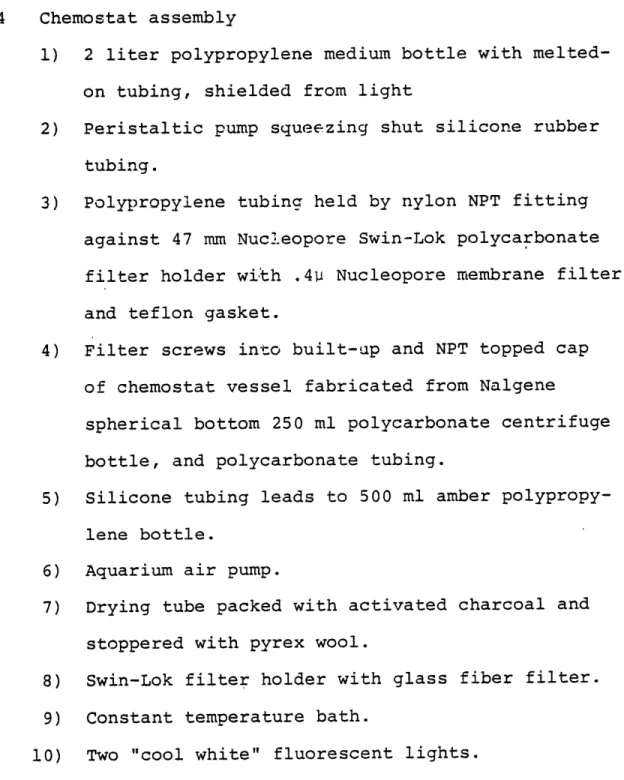
-36-Figure 4 Chemostat assembly
1) 2 liter polypropylene medium bottle with melted-on tubing, shielded from light
2) Peristaltic pump squeezing shut silicone rubber tubing.
3) Polypropylene tubing held by nylon NPT fitting against 47 mm Nucleopore Swin-Lok polycarbonate
filter holder with .41 Nucleopore membrane filter,
and teflon gasket.
4) Filter screws into built-up and NPT topped cap of chemostat vessel fabricated from Nalgene
spherical bottom 250 ml polycarbonate centrifuge bottle, and polycarbonate tubing.
5) Silicone tubing leads to 500 ml amber polypropy-lene bottle.
6) Aquarium air pump.
7) Drying tube packed with activated charcoal and stoppered with pyrex wool.
8) Swin-Lok filter holder with glass fiber filter. 9) Constant temperature bath.
10) Two "cool white" fluorescent lights.
0
C-
-38-this study i.e. low barium contamination, and silicate limi-tation. For instance, barium is near saturation at the levels used in the experiments and so sterilization of sea water can not be by autoclaving, which could radically change its
chemistry. Instead, the seawater is filtered before the
nutrients are added and there is an in-line filter just above the chemostat vessel. Clogging of the filter limits the
amount of medium used and thus, in tandem, the size of the chemostat vessel and the duration of the experiment. Given the duration of the experiment, the amount of time involved in barium analysis, and the residence of sample in the over-flow bottle for up to a day, it made most sense to analyze the entire contents of the chemostat vessel (as opposed to
the overflow as is traditional in chemostat work). The
algae were found to stick to the plastic vessel in the uni-form flow field of constant magnetic stirring, and so simple bubbling in a round-bottom vessel suffices to keep them in
suspension instead.
All components in the chemostat were chosen or constructed to minimize contamination by barium and by silica, to be
autoclavable, and also to minimize substrate for bacterial growth. To avoid leaching of silica into solution, no glass was used in the system. Possible barium contamination also precluded glass, as well as metal or black rubber, and mili-tated against the use of even silicone rubber whenever
pos-sible. Polyethylene and polystyrene do not survive autoclaving
-39-come loose in the autoclave. Further, Tygon tubing provides
a substrate for bacterial growth and so would have to be changed daily [37], which is unacceptable from the
stand-pdnt of contamination. The materials in contact with the
liquid are polypropylene, polycarbonate, teflon, and a mini-mum of silicone rubber. Polypropylene, polycarbonate and teflon are soaked in 1 NHC1 for at least a day and until
used. Silicone rubber is soaked in 2% EDTA.
The equipment consists of the following: Medium is
stored in a two liter polypropylene bottle. This has a 1
1/2 meter length of polypropylene tubing melted on. The
tubing leads into 10 cm of silicone rubber peristaltic tubing. A further short length of polypropylene tubing is held by
a nylon NPT fitting against a 47 mm Swin-Lok polycarbonate filter holder.(Nucleopore Co.) with a Teflon gasket, sili-cone rubber O-ring, and a .41 polycarbonate membrane filter
(Nucleopore Co.). The filter screws into a built-up and
NPT-tapped polypropylene cap, which screws onto the chemo-stat vessel. The vessel is fabricated from a 250 ml poly-carbonate spherical bottom centrifuge bottle (Nalge Co.) and 1/4" I.D., 3/8" O.D. polycarbonate tubing. The pieces are machined, bent and joined with trichloroethylene (later
evidence indicates chloroform serves better). One tube
comes down the side and is joined at the bottom of the bottle with a pinhole for bubbling air. The second tube is joined
at an angle near the top as an overflow tube. To the over-flow is attached a piece of silicone tubing leading to an
-40-amber polypropylene collection bottle. The air is sent by a small aquarium air pump through a drying tube packed with activated charcoal and pyrex wool and then through a glass fiber filter to the chemostat vessel. The vessel sits in a
200C (+ 0.20C) bath continually illuminated by two "cool
white" fluorescent bulbs from the side.
Since the chemostat overflow is at the top, 3 cm away from where the fresh medium drips in, conceivable complete mixing might be a problem. That this is not the case is in-dicated by two observations. First comes from a dye experi-ment, quantitated by spectrophotometry in which dye
concen-tration in the vessel decays with washout as predicted by complete mixing, within experimental error (see Table 3). Perhaps more convincing, the ambient silicate, as measured by sacrificing the entire chemostat vessel is not
consis-tently lower than the silicate in the overflow (it is lower
in three out of ten cases). If mixing were not complete,
and part of the inflow medium, which is between one hundred and two hundred times more concentrated, washed out directly, then the silicate concentration of the overflow would cer-tainly reflect this.
This lack of a consistent difference between instan-taneous and collected silica alleviates another concern, that while in the overflow bottle the diatoms are either dissolving or assimilating more silica. There is more variation from day to day than between the two determinations. The process of dissolution or extra assimilation must be either small or
41-Table 3
DYE MIXING EXPERIMENT
The chemostat vessel is filled with dye KMNO4
S = 526 nm at a certain concentration and distilled
water is added at a rate close to standard conditions while bubbling. After an interval of dilution the concentration of dye is measured spectrophotometrically in the chemostat vessel, the inflow, and the total overflow (normalized to the original concentration being equal to one).
Inflow (i) .008
Chemostat bottle (b) .440'
Total overflow (f) .669 Original (o) 1
With complete mixing
chemostat bottle capacity 238.2 Overflow 200.4
Mass balance [dye] Vb
[dye]bVb + [dye]fVf - [dye] iVf
238.4 \ 243.3
[dye]b = [dye] i + ([dye] o - [dye] i ) e -Vf/Vc
.440 - .436 .9% off in the opposite direction from incomplete mixing.
I_~~.~-*I-
-42-balancing.
Filtered seawater, obtained from the Environmental Sys-tems Laboratory, Woods Hole, Mass. is filtered again through
a glass fiber filter (nominal pore size Pl) before storage
in a 6-liter plastic carboy. Seawater is filtered through a .45p cellulose nitrate filter into the autoclaved medium bottle, and the nutrients are added to make F/2 medium. The bottle is placed, sealed from light, about 1 1/2 meters above
the level of the chemostat vessel. The rest of the equipment is rinsed in distilled deionized water and then glass dis-tilled water. The chemostat vessel is attached to its air and water filters and autoclaved, as is the peristaltic
tubing. When cool, the air source is connected and approx-imately 70 ml of actively growing culture is poured in. The vessel is set into the constant temperature bath, connected
to the peristaltic tubing and the medium bottle, and the medium is dripped in at about the same rate as will be for
the duration of the experiment. In this way (as opposed
to innoculating a full vessel with a small amount of cul-ture) the culture is almost at steady state by the time it comes to volume and the possibility of auxospore formation is
minimized [38]. The daily monitoring of the experiment is
as follows: The collected overflow is filtered into a
grad-uate, the volume recorded and the filter discarded. A sample of 25 ml is injected by syringe into a 100 ml poly-ethylene bottle, acidified, and stored for silicate analysis.
-43-Cell counts are done microscopically on samples obtained by tipping the vessel. The time required for five drops of
medium to fall is recorded as a check on the stability of the -L
flow rate. At a washout rate of 1 day and 2 liters of
medium, the experiment can last a maximum of six days. At the end, in addition to the daily monitoring regimen, the vessel
is detached from the medium filter at the cap, and with the air source still connected, the contents are poured into a Millipore Sterilfil unit with a pre-weighed .4 Nucleopore
filter. Part of the filtered liquid rinses the 500 ml
polyethylene sample bottle and then goes for silicate analysis. The rest of the liquid is poured into the bottle and spiked
for barium analysis. Another 500 ml sample bottle is placed below the pre-chemostat-vessel filter to catch inflow medium at the same rate as it had been delivered during the course
of the experiment. In this way, the difference between the
chemostat vessel sample and the inflow medium sample should be the residue from innoculation, the final filtration, the bubbling air, the residence inthe polycarbonate vessel, and
the activity of the phytoplankton.
The filtration process and the container have been
determined to not present significant sources of contamination. The residue from innoculation should not be significant
after several generations have passed, as the innocula
are grown in polycarbonate flasks and in the same medium.
The bubbling of air can affect the barium concentration in that it causes some evaporation of the medium and hence
in-
-44-creases the total ion concentration. The extent to which this occurs depends on the rate of bubbling, the room temperature and humidity. In the later runs corrections have been made to changes in chlorinity where significant (> 1%).
The "reactive" silicate is analyzed according to the re-duced silico-molybdate colorimetric method of Strickland and Parsons [39] with several modifications suggested by Fanning
[40]. A 25 ml sample is injected into a 100 ml polyethylene
bottle by syringe and acidified with two drops 6 NHC1 for storage. At the time of analysis 10 ml of ammonium para-molybdate is injected into the bottle by syringe. After 20 minutes the metol-sulphiteoxalic sulfuric acide reducing
agent is added. The interval is approximate but is main-tained exactly the same for samples and standards by stop-watch. Standards consist of a distilled water blank, a
blank based on synthetic seawater and a standard made up
in synthetic seawater of either 5p M or 50p M depending on
the concentration range of the samples. After 6 to 24 hours absorbance at 810n M is read in either 1 cm or 10 cm cells depending on the concentration and the instrument.
As a check on the precision of the method, a set of
standards from .1P M to 5.0 M in distilled water were run
(see Table 4). The standard deviation of the values from the
linear regression line was .006P M. This standard deviation is extremely small (and difficult to believe) but it was obtained under ideal conditions and so cannot be considered generally applicable. It serves to demonstrate, however, that
-45-Table 4
Silicate Standard Curves
Standards made in distilled water
Concentration 0 .1 .25 2.5 5.0
Absorbance f (absorbance) based Residual
on linear regression .020 .031 .47 .072 .291 .558 .0014 .1034 .2519 .4839 2.5159 4.9935 .0014 .0034 .0019 .0161 .0159 .0065 = .0060 6-2
-46-the "method" errors, e.g. contamination or insensitivity, are very low. "Careless" error, e.g. inaccuracy of standards, timing or reagent volume error, should be proportional to concentration. This indicates that measurements of low silicate values (between .1p M and 1i M) are as reliable
as those of high values (between 201 M and 80p M). The
major problem is a biological one, that at low growth rates, the concentration that the diatoms take the silica down
to is small but unstable. Some compensation must be made for the fact that the individual frustules suspended in the chemostat at any given moment were formed at different times and hence different ambient silica concentrations. A formula for "adjustment for history" is given in Table 5. It is basically a weighted average of recorded silica values where the weighting factor is the probability that a frustule formed at the time of the recorded silica value is still
present by the end of the experiment. For comparison
of ambient silicate with growth rate, however, (see Table 6) such an adjustment was not made. Instead an estimate of the approached "steady state" silicate concentration was used.
The analysis of dissolved barium is by the method of
Bacon and Edmond [13]: a sufficient amount of spike
solu-tion, enriched in the isotope 135Ba is added volumetrically
by microburette to yield a 1 3 8Ba/1 3 5Ba ratio of about one.
The barium is separated from other salts by cation exchange, concentrated down by evaporation and loaded on the filament
-47-Table 5 A Typical Run T13 Innoculation 11-17 13:00 Sec/drop Days to Overflow
the end volume
Time Cell Counts cells/mt
11-18 14:30 4.3 (3.3) 11-20 16:45 2.2 (1.6) 11-21 23:00 1.0 .5 (m,) 436 266 208 532/.2mm3 2.62x10⁶ 3 6 466/.2mm 2.33x10 430/1.5mm3 [SilM .22 .41 .24 6 2.87x10 11-22 22:15
Final chemostat vessel 235
For cell counts
a = Poisson-type counting error = 4.6%
S = 10.3%
Flow rate
Q = 210.5 mZ/day
Q/V = .896/day
Ambient silica adjusted for history
Si] Wi[Si] where Wi 2-(days to the end)i x(Q/V)i
Ewi .25 32,6 33.8 33.6 32.6
-48-Table 6
Skeletonema costatum chemostat particulate silicate
[Si]i - [Si] f particulate analysis % difference Run 5 41. 0pM 45.3pM 10.5 Run 6 21.7pM 19.9pM -8.3
-49-of a mass spectrometer. From the ratio 6f the two isotopes (R1 3 8/1 3 5) the original concentration of barium is calculated according to the relation
R138/135 .0389 nM 135Ba spike vol.
nM Ba/kg = ( M Ba/kg 928-R ) ( m ml ) )s spike x 0.0656
1 3 8/1 3 5
- column blank x sample weight /sample
column weight weight the constants involved having to do with the isotope ratios
in nature and in the spike solution.
Particulate silica was determined by dissolution in Na2CO3,
neutralization with H2SO4, and colorimetric analysis as with
dissolved silicate. In this method, the plankton is transferred
into a 125 ml polypropylene bottle which is filled with 5%
by weight Na2CO3, tightly capped and set in an 850C oven for
at least 10 hours. After cooling, the bottle is reweighed and
the bicarbonate neutralized with concentrated H2SO4 to
be-low the alkalinity endpoint pH = 4.5 (2.7 ml H2SO4/100 ml
Na2CO3). The blank and standard are made up in heated and
neutralized Na2CO3 in the same way as the sample. For later
runs this procedure was abandoned in favor of estimating particulate silica by difference between inflow and outflow
concentrations. The latter method compares well with
di-rect analysis of the particulate (see Table 7), is
pro-bably more precise, and involves no handling of the filtered diatom material, which is best as regards barium contamin-ation.
-50-Experimental weight [Si] Thalassiosira mg VM 7 48.4 8 30.2 9 3.86 47.3 10 2.68 35.2 11 2.63' 38.9 12 1.71 24.3 13 3.99 56.1 14 2.06 31.4 Table 7
Chemostat silica data %Opal [Si] [Si]i-[Si] by UM VM Weight .26 48.1 .30 29.9 .21 47.1 21.9 .17 35.0 23.5 .38 38.5 26.3 .35 24.0 25.3 .27 55.8 25.2 .33 31.1 27.2
Cell count Si/cell dry weight/
#/m yM/cell cell mg/cel
3.3x10⁶ 1.5x10- 8 2.0x10⁶ 1.5x10⁻⁸ 2.0xl06 2.4x10 8.0xl0 4 1.4x10⁶ 2.5x10 8.00 - 9 1.7x10⁶ 2.3xl0- 8 6.4xl0-9 6.2x10⁶ 3.9xl0-811.5x10- 9 2.9x10⁶ 1.9x10- 8 5.7x10⁻⁹ 2x6 -8 7.2x-9 1.2x10 2.6x10 7.2x10 Coscinodiscus X (estimated method error) a .29 2.23 3.04 2.82 62.5 31.9 4.0 .7 58.5 31.2 38.7 .02 2 .2 S S% 2.4 230 250 (for T.P.) (T.P.9-14) 24.9 1.6x10 2.6x10 7.8x10 1.1 .5xl10 6 1.9 .78x0 6 7.6 47
-8
.9xl0-8
.7x10 26 2.4x10- 9 2.0xl0 9 26
-51-Particulate barium is analyzed as follows: After
filtration of the contents of the chemostat vessel, the Nu-cleopore filter and the sides of the filter funnel are washed four times with vycor-distilled water. The osmotic pres-sure from the distilled water washed causes most of the cells to lyse with some removal of sQluble cellular components
into the wash water. If it had been important, cells could have been maintained intact by washing with ultrapure
iso-osmotic NH4Cl (residue NH4Cl crystals would have sublimed
during later sample preparation) but as it was, the distilled water wash gave consistent gravimetric results; that is, the biomass on the filter is tightly correlated to silicate
removal from the medium (see Table 7). Any mass balance
shortfall between inflow barium and the sum of ambient and particulate barium could be ascribed to soluble cellular barium, and interesting result in itself (or else to weakly
adsorbed barium which would have washed away with NH4C1 as
well as with distilled water).
The filter is removed and stored in a Millipore
petri-slide at room temperature until well dry, and then it is weighed. Fifty li of 135Ba-enriched spike are loaded onto the filter
and a blank filter (approximately a five-fold excess as
esti-mated from barium removal fro two reasons: smaller volumes
would have a large percentage uncertainty, and if a signi-ficant quantity of barium is irreversibly bound in the sample preparation, then starting with a good quantity of barium will guarantee enough at the end to give a traceable signal
-52-on the mass spectrometer). The spike is dried down in a
filtered air stream and each filter is folded into the bot-tom of a 5 ml vycor beaker. The beaker is covered with an
inverted 10 ml pyrex beaker and ashed at 6000C for 15 hours.
The ash is transferred and the vycor beaker rinsed twice with
the vycor-distilled HNO3 into a 5 ml Teflon beaker. The
HNO3 is dried away and approximately five drops of
ultra-pure HF are added (a hundred-fold excess with respect to
the quantitative formation of the volatile SiF4 , but just
enough to cover the bottom of the beaker). This rests for
a day, covered with parafilm. The HF is dried away on a
hot plate followed by five drops of ultrapure HC104 to
drive off the fluorine. This is heated by hot plate and heat
lamp until fuming stops (approximately two hours). A
sec-ond application of HC104 is driven off in the same way, but
more thoroughly; after the fuming stops the heat lamp
is moved closer to the beakers until the fuming stops again.
A few drops of vycor-distilled HNO3 are added and dried
down to convert the BaCl2 to Ba(N03)2. The beaker is
cov-ered with parafilm to later enter the regular barium analysis procedure at the step of loading the sample on the
fila-ment of the mass spectrometer.
-53-RESULTS AND DISCUSSION
If removal of barium from the water is related to the removal of silica, then presentation of the silica data is a logical prerequisite to the appreciation of the barium data. Skeletonema costatum, growing in batch culture, increased its biomass by a factor of almost one thousand and lowered the ambient silicate concentration from 140p M/1 to .71 M/1
(see Table 8). From day six to day eight the silicate
concen-tration remained relatively constant while the population
continued to increase by 25%. This would tend to support
the idea that dissolution occurs concomitant with growth,.: although it does not serve to quantitate it. Thalassiosira pseudonana in chemostat culture took an inflow medium
con-centration of about 40P M/1 silica to about .3p M/1 (see
Table 7). The progress of a typical run is displayed in Table
5. For comparison, the deep Atlantic has silica concentrations
around 35P M/1 and the deep Pacific around 160 M/l.
Sur-face values are around 21 M/l. One reason for lower inflow
silica values in chemostat than in either batch or in deep
water is to limit the density of the algae. An overdense
culture is prone to problems of self-shading, which makes interpretation of nutrient limitation difficult [41], and to takeover by bacteria. The low ambient silica values are produced by the particular alga at their low growth rates. The average for Skeletonema was .451 M Si/l and for Coscino-discus 2P M Si/l.
-54-Table 8
Skeletonema costatum Batch Culture experiment No. 6
Description Blank 1 Day 0 fBa] (nM/kg) 65.48 63.75
[Si]pM Cell Volume (p3/l)
141 140 4 x 10⁵ 63.92 64.83 65.49 65.53 101.5 6.14 x 10⁷ .8 2.25 x 10⁸ .7 2.82 x 10⁸ 140 mean 64.83 s.d. .82
maximum possible ABa = 1.78 nM/kg
maximum Sii/Si f = 140/.7 = 200 log (Bai/Baf) = -< .005 log(Sii/Sif) Day 4 Day 6 Day 8 Blank 2 ~___~_1________1)_1 /~CIZ~_ _/l_______s_ 1111111--1 )1 111~_~~
-55-Several lines of evidence lead to the conclusion the Thalassiosira was silica limited. One is that silica con-centration was so low. Paasche [42] determined .7p M Si/l to be the concentration below which Thalassiosira pseudonana ceased completely to take up silica (this result is in
direct contradiction to my data, which comes from sampling the chemostat itself, as opposed to the overflow as did
Paasche). Nelson et al [30] found no such threshold
con-centration and estimated the half-saturation constant for silica uptake by Thalassiosira pseudonana to be between 2.3p M Si/l and 0.8p M Si/l depending on the physiological state of the diatom. If all other requisites for growth are in surplus, a nutrient whose concentration is chronically
below Ks is considered limiting. Classically, a nutrient is considered limiting if an increment in its concentration produces a proportional increment in biomass. Comparison of
inflow silica concentration with diatom dry weight (see Table 7) shows this to be the case. Depletion of the cel-lular content of a certain nutrient compared that of well-supplied cells is commonly taken as symptomatic of
limita-tion [43]. Indeed, a plot of the fraction of diatom weight
accounted for by opal against ambient silica for Thalassiosira (see Fig. 5) shows this depletion, even within the small
range of ambient silica values encountered. This effect has been noted by Paasche [42] for Thalassiosira pseudonana
-56-Figure 5 Percent Opal (per dry weight)
versus Ambient Silicate (Adjusted*)
% Opal = 1.875 [Si] a + 19.6
*See Table 5
-57-%Opal
28
25
t .0.1
0.2
ESi]
a /.LM/I
0.3
0.4
-58-and Davis [41] for Skeletonema costatum.
A curious phenomenon, noted in other chemostat work [42], [43], is that at low flow rates (flow rate, at steady state, being equivalent to growth rate), the concentration of the
"limiting" nutrient increases (see Fig. 6). If growth
rate-versus-nutrients saturation kinetics were obeyed, the
concentration would drop linearly with growth rate. Other 0
models predict organisms' giving up altogether at low con-centrations, which would then make the ambient concentration
constant at low growth rates. The most obvious explanation
for the observed contrary behavior is that at low growth rates, a second, unmeasured, parameter such as nitrate is
depleted, to become more limiting [45]. Soeder [44]
in-stead forms an explanation based solely (albeit indirectly) on the concentration of the limiting nutrient (phosphorous in his case), that is, making no reference to any other para-meter, nor even to time. This is curious as mathkatically growth rate can not be considered a function of the nu-trient's concentration in this range, since it can take on
either of two values. (Strictly speaking, the growth rate
is set by the washout rate to which the ambient concentration adjusts itself. From the perspective of an individual alga,
however, growth rate depends - at steady state - on the
immediate environment.) Another possibility is that at low
growth rates the cells are physiologically impaired and lose silica to the medium during the stress of filtration. It
is doubtful whether this phenomenon can be demonstrated to
-59-Figure 6 Steady-State Silicate Concentration
versus Flow Rate for Thalassiosira pseudonana
[Si] a = 0.287 Q/V + .51
~_l__~~~iC1/ _T_1I~_~__ .X~ 1.._1.---~ -11~-1~~1--1111111 1^