HAL Id: hal-01790046
https://hal-upec-upem.archives-ouvertes.fr/hal-01790046
Submitted on 11 May 2018
HAL is a multi-disciplinary open access
archive for the deposit and dissemination of
sci-entific research documents, whether they are
pub-lished or not. The documents may come from
teaching and research institutions in France or
abroad, or from public or private research centers.
L’archive ouverte pluridisciplinaire HAL, est
destinée au dépôt et à la diffusion de documents
scientifiques de niveau recherche, publiés ou non,
émanant des établissements d’enseignement et de
recherche français ou étrangers, des laboratoires
publics ou privés.
Generalized Dyck Shifts
Marie-Pierre Béal, Pavel Heller
To cite this version:
Marie-Pierre Béal, Pavel Heller. Generalized Dyck Shifts . CSR 2017 , 2017, Kazan, Russia. pp.99-111.
�hal-01790046�
Generalized Dyck Shifts
⋆ Marie-Pierre B´eal1 and Pavel Heller1Universit´e Paris-Est, Laboratoire d’informatique Gaspard-Monge, UMR 8049 CNRS [email protected]@u-pem.fr
Abstract. We introduce a new class of subshifts of sequences, called generalized Dyck shifts, which extends the class of Dyck shifts introduced by Krieger. The finite factors of these shifts are factors of generalized Dyck words. Generalized Dyck words were introduced by Labelle and Yeh who exhibited unambiguous algebraic grammars generating these context-free languages. Other unambiguous algebraic grammars for gen-eralized Dyck languages were found by Duchon. We define a coding of periodic patterns of generalized Dyck shifts which allows to compute their zeta function. We prove that the zeta function of a generalized Dyck shift is the commutative image of the generating function of an unambiguous context-free language and is thus an N-algebraic series.
1
Introduction
The Dyck shift introduced by Krieger in [9] is the set of bi-infinite sequences of symbols whose finite factors are factors of Dyck words, or well-parenthesized words. To be well-parenthesized, a word needs to have exactly as many opening parentheses (represented here by the letter a) as closing parentheses (repre-sented by the letter b) with the added condition that each opening parenthesis is matched with a closing parenthesis. If one gives the height value +1 to the letter a and the height value −1 to the letter b, this condition means that the total height of a Dyck word is 0 and the height of each prefix of a Dyck word is nonnegative.
Dyck shifts are symbolic dynamical systems which are not sofic and belong to larger classes of shifts like Markov-Dyck shifts (see [13], [10]), or sofic-Dyck shifts (see [1]).
In [11] Labelle and Yeh introduced the notion of generalized Dyck words where potentially a larger set of height values are used. They proved the un-ambiguous context-free nature of generalized Dyck words and exhibited unam-biguous context-free grammars for these languages. In [6], Duchon gave new unambiguous context-free grammars for them. Generalized Dyck words were also studied from the point of view of Lyndon words by Melan¸con and Jacquet in [7].
⋆This work is supported by the French National Agency (ANR) through ”Programme
d’Investissements d’Avenir” (Project ACRONYME no. ANR-10-LABX-58) and by the region of ˆIle-de-France through the DIM RDM-IdF
In this paper we show how to define a shift from generalized Dyck words. This shift is called a generalized Dyck shift. We assign class values to letters (for instance, we assign the class value α to the letters a and b). In order to get a nontrivial shift we need to have at least two class values. Generalized Dyck words and factor-free generalized Dyck words are defined recursively as follows. Factor-free generalized Dyck words are the nonempty sequences w of letters of
a same class such that h(w) = 0, h(w1) > 0 for any proper prefix w1 of w,
and which have no proper factor with these properties. This includes the letters of height 0. Generalized Dyck words are defined as either the empty word or sequences a1d1· · · akdk where di are generalized Dyck words and a1· · · ak is a
factor-free generalized Dyck word. The generalized Dyck shift is the set of bi-infinite sequences of symbols whose finite factors are factors of generalized Dyck words. These shifts extend the Dyck shift of Krieger.
We give a computation of the zeta function of generalized Dyck shifts which counts the periodic sequences of the shift. We prove that the multivariate zeta function of a generalized Dyck shift is the commutative image of a product of the generating series of the stars of unambiguous context-free circular codes, the codes being cyclically disjoint. The result is based on an encoding of the periodic patterns of the shift. As a consequence the zeta function of a generalized Dyck shift is an N-algebraic series.
Section 2 provides some background on shifts. In Section 3 we define the notions of generalized Dyck words and generalized Dyck shifts. We give unam-biguous context-free grammars generating several languages linked to generalized Dyck words. The computation of the multivariate and ordinary zeta functions of a generalized Dyck shift is given in Section 4. This section contains the de-composition of the multivariate zeta function of a generalized Dyck shift into the commutative image of a product of the generating series of the stars of two unambiguous context-free circular codes.
2
Background on shifts
We refer to [12] for basic notions in symbolic dynamics. Let A be a finite alpha-bet. We denote by A∗ the set of words over A and by A+ the set of nonempty
words over A.
A factor of a word w is a word u such that w = vuz for some words v, z. A
proper factor of a word w is a factor distinct from w and the empty word.
A shift of sequences X is defined as the set XF of bi-infinite sequences of
symbols of A avoiding some set F of finite words (i.e. having no finite factor in F ). The set F is called a set of forbidden factors of X. We denote byB(X) the set of finite blocks of X, that is the set of allowed finite factors of X.
When F can be chosen finite (resp. regular, visibly pushdown), X is called a shift of finite type (resp. a sofic shift, a sofic-Dyck shift). The full shift over A is the set AZ.
Shifts of sequences may be defined as closed subsets of AZ invariant by
sequences which are invariant by the shift transformation without being nec-essarily closed subsets of AZare called σ-invariant sets. The orbit of a sequence
x ∈ AZ is the set of all σi(x) for i ∈ Z. A period of a sequence x ∈ AZ is a
positive integer p such that σp(x) = x.
A (topological) conjugacy from X⊆ AZto Y ⊆ BZ is a bijective continuous
map from X onto Y which commutes with the shift transformation. Observe that a conjugacy preserves the periods of a sequence.
3
Generalized Dyck words
In this paper, we consider a finite alphabet A ⊂ Z × Σ, where Σ is a finite alphabet, equipped with two functions: a height function h from A to Z and a
class function c from A to Σ. Letters with positive height will be denoted by
A+ and letters with negative height by A−. The set of letters of class α will
be denoted by Aα. The set of letters of class α with positive (resp. negative)
heigth is denoted by Aα,+ (resp. Aα,−). We assume that all sets Aα have both
letters with a positive and with a negative height. We set (iα, α) ∈ Aα,+ and
(−jα, α)∈ Aα,−. The height of a nonempty word is the sum of the height of its
letters. The height of the empty word is 0.
A factor-free generalized Dyck word is a nonempty sequence w of letters
of a same class such that h(w) = 0, h(w1) > 0 for any proper prefix w1 of w,
and which has no proper factor with these properties. This includes the letters of height 0. Note that it is a sequence of letters in a same class. We denote by ˜Dαthe
set of factor-free generalized Dyck words in A+
α and ˜D = ⊔αD˜α. A generalized Dyck word is defined recursively as follows. It is either the empty word or a
sequence a1d1· · · akdk where each di is a generalized Dyck word and a1· · · ak
is a factor-free generalized Dyck word, or a concatenation of generalized Dyck words. We denote by Dαthe set of generalized Dyck words built from factor-free
sequences a1· · · ak in A+α. We denote by D the set of generalized Dyck words.
Note that D =∪αDα∪ {ε}.
Hence a nonempty generalized Dyck word can be obtained by inserting after each letter of a factor-free generalized Dyck word, other generalized Dyck words. Further (see [6, Theorem 7]) this decomposition is unique.
A word is factor-free if no proper factor of this word belongs to D. The set of factor-free words of a language L is denoted by ˜L. Generalized Dyck words (resp. factor-free generalized Dyck words) will be simply called Dyck words (resp. factor-free Dyck words).
A prime Dyck word over A is a Dyck word which is not empty and not the product of shorter Dyck words. Note that the empty word is a Dyck word which is not prime. We denote by P the set of prime Dyck words.
Observe that P is a prefix and suffix code. A factor-free Dyck word is prime but the converse is not true. If w is a Dyck word over A then h(w) = 0 and h(w1) ≥ 0 for each prefix w1 of w. If w is a prime Dyck word over A then
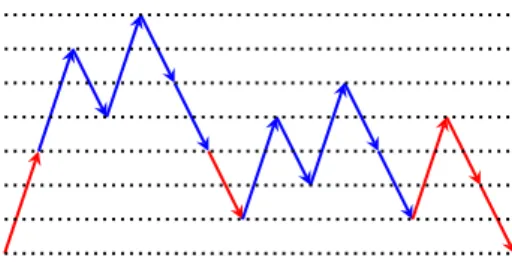
Example 1. Let Σ ={α, β} and A = {a = (+3, α), b = (−2, α), a′= (+3, β), b′=
(−2, β)}. The word ababb is a factor-free Dyck word over A, a(a′b′a′b′b′)b (a′b′a′b′b′)
abb (see Figure 1) is a prime Dyck word over A which is not factor-free. The generalized Dyck shift over A is the set of bi-infinite sequences whose blocks are factors of a Dyck word over A. We denote this shift by XA. It is thus
a coded system as defined by Blanchard and Hansel [4].
Example 2. If Σ is a singleton the generalized Dyck shift is just the full shift, i.e. the set of all bi-infinite sequences over A. So the notion of generalized Dyck
shift is interesting only for alphabets Σ of size at least two.
Example 3. If Σ = {α, β} and A = {”(” = (+1, α), ”)” = (−1, α), ”[” =
(+1, β), ”]” = (−1, β)}, the shift XA is the Dyck shift with two kinds of
paren-theses.
Example 4. If Σ ={α, β} and A = {a = (+3, α), b = (−2, α), a′ = (+3, β), b′ =
(−2, β)}, for instance the sequences · · · bbb.aaaa · · · ,ω(aba′b′abbaba′b′b′abb)ω
be-long to XA.
Fig. 1.The prime Dyck word a(a′b′a′b′b′)b(a′b′a′b′b′)abb of Example 1. Symbols a or
a′ are represented by up edges while symbols b or b′ by down edges according to the
height of the symbols. Symbols in Aα (resp. Aβ) are represented by red (resp. blue)
edges.
Following Duchon [6] we set m = maxa∈A+h(a), n =− mina∈A−h(a). We
define for α∈ Σ, i > 0, j > 0,
– ˜Li,αthe set of factor-free words w∈ A+α with height i such that each proper
prefix w1 of w has a height h(w1) > i.
– ˜Rj,α the set of factor-free words w ∈ A+α with height −j such that each
proper prefix w1 of w has a height h(w1) > 0.
– Li,α1 the set of nonempty words w = a1d1a2· · · dk−1ak with k≥ 1, di ∈ D,
a1a2. . . ak ∈ ˜Li,α.
1 The definition of L
– Rj,α the set of nonempty words w = a1d1a2· · · dk−1ak with k≥ 1, di∈ D,
a1a2. . . ak ∈ ˜Rj,α.
– Pα the set of nonempty words w = a1d1a2· · · dk−1ak with k ≥ 1, di ∈ D,
a1a2. . . ak ∈ ˜Dα.
We set Li = SαLi,α, Rj = SαRj,α, L = Smi=1Li, R = Snj=1Rj. Note that
a word in Li,α or Rj,β does not end nor start with a nonempty Dyck word by
definition.
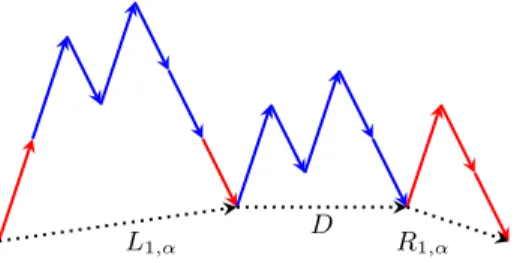
In terms of lattice paths, Li,αis a set of paths that start in (0, 0) and end on
the line y = i without having a step ending on or under this line before the last step. The set Rj,α is a set of paths that start in (0, 0) and end on the level−j
without having a step ending on or going below the line y = 0 before the last step (see Figure 2).
L1,α D R1,α
Fig. 2.The prime Dyck word a(a′b′a′b′b′)b(a′b′a′b′b′)abb of Example 1 in L
1,αDR1,α.
By definition Li,α and Rj,α are codes which are both prefix and suffix. The
set Li,αdoes not overlap strictly with Lj,α. Indeed, if uv∈ Li,αand vw∈ Lj,α,
h(v) < 0 unless v is the empty word or v = uv. A word of Li,αis neither prefix
nor suffix of a word in Lj,β with α 6= β. Observe also that Li,α is empty for
i > m and Rj,α is empty for j > n.
Lemma 1. We have the following unambiguous grammars for Li, Rj, P :
˜ Li,α= X h(a)=i,c(a)=α a +X k>i ˜ Lk,αR˜k−i,α (1) ˜ Rj,α= X h(a)=−j,c(a)=α a +X k ˜ Lk,αR˜k+j,α (2) ˜ Dα= X h(a)=0,c(a)=α a +X k ˜ Lk,αR˜k,α (3) Li,α= X h(a)=i,c(a)=α a +X k>i Lk,αDRk−i,α (4) Rj,α= X h(a)=−j,c(a)=α a +X k Lk,αDRk+j,α (5)
Pα= X h(a)=0 a +X k Lk,αDRk,α (6) P =X α Pα, D = P∗, Li= X α Li,α, Rj = X α Rj,α. (7)
Proof. We have ˜Li,αR˜j,β with α 6= β forbidden in ˜Li,α, ˜Rj,α, ˜Dα. We have
˜
Lk,αR˜k−i,α ⊆ ˜Li,α for any k > i. If w ∈ ˜Li,α, if |w| > 1, let u be the unique
proper prefix of w such that h(u) is minimal. Let h(u) = k > i and w = uv. Then u∈ ˜Lk,α and v∈ ˜Rk−i,α. Further, if uv = u′v′ with u∈ ˜Lk,α, v∈ ˜Rk−i,α,
u′
∈ ˜Lk′,α, v′∈ ˜Rk′−i,α. One has for instance u prefix of u′. Let u′ = uu”. Then
k≥ k′. If k > k′, then v /
∈ ˜Rk−i,α. Thus k = k′, u”∈ D, implying u” = ε. This
proves Equation (1). Equations (2), (3) are obtained similarly.
We have Lk,αDRk−i,α ⊆ Li,α. If w∈ Li,αand if|w| > 1 let u be the smallest
proper prefix of w such that h(u) is minimal and t be the largest proper prefix of w such that h(t) is minimal (see Figure 2). We have t = uv with v∈ D and w = uvz. Then u∈ Lk,α and z∈ Rk−i,α. Further, if uvz = u′v′z′with u∈ Lk,α,
z ∈ Rk−i,α, u′ ∈ Lk′,α, z′ ∈ Rk′−i,α, v, v′ ∈ D, then for instance u is a prefix
of u′. Assume that u is a strict prefix of u′. Let u′ = uu′′. Then k
≥ k′. If
k > k′, then vz /
∈ DRk−i,α. Thus k = k′. Then u”∈ D \ {ε}, a contradiction
since u′
∈ Lk′,αdos not end with a nonempty word of D. Thus u = u′. Similarly,
z = z′and thus v = v′. This proves Equation (4). Equations (5), (6) are obtained
similarly.
We consider the free monoid generated by A with a zero quotiented by the following relations
a1· · · ak = 1 if a1· · · ak is a factor-free Dyck word
w = 0, if w∈ ˜Li,αR˜j,β with α6= β and i, j > 0.
where 1 is the unity of the monoid.
For a word w over A, we denote by w∈ A∗
∪ {0, 1} its reduced form which is the unique word obtained by applying the above relations.
For instance ( ] reduces to 0 in the Dyck shift.
Observe that a word z in ˜Li,αR˜j,β with α6= β is not factor of a Dyck word.
Indeed, if z is a factor of a Dyck word d, it is a factor uv, where u ∈ ˜Li,α,
v∈ ˜Rj,β, of a1d1· · · akdk where di∈ D and a1· · · ak is a factor-free Dyck word.
If none aiis a factor of uv, then uv is a factor of some diwhose length is shorter
than d. By recurrence on the size of d we obtain that uv is factor of a factor-free Dyck word. Since uv∈ A+
αA+β, we get a contradiction. Observe that, since
u∈ ˜Li,α, v∈ ˜Rj,β and di∈ D for 1 ≤ i ≤ k, di cannot overlap nor be a factor of
uv unless diis the empty word. Thus if ai is factor of u or v for some 1≤ i ≤ k,
then uv = a1· · · ak and d1= d2=· · · dk−1= ε. This gives a contradiction since
uv∈ A+ αA
+
β with α6= β and a1· · · ak∈ A+γ for some γ.
The set of words reducing to 1 is the set of Dyck words. If two Dyck words overlap, the overlapping word is a Dyck word: if uv and vw are Dyck words,
then u, v, w also. Dyck words. Thus if uv and vw reduce to 1, then u, v, w also. Further, a factor-free word has no suffix being a prefix of a word in ˜Li,αR˜j,β
with α6= β. Hence a word reducing to 1 has no non trivial overlap with a word reducing to 0. As a consequence the reduced form is unique.
Proposition 1. The reduced form of a word w is either 0, 1, u, v or uv where
u∈ ˜Rjs,βs· · · ˜Rj1,β1
v∈ ˜Li1,α1· · · ˜Lir,αr
for some j1, . . , js, i1, . . , ir> 0 and β1, . . , βs, α1, . . , αr∈ Σ.
Proof. Assume that w6= 0, 1. Let u be the unique prefix of w of minimal height,
the unicity coming from the fact that w is reduced. This prefix may be the empty word. We set w = uv. Then v has a unique decomposition into ˜Li1,α1· · · ˜Lir,αr
where i1+· · · + is= i with h(v) = i > 0. Indeed let z be the unique nonempty
prefix of v such that h(z) = i1 is minimal. The prefix z being reduced, it is
a factor-free word. As z does not contain any factor in ˜Li,αR˜j,β with α 6= β,
i, j > 0, z∈ ˜Li1,α1 for some α1∈ Σ. The whole decomposition of v thus belongs
to ˜Li1,α1· · · ˜Lir,αr where i1+· · · + ir= i. A symmetrical property holds for u.
Let uv∈ ˜Rjs,βs· · · ˜Rj1,β1L˜i1,α1· · · ˜Lir,αr. Then uv6= 0. Indeed, if uv contains
a factor z in ˜Li,αR˜j,β with α 6= β and i, j > 0, then z = tt′ where t ∈ ˜Li,α
and t′
∈ ˜Rj,β. Since t cannot be a suffix of some word in ˜Rjk,βk· · · ˜Rjk′,βk′ it
is a suffix of some word in ˜Rjs,βs· · · ˜Rj1,β1L˜i1,α1· · · ˜Lik′,αk′ and t
′ cannot be
a prefix of a word in ˜Lik′ +1,αk′ +1· · · ˜Lir,αr. Thus uv 6= 0. Further a word in
˜
Li,αR˜j,β with α6= β and i, j > 0 is not factor of a Dyck word, thus 0 6= 1.
Words whose reduced form is either 1 or u (resp. v) as above are called
call (resp. return). The set of call (resp.
matched-return) words is denoted by MC(X) (resp. MR(X)). Thus matched-call words are sequences of words in R+D and mached-return words are sequences of words in L + D.
Example 5. For instance, the reduced form of the word ”) ( ( ) [ [ ] ] [” in the Dyck
shift with two kinds of parentheses is ”) ( [”. We have u =) in ˜R1,α and v = ( [
in ˜L1,αL˜1,β. In the shift of Example 1, the word ba(a′b′a′b′b′)ba has the reduced
form b(ab)a∈ ˜R2,αL˜1,αL˜3,α.
Proposition 2. The generalized Dyck shift is the set of sequences avoiding the factors whose reduced form is 0.
Proof. First a word whose reduced form is 0 is not factor of a Dyck word.
Con-versely let w be a word over A. Its reduced form is either 0, 1 or u, v, uv with u∈ X = ˜Rjs,βs· · · ˜Rj1,β1 and v∈ Y = ˜Li1,α1· · · ˜Lir,αr. Hence it is nonnull if and
only if it is a factor of a Dyck word. Indeed any word in X, Y or XY is factor of a Dyck word since (( ˜Liβ1,β1)
j1( ˜R j1,βs) iβ1−1)· · · (( ˜L iβs,βs) js ( ˜R js,βs) iβs−1) X ⊆ D, Y (( ˜Lir,αr) jαr−1 ( ˜R jαr,αr) ir)· · · (( ˜L i1,α1) jα1−1( ˜R jα1,α1) i1) ⊆ D and ˜Liβ1,β1, . . . , ˜
Example 6. We continue with Example 4. Setting in this example Li = Li,α,
Ri= Ri,α, and L′i = Li,β, Ri′ = Ri,β, ri= RiD, ℓi= LiD, we have
L3= a L′3= a′ L2= L3DR1= aDR1 L′2= a′DR′1 L1= L2DR1+ L3DR2 L′1= L ′ 2DR ′ 1+ L ′ 3DR ′ 2 R2= b R′2= b′ R1= L1DR2= L1Db R′1= L′1Db′ P = L1DR1+ L2DR2+ L1′DR′1+ L′2DR′2
Thus R1 = L1Db = (aDR1DR1+ aDb)Db = aD((R1D)2 + bD)b. We can
set U bD = (R1D)2 + bD since R1 ∈ A∗b. We get r1 = R1D = ℓ1bD =
(aD)U (bD)(bD), ℓ1= (aD)U (bD). We have R1D = (aD)U (bD)(bD) = (aD)((R1D)2+ bD)bD = (aD)(aDU bDbDaDU bDbD + bD)bD. Thus U = ε + (aD)U (bD)(bD)(aD)U (bD). Similarly, R′ 1D = (a′D)V (b′D)(b′D) V = ε + (a′D)V (b′D)(b′D)(a′D)V (b′D). We have
P D = (aD)U (bD)(aD)U (bD)(bD) + (aD)(aD)U (bD)(bD)(bD)+ (a′D)V (b′D)(a′D)V (b′D)(b′D) + (a′D)(a′D)V (b′D)(b′D)(b′D).
The right symbol D in all the above equations may be removed by right multi-plication of both sides by (1− P ) which is the inverse of D.
4
Zeta function of generalized Dyck shifts
4.1 Multivariate zeta functions
We recall the notion of multivariate zeta function introduced by Berstel and Reutenauer in [3], [14].
For K = Z or K = N (containing 0) we denote by KhhAii the set of noncom-mutative formal power series over the alphabet A with coefficients in K. For each language L of finite words over a finite alphabet A we define the characteristic
Let K[[A]] be the usual commutative algebra of formal power series in the variables of A and π : KhhAii → K[[A]] be the natural homomorphism. Let S be a commutative or noncommutative series. One can write S =Pn≥0[S]n where
each [S]n is the homogeneous part of S of degree n. The notation extends to
matrices H with coefficients in KhhAii or K[[A]] with ([H]n)pq = [Hpq]n, where
p, q are indices of H.
Call periodic pattern of a shift X a word u such that the bi-infinite concate-nation of u belongs to X and denote P(X) the set of periodic patterns of X. These definitions are extended to σ-invariant sets of bi-infinite sequences which may not be shifts.
The multivariate zeta function Z(X) of a σ-invariant set X is the commuta-tive series in Z[[A]]
Z(X) = expX
n≥1
π[P(X)]n
n .
The (ordinary) zeta function of a σ-invariant set X is ζX(z) = exp X n≥1 pn zn n,
where pn is the number of sequences of X of period n, i.e. of sequences x such
that σn(x) = x.
Let θ : Z[[A]]→ Z[[z]] be the homomorphism such that θ(a) = z for any letter a ∈ A. If S ∈ Z[[A]], θ(S) will also be denoted by S(z). Note that ζX(z) =
θ(Z(X)).
It is known that the multivariate zeta function of a shift has nonnegative integer coefficients [12].
4.2 Encoding of periodic sequences of a generalized Dyck shift We say that two finite words x, y are conjugate if x = uv and y = vu for some words u, v.
If C is a code, we denote by XC the σ-invariant set containing all bi-infinite
concatenation of words in C. This set is not a shift since it may not be closed. The following proposition gives an encoding of the periodic patterns of a generalized Dyck shift.
Proposition 3. Let X be the generalized Dyck shift over A. The set of periodic patterns P(X) of X is
P(X) = P(XDL)⊔ P(XR+P).
Proof. Let z be a periodic pattern. Then x =· · · zz.zz · · · is a periodic sequence
of X. The reduced form of z is z = 1, u, v or u· v where u∈ ˜Rjs,βs· · · ˜Rj1,β1
If z is not already in MC(X) or in MR(X), then its reduced form is uv. In this case z has a conjugate z′whose reduced form is the reduced form of vu. We have
vu∈ ˜Li1,α1· · · ˜Lir,αrR˜js,βs· · · ˜Rj1,β1.
Since· · · z′z′.z′z′
· · · ∈ X, we have αr= βs, and ˜Lir,αrR˜js,βsis included in either
Lir−js,αror Rjs−ir,αror D. In the first case, αr= βs−1and Lir−js,αrR˜js−1,βs−1is
then included in either Lir−js−js−1,αr or Rjs−1−(ir−js),αror D. In the second case
αr−1 = βs and ˜Lir−1,αr−1Rjs−ir,αr is then included in either Ljs−ir−ir−1,αr or
Rir−1+ir−js,αr or D. In the third case, αr−1 = βs−1 and ˜Lir−1,αr−1D ˜Rjs−1,αr−1
is then included in either Lir−1−js−1,αr−1 or Rjs−1−ir−1,αr−1 or D. By
iterat-ing the reduction, we get that vu is included in some product equal to either Lk1,γ1. . . Lkn,γn or Lk1,γ1. . . Lkn,γnD or Rkn,γn. . . Rk1,γ1 or DRkn,γn. . . Rk1,γ1
or D. This product vu is thus either in MC(X) or in MR(X).
If z′ is matched-call, then it is a product of words in P or in R. In this case
z is conjugate to a word in (P + R)∗.
If z′ is matched-return and not matched-call, i.e. z′ /
∈ D, we can assume that it does not end with a Dyck word (if z′ = uw with w Dyck, we could consider wu
instead). In that case it is a product of words in P∗L = DL and z is conjugate
to a word in (DL)∗. As a consequence
P(X) = P(XDL)⊔ P(XR+P).
Let us finally show thatP(XDL)∩ P(XR+P) =∅. Assume the contrary. Then
there are nonempty conjugate words w, w′ such that w is in (DL)∗ and w′ is in
(R + P )∗.
This implies that the height of w is positive and the height of w′ is
nonposi-tive, contradicting the conjugacy of w and w′.
4.3 Computation of the zeta function
We recall below the notion of circular codes (see for instance [2]). We say that a subset S of nonempty words over A is a circular code if for all n, m≥ 1 and x1, x2, . . . , xn ∈ S, y1, y2, . . . , ym ∈ S and p ∈ A∗ and s ∈ A+, the equalities
sx2x3· · · xnp = y1y2· · · ym and x1 = ps imply n = m, p = ε and xi = yi for
each 1≤ i ≤ n.
Two codes C1and C2are cyclically disjoint if a word of C1∗which is conjugate
to a word of C∗
2, is empty.
Proposition 4. The sets DL and P⊔ R are cyclically disjoint circular codes. Proof. We first show that R⊔P is circular. Keeping the notation of the definition,
let x1, x2, . . . , xn ∈ S, y1, y2, . . . , ym∈ S, p ∈ A∗and s∈ A+. We prove the claim
by induction on n + m. Suppose that sx2x3· · · xnp = y1y2· · · ym and x1 = ps
imply n = m and xi = yi when n + m < N . Assume now that sx2x3· · · xnp =
y1y2· · · ymand x1= ps for some n, m with n + m = N .
If p was nonempty, then, since x1= ps where s6= ε, we have h(p) > 0. This
would contradict p being a suffix of y1y2· · · ym, which is clearly matched-call,
hence we get p = ε. It follows that x1is a prefix of y1 or the converse, implying
Let us show that P∗L is circular. Let us assume that s
6= x1. Since s is a
prefix of y1y2· · · ymand is a suffix of x1, we have s∈ P∗L and p∈ P∗. As p6= ε,
p∈ P+. This contradicts the fact that p is a suffix of y
1· · · ym. Hence s = x1
and p = ε. Now x1· · · xn = y1y2· · · ym implies x1 = y1 since xi, yi ∈ P∗L. By
induction hypothesis we get n = m and xi= yi.
We now show that DL and P + R are cyclically disjoint. Let u∈ (DL)∗ and
v∈ (P + R)∗ such that u and v are two nonempty conjugate words. This implies
that the height of u is positive and the height of v is nonpositive, contradicting the conjugacy of u and v.
Proposition 5. Let X be a generalized Dyck shift over A. The multivariate zeta function of X has the following expression.
Z(X) = π((DL)∗(P + R)∗).
Proof. From Proposition 3 we get that the multivariate zeta function of X is
Z(X) = Z(XDL)Z(XP+R).
From [15, Proposition 4.7.11] (see also [2, Proposition 3.1],[8]), if C is a circular code Z(XC) = π(C∗). The result follows from the fact that DL and
P + R are circular codes.
Example 7. We consider the Dyck shift X with two kinds of parentheses of
Example 3 defined by Σ ={α, β} and A = {”(” = (+1, α), ”)” = (−1, α), ”[” = (+1, β), ”]” = (−1, β)}. Setting a = ”(”, b = ”)”, a′= ”[”, b′ = ”]′′, L 1= L1,α, L′1= L1,β, R1= R1,α, R′ 1= R1,β, we have L1= a L′1= a′ (8) R1= b R′1= b′ (9) P = L1DR1+ L′1DR′1= aDb + a′Db′ (10) D = 1 + P D = 1 + aDbD + a′Db′D (11) Thus Z(X) = π((D(a + a′))∗ (b + b′+ aDb + a′Db′)∗),
where D is defined by Equation 11. A computation gives the formula of Keller for ζX(z) [8]:
ζX(z) =
2(1 +√1− 8z2)
(1− 4z +√1− 8z2)2.
Example 8. We consider the shift XA defined by Σ = {α, β} and A = {a =
(+2, α), b = (−1, α), a′= (+2, β), b′ = (
−1, β)}.
Setting Li= Li,α, L′i= Li,β, and Ri= Ri,α, R′i= Ri,β, we have
L2= a L′2= a
′ (12)
R1= b R′1= b′ (13)
P = L1DR1+ L′1DR′1= aDbDb + a′Db′Db′ (15)
D = 1 + P D = 1 + aDbDbD + a′Db′Db′D (16)
Thus
Z(X) = π((D(aDb + a′Db′+ a + a′))∗ (b + b′+ aDbDb + a′Db′Db′)∗),
where D is defined by Equation 16.
Let S be a multivariate series in NhhAii. We denote by < S, u > the coefficient of a word u in S. We say that S is N-algebraic if S− < S, ε > ε is the multivariate generating series of some unambiguous context-free language. The multivariate zeta function of a shift is N-algebraic if it is the commutative image of some mul-tivariate N-algebraic series. In one variable, a series S(z) is N-algebraic if it is the first component (S1(z)) of a system of equations Si(z) = Pi(z, S1(z), . . , Sr(z)),
where 1≤ i ≤ r and Pi are multivariate polynomials with coefficients in N (see
for instance [5]).
Corollary 1. The multivariate zeta function of a generalized Dyck shift is the commutative image of a product of the generating series of the stars of unam-biguous context-free circular codes, the codes being cyclically disjoint. The mul-tivariate and ordinary zeta functions of a generalized Dyck shift are N-algebraic series.
Proof. The result follows from Proposition 5 and the fact that DL and P ∪ R are unambiguous context-free circular codes since the languages P, Li,α, Rj,β are
unambiguous context-free. Further DL and P∪ R are cyclically disjoint.
References
1. M.-P. B´eal, M. Blockelet, and C. Dima. Sofic-Dyck shifts. Theor. Comput. Sci., 609:226–244, 2016.
2. J. Berstel, D. Perrin, and C. Reutenauer. Codes and Automata, volume 129 of Encyclopedia of Mathematics and its Applications. Cambridge University Press, Cambridge, 2010.
3. J. Berstel and C. Reutenauer. Zeta functions of formal languages. Trans. Amer. Math. Soc., 321:533–546, 1990.
4. F. Blanchard and G. Hansel. Syst`emes cod´es. Theor. Comput. Sci., 44:17–49, 1986. 5. M. Bousquet-M´elou. Rational and algebraic series in combinatorial enumeration. In International Congress of Mathematicians. Vol. III, pages 789–826. Eur. Math. Soc., Z¨urich, 2006.
6. P. Duchon. On the enumeration and generation of generalized Dyck words. Discrete Mathematics, 225(1-3):121–135, 2000.
7. H. Jacquet and G. M´elan¸con. Langages de Dyck g´en´eralis´es et factorisations du monoide libre. Ann. Sci. Math. Qu´ebec, (97):103–122, 1997.
8. G. Keller. Circular codes, loop counting, and zeta-functions. J. Combin. Theory Ser. A, 56(1):75–83, 1991.
9. W. Krieger. On the uniqueness of the equilibrium state. Math. Systems Theory, 8(2):97–104, 1974/75.
10. W. Krieger and K. Matsumoto. Zeta functions and topological entropy of the Markov-Dyck shifts. M¨unster J. Math., 4:171–183, 2011.
11. J. Labelle and Y. Yeh. Generalized Dyck paths. Discrete Mathematics, 82(1):1–6, 1990.
12. D. Lind and B. Marcus. An Introduction to Symbolic Dynamics and Coding. Cam-bridge University Press, CamCam-bridge, 1995.
13. K. Matsumoto. On the simple C∗-algebras arising from Dyck systems. J. Operator
Theory, 58(1):205–226, 2007.
14. C. Reutenauer. N-rationality of zeta functions. Adv. in Appl. Math., 18(1):1–17, 1997.
15. R. P. Stanley. Enumerative Combinatorics. Wadsworth Publ. Co., Belmont, CA, USA, 1986.