Publisher’s version / Version de l'éditeur:
Canadian Journal of Civil Engineering, 3, 2, pp. 165-173, 1976-06
READ THESE TERMS AND CONDITIONS CAREFULLY BEFORE USING THIS WEBSITE.
https://nrc-publications.canada.ca/eng/copyright
Vous avez des questions? Nous pouvons vous aider. Pour communiquer directement avec un auteur, consultez la première page de la revue dans laquelle son article a été publié afin de trouver ses coordonnées. Si vous n’arrivez pas à les repérer, communiquez avec nous à [email protected].
Questions? Contact the NRC Publications Archive team at
[email protected]. If you wish to email the authors directly, please see the first page of the publication for their contact information.
NRC Publications Archive
Archives des publications du CNRC
This publication could be one of several versions: author’s original, accepted manuscript or the publisher’s version. / La version de cette publication peut être l’une des suivantes : la version prépublication de l’auteur, la version acceptée du manuscrit ou la version de l’éditeur.
Access and use of this website and the material on it are subject to the Terms and Conditions set forth at
Vibration criteria for long-span floors
Allen, D. E.; Rainer, J. H.
https://publications-cnrc.canada.ca/fra/droits
L’accès à ce site Web et l’utilisation de son contenu sont assujettis aux conditions présentées dans le site LISEZ CES CONDITIONS ATTENTIVEMENT AVANT D’UTILISER CE SITE WEB.
NRC Publications Record / Notice d'Archives des publications de CNRC:
https://nrc-publications.canada.ca/eng/view/object/?id=cda03e19-8250-4ac2-8e1c-587ec3ef030f https://publications-cnrc.canada.ca/fra/voir/objet/?id=cda03e19-8250-4ac2-8e1c-587ec3ef030f' N;.
no.
C I N A T I O N A L R E S E A R C H C O U N C I L O F C A N A D A C O N S E I L N A T I O N A LD E
R E C H E R C H E S D U C A N A D AI-
IVIBRATION CRITERIA FOR LONGSPAN FLOORS
I
1 DBR
Paper
No. 668DIVISION
OF
BUILDINGRESEARCH
.
-Price 25 cents O'ITAWA
NRCC 15207
Reprinted from
CANADIAN JOURNAL OF CIVIL ENGINEERING
vol. 3, NO. 2, June 1976
BU;LC?::C
RESEARCH
-
WBRARY
NOV
1
MAT~DHM. R * ~ ~ 9 P. L-Canadian Journal of Revue
canadienne
, ? u ~ E ~
Civil Engineering
de
genie civil
Published by Publike par
THE NATIONAL RESEARCH COUNCIL OF CANADA LE CONSEL NATIONAL DE RECHERCHES DU CANADA
Volume 3 Number 2 June 1976 Volume 3 numCro 2 juin 1976
Vibration criteria for long-span floors
D. E. ALLEN' A N D J . H. RAINER*
Division of Building Research, National Research Council of Canada, Ottawa, Canada K I A OR6 Received July 30, 1975
Accepted December 23, 1975
Annoyance criteria are derived for walking vibrations of long-span floors. The criteria are developed primarily for steel beam or joist construction with concrete deck, spans greater than about 25 St (8 m) and natural frequencies less than about 10 Hz. The criteria are expressed in terms of the dynamic properties of a floor as measured by a heel impact test. The advantage of the heel impact test is that it provides a tool for design calculation.
Les auteurs obtiennent des criteres de nuisance pour les vibrations dues aux pas dans les planchers degrande portee. Les criteres se rapportent surtout aux constructions de poutres ou de solives d'acier avec un tablier de beton, des travees de plus de 25 pieds (8 m) environ et des frequences naturelles de moins de 10 Hz environ. Les criteres sont exprimes en fonction des caracteristiques dynamiques d'un plancher mesurees par un essai d'impact de talon, qui offre I'avantage d'Ptre un instrument de calcul.
Can. J. Civ. Eng., 3. 165 (1976)
I Introduction
! Floors vibrate when people walk on them.
These vibrations have been controlled in the past for conventional building floors by well- known stiffness criteria such as limiting the deflection under live load to span/360 or limit-
# ing the ratio of span to depth of a supporting
steel beam to 20. Recently, however, excessive footstep vibrations have occurred for long-
!
span steel beam or joist floors with a concrete deck used in conjunction with open floor plans, free of partitions. The traditional stiffness cri- teria have been found inapplicable to these floors because they are not related to the mo- tion of the floor which a person feels. Existing criteria also neglect damping-a structuralI property that has been found to be the most
'Building Structures Section.
I
'Noise and Vibration Section.
I
significant one affecting the performance of long-span floors to walking vibrations.
This paper presents annoyance criteria for walking vibrations for long-span floors in terms of floor acceleration and damping. The criteria were developed for CSA Standard S16.1-1974 (Steel Structures for Buildings- Limit States Design) and are contained in Appendix G to the standard. The suggested criteria, which are an extension to those pre- sented by Lenzen (1966), are based on the experience of various investigators with long- span floors. Because of limited data the criteria are proposed only on an interim basis.
The criteria for acceptable floor vibrations presented here are intended for normal 'quiet' human occupancies, i.e. residences, offices, and schoolrooms. More stringent criteria may be required for sensitive occupancies such as hospital operating rooms and laboratories, and
166 CAN. J. CIV. ENG. VOL. 3, 1976
less stringent criteria for manufacturing work areas, footbridges, dance halls, gymnasia, and similar occupancies.
Criterion for Continuous Vibrations
Continuous vibrations considered here are those that persist at a reasonably constant am- plitude and frequency for a short duration, ap- proximately 10 to 30 cycles. Such vibrations can arise from dancing, regular jumping, or street traffic. Continuous vibration for hours caused by machinery will require a more severe criterion for the same type of occupancy.
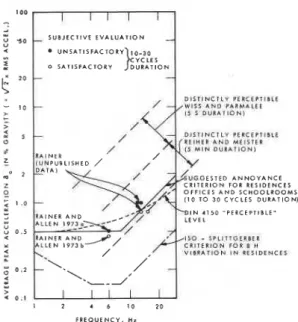
Figure 1 shows ranges of perception and criteria for continuous vibration presented by various investigators: (a) the 'distinctly per- ceptible' range for vibrations of 5 min duration by Reiher and Meister (1931) ; ( b ) the 'dis- tinctly perceptible' range for vibrations of 5 s duration by Wiss and Parmelee (1974) ; (c) 'perceptible' level of building vibrations given in the German Standard DIN 4150; (d) cri- terion suggested by Splittgerber based on a modification of International Standard I S 0 2631 curve for an 8 h exposure (Galambos et al. 1973). Also shown in Fig. 1 is the authors' proposed annoyance criterion for residences, offices and schoolrooms (10 to 30 cycles), which is based primarily on the data points for three case studies.
U N S A T I S F A C T O R Y 1 0 - 3 0 D h T A I
1
3
C R I T E R I O N G O E S FOR A N N O Y A N C E RESIDENCES O F F I C E S A N D S C H O O L R O O M S ( 1 0 TO 3 0 CYCLES D U R A T I O N ) HAINER A N D I N 4 1 5 0 'PERCEPTIBLEm A L L E N 1 9 7 9 - A - - - * - - / LEVEL /FIG. 1. Human response criteria for continuous
vibration.
A comparison of the various levels of per- ception and criteria in Fig. 1 shows the same general trend, but little agreement among the various sources. These differences can be at- tributed to: different vibration durations (10 cycles to 8 h ) ; different occupancies (e.g. office vs. manufacturing); and different meth- ods of testing and evaluating the results. It has been the authors' experience that continu- ous vibrations in 'quiet' human occupancies cause annoyance when they begin to be dis- tinctly perceptible. The proposed annoyance criterion approaches the lower bound of the Reiher and Meister 'distinctly perceptible' range.
Criteria for Walking Vibrations
If a person walks across a floor, vibrations are initiated at approximately
3
s intervals. Experience with long-span floors has shown that the higher modes of vibration need not be considered because they die out quickly and do not cause discomfort. If the floor vibrating in one or more of its lower modes has little damping, the induced vibrations merge to- gether resulting in an almost continuous mo- tion. The resulting degree of discomfort can be estimated by comparing peak accelerations due to walking with those corresponding to the proposed annoyance criterion in Fig. 1. There are, however, two shortcomings in this ap- proach. The first is that the damping is usually sufficient to prevent continuity of motion. The second, that although such a procedure could be used in a performance test of a built floor system, it is not amenable to design calcula- tion.In order to overcome these difficulties the heel impact test will be used to evaluate the dynamic properties of long-span floors. These properties will then be correlated with subjec- tive evaluations from which performance cri- teria will subsequently be derived. The heel impact test not only provides a means of evaluating floor performance but can also be modelled analytically to provide a loading function for design. The test is as follows:
A person weighing approximately 170 lb
(760 N) supports his weight on the balls of his feet with the heels raised about 2.5 in. (64 mm), then suddenly drops his weight on his heels to the floor.
ALLEN Ab ID RAINER 167 A typical acceleration trace of the resulting
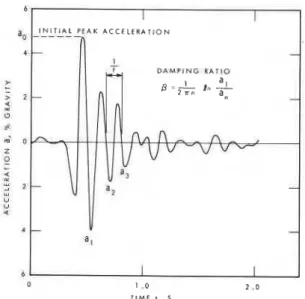
floor response is shown in Fig. 2. The signal has been filtered so that only the vibrations of the fundamental mode are retained, since, as stated above, the higher modes die out quickly and do not cause discomfort.
The following parameters, shown in Fig. 2, can be determined from the response curve: natural frequency ( f )
,
damping ratio (P),
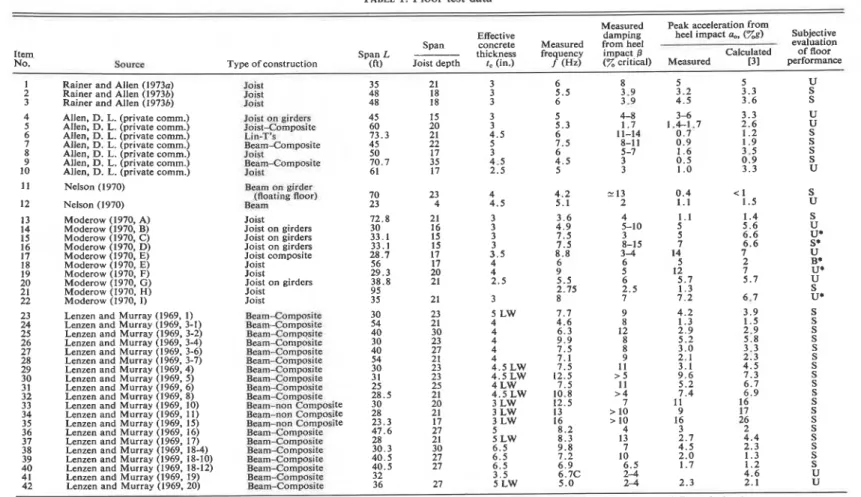
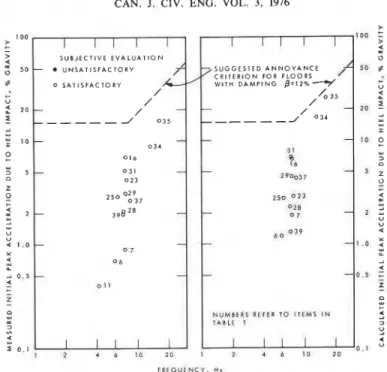
and initial peak acceleration (4). While the re- sponse curve is usually quite regular, some floors will produce a more irregular response, and their interpretation will require some judgement.Table 1 gives field' data from various investi- gators on the response of long-span steel and concrete floors to heel impact as well as their subjective evaluation for walking vibrations. The floors have been grouped. according to the damping ratios measured during heel impact tests as follows: /3
<
4% ; 4%<
P
< 8%
; ,8>
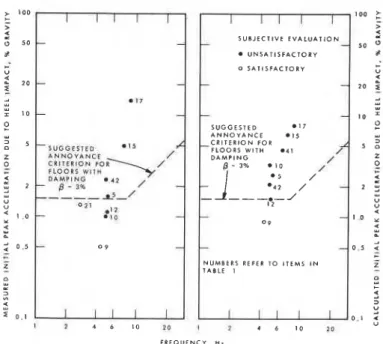
8 % . For each group, measured peak ac- celerations from heel impact are plotted in Figs. 3, 4, and 5 along with subjective evalua- tion of the floors to walking vibration. The data are also plotted in terms of peak accelera- tions calculated by a method described later.The data in Figs. 3, 4, and 5 indicate: ( 1 ) a good correlation between initial peak ac- celeration from heel impact and acceptability to footstep vibrations within a range of damp-
0 1 .o 2.0
TIME t , 5
FIG. 2. Typical floor response to heel impact (high frequencies filtered out).
ing; and ( 2 ) a strong dependence of accept- ability to footstep vibrations on damping. Cri- teria for 3, 6, and 12% damping, shown by the dashed lines, were estimated by shifting the curve for continuous vibration in Fig. 1 up to fit the data; the peak accelerations associated with the criteria are respectively 3, 10, and 30 times the level for continuous vibrations. The criterion for 6% damping agrees with the cri- terion of Lenzen (1966), who multiplied the Reiher and Meister curves for continuous vi- bration by 10 to obtain curves for finished floor systems without partitions (where
p
-
6% above) when using the heel impact test.The strong dependence of acceptable floor acceleration on damping, first shown by Len- Zen (1966), does not at first appear to be borne out by human response to isolated tran- sient vibrations. Wiss and Parmelee (1974) found a much weaker dependence of accept- able peak acceleration on damping for an isolated transient vibration. The reason for this, however, may be due to the fact that for low damping, the vibrations from walking propagate readily and merge together to pro- duce a nearly continuous motion, which is very annoying to those in quiet situations. The heel impact test, which produces an isolated tran- sient vibration, should therefore be viewed as providing a correlation between certain dy- namic floor properties and acceptability of walking vibrations, not as a direct simulation of the problem.
The suggested criteria for long-span floors do not apply to lighter short-span floors. For short-span floors the persons involved, both the one causing and the one feeling the vibra- tion, interact with the floor to damp out the vibration quickly. For these floors, the motion due to static deflections of the walker has more effect on human response than the transient vibrations in the fundamental mode; static de- flection criteria under concentrated load there- fore appear to be more appropriate in these cases.
The criteria for continuous vibration and for walking, which apply to long-span floors in 'quiet' occupancies, are summarized in Fig. 6.
Prediction of Performance by Design Calculation
TABLE 1. Floor test data Effective concrete thickness t. (in.) Measured damping from heel impact B (% critical)
Peak heel acceleration impact 4, (Y&) from Calculated Measured [31 Subjective evaluation of floor performance u S S Measured frequency f (Hz) Span Span L --- (ft) Joist depth 35 21 48 18 48 18 Item
No. Source T v ~ e of construction
Joial Joist Joist Allen, D. L. (private comm.)
Allen, D. L. (private cornm.) Allen, D. L. (private comrn.) Allen. D. L. lorivate comm.)
Joist on girders J o i s r ~ m p s i t t L!n-T's Beam-Compositc Jnist Bcam-Composite Joist
Allen, D. L. (brivate cornrn.) Allen, D. L. (pr~vale cornrn.) Allen, D. L. (private comrn.) 11 Nelson (1970) 12 Nelson (1970) Beam on girder {floating floor) 70 23 4 4.2 ~ 1 3 0.4 < 1 S Beam 23 4 4.5 5 . 1 2 1.1 1.5 U Joist Joist on girders Joist on girders Joist on girders Joist composite Joist Joist Joist on girders Joist Joist Moderow (1970, A) Moderow (1970, B) Moderow (1970, C) Moderow (1970, D) Moderow (1970, E) Moderow (1970, E) Moderow (1970, F) Moderow (1970, G ) Moderow (1970, H) Moderow (1970, 1) Lenzen and Lenzen and Lenzen and Lenzen and Lenzen and Lenzen and Lenzen and Lenzen and Lenzen and Lenzen and Lenzen and Lenzen and Lenzen and Lenzen and Lenzen and Lenzen and Lenzen and Lenzen and Lenzen and Lenzen and Bcam-Compmite ReamCornpaitc Bcam-Composite Beam-Cornposfle Bcarn<on~ws~te Beom-Compouite ~ e a m ~ o m p o a ~ l c Bcam-Compos~te Heam-Comnowie Bcam-Compuslre Ream-non C o r n m l t e Beam-non Composite lleamnon Composite Bcnm-Composrte Beam-Compusrrc li:amCompon~lc Bcom-Compoa~le FlcnniGmrws~tc Bcam-Composrle I l e a ~ o r n p c l s r l c ~ u r r a y (1969; Murrav (1969. ~ u r r a y (1969; Murray (1969. Murray (1969, Murray (1969, Murray (1969, Murray (1969, Murray (1969, Murray (1969, Murrav (1969. ~ u r r a i (1969; Murray (1969, Murray (1969, Murray (1969, I Murray (1969, - -
evaluation inferred from test report, LW = lightweight concrete, and C = calculated.
- -
ALLEN AND RAINER
FIG. 3. Heel impact tests of floors: damping j3 < 4 % .
H U M A N R E S P O N S E D I S T I N C T L Y S U Q J E C T I V E E V A L U A T I O N PERCEPTIBLE ( L E N Z E N I - U N S A T I S F A C T O R Y A B O R D E R L I N E S U G G E S T E D A N N O Y A N C E 0 S A T I S F A C T O R Y C S I l t R l O N W I T H D l M F l N G 1 0 e FLOORS
-
I 0 = z - 2 z 8o040 " u N U M B E R S REFER T O I T E M S I N F R E Q U E N C Y , H ZFIG. 4. Heel impact tests of floors: damping j3 = 4 to 8%.
walking vibrations can be predicted using Fig. on steel beams or joists but the same approach
6 in terms of frequency, damping, and initial can also be used for other types of construc-
peak acceleration due to heel impact. For tion.
design these parameters are estimated as fol- (a) The natural frequency f (Hz) of sim-
CAN. J. CIV. ENG. VOL. 3, 1976
floors can be calculated from
(
= 0.00496
in SI units) I 0 0z
> 4 ; 5 0 Z + u : 2 0 5 2 ", ; t o 2 ", 3 0 z 2 2 ", 2 ", u " 4 1 . o Y 4, 2 0 , s 4-
-
- z 0 w a 3 .a 4 ",where E = modulus of elasticity of steel, psi (kN/mm2), I = moment of inertia, in.4 (mm4),
w = dead weight, lb/in. (kN/m), L = span, in. (m).
Experience has shown that the steel and concrete deck usually acts compositely under dynamic loading, even for construction not structurally designed for composite action: I in [ I ] is usually determined, therefore, on the basis of full composite action. Special con- siderations are required in determining the frequency of more complex floor systems, e.g., one-way systems supported on girders.
( b ) Damping of a floor system must be esti- mated. The following values, based on experi- ence with existing long-span concrete deck floors on steel beams or joists, are suggested: bare floor,
p
= 3% ; finished floor-with ceilings, ducts, flooring, and furniture,P
=6 % ; and finished floor with partitions,
p
=F R I Q U E H C I . H r
FIG. 5. Heel impact tests of floors: damping /3
>
8%.I I I I I S U B J E C T I V E E V A L U A I I O N
-
U N S A T I S F A C T O R Yf
0 S A T I S F A C T O R Y / /-
/-
- - - J 0 3 5 - - 0 3 1 0 1 6 0 3 1 5 --
0 2 3 2 5 0 0y37 2 - 3 9 E Z 8-
-
-
0 7 01 - - 0 1 1 t I I I I l u l l T1 2 % . Further guidance for the estimation of damping is given by Allen ( 1974).
Human beings also contribute to the damp- ing, especially for light floors as discussed pre- viously, or when there are many persons on a long-span floor.
(c) One of the advantages of the heel im- pact test is that it provides a loading function for calculating floor response; initial peak ac- celeration can be estimated as follows.
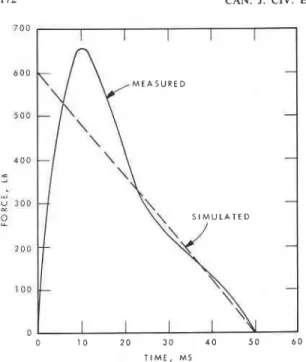
Figure 7 shows the measured force-time relationship for heel impact (Lenzen and Mur-
ray 1969). This relationship can be approxi- I mated by a triangular loading function with I
initial peak load of 600 lb (2.67 kN) lasting
I
1/20 s. For a floor system vibrating in its fundamental mode the loading function can
further be approximated by an impulse I of
4
15 lb-s (67 kN-s), provided the floor fre-quency is less than about 10 Hz. The resulting velocity k of an equivalent simple oscillator of mass M is given by
S U G G E S T E D A N N O Y A N C E , C R I E R I O N O R F L O O R S
J
W I T H D A M P I N G P ' 1 2 % 3 /
For small values of damping the initial peak acceleration, which occurs at 2 ~ f t = ~ / 2 , is
i
e 4 0 ID[
U , 4 3 5 2 - P O I-
- I 0 3 1 ", 3 - 2 9 0 0 3 7 1 5 0 0 2 3 0 2 8 - 0 7-
d o 0 J 9 - - 1-
NUMEELS l E F t U 10 I T E M 5 I N t 4 E l t I n - 5 2 !? = 4 ", ? : u U 4 ", 0:
2 - 0 . 5:
L n u + 5 3 YALLEN AND RAINER I I
I
1 I /-
/- / / /-
-
D A M P I N G R A T 1 0 g%J / / / /-
/-
/ D A M P I N G R A l I G GJ / 1 / / / /-
D A M P I N G R A 1 1 G 39b2---
-
I
I
I
I I .---
C R I T E R I A F O R W A L K I N G V I B R A T I O N S A S G I V E N BY H E E L I M P A C T TEST C R I T E R I A F O R C O N T I N U O U S V I B R A T I O N ( 1 0 T G 3 0 C Y C L E S )1
closely approximated by 0 . 1 1The mass M is determined by assuming an
isolated vibrating floor panel whose dimensions
L
correspond to the nodal lines of vibration in the fundamental mode. The width of such a
panel can be approximated byS 60 t,, where t,
I is the effective thickness4 of the concrete slab
I in inches. The weight of the steel beam or joist,
ceiling, and flooring is estimated to be 12 psf, For a deck of normal concrete, this gives a
I total mass of floor panel per ft of span of (121,
2 4 6 1 0 2 0
'For a more accurate determination, see Gaiarnbos (1973).
"For concrete on a ribbed deck the effective thick- ness is determined from the average weight of con- crete, including ribs.
F R E Q U E N C Y , H z
FIG. 6. Annoyance criteria for floor vibrations: residences, offices, and schoolrooms.
+
12) ( ( 6 0 / 1 2 ) t,) / g lb, where g is the ac-celeration due to gravity. If the response of the
floor panel in the fundamental mode is ap- proximated by a double sine wave, the lumped mass of an equivalent simple oscillator is 0.4 times the total distributed mass of the floor panel.
Thus
M = 0.4L 60 (t,
+
1 ) t,/gwhere L is span length in ft. Substitution in [2j gives
69
f
O
'
'
in SI units')(
=.zEFm
for a deck of n o d weight concrete. For
172 CAN. J . CIV. ENG. VOL. 3, 1976
T I M E , MS
FIG. 7. Average plot of force vs. time for heel im- pact (from Lenzen and Murray 1969).
lightweight concrete deck, assumed to weigh 105 lb/ft"l6.5 kN/m3), the following can be used
Table 1 compares peak accelerations com- puted by [3] with those measured in the field by various investigators. The comparison is generally quite reasonable considering that the concrete thickness t, was often not accurately known and that the intensity of heel impact varies from one tester to another.
Using the estimated values for natural fre- quency, damping, and initial peak acceleration due to heel impact, the response is compared with the suggested annoyance criteria shown in Fig. 6. If the floor is found to be unsuitable, then the designer can either increase the damp- ing ( e . g . by specifying partitions or damper posts) thereby moving up the annoyance cri- terion in Fig. 6 or by altering the floor prop- erties so as to move the peak acceleration into the acceptable region. Equation [3] shows that concrete thickness is very effective in reducing peak acceleration. For reasons given earlier,
however, [3] used in conjunction with Fig. 6 should not be applied to floors that are light (spans less than about 25 ft) or that have fre- quencies greater than about 10 Hz.
Summary and Conclusions
Annoyance criteria, shown in Fig. 6, are derived for floor vibrations for normal 'quiet' human occupancies-residences, offices, and schoolrooms. The criterion in Fig. 6 for con- tinuous vibrations is judged to be generally applicable, whereas the criteria for walking vibrations, the dashed lines in Fig. 6, are to be used only for evaluating long-span floors by means of the heel impact test or its calculated equivalent. The criteria are based on the ex- perience of various investigators with long- span steel and concrete floors.
The performance of long-span floors to walking vibrations can be estimated from a knowledge of damping and initial peak ac- celeration due to heel impact for the floor vibrating in the fundamental mode. For design of concrete deck floors on steel beams or joists, peak acceleration can be estimated by an im- pulse formula, [3], provided the span is greater than about 25 ft ( 8 m ) and the frequency is less than about 10 Hz.
An evaluation of the proposed criteria for long-span floors indicates that damping and slab thickness are effective in reducing annoy- ing walking vibrations, whereas stiffness is not. The proposed criteria are based on limited in- formation and simplifying assumptions, how- ever, and they will not guarantee satisfactory floor performance in all situations.
This paper is a contribution from the Divi-
sion of Building Research, National Research I
Council of Canada, and is published with the approval of the Director of the Division.
ALLEN, D. L. 1974. Vibrational behavior of long-span floor slabs. Can. J. Civ. Eng. 1 (I), pp. 108-115.
GALAMBOS, T. V. 1973. Vibration of steel joist-concrete slab floors. Techn. Dig. No. 5, Steel Joist Inst., Arling- ton, Va.
GALAMBOS, T. V., GOULD, P. L., RAVINDRA, M. K.,
SURYOUTOMO, H., and CRIST, R. A. 1973. Structural deflections. A Literature and State-of-the-Art Survey. Build. Sci. Ser. 47, Nat. Bureau Stand., U.S. Dep. Commer.
LENZEN, K. H. 1966. Vibration of steel joists. AISC Eng. J. 3(3) p. 133.
ALLGN AND RAINER 173 LENZEN, K. H. and MURRAY, T. M. 1969. Vibration of
steel beam concrete slab floor systems. Rep. No. 29, Univ. Kansas, Lawrence, Kan.
MODEROW, R. R. 1970. Vibration characteristics of steel joist-concrete slab floor systems. MSc thesis, Univ. Kansas Lawrence, Kan.
NELSON, F. C., 1970. Human awareness of transient floor vibration and reduction ofthis awareness by constraihed viscoelastic damping layers. Dynatech Rep. No. 920. Prepared for Am. Inst. Steel Constr. and Am. Iron Steel Inst.
RAINER, J. H. and ALLEN, D. E. 1 9 7 3 ~ . Vibration meas- urements on a steel joist floor-Montreal. Tech. Note
No. 573, Div. Build. Res., Nat. Res. Counc. Can., Ot- tawa, Can.
197%. Vibration characteristics of a dance floor. Tech. Note No. 576, Div. Build. Res., Nat. Res. Counc. Can., Ottawa, Can., (limited distribution).
REIHER, H. and MEISTER, F. J. 1931. The effect of vibra- tion on people. (in German) Forschung (VDI-Berlin), 2(1 I), pp. 381-386 (trans1.-Rep. No. F-TS-616-RE, Headquarters Air Mater. Command, Wright Field, Ohio, 1946).
Wlss, J . F. and PARMELEE, R. A. 1974. Human perception of transient vibrations. ASCE, J. Struct. Div. 100(ST4), pp. 773-787.