HAL Id: hal-00301064
https://hal.archives-ouvertes.fr/hal-00301064
Submitted on 15 May 2003HAL is a multi-disciplinary open access
archive for the deposit and dissemination of sci-entific research documents, whether they are pub-lished or not. The documents may come from teaching and research institutions in France or abroad, or from public or private research centers.
L’archive ouverte pluridisciplinaire HAL, est destinée au dépôt et à la diffusion de documents scientifiques de niveau recherche, publiés ou non, émanant des établissements d’enseignement et de recherche français ou étrangers, des laboratoires publics ou privés.
Trace gas transport in the 1999/2000 Arctic winter:
comparison of nudged GCM runs with observations
M. K. van Aalst, M. M. P. van den Broek, A. Bregman, C. Brühl, B. Steil, G.
C. Toon, S. Garcelon, G. M. Hansford, R. L. Jones, T. D. Gardiner, et al.
To cite this version:
M. K. van Aalst, M. M. P. van den Broek, A. Bregman, C. Brühl, B. Steil, et al.. Trace gas transport in the 1999/2000 Arctic winter: comparison of nudged GCM runs with observations. Atmospheric Chemistry and Physics Discussions, European Geosciences Union, 2003, 3 (3), pp.2465-2497. �hal-00301064�
ACPD
3, 2465–2497, 2003 Nudged GCM tracer transport in the 1999/2000 Arctic winter M. K. van Aalst et al.Title Page Abstract Introduction Conclusions References Tables Figures J I J I Back Close Full Screen / Esc
Print Version Interactive Discussion
c
EGU 2003
Atmos. Chem. Phys. Discuss., 3, 2465–2497, 2003 www.atmos-chem-phys.org/acpd/3/2465/
c
European Geosciences Union 2003
Atmospheric Chemistry and Physics Discussions
Trace gas transport in the 1999/2000
Arctic winter: comparison of nudged
GCM runs with observations
M. K. van Aalst1, M. M. P. van den Broek2, A. Bregman3, C. Br ¨uhl4, B. Steil4, G. C. Toon5, S. Garcelon6, G. M. Hansford6, R. L. Jones6, T. D. Gardiner7, G. J.
Roelofs1, J. Lelieveld4, and P. J. Crutzen4
1
Institute for Marine and Atmospheric Research (IMAU), Utrecht, The Netherlands
2
Space Research Organisation of the Netherlands (SRON), Utrecht, The Netherlands
3
Royal Netherlands Meteorological Institute (KNMI), De Bilt, The Netherlands
4
Max Planck Institut f ¨ur Chemie (MPI), Mainz, Germany
5
Jet Propulsion Laboratory (JPL), Pasadena, CA, USA
6
Cambridge University, Cambridge, UK
7
National Physical Laboratory (NPL), Teddington, UK
Received: 4 March 2003 – Accepted: 14 April 2003 – Published: 15 May 2003 Correspondence to: M. K. van Aalst ([email protected])
ACPD
3, 2465–2497, 2003 Nudged GCM tracer transport in the 1999/2000 Arctic winter M. K. van Aalst et al.Title Page Abstract Introduction Conclusions References Tables Figures J I J I Back Close Full Screen / Esc
Print Version Interactive Discussion
c
EGU 2003 Abstract
We have compared satellite and balloon observations of methane (CH4) and hydrogen fluoride (HF) during the Arctic winter 1999/2000 with results from the MA-ECHAM4 middle atmospheric general circulation model (GCM). For this purpose, the meteoro-logy in the model was nudged towards ECMWF analyses. This nudging technique is
5
shown to work well for this middle atmospheric model, and offers good opportunities for the simulation of realistic chemistry and transport processes. The current study focuses on transport of HF and CH4, initialized with satellite measurements from the HALOE instrument aboard the UARS satellite. We have compared the model results with HALOE data and balloon measurements throughout the winter, and analyzed the
10
uncertainties associated with tracer initialization, boundary conditions and the passive tracer assumption. This comparison shows that the model represents the Arctic vortex well, including relatively small-scale features. However, while profiles outside the vor-tex match well, the model underestimates HF and overestimates CH4 concentrations inside the vortex, particularly in the middle stratosphere. This problem is also evident
15
in a comparison of vortex descent rates based upon vortex average tracer profiles from MA-ECHAM4, and various observations, respectively. This could be due to an un-derestimate of diabatic subsidence in the model, or due to too much mixing between vortex and non-vortex air.
1. Introduction
20
The Arctic winter stratosphere is one of the main areas of interest regarding the ef-fects of increasing greenhouse gas concentrations on the middle atmosphere. The northern polar vortex is generally less stable and more disturbed than its southern counterpart. Consequently, the low temperatures that are necessary for the forma-tion of polar stratospheric clouds and activaforma-tion of chlorine that leads to ozone loss in
25
ACPD
3, 2465–2497, 2003 Nudged GCM tracer transport in the 1999/2000 Arctic winter M. K. van Aalst et al.Title Page Abstract Introduction Conclusions References Tables Figures J I J I Back Close Full Screen / Esc
Print Version Interactive Discussion
c
EGU 2003
stratosphere. However, in the 1990s, there have been several very cold Arctic win-ters, including 1994–1995, 1995–1996, and 1996–1997. The 1999–2000 winter stu-died here exhibited the lowest average temperatures on record (Manney and Sabutis, 2000), and extensive denitrification and ozone destruction took place (e.g. Rex et al., 2002). At the same time, some model studies have shown that increasing greenhouse
5
gas concentrations may indeed cause an increase in the stability of the vortex, and a decrease of polar middle atmospheric temperatures, resulting in enhanced ozone loss (e.g. Shindell et al., 1998, 1999; Austin et al., 2003).
To improve our understanding of these phenomena and the reliability of predictions for future ozone loss, it is crucial that climate models represent the polar vortex, and
10
the transport of reactive species inside it, realistically. In particular, we want to test our middle atmospheric general circulation models (GCMs), so that they can be used, with fully coupled chemistry, to simulate the future composition and climate of the middle atmosphere. However, by their very nature, these climate models do not reproduce the weather in any particular period of which we may have detailed measurements.
15
Hence, we can only validate their performance by assessing mean state and variability over a reasonably long time period in which sufficient observations are available. Many of the processes in climate models however, such as some of the middle atmospheric chemistry-climate interactions that are at play in polar ozone destruction, occur on much shorter timescales. Moreover, we often lack the observational record for proper
20
validation.
To overcome some of these difficulties, we have applied, for the first time, a relax-ation technique (“nudging”) to a middle-atmospheric GCM. By adding small additional tendencies, which hardly disturb the model’s inherent physical consistency, we con-tinuously adjust the model towards actual meteorological conditions (Jeuken et al.,
25
1996). In this way, the model can be compared with instantaneous observations that depend on the actual meteorological situation. Once tested with respect to processes on relatively short timescales, the GCM can be left free again to study longer-term changes associated with different atmospheric conditions. Such nudging techniques
ACPD
3, 2465–2497, 2003 Nudged GCM tracer transport in the 1999/2000 Arctic winter M. K. van Aalst et al.Title Page Abstract Introduction Conclusions References Tables Figures J I J I Back Close Full Screen / Esc
Print Version Interactive Discussion
c
EGU 2003
have been used extensively for tropospheric studies (e.g. de Laat et al., 1999), but not for the middle atmosphere. Until recently, the observational data to be assimilated into the model, provided by the ECMWF, were only available up to 10 hPa. Since March 1999 however, a new version of the ECMWF model is operational, with a new verti-cal resolution, and extended upwards to 0.2 hPa, equivalent to about 70 km. Using
5
these meteorological data, which are referred to as operational data (OD), we have applied this same technique in our middle atmospheric GCM. Once they are avail-able, we will also be able to employ data from the ERA-40 reanalysis, which will provide data with the same model top for the entire period from 1957 to 2001 (see
http://wms.ecmwf.int/research/era/index.html).
10
In this study, we have applied the nudging technique to test tracer transport in our MA-ECHAM4 model during the Arctic winter 1999/2000. Related transport studies with the same model include a report by Manzini and Feichter (1999), who evaluated the large-scale transport in MA-ECHAM4 by examining sulphur hexafluoride (SF6) concen-trations in a 15-year integration. They showed that the model reproduced an
appropri-15
ate evolution and distribution of this passive tracer, and that the mean age of air and transport barriers in the model compared favorably to observations and theory. In addi-tion, results from the MA-ECHAM4 model have been included in several stratospheric model intercomparisons, e.g. by Koshyk et al. (1999) and Pawson et al. (2000). The MA-ECHAM4 model has also been used for coupled climate-chemistry studies (Steil et
20
al., 1998, 2003), including investigations of the effect of changing atmospheric condi-tions on polar dynamics and chemistry. That model version, which includes the CHEM chemical module, has also been evaluated in a model intercomparison by Austin et al. (2003).
In addition, many studies have discussed stratospheric transport of trace gases in
25
middle atmospheric chemistry transport models (CTMs), and show than substantial challenges remain. For instance, Hall et al. (1999) showed that two- and three-dimensional chemistry transport models differed markedly in their performance in rela-tion to the age of air and the propagarela-tion of annual oscillarela-tions in tracer mixing ratios
ACPD
3, 2465–2497, 2003 Nudged GCM tracer transport in the 1999/2000 Arctic winter M. K. van Aalst et al.Title Page Abstract Introduction Conclusions References Tables Figures J I J I Back Close Full Screen / Esc
Print Version Interactive Discussion
c
EGU 2003
at the tropical tropopause (the tape recorder effect). Some of these problems may be related to advection schemes, the horizontal and vertical resolution, or the meteorolog-ical input data for the transport schemes, including the processing of those data for use in transport schemes (e.g. Bregman et al., 2002). Another possible cause for discrep-ancies, first recognized by Chipperfield et al. (1997), could be the formulation of the
5
vertical coordinate. Recently, Mahowald et al. (2002) presented results from IMATCH, a new version of the MATCH model that uses hybrid-isentropic coordinates, which are terrain following near the surface (like most models), but switch to isentropic levels from the upper troposphere on. They show that this model version is better able to capture the observed age of air distribution and water vapor transport than the regular
10
hybrid-pressure MATCH model, apparently due to the lower numerical vertical diffusion in IMATCH in the lower tropical stratosphere region. Looking more specifically at the Arctic vortex in 1999–2000, Ray et al. (2002) showed that both descent and mixing are required to properly reproduce observed long-lived tracer-tracer correlations. Based on simple calculations of changing correlations under different assumptions of the mixing
15
processes occurring within the vortex or between vortex and midlatitude air, they con-clude that differential descent and subsequent mixing within the vortex best reproduces the observed correlations. Plumb et al. (2003) found, based on comparisons of mod-eled N2O with observations throughout the winter, that their model (MATCH) overesti-mated N2O in the lower stratospheric vortex, due to an excess of inner-vortex mixing or
20
an overestimate of transport across the vortex boundary. Greenblatt et al. (2002) how-ever, found that vortex descent rates calculated by SLIMCAT and REPROBUS agreed reasonably well with observations.
To assess how our GCM is performing with respect to these transport challenges, we have compared model output with observations in that same Arctic winter 1999/2000,
25
which was well studied by the Third European Stratospheric Experiment on Ozone (THESEO) and the Stratospheric Aerosol and Gas Experiment III (SAGE III) Ozone loss and Validation Experiment (SOLVE) campaigns. We have compared model results with satellite and balloon measurements of hydrogen fluoride (HF) and methane (CH4),
ACPD
3, 2465–2497, 2003 Nudged GCM tracer transport in the 1999/2000 Arctic winter M. K. van Aalst et al.Title Page Abstract Introduction Conclusions References Tables Figures J I J I Back Close Full Screen / Esc
Print Version Interactive Discussion
c
EGU 2003
two tracers with relatively long chemical lifetimes that can be used as passive tracers of motion, particularly in the lower stratosphere (e.g. Brasseur and Solomon, 1986). The reverse distribution of sources and sinks of HF and CH4implies that they have roughly opposite vertical profiles, HF monotonically increasing with altitude, and CH4 mono-tonically decreasing. CH4is emitted at the surface, and broken down mainly at higher
5
altitudes by reaction with OH, O1D and Cl radicals, and, above the stratopause, by pho-tolysis. Its average lifetime is more than 30 years at an altitude of 20 km, decreases to about three months at 45 km, rises again to a few years at 65 km, and then decreases to a few days above 80 km (Brasseur and Solomon, 1986). The use of HF as a tracer of stratospheric motion has been discussed extensively by Chipperfield et al. (1997). It
10
originates in the middle and upper stratosphere as an end product of the fluorine that is released in the dissociation of CFCs. Once produced, it is very inactive, with tropo-spheric rainout as the only significant removal process. Its production timescale is of the same order as the dissociation timescale of CFCs (a combination of the local pho-tochemical destruction timescale and the overturning timescale that provides “fresh”
15
CFCs). In this study, HF and CH4were initialized with HALOE data in early September and then advected throughout the Arctic winter. On this timescale, CH4destruction and HF production may cause the passive tracer assumption to break down, particularly in the upper stratosphere and mesosphere. Moreover, these sources and sinks may also affect concentrations lower down, particularly when downward transport is relatively
20
strong, such as in the winter polar vortex. We have tested the sensitivity of our results to these effects by including appropriate upper boundary conditions, emissions and rainout, as well as approximate 2-dimensional CH4 loss rates, and comparing these results with purely passive tracer simulations. Based upon the same initialization and constraints as presented in this study, van den Broek et al. (2003), using the TM5
25
“zoom”-CTM, have assessed the effect of horizontal resolution on the representation of tracer transport.
Section 2 of this paper describes the measurements (satellite and balloon data) that we use for this comparison. Section 3 introduces our model and the nudging procedure,
ACPD
3, 2465–2497, 2003 Nudged GCM tracer transport in the 1999/2000 Arctic winter M. K. van Aalst et al.Title Page Abstract Introduction Conclusions References Tables Figures J I J I Back Close Full Screen / Esc
Print Version Interactive Discussion
c
EGU 2003
and Sect. 4 the experiment setup. Section 5 presents a brief overview of the conditions in the Arctic winter 1999/2000, as an introduction to Sect. 6 which presents the results of our model runs and a comparison with the data. Section 7 is a discussion of the findings, leading into the conclusion (Sect. 8).
2. Measurements
5
2.1. HALOE
Data from the Halogen Occultation Experiment (HALOE) were used for both the ini-tialization of the tracer fields in our model, as well as for comparison with model data later in the winter. HALOE was launched on the Upper Atmosphere Research Satellite (UARS) spacecraft in September 1991. It is a solar occultation experiment, which uses
10
wide band and gas cell correlation radiometry techniques in several infrared wave-bands to measure vertical profiles of O3, HCl, HF, CH4, H2O, NO, NO2, aerosol extinc-tion, and temperature versus pressure, providing a vertical resolution of about 2 km. More details about the experiment and its instruments are provided by Russell et al. (1993). HALOE measures a set of 15 sunset profiles and 15 sunrise profiles every day,
15
each set positioned around the earth along one latitude band (one on the northern and one on the southern hemisphere). HALOE’s line of sight moves from south to north (or vice-versa) in monthly “sweeps”, providing coverage of almost the whole globe, except over the two polar caps. Given the long polar nights, HALOE coverage of the polar vortex is limited to the instances when the vortex is elongated and/or off-center, so that
20
part of it crosses the most poleward latitudes covered by HALOE. In our Arctic winter, such observations were available, among others, in early December (at about 47◦N) and late February (at about 56◦N).
In this study we have used level 2, version 19 data, available at the HALOE website (http://haloedata.larc.nasa.gov). The validation of HALOE HF data is described by
25
ACPD
3, 2465–2497, 2003 Nudged GCM tracer transport in the 1999/2000 Arctic winter M. K. van Aalst et al.Title Page Abstract Introduction Conclusions References Tables Figures J I J I Back Close Full Screen / Esc
Print Version Interactive Discussion
c
EGU 2003
within 7% throughout the stratosphere above 70 mbar, at a precision smaller than 0.04 ppbv between the tropopause and the stratopause. Luo et al. (1994) gave a detailed description of the stratospheric HF distribution, based upon the new global HALOE measurements, comparisons with previous measurements, and the NCAR 2D model. The validation of HALOE CH4data is described by Park et al. (1996). The estimated
5
total error in the CH4concentrations is about 7% between 12 and 40 km; the precision is about 0.1 ppmv at 16 km, going down to values smaller than 0.05 ppmv between 25 and 75 km. For altitudes below 35 km, the HALOE retrieval of chemical data uses pressures from NCEP assimilated meteorology. Between 35 and 85 km, pressure is retrieved from the 2.8 µm CO2band (Russell et al., 1993).
10
2.2. Balloon data
The HALOE measurements described above have the general advantage of good spa-tial and temporal coverage and a large altitude range. Moreover, it is relatively straight-forward to compare HALOE measurements with our model data, which result from an initialization with data of the same origin. However, HALOE’s coverage is not optimal
15
for observing the polar vortex, and its vertical resolution is limited relative to situ in-struments. To circumvent these limitations, we have also included comparisons with measurements of the TDLAS and MkIV balloon-borne instruments that were deployed from Esrange (68◦N, 21◦E), near Kiruna, Sweden, in the framework of the Third Euro-pean Stratospheric Ozone Experiment (THESEO) 2000 and SAGE III Ozone Loss and
20
Validation Campaign (SOLVE).
The near-infrared Tunable Diode Laser Absorption Spectrometer (TDLAS) from the UK National Physical Laboratory and University of Cambridge performs in-situ mea-surements of CH4, at relatively high frequency (about every 2.3 s) and thus high vertical resolution (which of course depends upon the vertical speed of the balloon, but ranges
25
from about 0.5 hPa in the troposphere to less than 0.1 hPa towards the end of the flight, between 10 and 15 hPa). The instrument is calibrated prior to flights using gas stan-dards, with a concentration accuracy of 1%. The estimated absolute accuracy and the
ACPD
3, 2465–2497, 2003 Nudged GCM tracer transport in the 1999/2000 Arctic winter M. K. van Aalst et al.Title Page Abstract Introduction Conclusions References Tables Figures J I J I Back Close Full Screen / Esc
Print Version Interactive Discussion
c
EGU 2003
detection limit are 10% and a few ppbv, respectively. The TDLAS was deployed aboard the Systme d’Analyses par Observations Z ´enitales (SAOZ) platform on several days in the SOLVE/THESEO winter, including 28 January (inside the vortex; the instrument experienced a problem at the beginning of this flight, so data below about 78 hPa/407 K should be treated with caution), 9 February (outside the vortex), 13 February (inside
5
the vortex, close to the edge), 27 February (inside the vortex, close to the edge) and 25 March 2000 (after a vortex breakup episode, outside the vortex remnants).
The MkIV Interferometer from the Jet Propulsion Laboratory (JPL) is a Fourier Trans-form Infra-Red (FTIR) Spectrometer (e.g. Toon, 1991). It is a remote sensing instru-ment, using solar occultation absorption spectroscopy in the wavelength range of 1.77
10
to 15.4 µm to measure a number of trace gases, including both HF and CH4, with a ver-tical resolution of about 2 km (Toon et al., 1999). MkIV has been deployed on a number of aircraft and balloon missions since 1984, and has also been used extensively as a ground-based instrument. During the SOLVE/THESEO winter, MkIV was flown as part of the Observations of the Middle Stratosphere (OMS) payload on 3 December,
15
1999 and 15 March 2000 (both inside the vortex, at the latter date with substantial midlatitude air mixed in at higher altitudes).
3. Model description
3.1. MA-ECHAM4
MA-ECHAM4 is the middle atmospheric version of the ECHAM4 general circulation
20
model. It has 39 levels, with a model top at 0.01 hPa. A description of the ECHAM4 model can be found in Roeckner et al. (1996), and details of MA-ECHAM4 are given by Manzini and McFarlane (1998) and Manzini et al. (1997). Both versions have the same basic model structure and also share most of the physical parameterizations. The main dynamical calculations are performed in spectral space, while tracer
trans-25
ACPD
3, 2465–2497, 2003 Nudged GCM tracer transport in the 1999/2000 Arctic winter M. K. van Aalst et al.Title Page Abstract Introduction Conclusions References Tables Figures J I J I Back Close Full Screen / Esc
Print Version Interactive Discussion
c
EGU 2003
1990; Rasch et al., 1995). Aside from some modifications in the radiation scheme and horizontal diffusion, MA-ECHAM4’s main difference with ECHAM4 is the gravity wave parameterization. This parameterization is discussed by Manzini and McFarlane (1998), and includes a modified version of the McFarlane (1987) parameterization for the orographic gravity wave drag and a Doppler spread formulation of Hines (1997a,
5
b) to parameterize the effects of the broadband gravity wave spectrum. In this study, we have used MA-ECHAM4 at spectral triangular truncation T42, which corresponds to a horizontal resolution of about 2.8◦× 2.8◦. The time step was 900 s; full radiation calculations were performed every 8 timesteps.
3.2. Nudging procedure
10
To ensure that the model represents actual meteorological conditions during the period under investigation, we have used a four-dimensional assimilation technique (nudging), based upon simple Newtonian relaxation. A more detailed description of this “nudging” procedure, applied in the regular version of the ECHAM4 model, is given by Jeuken et al. (1996). Essentially, the model is nudged toward the observed state by adding a
15
nonphysical tendency to the overall tendency of a prognostic model variable:
d X/d t= Fm(X )+ G(X ) × [Xobs− X ]. (1)
X can be any prognostic model variable (in this study we nudge surface pressure,
di-vergence, vorticity, and temperature). Fm(X ) is the model forcing for variable X , G(X ) the relaxation coefficient (s−1), and [Xobs−X ] the difference between model and the
ob-20
servations. To some extent, the relaxation coefficient G can be chosen freely. However, if G is too small, the model will not be influenced by the observations. On the other hand, if G is chosen too large, the model may deviate too far from its own balanced state, leading to artificial responses to these unbalanced tendencies. We have adopted the optimal nudging settings from Jeuken et al. (1996) (see Table 1), who performed
25
sensitivity tests on the nudging strength of these four variables and showed that the model output depends only very weakly on the exact choice of G, particularly in the
ACPD
3, 2465–2497, 2003 Nudged GCM tracer transport in the 1999/2000 Arctic winter M. K. van Aalst et al.Title Page Abstract Introduction Conclusions References Tables Figures J I J I Back Close Full Screen / Esc
Print Version Interactive Discussion
c
EGU 2003
extratropics. We have checked that the nudging tendencies are generally significantly smaller than the model’s own physical tendencies, also in the middle atmosphere.
The prognostic variables are relaxed toward the 6-hourly operational ECMWF data, which are produced for weather forecasting purposes. We note that we thus do not nudge towards actual observations (such as data from meteorological stations across
5
the world, as well as satellites) but towards the ECMWF output, in effect an interpola-tion of a manifold of observainterpola-tions through an advanced data assimilainterpola-tion process that takes into account, for instance, the accuracy of the various observations. On 9 March 1999, the ECMWF deterministic forecasts switched to a 50 level model version extend-ing to 0.2 hPa. From 12 October 1999 on, the vertical resolution was increased to 60
10
levels. To match MA-ECHAM’s vertical coordinate system and orography, a sophis-ticated vertical interpolation of nudging data was performed by the INTERA package (Ingo Kirchner, personal communication). In this study, no nudging was applied to the top three MA-ECHAM4 levels, which lie at or above the highest ECMWF pressure level. Some caution is also required regarding the highest altitudes represented in the
15
ECMWF model, in the upper stratosphere and lower mesosphere. Although ECMWF analyses are readily available for these altitudes, observations to assimilate into the ECMWF model are relatively scarce. Hence, to some extent we are nudging toward the ECMWF model rather than real interpolated observations. Given this limitation, our analysis mainly concentrates on the lower stratosphere. Horizontally, we truncated the
20
data from ECMWF from its original resolution of T319 to the T42 resolution of our MA-ECHAM4 runs. Finally, the ECMWF data, which were available on a 6-hourly basis, were interpolated in time to match MA-ECHAM4’s time step (900 seconds). The spin-up time for the nudged model to reach a balanced state corresponding to a particular meteorological episode has been shown to be at most a few days (Jeuken et al., 1996;
25
ACPD
3, 2465–2497, 2003 Nudged GCM tracer transport in the 1999/2000 Arctic winter M. K. van Aalst et al.Title Page Abstract Introduction Conclusions References Tables Figures J I J I Back Close Full Screen / Esc
Print Version Interactive Discussion
c
EGU 2003 4. Experiment setup
The HF and CH4 tracer fields in MA-ECHAM4 were initialized on 1 September, 1999, but we started our model run one month earlier to spin-up the nudging procedure, allowing all dynamical and physical processes, including wave interactions between the troposphere and the middle atmosphere, to reach a balanced state. The tracer
5
initialization was based upon the zonally averaged data from the HALOE sunset sweep of 7 August to 22 September 1999, which ranged from 73.9◦N to 63.5◦S. The HALOE data did not fill the full model domain. Vertically, we filled the top layers by extending the highest HALOE data upwards, and the troposphere by prescribing tropospheric values for both species: zero for HF, 1.76 ppmv for CH4, distributed slightly over the two
10
hemispheres by adding a 0.02 ppmv sine function. Between the tropospheric values and the lowest available HALOE data, we performed a straightforward log-pressure interpolation. Horizontally, we interpolated between about 43 and 62◦ latitude to fill a data gap in the HALOE sweep, and extrapolated the data from the highest available latitudes towards each pole.
15
These two tracer fields were then advected from 1 September 1999 to 30 April, 2000. In the troposphere, we accounted for methane emissions by fixing the surface values, and for rainout of HF by including a two-week decay, similar to (Chipperfield et al., 1997). We simulated CH4loss in the stratosphere and mesosphere with zonally aver-aged CH4loss rates from the Mainz 2D model, which includes reactions with OH, O1D
20
and Cl as well as photolysis (Bergamaschi et al., 1996). Finally, we fixed the highest model values to the top values of the monthly zonally averaged UARS data (Randel et al., 1998), to account for missing chemistry and transport terms at the top of our model. While we included all of these processes and boundary conditions for completeness and to verify whether the passive tracer assumption would hold, sensitivity checks
in-25
dicated that none of them have a major impact on the model validation below 20 hPa, as will be shown in Fig. 8.
ACPD
3, 2465–2497, 2003 Nudged GCM tracer transport in the 1999/2000 Arctic winter M. K. van Aalst et al.Title Page Abstract Introduction Conclusions References Tables Figures J I J I Back Close Full Screen / Esc
Print Version Interactive Discussion
c
EGU 2003 5. The Arctic winter 1999–2000
In 1999–2000, the vortex was already apparent in the upper and mid-stratosphere in early November. It retained a complex structure but became stronger and colder during November and December, and by the end of December it also extended downward into the lower stratosphere, to remain continuously strong and stable during January. In
5
February and over the course of March, upper stratospheric warmings influenced the lower stratospheric circulation, and secondary cold centers developed. Nevertheless, the lower stratospheric vortex remained stable until the end of March, with cold core temperatures. Since the vortex was relatively stable throughout the winter, transport of polar air towards mid-latitudes was less intense than in many other years.
How-10
ever, there were several observations of polar filaments and weak transport, and likely stronger mixing of polar and midlatitude air during the split of the vortex related to the final warming in March. (Manney and Sabutis, 2000; European Ozone Research Coordinating Unit, 2000).
6. Model results
15
Figure 1 shows the zonally averaged CH4and HF fields at initialization on 1 September 1999, on 1 December 1999, and on 1 March 2000. The development of the northern winter vortex, indicated by a downward movement of the tracer isopleths, can be clearly identified in both HF and methane.
By comparing model data to HALOE profiles in October and November (not shown)
20
we confirmed that the initial initialization was satisfactory. On 3 December, HALOE measured a longitude-altitude cross-section at about 47◦N. These cross-sections, for CH4and HF, are compared to model data in Fig. 2. This comparison clearly shows that relatively small-scale features, including an intrusion of polar air into the midlatitudes, are well reproduced, both qualitatively and quantitatively. Nevertheless, the model does
25
ACPD
3, 2465–2497, 2003 Nudged GCM tracer transport in the 1999/2000 Arctic winter M. K. van Aalst et al.Title Page Abstract Introduction Conclusions References Tables Figures J I J I Back Close Full Screen / Esc
Print Version Interactive Discussion
c
EGU 2003
scheme. At that same day, MkIV balloon measurements were performed from Esrange, penetrating the vortex. The left frame of Fig. 3 presents a comparison of these balloon measurements with our model data. The fit is generally good, although there is, already this early in winter, a slight model overestimate of CH4 and underestimate of HF at about 30 hPa.
5
Furthermore, the model results are generally in good agreement with the profiles that were taken outside of the vortex later in the winter. For instance, the TDLAS-model comparisons in Fig. 4 show that the model fields match the CH4measurements on 9 February very well. The same agreement was obtained for a number of high latitude HALOE profiles outside of the vortex (not shown). The agreement between the model
10
and the measured profiles was poorer inside the vortex. For 28 January, MA-ECHAM4 overestimates CH4 relative to the TDLAS profile by 0.1–0.3 ppmv, with the maximum displacement at 80 hPa. Similarly, the MkIV measurements inside the vortex on 15 March show a model underestimate of HF everywhere in the stratosphere up to around 12 hPa, with the largest difference of about 0.3 ppb around 25 hPa. Interestingly, there
15
is good agreement again around 10 hPa. For CH4, there is good agreement up to about 100 hPa. At lower pressure levels, the model overestimates the concentrations (by up to 0.3 ppmv at 25 hPa). As in the case of the HF profiles, the agreement improves again around 10 hPa. Potential vorticity maps show that at this altitude (starting around 15 hPa), the observations were no longer taken inside the vortex but at the mixed edge
20
or even outside it, so that we are really intercomparing midlatitude data. The TDLAS measurements on 13 and 27 February sampled profiles inside the vortex, but close to the edge. Similar to the measurements inside the vortex, the shape of the modeled profiles is realistic, although the model tends to overestimate CH4in the stratosphere, by about 0.2 ppmv on 13 February and 0.1 ppmv on 27 February.
25
The difference between the model performance in- and outside the vortex seems to be confirmed by comparing the model results to HALOE data on 20 February. Figure 5 shows a comparison of longitude-altitude profiles at 56◦ latitude, cutting through the edge of the vortex at about 80◦W. At this longitude, HALOE clearly sampled vortex
ACPD
3, 2465–2497, 2003 Nudged GCM tracer transport in the 1999/2000 Arctic winter M. K. van Aalst et al.Title Page Abstract Introduction Conclusions References Tables Figures J I J I Back Close Full Screen / Esc
Print Version Interactive Discussion
c
EGU 2003
air (albeit at the edge of it). Inside the vortex, a similar disagreement appears as in the model-balloon comparisons discussed above. For instance, at 68◦W, we obtain a good match of model and measured CH4 concentrations at 100 hPa. However, a difference that increases with altitude appears, up to a substantial model overestimate by about 0.6 ppmv at 20 hPa, which decreases again to a small remaining overestimate
5
at 5 hPa. For HF, the pattern is roughly reversed, and thus consistent: good fit below 70 hPa, growing with altitude into a substantial model underestimate of about 0.4 ppb at 20 hPa, which decreases again above 6 hPa. Outside the vortex on the other hand, the model tends to overestimate HF and underestimate CH4. While the discrepancies inside the vortex could be caused by a lack of large-scale descent, which would also be
10
reflected at the edge of the vortex, it is also quite plausible that the model overestimates mixing between vortex and midlatitude air, a phenomenon that would affect vortex edge concentrations relatively strongly. Hence, we have plotted, in Fig. 6, similar longitude-altitude profiles, but now with 3◦ increments in latitude, starting at 53◦ and ending at 62◦ (only HF is shown, CH4 shows a similar pattern). These plots clearly show that
15
at 56◦, the model does not yet sample “pure” vortex air, since concentration show much steeper gradients at 59◦ and 62◦ (all at the same longitude of about 80◦W). The agreement between vortex profiles from the HALOE measurements at 56◦ and the model at 62◦is much better, particularly at higher altitudes. Unfortunately, we can only speculate about what HALOE would have seen at 62◦, but these results could
20
indicate that excessive mixing across the vortex edge plays a role in the observed discrepancies.
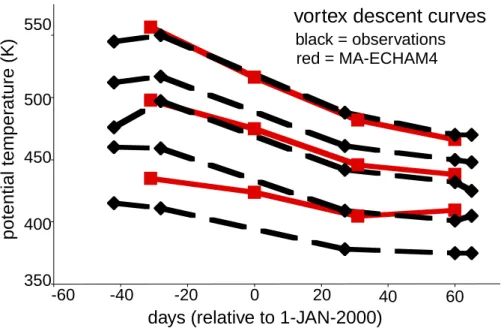
Given these anomalies, we have also assessed the model performance with respect to descent during the winter. On each first day of the month, we selected areas in the vortex (using the maximum PV gradients, checked by examining the horizontal
25
wind maximum) and calculated the average vertical profile of the tracer concentra-tions versus potential temperature. By tracking particular concentration levels as they descended to lower potential temperatures (and ascended again towards the end of the winter), we calculated the descent of the air inside the vortex. These results, based
ACPD
3, 2465–2497, 2003 Nudged GCM tracer transport in the 1999/2000 Arctic winter M. K. van Aalst et al.Title Page Abstract Introduction Conclusions References Tables Figures J I J I Back Close Full Screen / Esc
Print Version Interactive Discussion
c
EGU 2003
on CH4profiles, are presented in Table 2 and plotted in Fig. 7. We calculated statistical errors based on the variability in the sample, and found them to be at most a few per-cent (note that this is the statistical error for the average profile; the variability between individual profiles is of course considerably larger). Very similar results were obtained when we repeated our calculations based on the HF concentrations in our model. In
5
Fig. 7, we compare our results to similar analyses of CH4 and N2O observations by Greenblatt et al. (2002). The match is quite good at higher altitudes (e.g. at early-winter potential temperatures of 500–550 K). Lower in the vortex however, the model descent rate appears to be much lower than observed, consistent with the mismatch in the earlier comparisons between observations and model output.
10
We have verified that the discrepancies cannot be caused by the lack of full chemis-try, or the choice of boundary conditions. First of all, we note that the discrepancies do not occur outside of the vortex. Secondly, we have checked the sensitivity of the model concentrations to changes in the boundary conditions and simplified loss chemistry, and found that at the altitudes of our comparisons, there is very little influence of either
15
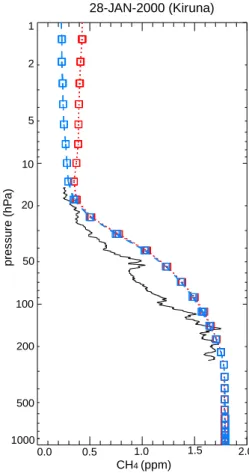
the boundary conditions or the chemistry that we included in our sensitivity runs, even for the late winter. A clear example is provided in Fig. 8, where we display the same CH4 balloon-model comparison of 28 January, but now with the passive tracer val-ues (the curve that bends towards the right) and the one used above, which includes methane emissions, a top fixed to the UARS methane climatology, and 2D methane
20
loss rates to account for reactions with Cl, O1D and OH as well as photodissociation. The calculated concentrations only start to diverge above 15 hPa. Similar graphs were obtained at other dates and places, indicating that difference between the close match of the two calculated methane tracers at lower altitudes and their divergence at higher altitudes cannot be explained by a temporary and location-specific altitude-related
dif-25
ference in the amount of mixing between inner- and outer-vortex air. Instead, it must be due to the varying influence of chemistry - negligible at lower altitudes, but more important higher up. Given that the differences are negligible below 20 hPa, uncertain-ties with respect to the representation of the chemistry do not affect our model-balloon
ACPD
3, 2465–2497, 2003 Nudged GCM tracer transport in the 1999/2000 Arctic winter M. K. van Aalst et al.Title Page Abstract Introduction Conclusions References Tables Figures J I J I Back Close Full Screen / Esc
Print Version Interactive Discussion c EGU 2003 comparisons. 7. Discussion
The general picture emerging from the comparison of our model results with the obser-vations is that the model reproduces relatively small-scale features related to the polar vortex, showing that the nudging procedure enables detailed comparisons between our
5
GCM and individual balloon or satellite measurements. Early in the winter and later in the winter outside the vortex, the model also exhibits good quantitative agreement with the measurements. However, there is a consistent problem later in the winter inside the vortex, where the model overestimates CH4and underestimates HF.
There are two main options to explain these discrepancies. The first is a lack of
10
descent of air from higher altitudes within the vortex. This could suggest that such de-scent is underestimated in the ECMWF fields that we use as input for our nudging pro-cedure. However, ECMWF’s temperatures in the 1999–2000 winter have been shown to be quite close to (both independent and assimilated) observations (Knudsen, 2002; Knudsen et al. 2002), so one would expect that radiative cooling is also modeled
15
reasonably well, and thus also the diabatic descent. However, the calculation of the vertical wind, as well as the processing thereof for the use in transport schemes, could cause additional errors (e.g. Bregman et al., 2002).
The second possible cause of the discrepancy is an excess of mixing of air across the vortex edge, diluting the air that has descended from higher up. This option seems to
20
be supported by the HALOE-model comparison on 20 February. We have investigated whether such excessive mixing might be caused by the horizontal resolution, which could be too coarse to properly represent the vortex edge. This was tested in runs with the TM5 chemistry transport “zoom”-model, which was run with the same experimental setup and using the same ECMWF meteorology, but with a different advection scheme
25
than MA-ECHAM4 and at different resolutions. The TM5 model exhibited the same lack of descent in the vortex, and appears to show that at 2◦ × 3◦ and even 1◦× 1◦
ACPD
3, 2465–2497, 2003 Nudged GCM tracer transport in the 1999/2000 Arctic winter M. K. van Aalst et al.Title Page Abstract Introduction Conclusions References Tables Figures J I J I Back Close Full Screen / Esc
Print Version Interactive Discussion
c
EGU 2003
horizontal resolution, the descent does not improve. These results will be discussed in more detail in a separate paper (van den Broek et al., 2003).
Some of the discrepancies might instead be related to the vertical resolution and coordinate system. In a model with isobaric coordinates, the regular “horizontal” isen-tropic transport in the stratosphere occurs partly across different isobaric levels. This
5
can cause spurious vertical mixing between levels, particularly when the resolution is too coarse (e.g. Chipperfield et al., 1997, Mahowald et al. 2002). This spurious vertical mixing could also affect mixing across the vortex edge, particularly when the vortex edge is not positioned exactly upright (as is often the case). Finally, Steil et al. (2002) have suggested that the semi-Lagrangian advection scheme employed here
10
also tends to lead to relatively weak downward transport inside the vortex and weak gradients across the vortex edge. In general, this advection scheme results in a rela-tively high numerical diffusion. However, we note that Van den Broek et al. (2003) found very similar problems in similar experiments with the TM5 CTM, which has a mass-flux advection scheme using first-order slopes (Russell and Lerner, 1993). Moreover, their
15
results did not improve when the horizontal resolution was raised, even up to 1◦by 1◦. Future work could include tests at higher vertical resolution, or with other advection schemes, such as the Spitfire advection scheme (Rasch and Lawrence, 1998), which is also employed by Steil et al. (2002), or the Lin and Rood advection scheme (Lin and Rood, 1996), which will be incorporated in (MA-)ECHAM5.
20
8. Conclusions
We have nudged the meteorology in our MA-ECHAM4 model towards ECMWF anal-yses to compare model runs of HF and CH4, initialized with HALOE data, to balloon and satellite measurements in the SOLVE/THESEO winter 1999/2000. Overall, we find that the nudging procedure, which had not previously been applied in the middle
25
atmosphere, is applicable and allows for a detailed comparison between model output and individual balloon and satellite measurements. It appears that the overall transport
ACPD
3, 2465–2497, 2003 Nudged GCM tracer transport in the 1999/2000 Arctic winter M. K. van Aalst et al.Title Page Abstract Introduction Conclusions References Tables Figures J I J I Back Close Full Screen / Esc
Print Version Interactive Discussion
c
EGU 2003
patterns around the Arctic vortex are reasonably well modeled. The model reproduces small-scale vortex features, and throughout the winter there is generally good quan-titative agreement between the model and the observations, except late in the winter inside the vortex. This may be due to either an underestimate of subsidence in the vortex, or spurious mixing of mid-latitude air into the vortex. Possible causes for the
5
latter could be the choice of advection scheme, the current coordinate system, which applies pressure levels in the middle atmosphere, or the processing of the meteorolog-ical vertmeteorolog-ical wind field for tracer transport purposes. In any case, these results suggest that care must be taken when studying sensitive chemistry/transport processes in the Arctic vortex with GCMs like MA-ECHAM4.
10
Acknowledgement. We thank the UARS and HALOE teams for the use of their data, as well as
the other members of the TDLAS and MkIV teams, in particular I. H. Howieson, N. R. Swann, and P. T. Woods. We also thank I. Kirchner from the Max Plank Institute for Meteorology in Hamburg, who provided the INTERA interpolation package, and assisted in setting up the nudging procedure. Finally, we are very grateful to H. Cuijpers (CKO/KNMI) for his excellent
15
ECHAM support.
References
Austin, J., et al.: Uncertainties and assessments of chemistry-climate models of the strato-sphere, Atmos. Chem. Phys., 3, 1–27, 2003.
Beaver, G. M. and Russell III, J. M.: The Climatology of HCl and HF Observed by HALOE, Adv.
20
Space Res., 21, 1373–1382, 1998.
Bergamaschi, P., Br ¨uhl, C., Brenninkmeijer, C. A. M., Saueressig, G., Crowley, J. N., Grooss, J. U., Fischer, H., and Crutzen, P. J.: Implications of the large carbon kinetic isotope effect in the reaction of CH4+ Cl for the 13C/12C ratio of stratospheric CH4, Geophys. Res. Lett., 23, 2227–2230, 1996.
25
Bregman, A., Segers, A., Krol, M., Meijer, E., and van Velthoven, P.: On the use of mass-conserving wind fields in chemistry-transport models, Atmos. Chem. Phys. Discuss., 2, 1765–1790, 2002.
ACPD
3, 2465–2497, 2003 Nudged GCM tracer transport in the 1999/2000 Arctic winter M. K. van Aalst et al.Title Page Abstract Introduction Conclusions References Tables Figures J I J I Back Close Full Screen / Esc
Print Version Interactive Discussion
c
EGU 2003 Chipperfield, M. P., Lutman, E. R., Kettleborough, J. A., Pyle, J. A., and Roche, A. E.: Model
studies of chlorine deactivation and formation of ClONO2collar in the Arctic polar vortex, J. Geophys. Res., 102, 1467–1478, 1997.
Chipperfield, M. P. et al.: On the use of HF as a reference for the comparison of stratospheric observations and models, J. Geophys. Res., 102, 12 901–12 919, 1997.
5
Considine, G., Deaver, L., Remsberg, E., and Russell III, J. M.: Analysis of Near-Global Trends and Variability in HALOE HF and HCl Data in the Middle Atmosphere, J. Geophys. Res., 104, 24 297–24 308, 1999.
Considine, G., Deaver, L., Remsberg, E., and Russell III, J. M.: HALOE Observations of a Slowdown in the Rate of Increase of HF in the Lower Mesosphere, Geophys. Res. Lett., 24,
10
3217–3220, 1997.
De Laat, A.T.J., Zachariasse, M., Roelofs, G. J., van Velthoven, P., Dickerson, R. R., Rhoads, K. P., Oltmans, S. J., and Lelieveld, J.: Tropospheric O-3 distribution over the Indian Ocean dur-ing sprdur-ing 1995 evaluated with a chemistry-climate model, J. Geophys. Res., 104, 13 881– 13 893, 1999.
15
European Ozone Research Coordinating Unit: The Northern Hemisphere Stratosphere in the Winter and Spring of 1999/2000, Cambridge, 2001.
Gettelman, A., Holton, J. R., and Rosenlof, K. H.: Mass Fluxes of O3, CH4, N2O, and CF2Cl2in
the Lower Stratosphere calculated from observational Data, J. Geophys. Res. 102, 19 149– 19 159, 1997.
20
Greenblatt, J. B. et al.: Tracer-based determination of vortex descent in the 1999-2000 Arctic winter, J. Geophys. Res., 107, D20, 2001JD000937, 2002.
Hall, T. M., Waugh, D. W. , Boering, K. A., and Plumb, R. A.: Evaluation of transport in strato-spheric models, J. Geophys. Res., 104 , 18 815–18 840, 1999.
Hines, C. O.: Doppler spread parameterization of gravity wave momentum deposition in the
25
middle atmosphere. Part 1: Basic formulation, J. Atmos. Solar Terr. Phys., 59, 371–386, 1997a.
Hines, C. O.: Doppler spread parameterization of gravity wave momentum deposition in the middle atmosphere. Part 2: Broad and quasi monochromatic spectra and implementation, J. Atmos. Solar Terr. Phys., 59, 387–400, 1997b.
30
Jeuken, A. B. M., Siegmund, P. C., Heijboer, L. C., Feichter, J., and Bengtson, L.: On the potential of assimilating meteorological analysis in a climate model for the purpose of model validation, J. Geophys. Res., 101, 16 939–16 950, 1996.
ACPD
3, 2465–2497, 2003 Nudged GCM tracer transport in the 1999/2000 Arctic winter M. K. van Aalst et al.Title Page Abstract Introduction Conclusions References Tables Figures J I J I Back Close Full Screen / Esc
Print Version Interactive Discussion
c
EGU 2003 Knudsen, B. M.: Updated ECMWF temperature accuracies, poster presentation at the
Euro-pean Ozone Symposium, Gothenburg, 7–9 September, 2002.
Knudsen, B. M., Pommereau, J.-P., Garnier, A., Nunes-Pnharanda, M., Denis, L., Newman, P., Letrenne, G., and Durand, M.: Accuracy of analyzed stratospheric temperatures in the winter Arctic vortex from infrared Montgolfier long-duration balloon flights. 2. Results, J. Geophys.
5
Res., 107, D20, 10.1029/2001JD001329, 2002.
Koshyk, J. N., Boville, B. A., Hamilton, K., Manzini, E., and Shibata, K.: Kinetic energy spectrum of horizontal motions in middle-atmosphere models, J. Geophys. Res., 104, 27 177–27 190, 1999.
Lin, S. J. and Rood, R.: Multi-dimensional flux-form semi-Lagrangian transport schemes, Mon.
10
Weather Rev., 124, 2046–2070, 1996.
Liu, X., Murcray, F. J., Murcray, D. G., and Russell III, J. M.: Comparison of HF and HCl Vertical Profiles from Ground-Based High-Resolution Infrared Solar Spectra with Halogen Occulta-tion Experiment ObservaOcculta-tions, J. Geophys. Res., 101, 10 175–10 182, 1996.
Luo, M., Cicerone, R. J., and Russell III, J. M.: Analysis of Halogen Occultation Experiment HF
15
Versus CH4Correlation Plots: Chemistry and Transport Implications, J. Geophys. Res., 100, 13 927–13 937, 1995.
Mahowald, N. M., Plumb, R. A., Rasch, P. J., del Corral, J., Sassi, F., and Heres, W.: Strato-spheric transport in a 3-dimensional isentropic coordinate model, J. Geophys. Res, 107, D15, 2001JD1313, 2002.
20
Manney, G. L. and Sabutis, J. L.: Development of the polar vortex in the 1999–2000 Arctic winter stratosphere, Geophys. Res. Lett., 27, 2589–2592, 2000.
Manzini, E. and Feichter, J.: Simulation of the SF6 tracer with the middle atmosphere MAECHAM4 model: Aspects of the large-scale transport, J. Geophys. Res., 104, 31 097– 31 108, 1999.
25
Manzini, E. and McFarlane, N. A.: The effect of varying the source spectrum of a gravity wave parameterization in a middle atmosphere general circulation model, J. Geophys. Res., 103, 31 523–31 539, 1998.
Manzini, E., McFarlane, N. A., and McLandress, C.: Impact of the Doppler spread parameteri-zation on the simulation of the middle atmosphere circulation using the MA/ECHAM4 general
30
circulation model, J. Geophys. Res., 102, 25 751–25 762, 1997.
McFarlane, N. A.: The effect of orographically exited gravity wave drag on the general circulation of the lower stratosphere and troposphere, J. Atmos. Sci., 44, 1775–1800, 1987.
ACPD
3, 2465–2497, 2003 Nudged GCM tracer transport in the 1999/2000 Arctic winter M. K. van Aalst et al.Title Page Abstract Introduction Conclusions References Tables Figures J I J I Back Close Full Screen / Esc
Print Version Interactive Discussion
c
EGU 2003 M ¨uller, R., Grooss, J.-U., McKenna, D. S., Crutzen, P. J., Br ¨uhl, C., Russell III, J. M., and Tuck,
A. F.: HALOE Observations of the Vertical Structure of Chemical Ozone Depletion in the Arctic Vortex During Winter and Early Spring 1996–1997, Geophys. Res. Lett., 24, 2717– 2720, 1997.
Nedoluha, G. E., Siskind, D. E., Bacmeister, J. T., Bevilacqua, R. M., and Russell III, J. M.:
5
Changes in Upper Stratospheric CH4and NO2as measured by HALOE and Implications for Changes in Transport, Geophys. Res. Lett., 25, 987–990, 1998.
Park, J. H. , Russell III, J. M., Gordley, L. L., Drayson, S. R., Chris Benner, D., McInerney, J., Gunson, M. R., Toon, G. G., Sen, B., Blavier, J.-F., Webster, C. R., Zipf, E. C., Erdman, P., Schmidt, U., and Schiller, C.: Validation of Halogen Occultation Experiment CH4
Measure-10
ments from the UARS, J. Geophys. Res., 101, 10 183–10 203, 1996.
Pawson, S. et al.: The GCM-Reality Intercomparison Project for SPARC: Scientific Issues and Initial Results, Bull. Am. Meteorol. Soc., 81, 2000.
Plumb, R. A., Heres, W., Neu, J. L., Mahowald, N., del Corral, J., Toon, G. C., Ray, E., Moore, F., and Andrews, A. E.: Global tracer modeling during SOLVE: high latitude descent and
15
mixing, J. Geophys. Res., in press, 2003.
Randel, W. J., Wu, F., Russell III, J. M., Roche, A., and Waters, J. W.: Seasonal Cycles and QBO Variations in Stratospheric CH4 and H2O observed in UARS HALOE Data, J. Atmos.
Sci., 55, 163–185, 1998.
Rasch, P. J., Boville, B. A., and Brasseur, G. P.: A three-dimensional general circulation model
20
with coupled chemistry for the middle atmosphere, J. Geophys. Res., 100, 9041–9071, 1995. Rasch, P. J. and Williamson, D. L.: On shape-preserving interpolation and semi-Lagrangian
transport, SIAM, J. Sci. Stat. Comput., 11, 656–687, 1990.
Rasch, P. J. and Lawrence, M.: Recent development in transport methods at NCAR. MPI-Report No. 265, Max-Planck-Institut f ¨ur Meteorologie, FRG, 65–75, 1998.
25
Ray, E. A., Moore, F. L., Elkins, J. W., Hurst, D. F., Romashkin, P. A., Dutton, G. S., and Fahey, D. W.: Descent and mixing in the 1999–2000 northern polar vortex inferred from in situ tracer measurements, J. Geophys. Res., 107, D20, 2001JD000961, 2002.
Rex, M. et al.: Chemical depletion of Arctic ozone in winter 1999/2000, J. Geophys. Res., in press, 2002.
30
Roeckner, E., Arpe, K., Bengtsson, L., Christoph, M., Claussen, M., D ¨umenil, L., Esch, M., Giorgetta, M., Schlese, U., and Schulzweida, U.: The atmospheric general circulation model ECHAM4: Model description and simulation of present-day climate. MPI Rep. 218, Hamburg,
ACPD
3, 2465–2497, 2003 Nudged GCM tracer transport in the 1999/2000 Arctic winter M. K. van Aalst et al.Title Page Abstract Introduction Conclusions References Tables Figures J I J I Back Close Full Screen / Esc
Print Version Interactive Discussion
c
EGU 2003 Germany, 1996.
Russell, G. M., and Lerner, J. A.: A new finite-differencing scheme for the tracer transport equation, J. Appl. Meteorol., 20, 1483–1498, 1993.
Russell III, J. M., Deaver, L. E., Luo, M., Cicerone, R. J., Park, J. H., Gordley, L. L., Toon, G. C., Gunson, M. R., Traub, W. A., Johnson, D. G., Jucks, K. W., Zander, R., and Nolt, I.:
5
Validation of Hydrogen Fluoride Measurements made by the HALOE Experiment from the UARS Platform, J. Geophys. Res., 101, 10 163–10 174, 1996.
Russell III, J. M., Gordley, L. L., Park, J. H., Drayson, S. R., Hesketh, D. H., Cicerone, R. J., Tuck, A. F., Frederick, J. E., Harries, J. E., and Crutzen, P. J.: The Halogen Occultation Experiment, J. Geophys. Res., 98, 10 777–10 797, 1993.
10
Shindell, D. T., et al.: Simulation of recent northern winter climate trends by greenhouse-gas forcing, Nature, 399, 452–455, 1999.
Shindell, D. T., Rind, D., and Lonergan, P.: Increased polar stratospheric ozone losses and delayed eventual recovery owing to increasing greenhouse-gas concentrations, Nature, 392, 589–592, 1998.
15
Shindell, D. T., et al.: Northern Hemisphere winter climate response to greenhouse gas, ozone, solar, and volcanic forcing, J. Geophys Res, 106, 7193–7210, 2001.
Steil, B., Dameris, M., Br ¨uhl, C., Crutzen, P. J., Grewe, V., Ponater, M., and Sausen, R.: De-velopment of a chemistry module for GCMs: first results of a multi-annual integration. Ann. Geophys., 16, 205–228, 1998.
20
Steil, B., Br ¨uhl, C., Manzini, E., Crutzen, P. J., Lelieveld, J., Rasch, P. J., Roeckner, E., and Kr ¨uger, K.: A new interactive chemistry climate model. I: Present day climatology and inter-annual variability of the middle atmosphere using the model and 9 years of HALOE/UARS data, J. Geophys. Res., submitted, 2002.
Toon, G. C.: The JPL MkIV Interferometer, Optics and Photonics News, 2, 19–21, 1991.
25
Toon, G. C., et al.: Comparison of MkIV balloon and ER-2 aircraft measurements of atmo-spheric trace gases, J. Geophys Res., 104, 26 779–26 790, 1999.
Van den Broek, M. M. P., van Aalst, M. K., Bregman, A., Krol, M., Lelieveld, J., Toon, G. C., Garcelon, S., Hansford, G. M., Jones, R. L., and Gardiner, T. D.: : The impact of model grid zooming on tracer transport in the 1999/2000 Arctic polar vortex, Atmos. Chem. Phys.
30
ACPD
3, 2465–2497, 2003 Nudged GCM tracer transport in the 1999/2000 Arctic winter M. K. van Aalst et al.Title Page Abstract Introduction Conclusions References Tables Figures J I J I Back Close Full Screen / Esc
Print Version Interactive Discussion
c
EGU 2003
Table 1. Nudging settings, for the four nudged model variables
Prognostic variable Nudging strength G (s−1)
Temperature 1 × 10⁻⁵
Divergence 5 × 10⁻⁵
Vorticity 10 × 10−5
ACPD
3, 2465–2497, 2003 Nudged GCM tracer transport in the 1999/2000 Arctic winter M. K. van Aalst et al.Title Page Abstract Introduction Conclusions References Tables Figures J I J I Back Close Full Screen / Esc
Print Version Interactive Discussion
c
EGU 2003
Table 2. Descent calculations, based upon MA-ECHAM results for CH4. Descent rates are given in Kelvin per day
CH4 Initial Tpot Tpot Average Descent Descent Descent Descent
(ppmv) (1 Dec) (1 Mar) descent rate rate Dec rate Jan rate Feb rate Mar (DJF) 0.8 619 496 1.35 2.00 1.21 0.79 –0.88 1.0 557 466 0.99 1.30 1.11 0.53 –0.44 1.2 498 438 0.66 0.73 0.94 0.27 –0.26 1.4 435 409 0.28 0.36 0.62 –0.16 –0.15 1.6 370 372 –0.03 0.10 0.08 –0.29 –0.03
ACPD
3, 2465–2497, 2003 Nudged GCM tracer transport in the 1999/2000 Arctic winter M. K. van Aalst et al.Title Page Abstract Introduction Conclusions References Tables Figures J I J I Back Close Full Screen / Esc
Print Version Interactive Discussion
c
EGU 2003
HF (ppb), 1 September HF (ppb), 1 December HF (ppb), 1 March CH4 (ppm), 1 September CH4 (ppm), 1 December CH4 (ppm), 1 March
0.00 0.00 1.80. 2.00. 0.23 0.45 0.68 0.90 1.13 1.35 0.58 0.25 0.50 0.75 1.00 1.25 1.50 1.75 100 200 100 200 20 10 2 1 10 20 2 1 50 50 5 5 0 0 0 0 0 0 - 90 90 - 90 90 - 90 90 - 90 90 - 90 90 - 90 90 latitude latitude latitude latitude latitude latitude pressure (hP a) pressure (hP a)
Fig. 1. Latitude versus pressure (from 200 to 1 hPa) zonal mean cross-sections of MA-ECHAM4 CH4and HF fields on 1 September (initialization), 1 December and 1 March.
ACPD
3, 2465–2497, 2003 Nudged GCM tracer transport in the 1999/2000 Arctic winter M. K. van Aalst et al.Title Page Abstract Introduction Conclusions References Tables Figures J I J I Back Close Full Screen / Esc
Print Version Interactive Discussion
c
EGU 2003
MA-ECHAM4: CH4 (ppm) 3-DEC-1999 lat=47N MA-ECHAM4: HF (ppb) 3-DEC-1999 lat=N47 HALOE: CH4 (ppm) 3-DEC-1999 lat=47N HALOE: HF (ppb) 3-DEC-1999 lat=47N 1 100 10 pressure (hP a) 1 100 10 pressure (hP a) 1 100 10 1 100 10 -180 -90 0 90 180 -180 -90 0 90 180 -180 -90 0 90 180 longitude (degrees) -180 -90 0 90 180 longitude (degrees)
Fig. 2. Longitude versus pressure (from 200 to 1 hPa) cross-sections of HALOE observations
(top) and MA-ECHAM4 fields (bottom) for CH4 (left) and HF (right) on 3 December, at 47◦ latitude.
ACPD
3, 2465–2497, 2003 Nudged GCM tracer transport in the 1999/2000 Arctic winter M. K. van Aalst et al.Title Page Abstract Introduction Conclusions References Tables Figures J I J I Back Close Full Screen / Esc
Print Version Interactive Discussion c EGU 2003 15-MAR-2000 (Kiruna) 0.0 0.5 0.0 3-DEC-1999 (Kiruna) 0.5 2.0 2.0 1.5 1.0 1.0 1.5 50 30 20 100 100 10 10 20 30 50 200 200 CH4 (ppm) / HF (ppb) CH4 (ppm) / HF (ppb) pressure (hP a) pressure (hP a)
Fig. 3. Concentration versus pressure (from 200 to 10 hPa) plots of MA-ECHAM4 fields of
HF (blue) and CH4 (green) compared to MkIV observations taken from Kiruna (solid) on 3 December and 15 March. Squares represent data at model levels. Model fields were sampled at the four grid boxes surrounding the measurements.
ACPD
3, 2465–2497, 2003 Nudged GCM tracer transport in the 1999/2000 Arctic winter M. K. van Aalst et al.Title Page Abstract Introduction Conclusions References Tables Figures J I J I Back Close Full Screen / Esc
Print Version Interactive Discussion c EGU 2003 0.0 50 30 20 100 10 200 pressure (hP a) 2.00.0 1.0 2.00.0 2.00.0 2.00.0 1.0 2.0 1.0 1.0 1.0 CH4 (ppm) CH4 (ppm) CH4 (ppm) CH4 (ppm) CH4 (ppm)
28-JAN-2000 9-FEB-2000 13-FEB-2000 27-FEB-2000 25-MAR-2000
(inside vortex) (outside vortex) (vortex edge) (vortex edge) (outside vortex)
Fig. 4. Concentration versus pressure (from 200 to 10 hPa) plots of MA-ECHAM4 CH4results (blue) compared to TDLAS observations taken from Kiruna (solid), on 28 January (inside the vortex), 9 February (outside the vortex), 13 February (inside the vortex, close to the edge), 27 February (inside the vortex, close to the edge), and 25 March (outside the vortex). Squares represent data at model levels. Model fields were sampled at the four grid boxes surrounding the measurements.
ACPD
3, 2465–2497, 2003 Nudged GCM tracer transport in the 1999/2000 Arctic winter M. K. van Aalst et al.Title Page Abstract Introduction Conclusions References Tables Figures J I J I Back Close Full Screen / Esc
Print Version Interactive Discussion
c
EGU 2003
MA-ECHAM4: CH4 (ppm) 20-FEB-2000 lat=56N MA-ECHAM4: HF (ppb) 20-FEB-2000 lat=56N
HALOE: CH4 (ppm) 20-FEB-2000 lat=56N HALOE CH4 (ppm) 20-FEB-2000 lat=56N
120 -150 -60 30 120 longitude (degrees) 120 -150 -60 30 120 longitude (degrees) 120 -150 -60 30 120 120 -150 -60 30 120 1 100 10 1 100 10 1 100 10 1 100 10 pressure (hP a) pressure (hP a)
Fig. 5. Longitude versus pressure (from 200 to 1 hPa) cross-sections of HALOE observations
(top) and MA-ECHAM4 fields (bottom) for CH4 (left) and HF (right) on 20 February, at 56◦ latitude.
ACPD
3, 2465–2497, 2003 Nudged GCM tracer transport in the 1999/2000 Arctic winter M. K. van Aalst et al.Title Page Abstract Introduction Conclusions References Tables Figures J I J I Back Close Full Screen / Esc
Print Version Interactive Discussion c EGU 2003 1 100 10 pressure (hP a) 1 100 10 pressure (hP a) 1 100 10 1 100 10 120 -150 -60 30 120 120 -150 -60 30 120 120 -150 -60 30 120 longitude (degrees) 120 -150 -60 30 120 longitude (degrees)
MA-ECHAM4: CH4 (ppm) 20-FEB-2000 lat=62N
MA-ECHAM4: CH4 (ppm) 20-FEB-2000 lat=59N
MA-ECHAM4: CH4 (ppm) 20-FEB-2000 lat=56N
MA-ECHAM4: CH4 (ppm) 20-FEB-2000 lat=53N
Fig. 6. Longitude versus pressure (from 200 to 1 hPa) cross-sections of MA-ECHAM4 HF fields
on 20 February, at 53, 56, 59, and 62◦latitude (to be compared to the HALOE observations in the top right panel of Fig. 5).
ACPD
3, 2465–2497, 2003 Nudged GCM tracer transport in the 1999/2000 Arctic winter M. K. van Aalst et al.Title Page Abstract Introduction Conclusions References Tables Figures J I J I Back Close Full Screen / Esc
Print Version Interactive Discussion
c
EGU 2003
vortex descent curves
550 400 350 450 500 -60 -40 -20 0 20 40 60
days (relative to 1-JAN-2000)
potential temper
ature (K)
black = observations red = MA-ECHAM4
Fig. 7. Vortex descent curves, showing the potential temperature at which various fixed methane concentrations are found through the winter (horizontal: date, relative to 1 January 2000; vertical: potential temperature at which a particular concentration is found at a given date). Solid red: vortex average MA-ECHAM4. Dashed black: individual balloon measure-ments (Greenblatt et al., 2002). The latter were derived from individual CH4balloon observa-tions (LACE on 19 November and 5 March, MkIV on 3 December, and BONBON on 27 January and 1 March, respectively).
ACPD
3, 2465–2497, 2003 Nudged GCM tracer transport in the 1999/2000 Arctic winter M. K. van Aalst et al.Title Page Abstract Introduction Conclusions References Tables Figures J I J I Back Close Full Screen / Esc
Print Version Interactive Discussion c EGU 2003 0.0 0.5 1.0 1.5 2.0 CH4 (ppm) 50 500 20 100 10 200 pressure (hP a) 5 2 1 1000 28-JAN-2000 (Kiruna)
Fig. 8. Concentration versus pressure (from 200 to 10 hPa) of MA-ECHAM4 fields of a passive
CH4tracer run (red), and a similar run with methane emissions, chemistry (using 2D loss rates) and top constraints from the UARS climatology (blue), compared to TDLAS balloon measure-ments (black) on 28 January 2000, inside the vortex.