Dynometrics: An Innovative Lactic Acid Measurement Solution for
Endurance Athletes
By
Alessandro Babini
BSc Business Mathematics and Statistics, LSE, 2012 MSc Management, HEC Paris, 2015
ARCHIVES
MASSACHUSETTS INSTITUTEOF TECHNOLOLGY
JUN 2 4 2015
LIBRARIES
SUBMITTED TO THE MIT SLOAN SCHOOL OF MANAGEMENT IN PARTIAL FULFILLMENT OF THE REQUIREMENTS FOR THE DEGREE OF
MASTER OF SCIENCE IN MANAGEMENT STUDIES
AT THE
MASSACHUSETTS INSTITUTE OF TECHNOLOGY JUNE 2015
@2015 Alessandro Babini. All rights reserved.
The author hereby grants to MIT permission to reproduce and to distribute publicly paper and electronic copies of this thesis document in whole or in part
in any medium now known or hereafter created.
Signature of Author:
Signature redacted
MIT Sloan School of Management May 8, 2015
Signature redacted
Certified by: __________________Christian Catalini Assistant Professor of Technological Innovation, Entrepreneurship, and Strategic Management Thesis Supervisor
Accepted by:
Signature
redacted-Michael A. Cusumano
SMR Distinguished Professor of Management Program Director, M.S. in Management Studies Program MIT Sloan School of Management
Dynometrics: An Innovative Lactic Acid Measurement Solution for
Endurance Athletes
By
Alessandro Babini
Submitted to MIT Sloan School of Management on May 8, 2015 in Partial Fulfillment of the requirements for the Degree of Master of Science in
Management Studies.
ABSTRACT
Aspire is a company I co-founded along with John, PhD, in September 2014. Our mission is to be a breath of fresh air in the old-fashioned wearable sports technology market by leveraging the power of science and data to empower athletes with factual insights from their bodies and help them improve their performance. We have developed the first wearable lactic acid meter that works in real time and does not require a single drop of blood. This thesis will outline our business plan for this product by analyzing our market, competitive positioning, product roadmap as well as defining our customer, his expectations and introducing our team. Finally, we will discuss our growth strategy and expected financial performance in the long run.
Thesis Supervisor: Christian Catalini
Title: Assistant Professor of Technological Innovation, Entrepreneurship, and Strategic
Acknowledgments
The progress we made over the past 9 months would not have been possible without the help and resources from MIT. I would like to thank Christian Catalini for his yearlong support and dedicated help as well as everyone from the Martin Trust Center for MIT Entrepreneurship including Bill Aulet, Kyle Judah, Christina Chase, Josh Forman and Alan Ringvald for their advice and endless time. I would also like to thank Brian Halligan and Paul English for their precious insights, the MIT VMS for their mentorship sessions as well as the MIT $1 00K committee for their support and encouragements. Finally I am grateful to the MSMS program, in particular, Chanh
Q.
Panh, Michael Cusumano, Chris Bolzan and the entire 2015 cohort for their support and encouragement throughout the year.I would also like to thank my parents who allowed me to come at study at MIT and undoubtedly
Table of Contents
1. Introduction ... 9
V ision & M ission ... 9
11. T he Problem ... 11
A n O verview of Lactic A cid ... 12
Ill. T he A spirel ... 14
i. Product Specifications ... 14
ii. Prototype ... 15
iii. Product Plan ... 16
1 V . M arket A nalysis ... 18
i. Identifying M arkets ... 18
ii. Beachhead M arket ... 20
i. Subsequent M arkets ... 21
ii. M arket Sizing ... 21
iii. Persona ... 24
V . T he C ustom er ... 26
i. Life Cycle U se Case ... 26
ii. Q uantified V alue Proposition ... 26
iii. Core ... 27
iv. D ecision M aking U nit ... 27
v. D ecision M aking Process ... 28
X1. C om petitive Landscape ... 30
i. Traditional Blood Tests ... 30
ii. M inim ally Invasive Blood Tests ... 30
iii. M inim ally Invasive Lactate Tests ... 30
iv. N on-invasive Lactate M eters ... 31
N'11. T eam ... 33
1. O verview ... 33
11. Roles and Titles ... 34
B usiness M odel ... 35
i. Route to M arket ... 35
ii. Pricing Fram ew ork ... 35
iii. CA C/LTV ... 36
i. G row th Strategy ... 37
ii. Estim ated Costs to shipping ... 38
IX . PR and M arketing ... o ... o ... 39
X . T he Future ... 39
X 1. R eflections on entrepreneurial experience ... 41
i. W hat M akes It W orth It? ... 41
ii. Pain Points ... 41
iii. Letting G o ... 42
iv. M istakes ... 42 42
v i. P erson al G row th ... 4 3 X11. Appendix ... 44 i. Primary M arket Research Framework ... 44
I.
Introduction
This thesis will outline the business plan of Aspire a Boston based startup which aims to improve the way endurance athletes train on a daily basis by providing them with the first wearable lactic acid meter that works in real time and does not require a single drop of blood. The initial idea and team around the project was formed in Bill Aulet's 'New Enterprises' class at MIT Sloan in September 2014. This thesis is written in April 2015, after having done 6 months of primary market research, having assembled a team of 5, having validated the need in the market and having started working on a prototype. The cofounders', Alessandro Babini & John, goal is to incorporate the company by submission of this paper and work on it full time from June. Aspire was also incubated by the Martin Trust center for MIT entrepreneurship in January 2015 during 1 month.
This thesis will be published by MIT and available to anyone. As a result, key sections of the business plan such as names of team members, pictures of the prototypes, product plan and IP have been removed.
Vision & Mission
The sports industry today still relies on technology that was brought to market more than a decade ago. As an example, the most common piece of technology that athletes use today is heart rate monitors. This performance indicator is however highly dependent on external factors such as temperature, weather, caffeine intake and therefore does not constitute a reliable source of data that can be leveraged to improve one's pace or training schedule. Moreover, companies like Garmin focus on bringing incremental improvements of their existing product lines to market rather than rethinking and innovating the industry.
In the amateur consumer market, Jambone, Fitbit and many others have democratized the 'fitness tracker' allowing people to approximately know how many calories they burnt, or steps they walked. Aspire' vision is to innovate the quantified self-market by providing athletes and fitness oriented individuals with factual data about the state of their body at a given time. We aim to disrupt this market currently cannibalized by the big players cited above by bringing to market
a product based on new technology.
Our mission is to enable humans to seamlessly understand what is happening in their body at a given point in time without needing a single drop of blood. In essence, we are building the technology that aims to replace the blood test in the long run, allowing anyone to leverage their blood data without the hassle of needles and knowledge of doctors to interpret it. We want to empower you with the information you need to understand how your body reacts to your daily activities and be able to prevent you from getting sick, exceeding your maximum training rate or
feeling tired. To this day, Aspire' mission is to provide people with instant actionable insights about their blood data.
As a starting point, we are building the first wearable optical lactic acid meter to help endurance athletes improve their performance in real time. Our device will non-invasively measure the lactic acid concentration in a training subject, identify his threshold and give him
II.
The Problem
Our first prototype will be aimed at the endurance athlete market. A thorough market research (as outlined later in the paper) has identified this market as the one most in need for this technology and as having the highest willingness to pay.
Endurance athletes dedicate their lives to training and dieting to run, swim, cycle, row and ski as fast as possible. To perform to their best they require periodic blood tests to measure their lactic acid levels and adjust their training program accordingly. These tests are invasive, expensive and inconvenient.
Lets consider a professional marathon runner: Every 6 to 12 months he will need to do a lactic acid test, either on a track or in a lab. He will run an average of 10 laps between which, a nurse will prick his fingers to extract blood and measure his lactic acid levels. His 6-month training plan will then be mostly based on these sole 10 data points. The coach will then correlate his lactate levels to his heart rate in order for him to get an estimate of where he stands on his lactate curve during a race. To date, there is no solution that allows endurance athletes to measure their lactate levels and compare them to their threshold in real time.
Figure 1 shows Mike, 27, Lieutenant in the US army training for a triathlon. He periodically pricks his fingers to leverage the data about his lactic acid levels during training. The right part of the figure illustrates the fact that this process is inconvenient and can be painful.
We are building the first ever lactate meter that does not require a single drop of blood. By measuring and displaying athletes' lactate levels in real time, we enable them to achieve the maximum possible performance from their bodies, without the pain and hassle of needles and blood tests.
An Overview of Lactic Acid
Lactic acid is constantly synthetized by our body. As we demand for energy, glucose is broken down in our body and lactate is produced in the process. Lactic acid is then removed from our body by the liver or well-oxygenated muscle, heart and brain cells. However, during high intensity exercise, the rate at which our body produces lactate can exceed our maximum consumption rate which is called the Lactate Threshold.
When an athlete hits this threshold and continues to exercise at a high pace, the lactate concentration in his blood starts increasing very steeply and this excess sticks to his muscles causing them to paralyze. Exceeding the lactate threshold during a marathon or any other endurance competition is one of the main reasons of failure and abandonment.
Another way to see it is by pretending that our body works like a car engine. The goal would then be to finish the race with an empty tank. If you have extra gas left that means you could have driven faster. On the other hand if you're too aggressive you will run out of fuel before the end of the race. An athlete's goal is very similar, as he wants to finish the race with no more energy in his or her body.
Figure 2 below, gives an illustration of an athlete's lactate curve. The x-access represents the workout rate in Watts and the y-axis his blood lactate concentration is (mmol/L). The threshold can be identified around 275W for the untrained athlete and 325W for the trained athlete, when the concentration starts increasing steeply with workout rate. For example, if the untrained individual in Figure 2 were to run a marathon, his goal would be to never exceed ~275W workout rate. Another key takeaway from the below graph is that an individual's threshold evolves as he trains. This curve can shift by up to 7% in a given year highlighting the importance of this measurement. Endurance athletes who cannot afford to measure their lactate levels periodically, have no way to not adapt their training schedule based on their threshold resulting in a pure 1-7% power loss during a race. This can represents up to 10 minutes during a marathon.
- Untrained -- -Trained 12 E 10 0 M2 0
I
- --125 150 175 200 250 275 Work rate (W 300 325 350 350 400http/www.humankinetics.com/AcuCustom/Sitename/DAM/081/142 art Main.png
Leveraging this shift in threshold proves to be very tricky given that there is no way to assess lactic acid concentration in real time and very few endurance athletes perform more than 1 of these tests every year. As explained earlier, most people try to correlate this measurement to their heart rate to get a sense of where they are on the curve at a given point in time. An individual's heart rate is however dependent on many external factors.
As a result, lactic acid has become, over the years, the number one performance indicator and an athlete's number one goal is to train up to this threshold, but never exceed it. Theoretically if an athlete trains at his lactic acid threshold and is given enough food and water he could go on indefinitely.
/
Ol"
III.
The Aspire1
i. Product Specifications
As a result of this problem endured by athletes, we are building the first wearable lactic acid meter that works in real time and does not require a single drop of blood. The athletes will wear the "Aspire 1" on the working muscle when they train and will received live feedback about their lactic acid concentration and lactate threshold allowing them to make real time decision for instant performance improvement. The device will also vibrate when the individual reaches his burn down rate enabling him to adjust his pace and never hit the wall'.
Our device will be conceived for endurance athletes only, will be water and sweat proof. All the data gathered will be stored and instantly accessible by the athlete, coach or trainer for live feedback.
Early conversations with our beachhead market have helped us design a mockup of the "Aspirel". Our initial designs included a LED screen displaying a gauge indicating the individual's lactate measurement compared to his threshold. Initial feedback we received made us reconsider our decision to display the data as it will not be directly visible by the athletes during training. Figure 3 shows the evolution of the wearable display before we received the
feedback. Our final version will not include a LED screen.
Figure 3
The device's estimated retail cost is between $299 and $399, which has been derived from the customer interviews we conducted (more details below). The Aspire I is expected to generate a total cost saving of $2230 over a period of 2 years per owner. It replaces the need for recurring blood test, removes the unnecessary supplement intakes and improves training efficiency. All assumptions can be found in the table below.
Assumptions for yearly Savings
Cost per Lactate test $250
Cost of Unnecessary supplement intake per year $150
Expected improved training efficiency 5%
Average Yearly Wage for target market $75,000
Average Wage per hours for target market $55
Average weekly training time 5hrs
Estimated value of saved training time per year $715
ii. Prototype
As of March 2015, the Aspirel is fully wearable and can identify the incremental change in blood lactic acid concentration in real time. We expect to start professional trials by early July.
Figure 4
Figure 4 above gives a high level illustration of the Aspire 1 as of February 2015. All pictures have been blurred for privacy issues.
As of March 2015, the Aspirel is fully wearable and does not require any external light source or spectrometer. It can be seem on the far left of Figure 5 below.
iii. Product Plan
Since day 1 of the prototyping phase, roles in the team have been clearly defined allowing us to iterate through 1 version of the product every week. Roles have been divided between hardware, signal processing, and software, which has allowed us to get to a fully working prototype in less than 2 months. As of March 2015 we have a wearable prototype that non-invasively measures the incremental change in lactate and threshold. We are currently working on the software that will allow us to get a reliable numerical value of lactic acid concentration in the blood. The detailed product plan below has been blurred for privacy concerns.
IV.
Market Analysis
i. Identifying Markets
As mentioned earlier in this paper, my cofounder and I decided, when we started this company, to build the technology that would enable people to seamlessly know what is happening in their body without the pain and hassle of needles and blood test. We started our market research by identifying 5 potential markets that would highly benefit form such technology:
1 - Hormone Therapy Patients
Many women trying to get pregnant or experiencing postmenopausal difficulties often undergo 6-months long hormones treatments. These treatments require a precise dosage of medication intake and therefore weekly blood tests. Given that there is no way to measure hormone levels in real time seamlessly, these treatments often result in overmedication. These women would be able to use our technology to allow them to take precise dosages of medication at home, without having to see a doctor or go through the hassle of needles and blood tests.
2 - ICU Patients
These types of patients are typically in unstable conditions and require a nurse to constantly draw blood out of their bodies at regular intervals to ensure they are well. These are highly
uncomfortable, take time and can seriously damage the skin.
3- Children
Babies and young children have a weak immune system and are often unable to effectively communicate how they feel to their parents causing a potentially unhealthy child not to receive appropriate care.
4 - Elderly People
Elderly people have weak immune systems and require period blood tests to monitor their health and make sure that they receive the necessary treatment to keep their body healthy.
5 - Athletes
Athletes often carefully control their diet and training program to improve their strength and performance but may not be eating or training correctly due to the lack of feedback about the state of their bodies.
After having spent a month talking to more than 30 people in all these different markets it became obvious to us that we were going to build the technology for athletes for the following reasons.
1 - Hormone Therapy Patients
These treatments need to be prescribed by doctors, which makes the decision-making unit much more complicated. Moreover, these treatments are usually shorter than 1 year and the women we interviewed, who were undergoing these treatments, seemed reluctant to invest money in such a device. Additionally the sales channels to distribute such a device are very hard to penetrate and would require us to have an FDA approved device. Overall, we decided to abandon this market as the value added by such a device would not have been large enough to justify a viable retail price. Moreover we expect the LTV of that market to by extremely low as there would not have been any repeat purchases or potential for a subscription model.
2 - ICU Patients
Selling to hospitals made the go-to-market strategy extremely hard. Moreover, nurses are trained on existing devices and are often reluctant to change equipment. The training costs associated with using new equipment are charged to the manufacturer and sales cycles are usually extremely long. Moreover this market requires a high level of accuracy, which we do not know yet if we will get in the short term as we are inventing this new technology. Finally our goal is to leverage the fact that most components that constitute our device are very standard and that we expect to have extremely low COGS. Selling to hospitals would assume many people would use the same device week after week and that we would have had to go for the low volume high margin model. Our goals and vision are not aligned with this model, as our mission is to bring this technology to the mass in order to prevent them from ending in a hospital. These are the
reasons we discarded this market.
3- Children
Mothers want the best possible treatment for their children and are often very reluctant to try out new technology. Our PMR showed us that mothers will automatically see a doctor if their child is sick and most often do not trust online sources. They also like to keep the same doctor during the entire childhood as the child feel more confortable with him/her. They will never use a new kind of technology on their child without having tested it on themselves unless doctors have recommended it. After talking to these doctors we realized that they were interested in measuring a plethora of blood parameters. The risks associated with trying to build such a device was too high so we decided to discard this market.
4 - Elderly People
Elderly are very averse to new technologies. We have been told numerous stories about old people destroying the equipment that was put on them in hospital because they were not used to it. In some cases, new technology that had been vetted by the hospital officials and doctors was never implemented due to the reaction of some patients, especially old people. We also encountered the same problem as with the children, which is that there was no single blood
parameter that was more important that any other. This did not fit our ambition to bring a product to market within 12 months so we discarded the market.
5 - Athletes
Athletes find traditional blood tests too expensive and inconvenient but need the data from it. Moreover, they need help interpreting their results and therefore are not completely independent. They are data geeks, own wearable devices and are usually very tech savvy. Additionally, athletes were the only market who could tell us what they wanted to measure in their blood: Lactic Acid levels. Finally, selling to this market does not require us to make any medical claims or to be FDA approved.
ii. Beachhead Market
At this point, our vision for the company is to build the technology that enables athletes to monitor and factually measure the status of their health and provide them with feedback for improved performance. We therefore started to deep dive into the athlete world to better understand who was going to be our beachhead market.
Extended primary market research allowed us to divide the athlete market in 3 main categories:
- Professional athletes
- Semi-professional athletes and avid trainers
- Beginners.
Making the choice between these 3 sub-markets turned out to be easier than expected. Beginner athletes often train in order to get more fit and loose weight. Their goal is not to improve their performance, which reduces significantly the need for blood test and live monitoring of body parameters. We are not building a device to help you get fitter; Fitbits and Jawbones do the job well enough. We will therefore not be targeting this market.
Professionals on the other hand are often renown in their respective sports and sponsored by major brands. They very rarely pay for their equipment and do not constitute a large enough market. Our goal is for them to be our champion; we want them to endorse our device to help market it to the semi-professional market.
Semi-professionals athletes turned out to be the perfect fit for our device. Their number one goal for training is improving their performance. Moreover they are educated about lactic acid and know the benefits of monitoring it in real time. They have a comfortable income and are used to spending a large portion of it to improve their training.
Knowing we were going build our device for "semi-professional" athletes, we then deep dived into the different sports to refine our analysis.
The athletes who need lactate monitoring the most are endurance athletes. Over the course of 4 months we interviewed more than 100 runners, cyclists, triathletes, swimmers, rowers and skiers.
As a result of this primary market research, we realized that marathon runners were our perfect beachhead market. More precisely people with the following characteristics:
- US citizens (The US is one of the most sports savvy market)
- Run at least 1 marathon/year (Shows a certain level of consistency which pushes them
to try and improve their performance year after year)
- Run a marathon in less than 3.5 hours (Identifies individuals that are already well
trained and in good shape)
- Male (Statistically, more male are tech savvy in the sports market)
- Married (They tend to have a much more structured life and are more interested in
having a time efficient and productive training)
- Earn more than $70k/year (have enough income to spend on sports gear)
- Own a $200+ heart rate monitor (are already data geeks and familiar with sports tech)
Marathon runners seemed the best possible choice given that they are usually very educated and earn a conformable salary, which gives them a great purchasing power. Moreover they are the most tech-savvy and 90% of them already own a wearable device. Finally they form one of the strongest communities in the US. They meet every weekend across the US, to run, talk or hangout. We expect the word of mouth to be extremely strong amongst them.
Moreover, the extensive primary market research we conducted indicated that semi-professional cyclists with similar characteristics are also an excellent candidate for our beachhead market. Given these two markets are extremely similar, we are building our first product for both of them and consider them as equally important.
i. Subsequent Markets
Our subsequent markets include, cyclists, triathletes, rowers, swimmers and skiers. Additionally, we have identified other markets that currently monitor lactic acid levels and could
highly benefit form our device. Ballet dancers and soccer players are an example but we don't
plan to build any solution for them in the short term.
ii. Market Sizing
Beachhead Market
This section explains the calculation that justifies the total addressable size of our beachhead market as explained in William Aulet's Disciplined Entrepreneurship book.
One additional assumption made in this calculation is that Aspire will only have 1 product line and that on average the people renew their wearable sports gear every three years.
Market: US Only 2014
Men Marathon finishers (57%) 308,370
Men marathon finishers between 25-44 (56) ) 172,687
x
Assumed device price ($) 349
As explained above, we expect the total addressable market size for our beachhead market
(US male marathon finishers between 25-44) to be slightly north of 20 millions dollars per year.
Our goal is to develop a monopole on this market before we start selling to other people.
Additionally, the marathon and general running market has been increasing significantly in the past 10 years. According to Running USA, the number of marathon finishers in 2013 was 541,000, which is 40% more than a decade ago. Similarly, the number of half marathon runners has increased by an impressive 307% in the past decade to reach an astonishing 1,196,000 in
2013.
More generally the running market has increased steadily over the past 25 years as illustrated
by Figure 6 below. Running has become a trend in the past years and keeps on seducing more
Running Event Finishers 1990 - 2013
447% Male U Female 1995 2000 2005 2,215,500 3,619,600 4,494,400 4,708,000 4,998,400 4,947,600 2010 2011 2012 2013 6,929,000 7,685,700 8,699,000 10,844,200 6,071,000 6,288,300 6,835,000 8,180,800 Figure 6 http://www.runningusa.org/state-of-the-sport-race-trendsFollow on Endurance Athlete Markets
The following market size includes all the semi-professional athletes targeted the long term. Triathletes have intentionally been removed from this calculation often overlap with the runner and cyclist categories.
Number of Semi-Professional Competing endurance athletes in t
US Alone
Marathon Runners 360,000
Half Marathon Runners 1,300,000
Cyclists 450,000 Rowers 220,000 Skiers 300,000 Swimmers 300,000 Total by Aspire in as they most he 2,930,000 x
Assumed device price ($) 349
Yearly ($) 340,856,667 20,000,000[ 10,000,000 0 Female Male 1990 1,199,200 3,597,800
As shown by the table above, the dollar potential generated by this market exceeds a billion dollar and is expected to grow significantly as outlined in the next part.
Fitness and Sports Wearable Market
Figure 7 below illustrates the fact that according to HIS the world market for sports, fitness
& activity monitors is expected to grow by 7% CAGR from 2013 to 2019. The categories that
capture most of the shipments are pedometers, activity, fitness and hear rate monitors.
Figure 7
http://www.electronics-eetimes.com/en/slideshow-wearables-by-the-ihs-forecast-numbers.html?cmp id=7&news id=222921173&page=2
By trying to grow Aspire, we are making the bet that this market will keep on growing at a
great pace and that it is ready to face innovation. We believe that the market for lactic acid monitoring is about to face what the Bluetooth speakers market faced when Jawbone released the Jambox. Prior to this, the market share of portable Bluetooth speakers was close to 0%. Jambox then released a new innovative and convenient way to listen to music on the go with friends, which spiked its market share to the high 2 digits.
By bringing the first reliable lactic acid monitor to market we are bringing a new solution to
help athletes increase their performance and hope that it will be mass adopted. We believe that lactic acid is about to become the new heart rate in the athletic performance market.
iii. Persona
Performance Patrick is our first Persona. Performance Pat is 28 kids (3 months and 2 years old) and lives in Louisiana. Below is habits and personality, which makes him our number 1 target buyer.
years old; married with two a detailed description of his
280
1:
0~
20 *0Aaf
-**
F*= I Home. Rom ".t 1p *M* I- Wmi Vi W$1 X"4 Mt5 200 2W? Lk ' o"SEducation & Job:
Performance Pat received a Bachelor of Science in physics from MSU, a Masters of Science from AFIT and is currently a Lieutenant in the Air Force.
Income and Spending Habits
He earns $70k a year and pays for his entire family's needs as his wife stopped working as a teacher when their second child was born. He is passionate about his hobbies and does not hesitate to spend money if it can help him get better at these. When he starts training for new sports, he usually gets very serious about it very quickly and buys tier-2 equipment (below professional).
Sport Habits:
Performance Pat started running as a hobby about 10 years ago with increasing realization of health improving effects and quickly started training for competitions. He currently runs in his neighborhood, mornings before work or evenings, and goes to the gym 2-3 times a week to
complement his training.
Personality
Performance Pat is competitive and compares himself to others frequently. He usually trains with fixed goals and his number 1 priority is to run faster. He gives himself no excuses to fail. He is happy with his life combining sports and progressing up the career ladder. He likes talking about his sports skills at work as a way to differentiate himself and prove to others what he is capable of.
V.
The Customer
i. Life Cycle Use Case
This section of the paper aims to outline the current full life cycle use case of our persona before our solution is implemented. As shown in Figure 8, the runner is usually a fitness enthusiast who rigorously trains up to 5 times a week. When the marathon season arrives, he starts looking into the different competitions he could participate in and usually registers for I or more at the time. As soon as his tickets are booked, his training schedule slightly changes and he start focusing more on performance improvement. His number one goal becomes improving his last personal best record. He therefore starts looking into new training plans and accessories that could help him run faster. This journey usually brings him onto the Garmin website and a few famous runners' blogs. He then, runs the race and shares it on social networks to show his friends how good of a runner he is. Being very competitive, this is also a way for him to show the world how good of a runner he is.
Considers running a marathon
Plan and book tickets
Our p ersnse bigetfa s htigawl uigarc n aigt lwdw.Ordvc
Tra* to improve performance Share with the worl
Research training techniques, dietary Compete! complements, tips
Figure 8
ii.
Quantified
Value PropositionOur personas biggest fear is hitting a wall during a race and having to slow down. Our device
gives him the necessary data to prevent this form happening. The table below explains what value we deliver to our customer.
. Performance Pat can tailor his training plan like never eformnce Pat wat to tcrain before with factual data about his lactic acid curve.
hipeffci anoer tThe Aspire1 empowers him with data that was not
accessible to him before.
With this data he can leverage his change in threshold Performance Pat wants to like never before and deliver the maximum possible perform better and be faster power on the race day without ever hitting a wall. He than the day before. can train up to his body's redline, without ever
exceeding it and breaking down.
The Aspire I will increase the quality and efficiency of peforime athis wmi. Performance Pat's workouts, allowing him to achieve
the same benefits in less time.
iii. Core
Our core is and undoubtedly always will be "reliability". Our goal is to build a device that enables athletes to improve their performance by leveraging factual data about their body. Our device can be beautiful, confortable to wear and cheap but if it does not help our customer achieve their goal we would have failed. The only way we can fulfill this mission is by delivering the most reliable lactic acid concentration reader in the market today. This is what we want our brand to be known for and what we are working towards. We want our customers to trust our device more than their instincts.
iv. Decision Making Unit
This part of the business plan will explain who makes the ultimate decision to purchase our product and who will be advocating for its purchase. It will also outline the influencers that help our customers make their final decision.
* The Marathon Runners (Customer and Money)
He has the problem and is looking for solutions to improve his performance. He also has the money to make the purchase but needs to discuss the budget with influencers before any major spend as he is married and has a family to take care of He is also the one who uses our product and will advocate for it in front of his athlete friends if he likes it.
He or she co-owns the budget and often has different priorities than his/her second half s sports activities.
* Trainer Coach (Influencer and Champion when he exists)
He will advise whether he or she thinks a product will be beneficial to the athlete and has the power to suggest alternative solutions. He is the one we need to convince of the use of our device.
e Fellow Marathon Runners (Influencers)
They have the same problems as our users and often discuss it with one another.
0 Professional Runners (Influencers)
They are seen as a role model for our customers and constitute one of its most trusted influencer. They also have the same problems as our users.
e Media/Runner's Magazines (Influencers)
They provide advertisements and reviews of products to inform users of alternative solutions. These magazines usually help runners shape their decisions.
Triggers:
There are usually 2 triggers that make our customers realize that they need the solution we are offering. The first one is when they hit the wall during a competition and are unable to finish the race. This usually triggers a combination of shame and anger, which forces the athlete to reconsider his/her training program. The second trigger happens when athletes finish a race and still feel that they have extra power to continue running. They feel disappointed and frustrated, whishing they had pushed harder during the race to improve their time. They therefore look into solutions that can help them tailor their training program to achieve the maximum possible performance from their body.
v. Decision Making Process
The decision-making process maps out the process by which a customer decides to purchase our product.
Timeline Stage
1-2 Months Lead Generation:
- Customer develops the need for the product.
I Month Access to influencers
runners about his problem and hears about our product. He asks his trainer about it, reads the reviews and looks into the devices used by his "marathon heroes" improve their performance.
1-2 Weeks Discussing with Veto Power
- Customer talks to his significant other about his potential purchase and discusses whether it would fit in the monthly budget.
1 Week Purchase
- Customer buys the product online and pays with credit card. 1-2 Weeks Installation
- Customer spends 10 minutes installing the product before his next run and tries it out.
VI.
Competitive Landscape
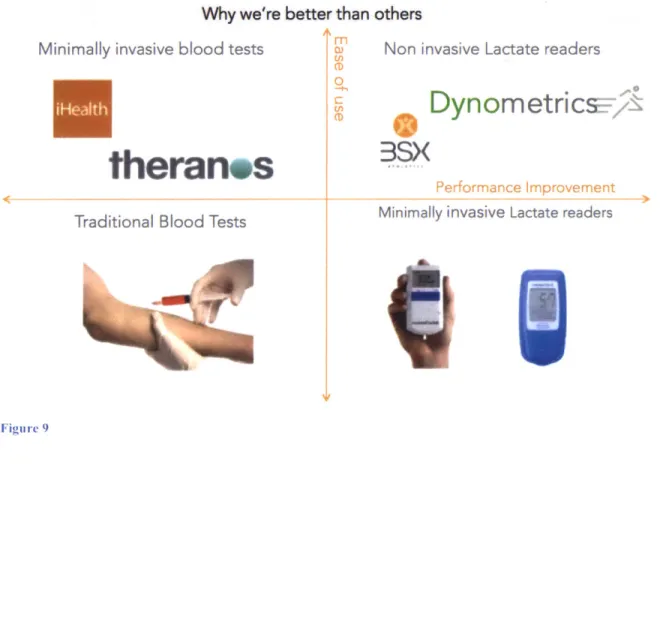
The existing solutions that allow athletes to measure their lactate levels can be divided in 4 main groups as shown below:
i. Traditional Blood Tests
The most common way to know what is in your blood is to do a traditional blood test. These need to be performed by accredited nurses or doctors, usually take up to 15 minutes and can cost up to $250 depending on the location and insight level. For training purposes these are highly inefficient as they require a complete immobilization of the athlete and require a substantial amount of blood to be drawn out of the body. Moreover, very few individual are able to interpret the results on their own and a doctor or nurse needs to act as a translator to gather useful training insights. Most of the coaches we interviewed also admitted they could not fully understand these reports.
ii. Minimally Invasive Blood Tests
This category is very similar to the above but differs on two main points. The first is that the amount of blood drawn out of the body is very small (a drop is usually enough), the second is that the interface that analyses the results is user friendly and does not require a third party, such
as a doctor for example. Two companies worth highlighting are Theranos and iHealth.
Theranos has developed the technology to perform any blood test "A la carte" using only a drop of blood. This allows the process to happen in a pharmacy or even a random store. Customers then choose what tests they want to perform on their blood, say Lactate for $2.99 and receive their results within the hour. Although not rolled out at a large scale in the US, Theranos' business model is highly innovative which allows them to be valued at $9 billions. This company's target market however is far away from athletes as there are targeting people who need to perform blood tests for medical purposes.
iHealth, can be a seen as the new generation of connected devices. They focus on building connected glucose meters to help diabetics keep track of their levels with their phone. The device however requires pricking your finger with a needle, transferring the blood to a strip and putting the strip in the device. The process is not simplified but the users interface to read and analyze the results is very polished. iHealth's goal is to improve the user interface rather than the user experience.
iii. Minimally Invasive Lactate Tests
This third category is the most relevant to Aspire. These portable pricking devices are most commonly used by athletes to measure their lactate levels after a lap or a race as outlined in the introduction. Such a product costs between $300-$2000 plus a $1.5 strip fee per test, is the size
of a smartphone and historically has a very poor user interface. These devices are usually manufactured by healthcare companies and therefore inherit from the poor user experience common to most medical devices. It takes the device, a pricker, a strip and roughly 1 minute to take a measurement invasively. This process also requires a large amount of precaution and hygiene as blood is drawn out of the body using a needle. Most coaches for example are not allowed to use these to prick their clients for liability reasons. Moreover these products do not offer a way of transferring the data to a computing device or directly to a trainer and usually need to be manually recorded.
iv. Non-invasive Lactate Meters
The Aspirel fits in this category. To date our main competitor is BSX training. This company based out of Houston has been working on a optical lactate meter for endurance athletes for the past 4 years, has raised more than $120k on Kickstarter and has started shipping pre-orders in February 2015. Their marketing video advertises a wearable device that works in real time, however, after talking with them multiple times, the advertised product is not what they will ship. In reality, their device is meant to be used every 6-8 weeks on a treadmill to gather insights about an individual's lactate curve, which then needs to be correlated to their heart rate for an every day use. Initial reviews have been very negative and some users are asking for their money back after realizing they could not use the device on a track.
Other competitors in this fourth category include:
Leo - Startup out of Carleton University. They still have not shipped a product but claim to be able to measure more than 9 body parameters including muscle intensity, hydration, balance, lactic acid and heart rate using EMG. We are very skeptical on their ability to deliver the promised product. Their expected shipping price is $299 per device.
e Kenzen has developed the Echo H2 and claims to be able to measure hydration, lactic
acid and calories with biomedical sensors. They are expected to ship at a price of $149 per device.
e LynnTech Inc is an established company that recently received a grant from the
government to expand into real-time lactate monitoring.
(https://www.sbir.gov/sbirsearch/detail/220055). No expected shipping date in the short term had been disclosed yet.
e Power Fit s.r.l. (http://www.powerfitsrl.com/the-company) is an Italian company that
has been doing non-invasive lactate monitoring for a while and holds four relevant patents (http://www.google.com/patents/WO2013045443A I ?cl=en) in the field. There is however no expected product launch yet.
e Gomore is a company that measures only heart rate, but claims that their algorithms
* Moxy has developed the technology that makes muscle oxygenation measurements
possible. They have no consumer offering yet but should be considered as a real competitor.
e Electrozyme is company coming out of Prof. Joseph Wang's lab in California. It does
not have any obvious plans to release a lactate meter as their first product, but they might change direction is the near future. This group also has been working on a tattoo that can monitor lactic acid using sweat.
Figure 9 below gives a visual representation of the above categories.
Why we're Minimally invasive blood tests
theranes
Traditional Blood Tests
better than others
Non invasive Lactate readers
0
C:
.*Dyn
3SX
ometrics-1
Performance Improvement Minimally invasive Lactate readers
VII.
Team
1. Overview
Alessandro Babini and John are cofounders of Aspire. Alessandro grew up in Paris, France, where he attended an international high school. Being passionate about mathematics he decided to pursue his studies in this field at the London School of Economics and Political Science where he earned a degree in Business Mathematic and Statistic with a strong focus on Abstract Mathematics. His strong passion for startups innovation and the entrepreneurial world led him to abandon this field of study after 3 years and start a Masters in Management from HEC Paris. He then joined DN Capital, a cross Atlantic venture capital firm with offices in London and Palo Alto where he was a wearable technology and consumer mobile investor for more than a year. He then joined the MIT Sloan School of Management to complete the MSMS (Masters of Science in Management Study) where he met John, his cofounder. He enjoys squash, travelling and eating.
John was born and raised in California, where, following high school he worked many odd jobs in various trades before returning to college. John received dual B.S. from the University of California, Davis in mechanical engineering, and aerospace science and engineering in 2011. He then completed his S.M. in 2013 at the Massachusetts Institute of Technology, and is currently working towards completing his Ph.D. at MIT, with a focus in adaptive flight control. John is a private pilot and looks forward to obtaining a commercial pilot certificate. He is a fitness enthusiast, enjoys riding motorcycles as well as web & mobile programming. John's expertise in adaptive learning systems for aircrafts is highly applicable to Aspire. His research enables him to understand as much as possible about highly unknown systems (such as the human body) from a very limited number of measurements.
John and Alessandro, after having been through 6 months of market research to validate the opportunity took the decision to assemble a team to build a first prototype. This process took more than a month after which 3 new members where added as early team members.
Jack is a postdoctoral Fellow in the laboratory for Nano-scale Optics at Harvard School of Engineering and Applied Sciences. He earned a PhD in microelectronics from Vienna University of Technology (Austria) and is an expert in developing infrared spectroscopy systems for the detection of toxic chemicals or explosives. He has also been through 2 years of intense research collaboration with the start-up company Eos Photonics Inc and founded the Science Education Platform ScienceClip.at, which received several awards and currently has 1 full-time employee.
Philip is a 2nd year PhD candidate in the Nanoengineering Lab at MIT. He works on developing optical techniques to characterize a material's thermal properties at small length
scales. He has completed one marathon and is hoping do another!
Paul grew up in Austria, where he completed his undergraduate degree in pharmacy at the University of Vienna. In 2014, he received his PhD from Imperial College London, where he worked on metabolism and molecular imaging. Now he is a postdoctoral researcher at the Massachusetts General Hospital and Harvard Medical School and has a strong drive to translate our physiological knowledge into medicines and consumer products that benefit people.
II. Roles and Titles
Names Roles
Alessandro Babini CEO
John CTO
Jack Hardware lead
Philip Optics & Software engineer
VIII.
Business Model
i. Route to Market
As mentioned earlier in this paper, our beachhead market is Marathon Runners. These are the people who we expect to buy the first 10,000 Aspirels. Marathon runners constitute a very attractive group of customer as they form one of the strongest communities in the US. We aim to leverage their meet-ups, organized on a weekly basis across the country to reach them and encourage work of mouth.
Short Term Sales Channel:
We expect to launch our product through a crowd funding campaign in order to generate enough pre-orders to attract funding. We will then focus on selling directly to customers for the first 12 months post-launch, attending meetups and marathon races all over the country. Moreover, we plan to sell a large proportion of our devices through coaches. Most trainers force their athletes to buy certain types of equipment before they start training. This enables them to know if their clients have "done their homework" the same way a teacher would want to know if his/her students have done theirs. We will also sell online internationally.
Long Term Sales
From Year 2 we will focus on building a strong reseller network through gyms initially, sports stores as well as improving our online platform. In the long term we expect to generate 70% of our sales online and 30% through retail stores. We will therefore start investing more significant amounts in online marketing.
ii. Pricing Framework
In the short term (12-24 months) our sole business model will be selling our device for a fixed amount. Access to our platform and app will be completely free. We are still in the process of deciding how much to charge for it but it will be in the $200 - $400 range. This price has been derived from our market research and interview. 85% of people interview mentioned they would pay a price in that range. Gym owners and coaches who own clubs are ready to pay more for it (around $800) which could potential lead us to building a "pro" version for gyms. Finally, athletes who's number goal when they train is to get "fit" would pay $100-$200 for our device.
An additional pricing strategy might lead us to reduce the upfront cost for the device but charge and recurring subscription fee for the software and insight tools. We are still evaluating the feasibility of both possible business models.
iii. CAC/LTV
Customer Life Time Value
The below table provides the best estimate of our forecasted LTV at this time. This will change as our pricing strategy evolves.
Year0 Year1 Year2 Year3 Year4 Year5
Revenue Time Series: Vita-R
Price of Device**** $349 $349 $349
Next Product Purchase rate*** 65% 75%
Gross Margint** 80% 80% 80%
Profit $279 $181.48 $209.40
Cost of Capital 50% 50% 50%
NPV factor 100% 25% 6%
NPV above cost of capital $279 $45.37 $13
NPV of Profits $338
A few assumptions included in the life time value calculation:
* *Average lifespan of a Fitbit is 2 years
e **Based on our understanding of raw material price and manufacturing costs e **Improves with R&D/ Nest Gross Margin is 73%
* ***We target a very committed market so except the repurchase rate to be high
e ***Increases, as our brand gets stronger.
* ****We expect to issue a new, more powerful version of our device every 12 month at scale
Finally this does not include any revenue from potential IP licensing.
Cost of Customer Acquisition
At this stage, our cost of customer acquisition is very hard to estimate as we have not started testing ads on social media websites or tried to sell our device outside the scope of the primary market research.
Figure 10 below, provides a best estimate of our COCA versus LTV today (Month 1 represents
our first month of shipping). The spikes in months 1 and 8 are due to sales person hires whose jobs will be to manage relationships with coaches, gyms and be field representatives for Aspire. From Month 24, the expected ratio LTV to COCA is expected to reach the sweet spot of 3x and
COCA vs LTV
-COCA700
-I 60oj LTV
600 .
500 - * LTV vwaadditional
4-Pouct line and
40. * commercialization of data 300 200 100 0 i. Growth Strategy
Figure II below represents the expected growth path and revenue generated over the next three
years starting on expected shipping day (March 2016). These financials do not include the costs required to prepare the company for preorders (roughly 12 months) for which Aspire will need to receive external funding. After this, our goal is to be able to finance the company's growth from
sales and only require additional external funding in a worst-case scenario.
This scenario assumes we will be able to sell 1500 devices in year one, 10,000 in year 2 and grow up to 65,000 in our third year of operations. A detailed list of assumption can be found in
2,016 2,017 2,018
Device Cost ($) 349 349 349
# of devices sold 1,493 ' 10,430 ' 63,109
Monthly Pre-orders Monthly growth 20% 18% 15% Total Revenue 521,054 3,640,196 22,025,205
COGS per Device sold 208,422 1,274,069 7,708,822 Gross Profit 312,633 2,366,128 14,316,383
Gross Margin (2) 60% 65% 65% Shipping Costs per Device (3) 10 10 10
Total Shipping Costs 14,930 104,304 631,095 Contribution Margin 11 297,703 2,261,824 13,685,289 margin 57% 62% 62% Variable Marketing 26,400 888,000 1,836,000 Contribution Margin 111 271,303 1,373,824 11,849,289 margin 52% 38% 54% Salaries Co-founders Salaries - 40,000 50,000 Researchers Salaries 60,000 70,000 80,000 Engineers Salaries 60,000 70,000 80,000 Other Salaries 50,000 55,000 60,000 Employees Co-founders 2 2 2 Researchers 1 2 4 Engineers 2 2 3 Other Salaries 1 4 4 Total Salaries 212,500 557,083 873,333 R&D (excl Salaries) 36000 60000 120000
Office 18000 24000 60000 Monthly PR 12000 60000 360000 Overhead 12000 60000 120000 Total Opex 290,500 761,083 1,533,333 EBITDA (19,197.4) 612,740.6 10,315,955.2 margin -4% 17% 47% Figure II Yearly Assumptions 2016 2017 2018
Monthly Pre-orders Monthly growth 20% 18% 15%
Gross Margin (2) 60% 65% 65%
Shipping Costs per Device (3) 10 10 10
Monthly Variable Marketing 2,200 74,000 153,000
Monthly PR 1,000 5,000 30,000
Office 1,500 2,000 5,000
Overhead 1,000 5,000 10,000
R&D (excl Salaries) 3,000 5,000 10,000
Co-founders Salaries - 40,000 50,000
Researchers Salaries 60,000 70,000 80,000
Engineers Salaries 60,000 70,000 80,000
Other Salaries 50,000 55,000 60,000
Figure 12
ii. Estimated Costs to shipping
Figure 13 below outlines the expected funding requirement needed by Aspire in order to ship a fully working reliable product by March 16. The below assumptions represent to our best understanding the exact number of employees and overhead costs needed to run the company successfully. We expect hardware and product design costs to vary from month to month as well as the expected marketing expenditure.
We are however confident that a ball park of $300k would allow us to get to a product ready to be shipped, that we are proud of and that fits our lean and productive culture.
Funding Requirement - Dynometrics - Pre Shipping
Expected Shipping - March 2016
Apr-15 May-15 Jun-15 Jul-15 Aug-15 Sep-15 Oct-15 Nov-15 Dec-15 Jan-16 Feb-16 Mar-16
Salaries - - - 16,250 " 16,250 25,833 30,833 30,833 30,833 30,833 Dan - - - - - - -Alessandro - - - - - - -Sam - - - -Sebastian - - - - - - - -Stefan - - - 5,833 5,833 5,833 5,833 5,833 5,833 5,833 Firmware Engineer - - - 5,000 5,000 5,000 5,000 5,000 5,000 5,000
Signal Processing Engineer - - - 5,417 5,417 5,417 5,417 5,417 5,417 5,417 Ul/UX/Designer - - - 4,167 r 4,167 4,167 4,167 r 4,167 Algorythm Engineer - - - 5,417 5,417 5,417 5,417 5,417 Software engineer - - - 5,000 5,000 5,000 5,000 Prototyping 200 200 500 ' 2,500 * 500 10,500 ' 1,000 1,000 8,000 ' 2,000 2,000 2,000 Hardware cost (1) 200 200 500 500 500 500 1,000 1,000 1,000 2,000 2,000 2,000 Tools 5,000 2,000 Product Design 2,000 5,000 5,000 Rent - ' - 7 - 7 - - 1,200 1,200 1,200 1,200 1,200 1,200 1,200 Office 1,200 1,200 1,200 1,200 1,200 1,200 1,200 Overhead 200 ' 200 200 ' 2,700 ' 200 ' 500 ' 15,500 ' 15,500 15,500 ' 16,000 ' 1,000 ' 1,000
Incorporation & trademarking 2,500
Dragon Innovation 15,000 15,000 15,000 15,000
Employee Benefits 200 200 200 200 200 500 500 500 500 1,000 1,000 1,000
Marketing & PR ' - - - - - 1,500 1,000 1,000 ' 1,000 ' 1,000 1,000 1,000
Promotion material for Disrupt 500
Travel for meetups 500 500 500 500 500 500 500
PR materials for meetups 500 500 500 500 500 500 500 TOTAL COSTS 400 400 700 5,200 700 29,950 34,950 44,533 56,533 51,033 36,033 36,033
Total until March 2016 296,467
(1) increases as we test multiples prototypes simulatenoulsy
Figure 13
IX.
PR and Marketing
We plan to start investing time and money into marketing and PR a couple of months prior to the expected pre-order launch date. We are however in the process or rebranding ourselves as "Aspire" is too long, complicated and people think that we are building devices for dinosaurs. Our new name will be "censored". We were offered a booth at the TechCrunch Disrupt event in San Francisco in September where we aim to start investing time and money in marketing and PR. Our focus before then is building a reliable product that our customers want and love.
X.
The Future
As explained earlier on, the mission of Aspire is to develop the technology to enable every human to seamlessly know what is happening in their body at any given point in time without needing a single drop of blood. The quantitative self movement is at an inflection point today
with the market being flooded by fitness and activity trackers that give an approximation of the number of steps walked and calories burnt. We, at Aspire, do not embrace these trackers, as we believe consumers should be able to know much more about the state of their body without having to go to the hospital. This is why we are building the technology that will give people access to factual data about the state of their body at any given point in time and enable them to take sound decisions to improve their general health and performance,
We are focusing our efforts to develop the most reliable lactic acid measurement device on the market, but in the long term, we plan to start building the technology to non-invasively monitor additional blood parameters. Our product will always be built for athletes (teams and individuals) but we will do our best to bring this technology to the amateur consumer market. We will not develop any products for in-hospital use, as our goal is to empower people with the factual data they need to prevent them from ending in any medical facilities.