Modélisation de rupture en béton par éléments discrets
ZHU Ran, Syed Yasir Alam, Ahmed Loukili
GeM Institute, École Centrale de Nantes/Université de Nantes/CNRS, 1 rue de la Noë, 44321 Nantes, France - {ran.zhu ; Syed-Yasir.Alam ; Ahmed.Loukili}@ec-nantes.fr
RÉSUMÉ. L’effet d’échelle est un problème majeur dans la conception des structures. Ce problème devient de plus en plus complexe et prononcé dans le béton car ces matériaux ne possèdent pas d’adoucissement plastique, et leur rupture est due à la fissuration caractérisée par une grande zone de microfissuration (fracture process zone). Cette fissuration passe par un adoucissement sous la forme de microfissures et de glissement interparticules. Cette étude utilise la méthode des éléments discrets (MED).
Le modèle de contact linéaire n’est pas adéquat pour les matériaux comme le mortier et le béton dont le rapport de résistance à la compression sur la résistance à la traction est très élevé. De ce fait, le modèle de contact a été modifié pour la modélisation du béton, dont trois types de contact différents pour trois phases sont distinguées (matrice, interface et granulats). Pour la détermination des paramètres micromécaniques, l’algorithme de Levenberg-Marquardt (LM) est proposé. Les résultats montrent que l’approche MED est capable de reproduire le comportement à la fissuration locale du béton.
ABSTRACT. Size effect has been a major problem in the design of structures. The problem becomes more acute and complex in concrete as these materials are incapable of plastic yielding, failing due to fracture characterized by a large fracture process zone (FPZ) that undergoes distributed strain-softening in the form of microcracking and fractional slip. This study uses discrete element approach to model concrete.
The linear contact model inserted in DEM is not suitable to satisfy the materials like mortar and concrete with high unconfined compressive strength to tensile strength (UCS/T) ratio. So the contact model is improved for concrete modeling where three types of contacts are determined for three phases (matrix, interface and aggregate). For micro parameters determination, Levenberg-Marquardt (LM) algorithm is used. The results show that DEM approach can be and suitable for modelling the local fracture behavior of concrete.
MOTS-CLÉS : béton, zone de microfissuration, MED, algorithme de LM KEY WORDS: concrete, fracture process zone, DEM, LM algorithm.
100
sciencesconf.org:rugc17:139790
35èmes Rencontres de l’AUGC, ECN/UN, Nantes, 22 au 24 mai 2017 2
1. Introduction
Concrete is a typical quasi-brittle material. Compared with those materials, its mechanical behaviors and rupture processes are so complicated. Still now there are many controversial issues. The microstructure features of concrete such as aggregate size, shape and volume fraction have certain effects on its macroscopic mechanisms, as it leads to the development of a microcracking zone which causes large energy dissipation. Macroscopic mechanical models explicitly take into account the nonlinear zone where the microcracking occurs. It somehow resolves the issue of softening the damage in the fracture process zone but still not being completely able to handle important structural problems like size effect and boundary effects. Moreover, the local fracture characteristics cannot be captured. So the numerical investigation of concrete behavior at the meso-scale is carried out by using Discrete Element Modeling (DEM). A 3-phase (matrix, interface and aggregate) body is used in concrete modeling. The effects of aggregate and specimen size on the behavior of concrete on the stress– strain curve, volume change and fracture process were shown. The DEM results at the global level were compared with the corresponding experiments.
2. DEM approach
The particle elements are assumed either rigid discs in 2D or rigid spheroids in 3D. These particles can overlap or detach, when the system is subjected to mechanical actions. The concept of DEM is based on the translational and rotational movement of particles due to forces and moments which act at the contact point between the particles.
While the micro-parameters of insert contact bond model in DEM could not satisfy the compressive strength and tensile strength simultaneously. Potyondy [POT 04] and Schopfer[SCH 09] showed that when the model is calibrated to match the UCS experiment of rock, the tensile strength of rock is significantly overestimated.. The reason is that the tensile strength and compressive strength are increased with the increase of bond tensile strength (
c). While for the brittle materials like rock and concrete, the compressive strength is about one order of magnitude lager than tensile strength. As a result, the micro parameter
c for compressive strength is also about one order of magnitude larger than tensile strength. Therefore, the parallel bond model inserts in DEM is no longer suitable for the simulation of brittle, like rock and concrete. So in this paper, the model developed by [DIN 14] is adopted. The new model introduces
1 to control the contribution of moments to the maximum normal and shear contact stresses, as expressed below:max 1 max n s s
F
M R
A
I
F
A
[1]Where
max,
max,F
n,F
s,M
nandM
s are as defined earlier; and
1 is ranging from 0 to 1. When
1 equals to 1, Eq. [1] reduces to the equation for the default contact model.The new contact model also assumes that the shear strength follows the Coulomb criterion as shown in Figure 1.In the new contact model, the shear strength is determined by:
tan
C
tan
1
tan
1
s n n s nif
C
C
if
C
[2]Where
nthe normal is contact stress;C
is the cohesion strength;
is the friction angle and
is the parameter that determines the ratio of the maximum shear strength over the cohesion strength.After shear failure, the cohesion is set to zero and the frictional angle can decrease to residual angle
r and the shear strength is determined by:tan
s n r
[3]101
sciencesconf.org:rugc17:139790
DEM approach for modeling fracture behavior of concrete 3
Figure 1. Shear strength criterion
Thus, the newly contact model contains the following microscopic parameters:
,k
n,k
nk
s,C
,
t,
1,
,
,
rIn order to perform the model, a parametric study was carried out to investigate the effect of parameters on the stimulated macroscale properties. According to the previous work [TAN 08], the ratio of strength properties of aggregate, mortar and interface is 7:2.5:1. In present study, this ratio is adopted in order to save time for concrete modeling. In addition, Levenberg-Marquardt(LM) algorithm [LEV 44; MAR 63], which is also known as the damped least-squares (DLS) method, is used for parameters selecting.
2.1 Development and calibration of parameters for mortar
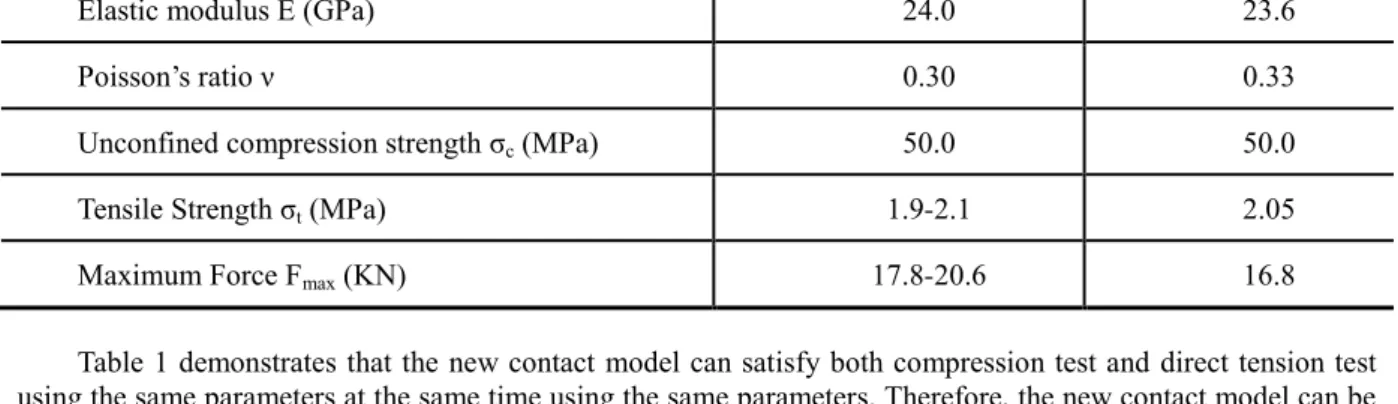
The aforesaid ratio for 3 phases concrete model is given, so the parameters for mortar need to be determined first. The numerical model with a size of 40×40mm was generated for unconfined compression test and model with a size of 110×400mm for direct tension test. In addition, the comparison between the experimental results and modeling results are listed in Table 1.
Table 1. Comparison between laboratory tests and modeling results
Mechanical properties Experiment Results DEM Modeling
Elastic modulus E (GPa) 24.0 23.6
Poisson’s ratio ν 0.30 0.33
Unconfined compression strength σc (MPa) 50.0 50.0
Tensile Strength σt (MPa) 1.9-2.1 2.05
Maximum Force Fmax (KN) 17.8-20.6 16.8
Table 1 demonstrates that the new contact model can satisfy both compression test and direct tension test using the same parameters at the same time using the same parameters. Therefore, the new contact model can be used for mortar by means of LM calibration procedures to determine the micro parameters.
3. Concrete Modeling
In this part, compression test and Brazilian test are adopted for calibration processes. The size of specimen for modeling is 0.11×0.22m2 for compression test and Φ0.11m for Brazilian test in 2D. Aggregates are modeled
by using clusters. A cluster is defined as a set of particles that are bonded to one another (Figure 2) and intra-cluster particles in intra-clustered material have rotational velocities.
102
sciencesconf.org:rugc17:139790
35èmes Rencontres de l’AUGC, ECN/UN, Nantes, 22 au 24 mai 2017 4
Figure 2. Cluster particles.
Using the same calibration procedures, the obtained data with the experimental data are listed in Table 2.
Table 2.Results of using clusters and laboratory tests.
Property Laboratory tests Concrete Modeling Results
Unconfined compressive strength(σc) (MPa) 42.6±0.64 42.6
Young’s Modulus(E) (GPa) 35.0±2.0 33.4
Brazilian tensile strength(σb) (MPa) 3.8±0.36 3.97
Direct tensile Force maximum(Fmax) (kN) 24.2±1.8 22.7
Table 2 illustrates that the modeling results can properly predict then behaviors of concrete both in compression and tension.
4. Conclusion
DEM modeling approach can be used in concrete fracture modeling by modifying the default model insert in DEM.
Cluster particles can properly model the behaviors that aggregates can break in the tests. DEM is suitable to investigate the local fracture behaviors in the fracture processes of concrete.
5. Bibliography
[CHE 04] Chen, B. and J. Liu, « Effect of aggregate on the fracture behavior of high strength concrete », Construction and Building Materials, vol. 18, n° 8, 2004 p. 585-590.
[POT 04] Potyondy, D. and P. Cundall, « A bonded-particle model for rock », International journal of rock mechanics and mining sciences, vol. 41, n° 8, 2004 p. 1329-1364.
[SCH 09] Schöpfer, M.P., et al., « The impact of porosity and crack density on the elasticity, strength and friction of cohesive granular materials: insights from DEM modelling », International journal of rock mechanics and mining sciences, vol. 46, n° 2, 2009 p. 250-261.
[DIN 14] Ding, X. and L. Zhang, « A new contact model to improve the simulated ratio of unconfined compressive strength to tensile strength in bonded particle models », International journal of rock mechanics and mining sciences, vol. 69, 2014 p. 111-119.
[TAN 08] Tang, X., C. Zhang, and J. Shi, « A multiphase mesostructure mechanics approach to the study of the fracture-damage behavior of concrete », Science in China Series E: Technological Sciences, vol. 51, n° 2, 2008 p. 8-24.
[LEV 44] Levenberg, K., « A method for the solution of certain non-linear problems in least squares », Quarterly of applied mathematics, vol. 2, n° 2, 1944, p. 164-168.
[MAR 63] Marquardt, D.W., « An algorithm for least-squares estimation of nonlinear parameters », Journal of the society for Industrial and Applied Mathematics, vol. 11, n° 2, 1963, p. 431-441.