HAL Id: tel-01915196
https://tel.archives-ouvertes.fr/tel-01915196
Submitted on 7 Nov 2018
HAL is a multi-disciplinary open access archive for the deposit and dissemination of sci-entific research documents, whether they are pub-lished or not. The documents may come from teaching and research institutions in France or abroad, or from public or private research centers.
L’archive ouverte pluridisciplinaire HAL, est destinée au dépôt et à la diffusion de documents scientifiques de niveau recherche, publiés ou non, émanant des établissements d’enseignement et de recherche français ou étrangers, des laboratoires publics ou privés.
user-oriented evaluation
Ahmed Mohammad Al Othman
To cite this version:
Ahmed Mohammad Al Othman. Information model for representing people’s needs in charity orga-nizations work in Saudi Arabia : towards a user-oriented evaluation. Computers and Society [cs.CY]. Université Charles de Gaulle - Lille III, 2017. English. �NNT : 2017LIL30046�. �tel-01915196�
Abstract
The aim of this study is to develop an information model for representing people’s needs in charity organizations of Saudi Arabia. The target population are the charity organizations that are concerned with donations gathering and distribution to their constituents.
The aim of this study is achieved through three objectives; the first objective is to identify the current state of information systems use in the sector of charity organizations. The second objective is to identify the information needs of those charity organizations with regard to their constituents. By using the sense-making theory and its set of methods, we were able to understand the informational needs from the perspective of the users themselves. The third objective is to match the resulting sets of informational needs of charity organizations with the dimensions of human development needs by Narayan et al., (2000) which was researched to inform the World Development report on Poverty and Development. This study is significant because it was not conducted in that scale or scope before, and it provides a clear picture of the current state of information systems use in the sector, it also provides a research informed model, which will help better fulfill the needs of the poor people registered at those charities. The information needs model resulting from this study provides a valuable building block for a future information system, which is based on research data to improve efficiency, reliability and accountability in donations management for the wellbeing of the constituent.
The data for this research was collected through two studies, the first study was targeted at the whole population of charity organizations through an electronic survey, and the final case number was 83 charities. This study aimed at investigating the current
charity with regard to constituents and donations. The interviews were conducted face-to-face with each single case in the second study.
The results of this research show that the use of information systems at charities is widespread, with 89.2% of charities using an IS in some or all work processes. It also revealed the diversity of processes in which charities employee IS, comprising 4 major themes and 22 distinct work processes. It also revealed that the information needs of charity organizations has seven distinct sets, and each set included between 2 and 19 information gaps. The results also show that the information needs of charities has a great coverage of the wellbeing dimensions of the World Development report of 2000/2001, spanning from 50% to 100% coverage. It also revealed that the number of all information sources, which could bridge the information gaps, are 18 sources spread across five sectors in the country.
The information needs model for representing people’s needs was a result of the combination and analysis of all research findings to develop that model. It has nine dimensions of information and its corresponding data inputs, leading to the desired knowledge about the constituent. The model covers all aspects of the life of the constituent and can be modified by individual charities to satisfy their own objectives and to lead to new and relevant knowledge.
The implications of these results and suggestions for future work are presented at the end of this thesis to make full use of the results in improving the wellbeing of constituents of charity organizations, and to maximize the impact of donations and the efficiency of charitable work.
Keywords: sense-making, information needs, Saudi Arabia, charity originations, poor people, information model, wellbeing of the poor people, dimensions of wellbeing, representing poor people’s needs, charitable societies, information systems
Résumé en Français
NB: Un résumé étendu et complet en français se trouve en annexe
L'objectif de cette étude est de développer un modèle d'information pour représenter les besoins des personnes dans les organismes de bienfaisance de l'Arabie Saoudite. La population cible sont les organismes de bienfaisance qui s'intéressent à la collecte et à la distribution des dons à leurs électeurs.
Le but de cette étude est atteint par trois objectifs ; Le premier objectif est d'identifier l'état actuel de l'utilisation des systèmes d'information dans le secteur des organismes de bienfaisance. Le deuxième objectif est d'identifier les besoins d'information de ces organismes de charité à l'égard de leurs bénéficiaires.. En utilisant la théorie des sens et son ensemble de méthodes, nous avons pu comprendre les besoins informatiques du point de vue des utilisateurs eux-mêmes. Le troisième objectif est de faire correspondre les besoins résultant des besoins d'information des organismes de charité avec les dimensions des besoins de développement humain par Narayan et al., (2000) qui a été étudié pour informer le rapport sur le Développement Mondial de la Pauvreté et du Développement. Cette étude est significative parce qu'elle n'a pas été menée dans cette échelle ou cette portée avant, et elle fournit une image claire de l'état actuel de l'utilisation des systèmes d'information dans le secteur, elle fournit également un modèle de recherche éclairé qui aidera à mieux répondre aux besoins des personnes pauvres inscrites dans ces organismes de bienfaisance. Le modèle de besoins d'information résultant de cette étude fournit un élément précieux pour un système d'information futur, basé sur des données de recherche visant à améliorer l'efficacité, la fiabilité et la responsabilité dans la gestion des dons pour le bien-être du constituant.
information supplémentaire sur l'adaptation des SI futurs. La deuxième étude a été une entrevue avec 15 organismes de bienfaisance de la région de Riyad. Ils comprenaient des organismes de bienfaisance masculins et féminins, et des organismes de bienfaisance de différentes localités comme le village et la petite ville. Cette étude a utilisé la théorie des sens de Brenda Dervin pour étudier les besoins d'information du point de vue de l'utilisateur à l'organisme de bienfaisance en ce qui concerne les bénéficiaires. et les dons. Les entrevues ont été menées face à face avec chaque cas dans la deuxième étude.
Les résultats de cette recherche montrent que l'utilisation des systèmes d'information dans les organismes de bienfaisance est répandue, avec 89,2% des organismes de bienfaisance utilisant un SI dans certains ou tous les processus de travail. Il a également révélé la diversité des processus dans lesquels les organismes de bienfaisance employés SI, comprenant 4 thèmes majeurs et 22 processus de travail distincts. Il a également révélé que les besoins d'information des organismes de charité ont sept ensembles distincts, et chaque ensemble comprend entre 2 et 19 lacunes en matière d'information. Les résultats montrent également que les besoins d'information des organismes de bienfaisance ont une grande couverture des dimensions de bien-être du rapport sur le développement mondial de 2000/2001, couvrant une couverture de 50% à 100%. Il a également révélé que le nombre de toutes les sources d'information, qui pourraient combler les lacunes en matière d'information, sont 18 sources réparties dans cinq secteurs dans le pays.
Le modèle de besoins d'information pour représenter les besoins des personnes résulte de la combinaison et de l'analyse de tous les résultats de la recherche pour développer ce modèle. Il a neuf dimensions de l'information et ses entrées de données correspondantes, conduisant à la connaissance souhaitée sur le constituant. Le modèle couvre tous les aspects de la vie du constituant et peut être modifié par les organismes de bienfaisance individuels pour satisfaire leurs propres objectifs et conduire à des connaissances nouvelles et pertinentes.
le bien-être des bénéficiaires des organismes de bienfaisance et pour maximiser l'impact des dons et l'efficacité du travail de bienfaisance.
Mots-clés : sensibilité, besoins d'information, Arabie Saoudite, origines de la charité, personnes pauvres, modèle d'information, être des pauvres, dimensions du bien-être, représentation des besoins des pauvres, sociétés de bienfaisance, systèmes d'information.
Dedication
This work is dedicate to my loving parents, Mohammad Alothman and Tarfah Al Tamymy, whom supported me in all possible ways to achieve this goal. This work is also dedicate to all the great people, men and women, working in the charity sector and giving their valuable time, year after year, to make life better for people in need.
Acknowledgement
I would like to thank my Director Professor Widad El Hadi, for her continuous support and guidance in my thesis and my training as a doctor. I hold the deepest gratitude for her efforts during my thesis years, which allowed me to see this scientific endeavor to its completion.
I also acknowledge the help and support I received from the Ministry of Labor and Social affairs, and especially Dr. Khalid Al Sarhan, who supported my work and facilitated my data collection phase. In addition, I would like also to thank my colleagues at the laboratory GERIICO for our many fruitful scientific discussions that helped me during the years of my research. I also extend my gratitude to my friends, their friendship made living abroad, and away from one’s home and family seem bearable and even enjoyable.
I am also grateful for the Ministry of Education of Saudi Arabia and the Saudi cultural office in Paris for the scholarship and the many ways they supported me during my residency in France for the goal of obtaining a PhD to support our national development.
I thank Allah, most merciful and most gracious, for guiding me through the years and allowing me this chance to develop into a better and more useful person, to myself, and to society.
Organization of the thesis
Chapter 1: Introduction ... 23
Chapter 2: Literature Review ... 29
Chapter 3: Research Methodology... 69
Chapter 4: Analysis ... 85
Chapter 5: Conclusion... 127
References ... 143
Appendices ... 153
Table of contents
Abstract ... 3 Résumé en Français ... 5 Dedication ... 9 Acknowledgement ... 11 Chapter 1: Introduction ... 231.1 Context of the study ... 23
1.2 Problem Statement ... 24
1.3 Aim and Scope ... 24
1.4 Significance of the study ... 25
1.5 Overview of the study ... 25
1.6 Assumptions ... 26
1.7 Research process of the study ... 26
1.8 Delimitation of the study ... 28
1.9 Definition of terms ... 28
Chapter 2: Literature Review ... 29
2.1 Overview of the chapter ... 29
2.2 What is Knowledge Management ... 29
2.2.1 Conceptions of knowledge ... 31
2.2.2 Knowledge creation models ... 33
2.2.3 The knowledge hierarchy ... 37
2.3 Human information behavior and practice ... 41
2.4 Information needs ... 45
2.5 Sense-making theory ... 46
3.3 Population ... 70
3.4 Sample and sampling procedure ... 70
3.4.1 Study one ... 70
3.4.2 Study two ... 71
3.5 The instrument ... 73
3.6 Software used ... 77
3.7 Language of the survey ... 78
3.8 Respondents ... 78
3.9 Evaluation of the instrument ... 79
3.9.1 Field pretesting... 79
3.9.2 Expert Panel ... 80
3.10 Response rate and final dataset ... 81
3.11 Ethical considerations ... 81
3.12 Summary of the chapter ... 82
Chapter 4: Analysis ... 85
4.1 Overview of the chapter ... 85
4.2 Study one data analysis ... 85
4.2.1 Study one sample demographic characteristics ... 85
4.2.2 Missing values analysis... 86
4.2.3 The use of information systems for donations ... 87
4.2.4 Constituents at Bir charities ... 95
4.2.5 Adaptation of a unified information system ... 96
4.3 Study Two data analysis ... 98
4.3.1 Study two sample demographic characteristics ... 98
4.3.2 Data collection and preparation for analysis ... 99
4.3.3 Sets of informational needs ... 100
4.3.4 Cases analysis ... 102
4.3.5 Set 1: Registration of new constituents ... 102
4.3.6 Set 2: Determining donation needs ... 106
4.3.7 Set 3: Confirmation of those needs ... 107
4.3.10 Set 6: Unregistering a constituent ... 111
4.3.11 Set 7: Evaluating the impact of those donations on constituents ... 113
4.3.12 Sources of information ... 114
4.4 Dimensions of information needs and dimensions of human needs ... 119
4.5 Summary of the chapter ... 125
Chapter 5: Conclusion... 127
5.1 Overview of the chapter ... 127
5.2 Major findings ... 127
5.2.1 Information systems use at Bir charities ... 128
5.2.2 Information needs at Bir charities ... 129
5.2.2.1 Sets of information needs... 129
5.2.2.2 Sources of information ... 134
5.2.3 Dimensions of human development needs and information needs ... 136
5.2.4 Information model for representing people’s needs at charities ... 137
5.3 Implications of the study ... 141
References ... 143
Appendices ... 153
List of tables
Table 1 Sub-components of situation division suggested in interviewing method by
(Dervin, 1999) ... 49
Table 2 Adapted from Nussbaum List of central human functional capabilities. (Nussbaum, 2001). ... 52
Table 3 Dimensions of wellbeing from the point of view of the poor men and women in (Narayan et al., 2000) ... 54
Table 4 Types of charity organizations and its relation to government ministries ... 56
Table 5 Types, categories, and count of charitable organizations in Saudi Arabia ... 57
Table 6 A brief example of activates of charities concerned with this study ... 58
Table 7 Charity distribution by region and category ... 59
Table 8 Bir charities ratio to region population ... 61
Table 9 Types of aid provided to charities by the Ministry of Social Affairs (Ministry of Social Affairs, 2013)... 62
Table 10 Al-Jouf Bir Charity registration request form (adapted from (Al-Jouf Bir Charity, 2016) ... 64
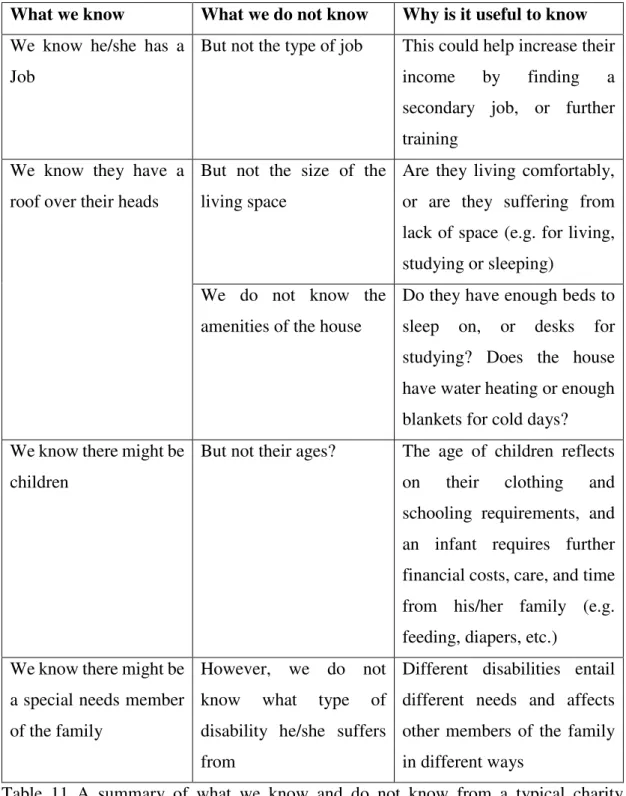
Table 11 A summary of what we know and do not know from a typical charity registration form, and what benefit we get from knowing it. ... 65
Table 12 Stratification attributes/criteria of the study two sample frame ... 71
Table 13 New stratification attributes/criteria of the study two sample frame ... 72
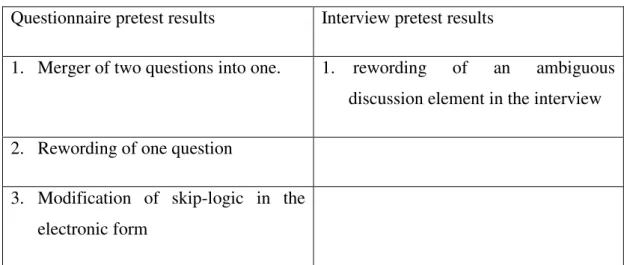
Table 14 Summary of the instruments pretest ... 80
Table 15 Expert panel review result for the instruments ... 81
Table 16 Employment of IS in charities for Needs evaluation ... 91
Table 17 Employment of IS in charities for Donations ... 92
Table 26 Information needs set 4: Follow-up on constituents' satisfaction about
donations ... 109
Table 27 Information needs set 5: The long-term follow-up of constituent needs .... 110
Table 28 Information needs set 6: unregistering a constituent ... 113
Table 29 Information need set 7: Evaluating the impact of those donations on constituents ... 114
Table 30 Breakdown list of first dimension of human development needs and informational needs ... 121
Table 31 Breakdown list of second dimension of human development needs and informational needs ... 121
Table 32 Breakdown list of third dimension of human development needs and informational needs ... 122
Table 33 Breakdown list of fourth dimension of human development needs and informational needs ... 124
Table 34 Breakdown list of fifth and sixth dimension of human development needs and informational needs ... 125
Table 35 Breakdown list of sources of information... 135
Table 36 Dimensions of information and its essential data inputs ... 138
List of figures
Figure 1 Research process flow chart of the study ... 27 Figure 2 The interplay between knowledge and knowing, adapted from (Cook and
Brown, 1999) ... 32 Figure 3 Nonaka's model of knowledge creation, adapted from (Nonaka, 1994) ... 34 Figure 4 Organizations and knowledge types, adapted from (Blackler, 1995) ... 35 Figure 5 Spender's forms of knowledge, adapted from (Spender, 1996)... 36 Figure 6 Methods of transforming Data into Information. Adapted from (Davenport and
Prusak, 2000) ... 38 Figure 7 Transformation of Information to Knowledge. adapted from (Davenport and
Prusak, 2000). ... 39 Figure 8 Illustration of the concept of understanding based on Ackoff's description . 40 Figure 9 Common representation of the Wisdom Hierarchy ... 41 Figure 10 Wilson's information-seeking behavior revised model (Wilson, 1997). ... 43 Figure 11 Information Behavior general model revised (Wilson, 1997). ... 44 Figure 12 Charities distribution by region ... 58 Figure 13 Bir charities distribution by region ... 60 Figure 14 The information model for representing people’s needs in charities of Saudi
Arabia ... 67 Figure 15 Representation of the sample structure for studies one and two ... 70 Figure 16 Study one and two sampling process of the study ... 73 Figure 17 the interview technique implemented for the study ... 75 Figure 18 Respondent Bir charities regional distribution for study one ... 86 Figure 19 Use of information systems in the work processes at charities ... 87 Figure 20 Reasons for not using an information system at Bir charities ... 88
Figure 27 Structure of the gap 1 in set 1 ... 102 Figure 28 Sources of information: The private sector ... 115 Figure 29 Sources of information: the government, part one ... 116 Figure 30 Sources of information: the government, part two ... 117 Figure 31 Sources of the information: The Charity ... 118 Figure 32 Information needs set 1 and corresponding gaps ... 129 Figure 33 Information needs set 2 and corresponding gaps ... 130 Figure 34 Information needs set 3 and corresponding gaps ... 131 Figure 35 Informational needs set 4 and corresponding gaps... 131 Figure 36 Informational needs set 5 and corresponding gaps... 132 Figure 37 Information needs set 6 and corresponding gaps ... 133 Figure 38 Information needs set 7 and corresponding gaps ... 134
Chapter 1:
Introduction
1.1
Context of the study
The total number of charity organizations in Saudi Arabia have reached 601 by 2011-2012 with 15,375 workers spread over 13 regions of the country, in the same year; the Ministry of Social Affairs have supported those organizations by 753,730,549 SAR, from that amount, the physical donations provided by the ministry was 18,210,807 SAR (Ministry of Social Affairs, 2013). The yearly statistical book of Ministry of Social Affairs for the year 2011-2012 does not mention the amount of physical donations given to those charity organizations by the public, which we suspect, exceeds the governmental amount by several folds.
There are three objectives of this study. The first objective is to identify the current state of information systems use in the sector of charity organizations. This investigation includes a detailed analysis of the work processes where information systems are used. Moreover, the reasons that prevent a charity from using any IS in their work tasks.
The second objective is to identify the informational needs of those charity organizations with regard to their constituents. By using the Sense-making theory (Dervin, 1992) and its set of methods, we will be able to understand the informational needs from the perspective of the users themselves.
The third objective is to match the resulting sets of informational needs of charity organizations with the dimensions of human development needs by Narayan et al., (2000) which was researched to inform the World Development report on Poverty
By achieving those objectives, we will be able to develop an information model for representing people’s needs that is research informed and from the viewpoint of the user.
We hope that, by developing this information model, a unified and research informed information system can be developed, and used by all charities to improve efficiency, transparency, reliability and resources management within a single charity, and among charities and their constituents. In addition to, promoting inter-charities resources sharing and savings. The implementation of such information system will also help in improving the speed and precision of distribution, and will accumulate significant statistical data about needs and trend patterns across the nation, which will inform a continues cycle of policies and programs evaluation and improvements.
1.2
Problem Statement
1. What is the level of implementation of information systems in charities of Saudi Arabia in all aspects related to constituents?
2. What are the processes in which information systems are used?
3. What are the informational needs of charity organizations from the user's perspective with regard to constituents’?
4. How much of that information needs satisfies and falls under the human development dimensions?
1.3
Aim and Scope
The Aim of this study is to develop an information model for representing people’s needs at charitable societies as a prelude to a future information system, which reflects the multi-dimensionality aspect of the constituent’s needs.
The scope of this research is limited to charity organizations working domestically and categorized as Bir charities, which means that their main objective is to assist poor individuals and households using various forms of donations, e.g. cash, shopping cards, gifts, food baskets, etc.
Although the title Bir charity refers to the type of work the charity performs, and defines its programs and policy in general, many charities under this category refer to themselves as charitable societies. When a charity does so, then this means they do the work of a Bir charity in addition to other services, such as consultation and development programs. However, the constituents in both cases are essentially the same.
1.4
Significance of the study
This study is significant in several ways. First, it gives a clear picture of the status of information systems used in charities in general. This includes the level of implementation, and analysis of work processes involved.
Second, it provides complete sets of information needs of charity organizations in their work processes related to constituents. These information needs sets serve as the building blocks for the information model representing the informational needs from the perspective of the user.
This information model, in turn, is a crucial step in designing an efficient and useful information system for any or all charities in the sector.
Third, the resulting information needs are compared and matched with human development needs dimensions, defined in the international multicultural study by the poverty group at the World Bank, (Narayan et al., 2000). This helps put in perspective the position of local charities in context of established international human development needs.
Those objectives have not been studied in this context and scope before. In addition, it will be an important base for the development of new and more useful information systems in the charity sector, or modification of existing systems.
Stage 4: Choice of Technique and Data collection methods
Stage 5: Data collection and corrections
Stage 6: Data analyses, findings, and development of the final IS model
Stage 7: Conclusion and recommendations
1.6
Assumptions
The following assumptions were made for the study:
1. Participants in the study are aware of the benefit of technology in work
2. They are knowledgeable about charity work in general and the information needs in their routine work tasks
3. Participants have a shared goal of satisfying the needs of their respective constituents
4. Participants are free to criticize and suggest alternative solutions to current processes and systems
5. Through Sense-making theory we are able to understand the informational needs of the participants/users from their perspective
1.7
Research process of the study
1.8
Delimitation of the study
The study is limited to charity organizations that are working within Saudi Arabia, and registered at the Ministry of Labor and Social Development and are active during the time of study. The number of research subjects for study one and two is discussed in detail in Chapter 3: Research Methodology.
1.9
Definition of terms
Following are definitions of terms for the purpose of the study:
MLSD: Is an acronym for The Ministry of Labor and Social Development.
MOSA: referred to the ancient ministry of Social Affairs before being merging with the Ministry of Labor, creating the new Ministry of Labor and Social Development 2016.
Bir Charity: Bir is an Arabic word, which refers to the act of giving back the good deeds one received during his/her lifetime. A Bir charity therefore is concerned with compensating people in need using different forms of donations, as clothing, household equipment, food, etc.
Charitable Society: Another name of a Bir charity, which adds to the scope of the charity. When a charity names itself as a charitable society, then this means its objectives exceed feeding and clothing to development, community activities and consultation.
Constituent: Refers to individuals whom enroll at a charity to receive help and support in order to overcome poverty or difficulties in life, which they are unable to overcome by themselves.
Information system: Refers to “integrated set of components for collecting, storing, and processing data and for providing information, knowledge, and digital products” (Zwass, 2016)
Poor people: The term poor people may not sound appropriate or politically correct to use, and could be replaced by the term ‘poverty stricken people’ or ‘people living in poverty’. However, since the main reference work use it in the studies of the World bank poverty group (World Bank, 2000), we decided to follow that pattern.
Chapter 2:
Literature Review
2.1
Overview of the chapter
The aim of this chapter is to review relevant literature about key concepts of this research, including information and knowledge, knowledge creation, information needs, human information behavior and the Sense-making theory. We will also review dimensions of human development needs, charities in Saudi Arabia, and present the informational problem and information model by the end of this chapter.
2.2
What is Knowledge Management
Knowledge management involves all aspects and life stages of knowledge, starting from its creation through its preservation, including manipulation, dissemination, and its consumption.
There are different perspectives to understanding and defining what knowledge management is, (Broadbent, 1998) defines knowledge management from the information profession point of view as:
Enhancing the use of organizational knowledge through sound practices of information management and organizational learning
She adds that the purpose of this management is to bring value to the business by creating purposeful management practices to capture information and exploit it to the benefit of the organization itself. To Broadbent (1998), the successful management of knowledge relies on two factors. First, the use of the organization’s current
making it a productive factor in achieving the organization’s goals and ensuring continues innovation, (Beijerse, 2000; Newell et al., 2009).
Beijerse regards the effective use of knowledge a necessity in the modern life competition among enterprises in the knowledge economies, a competitive edge that needs to be leveraged in order to stay ahead in the business environments. To him, knowledge itself consists of three components, the explicit component, which is information, and the implicit component that is within the people, namely the attitude and the capacity. The attitude refers to the desire to create knowledge by thinking and acting and the capacity is one’s ability to transform raw data to useful information.
Davenport and Prusak (2000) highlight the importance of good sense in managing knowledge, and that successful knowledge management starts with a high-value knowledge within the organization. In their integrative view of knowledge management, they recognize that good practices in managing information systems, organizational change, and human resources practices are sources that maybe already established at the organization of which knowledge management can draw from.
To successfully manage knowledge; organizations must recognize the multi dimensionality of knowledge management, it is not simply technological systems and internal processes working together, but rather the integration of the organization’s culture and change management with those systems and processes, (Ashok, 2004).
Drucker (1969) shed light on the change from the economy of goods (in industrial nations) to the knowledge economy, where a big portion of a gross national income is earned by production, distribution and procurement of information. The knowledge economy needs more than the worker’s hand skills, it requires also his knowledge. Drucker explains:
Today the center is the knowledge worker, the man or woman who applies to productive work ideas, concepts, and information rather than manual skills or brown.
He explains that knowledge has become the foundation of economy and the primary industry in the sense that it is which “supplies to the economy the essential and central resources for production” (Drucker, 1969).
Knowledge management can be seen as a response to the changing typology of organizations as they are “increasingly stretched across time and space, reorganized around process or product line, and restructured around virtual teams and networks” (Scarbrough and Swan, 2001). Through Knowledge management, the intellectual capital can be maintained and leveraged, and the organization’s competitive advantage can be increased through the integration of their most strategically important asset; Knowledge (Quinn, 1992; Grant, 1996).
2.2.1
Conceptions of knowledge
In knowledge management, there are two conceptions of knowledge, the first conception views knowledge as an epistemology of possession, meaning that knowledge is a trait of the cognition of the humans, which can be developed and applied to work. The second conception views knowledge as the epistemology of practice, that is to say, knowledge stems from what people practice. It is not within the human mind, rather what people share and experience. It is bound to context and interaction among humans, (Cook and Brown, 1999). To Cook and Brown, the epistemology of possession refers to knowledge, while the epistemology of practice should be referred to as knowing, and they argue that those two forms of knowledge are complimentary to each other, they are not competing, rather one enables the other. In that view, they add that knowledge manifest in four distinct forms, the tacit, the explicit, and the individual’s and group’s knowledge, each of those four forms cannot do the work of the other, and by treating knowledge in action as knowing, we can better understand the process of learning and innovation in human groups.
1. Equivocal, that means knowledge is not one truth, and that it is open to interpretations
2. Dynamic, which meaning that it is changing and sensitive to situations and actors
3. Context-dependent, that is, each context will produce a unique knowledge, it is not rigid (Newell et al., 2009)
In the processual conception of knowledge, it is bound to context and embedded in the social interaction and sharing, it is in between two conceptions of knowledge, the structural conception that views knowledge as within the mind, and the practice conception which differentiates between knowledge embedded in the cognition and knowing which is embedded in what we do, the work.
2.2.2
Knowledge creation models
There are several frameworks for understanding knowledge creation and knowledge types in organizations. Those frameworks present various theoretical perspectives depending on distinct conceptions of knowledge. Described below are a selection of three frameworks that distinctly vary with regard to conceptions of knowledge and approaches to managing knowledge, namely (1) Nonaka (1994); Nonaka and Takeuchi (1995), (2) Blackler (2002, 1995), and (3) Spender (1996).
Nonaka's (1994) model relies on the assumption that “a fundamental task for the organization is how efficiently it can deal with information and decisions in an uncertain environment”. This gives great emphasis on knowledge itself within an organization and how it is created and shared. Nonaka’s model builds on the conception of knowledge as an epistemology of possession. It represents the process of knowledge creation as a spiral of interaction between four different patterns of interaction between the tacit and the explicit forms of knowledge, which lead to creation of new knowledge
The fourth is the social implicit knowledge, which is collective and reside in the culture of the organization, (Spender, 1998, 1996).
In the following section, we will review the components of knowledge hierarchy, which is used to describe knowledge in terms of interacting and codependent components. We will also review the various processes in which those components transform from one form to the other.
2.2.3
The knowledge hierarchy
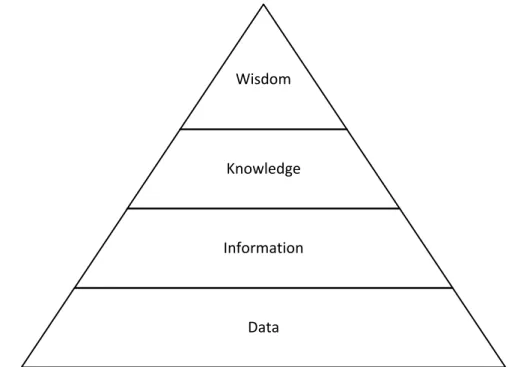
The data – information – knowledge – wisdom hierarchy, known shortly as DIKW Hierarchy or simply as the knowledge hierarchy, is a fundamental and a widely used model in the literature of knowledge and information management. It is used to describe knowledge as a pyramid comprising different components, and to contextualize knowledge and explain its relationship to data, information and wisdom, (Ackoff, 1989; Newell et al., 2009).
Russell L. Ackoff (1989) is often credited with proposing the model in his presidential address to the international society for general systems research. Although Ackoff's paper did not contain the visual pyramid, his words described it clearly:
Wisdom is located at the top of a hierarchy of types, types of content of the human mind. Descending from wisdom there is understanding, knowledge, information, and, at the bottom, data.
Data, is the plural of datum, it is considered the grain or building block of information. According to Ackoff, data are "symbols that represent properties of objects, events and their environment". It has no meaning by its own, because it requires
down and vice versa (Pearlson and Saunders, 2004), their core elements remain the same. Ashock adds a layer above wisdom, which he calls truth. He explains that our conceptions affects our observation, and that there are more than one way to look at the social world, otherwise the "notion of 'truth' and 'objectivity' can appear meaningless", (Ashok, 2004). Typically, all representations agree that: data, information, knowledge and wisdom are the central elements, and they are arranged in the same order represented in Figure 9, (Rowley, 2007).
Figure 9 Common representation of the Wisdom Hierarchy
2.3
Human information behavior and practice
Human information behavior refers to “the totality of human behavior in relation to sources and channels of information, including both active and passive information seeking, and information use” (Wilson, 2000). The all-encompassing term information behavior was introduced into the information-seeking studies in the 1960s (Savolainen, 2007) and gained wide use in the 1990s, where before, it was called studies of
Wisdom
Knowledge
Information
On the other hand, Talja and Hansen (2006) define Information practice as the “practices of information seeking, retrieval, filtering and synthesis”. According to Talja (2006) a major distinguishing feature of information practice approach to information-seeking studies is that it is more sociological and contextually oriented path of research in contrast with the umbrella concept of information behavior. Savolainen (2007) notes that the focus on the practice of information rather than the behavior sheds more light on the social element of information seeking. He adds:
The major difference is that within the discourse on information behavior, the “dealing with information” is primarily seen to be triggered by needs or motives, while the discourse on information practice accentuates the continuity and habitualization of activities affected and shaped by social factors
Wilson’s model (1997) on information seeking behavior, Figure 10, was amended in 1994 to include Ellis’s work on information-seeking. His model illustrates the situation which gives start to an information seeking event and describes the main components of the environment and barriers, this includes the person, the role and the environment in which a situation exist and the possible barriers in the process of information seeking behavior. Ellis’s (1989) model on information seeking behavior pattern included in Wilson’s general model for information seeking behavior was a result of his research on information retrieval system design for academic social scientists, it yielded a set of generic features that constituted the academics’ information seeking personal patterns. It is as follows: starting, chaining, browsing, differentiating, monitoring, and extracting.
2.4
Information needs
Wilson’s information behavior general model reflects the coexistence of such concepts as information needs and information seeking and the dynamic relationship among them within the sphere of information behavior (Siatri, 1999). In Wilson’s (1997, 1994) model of information seeking behavior, he borrows from psychology literature the categories of information needs, and notes that information needs has to satisfy a cognitive, affective or physiological requirements, which in turn leads to the initiation of the information seeking behavior. The context in which the need arise could be personal, role based, or the environment in which the individual plays the role. Wilson’s model (depicted in Figure 10 section 2.3) reflects those three categories of needs and the context in which they develop (Wilson, 2000, 1981).
In the cognitive dimension, the need arises from a gap in knowledge (such as in the need to learn a new skill). While the affective (or emotional) dimension refers to information need as a response to adverse or life-threating situations (such as in the need for reassurance). Finally, the physiological need, which refers to needs prompted by physiological necessities, such as the need to drink water. (Wilson, 1981; Choo et al., 2013).
Taylor (1968) identifies four levels to understanding a user’s information needs in the context of information seeking in libraries. They are as follows: first, the visceral need, this refers to the actual but unexpressed need. In this level, the user experiences dissatisfaction and senses a gap in his/her knowledge. Second, the conscious need, this is the description of the need in the mind of the user, and the need moves to this level from the visceral level as more information is encountered. Third, the formalized need where a formal statement of the need is constructed. Fourth, the compromised need, which happens when the formalized question is presented to the information system – this question adheres to the constraints of the system language (Choo et al., 2013;
information arise when there is a cognitive gap in knowledge, and by bridging that gap a person is able to move forward in the problematic situation.
Also from this person-centered approach (cognitive view point), Belkin (1980) describes the information need as a result of the realization of an anomaly in the person’s state of knowledge when faced with a problem. This anomalous state of knowledge (ASK) initiates the information-seeking behavior. After the information is obtained, the user evaluates if that information resolved the anomaly, if not then the processes is repeated. To Belkin, the anomaly refers to inadequacies in the state of the person’s knowledge, this inadequacy could be a gap in knowledge or an uncertainty.
The choice in this study fell on Dervin’s model of information need because the context in which it can be applied to is much more generic while Belkin’s model is oriented toward the context of information retrieval systems, and Taylor’s model is focused on information systems or librarians. Dervin’s model also has a complete methodology and data collection methods aligned with the theory and applied in numerous studies in various settings. Her model is precisely focused on understanding what the gap in knowledge is, how it can be bridged – how the information need can be satisfied in any specific context and situation.
2.5
Sense-making theory
Sense-making theory is a methodological approach for the study of the human use of information, and information systems. It is a user-centered approach developed as an alternative in user studies of information and communication uses, and information needs from the perspective of the user, (Dervin, 1992). Brenda Dervin began developing Sense-making theory since 1972, to understand the information needs in communication campaigns. It defines a clear methodology to conduct interviews with users and understand their information needs through reviewing the triangle of situations, gaps, and help. It was adopted in the library and information sciences research since 1980s to study the information seeking and behavior, and in the 1990s it gained a wide recognition in the discipline, (Cheuk, 2008).
Dervin's Sense-making theory defines a set of meta-theoretic assumption about the user and the world, accompanied by its methodology and specific research methods
developed to understand how people make sense of their daily experience. Those assumptions provide the methodological guidance for formulating the research question conducting the interviews (Dervin, 1992).
The first meta-theoretic assumption underlining the Sense-making theory is that discontinuity is a fundamental aspect of reality, discontinuity exists in everything, it exists between the human and reality, between the message and the channel, between the human at time one and the human at time two. In this context, information is conceptualized as "the sense created at a specific moment in time-space by one or more humans" (Dervin, 1992). Under this assumption, Dervin does not see information as existing apart from the behavioral activity of humans, she adds that the assumption of the existence of information apart from humans constructing leads to questions focusing on transmission of information, e.g. how much information did someone get? While when we assume that information exist as a consequence of human interaction at a specific moment in time-space, we focus our questions on the construction of information by the user, e.g. what strategy did an individual use to determine the accuracy of information? (Dervin, 1983; Dervin, 1992).
The second assumption is that the human use of information and information systems should be studied from the actor side not the observer, and users are the center and order, and that the system should adapt to his/her needs not the other way around, (Dervin, 1992).
The third assumption is that we learn more important things about the human use of information when we view it as a behavior rather than as a state condition. Sense-making assumes that there is systematic aspects of human behavior with regard to information at a moment in time-space if they are viewed not merely as an entity but as a behaving-entity, a person-in-situation, (Dervin, 1998), That behavior is sometimes repeated at other time-space situations depending on the user's definition of the new
This new assumption of information gap that emerged from previous assumptions is the guiding frame for the set of methods that are used when construction questions, conducting interviews and analyzing of research data afterwards.
The implementation of Sense-making in the study of the experiences of humans related to the information and communication systems design, management, practices, is achieved by utilizing the central metaphor of gaps, which in turn derived from the discontinuity assumption about reality.
The individual moving through time-space and facing gaps then bridging those gaps and moving to new situations, is the central methodological metaphor of Sense-making theoretical assumptions, (Dervin, 1999). In Dervin's conception of the experience of the user going through situations, each moment is considered a new step specific in time-space. Moreover, as discussed earlier, behavior of the user in new moments may be repeated. The user goes through the experience but may face a gap which in his perception prevents him from moving forward unless he/she develops a new sense of the situation, (Dervin, 1992).
The study of this individual's situation involves understanding how he/she interpreted the gap, then how he/she bridged it, and what strategy did he/she use. In addition to how he/she conceptualized the gap and the bridge. This process of investigating the user's behavior in such situation from the beginning of facing and conceptualizing the gap to moving across the bridge, represents the Sense-making triangle of situation, gap/bridge-help/outcome.
It is important to note that according to Dervin's formalization of Sense-making theory and its methodology, the actor is the center of the understanding of his or her situation. His/her conceptualization of the gap and his own definition of the situation are the reference in understanding his/her practice and his/her needs. she adds "given the discontinuity assumption, the moments are seen as vehicles for examining gap-defining and gap-bridging not representations of reality as it is", (Dervin, 1992).
The Sense-making application in interviews is achieved using several methods; one of them is the Helps/Hurts chaining, where the interviewer concentrates on how the user makes a connection between him/herself and the message involved. The line of
connects the subsequent query to the previous response. A second type of methods is the message Q/Ing, where the interviewer focuses on how to exploit the user's sense making in order to improve the message. A third interviewing method is the time-line method. In this method, the focus is on one situation that can be described as the worst, the best, or most troublesome situation. This method is used when no in-depth details are needed, (Dervin, 1992). A fourth method, which is the most aligned with the theory of Sense-making, is the micro-moment time-line interviewing method. It is described as the "foundational interviewing approach" (Dervin, 1999, 1983) for the Sense-making theory, and in this method the user is asked to describe critical situations as steps, then each step is devised into time-line moments and each time line moment is elaborated by the user in specific divides as follows: situations, gaps, bridges, and outcomes. The following table lists subcomponents of each division as suggested by Dervin:
Situation Barriers, constraints, history, memory, experience
Gap Confusions, worries, questions, muddles
Bridges Ideas, conclusions, feelings, opinions, hypothesis, hunches, stories, values, strategies, sources
Outcomes Helps, facilitations, hurts, hindrances, outcomes, effects, impacts
Table 1 Sub-components of situation division suggested in interviewing method by (Dervin, 1999)
As emphasized in the Sense-making literature, the interviewing method is dependent on the application and no script is provided, rather, Sense-making provides a theory of how an interview method should be, and the final implementation rests on the level of depth required by the study and its purpose, (Dervin, 1992, 1999).
2.6
Dimensions of human needs for poor people
Dimension is an aspect or a feature of a situation (Oxford Dictionary of English, 2015), and human development comprise of several dimensions that together cover the different facets of development needs. Scientists in sociology, law, and economy have often tried to put a list of basic human needs and wellbeing. These efforts gives the multidimensional objective of human development needs a secure epistemological and empirical ground. It also helps bring to the front other non-commodity aspects of human development, such as belief and sense of security. Developing those dimensions also helps in understanding and evaluating tradeoffs and unintended impacts in the process of development investment, (Alkire, 2002).
Nussbaum (2001) identified a set of capabilities all humans must be able to enjoy to have a dignified existence. Her list is directed at constitutional and political applications. It includes the capability to enjoy full life, being able to have good health and nourishment, to express emotions, to reason, to affiliate, to care for the environment and other species, and to play. A complete list is represented in Table 2.
Life: being able to live to the end of a human life of normal length; not dying
prematurely, or before one’s life is so reduced as to be not worth living.
Bodily Health: being able to have good health, including reproductive health; to be
adequately nourished; to have adequate shelter.
Bodily integrity: Being able to move freely from place to place; having one’s bodily
boundaries treated as sovereign, i.e. being able to be secure against assault, including sexual assault, child sexual abuse, and domestic violence; having opportunities for sexual satisfaction and for choice in matters of reproduction.
Senses, imagination, thought: Being able to use the senses, to imagine, think, and
reason—and to do these things in a ‘‘truly human’’ way, a way informed and cultivated by an adequate education, including, but by no means limited to, literacy and basic mathematical and scientific training. Being able to use imagination and thought in connection with experiencing and producing self-expressive works and events of one’s own choice, religious, literary, musical, and so forth. Being able to use one’s mind in ways protected by guarantees of freedom of expression with
respect to both political and artistic speech, and freedom of religious exercise. Being able to search for the ultimate meaning of life in one’s own way. Being able to have pleasurable experiences, and to avoid non-necessary pain.
Emotions: Being able to have attachments to things and persons outside ourselves;
to love those who love and care for us, to grieve at their absence; in general, to love, to grieve, to experience longing, gratitude, and justified anger. Not having one’s emotional development blighted by overwhelming fear and anxiety, or by traumatic events of abuse or neglect. (Supporting this capability means supporting forms of human association that can be shown to be crucial in their development).
Practical reason: Being able to form a conception of the good and to engage in
critical reflection about the planning of one’s own life. (This entails protection for the liberty of conscience).
Affiliation: A. Being able to live for and towards others, to recognize and show
concern for other human beings, to engage in various forms of social interaction; to be able to imagine the situation of another and to have compassion for that situation; to have the capability for both justice and friendship. (Protecting this capability means protecting institutions that constitute and nourish such forms of affiliation, and also protecting the freedoms of assembly and political speech.) B. Having the social bases of self-respect and non-humiliation; being able to be treated as a dignified being whose worth is equal to that of others. This entails, at a minimum, protections against discrimination on the basis of race, sex, religion, caste, ethnicity, or national origin.
Other Species: Being able to live with concern for and in relation to animals, plants,
Play: Being able to laugh, to play, to enjoy recreational activities. Control over one’s Environment:
A. Political. Being able to participate effectively in political choices that govern
one’s life; having the right of political participation, protections of free speech and association.
B. Material. Being able to hold property (both land and movable goods), not just
formally but in terms of real opportunity; and having property rights on an equal basis with others; having the right to seek employment on an equal basis with others; having the freedom from unwarranted search and seizure. In work, being able to work as a human being, exercising practical reason and entering into mutual relationships of mutual recognition with other workers.
Table 2 Adapted from Nussbaum List of central human functional capabilities. (Nussbaum, 2001).
Manfred Max-Neef, (1991) developed a matrix of human needs to conduct community exercises with a groups of local people to investigate satisfiers or needs that have a constructive or destructive effect on their society. He contests that needs can be satisfied at different levels. Those needs, which are not adequately satisfied, reflect a human poverty side. His classification is generic and comprises nine components as follows: subsistence, protection, affection, understanding, participation, leisure, creation, identity, and freedom. It was used so far in Chile, Argentina, Bolivia, Columbia, Sweden and the UK.
A valuable and large-scale cross-cultural study was conducted by Narayan and his team of researchers (Deepa et al., 2000) about the values of the poor, entitled Voices of the Poor. The first part of this three-series study was conducted across 50 counties with 40.000 participants, the aim was to captures aspirations and views of those people selected for the study, and was titled: Can Anyone Hear Us. The second study in the series titled Crying Out for Change which represents voices of 20.000 poor men and women in 23 countries through comparative fieldwork (Narayan et al., 2000), and the final part titled From Many Lands which comprise of a selected country studies on poverty. The studies under the project Voices of the Poor was made for the World Development Report 2000/2001 (World Bank, 2000) and used participatory and qualitative methods to understand how poor people view poverty and wellbeing.
They note that, within a single country location, poor people distinguish between different social groups of poor, the dependent poor, the resource-less poor, the temporary poor, the working poor, and God’s poor. Their analysis of 81 Participatory Poverty Assessment (PPA) based on discussions with 40.000 poor men and women in 50 countries, yielded five main conclusions about the experience of poverty, they are: (1) Poverty is Multidimensional. (2) The state has been largely ineffective in helping the poor. (3) Non-profit organizations impact on the poor is limited. (4) Stress of poverty is affecting the households. (5) The social bonds of reciprocity and trust within communities are fading due to political and economic changes, (Deepa et al., 2000).
Narayan et al., (2000) note in their second part of the research, Crying Out for Change, that poor peoples’ conception of wellbeing and good quality of life is
multidimensional. Their understanding and view of wellbeing is persistent across cultures and continents. As they put it:
The same dimensions and aspects of wellbeing are repeatedly expressed, across continents, countries and cultures, in cities, towns and rural areas alike. And they are expressed by different people-women and men, young and old, children and adults
Those dimensions are as follows: Material wellbeing, Physical wellbeing,
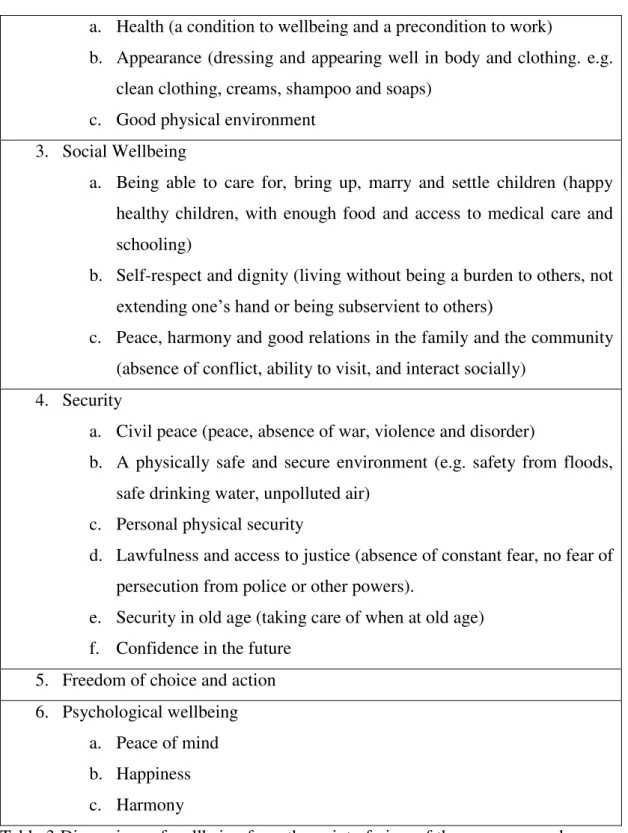
Social wellbeing, Security and freedom of choice and action, and Physiological wellbeing. Table 3 lists the dimensions of wellbeing and its subcomponents according to their research.
a. Health (a condition to wellbeing and a precondition to work)
b. Appearance (dressing and appearing well in body and clothing. e.g. clean clothing, creams, shampoo and soaps)
c. Good physical environment 3. Social Wellbeing
a. Being able to care for, bring up, marry and settle children (happy healthy children, with enough food and access to medical care and schooling)
b. Self-respect and dignity (living without being a burden to others, not extending one’s hand or being subservient to others)
c. Peace, harmony and good relations in the family and the community (absence of conflict, ability to visit, and interact socially)
4. Security
a. Civil peace (peace, absence of war, violence and disorder)
b. A physically safe and secure environment (e.g. safety from floods, safe drinking water, unpolluted air)
c. Personal physical security
d. Lawfulness and access to justice (absence of constant fear, no fear of persecution from police or other powers).
e. Security in old age (taking care of when at old age) f. Confidence in the future
5. Freedom of choice and action 6. Psychological wellbeing
a. Peace of mind b. Happiness c. Harmony
Table 3 Dimensions of wellbeing from the point of view of the poor men and women in (Narayan et al., 2000)
In their book titled A theory of Human Need, Doyal and Gough (1991) define two basic universal human needs: Physical health and Autonomy of agency. They are individual basic human needs that require intermediate needs for their fulfillment. They list a set of universal satisfier characteristics or intermediate needs that apply to all
are 11 and as follows: (1) Nutritional food and clean water, (2) Protective housing, (3) A non-hazardous work environment, (4) A non-hazardous physical environment, (5) Safe birth control and childbearing, (6) Appropriate health care, (7) A secure childhood, (8) Significant primary relationships, (9) Physical security, (10) Economic security, (11) Appropriate education.
For our research we are using the dimensions of wellbeing put forward by Narayan et al., (2000) in our information model for representing people’s needs which we propose in section 2.10. The reason is that their list of dimensions is multicultural and grounded in the reality of the poor men and women in the third world. It is directly related to the thesis subject as the poor people’s view of poverty and definition of its aspects/dimensions, which we build on to better represent their needs as a well-defined segment of the population dependent on charity organizations support.
2.7
Charity Organizations in Saudi Arabia
Charity organizations are a type of non-profit organization which have other goals than making profit, for example; fulfilling the needs of the poor in a certain society, helping patients adapt to chronic illness, building and improving housing for those in need, and providing support for elders and orphans. Essentially, charity organizations are those that work for the goals of the wellbeing of society and philanthropy.
In Saudi Arabia, there are several types of non-profit organizations, and depending on their purpose and the governmental entity they fall under, they can be classified as follows: In the domain of humanitarian and cooperative there are charitable organizations, cooperative associations, charitable endowments which are public entities, and charitable foundations which are private. In the domain of economics, there are the financial interests national committees, and in the domain of science, there are the scientific organizations. In addition to the sports unions and equestrian centers,
Category Example of activity Responsible entity Donations, social
wellbeing and development
- Marriage and family counseling
- Housing and housing rehabilitation
- Rehabilitation, support and education for people of special needs
- Medical and social care for the elders
- Social and physical support for the poor
The Ministry of Labor and Social Development
Religion and Islamic advocacy
- Study and memorization of the Koran
- Advocacy and guidance
The Ministry of Islamic Affairs, Endowments, Da’wah and Guidance Education - Educational purposes
above high school level
The Ministry of Education
Science and practice - Advance the science and practice of different fields, e.g. the Saudi council of engineers
The Ministry of Commerce, Saudi Commission for Health Specialties and different universities
Table 4 Types of charity organizations and its relation to government ministries
In addition to the above-mentioned types of organizations, there are two more types, which do not belong to any ministry or government entity. They are mainly the organizations established by a royal decree like The World Assembly of Muslim Youth, which is a member of the United Nations non-governmental organizations, and those that belong to an international entity as the case with the international Islamic Relief Organization, which emanated from the Muslim World League (“UN ESANGO,” 1979). It is worth to mention that although their headquarters are in the Kingdom of Saudi Arabia, they strictly operate internationally.
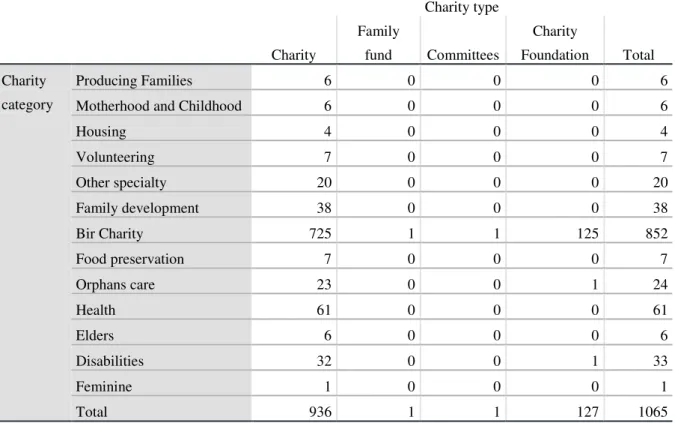
As of January 2017, the Ministry of Labor and Social Development, oversees 635 registered charitable organization, and 124 charitable foundation spread acrossall the regions of the country. In addition to those figures, there are 90 Bir charities and 1 charitable foundation under the process of establishment. The type of categories of which charities in general operate under covers various aspects of life, spanning from housing, social development, healthcare, and up to developing the family’s financial independence through the support of their in-house production of food and hand-made crafts. Table 5 shows the types, and count of charitable organizations in the Kingdom of Saudi Arabia with the complete list of their category of operation, (General Directorate for Societies, Foundations and Centers, 2016).
Charity type Charity Family fund Committees Charity Foundation Total Charity category Producing Families 6 0 0 0 6
Motherhood and Childhood 6 0 0 0 6
Housing 4 0 0 0 4 Volunteering 7 0 0 0 7 Other specialty 20 0 0 0 20 Family development 38 0 0 0 38 Bir Charity 725 1 1 125 852 Food preservation 7 0 0 0 7 Orphans care 23 0 0 1 24 Health 61 0 0 0 61 Elders 6 0 0 0 6 Disabilities 32 0 0 1 33 Feminine 1 0 0 0 1 Total 936 1 1 127 1065
Table 5 Types, categories, and count of charitable organizations in Saudi Arabia
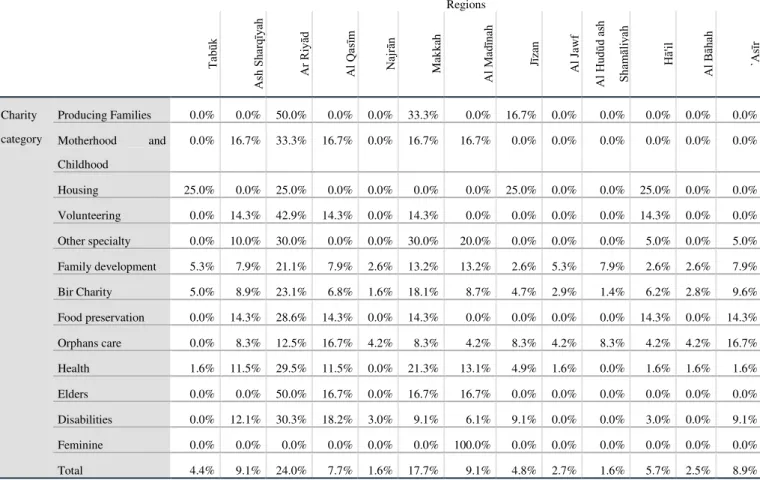
In Ar Riyād region, we find 24% of the total charities in the country, followed by Makkah the second biggest region with 17.7%, this is compared with the two least populous regions of Al Hudūd Al Shamāliyah and Al Bāhah, with 1.6% and 2.5% respectively. Housing charities exist in four regions only as follows: Tabūk 25%, Ar Riyād, 25%, Jīzan 25% and finally Hā'il with 25% of all housing charities. Producing families charities cluster in three regions only, namely: Ar Riyād, Makkah and Jīzan. Some regions do not have essential types of charities like Disabilities, as in the case of Tabūk, Al Jawf, Al Hudūd Al Shamāliyah and Al Bāhah. A detailed account of charity category and distribution across the nation is represented in Table 7, (General Directorate for Societies, Foundations and Centers, 2016)..
Regions Ta bū k A sh S ha rq īy ah A r R iy ād A l Q as īm N aj rā n M ak ka h A l M ad īn ah Jīz an A l Jawf A l H ud ūd a sh Sh am āl iy ah H ā'i l A l B āh ah `A sīr Charity category Producing Families 0.0% 0.0% 50.0% 0.0% 0.0% 33.3% 0.0% 16.7% 0.0% 0.0% 0.0% 0.0% 0.0% Motherhood and Childhood 0.0% 16.7% 33.3% 16.7% 0.0% 16.7% 16.7% 0.0% 0.0% 0.0% 0.0% 0.0% 0.0% Housing 25.0% 0.0% 25.0% 0.0% 0.0% 0.0% 0.0% 25.0% 0.0% 0.0% 25.0% 0.0% 0.0% Volunteering 0.0% 14.3% 42.9% 14.3% 0.0% 14.3% 0.0% 0.0% 0.0% 0.0% 14.3% 0.0% 0.0% Other specialty 0.0% 10.0% 30.0% 0.0% 0.0% 30.0% 20.0% 0.0% 0.0% 0.0% 5.0% 0.0% 5.0% Family development 5.3% 7.9% 21.1% 7.9% 2.6% 13.2% 13.2% 2.6% 5.3% 7.9% 2.6% 2.6% 7.9% Bir Charity 5.0% 8.9% 23.1% 6.8% 1.6% 18.1% 8.7% 4.7% 2.9% 1.4% 6.2% 2.8% 9.6% Food preservation 0.0% 14.3% 28.6% 14.3% 0.0% 14.3% 0.0% 0.0% 0.0% 0.0% 14.3% 0.0% 14.3% Orphans care 0.0% 8.3% 12.5% 16.7% 4.2% 8.3% 4.2% 8.3% 4.2% 8.3% 4.2% 4.2% 16.7% Health 1.6% 11.5% 29.5% 11.5% 0.0% 21.3% 13.1% 4.9% 1.6% 0.0% 1.6% 1.6% 1.6% Elders 0.0% 0.0% 50.0% 16.7% 0.0% 16.7% 16.7% 0.0% 0.0% 0.0% 0.0% 0.0% 0.0%
representing 15.43% of all Bir charities in the country. In addition, Makkah region the most populous region has 119 Bir charities representing 18.7% of total charities in the country. Despite having around 318, 000 people more, Makkah’s region surpassed Riyadh by 21 more Bir charities. Figure 13 shows a representation of the number of charities by region in details.
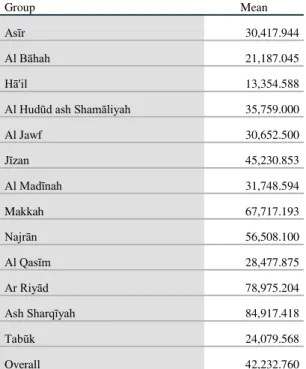
A further analysis of the ratio of Bir charities to residents in each region reveals more information about the coverage of those charities. From Table 8, we see that the mean overall ratio of charities to population for all regions is one charity for every 42,232. The three regions with the highest ratio of Bir charities to population are as follows: Hā'il with a ratio of one to 13,354 followed by Al Bāhah with a ratio of one to 21,187 and Tabūk with 1 to 24,079. On the other end, the three regions with the lowest ratio of Bir charities per capita are as follows, in a descending order: Ash Sharqīyah Figure 13 Bir charities distribution by region