HAL Id: hal-00299460
https://hal.archives-ouvertes.fr/hal-00299460
Submitted on 26 Oct 2007
HAL is a multi-disciplinary open access
archive for the deposit and dissemination of
sci-entific research documents, whether they are
pub-lished or not. The documents may come from
teaching and research institutions in France or
abroad, or from public or private research centers.
L’archive ouverte pluridisciplinaire HAL, est
destinée au dépôt et à la diffusion de documents
scientifiques de niveau recherche, publiés ou non,
émanant des établissements d’enseignement et de
recherche français ou étrangers, des laboratoires
publics ou privés.
Anomalous radon emanation linked to preseismic
electromagnetic phenomena
Y. Omori, Y. Yasuoka, H. Nagahama, Y. Kawada, T. Ishikawa, S. Tokonami,
M. Shinogi
To cite this version:
Y. Omori, Y. Yasuoka, H. Nagahama, Y. Kawada, T. Ishikawa, et al.. Anomalous radon
emana-tion linked to preseismic electromagnetic phenomena. Natural Hazards and Earth System Science,
Copernicus Publications on behalf of the European Geosciences Union, 2007, 7 (5), pp.629-635.
�hal-00299460�
www.nat-hazards-earth-syst-sci.net/7/629/2007/ © Author(s) 2007. This work is licensed under a Creative Commons License.
and Earth
System Sciences
Anomalous radon emanation linked to preseismic electromagnetic
phenomena
Y. Omori1, Y. Yasuoka2, H. Nagahama1, Y. Kawada1,3, T. Ishikawa4, S. Tokonami4, and M. Shinogi2 1Department of Geoenvironmental Sciences, Graduate School of Science, Tohoku University, Sendai, Japan 2Institute of Radioisotope Research, Kobe Pharmaceutical University, Kobe, Japan
3School of GeoSciences, University of Edinburgh, Edinburgh, UK 4National Institute of Radiological Sciences, Chiba, Japan
Received: 20 July 2007 – Revised: 18 October 2007 – Accepted: 18 October 2007 – Published: 26 October 2007
Abstract. Anomalous emanation of radon (222Rn) was ob-served preceding large earthquakes and is considered to be linked to preseismic electromagnetic phenomena (e.g. great changes of atmospheric electric field and ionospheric distur-bances). Here we analyze atmospheric radon concentration and estimate changes of electrical conditions in atmosphere due to preseismic radon anomaly. The increase of radon em-anation obeys crustal damage evolution, following a power-law of time-to-earthquake. Moreover, the radon emanation decreases the atmospheric electric field by 40%, besides in-fluencing the maximum strength of atmospheric electric field by 104–105V/m enough to trigger ionospheric disturbances. These changes are within the ranges observed or explain-ing electromagnetic phenomena associated with large earth-quakes.
1 Introduction
Electromagnetic phenomena associated with large earth-quakes have been observed for many years. For example, earthquake light (Derr, 1973; Kamogawa et al., 2005), elec-tromagnetic radiations (Gokhberg et al., 1982; Nagao et al., 2002), great changes of atmospheric electric field (Kondo, 1968; Vershinin et al., 1999) and ionospheric perturbations (Molchanov and Hayakawa, 1998; Liu et al., 2000) are well known. Among them, ionospheric perturbations have attracted many researchers and have been investigated for earthquake predictions (Hayakawa et al., 2004; Pulinets and Boyarchuk, 2004). Gokhberg et al. (1989) and Molchanov and Hayakawa (1998) pointed out the precursory ionospheric anomalies associated with large earthquakes, and Maekawa et al. (2006) emphasized the verification of the existence from a statistical analysis of the subionospheric LF
propa-Correspondence to: Y. Omori
gation data (Kamogawa, 2007). Since lithosphere does not have a direct connection with the ionosphere, problems re-lated to seismo-ionospheric disturbances are treated by con-sidering the interaction among the lithosphere, atmosphere and the ionosphere, i.e., the LAI coupling (Hayakawa et al., 2004; Kamogawa, 2006).
On the other hand, for modeling ionospheric disturbances within the regime of the LAI coupling, radon emanation that causes changes in the atmospheric electrical proper-ties has been focused on recently (e.g. Sorokin et al., 2001; Hayakawa et al., 2004; Pulinets and Boyarchuk, 2004; Rapoport et al., 2004; Kamogawa, 2006; Pulinets, 2007). Many investigations have revealed the anomalous radon em-anation out of the lithosphere into the near-earth atmosphere (King, 1978, 1986) and the ground water (King, 1986; Igarashi et al., 1995), and United Nations Scientific Com-mittee on the Effects of Atomic Radiation (2000) also re-ported the same things. In case of radon in the atmosphere, Okabe (1956) observed the increase of radon content at the near-surface atmosphere after earthquakes at Tottori, Japan, while nobody clearly shows preseismic variations of radon which are required for estimating the atmospheric electrical properties. Although Pierce (1976) pointed out the impor-tance of the radon behavior to the preseismic change of the atmospheric electric field, there is no quantitative analysis of radon concentration measured in the atmosphere, among the various studies dealing with radon effects as part of the LAI coupling. Thus it is necessary to verify radon emanation into atmosphere, enough to trigger ionospheric perturbations as part of the LAI coupling, prior to earthquakes.
In this paper, we clarify whether the radon emanation triggers preseismic electromagnetic phenomena such as an anomaly in the atmospheric electric field causing ionospheric perturbations. First, we show that anomalous radon ema-nation reflects the damage process in the crust associated with large earthquakes. Next, we introduce the knowledge of atmospheric electricity, and investigate the atmospheric
630 Y. Omori et al.: Radon anomaly linked to preseismic electromagnetic phenomena Monitoring station Kobe Mt.Rokko 30 km Epicenter Mw 6.9 Rokko fault zo ne 500 m 130° 140° 40° 30° Awaji Island Osaka
Fig. 1. Location of the radon monitoring station and the
distribu-tion of active faults and epicenters in Kobe. Square shows the radon monitoring station. Lines, star and solid circles indicate active faults and epicenters of the Kobe earthquake and its aftershocks (magni-tude M≥3.0) until 31 January 1995, respectively. The distribution of active faults and the epicenters of aftershocks were obtained from the Research Group for Active Faults of Japan (1991) and Japan University Network Earthquake Catalog Hypocenters Files (http: //wwweic.eri.u-tokyo.ac.jp/db/junec/index-j.html), respectively. 0 10 20 30 1984 1986 1988 1990 1992 1994 Year
Atmospheric radon concentration (Bq/m
3)
Kobe earthquake
Fig. 2. Temporal variation of the atmospheric radon
concentra-tion. The data were sampled from 1984 to 1995, except for 1989 and during the 11 days just after the Kobe earthquake. The filled circles depict the time variation of the daily mean of the hourly radon concentration. The red and green lines indicate the tempo-ral change in the averages of the daily mean values from January 1984 to December 1993 except for 1989 and their 3σ range, respec-tively. Blue two-headed arrows represent seismic related anomaly in atmospheric radon concentration.
electrical conditions that contain the atmospheric electric field altered by preseismic radon emanation. For this pur-pose, the data on atmospheric radon concentration measured around the time of the Kobe earthquake (17 January 1995, Japan; moment magnitude Mw=6.9) are used.
2 Location and measurement procedure
The site investigated is located in Kobe immediately above the Rokko fault zone, which is a part of the fault zones that caused the Kobe earthquake and the aftershocks, sit-uated about 25 km away from the epicenter (Fig. 1). The northern part of the site around the monitoring station is known as the Rokko mountain. It is composed mainly of the Nunobiki granodiorite and the Rokko granite (Huzita and Kasama, 1982), generally containing more238U (Wollenberg and Smith, 1987). 238U is a parent nuclide of 226Ra which decays into radon. Therefore, the monitoring station is situ-ated in a region where radon gas is released along the fault into atmosphere.
The measurements of atmospheric radon concentration had been running since 1984, except for the lack of obser-vations in 1989 and also during the 11 days just after the Kobe earthquake. In order to determine the atmospheric radon concentration, we used a flow-type ionization cham-ber having a volume of 1.8×10⁻²m3(Model NAG513, Fuji
Electric Systems Co., Ltd.). Air, 5 m above the ground, was passed through a prefilter and a high efficiency particulate air filter with a ventilation rate of 15.6 m3/min, for retriev-ing the radon progenies which form the aerosols. A part of the filtered air was pumped into the ionization chamber with a flow rate of 6.7×10⁻³m3/min. The measurements were carried out every hour, continuously and automatically (Ya-suoka and Shinogi, 1997; Ya(Ya-suoka et al., 2006).
3 Data analysis and discussions
3.1 Preseismic radon emanation into atmosphere
Figure 2 shows the temporal variation in the atmospheric radon concentration between 1984 and 1995. One can see that the daily mean of the radon concentration presents a sea-sonal change, having a minimum in summer and a maximum in winter. This is due to atmospheric turbulence (Gesell, 1983) and the annual wind rose (Porstend¨orfer, 1994). The former points to the fact that the vertical mixing is smaller due to low solar heating in winter, than in summer (Liu et al., 1984). The latter indicates that continental air mass such as the Siberian air mass in Japan brings radon, originated else-where than Kobe, during winter.
Figure 2 also shows the anomalous increase in radon con-centration during three periods; winter in 1987–1988, sum-mer in 1988 and winter in 1994–1995 just before the Kobe earthquake. The former two correspond to a somewhat seismic-activated period. Mogi (1995) pointed out that the seismic activity had decreased, i.e., a seismic gap had been formed in Kobe area in the mid 1960s or later. However, the activity with magnitude (M) 3 began to increase in the late 1980 (Mogi, 1995), especially, that was remarkable in the northern part of Awaji Island in 1986-1989 (Katao and
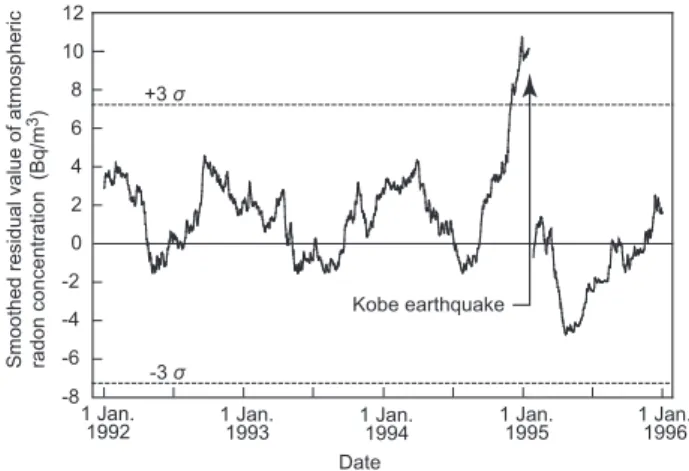
Ando, 1996; Watanabe, 1998). On the other hand, during the third period, i.e., just before the Kobe earthquake, the at-mospheric radon concentration can be seen to be located far beyond 3σ range (σ : standard deviation) for the successive days during the two months. Moreover, the similar tendency is shown from the analysis of the daily minimums (Fig. 2 in Kawada et al., 2007). Therefore we consider the anomaly during the three periods to be seismic related. Below, we handle the example in the 1995 Kobe earthquake.
For quantifying the unusual concentration of radon in the atmosphere, we analyzed the change in smoothed residual and cumulative values of concentration, from 1 September 1994 to 16 January 1995 (Figs. 3 and 4). By the use of the ex-ponential smoothing method, the meteorological fluctuations of atmospheric radon are minimized. In addition, for exclud-ing the seasonal effect, the residual is defined as the differ-ence between the daily minimum and the smoothed normal variation of the minimums of atmospheric radon concentra-tion for each day (Yasuoka et al., 2006) where the daily min-imum represents the background radon concentration. The smoothed residual values are plotted above the 3σ range, as well as the daily averages preceding the Kobe earthquake. During the period from 24 December 1994 to the time of the earthquake, the residual values can be seen to have attained magnitudes of up to about 10 Bq/m3(Fig. 3). Figure 4 shows the temporal variation of the cumulative residual values of atmospheric radon. Each cumulative residual value is ex-pressed by summing up the residual value from 1 September 1994 to each day and finally to 16 January 1995. The vari-ation of the cumulative value has a power-law dependence formulated as
X
(C1−CR) = C2(tc−t )δ, (1)
or XCR=C3−C2(tc−t )δ, (1′)
where CR, t, and tcare the smoothed residual value of
atmo-spheric radon concentration, time, and the occurrence time of the Kobe earthquake, respectively (see also Kawada et al., 2007). The other variables, C1, C2, C3, and δ are constants.
These constants can be seen to change approximately 17 days prior to the earthquake (each value of tc, C1, C2, C3, and δ is
denoted in the caption of Fig. 4). Since the smoothed resid-ual value excludes the seasonal effects (Yasuoka et al., 2006), the increase following a power-law reflects crustal deforma-tion. This temporal power-law change is similar to cumula-tive Benioff strain release which represents the summation of the square root of the energy released for sequential frac-ture events, prior to the time to the collapse. The change relates to the damage process in the crust (e.g. Ben-Zion and Lyakhovsky, 2002; Turcotte et al., 2003), and being a critical phenomenon prior to large earthquakes, shows a time-scale invariance, i.e., the temporal power-law (Kawada and Naga-hama, 2006; Kawada et al., 2007). Furthermore, the inflec-tion point in Fig. 4 is emerged, and the determinainflec-tion of this
Kobe earthquake Smo ot he d re si du al va lu e of a tmo sp he ric ra do n co nce nt ra tio n (Bq /m 3) +3 σ -3 σ Date 1 Jan. 1993 1 Jan. 1994 1 Jan. 1995 1 Jan. 1992 1 Jan. 1996 -6 -4 -2 0 2 4 6 8 10 12 -8
Fig. 3. Temporal variation of the smoothed residual value of
at-mospheric radon concentration. Broken lines represent ±3σ range. This figure is modified from Kawada et al. (2007).
log [Time-to-failure tc- t (year)]
log [Cumulative smoothed residual
C1 - CR (Bq/m 3)] 1.0 1.5 2.0 2.5 3.0 3.5 -2.5 -2.0 -1.5 -1.0 -0.5 15 Jan. 1995 1 Jan. 1995 1 Dec. 1994 1 Sep. 1994 δ = 1.01 δ = 1.13 Inflection point
Fig. 4. Temporal variation of the cumulative smoothed residual
of atmospheric radon concentration. The fit follows
power-laws given in Eq. (1) or (1′), and the constants change on
31 December 1994. The constants of the respective
equa-tions are C1=2.86×10 Bq/m3, C2=9.58×10³Bq/m3/yearδ,
C3=3.95×10³Bq/m3, δ=1.13 and tc=1995.045 year,
and C1=2.86×10 Bq/m3, C2=7.13×10³Bq/m3/yearδ,
C3=3.95×10³Bq/m3, δ=1.01 and tc=1995.045 year.
is likely to enable us in predicting earthquakes. The crustal damage evolution in the critical state promotes radon mi-gration and emanation into the atmosphere, constrained the power-law increase of the atmospheric radon concentration. 3.2 Changes of atmospheric electrical conditions due to
radon emanation
Radon emanation into the atmosphere can cause ionization of atmospheric gases. The atmospheric electrical conditions are basically constrained by the concentration of small ions (Chalmers, 1957; Pierce, 1976) and these can be altered near
632 Y. Omori et al.: Radon anomaly linked to preseismic electromagnetic phenomena
Table 1. The values of the constants in the text.
Constants Values References
e 1.6×10⁻¹⁹C
k 1.5×10⁻⁴m2/V/s Pierce (1976)
N 1010/m3 Junge (1963)
α (1.4–1.6)×10−12m3/s Pierce (1976), and
Kulkarni and Kamra (2001)
β (3.0–4.0)×10−12m3/s Pierce (1976), and
Kulkarni and Kamra (2001)
ε0 8.9×10⁻¹²F/m
R ≤10 µm Liperovsky et al. (2005)
ρa (1.0–2.0)×103kg/m3 Junge (1963)
Na 109/m3 Sorokin et al. (2001), and
Liperovsky et al. (2005)
Q 2000e Liperovsky et al. (2005)
g 9.8 m/s2
η 1.7×10⁻⁵kg/m/s
ground by radon, its progenies and radioactivity in the earth, producing ion-pairs in air. We now discuss the concentration of small ions and the atmospheric conditions such as the at-mospheric conductivity and the electric field preceding the Kobe earthquake below.
3.2.1 The concentration of small ions
The concentration of small ions near ground is controlled by the ionization rate, the recombination of positive and neg-ative ions, and the attachment of small ions to the charged aerosols (e.g. Chalmers, 1957; Pierce, 1976; Liperovsky et al., 2005). Hence, one can construct the equation regarding the temporal change of small ion concentration as
∂n
∂t =q − αn
2−βnN, (2)
and the estimate for the small ion concentration in the steady state as
n = −βN + p
(βN )2+4αq
2α . (3)
Here q is the ionization rate obtained from cosmic rays, ra-dioactivity in the atmosphere including radon and the radia-tion from soil, N is the aerosol density, α is the recombina-tion coefficient and β is the attachment coefficient of small ions to charged aerosols (see also Table 1). We take the ion-ization rate of cosmic rays to be 1.9×10⁶ion-pairs/m3/s at 35◦N and that of the radiation from soil to be 4.5×10⁶ ion-pairs/m3/s (Mohnen, 1977). A radon concentration of 10 Bq/m3 corresponds to an ionization rate of (3.9–5.5) ×106 ion-pairs/m3/s, from observations (e.g. Nagaraja et al., 2003) and calculation (see Appendix A). Then, at Kobe, the normal concentration of small ions in the atmosphere (n0) was
eval-uated to be (2.6–3.9)×108/m3, from an atmospheric radon
concentration of 10 Bq/m3, during winter (Fig. 2). This esti-mation is comparable to the concentration measured in Kobe (Tsunoda and Satsutani, 1976). When the remarkable radon emanation occurred before the Kobe earthquake, i.e., during the period of more than 10 Bq/m3increase in the atmosphere (Fig. 3), the small ion concentration was seen to have var-ied from (2.6–3.9)×108/m3to (3.5–5.7)×108/m3. This in-crement was supported by the increase of small ion density by (1.0–1.4)×108/m3before the earthquake (Satsutani, 1996, 1999).
3.2.2 The atmospheric electrical conditions
The basic elements of atmospheric electricity are the atmo-spheric conductivity, the atmoatmo-spheric electric field and the air-earth current. The atmospheric conductivity affects the atmospheric electric field and air-earth current (Makino and Ogawa, 1984). The relationship among them has Ohm’s law (Chalmers, 1957; Pierce, 1976). Hence, the atmospheric conductivity is useful for discussing atmospheric electrical conditions prior to the Kobe earthquake.
Because the small ions migrate easier than the large ones, the atmospheric conductivity is proportional to the concen-tration of small ions and given by
λ ≈ 2ekn, (4)
where e is the electron charge, and k is the mobility of the small ions at the ground level (Pierce, 1976 and see Ta-ble 1). From Eq. (4) and the small ion concentration men-tioned above, the atmospheric conductivity in normal win-ter (λ0) and preceding the Kobe earthquake (λ) are (1.2–
1.9)×10−14//m and (1.7–2.7)×10−14//m, respectively. That is, the preseismic radon emanation increases the atmo-spheric conductivity by about 40%. And in turn, according to the constancy of air-earth current in Ohm’s law, the at-mospheric electric field decreases by about 40%. The Mat-sushiro earthquake swarm (1965, Japan) formed many frac-tures, and anomalous variation in atmospheric electric field was observed (Kondo, 1968), as well as earthquake lights (Derr, 1973). High densities of the positive ions were pro-posed to influence the abnormal animal behavior preceding earthquakes (Tributsch, 1978). Crustal damage evolutions prompt radon emanation into the open air, which is responsi-ble for the alteration of the atmospheric electric field and the densities of positive ions by ionizing the aerial gases.
On the other hand, radon emanation induces temporal evolution of large atmospheric electric fields under non-stationary conditions as compared to non-stationary. We can de-fine these non-stationary and stationary conditions as having the presence and absence of a characteristic time, as denoted by
τ ≈ ε0n0 λ0n
, (5)
where ε0is the permittivity constant, λ0is the undisturbed
atmospheric conductivity near the ground and n is the
turbed value of ion concentration, that depends on the ion-ization rate, respectively. The difference in the mobility and the size distribution of the positive and negative ions gener-ate the pulses of local electric fields (Liperovsky et al., 2005). One can quantify the maximum amplitude of the electric field pulses by Eg = 2R2ρaNaQg 9ηnλ0nn 0 + Q2N a 6π ηR o , (6)
where R is the large aerosols’ radius, ρais the aerosol mass
density based on the general chemical composition of natural aerosols, Nais the large aerosol concentration, Q is the large
aerosol charge, g is the gravitational acceleration, and η is the viscosity of air at 0◦C (We modify the equation in Liper-ovsky et al., 2005. Each value of R, ρa, Na, Q, g and η is
given in Table 1). Based on the radon concentration and the estimated ion density, we can show that the maximum ampli-tude (Eg) was up to about 104-105V/m. These ranges, even
in fair weather, were found to be nearly equal to those un-der thunun-der clouds and the characteristic time (τ ) in Eq. (5) was (3.3–5.3)×102 s, for an atmospheric radon concentra-tion of 10 Bq/m3, prior to the Kobe earthquake. During the earthquake, a decrease of the reflection height in the D region (around 50–90 km in ionospheric altitude) was observed, de-termined from VLF transmission anomaly (Molchanov and Hayakawa, 1998; Molchanov et al., 1998). When the atmo-spheric conductivity near the ground increases by a factor of 2, the ionospheric perturbation can be explained in terms of the induction of the electrostatic field by (0.5–1.5)×103V/m (Grimalsky et al., 2003; Rapoport et al., 2004). These values were within our estimation, and thus the pulses can trigger lowering the reflection altitude. Therefore radon emanation is essential for the preseismic ionospheric disturbances and they are detectable via VLF transmission.
The calculated changes in the atmospheric conductivity and electric fields under stationary and non-stationary con-ditions were obtained only from the contribution of radon and its shorter half-life progenies. We ignore the variations of thoron (220Rn) and its daughter nuclides and the radiation from soil. Additional measurements of thoron and the radia-tion from soil would be required in future.
4 Conclusions
We have considered the effects of radon on the preseismic electromagnetic phenomena by use of the data on the anoma-lous concentration of atmospheric radon measured around the time of the Kobe earthquake. The cumulative residual values of the radon concentration were found to follow temo-pral power-law of time-to-the earthquake. This increase re-sponded to the damage process in the crust associated with large earthquakes. In addition, our quotations for atmo-spheric electrical conditions altered due to radon emanation
were comparable with those from the acutual observations and the estimations in large earthquakes. Hence, seismic related anomaly in radon emanation can be linked to pre-sesmic electromagnetic phenomena such as the great change of small ion concentrations and atmospheric electric field and ionospheric perturbations. These effects are applicable for the prediction of large earthquakes.
The present study indicates that ionization due to radon emanation into atmosphere plays a very important role in the LAI coupling scheme associated with earthquakes.
Appendix A
Ionization rate of radon
When radon emanates from the ground, they (radon and its progenies) produce ion-pairs in the atmosphere. It is polo-nium (218Po,214Po) that mainly contributes to ionizing aerial gases, from amongst the various daughter nuclides of radon because of its decay accompanied by α-particles. Then, the ionization rate can be quantified by the ratio of the energy of α-particles emitted by radon and its progenies to the average energy (35eV) required for producing an ion-pair in atmo-sphere. This can be formulated as
qr=
5.49×10⁶Cr+6.00×10⁶CP 1+7.69×10⁶CP 2
35 , (A1)
where Cr, CP 1 and CP 2 are the concentrations of radon, 218Po and214Po, respectively. Assuming a secular
equilib-rium between214Bi and214Po, the ratio of Cr, CP 1and CP 2,
averaged over time, was evaluated to be 1:0.7:0.5 (see Fig. 11 in Porstend¨orfer, 1994). Because the range of α-particles is much larger than the radius of the aerosols, the attachment of the nuclides to aerosols does not influence the ionization of atmosphere. Hence, when atmospheric radon concentration is 10 Bq/m3, we can estimate the ionization rate of radon to be 3.9×10⁶ion-pairs/m3/s.
Acknowledgements. The authors thank C.-V. Meister, P. F. Biagi and an anonymous referee for critical reviews and meaningful com-ments, B. Tinsley for insightful comcom-ments, and D. Nair for revising the English style of this manuscript. We used Japan University Network Earthquake Catalog Hypocenters Files for showing the epicenters of the aftershocks of the Kobe earthquake. This study was conducted as a part of the 21st Century Center-Of-Excellence program, “Advanced Science and Technology Center for the
Dynamic Earth”, of Tohoku University. The fourth author (Y.
Kawada) is financially supported by the JSPS Research Fellowship for Young Scientists.
Edited by: P. F. Biagi
634 Y. Omori et al.: Radon anomaly linked to preseismic electromagnetic phenomena
References
Ben-Zion, Y. and Lyakhovsky, V.: Accelerated seismic release and related aspects of seismicity patterns on earthquake faults, Pure Appl. Geophys., 159, 2385–2412, 2002.
Chalmers, J. A.: Atmospheric Electricity, Pergamon Press, London, 1957.
Derr, J. S.: Earthquake lights: a review of observations and present theories, Bull. Seismol. Soc. Am., 63, 2177–2187, 1973.
Gesell, T. F.: Background atmospheric222Rn concentrations
out-doors and inout-doors: a review, Health Phys., 45, 289–302, 1983. Gokhberg, M. B., Gufeld, I. L., Rozhnoy, A. A., Marenko, V. F.,
Yampolsky, V. S., and Ponomarev, E. A.: Study of seismic in-fluence on the ionosphere by super long-wave probing of the earth-ionosphere waveguide, Phys. Earth Planet. Inter., 57, 64– 67, 1989.
Gokhberg, M. B., Morgounov, V. A., Yoshino, T., and Tomizawa, I.: Experimental measurement of electromagnetic emissions pos-sibly related to earthquakes in Japan, J. Geophys. Res. B, 87, 7824–7828, 1982.
Grimalsky, V. V., Hayakawa, M., Ivchenko, V. N., Rapoport, Y. G., and Zadorozhnii, V. I.: Penetration of an electrostatic field from the lithosphere into the ionosphere and its effect on the D-region before earthquakes, J. Atmos. Sol-Terr. Phys., 65, 391– 407, 2003.
Hayakawa, M., Molchanov, O. A., and NASDA/UEC team: Sum-mary report of NASDA’s earthquake remote sensing frontier project, Phys. Chem. Earth, 29, 617–625, 2004.
Huzita, K. and Kasama, T.: Geology of the Osaka-Seihokubu Dis-trict, Quadrangle Series, with Geological Sheet Map at 1:50 000 (in Japanese, with English abstr.), Geol. Surv. Japan, Yatabe, 1982.
Igarashi, G., Saeki, S., Takahata, N., Sumikawa, K., Tasaka, S., Sasaki, Y., Takahashi, M., and Sano, Y.: Ground-water radon anomaly before the Kobe earthquake in Japan, Science, 269, 60– 61, 1995.
Junge, C. E.: Air Chemistry and Radioactivity, Academic Press, New York, 1963.
Kamogawa, M.: Preseismic lithosphere-atmosphere-ionosphere
coupling, EOS, 87, 417, 424, 2006.
Kamogawa, M.: Reply to comment on “Preseismic lithosphere-atmosphere-ionosphere coupling”, EOS, 88, 248, 2007. Kamogawa, M., Ofuruton, H., and Ohtsuki, Y. H.: Earthquake light:
1995 Kobe earthquake in Japan, Atmos. Res., 76, 438–444, 2005. Katao, H. and Ando, M.: Crustal activity before and after the 1995 Hyogoken-nanbu earthquake, Kagaku (Science) (in Japanese), 66, 78–85, 1996.
Kawada, Y. and Nagahama, H.: Cumulative Benioff strain-release, modified Omori’s law and transient behaviour of rocks, Tectono-physics, 424, 157–166, 2006.
Kawada, Y., Nagahama, H., Omori, Y., Yasuoka, Y., Ishikawa, T., Tokonami, S., and Shinogi, M.: Time-scale invariant changes in atmospheric radon concentration and crustal strain prior to a large earthquake, Nonlin. Processes Geophys., 14, 123–130, 2007,
http://www.nonlin-processes-geophys.net/14/123/2007/. King, C. Y.: Radon emanation on San Andreas Fault, Nature, 271,
516-519, 1978.
King, C. Y.: Gas geochemistry applied to earthquake prediction: an overview, J. Geophys. Res. B, 91, 12 269–12 281, 1986.
Kondo, G.: The variation of the atmospheric electric field at the time of earthquake, Mem. Kakioka Magn. Observ., 13, 11–23, 1968.
Kulkarni, M. and Kamra, A. K.: Vertical profiles of atmospheric electric parameters close to ground, J. Geophys. Res. D, 106, 28 209–28 221, 2001.
Liperovsky, V. A., Meister, C. -V., Liperovskaya, E. V., Davidov, V. F., and Bogdanov, V. V.: On the possible influence of radon and aerosol injection on the atmosphere and ionosphere before earthquakes, Nat. Hazards Earth Syst. Sci., 5, 783–789, 2005, http://www.nat-hazards-earth-syst-sci.net/5/783/2005/.
Liu, J. Y., Chen, Y. I., Pulinets, S. A., Tsai, Y. B., and Chuo, Y. J.: Seismo-ionospheric signatures prior to M ≥ 6.0 Taiwan earth-quakes, Geophys. Res. Lett., 27, 3113–3116, 2000.
Liu, S. C., McAfee, J. R., and Cicerone, R. J.: Radon 222 and tro-pospheric vertical transport, J. Geophys. Res. D, 89, 7291–7297, 1984.
Maekawa, S., Horie, T., Yamauchi, T., Sawaya, T., Ishikawa, M., Hayakawa, M., and Sasaki, H.: A statistical study on the effect of earthquakes on the ionosphere, based on the subionospheric LF propagation data in Japan, Ann. Geophys., 24, 2219–2225, 2006,
http://www.ann-geophys.net/24/2219/2006/.
Makino, M. and Ogawa, T.: Responses of atmospheric electric field and air-earth current to variations of conductivity profiles, J. At-mos. Terr. Phys., 46, 431–445, 1984.
Mogi, K.: Seismic activity before and after the 1995 Hyogoken-nanbu earthquake, Report of the Coordinating Committee for Earthquake Prediction (in Japanese), 54, 557–567, 1995. Mohnen, V. A.: Formation, nature, and mobility of ions of
at-mospheric importance, in: Electrical Processes in Atmospheres, edited by: Dolezalek, H. and Reiter, R., DR. Dietrich Steinkopff Verlag, Darmstadt, 1–17, 1977.
Molchanov, O. A. and Hayakawa, M.: Subionospheric VLF signal perturbations possibly related to earthquakes, J. Geophys. Res. A., 103, 17 489–17 504, 1998.
Molchanov, O. A., Hayakawa, M., Oudoh, T., and Kawai, E.: Pre-cursory effects in the subionospheric VLF signals for the Kobe earthquake, Phys. Earth Planet. Inter., 105, 239–248, 1998. Nagao, T., Enomoto, Y., Fujinawa, Y., Hata, M., Hayakawa, M.,
Huang, Q., Izutsu, J., Kushida, Y., Maeda, K., Oike, K., Uyeda, S., and Yoshino, T.: Electromagnetic anomalies associated with 1995 Kobe earthquake, J. Geodyn., 33, 401–411, 2002. Nagaraja, K., Prasad, B. S. N., Madhava, M. S., Chandrashekara,
M. S., Paramesh, L., Sannappa, J., Pawar, S. D., Murugavel, P., and Kamra, A. K.: Radon and its short-lived progeny: variations near the ground, Radiat. Meas., 36, 413–417, 2003.
Okabe, S.: Time variation of the atmospheric radon-content near the ground surface with relation to some geophysical phenomena, Mem. Coll. Sci. Univ. Kyoto. Ser. A, 28, 99–115, 1956. Pierce, E. T.: Atmospheric electricity and earthquake prediction,
Geophys. Res. Lett., 3, 185–188, 1976.
Porstend¨orfer, J.: Properties and behaviour of radon and thoron and their decay products in the air, J. Aerosol Sci., 25, 219–263, 1994.
Pulinets, S. A.: Natural radioactivity, earthquakes, and the iono-sphere, EOS, 88, 217–218, 2007.
Pulinets, S. and Boyarchuk, K.: Ionospheric Precursors of Earth-quakes, Springer, Heidelberg, 2004.
Rapoport, Y., Grimalsky, V., Hayakawa, M., Ivchenko, V., Juarez-R, D., Koshevaya, S., and Gotynyan, O.: Change of ionospheric plasma parameters under the influence of electric field which has lithospheric origin and due to radon emanation, Phys. Chem. Earth, 29, 579–587, 2004.
Satsutani, T.: Measurement of atmospheric ions distribution and density in environmental space, ITE Tech. Rep. (in Japanese, with English abstr.), 20, 31–36, 1996.
Satsutani, T. and Toya, Y.: Forecast of earthquake, Symp. Aerosol Sci. Tech. (in Japanese, with English abstr.), 16, 145–147, 1999. Sorokin, V. M., Chmyrev, V. M., and Yaschenko, A. K.: Electro-dynamic model of the lower atmosphere and the ionosphere cou-pling, J. Atmos. Sol-Terr. Phys., 63, 1681–1691, 2001.
The Research Group for Active Faults of Japan: Active Faults in Japan: Sheet Maps and Inventories (in Japanese), Univ. of Tokyo Press, Tokyo, 1991.
Tributsch, H.: Do aerosol anomalies precede earthquakes?, Nature, 276, 606–608, 1978.
Tsunoda, Y. and Satsutani, T.: Observation of atmospheric ions and atmospheric phenomena in Kobe area: 3, Mem. Faculty of Engin. Kobe Univ., 22, 165–171, 1976.
Turcotte, D. L., Newman, W. I., and Shcherbakov, R.: Micro and macroscopic models of rock fracture, Geophys. J. Int., 152, 718– 728, 2003.
United Nations Scientific Committee on the Effects of Atomic Ra-diation: UNSCEAR 2000 Report to the General Assembly, with Scientific Annexes, Vol. 1, Sources, UN Publ., New York, 2000. Vershinin, E. F., Buzevich, A. V., Yumoto, K., Saita, K., and Tanaka, Y.: Correlations of seismic activity with electromagnetic emis-sions and variations in Kamchatka region, in: Atmospheric and Ionospheric Electromagnetic Phenomena Associated with Earth-quakes, edited by: Hayakawa, M., Terra Sci. Pub. Comp., Tokyo, 513–517, 1999.
Watanabe, H.: The 1995 Hyogoken-nanbu earthquake and the accompanying seismic activity – behavior of the background seismicity, Annuals of Disas. Prev. Res. Inst., Kyoto Univ. (in Japanese, with English abstr.), 41, 25–42, 1998.
Wollenberg, H. A. and Smith, A. R.: Radiogenic heat production of crustal rocks: an assessment based on geochemical data, Geo-phys. Res. Lett., 14, 295–298, 1987.
Yasuoka, Y. and Shinogi, M.: Anomaly in atmospheric radon con-centration: a possible precursor of the 1995 Kobe, Japan, earth-quake, Health Phys., 72, 759–761, 1997.
Yasuoka, Y., Igarashi, G., Ishikawa, T., Tokonami, S., and Shinogi,
M.: Evidence of precursor phenomena in the Kobe
earth-quake obtained from atmospheric radon concentration, Appl. Geochem., 21, 1064–1072, 2006.