HAL Id: tel-00625248
https://tel.archives-ouvertes.fr/tel-00625248
Submitted on 21 Sep 2011HAL is a multi-disciplinary open access
archive for the deposit and dissemination of sci-entific research documents, whether they are pub-lished or not. The documents may come from teaching and research institutions in France or abroad, or from public or private research centers.
L’archive ouverte pluridisciplinaire HAL, est destinée au dépôt et à la diffusion de documents scientifiques de niveau recherche, publiés ou non, émanant des établissements d’enseignement et de recherche français ou étrangers, des laboratoires publics ou privés.
Specification, Model Generation, and Verification of
Distributed Applications
Eric Madelaine
To cite this version:
Eric Madelaine. Specification, Model Generation, and Verification of Distributed Applications. Net-working and Internet Architecture [cs.NI]. Université Nice Sophia Antipolis, 2011. �tel-00625248�
Specification, Model Generation, and
Verification
of Distributed Applications
M´emoire de Synth`ese pr´esent´e `a l’Universit´e de Nice Sophia Antipolis pour l’obtention d’une
HABILITATION `A DIRIGER LES RECHERCHES Sp´ecialit´e Informatique
par
Eric Madelaine
Soutenue le 29 septembre 2011
devant la commission d’examen compos´ee de MM. :
Pr´esident : Pr. G´erard Berry INRIA Sophia Antipolis - M´edit´erran´ee
Rapporteurs : Pr. Frantisek Plasil Charles University, Prague Pr. Christian Attiogb´e Universit´e de Nantes
M. Radu Mateescu INRIA Grenoble - Rhˆones-Alpes
Examinateurs : Pr. Denis Caromel Universit´e de Nice Sophia-Antipolis Pr. Elie Najm T´el´ecom ParisTech, Paris
Oasis, de l’INRIA `a Sophia-Antipolis, mais aussi de bien plus loin. Un travail de recherche de ce type est avant tout un travail d’´equipe, et le soutien de tous, au quotidien dans les affres d’une soumission d’article ou de proposition de projet, ou au hasard des rencontres dans une conf´erence `a l’autre bout du monde, fait de nous un peu plus qu’un chercheur solitaire en tˆete `a tˆete avec son ordinateur. J’ai aujourd’hui une pens´ee particuli`ere pour Isabelle Attali qui avait cr´e´e notre ´equipe, avait su lui insuffler une dynamique remarquable, et nous a quitt´e tragiquement en d´ecembre 2004.
Mes remerciements vont aussi aux doctorants, qui ont eu une place centrale dans ce travail, Didier, Val´erie chez Meije, Tom´as, Rab´ea, Antonio chez Oasis, mais aussi `a tous les ´etudiants qui ont apport´e leur brique `a notre ´edifice, leur enthousiasme et leur convivialit´e.
C’est avec grand plaisir que je remercie tr`es sinc`erement mes rapporteurs et tous les membres de mon jury d’Habilitation, pour ce temps pr´ecieux qu’ils ont bien voulu consacrer `a l’´evaluation de mes travaux.
Enfin ma tendresse `a Cathy et `a mes enfants, qui supportent mes heures de travail irr´eguli`eres comme mes voyages occasionnels depuis toujours, et m’ ´ecoutent patiemment raconter des trucs incompr´ehensibles. Peut-ˆetre, qui sait, l’un d’eux se retrouvera-t’il un jour devant un manuscrit semblable, que je ne comprendrai pas mieux, et aura-t-il une pens´ee pour son p`ere...
TABLE DES MATI`ERES
Table des mati`
eres
1 Introduction - fran¸cais 2
1.1 R´esum´e . . . 2 1.2 Structure du Document . . . 7 2 Introduction - english 8 2.1 Summary . . . 8 2.2 Document Structure . . . 12 3 Related Work 14 4 Behavioural Models 19 4.1 Summary . . . 19
4.2 Paper from Annals of Telecommunications, Jan. 2009 . . . 22
5 Tool platform 42 5.1 Summary . . . 42
5.2 Paper from FMCO Symposium, Sep. 2008 . . . 46
6 Specification Languages 71 6.1 Summary . . . 71
6.2 Paper from FACS Workshop, June 2008 . . . 73
7 Case-studies 95 7.1 Summary . . . 95
7.2 Paper from WCSI Workshop, June 2010 . . . 97
7.3 Extended Abstract from SAFA Workshop, Sept. 2010 . . . 97
8 Conclusion and Perspectives 116 9 Annexes 120 9.1 Diplomas . . . 120
9.2 Professional activities . . . 120
9.3 Research community responsibilities . . . 120
9.4 Scientific collaboration, projects, contracts . . . 121
9.5 Participation to PhD juries . . . 123
9.6 Activities as Students Adviser/Director . . . 123
10 Personal Bibliography 128
Chapitre 1
Introduction - fran¸cais
1.1
R´
esum´
e
Ce m´emoire marque une ´etape importante dans une carri`ere de chercheur longue d´ej`a de 28 ans, depuis l’obtention de ma th`ese en 1983 et mon arriv´ee la mˆeme ann´ee dans l’´equipe Meije `a l’INRIA Sophia-Antipolis jusqu’`a mes travaux dans l’´equipe Oasis depuis l’ann´ee 2000.
Les chapitres qui suivent concernent essentiellement ces dix derni`eres ann´ees d’activit´es, mˆeme si on pourra y trouver, au d´etour des pages, un certain nombre de r´ef´erences `a mes travaux ant´erieurs. Je souhaite cependant, dans cette introduction, donner quelques ´el´ements mettant en perspective les diff´erents th`emes de ces ann´ees de recherche, et, peut-ˆetre, en souligner la coh´erence et l’´evolution.
Pendant ma th`ese [T-83] 1, je me suis int´eress´e `a la s´emantique des langages de programmation, sous l’´eclairage de leur s´emantique axiomatique, dans le but d’´etablir une m´ethode pour prouver la correction de l’ensemble des composants d’un compilateur. Ce travail a donn´e lieu `a une implantation prototype, utilisant le syst`eme de preuve de th´eor`emes LCF (Logic for Computable Functions [71, 76]). Mon arriv´ee dans l’´equipe Meije en 1983 (avec G. Berry et G. Boudol), `a Sophia-Antipolis, a marqu´e un changement significatif de mes th`emes de recherches. Si le domaine g´en´eral restait celui de la s´emantique des langages et des programmes, avec un focus marqu´e sur les preuves de programmes, les m´ethodes changeaient tant sur les fondements th´eoriques que sur les techniques et les domaines d’application. Au plan th´eorique, mes travaux de th`ese s’appuyaient sur des mod`eles s´emantiques ´equationnels, et des techniques de r´e´ecriture. Ils portaient sur la preuve de pro-gramme, mais dans le cas tr`es particulier de la preuve de correction de compilateurs, et `a l’aide d’un logiciel de preuve de th´eor`emes interactif (LCF) [R-82,T-83,C-84]. A partir de 1983, mes travaux se sont orient´es vers des s´emantiques op´erationnelles, et plus particuli`erement comportementales, et j’ai particip´e au d´eveloppement ma-jeur, pendant les ann´ees 80 et 90, des travaux sur les alg`ebres de processus. En mˆeme temps, sur le plan des outils logiciels, j’ai particip´e au d´eveloppement d’ou-tils automatiques, de moteurs de v´erification de mod`eles (model-checkers) fond´es sur la th´eorie de la bisimulation, d’´editeurs pour des langages de sp´ecification gra-phiques, mais aussi plus en amont, d’outils g´en´eriques pour l’´etude des s´emantiques comportementales.
1Les r´ef´erences bibliographiques de mes publications personnelles sont indiqu´ees par cat´egorie de publication, avec le code suivant : E=´Editions, J=Journaux, C=Conf´erences internationales, W=Workshops, T=Th`eses, R=Rapports, S=Standards et Logiciels. Les r´ef´erences g´en´erales, pour leur part, sont r´ef´erenc´ees par un simple num´ero.
1. Introduction - fran¸cais
Dans la deuxi`eme moiti´e des ann´ees 80, les recherches sur les alg`ebres de pro-cessus battaient leur plein, avec un foisonnement de travaux ´etendant les calculs (ou langages) originels CCS, CSP, ou ACP. Dans l’´equipe Meije, nous ´etions par-ticuli`erement focalis´es sur une famille de calculs asynchrones pr´esentant des primi-tives de synchronisation tr`es expressives : Meije-SCCS. Dans ce contexte, mais aussi dans les projets europ´eens Concur et Concur2, j’ai particip´e `a des recherches sur la forme des sp´ecifications de s´emantique op´erationnelle, dans le but de caract´eriser syntaxiquement des calculs pour lesquels on savait donner des conditions suffisantes syntaxiques pour la terminaison des algorithmes de g´en´eration de mod`ele, donc uti-liser des model-checkers. Ces travaux ont donn´e lieu `a publication [C-90], mais aussi `
a la r´ealisation d’un outil nomm´e PAC (Process Algebra Compiler), dans le cadre d’une collaboration NSF-INRIA avec le Pr R. Cleaveland `a N.C. State University (Raleigh, USA) [C-95].
Une application directe de ces r´esultats a permis la construction des outils de v´erification AUTO [C-89], puis MAUTO [C-91b,C-92] et FC2Tools [24, 25], dans le cadre de la th`ese de doctorat de Didier Vergamini [87]. AUTO ´etait un v´erificateur de propri´et´es et d’´equivalences utilisant une repr´esentation explicite des ´etats, et des algorithmes de construction hi´erarchique et de minimisation utilisant des bisi-mulations fortes ou observationnelles. Il ´etait programm´e en LeLisp. Les d´efis prin-cipaux, `a l’issue de la th`ese de Didier Vergamini, concernaient d’une part en amont, les passerelles entre diff´erents langages de sp´ecification ou de programmation et les formats d’entr´ee du syst`eme, d’autre part les performances des algorithmes de bi-simulation. Nous avons r´epondu au premier point avec le syst`eme MAUTO, dans lequel les parties amont d’analyse syntaxique et de g´en´eration des mod`eles compor-tementaux ´etaient g´en´er´es `a partir des descriptions syntaxiques et s´emantiques du langage (par le syst`eme ECRINS, pr´ecurseur du PAC), puis quelques ann´ees plus tard avec la conception du format interm´ediaire FC2, format pivot de la plate-forme de v´erification de notre ´equipe. Le deuxi`eme point, toujours en collaboration avec Didier Vergamini, a ´et´e implant´e dans les outils FC2Tools, en C++, qui com-portent des algorithmes de minimisation par bisimulation tr`es efficaces, tant sur des repr´esentations explicites qu’implicites (BDDs).
BeginTask BeginTask BeginTask BeginTask BeginTaskBeginTaskBeginTaskBeginTaskBeginTaskBeginTaskBeginTaskBeginTaskBeginTaskBeginTaskBeginTaskBeginTaskBeginTask EndTaskEndTaskEndTaskEndTaskEndTaskEndTaskEndTaskEndTaskEndTaskEndTaskEndTaskEndTaskEndTaskEndTaskEndTaskEndTaskEndTask
BeginTask BeginTask BeginTask BeginTask BeginTaskBeginTaskBeginTaskBeginTaskBeginTaskBeginTaskBeginTaskBeginTaskBeginTaskBeginTaskBeginTaskBeginTaskBeginTask EndTaskEndTaskEndTaskEndTaskEndTaskEndTaskEndTaskEndTaskEndTaskEndTaskEndTaskEndTaskEndTaskEndTaskEndTaskEndTaskEndTask
BeginTask BeginTask BeginTask BeginTask BeginTask BeginTaskBeginTaskBeginTaskBeginTaskBeginTaskBeginTaskBeginTaskBeginTaskBeginTaskBeginTask BeginTaskBeginTask EndTask EndTask EndTask EndTask EndTask EndTask EndTaskEndTaskEndTaskEndTaskEndTaskEndTaskEndTaskEndTask EndTask EndTask EndTask ?TokenIn ?TokenIn ?TokenIn ?TokenIn ?TokenIn ?TokenIn ?TokenIn?TokenIn?TokenIn?TokenIn?TokenIn?TokenIn?TokenIn?TokenIn ?TokenIn ?TokenIn ?TokenIn !TokenOut !TokenOut !TokenOut !TokenOut !TokenOut !TokenOut!TokenOut!TokenOut!TokenOut!TokenOut!TokenOut!TokenOut!TokenOut!TokenOut!TokenOut!TokenOut!TokenOut
?TokenIn ?TokenIn ?TokenIn ?TokenIn ?TokenIn ?TokenIn?TokenIn?TokenIn?TokenIn?TokenIn?TokenIn?TokenIn?TokenIn?TokenIn?TokenIn ?TokenIn?TokenIn !InitTok !InitTok !InitTok !InitTok !InitTok !InitTok !InitTok!InitTok!InitTok!InitTok!InitTok!InitTok!InitTok!InitTok !InitTok !InitTok !InitTok BeginTask1 BeginTask1 BeginTask1 BeginTask1 BeginTask1 BeginTask1 BeginTask1 BeginTask1BeginTask1BeginTask1BeginTask1BeginTask1BeginTask1 BeginTask1 BeginTask1 BeginTask1
BeginTask1 EndTask1EndTask1EndTask1EndTask1EndTask1EndTask1EndTask1EndTask1EndTask1EndTask1EndTask1EndTask1EndTask1EndTask1EndTask1EndTask1EndTask1
BeginTask3 BeginTask3 BeginTask3 BeginTask3 BeginTask3BeginTask3BeginTask3BeginTask3BeginTask3BeginTask3BeginTask3BeginTask3BeginTask3BeginTask3BeginTask3BeginTask3BeginTask3 EndTask3EndTask3EndTask3EndTask3EndTask3EndTask3EndTask3EndTask3EndTask3EndTask3EndTask3EndTask3EndTask3EndTask3EndTask3EndTask3EndTask3
BeginTask2 BeginTask2 BeginTask2 BeginTask2 BeginTask2 BeginTask2 BeginTask2BeginTask2BeginTask2BeginTask2BeginTask2BeginTask2BeginTask2BeginTask2 BeginTask2 BeginTask2 BeginTask2 EndTask2 EndTask2 EndTask2 EndTask2 EndTask2 EndTask2EndTask2EndTask2EndTask2EndTask2EndTask2EndTask2EndTask2EndTask2EndTask2 EndTask2EndTask2 !TokenOut !TokenOut !TokenOut !TokenOut !TokenOut !TokenOut !TokenOut!TokenOut!TokenOut!TokenOut!TokenOut!TokenOut!TokenOut!TokenOut !TokenOut !TokenOut !TokenOut !TokenOut !TokenOut !TokenOut !TokenOut !TokenOut !TokenOut !TokenOut !TokenOut!TokenOut!TokenOut!TokenOut!TokenOut!TokenOut !TokenOut !TokenOut !TokenOut !TokenOut ?TokenIn ?TokenIn ?TokenIn ?TokenIn ?TokenIn ?TokenIn?TokenIn?TokenIn?TokenIn?TokenIn?TokenIn?TokenIn?TokenIn?TokenIn?TokenIn ?TokenIn?TokenIn BeginTask BeginTask BeginTask BeginTask BeginTask BeginTaskBeginTaskBeginTaskBeginTaskBeginTaskBeginTaskBeginTaskBeginTaskBeginTaskBeginTask BeginTaskBeginTask EndTask EndTask EndTask EndTask EndTask EndTask EndTaskEndTaskEndTaskEndTaskEndTaskEndTaskEndTaskEndTask EndTask EndTask EndTask TokenOut TokenOut TokenOut TokenOut TokenOut TokenOut TokenOutTokenOutTokenOutTokenOutTokenOutTokenOutTokenOutTokenOut TokenOut TokenOut TokenOut TokenIn TokenIn TokenIn TokenIn TokenIn TokenInTokenInTokenInTokenInTokenInTokenInTokenInTokenInTokenInTokenIn TokenInTokenIn
BeginTask BeginTask BeginTask BeginTask BeginTaskBeginTaskBeginTaskBeginTaskBeginTaskBeginTaskBeginTaskBeginTaskBeginTaskBeginTaskBeginTaskBeginTaskBeginTask
!InitTok !InitTok !InitTok !InitTok !InitTok !InitTok !InitTok!InitTok!InitTok!InitTok!InitTok!InitTok!InitTok!InitTok !InitTok !InitTok !InitTok TokenOut TokenOut TokenOut TokenOut TokenOut TokenOutTokenOutTokenOutTokenOutTokenOutTokenOutTokenOutTokenOutTokenOutTokenOut TokenOutTokenOut
BeginTask BeginTask BeginTask BeginTask BeginTaskBeginTaskBeginTaskBeginTaskBeginTaskBeginTaskBeginTaskBeginTaskBeginTaskBeginTaskBeginTaskBeginTaskBeginTask TokenIn
TokenIn TokenIn TokenIn TokenIn TokenInTokenInTokenInTokenInTokenInTokenInTokenInTokenInTokenInTokenIn TokenInTokenIn EndTask EndTask EndTask EndTask EndTask EndTaskEndTaskEndTaskEndTaskEndTaskEndTaskEndTaskEndTaskEndTaskEndTask EndTaskEndTask
BeginTask BeginTask BeginTask BeginTask BeginTaskBeginTaskBeginTaskBeginTaskBeginTaskBeginTaskBeginTaskBeginTaskBeginTaskBeginTaskBeginTaskBeginTaskBeginTask
Fig. 1.1 – Dessin ATG de la sp´ecification hi´erarchique d’un Ordonanceur Le compagnon indispensable de ces outils fut le syst`eme Autograph [80], con¸cu et implant´e par Val´erie Roy sous la direction de Robert de Simone, qui fournit aussi bien des ´editeurs graphiques pour les automates comportementaux (syst`emes de transition ´etiquet´es) et les processus communicants, leur traduction en FC2, mais aussi la visualisation des r´esultats des outils de v´erification, et en particulier des contre-exemples, lorsqu’une v´erification ´echoue. Il est remarquable de noter que le syst`eme Autograph, dont le d´eveloppement s’est arrˆet´e en 1997, est encore
r´eguli`erement t´el´echarg´e aujourd’hui et utilis´e pour des besoins de recherche et d’enseignement. Le format FC2 a ´egalement ´et´e utilis´e `a cette ´epoque par plu-sieurs syst`emes de v´erification de nos partenaires (CWB, CADP, UPAAL, Este-rel, RTL, ...), et a ainsi permis des travaux de comparaison int´eressants entre nos diff´erentes techniques.
Un domaine d’application important de ces techniques ´etait le langage de sp´ecification LOTOS, pour lequel nous avons r´ealis´e dans le cadre du projet Es-prit Lotosphere une instanciation sp´ecifique de MAUTO, destin´ee aux preuves de propri´et´es comportementales de programmes Basic Lotos [C-91A]. J’ai publi´e un article de synth`ese pr´esentant nos outils de v´erification, et ceux de nos partenaires du projet CONCUR, dans la revue EATCS Bulletin [J-92]. La probl´ematique d’ap-plication des outils de v´erification en grandeur nature `a de vrais langages de pro-grammation restera une pr´eoccupation et un d´efi important dans mes th`emes de recherche, et sous-tendra une partie importante de mes activit´es futures.
En 2000 j’ai rejoint Isabelle Attali et Denis Caromel au sein de la jeune ´equipe OASIS, toujours `a l’INRIA Sophia-Antipolis. L’id´ee ´etait de confronter les m´ethodes plutˆot g´en´eriques que j’avais d´evelopp´ees pr´ec´edemment `a un vrai langage de pro-grammation, de d´efinir les bases s´emantiques permettant d’adapter nos m´ethodes g´en´eriques aux mod`eles de programmation cr´e´es par Oasis, de d´evelopper une plate-forme logicielle int´egrant des outils sp´ecifiques de g´en´eration de mod`eles s´emantiques avec des moteurs g´en´eriques de v´erification, enfin de nous confronter `a des cas d’´etude r´ealistes dont la complexit´e d´epassait de loin, nous le savions, les possibi-lit´es brutes des outils de l’´epoque.
Les d´efis ´etaient nombreux. Parmi les traits indispensables au traitement de langages et de cas d’´etude r´ealistes, la prise en compte des types de donn´ees, d’ap-pels de m´ethodes (mutuellement) r´ecursives, de traitement des exceptions, ´etaient autant de probl`emes critiques pour la d´efinition de crit`eres de finitude, ou de bonnes abstractions, de nos mod`eles. D’autres traits, plus sp´ecifiques aux mod`eles de pro-grammation Oasis, s’ajoutaient aux besoins de d´efinition de mod`eles s´emantiques : la prise en compte des appels asynchrones de m´ethodes entre objets actifs, avec leurs queues de requˆetes et leurs futurs ; le support pour les futurs de premi`ere classe et leurs strat´egies de mise `a jour ; les communications de groupe ; les compo-sants distribu´es enfin, formalis´es dans le mod`ele GCM (Grid Component Model), avec leur structure d’encapsulation hi´erarchique, leurs possibilit´es de reconfigura-tion dynamique, leurs contrˆoleurs non-fonctionnels [C-07b].
Dans un premier temps, dans le cadre des travaux de doctorat de Rab´ea Boulifa [27], puis de Tom´as Barros [14], nous avons d´efini un mod`ele s´emantique compor-temental ´etendant les mod`eles existants dans le monde des alg`ebres de processus, pour :
– prendre en compte la composition hi´erarchique des processus, `a un niveau s´emantique tr`es expressif : nous avons con¸cu pour cela une extension des vecteurs de synchronisation d’Arnold et Nivat (l’h´eritage de nos travaux sur le format FC2 est ´evident), permettant un codage s´emantique flexible de modes de synchronisation tr`es vari´es, plutˆot que de nous limiter `a un choix restreint d’op´erateurs de parall´elisme,
– incorporer un codage explicite des donn´ees, tant sous forme de communica-tion “value-passing”, que pour la descripcommunica-tion de topologies param´etr´ees de processus.
Ce mod`ele, baptis´e pNets (pour parameterized Networks of automata), a ´et´e publi´e d’abord dans [C-04a] en 2004, puis dans ses formes les plus ´evolu´ees, dans [J-08,J-09]. Il nous a permis de d´efinir des proc´edures de g´en´eration de mod`eles
1. Introduction - fran¸cais
comportementaux pour la plupart des “d´efis” list´es ci-dessus, et en particulier : les objets actifs du mod`ele de programmation ASP [34] et de la biblioth`eque ProActive, avec leurs queues de requˆetes asynchrones et leurs futurs [C-03a,C-03b,C-04a], les composants distribu´es Proactive/GCM [C-05a,C-05b,C-06], les futurs de premi`ere classe [C-08a] et les communications de groupe [C-10].
Queue LF ?Serve start/stop ?Serve M,fut,args ?Serve bind/unbind, args !ServeFirstNF NF,args !ServeFirst M or NF,fut,args !Request M,fut2,args ?Response M,fut2,args !Response M,fut,args ?Response M,fut2,args !Request M,fut2,args !Response M,fut,args ?Request M or NF,fut,args Proxy Body !bind/unbind,args Composite ! start/stop RunActive !fut.call(M,args) ! bind/unbind (args) Membrane (Interceptors + LF) !started !start/stop !stopped fut ?call(M,args)
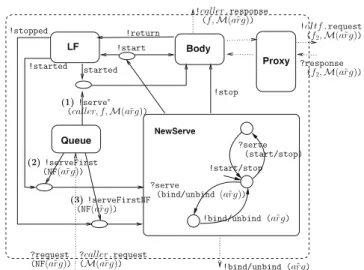
Fig. 1.2 – Structure pNets de la membrane d’un composant composite, FACS’05 En amont de la g´en´eration de mod`eles comportementaux, se pose le probl`eme de l’abstraction : les programmes concrets sont trop complexes, trop d´etaill´es pour ˆetre directement mod´elis´es, il faut d´eterminer le juste niveau d’abstraction pour obtenir un mod`ele g´erable (e.g. fini ou r´egulier), tout en capturant les propri´et´es que l’on veut garantir. Il y a essentiellement deux approches `a ce probl`eme : soit on utilise des m´ecanismes d’analyse statique de code source (´eventuellement compl´et´es par des annotations), soit on se base sur une mod´elisation pr´ealable (langage de sp´ecification ou formalismes `a la UML), `a partir de laquelle on g´en´erera du code “correct par construction”. Dans les deux cas on pourra aussi ˆetre amen´e `a appli-quer des techniques d’interpr´etation abstraite pour r´eduire encore la complexit´e du mod`ele sur lequel travaillent les moteurs de v´erification.
Dans nos premiers travaux [C-03a,C-03b,C-04a], nous avons d´efini une m´ethodo-logie bas´ee sur la premi`ere approche : extraction par analyse statique d’un graphe d’appel de m´ethodes et abstraction des domaines de donn´ees, aboutissant `a la construction d’un mod`ele pNets codant la structure et la dynamique des objets actifs. Cette approche se heurte `a de s´erieux probl`emes de pr´ecision de l’analyse statique d’une part, mais aussi de complexit´e, les techniques d’analyse se prˆetant mal `a des approches compositionnelles. Le passage aux composants distribu´es, par opposition aux objets actifs simples, permet de gagner de mani`ere significative sur la pr´ecision de l’analyse, en particulier parce que la d´efinition des composants im-pose de d´efinir localement les besoins d’interactions avec le reste du syst`eme ou de l’environnement : ce sont les interfaces dites requises (ou client) du composant qui relaient les appels de m´ethodes distantes, et ces interfaces sont connues loca-lement et statiquement. En mˆeme temps, nous avons explor´e plusieurs voies pour la sp´ecification du comportement et de l’architecture des syst`emes de composants distribu´es, soit graphiques [C-07a,J-08], soit textuels [C-08c], dans le cadre de la th`ese d’Antonio Cansado [32].
La mise en pratique de ces principes est une activit´e exigeante en terme de d´eveloppement logiciel, surtout que notre ambition est de pouvoir mettre ces outils dans les mains de non-sp´ecialistes, donc de mettre en place des interfaces utilisateur
de haut niveau, suffisamment intuitives pour cacher la complexit´e des mod`eles sous-jacents et des outils de v´erification utilis´es. Par ailleurs, notre vocation n’´etait pas de travailler sur les algorithmes et sur les moteurs de v´erification eux-mˆemes ; nous avons naturellement choisi des outils bas´es sur les ´equivalences de bisimulation, et utilis´e des moteurs tr`es performants, en particulier ceux de la plateforme CADP.
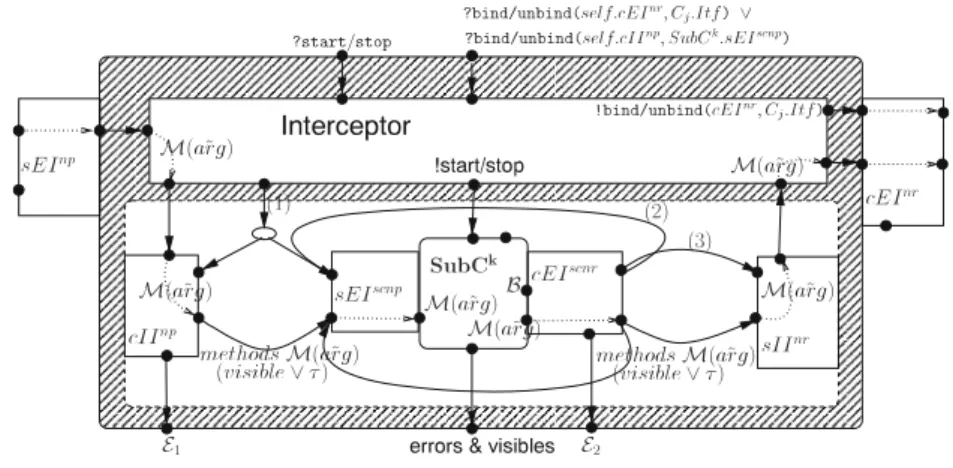
Fig.1.3 – Editeur graphique de composants de la plateforme Vercors Notre plateforme VerCors [W-06,C-05b,C-06,C-09] r´eunit notre ´editeur gra-phique pour la sp´ecification des architectures de composants, nos outils d’abstrac-tion et de g´en´erad’abstrac-tion de mod`eles, et les passerelles vers les outils de minimisad’abstrac-tion et de model-checking de CADP. Le format pivot entre notre mod`ele pNets et les outils de CADP est le format Fiacre, que nous avons d´efini avec nos partenaires du projet (ACI S´ecurit´e) Fiacre.
Bien sˆur nous avons pu traiter, au fur et `a mesure des progr`es de ces tra-vaux, un certain nombre de cas d’´etude de complexit´e grandissante, depuis une mod´elisation du syst`eme de taxes ´electroniques chilien [C-04b] premier exemple de grande taille d’un mod`ele pNets ; du “Common Component Modeling Example” (CoCoME [J-08]), syst`eme de composants distribu´es hi´erarchiques avec communi-cation par messages synchrones ; au dernier en date [C-10] sur la v´erificommuni-cation d’un protocole de vote avec queues de requˆetes asynchrones et communication de groupe. La prochaine ´etape, centrale en l’´etat actuel des travaux de l’´equipe, consiste `
a prendre en compte les aspects dynamiques de nos syst`emes. Le mod`ele GCM permet d’inclure dans les composants des contrˆoleurs g´erant la plupart des aspects non-fonctionnels, y compris la reconfiguration (dynamique) des liaisons entre inter-faces, le remplacement de composants, des protocoles r´esistants aux pannes, voire des strat´egies complexes de type ´equilibrage de charge, optimisation de la consom-mation ´energ´etique, ou adaptation `a la demande. Les mod`eles comportementaux de ces applications seront de plusieurs ordres de grandeur plus complexes que ceux actuellement trait´es, et les propri´et´es `a prouver d´ependront de param`etres plus dynamiques.
Les pistes pour relever ces nouveaux d´efis passent vraisemblablement par des techniques de mod´elisation innovantes (nous avons par exemple men´e quelques exp´erimentations dans le domaine des syst`emes infinis), mais aussi par des in-teractions avec des techniques de preuve interactives, permettant de prouver des
1. Introduction - fran¸cais
propri´et´es g´en´eriques des mod`eles, et de r´eduire la complexit´e de la partie model-checking.
1.2
Structure du Document
Le chapitre 3 rassemble des ´el´ements de comparaison avec d’autres travaux de recherche directement li´es ‘a notre sujet : syst`emes distribu´es et mod`eles `a base de composants ; s´emantiques comportementales ; model-checking et plateformes de v´erification.
Le chapitre 4 d´ecrit notre d´eveloppement du mod`ele s´emantique pNets (para-meterized networks of synchronized automata), et notre codage dans ce mod`ele de la s´emantique du comportement des applications distribu´ees, en commen¸cant par les objets actifs, et en int´egrant progressivement toutes les fonctionnalit´es du mod`ele GCM. L’article principal sur le mod`ele pNets a ´et´e publi´e dans la revue Annals of Telecommunications [J-09] et est inclus ici.
Puis le chapitre 5 pr´esente le d´eveloppement de notre plate-forme de sp´ecification et de v´erification, depuis nos premiers d´eveloppements de traducteurs de pro-grammes ProActive vers les formats d’entr´ee des outils de v´erification CADP, `a travers les ´etapes successives de nos formalismes de sp´ecification, jusqu’`a la plate-forme actuelle VerCors et nos plus r´ecents d´eveloppements. Cette partie est illustr´ee par le document pr´esent´e au symposium FMCO’08 [C-09].
Le chapitre 6 d´ecrit nos recherches en termes de formalismes de sp´ecification, aussi bien graphiques (d´ej`a inclus dans la plate-forme Vercors), que textuels, avec le langage de sp´ecification JDC (Java Distributed Component). Ce dernier langage a ´et´e d´ecrit dans un article `a la conf´erence FACS’08 [C-08c], qui est inclus ici.
Le chapitre 7 est la derni`ere section technique de cette th`ese, et pr´esente trois importantes ´etudes de cas qui ont marqu´e notre travail. Dans chaque cas, nous sou-lignons les techniques utilis´ees pour mod´eliser le syst`eme, maˆıtriser la g´en´eration d’´etats, et prouver les propri´et´es requises. Ce chapitre est illustr´e par les publica-tions d´ecrivant le plus r´ecent de ces cas d’utilisation [C-10, R-10].
Le chapitre 8 contient une analyse de l’´etat actuel de ce travail, et en expose les perspectives pour les ann´ees `a venir.
Enfin, le chapitre 9 assemble les diff´erents ´el´ements de ma carri`ere en tant que chercheur, y compris mes activit´es de recherche et d’enseignement, principales collaborations, participations `a des contrats de recherche, directions des ´etudiants (au doctorat, postdoc, mast`ere), et bibliographie.
Chapitre 2
Introduction - english
2.1
Summary
This dissertation marks an important step in a researcher career already 28 years long, since my PhD in 1983 and my arrival in the same year in the Meije team at INRIA Sophia-Antipolis, until my work in Oasis Team since 2000.
The following chapters mainly concern these last ten years of activity, even if we can find, along the pages, a number of references to my previous work. However I wish, in this introduction, to give some elements making perspectives on the dif-ferent themes of these years of research, and perhaps, to highlight their consistency and their evolution.
During my thesis [T-83] 1, I was interested in the semantics of programming languages, from the point of view of their axiomatic semantics, in order to establish a method to prove the end-to-end correctness of a compiler. This work gives rise to a prototype implementation, using the theorem-prover LCF (Logic for Computable Functions [71, 76]).
My arrival in the team Meije in 1983 (with G. Berry and G. Boudol), in Sophia-Antipolis, marked a significant change in my research. If the overall domain was still the general semantics of languages and programs, with a focus on brand and program proofs, we changed both the theoretical grounds and on techniques and application domains. On the theory side, my thesis work was based on equational semantic models and rewriting techniques. My thesis focused on proofs of pro-grams, but in the very particular case of the proof of correctness of compilers, and using a software interactive theorem proving [R-82,T-83,C-84]. In 1983, my work moved towards operational semantics, and more particularly behavioural seman-tics, and I contributed during years 80 and 90, to major developments on process algebras. At the same time, in terms of software tools, I participated in the deve-lopment of automated tools, model verification engines (model-checkers) based on the theory of bisimulation, editors for graphical specification languages, but also of generic tools for the study of behavioural semantic.
In the second half of year 80, research on process algebras were in full swing, with an abundance of work extending the original process calculi (or languages) CCS, CSP or ACP. In the team Meije, we were particularly focused on a family of asynchronous calculi offering very expressive synchronization primitives : Meije-SCCS. In this context, but also in European projects Concur and Concur2, I
par-1The bibliographic references of my personal publications are referred by category, with the fol-lowing code : E=Editions, J=Journals, C=Conferences (international), W=Workshops, T=Thesis (PhD), R=Reports, S=Standards and Software. The general references are referred by simple numbers.
2. Introduction - english
ticipated in research on the form of operational semantics specifications, in order to characterize syntactically calculi for which we could give sufficient conditions for the termination of model generation algorithms, then use model-checkers. This work has was subject to publication [C-90], but also to the realization of a tool called PAC (Process Algebra Compiler), as part of an NSF-INRIA collaboration with Prof. R. Cleaveland at NC State University (Raleigh, USA) [C-95].
A direct application of these results allowed the construction of the verification tools AUTO [C-89], then Mauto [C-91b,C-92] and Fc2Tools, as part of the doctoral thesis of Didier Vergamini [87]. AUTO was a verifier for properties and equivalences using an explicit representation of states, and hierarchical construction and mini-mization algorithms using strong or observational bisimulation equivalences. He was programmed in LeLisp. The main challenges, at the end of the Didier’s thesis, concerned first upstream bridges between different specification or programming languages and the input formats of the system, secondly the performance of bisi-mulation algorithms. We answered the first point with the Mauto system, wherein the front-end parsing and construction of behavioural models were generated from syntactic and semantic descriptions of languages (by the ECRINS software, precur-sor of the PAC), then a few years later with the design of the intermediate format FC2, central formalism of the verification platform of our team. The second point, again in collaboration with Didier Vergamini, was implanted in Fc2Tools tools, built in C++, which include very efficient bisimulation minimization algorithms, using both explicit and implicit (BDDs) representations.
BeginTask BeginTask BeginTask BeginTask BeginTaskBeginTaskBeginTaskBeginTaskBeginTaskBeginTaskBeginTaskBeginTaskBeginTaskBeginTaskBeginTaskBeginTaskBeginTask EndTaskEndTaskEndTaskEndTaskEndTaskEndTaskEndTaskEndTaskEndTaskEndTaskEndTaskEndTaskEndTaskEndTaskEndTaskEndTaskEndTask
BeginTask BeginTask BeginTask BeginTask BeginTaskBeginTaskBeginTaskBeginTaskBeginTaskBeginTaskBeginTaskBeginTaskBeginTaskBeginTaskBeginTaskBeginTaskBeginTask EndTaskEndTaskEndTaskEndTaskEndTaskEndTaskEndTaskEndTaskEndTaskEndTaskEndTaskEndTaskEndTaskEndTaskEndTaskEndTaskEndTask
BeginTask BeginTask BeginTask BeginTask BeginTask BeginTaskBeginTaskBeginTaskBeginTaskBeginTaskBeginTaskBeginTaskBeginTaskBeginTaskBeginTask BeginTaskBeginTask EndTask EndTask EndTask EndTask EndTask EndTask EndTaskEndTaskEndTaskEndTaskEndTaskEndTaskEndTaskEndTask EndTask EndTask EndTask ?TokenIn ?TokenIn ?TokenIn ?TokenIn ?TokenIn ?TokenIn ?TokenIn?TokenIn?TokenIn?TokenIn?TokenIn?TokenIn?TokenIn?TokenIn ?TokenIn ?TokenIn ?TokenIn !TokenOut !TokenOut !TokenOut !TokenOut !TokenOut !TokenOut!TokenOut!TokenOut!TokenOut!TokenOut!TokenOut!TokenOut!TokenOut!TokenOut!TokenOut!TokenOut!TokenOut
?TokenIn ?TokenIn ?TokenIn ?TokenIn ?TokenIn ?TokenIn?TokenIn?TokenIn?TokenIn?TokenIn?TokenIn?TokenIn?TokenIn?TokenIn?TokenIn ?TokenIn?TokenIn !InitTok !InitTok !InitTok !InitTok !InitTok !InitTok !InitTok!InitTok!InitTok!InitTok!InitTok!InitTok!InitTok!InitTok !InitTok !InitTok !InitTok BeginTask1 BeginTask1 BeginTask1 BeginTask1 BeginTask1 BeginTask1 BeginTask1 BeginTask1BeginTask1BeginTask1BeginTask1BeginTask1BeginTask1 BeginTask1 BeginTask1 BeginTask1
BeginTask1 EndTask1EndTask1EndTask1EndTask1EndTask1EndTask1EndTask1EndTask1EndTask1EndTask1EndTask1EndTask1EndTask1EndTask1EndTask1EndTask1EndTask1
BeginTask3 BeginTask3 BeginTask3 BeginTask3 BeginTask3BeginTask3BeginTask3BeginTask3BeginTask3BeginTask3BeginTask3BeginTask3BeginTask3BeginTask3BeginTask3BeginTask3BeginTask3 EndTask3EndTask3EndTask3EndTask3EndTask3EndTask3EndTask3EndTask3EndTask3EndTask3EndTask3EndTask3EndTask3EndTask3EndTask3EndTask3EndTask3
BeginTask2 BeginTask2 BeginTask2 BeginTask2 BeginTask2 BeginTask2 BeginTask2BeginTask2BeginTask2BeginTask2BeginTask2BeginTask2BeginTask2BeginTask2 BeginTask2 BeginTask2 BeginTask2 EndTask2 EndTask2 EndTask2 EndTask2 EndTask2 EndTask2EndTask2EndTask2EndTask2EndTask2EndTask2EndTask2EndTask2EndTask2EndTask2 EndTask2EndTask2 !TokenOut !TokenOut !TokenOut !TokenOut !TokenOut !TokenOut !TokenOut!TokenOut!TokenOut!TokenOut!TokenOut!TokenOut!TokenOut!TokenOut !TokenOut !TokenOut !TokenOut !TokenOut !TokenOut !TokenOut !TokenOut !TokenOut !TokenOut !TokenOut !TokenOut!TokenOut!TokenOut!TokenOut!TokenOut!TokenOut !TokenOut !TokenOut !TokenOut !TokenOut ?TokenIn ?TokenIn ?TokenIn ?TokenIn ?TokenIn ?TokenIn?TokenIn?TokenIn?TokenIn?TokenIn?TokenIn?TokenIn?TokenIn?TokenIn?TokenIn ?TokenIn?TokenIn BeginTask BeginTask BeginTask BeginTask BeginTask BeginTaskBeginTaskBeginTaskBeginTaskBeginTaskBeginTaskBeginTaskBeginTaskBeginTaskBeginTask BeginTaskBeginTask EndTask EndTask EndTask EndTask EndTask EndTask EndTaskEndTaskEndTaskEndTaskEndTaskEndTaskEndTaskEndTask EndTask EndTask EndTask TokenOut TokenOut TokenOut TokenOut TokenOut TokenOut TokenOutTokenOutTokenOutTokenOutTokenOutTokenOutTokenOutTokenOut TokenOut TokenOut TokenOut TokenIn TokenIn TokenIn TokenIn TokenIn TokenInTokenInTokenInTokenInTokenInTokenInTokenInTokenInTokenInTokenIn TokenInTokenIn
BeginTask BeginTask BeginTask BeginTask BeginTaskBeginTaskBeginTaskBeginTaskBeginTaskBeginTaskBeginTaskBeginTaskBeginTaskBeginTaskBeginTaskBeginTaskBeginTask
!InitTok !InitTok !InitTok !InitTok !InitTok !InitTok !InitTok!InitTok!InitTok!InitTok!InitTok!InitTok!InitTok!InitTok !InitTok !InitTok !InitTok TokenOut TokenOut TokenOut TokenOut TokenOut TokenOutTokenOutTokenOutTokenOutTokenOutTokenOutTokenOutTokenOutTokenOutTokenOut TokenOutTokenOut
BeginTask BeginTask BeginTask BeginTask BeginTaskBeginTaskBeginTaskBeginTaskBeginTaskBeginTaskBeginTaskBeginTaskBeginTaskBeginTaskBeginTaskBeginTaskBeginTask TokenIn
TokenIn TokenIn TokenIn TokenIn TokenInTokenInTokenInTokenInTokenInTokenInTokenInTokenInTokenInTokenIn TokenInTokenIn EndTask EndTask EndTask EndTask EndTask EndTaskEndTaskEndTaskEndTaskEndTaskEndTaskEndTaskEndTaskEndTaskEndTask EndTaskEndTask
BeginTask BeginTask BeginTask BeginTask BeginTaskBeginTaskBeginTaskBeginTaskBeginTaskBeginTaskBeginTaskBeginTaskBeginTaskBeginTaskBeginTaskBeginTaskBeginTask
Fig. 2.1 – ATG drawing for a Scheduler hierarchical architecture
The companion of these tools was the Autograph system [80], designed and im-plemented by Valerie Roy under the direction of Robert de Simone, who provides both a graphical editor for behavioural automata (labeled transition systems) and communicating processes, a translator to the FC2 format, but also a visualization tool for the results of verification tools, in particular counter-examples, when the verification fails. It is remarkable to note that the Autograph system, whose de-velopment was stopped in 1997, is today still regularly downloaded and used for purposes of research and teaching. FC2 format has also been used at that time by several verification systems of our partners (CWB, CADP, UPAAL, Esterel, RTL, ...), and thus allowed an interesting comparison work between our different techniques.
An important application area of these techniques was the specification lan-guage LOTOS, for which we implemented within the Esprit project Lotosphere a specific instantiation of Mauto, intended for proofs of behavioural properties of
Ba-sic Lotos programs [C-91A]. I published a review paper presenting our verification tools, and those of our partners in the project CONCUR in the journal EATCS Bulletin [J-92]. The problem of using verification tools for real-size applications, and real programming languages, will remain a major concern and challenge in my research topics, and will underpin a significant part of my future activities.
In 2000, I joined the young team of Isabelle Attali, also at INRIA Sophia-Antipolis. The idea was to check the applicability of the generic methods I had pre-viously developed to a real programming language, to define the semantic grounds for adapting our generic methods to the programming models created by Oasis, to develop a software platform integrating specific tools for generation of semantic models with generic verification engines, finally, to address case studies of realistic complexity which far exceeded the crude possibilities of state-of-the-art tools of that time.
The challenges were numerous. Among the features essential for realistic lan-guage and case-study processing, taking into account the data types, (mutually) recursive method calls, exceptions handling, were all critical problems for the defi-nition of finiteness criteria, and of good abstractions, of our models. Other features, more specific to Oasis programming models, also required a precise definition of their behavioural semantics, in terms of pNets generation : management of asyn-chronous methods calls between active objects, with their future and their request queues, support for first class futures and their update strategies, group communi-cations ; and finally distributed components as formalized in the Grid Component Model (GCM), with their hierarchical structure, encapsulation, their possibilities for dynamic reconfiguration, their non-functional controllers [C-07b].
Initially, as part of doctoral work of Rabea Boulifa [27] and Tomas Barros [14], we defined a behavioural semantic model extending the existing models in the world of process algebras, to take into account :
– hierarchical composition of processes, hat a very expressive semantic level : we developed to this aim an extension of synchronization vector technique of Arnold and Nivat (the heritage from our work on the FC2 format is obvious), allowing a flexible semantic coding of various synchronization modes, rather than limiting ourselves to a limited choice of parallel operators,
– explicit management of data, both for “value-passing communication”, and for the description of parameterized process topologies.
This model, called pNets (for Parameterized Networks of Automata), was first published in [C-04a] in 2004, and later in its most developed form, in [J-08,J-09]. It allowed us to define procedures for generation of behavioural models for most of the “challenges”lists above, and specifically : active objects of ProActive programming model, with their asynchronous request queues and their futures [C-03a,C-03b,C-04a], distributed components ProActive/GCM [C-05a,C-05b,C-06], first class fu-tures [C-08a], and group communications [C-10].
Ahead of the generation of behavioural models, is the problem of abstraction : concrete programs are too complex, too detailed to be modeled directly, and we must determine the right level of abstraction to obtain a manageable model (ed finite or regular), while capturing the properties we want to guarantee. There are basically two approaches to this problem : either we use static analysis methods on the source code (possibly supplemented by annotations), or we start with an early modeling phase (using a specification language or a modeling formalism a la UML), from which we generate code “correct by construction”. In both cases we may also have to apply abstract interpretation techniques to further reduce the complexity of the model on which the verification engines will work.
2. Introduction - english Queue LF ?Serve start/stop ?Serve M,fut,args ?Serve bind/unbind, args !ServeFirstNF NF,args !ServeFirst M or NF,fut,args !Request M,fut2,args ?Response M,fut2,args !Response M,fut,args ?Response M,fut2,args !Request M,fut2,args !Response M,fut,args ?Request M or NF,fut,args Proxy Body !bind/unbind,args Composite ! start/stop RunActive !fut.call(M,args) ! bind/unbind (args) Membrane (Interceptors + LF) !started !start/stop !stopped fut ?call(M,args)
Fig. 2.2 – pNets structure of a composite component membrane, FACS’05
In our early work [C-03a C-03b, C-04a], we defined a methodology based on the first approach : extraction by static analysis of a method call graph and abs-traction of data domains, resulting in the construction of a pNets model coding the structure and dynamics of active objects. This approach faces serious problems of accuracy of the static analysis on the one hand, but also of complexity, because analysis techniques are ill-suited for compositional approaches. The move to distri-buted components, as opposed to simple active objects, saving significantly on the accuracy of the analysis, especially because the definition of components requires a precise definition of interactions with the rest of the system or the environment (through required interfaces). At the same time, we explored several avenues for the specification of the behaviour and architecture of distributed component sys-tems, either graphical [C-07a, J-08] or textual [C-08c], in the context of Antonio Cansado PhD thesis [32].
The implementation of these principles is a demanding activity in terms of soft-ware development, especially since our ambition is to put these tools in the hands of non-specialists, thus establishing high-level user interfaces, intuitive enough to hide the complexity of the underlying models and verification tools. Besides, our aim was not to work on algorithms and verification engines themselves ; we use existing state-of-the-art engines from the area of bisimulation-based verification, in particular those from the CADP toolset.
Our Vercors platform [W-06,C-05b,C-06,C-09] associates our graphical editor for the specification of component architectures, our tools for abstraction and model generation, and bridges to the minimization and model checking tools of CADP. The pivot format between our pNets model and the CADP tools is the Fiacre language, that we defined with our partners in the Fiacre project (ACI Safety).
Of course we have handled, along the progress of these work, a number of case studies of increasing complexity, a modeling of the emerging Chilean electronic tax system [C-04b], which was a first example of large a pNets model ; the “Common Component Modeling Example”(CoCoME [J-08]), hierarchical distributed com-ponent system with synchronous message passing ; and the latest to-date [C-10] a voting protocol with asynchronous requests queues and group communication.
The next step, essential in the current state of our team work, is to take into account the dynamic aspects of our systems. The GCM can include component controllers managing most non-functional aspects, including the (dynamic) recon-figuration of bindings between interfaces, replacements of components, failure
re-Fig.2.3 – Vercors Graphical Component Editor
sistant protocols, or even complex strategies like load balancing, optimizing the energy consumption or adaptation to external demands. Behavioural models for these applications will be several orders of magnitude more complex than those currently treated, and properties to prove will depend on more dynamic parame-ters.
Tracks to address these new challenges are likely to pass through innovative semantic representation techniques (for example, we conducted some experiments in the field of infinite systems), but also by interactions with interactive proof techniques, for proving the properties of generic models, and reduce the complexity of the model-checking activity itself.
2.2
Document Structure
Chapter 3 gathers elements of comparison with related work : Distributed systems and Component Models, Behavioural Models and Abstract Models, Model-checking and Verification Platforms.
Chapter 4 will describe our development of a semantic model pNets (parame-terized networks of synchronized automata), and our encoding in this model of the behavioural semantics of distributed applications, starting with active objects, and incorporating progressively all features of the GCM model. The main article on the pNets model was published in the Annals of Telecommunication journal [J-09], and is included here.
Then, chapter 5 presents the development of our specification and verification platform, from the early development of translators from ProActive programs to the input formats of the CADP verification toolset, through the successive steps of our specification formalisms, to the current VerCors platform and our most recent developments. This part is illustrated by the paper presented at the FMCO’08 symposium [C-09].
Chapter 6 describes our research in terms of specification formalisms, both graphical (as included in the VerCors platform), and textual, with the Java Distri-buted Component specification language (JDC). This last language was described a paper at the FACS’08 conference [C-08c], which is included here.
2. Introduction - english
Chapter 7 is the last technical section of this thesis, and presents three impor-tant case-studies that have marked our work. In each case, we emphasize the tech-niques used for modeling the application, mastering the state-generation process, and proving the required properties. The chapter is illustrated by the publications describing the most recent of these use-cases [C-10,R-10].
Chapter 8 contains an analysis of the current state of this work, and exposes perspectives for the forthcoming years.
Finally, chapter 9 assembles the various elements of my career as a researcher, including my research and teaching activities, main collaborations, involvement in research contracts, students direction (at PhD, postdoc, master levels), and bibliography.
Chapitre 3
Related Work
In this chapter we give an overview of research related to our subject, com-menting the relations and differences when possible. We start with (distributed) component models, then describe various (low-level) formalisms used to model dis-tributed systems, and list a number of existing verification tool-sets, dedicated to various programming languages, or based on different model-checking methods. Finally we mention shortly a number of more recent approaches, that are not yet fully integrated in available platforms, but that are worth considering for experi-mentation and further work.
Distributed systems and Component Models
Our focus in this work is not the design of (software) components models, but our starting point was necessarily the choice of a programming model for distributed applications on which we could build our semantic definitions and our verification methodology. So we start our related work section by a short panorama of models for distributed programming and distributed component systems.
In this section, we review some software component models that are targeted at the programming of distributed applications, and development of middleware, taking into account constraints raised by distribution. We start with some of the most commonly known models for a component-oriented approach [75] to distri-buted computing : the Common Component Architecture (CCA), the CORBA Component Model (CCM), and the Service Component Architecture (SCA) after which we will describe the main features of Fractal and GCM, and motivate their choice for our work.
CCA has been defined by a group of researchers from laboratories and academic institutions committed to specifying standard component architectures for (Grid) high performance computing [10, 35]. In CCA a component “is a software object, meant to interact with other components, encapsulating certain functionality or a set of functionalities. A component has a clearly defined interface and conforms to a prescribed behaviour common to all components within an architecture.” Cur-rently the CCA Forum (www.cca-forum.org) gathers documents, projects and other CCA-related work including the definition of a CCA-specific format of component interfaces (Babel/SIDL - SRPC Interface Description Language) and framework implementations (Ccaffeine, Xcat).
However, the CCA model is non-hierarchical, thereby making it difficult to handle the distributed and possibly large set of components forming a Grid or Cloud application in a structured way. Indeed, hierarchical organization of a compound application can prove very useful in getting scalable solutions for management
3. Related Work
operations pertaining to monitoring, life-cycle, reconfiguration, physical mapping on infrastructure resources, load-balancing, etc. Unfortunately, the CCA model is rather poor with regards to managing components at runtime. It means a CCA component per se does not have to expose standard interfaces dedicated to non-functional aspects as it is the case for Fractal components. This makes it hard to realize certain features, for instance, dynamic reconfiguration based on observed performance or failures, or elastic adaptation to ”business” requirements. However, some implementations of the model, like e.g. XCAT, can provide some additional components (like an Application Manager) dedicated to manage the non-functional aspects of a CCA-based application.
CCM is a component model defined by the Object Management Group (OMG). The CCM specifications include a Component Implementation Definition Lan-guage (CIDL) ; the semantics of the CORBA Component Model (CCM) ; a Com-ponent Implementation Framework (CIF), which defines the programming model for constructing component implementations and a container programming model. Important work has been performed to turn the CCM in a Grid component model, like GridCCM [44].
In CCM, the ADL is able to deal with distributed resources but it is outside the scope of the specifications to describe how such a description has been generated. However, this task requires a high level of knowledge of the application structure as well as the resource properties. This approach is not satisfactory for Grids or Clouds where resources are provided dynamically.
Even if CCA and CCM components can fit into a distributed infrastructure, they are not designed as being per se distributed. Consequently, it is quite unna-tural to use them to build parallel entities to be mapped onto a set of distribu-ted resources, or having the capability to self-adapt to the changing context. By contrast, the Enterprise Grid Alliance effort [85] is an attempt to derive a common model adopting Grid technologies for enhancing the enterprise and business appli-cations. The model, which is aligned with industry-strength requirements, strongly relies on component technology along with necessary associations with component-specific attributes, dependencies, constraints, service-level agreements, service-level objectives and configuration information. One of the key features that the EGA reference model suggests is the life-cycle management of components which could be governed by policies and other management aspects. The level of this specifica-tion, however, is very coarse-grain focusing on system integration support rather than providing an abstract model and specification for Grid programming which is the main goal of GCM.
University of Kansas has developed the verification environment Cadena [56, 36], and its meta-modeling language CALM [61], for the specification, verification, and development of CCM applications.
SCA is a set of specifications proposed by the OASIS standard body [4], which describe a hierarchical model for building applications and systems using a Service-Oriented Architecture (SOA). The SCA specifications were first published in Nov. 2005, including the Assembly Specification, the Client and Implementation Speci-fication for Java and the Client and Implementation SpeciSpeci-fication for C++. Imple-mentations include open-source tools developed by the Tuscany project [1] of the Apache Software Foundation, or the SCOrWare french project [2].
Fractal and GCM Fractal [29] is a general component model which is intended to implement, deploy and manage (i.e. monitor, control and dynamically configure) complex software systems, including in particular operating systems and middle-ware. The Grid Component Model (GCM) [11, 15] is a Fractal extension providing specific features for programming distributed systems, typically on Grid, P2P, or Cloud infrastructures.
Among Fractal’s peculiar features, below are those that motivated us to select it as the basis for the GCM.
– Hierarchy (composite components can contain sub-components), to have a uniform view of applications at various levels of abstraction.
– Introspection capabilities, to monitor and control the execution of a running system.
– Reconfiguration capabilities, to dynamically configure a system.
To allow programmers to tune the control of reflective features of components to the requirements of their applications, Fractal is defined as an extensible system. In addition, the Fractal specification is a multi-level specification, where depending on the level some of the specified features are optional. That means that the model allows for a continuum of reflective features or levels of control, ranging from no control (black-boxes, standard objects) to full-fledged introspection and interces-sion capabilities (including e.g. access and manipulation of component contents, control over components life-cycle and behaviour, etc). Fractal does not constrain the way(s) the GCM can be implemented, but it provides a basis for its formal specification, allowing us to focus only on the Grid-specific features. Eventually, platforms implementing the GCM should constitute suitable grid programming and execution environments. ProActive offers one such implementation [10].
Behavioural Models, Abstract Models
Historically, models of behaviours were defined in terms of semantic-level re-presentations, ranging from core Labelled Transition Systems (LTS), from the very beginning of the process algebra era (see [72, 19]), and the synchronization vectors of Arnold and Nivat [8], to Milner’s π-calculus [73]. LTS is, without contest, the most often used model for the representing behaviours in analysis and verification toolsets. At the other end of the spectrum, the π-calculus has only been used in a few research prototypes, because its high expressiveness comes with a very high complexity of the related representations and algorithms.
Most established approaches, on the other side, are using intermediate formats with data, that can be unfolded to finite-state structures. This is the case e.g. for the CADP toolbox [47], or for the SPIN model-checker [58]. These systems have a usual input language (Lotos and Promela, respectively) that can be used directly to model the systems to be analyzed. But many users are implemen-ting translators from their source language into Lotos or Promela. Both of these modeling languages have very expressive constructs, high-level process definition and communication mechanisms (with gate negotiation in Lotos, or more classical channels in Promela), and typed data manipulation. Naturally, Lotos and Pro-mela programs have infinite behaviours, due to unbounded data on one hand, and to recursive process definition on the other hand. The state exploration engines of the model-checkers have mechanisms to specify bound domains for data, or bound expansion of the behaviours.
When model-checking software systems written in usual programming lan-guages, there is an inescapable step dedicated to build an abstract, smaller and
3. Related Work
more manageable, version of the original program.
Quoting Patrick Cousot : Model-checking exhaustively verifies temporal properties on a finite model of hardware or software computer systems [38]. This abstraction of a system into a model is often left impli-cit. Abstract model checking, as formalized by abstract interpretation, makes this abstraction explicit [39], [42]. Model-checking is reputed to be terminating, sound, and complete on the model. From an abstract interpretation point of view, relating the system to its model, it may be sound on the model but unsound on the system (e.g. the model is correct for safety properties but wrong for liveness properties), it is often incomplete (no finite model can cover the specified behaviors of the system [78]) and, in practice, may explode combinatorially. In all cases abstract interpretations of the system into a model have to be considered.
There is one early work from Cleaveland & Riely [40], that defines a conve-nient mechanism for building abstract (finite) behavioural models of distributed applications, starting from the specification of abstract interpretations of the data domains, while respecting safety and liveness properties of the original concrete (infinite) programs.
Finding the right compromise between very abstract (and small) models, and more precise (but larger) models may be a difficult task. Part of the solution relies on program slicing (keeping only the segments of the program that influences the property or the set of properties to be proved) (see e.g. [21, 45]). Some authors have proposed iterative methods, where failures of the model-checking engine are analyzed and are used to refine the abstraction, until the model is precise enough to prove the goals [37, 55, 54].
Model-checking and Verification Platforms
Many works have been done based on process algebra foundations, starting in the eighties with research tools implementing the CCS, CSP, or ACP algebras [J-92]. Some of these tools have given birth to systems with a more developer-oriented specification language :
The FDR2 tool [28] offers a high-level language for expressing CSP models, and an internal machine-readable dialect of CSP [84] using a specific expression language, more adapted to generate the models needed by the verification engines. Strictly speaking, FDR2 is a refinement checker rather than a model-checker, in the sense that it compares two LTSs,the system and its specification, with respect to some specified refinement relation (trace, failures or failure/divergence).
The µCRL tool, and its successor mCRL2 [52, 51], based on the ACP process algebra, are offering an expressive language with data manipulation, and rich analysis tools for linearization, simula-tion, state-space exploration and generation and tools to optimize and analyze specifications. Mo-reover, state spaces can be manipulated, visualized
and analyzed. A colorful transition system
visualization with the mCRL2 toolset
The UPAAL system [18, 63, 16] was born also in the process algebra era, and implements a number of extensions of the original “pure” calculi, including data, timed and probabilistic calculi. It is still one of the extensively used system in research and education, and also offers a commercial version.
The CADP toolset [48] is one of the proeminent platforms for the specification, verification, and testing of distributed systems in the European academic landscape. Initially built as an environment dedicated to LOTOS programs, it was progressi-vely open to handle a number of different input formalisms, through several input formats, together with an extensible API. The toolset includes engines for building the state-space of systems in a hierarchical way, building and manipulating LTSs on distributed infrastructures, minimizing LTSs along several behavioural equiva-lences, model-checking properties, checking equivalences between systems, building test suites, evaluating performances, etc.
In parallel with all these “process algebra” based tools, most of them from Eu-ropean research labs, there were a very important family of tools born on the other side of the Atlantic, mostly based on trace semantics and linear time logics, rather than bisimulation semantics and branching time logics. The most renowned of these are certainly SPIN [59, 58] (linear time), SMV [30] (branching time, state-based) and its real-time/hybrid extensions [31, 64], or SLAM [13, 12] (linear-time, with focus on C-code abstraction). These tools have been extensively used for hardware and embedded system verification, but they also have been used (by translation to their respective input formalisms), in the area of protocols and distributed systems. There are also a small number of researches dedicated more specifically to com-ponent oriented verification. This is the case e.g. of SOFA, STSlib, and Kmelia... : The SOFA system [77, 3, 60] is dedicated to the development of large, dis-tributed software systems, based on hierarchical components. It uses a model of ”behavior protocols” for the specification of possible interactions between compo-nents, and notions of compatibility for safe component assembly, and of hierarchical refinement.
The STSLib library [46] provides a formal component framework that synthe-sizes components from symbolic protocols in terms of Symbolic Transition Systems (STS). Just as pNets, STS concisely represents infinite systems, however, STS rely on Abstract Data Types (ADT) which are more expressive than the Simple Types used in pNets but less intuitive for software engineers. Both formalisms rely on (N-ary) synchronization vectors, but in STS they are static whereas in pNets they are dynamic. STSLib synthesizes components based on their STS protocols ; a controller interprets the STS protocol and data from the ADT is implemented (and generated) in Java. The communication in STS components is rather low-level ; both emitter and receiver must agree exchange a message, although there is no explicit notion of required nor provided services.
Kmelia [9, 6, 5] is a component specification model based on the description of complex services. Kmelia and its toolbox COSTO can be used to model software architectures and their properties, these models being later refined to execution platforms. It can also be used as a common model for studying component or ser-vice model properties (abstraction, interoperability, composability), using various verifications toolsets, including CADP, MEC5, and Atelier-B.
4. Behavioural Models
Chapitre 4
Behavioural Models
4.1
Summary
The paper included in this chapter has been published in January 2009 in the Annals of Telecommunications journal, issue entitled “Component-based architec-ture : the Fractal initiative”. This article is the outcome of a series of workshop and conference papers presenting our efforts for building a semantic model dedicated to the analysis of distributed software.
In the Introduction chapter we have motivated the need for such a behavioural model, that would be :
– flexible enough to address a large set of distributed programming concepts, – compact enough to be the basis for a manageable intermediate format, – and defined with the idea of opening the possibilities for convenient
“abstrac-tions” towards specific classes of decidable models (finite, regular, etc.). This story started in years 2002-2003. The original question was :
Can we use existing formalisms and existing semantic models to lift verification methods from “academic” calculi (process algebras and their natural LTS-based behavioural semantics), to real languages, to support the analysis of Java/ProActive applications ?
The challenge was to address the kernel features and paradigms of ProActive, including Java object/method basic structure, asynchronous communication using ASP/ProActive remote procedure calls, programmable request selection policies, and a small subset of data and data-types manipulation, sufficient to build realistic small examples. This was quite different from the work we developed previously in the Meije team : instead of defining a kernel formalism (a calculus or an algebra) as small and expressive as possible, dedicated to our specific interest of the moment, we had to tackle existing languages, with their large set of constructs,
Among the formalisms mentioned in the state of the art (Section 3), Lotos was certainly the closest to our goals, inherited from the process algebra decades, it had good capabilities for process definition, parallelism construction, and commu-nication expression. I had worked a lot with Lotos, in particular in the context of the Lotosphere Esprit project, and developed specific behaviour model construc-tion tools, and successful verificaconstruc-tion case-studies, for a sub-language without data called Basic Lotos. There were at least three important reasons why Lotos was not a good candidate to define the behavioural models of ProActive : its (algebraic) data type descriptions are very far from object oriented types of Java, so the enco-ding would have been complex ; the parallel constructs of Lotos, with their original
“offer negotiation” are very different from the more pragmatic remote method call of ProActive, and totally unable to encode the multicast communication of our programming models ; and, last but not least, the recursive definition of processes in Lotos is too powerful for deciding conveniently of the finiteness of process ar-chitectures. So it failed to meet most of the items listed at the beginning of this chapter.
In the context of Rab´ea Boulifa’s PhD doctoral thesis (2002-2004), we explored the idea of building by code analysis an “extended method call graph” (XMCG), encoding : 1) the dynamic structure of (possibly recursive) method calls, 2) the special structure for managing remote method calls, with their future proxies and their request queues, 3) an abstraction of data-types and data-variables. From these XMCGs, a behavioural semantics defined by Structural Operational Semantic (SOS) rules was able to produce pNets semantic models.
The pNets model is a tree-like structure which leaves are Labelled Transition Systems with data values (similar to the “Symbolic Transition Systems” of Lin and Ingolfsdir [65]), and nodes (Networks) have the role of synchronizing the commu-nication events of subsystems (similar to the “Synchronization Vectors” of Arnold and Nivat [8]). See the formal definition in [J-09, pages 30-31]. The main originality of this model is the idea that Networks themselves are parameterized, i.e. indexed by data-variables, that allows us to model directly the parameterized architectures (pipelines, rings, vectors or matrices of processes, etc.), and also dynamic message routing or dynamic architecture configuration. This was first published in work-shops at [C-03a], [C-03b], [W-04], and at the FORTE conference in September 2004 [C-04a], where the denomination pNets first appeared.
In the Forte’04 version, we used pNets solely for encoding the behaviour of Java method calls (potentially recursive), and ProActive mechanisms for active objects, including asynchronous communication, management of request queues, and of future values. This encoding uses heavily the parameterized Network structure of the pNets, where e.g. the set of invocations of a given method in an active object is encoded by an unbounded family of processes in the pNets, indexed by a natural number representing the successive calls of the method [C-03b]. In the same paper, we described the method for static analysis of Java/ProActive code, building the extended method call graph, and for building safe abstraction of data domains. In Rab´ea Boulifa PhD thesis [27], we proved that this construction terminates. But there were strong open questions at this point, the most important being the imprecision of static analysis. In particular, consider the case of a piece of code containing a loop structure over an indexed structure (pipe-line, ring, vector, matrice, etc...) containing active objects ; a statement addressing these objects by an indexed reference in the structure will refer both to the local and to remote objects, so it is impossible to determine statically which calls correspond to the local object, and which calls correspond to remote objects. This fact has serious consequences in terms of the kind of properties that the model can prove, for such parameterized topologies.
The next step was to consider distributed components, as a mean to answer this problem. One of the main feature of components is that dependencies upon exter-nal (= remote) components are explicit, through the use of required interfaces. A number of component models also feature hierarchical structures, that fit naturally well with our semantic models (hierarchical networks + bisimulation). We conside-red Fractal components [29], as a flexible and extensible model offering the desiconside-red properties, and also the Grid Component Model [15] (GCM), that is the distributed extension of Fractal compatible with ProActive active objects. In [C-05a,C-05b],
4. Behavioural Models
we published the description of pNets model generation for 1) hierarchical compo-nents, 2) Fractal hierarchical components with life-cycle and binding controllers, 3) GCM components, i.e. Fractal components encapsulating active objects at both primitive and composite levels.
Naturally, it took us a couple years before publishing a journal version summa-rizing this work [J-09]. The contributions of this article are :
– a formal definition of the pNets model, together with its instantiation opera-tor, and a product operator defined on instantiated nets,
– Four different application cases of increasing complexity, defining the mo-del generation for ProActive active objects, hierarchical components, Fractal components, GCM components.
The version described in the Annals paper did not cover some advanced features of GCM that are very useful for our distributed application area, in particular first class futures and group communication, that we developed in the same period than the journal paper, and presented at FACS [C-08a] and at FMCO’2008 [C-09].
First class futures allow components to pass references to futures within requests arguments. In the ProActive library, futures are managed by proxy mechanisms, which act as relays between the request caller and the remote service. This is an important feature for GCM applications, permitting more asynchrony between components. But it also raises new questions for verification, because of depen-dencies introduced between the futures passing and update occurrences. There are a number of strategies for future updates, that require different kinds of future handling mechanisms in the implementation, and naturally different kind of future proxies in our models. We have published some of these variants in [C-08a], and have described the basis of this proxy model in [C-09, page17].
Fig. 4.1 – Example of Multicast and Gathercast communication
Collective interfaces, in the GCM model, introduce a new structuring feature in component architectures : Multicast interfaces are managing 1 to N communica-tions, delivering their messages in a broadcast manner, and collecting results asyn-chronously. Gathercast interfaces is the dual mechanism, gathering requests along a number of connected “client” components, assembling them in a single request transmitted to the service interface, then distributing the result of the computation along some specific policy (that could be duplicating, scattering, or others). Here again we model this mechanism using Group proxies, that encode the policies and the API methods of both multicast and gathercast interfaces. The synchroniza-tion variants make use of the flexibility of pNets parameterized synchronizasynchroniza-tion vectors to encode directly point to point (interleaved) or multi-point (multicast) communication. We shall give more feedback on this part in the Use-cases chapter 7.1.
![Fig. 1.3 – Editeur graphique de composants de la plateforme Vercors Notre plateforme VerCors [W-06,C-05b,C-06,C-09] r´eunit notre ´editeur gra-phique pour la sp´ecification des architectures de composants, nos outils d’abstrac-tion et de g´en´erad’abstra](https://thumb-eu.123doks.com/thumbv2/123doknet/14711348.748967/9.892.132.658.226.558/editeur-graphique-composants-plateforme-plateforme-ecification-architectures-composants.webp)

![Fig. 2.2 – pNets structure of a composite component membrane, FACS’05 In our early work [C-03a C-03b, C-04a], we defined a methodology based on the first approach : extraction by static analysis of a method call graph and abs-traction of data domains, res](https://thumb-eu.123doks.com/thumbv2/123doknet/14711348.748967/14.892.285.714.111.380/structure-composite-component-membrane-methodology-approach-extraction-analysis.webp)