ScienceDirect
Available online at www.sciencedirect.com
Procedia Computer Science 110 (2017) 110–116
1877-0509 © 2017 The Authors. Published by Elsevier B.V. Peer-review under responsibility of the Conference Program Chairs. 10.1016/j.procs.2017.06.127
10.1016/j.procs.2017.06.127
© 2017 The Authors. Published by Elsevier B.V.
Peer-review under responsibility of the Conference Program Chairs.
1877-0509 Available online at www.sciencedirect.com
ScienceDirect
Procedia Computer Science 00 (2017) 000–000www.elsevier.com/locate/procedia
1877-0509 © 2017 The Authors. Published by Elsevier B.V. Peer-review under responsibility of the Conference Program Chairs.
The 14th International Conference on Mobile Systems and Pervasive Computing
(MobiSPC 2017)
Web-based cattle behavior service for researchers based on the
smartphone inertial central
Olivier Debauche
a,b,*, Saïd Mahmoudi
a, Andriamasinoro Lalaina Herinaina
Andriamandroso
b,c, Pierre Manneback
a, Jérôme Bindelle
cFrédéric Lebeau
ba Computer Science Unit, Faculty of Engineering, Unversity of Mons, 20 Place du Parc, B-7000 Mons, Belgium.
bBiosystems Dynamics and Exchanges Axis, Biosystem Engineering Department, ULg – Gembloux Agro-Bio Tech, University of Liège, Passage
des Déportés 2, B-5030 Gembloux, Belgium.
cTERRA Teaching and Research Centre, AgricultureIsLife/EnvironmentIsLife & Precision Livestock and Nutrition, AgroBioChem, Gembloux
Agro-Bio Tech, University of Liège, Passage des Déportés 2, B-5030 Gembloux, Belgium.
Abstract
Smartphones, particularly iPhones, can be relevant instruments for researchers in animal behavior because they are readily available on the planet, contain many sensors and require no hardware development. They are equipped with high performance inertial measurement units (IMU) and absolute positioning systems analyzing users’ movements, but they can easily be diverted to analyze likewise the behaviors of domestic animals such as cattle. The study of animal behavior using smartphones requires the storage of many high frequency variables from a large number of individuals and their processing through various relevant variables combinations for modeling and decision-making. Transferring, storing, treating and sharing such an amount of data is a big challenge. In this paper, a lambda cloud architecture and a scientific sharing platform used to archive and process high-frequency data are proposed. An application to the study of cattle behavior on pasture on the basis of the data recorded with the IMU of iPhones 4S is exemplified. The package comes also with a web interface to encode the actual behavior observed on videos and to synchronize observations with the sensor signals. Finally, the use of fog computing on the iPhone reduced by 42% on average the size of the raw data by eliminating redundancies.
© 2017 The Authors. Published by Elsevier B.V.
Peer-review under responsibility of the Conference Program Chairs.
Keywords: precision livestock farming; smart breeding; smart agriculture; database; intertial unit; webservice; Internet of things; animal behavior; classification algorithms
* Corresponding author. Tel.: +32(0)65-374-059; fax: +32(0)71-140-095.
E-mail address: [email protected]
Available online at www.sciencedirect.com
ScienceDirect
Procedia Computer Science 00 (2017) 000–000www.elsevier.com/locate/procedia
1877-0509 © 2017 The Authors. Published by Elsevier B.V. Peer-review under responsibility of the Conference Program Chairs.
The 14th International Conference on Mobile Systems and Pervasive Computing
(MobiSPC 2017)
Web-based cattle behavior service for researchers based on the
smartphone inertial central
Olivier Debauche
a,b,*, Saïd Mahmoudi
a, Andriamasinoro Lalaina Herinaina
Andriamandroso
b,c, Pierre Manneback
a, Jérôme Bindelle
cFrédéric Lebeau
ba Computer Science Unit, Faculty of Engineering, Unversity of Mons, 20 Place du Parc, B-7000 Mons, Belgium.
bBiosystems Dynamics and Exchanges Axis, Biosystem Engineering Department, ULg – Gembloux Agro-Bio Tech, University of Liège, Passage
des Déportés 2, B-5030 Gembloux, Belgium.
cTERRA Teaching and Research Centre, AgricultureIsLife/EnvironmentIsLife & Precision Livestock and Nutrition, AgroBioChem, Gembloux
Agro-Bio Tech, University of Liège, Passage des Déportés 2, B-5030 Gembloux, Belgium.
Abstract
Smartphones, particularly iPhones, can be relevant instruments for researchers in animal behavior because they are readily available on the planet, contain many sensors and require no hardware development. They are equipped with high performance inertial measurement units (IMU) and absolute positioning systems analyzing users’ movements, but they can easily be diverted to analyze likewise the behaviors of domestic animals such as cattle. The study of animal behavior using smartphones requires the storage of many high frequency variables from a large number of individuals and their processing through various relevant variables combinations for modeling and decision-making. Transferring, storing, treating and sharing such an amount of data is a big challenge. In this paper, a lambda cloud architecture and a scientific sharing platform used to archive and process high-frequency data are proposed. An application to the study of cattle behavior on pasture on the basis of the data recorded with the IMU of iPhones 4S is exemplified. The package comes also with a web interface to encode the actual behavior observed on videos and to synchronize observations with the sensor signals. Finally, the use of fog computing on the iPhone reduced by 42% on average the size of the raw data by eliminating redundancies.
© 2017 The Authors. Published by Elsevier B.V.
Peer-review under responsibility of the Conference Program Chairs.
Keywords: precision livestock farming; smart breeding; smart agriculture; database; intertial unit; webservice; Internet of things; animal behavior; classification algorithms
* Corresponding author. Tel.: +32(0)65-374-059; fax: +32(0)71-140-095.
E-mail address: [email protected]
2 Olivier Debauche et al. / Procedia Computer Science 00 (2017) 000–000
1. Introduction
The use of sensors in livestock farming is becoming widespread, especially in dairy cattle operations. Most methods suggested to treat the data collected to analyze the feeding behavior of cows use black-box type models and reach accuracies as high as 90% of correctly classified behaviors1. According to the literature, three main
components are required to analyze the behavior of animals: (1) location obtained by radio frequency triangulation or by global positioning system (GPS), (2) low frequency component of behavior as posture of the animal (e.g.: position of the head, tilt of the neck, etc.), (3) high frequency component of behavior (e.g. movement of the jaws)5.
Recently, the use of smartphones, particularly iPhones, was suggested for this purpose1 as they are readily available
on the planet, contain many relevant sensors and require no hardware development. They are equipped with high performance inertial measurement units (IMU) and absolute positioning systems that can easily be diverted to investigate the feeding behaviors of cows under a range of environmental conditions. Such researches aiming to the development of precision livestock farming (PLF) applications, i.e. shifting from the management of a herd to the individual management of the animals in the herd, require the collection of many data in real or near real time and the setting up of a dedicated computer infrastructure. This infrastructure, in addition to data collection, should allow researchers to share their datasets and models. To fulfill this goal, the experimental data must be consistently structured in order to facilitate the exchange. Using data collectively will enable the development and the validation of new models from larger datasets and provide new research opportunities for animal feeding behavior and health as well as pasture management. This will also pave the way to PLF by allowing parameter identification or combination and the sampling frequencies that are required to accurately detect specific behaviors, and the development of specific, accurate and reliable connected sensors. Indeed, the Internet of the things will offer tremendous opportunities in PLF by making it possible to know at any moment the health status of the animals and to detect problems before they become worse. For this purpose, using connected sensors in association with cloud technologies for research and later routinely in the farms poses a double challenge. Firstly, at the level of the sensors, data must be collected at a high-frequency (up to 100 Hz) and processed to eliminate redundancy. The reduction in data size is essential to reduce bandwidth requirements for transmission and improve battery life. Indeed, sensors are generally powered by external batteries whose main sources of consumption are the network transmissions. The second challenge is the storage and the processing of large amounts of data per animal per day (from several tera to several peta bytes) arriving at high speed at the cloud level.
The collection of data for a large number of cows in different environments around the world is a corner stone in the development of new models and their validation on large data sets. Moreover, in order to allow farmers to benefit from these new technologies, the development of a new set of microcontrollers sensors will be necessary. The sensor will be optimized on the basis of the results of the research previously mentioned to collect essential information at the adapted frequency in order to identify behavior with high accuracy. The new sensors need also to be optimized in order to reduce power consumption through local processing of information and a limit transmission of information through the network. Finally, data related to breeding conditions, animal performances and health may be sensitive and require protective measures, by anonymizing and controlling their use.
In this paper, we present a chain of tools fulfilling the above-mentioned criteria for data related to cattle behavior measured by means of the IMU signals of I-phones worn by the animals on halters6. We propose and describe a new
infrastructure allowing to collect, store, treat and share information between scientists. The sharing of important amount of data is important to create more robust models and (re)validate existing models. The proposed lambda architecture brings benefits in storage, real-time processing and abilities for large scale data storage and analytics.
2. Literature review
Large-scale data collection and sharing requires a cloud storage platform to standardize, store and exchange data. This kind of platform could be used to develop, test and validate new models analyzing animals behavior and the relevant signals to be recorded. When the amount of data is large and diversified enough, the most relevant parameters used to detect a given behavior can be identified. The best sampling frequencies can also be extracted in
Olivier Debauche et al. / Procedia Computer Science 110 (2017) 110–116 111
ScienceDirect
Procedia Computer Science 00 (2017) 000–000
www.elsevier.com/locate/procedia
1877-0509 © 2017 The Authors. Published by Elsevier B.V. Peer-review under responsibility of the Conference Program Chairs.
The 14th International Conference on Mobile Systems and Pervasive Computing
(MobiSPC 2017)
Web-based cattle behavior service for researchers based on the
smartphone inertial central
Olivier Debauche
a,b,*, Saïd Mahmoudi
a, Andriamasinoro Lalaina Herinaina
Andriamandroso
b,c, Pierre Manneback
a, Jérôme Bindelle
cFrédéric Lebeau
ba Computer Science Unit, Faculty of Engineering, Unversity of Mons, 20 Place du Parc, B-7000 Mons, Belgium.
bBiosystems Dynamics and Exchanges Axis, Biosystem Engineering Department, ULg – Gembloux Agro-Bio Tech, University of Liège, Passage
des Déportés 2, B-5030 Gembloux, Belgium.
cTERRA Teaching and Research Centre, AgricultureIsLife/EnvironmentIsLife & Precision Livestock and Nutrition, AgroBioChem, Gembloux
Agro-Bio Tech, University of Liège, Passage des Déportés 2, B-5030 Gembloux, Belgium.
Abstract
Smartphones, particularly iPhones, can be relevant instruments for researchers in animal behavior because they are readily available on the planet, contain many sensors and require no hardware development. They are equipped with high performance inertial measurement units (IMU) and absolute positioning systems analyzing users’ movements, but they can easily be diverted to analyze likewise the behaviors of domestic animals such as cattle. The study of animal behavior using smartphones requires the storage of many high frequency variables from a large number of individuals and their processing through various relevant variables combinations for modeling and decision-making. Transferring, storing, treating and sharing such an amount of data is a big challenge. In this paper, a lambda cloud architecture and a scientific sharing platform used to archive and process high-frequency data are proposed. An application to the study of cattle behavior on pasture on the basis of the data recorded with the IMU of iPhones 4S is exemplified. The package comes also with a web interface to encode the actual behavior observed on videos and to synchronize observations with the sensor signals. Finally, the use of fog computing on the iPhone reduced by 42% on average the size of the raw data by eliminating redundancies.
© 2017 The Authors. Published by Elsevier B.V.
Peer-review under responsibility of the Conference Program Chairs.
Keywords: precision livestock farming; smart breeding; smart agriculture; database; intertial unit; webservice; Internet of things; animal behavior; classification algorithms
* Corresponding author. Tel.: +32(0)65-374-059; fax: +32(0)71-140-095.
E-mail address: [email protected]
Available online at www.sciencedirect.com
ScienceDirect
Procedia Computer Science 00 (2017) 000–000www.elsevier.com/locate/procedia
1877-0509 © 2017 The Authors. Published by Elsevier B.V. Peer-review under responsibility of the Conference Program Chairs.
The 14th International Conference on Mobile Systems and Pervasive Computing
(MobiSPC 2017)
Web-based cattle behavior service for researchers based on the
smartphone inertial central
Olivier Debauche
a,b,*, Saïd Mahmoudi
a, Andriamasinoro Lalaina Herinaina
Andriamandroso
b,c, Pierre Manneback
a, Jérôme Bindelle
cFrédéric Lebeau
ba Computer Science Unit, Faculty of Engineering, Unversity of Mons, 20 Place du Parc, B-7000 Mons, Belgium.
bBiosystems Dynamics and Exchanges Axis, Biosystem Engineering Department, ULg – Gembloux Agro-Bio Tech, University of Liège, Passage
des Déportés 2, B-5030 Gembloux, Belgium.
cTERRA Teaching and Research Centre, AgricultureIsLife/EnvironmentIsLife & Precision Livestock and Nutrition, AgroBioChem, Gembloux
Agro-Bio Tech, University of Liège, Passage des Déportés 2, B-5030 Gembloux, Belgium.
Abstract
Smartphones, particularly iPhones, can be relevant instruments for researchers in animal behavior because they are readily available on the planet, contain many sensors and require no hardware development. They are equipped with high performance inertial measurement units (IMU) and absolute positioning systems analyzing users’ movements, but they can easily be diverted to analyze likewise the behaviors of domestic animals such as cattle. The study of animal behavior using smartphones requires the storage of many high frequency variables from a large number of individuals and their processing through various relevant variables combinations for modeling and decision-making. Transferring, storing, treating and sharing such an amount of data is a big challenge. In this paper, a lambda cloud architecture and a scientific sharing platform used to archive and process high-frequency data are proposed. An application to the study of cattle behavior on pasture on the basis of the data recorded with the IMU of iPhones 4S is exemplified. The package comes also with a web interface to encode the actual behavior observed on videos and to synchronize observations with the sensor signals. Finally, the use of fog computing on the iPhone reduced by 42% on average the size of the raw data by eliminating redundancies.
© 2017 The Authors. Published by Elsevier B.V.
Peer-review under responsibility of the Conference Program Chairs.
Keywords: precision livestock farming; smart breeding; smart agriculture; database; intertial unit; webservice; Internet of things; animal behavior; classification algorithms
* Corresponding author. Tel.: +32(0)65-374-059; fax: +32(0)71-140-095.
E-mail address: [email protected]
2 Olivier Debauche et al. / Procedia Computer Science 00 (2017) 000–000
1. Introduction
The use of sensors in livestock farming is becoming widespread, especially in dairy cattle operations. Most methods suggested to treat the data collected to analyze the feeding behavior of cows use black-box type models and reach accuracies as high as 90% of correctly classified behaviors1. According to the literature, three main
components are required to analyze the behavior of animals: (1) location obtained by radio frequency triangulation or by global positioning system (GPS), (2) low frequency component of behavior as posture of the animal (e.g.: position of the head, tilt of the neck, etc.), (3) high frequency component of behavior (e.g. movement of the jaws)5.
Recently, the use of smartphones, particularly iPhones, was suggested for this purpose1 as they are readily available
on the planet, contain many relevant sensors and require no hardware development. They are equipped with high performance inertial measurement units (IMU) and absolute positioning systems that can easily be diverted to investigate the feeding behaviors of cows under a range of environmental conditions. Such researches aiming to the development of precision livestock farming (PLF) applications, i.e. shifting from the management of a herd to the individual management of the animals in the herd, require the collection of many data in real or near real time and the setting up of a dedicated computer infrastructure. This infrastructure, in addition to data collection, should allow researchers to share their datasets and models. To fulfill this goal, the experimental data must be consistently structured in order to facilitate the exchange. Using data collectively will enable the development and the validation of new models from larger datasets and provide new research opportunities for animal feeding behavior and health as well as pasture management. This will also pave the way to PLF by allowing parameter identification or combination and the sampling frequencies that are required to accurately detect specific behaviors, and the development of specific, accurate and reliable connected sensors. Indeed, the Internet of the things will offer tremendous opportunities in PLF by making it possible to know at any moment the health status of the animals and to detect problems before they become worse. For this purpose, using connected sensors in association with cloud technologies for research and later routinely in the farms poses a double challenge. Firstly, at the level of the sensors, data must be collected at a high-frequency (up to 100 Hz) and processed to eliminate redundancy. The reduction in data size is essential to reduce bandwidth requirements for transmission and improve battery life. Indeed, sensors are generally powered by external batteries whose main sources of consumption are the network transmissions. The second challenge is the storage and the processing of large amounts of data per animal per day (from several tera to several peta bytes) arriving at high speed at the cloud level.
The collection of data for a large number of cows in different environments around the world is a corner stone in the development of new models and their validation on large data sets. Moreover, in order to allow farmers to benefit from these new technologies, the development of a new set of microcontrollers sensors will be necessary. The sensor will be optimized on the basis of the results of the research previously mentioned to collect essential information at the adapted frequency in order to identify behavior with high accuracy. The new sensors need also to be optimized in order to reduce power consumption through local processing of information and a limit transmission of information through the network. Finally, data related to breeding conditions, animal performances and health may be sensitive and require protective measures, by anonymizing and controlling their use.
In this paper, we present a chain of tools fulfilling the above-mentioned criteria for data related to cattle behavior measured by means of the IMU signals of I-phones worn by the animals on halters6. We propose and describe a new
infrastructure allowing to collect, store, treat and share information between scientists. The sharing of important amount of data is important to create more robust models and (re)validate existing models. The proposed lambda architecture brings benefits in storage, real-time processing and abilities for large scale data storage and analytics.
2. Literature review
Large-scale data collection and sharing requires a cloud storage platform to standardize, store and exchange data. This kind of platform could be used to develop, test and validate new models analyzing animals behavior and the relevant signals to be recorded. When the amount of data is large and diversified enough, the most relevant parameters used to detect a given behavior can be identified. The best sampling frequencies can also be extracted in
112 Olivier Debauche et al. / Procedia Computer Science 00 (2017) 000–000 Olivier Debauche et al. / Procedia Computer Science 110 (2017) 110–116 3
order to optimize the energy consumption of sensors. In this field, several works have been published, for example: a lambda architecture to treat all kinds of data was proposed in Diáz et al.2. Marioti et al.3 propose a novel database
management system (DBMS)-based system for the integration of Grids and Clouds. Kozhirbayev and Sinnott4
compared virtualization technologies with containers-based technologies and showed that the virtualization is utilized in data centers, for server consolidation and elastic scaling. But, they are overheads technologies avoided in high performance Computing (HPC) environments and limited in Input/Output (I/O), while Docker is horizontal scalable and low cost. They also compared performances on CPU, disk I/O and memory of container-based technologies and show that Docker can be faster compared to Flockport (LXC) if it uses multi-layer unification file system without using of network translation module.
Different types of sensors are used to monitor the behavior of Humans and animals such as microphones, pressure sensors, electromyography, location sensors and accelerometers5. Smartphones generally hold in an inertial
measurement unit (IMU) which contains motion and location sensors able to record signals at high rate6. They are
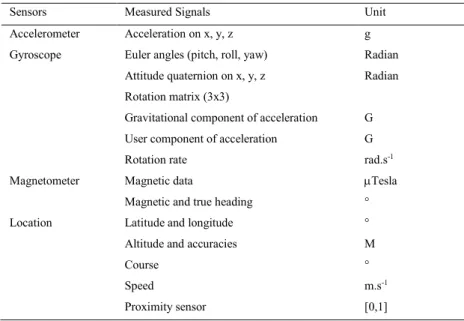
widely available, easy to use and they save long hardware developments. IMU generally contains a 3-axis accelerometer, a 3-axis gyroscope and in recent version a magnetometer (digital triaxial compass) (see Table 1). The accelerometer is used to measure inertial acceleration. The gyroscope measures angular rotation. The magnetometer improves the precision of the gyroscopic measurements by correcting the drift of the magnetic pole. In this field, several works have been published using the IMU of iPhones. The iPhone 4S has been used to measure human posture and movement for upper arm in Yang et al.7, human body position8, and sports monitoring9,11.
The use of a GPS and an accelerometer implanted on the neck of a cow to detect behaviors with more than 90% efficiency has already been achieved in González et al.10. Similarly, for the investigated case-study, a grazing cow
was monitored using a factory-calibrated IMU in an iPhone 4S mounted on a halter6. Signals were sampled at a
frequency of 100 Hz (obtained with iOS operating system) for 24 h and video sequences were recorded for proper comparison of visual and signals observations.
Table 1. List of signals captured by IMU of Iphone 4S using Sensor Data application
Sensors Measured Signals Unit
Accelerometer Acceleration on x, y, z g
Gyroscope Euler angles (pitch, roll, yaw) Radian Attitude quaternion on x, y, z Radian Rotation matrix (3x3)
Gravitational component of acceleration G User component of acceleration G
Rotation rate rad.s-1
Magnetometer Magnetic data Tesla
Magnetic and true heading °
Location Latitude and longitude °
Altitude and accuracies M
Course °
Speed m.s-1
Proximity sensor [0,1]
4 Olivier Debauche et al. / Procedia Computer Science 00 (2017) 000–000
Table 1 shows the parameters measured by the iPhone and sampled at the frequency of 100 Hz by the Data Sensor application v1.26† that was installed on the phone. This application stores data locally in csv files or use
UDP protocol over IEEE 802.11g to stream data to the gateway. This protocol is acceptable for short range, reliable connections with no expected loss of information packets with direct wireless connection (ad hoc)11.
3. Platform architecture
A lambda architecture is able to collect and store different kinds of data and keep the structure easily adaptable2.
The use of container technology makes it easy to deploy different versions of the same model. This technology also allows a continuous integration of changes made on the model and rapid deployment. Virtual machines are also implemented for the elastic scaling of the infrastructure with the load.
In this paper, we propose a new lambda architecture structure, shown in Fig. 1, which is designed to be easily adaptable to many use cases. In the proposed lambda architecture, data are separated into video streams treated by video streaming processing and time / event - related data. Time-related and event related data are treated by batch processing which consists of data verification (complete data). If data are not complete, they can be corrected and missing data must be interpolated. Each interpolated data is specifically tagged “generated data” in order to differentiate it from the original data. All this information is subsequently stored in a distributed database.
Fig. 1. Lambda architecture with scientific sharing platform
Video streaming processing achieve video annotation and features calculation. The results of both operations are stored in the distributed database. Video and other data are synchronized to associate tagged behaviors on video with variations of sensors measures. Views toolbox allows to graphically visualize the real-time data that is sent to the database. A monitoring system sends alerts when the data exceeds previously determined thresholds. This toolkit is available for the platform for sharing scientific data. Data analytic toolbox contains tools for modeling and
order to optimize the energy consumption of sensors. In this field, several works have been published, for example: a lambda architecture to treat all kinds of data was proposed in Diáz et al.2. Marioti et al.3 propose a novel database
management system (DBMS)-based system for the integration of Grids and Clouds. Kozhirbayev and Sinnott4
compared virtualization technologies with containers-based technologies and showed that the virtualization is utilized in data centers, for server consolidation and elastic scaling. But, they are overheads technologies avoided in high performance Computing (HPC) environments and limited in Input/Output (I/O), while Docker is horizontal scalable and low cost. They also compared performances on CPU, disk I/O and memory of container-based technologies and show that Docker can be faster compared to Flockport (LXC) if it uses multi-layer unification file system without using of network translation module.
Different types of sensors are used to monitor the behavior of Humans and animals such as microphones, pressure sensors, electromyography, location sensors and accelerometers5. Smartphones generally hold in an inertial
measurement unit (IMU) which contains motion and location sensors able to record signals at high rate6. They are
widely available, easy to use and they save long hardware developments. IMU generally contains a 3-axis accelerometer, a 3-axis gyroscope and in recent version a magnetometer (digital triaxial compass) (see Table 1). The accelerometer is used to measure inertial acceleration. The gyroscope measures angular rotation. The magnetometer improves the precision of the gyroscopic measurements by correcting the drift of the magnetic pole. In this field, several works have been published using the IMU of iPhones. The iPhone 4S has been used to measure human posture and movement for upper arm in Yang et al.7, human body position8, and sports monitoring9,11.
The use of a GPS and an accelerometer implanted on the neck of a cow to detect behaviors with more than 90% efficiency has already been achieved in González et al.10. Similarly, for the investigated case-study, a grazing cow
was monitored using a factory-calibrated IMU in an iPhone 4S mounted on a halter6. Signals were sampled at a
frequency of 100 Hz (obtained with iOS operating system) for 24 h and video sequences were recorded for proper comparison of visual and signals observations.
Table 1. List of signals captured by IMU of Iphone 4S using Sensor Data application
Sensors Measured Signals Unit
Accelerometer Acceleration on x, y, z g
Gyroscope Euler angles (pitch, roll, yaw) Radian Attitude quaternion on x, y, z Radian Rotation matrix (3x3)
Gravitational component of acceleration G User component of acceleration G
Rotation rate rad.s-1
Magnetometer Magnetic data Tesla
Magnetic and true heading °
Location Latitude and longitude °
Altitude and accuracies M
Course °
Speed m.s-1
Proximity sensor [0,1]
Table 1 shows the parameters measured by the iPhone and sampled at the frequency of 100 Hz by the Data Sensor application v1.26† that was installed on the phone. This application stores data locally in csv files or use
UDP protocol over IEEE 802.11g to stream data to the gateway. This protocol is acceptable for short range, reliable connections with no expected loss of information packets with direct wireless connection (ad hoc)11.
3. Platform architecture
A lambda architecture is able to collect and store different kinds of data and keep the structure easily adaptable2.
The use of container technology makes it easy to deploy different versions of the same model. This technology also allows a continuous integration of changes made on the model and rapid deployment. Virtual machines are also implemented for the elastic scaling of the infrastructure with the load.
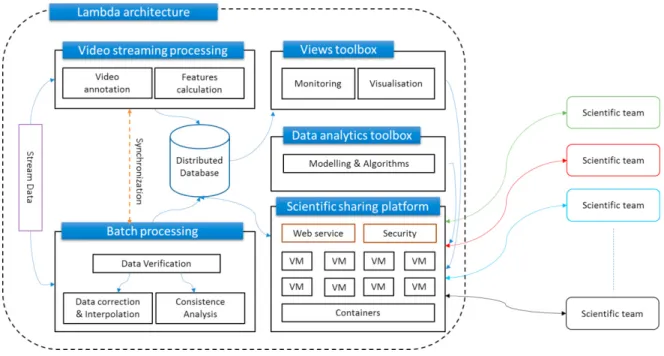
In this paper, we propose a new lambda architecture structure, shown in Fig. 1, which is designed to be easily adaptable to many use cases. In the proposed lambda architecture, data are separated into video streams treated by video streaming processing and time / event - related data. Time-related and event related data are treated by batch processing which consists of data verification (complete data). If data are not complete, they can be corrected and missing data must be interpolated. Each interpolated data is specifically tagged “generated data” in order to differentiate it from the original data. All this information is subsequently stored in a distributed database.
Fig. 1. Lambda architecture with scientific sharing platform
Video streaming processing achieve video annotation and features calculation. The results of both operations are stored in the distributed database. Video and other data are synchronized to associate tagged behaviors on video with variations of sensors measures. Views toolbox allows to graphically visualize the real-time data that is sent to the database. A monitoring system sends alerts when the data exceeds previously determined thresholds. This toolkit is available for the platform for sharing scientific data. Data analytic toolbox contains tools for modeling and
114 Olivier Debauche et al. / Procedia Computer Science 110 (2017) 110–116
Olivier Debauche et al. / Procedia Computer Science 00 (2017) 000–000 5 algorithm creation that can be deployed continuously on virtual machines or containers of the scientific sharing platform. Several versions of the same software can be maintained in the platform by using virtual machines or containers and versioning system.
The proposed scientific sharing platform is a major novelty of our lambda architecture. A web service takes care of the anonymization of the data. The security module provides authentication and authorization that enables setting up role based on permission granted per privacy policies. Permissions to access the data and the different applications are proposed by the research teams. The rights can be given at the individual level, for a group of users or to a fixed IP address.
The behavior of the cows is studied using sensors placed on the animal. These sensors measure the movement of the cow in its environment. Videos of the behavior of the cows are also carried out and then synchronized with the data measured on the animal. Identification of values variations of the measured parameters on the cows are associated to a behavior identified on the video. The variations of measured parameters allow to create models of classification of behaviors.
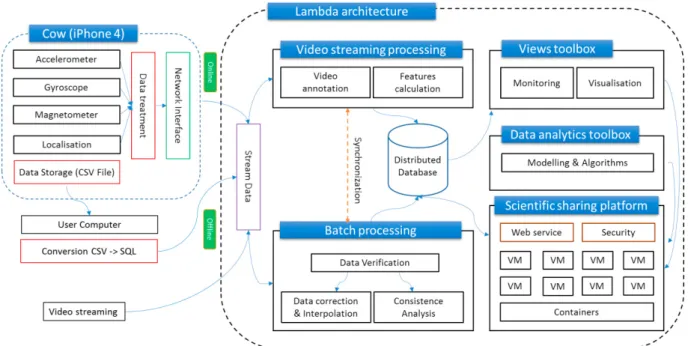
In our case-study, an iPhone 4S was used as set of sensors. The information produced by the iPhone 4S is sent in online or offline mode. In the online mode, the data measured by the sensors can be used to calculate other derived parameters that are sent by UDP protocol over Wi-Fi to the Cloud platform. In the offline mode, the iPhone uses local storage to back up measured and calculated data. The data is saved locally in a CSV file, which is then transmitted and processed on a gateway before being transmitted to the cloud platform. Videos can be streamed live or sent periodically.
Fig. 2. Cow measurement chain tools and lambda architecture
4. Experimental results
In the experiments related to this case-study, the impact of data compression at the sensor level was measured. Data compression consisted in eliminating the redundant data for each category presented in Table 2 and recorded at 100 Hz. In the present case-study, all data must be kept so replacement of redundant data by a time interval during which the value remains constant was applied in order to preserve data integrity.
6 Olivier Debauche et al. / Procedia Computer Science 00 (2017) 000–000
The implementation of the lambda architecture and fog computing on the iPhone 4S allows the reduction in the amount of data that must be transmitted to the gateway and the bandwidth used. The compression algorithm proposed in this paper improves storage efficiency in the distributed database hosted in the cloud.
The results are obtained for 24 hours of data collected locally and stored on the iPhone in offline mode and post treated on a Laptop with Intel core i7-6700HQ processor 2,6Ghz with 16GB RAM. Computing time related to 24 hours of data (1 879 596 KB) is 72,29s.
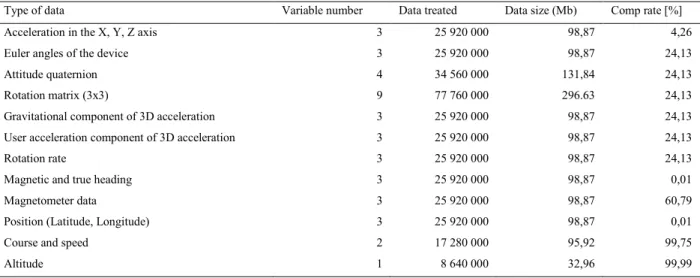
Table 2 shows the different compression rates obtained on raw data by redundancy elimination without loss of data.
Table 2. Compression rate obtained for each category of data collected on 24 hours.
Type of data Variable number Data treated Data size (Mb) Comp rate [%]
Acceleration in the X, Y, Z axis 3 25 920 000 98,87 4,26
Euler angles of the device 3 25 920 000 98,87 24,13
Attitude quaternion 4 34 560 000 131,84 24,13
Rotation matrix (3x3) 9 77 760 000 296.63 24,13
Gravitational component of 3D acceleration 3 25 920 000 98,87 24,13
User acceleration component of 3D acceleration 3 25 920 000 98,87 24,13
Rotation rate 3 25 920 000 98,87 24,13
Magnetic and true heading 3 25 920 000 98,87 0,01
Magnetometer data 3 25 920 000 98,87 60,79
Position (Latitude, Longitude) 3 25 920 000 98,87 0,01
Course and speed 2 17 280 000 95,92 99,75
Altitude 1 8 640 000 32,96 99,99
The analysis of compression rate shows that acceleration, Magnetic / true heading and position data are weakly compressible by opposition to magnetometer data, course and speed, altitude that are extremely compressible. Other data have the same compressing rate of 24,1% because they are linked data or calculated valued.
The compression of the data allowed a reduction of the bandwidth consumed for their transmission to the gateway by 42% on average. The transmission of the float data at 100Hz corresponds to 16000 bytes of data. By eliminating redundancies, the amount of data transmitted every second was reduced to 9290 bytes per second.
5. Conclusion
In this paper, a new data storage architecture dedicated to scientific research has been proposed. This lambda architecture is able to collect data at high frequency and is adaptable easily to many use cases. The main originality of the architecture lies in its ability to share the data and applications created by the different teams of scientists from a common database. The iPhone is an inexpensive means of measuring cow behavior. I-Phone 6 and 7 are equipped with a new factory-calibrated IMU. This new IMU is not much evaluated in scientific literature6. Currently
the data is transmitted from the iPhone to the gateway by using the UDP protocol but this protocol may cause a data packet loss problem when it is necessary to collect data from several iPhones simultaneously. The lambda architecture proposed for collecting, storing, processing and sharing data between research teams is flexible enough to be used for other uses than cow behavior provided such that different teams contribute to the system. Other data compression algorithms must be considered to optimize the energy consumption of the battery.
algorithm creation that can be deployed continuously on virtual machines or containers of the scientific sharing platform. Several versions of the same software can be maintained in the platform by using virtual machines or containers and versioning system.
The proposed scientific sharing platform is a major novelty of our lambda architecture. A web service takes care of the anonymization of the data. The security module provides authentication and authorization that enables setting up role based on permission granted per privacy policies. Permissions to access the data and the different applications are proposed by the research teams. The rights can be given at the individual level, for a group of users or to a fixed IP address.
The behavior of the cows is studied using sensors placed on the animal. These sensors measure the movement of the cow in its environment. Videos of the behavior of the cows are also carried out and then synchronized with the data measured on the animal. Identification of values variations of the measured parameters on the cows are associated to a behavior identified on the video. The variations of measured parameters allow to create models of classification of behaviors.
In our case-study, an iPhone 4S was used as set of sensors. The information produced by the iPhone 4S is sent in online or offline mode. In the online mode, the data measured by the sensors can be used to calculate other derived parameters that are sent by UDP protocol over Wi-Fi to the Cloud platform. In the offline mode, the iPhone uses local storage to back up measured and calculated data. The data is saved locally in a CSV file, which is then transmitted and processed on a gateway before being transmitted to the cloud platform. Videos can be streamed live or sent periodically.
Fig. 2. Cow measurement chain tools and lambda architecture
4. Experimental results
In the experiments related to this case-study, the impact of data compression at the sensor level was measured. Data compression consisted in eliminating the redundant data for each category presented in Table 2 and recorded at 100 Hz. In the present case-study, all data must be kept so replacement of redundant data by a time interval during which the value remains constant was applied in order to preserve data integrity.
The implementation of the lambda architecture and fog computing on the iPhone 4S allows the reduction in the amount of data that must be transmitted to the gateway and the bandwidth used. The compression algorithm proposed in this paper improves storage efficiency in the distributed database hosted in the cloud.
The results are obtained for 24 hours of data collected locally and stored on the iPhone in offline mode and post treated on a Laptop with Intel core i7-6700HQ processor 2,6Ghz with 16GB RAM. Computing time related to 24 hours of data (1 879 596 KB) is 72,29s.
Table 2 shows the different compression rates obtained on raw data by redundancy elimination without loss of data.
Table 2. Compression rate obtained for each category of data collected on 24 hours.
Type of data Variable number Data treated Data size (Mb) Comp rate [%]
Acceleration in the X, Y, Z axis 3 25 920 000 98,87 4,26
Euler angles of the device 3 25 920 000 98,87 24,13
Attitude quaternion 4 34 560 000 131,84 24,13
Rotation matrix (3x3) 9 77 760 000 296.63 24,13
Gravitational component of 3D acceleration 3 25 920 000 98,87 24,13
User acceleration component of 3D acceleration 3 25 920 000 98,87 24,13
Rotation rate 3 25 920 000 98,87 24,13
Magnetic and true heading 3 25 920 000 98,87 0,01
Magnetometer data 3 25 920 000 98,87 60,79
Position (Latitude, Longitude) 3 25 920 000 98,87 0,01
Course and speed 2 17 280 000 95,92 99,75
Altitude 1 8 640 000 32,96 99,99
The analysis of compression rate shows that acceleration, Magnetic / true heading and position data are weakly compressible by opposition to magnetometer data, course and speed, altitude that are extremely compressible. Other data have the same compressing rate of 24,1% because they are linked data or calculated valued.
The compression of the data allowed a reduction of the bandwidth consumed for their transmission to the gateway by 42% on average. The transmission of the float data at 100Hz corresponds to 16000 bytes of data. By eliminating redundancies, the amount of data transmitted every second was reduced to 9290 bytes per second.
5. Conclusion
In this paper, a new data storage architecture dedicated to scientific research has been proposed. This lambda architecture is able to collect data at high frequency and is adaptable easily to many use cases. The main originality of the architecture lies in its ability to share the data and applications created by the different teams of scientists from a common database. The iPhone is an inexpensive means of measuring cow behavior. I-Phone 6 and 7 are equipped with a new factory-calibrated IMU. This new IMU is not much evaluated in scientific literature6. Currently
the data is transmitted from the iPhone to the gateway by using the UDP protocol but this protocol may cause a data packet loss problem when it is necessary to collect data from several iPhones simultaneously. The lambda architecture proposed for collecting, storing, processing and sharing data between research teams is flexible enough to be used for other uses than cow behavior provided such that different teams contribute to the system. Other data compression algorithms must be considered to optimize the energy consumption of the battery.
116 Olivier Debauche et al. / Procedia Computer Science 00 (2017) 000–000 Olivier Debauche et al. / Procedia Computer Science 110 (2017) 110–116 7
Acknowledgements
We would like to thank our colleagues from the CARE AgricultureIsLife (TERRA Teaching and Research Unit, Gembloux Agro-Bio Tech) and the Precision Livestock and Nutrition Axis, without whom this work would not have been possible. We would also like to thank Prof. Ghalem Belalem for the architecture brainstorming.
References
1. Andriamandroso, Andriamasinoro, Frédéric Lebeau, and Jérôme Bindelle. Changes in biting characteristics recorded using the inertial measurement unit of a smartphone reflect differences in sward attributes. Precision Livestock Farming. 2015; 15: 283-289.
2. Diáz M, Martin C, Rubio B. State-of-the art, challenges, and open issues in the integration of Internet of things and cloud computing. Journal of Network and Computer Applications. 2016; 67:99-117. DOI: 10.1016/j.jnca.2016.01.010.
3. Mariotti M, Gervasi O, Vella F, Cuzzocrea A, Costantini A. Strategies and systems towards grid and clouds integration: A DBMS-based solution. Future Generation Computer Systems. 2017. DOI: 10.1016/j.future.2017.02.047.
4. Kozhirbayev Z, Sinnott RO. A performance comparison of container-based technologies for the Cloud. 2017; 68:175-182. DOI: 10.1016/j.future.2016.08.025.
5. Andriamandroso ALH, Bindelle J, Mercatoris B, Lebeau F. Review on the use of sensors for jaw movements’ detection. Biotechnol. Agron. Soc. Environ. 2016; 20(S1):273-286.
6. Andriamandroso ALH, Lebeau F, Beckers Y, Froidmond E, Dufrasne I, Heinesch B, Dumortier P, Blanchy G, Blaise Y, Bindelle J. Development of an open-source algorithm based on inertial measurement units (IMU) of a smartphone to detect cattle grass intake and ruminating behaviors. Computers and Electronics in Agriculture, 2017; 139:126-137. DOI: 10.1016/j.compag.2017.05.020.
7. Yang L, Grooten WJA, Forsman M, 2017. An iPhone application for upper arm posture and movement measurements. Applied Ergonomics. 2017 (In Press). DOI: 10.1016/j.apergo.2017.02.012.
8. Milani P, Coccetta CA, Rabini A, Sciarra T, Massazza G, Ferriero G. Mobile smartphone application for body position measurement in reabilitation: a review of goniometric tools. PM R. 2014; 6:1038-1043. DOI: 10.1016/j.pmrj.2014.05.003.
9. McNab T, James DA, Rowlands D. Iphone sensor plaforms : Applications to sports monitoring. 5th Asia-Pacific Congress on Sport Technology
(APCST). Procedia Engineering. 2011; 13:507-512. DOI: 10.1016/j.proeng.2011.05.122.
10. González LA, Bishop-Hurley GJ, Handcock RN, Crossman C. Behavioral classification of data from collars containing motion sensors in grazing cattle. Computers and Electronics in Agriculture. 2015; 110: 91-102. DOI: 10.1016/j.compag.2014.10.018.
11. Rowlands D, James D. Real time data streaming from smart phones. Procedia. 5th Asia-Pacific Congress on Sports Technology (APCST)