HAL Id: hal-01235602
https://hal.archives-ouvertes.fr/hal-01235602
Submitted on 30 Nov 2015
HAL is a multi-disciplinary open access
archive for the deposit and dissemination of
sci-entific research documents, whether they are
pub-lished or not. The documents may come from
teaching and research institutions in France or
L’archive ouverte pluridisciplinaire HAL, est
destinée au dépôt et à la diffusion de documents
scientifiques de niveau recherche, publiés ou non,
émanant des établissements d’enseignement et de
recherche français ou étrangers, des laboratoires
Safe reconfiguration of Coqcots and Pycots components
Jérémy Buisson, Fabien Dagnat, Elena Leroux, Sébastien Martinez
To cite this version:
Jérémy Buisson, Fabien Dagnat, Elena Leroux, Sébastien Martinez. Safe reconfiguration of
Coq-cots and PyCoq-cots components. Journal of Systems and Software, Elsevier, 2016, 122, pp.430-444.
�10.1016/j.jss.2015.11.039�. �hal-01235602�
Safe reconfiguration of Coqcots and Pycots components
J´er´emy Buissona,b,∗, Fabien Dagnata,c, Elena Lerouxa,d, S´ebastien Martineza,c
aIRISA, Brest – Rennes – Vannes, France bSt-Cyr Co¨etquidan Schools, Guer, France
cT´el´ecom Bretagne, Brest, France dUniversity of South Brittany, Vannes, France
Abstract
Software systems have to face evolutions of their running context and users. Therefore, the so-called dynamic reconfiguration has been commonly adopted for modifying some components and/or the architecture at runtime. Traditional approaches typically stop the needed components, apply the changes, and restart the components. However, this scheme is not suitable for critical systems and degrades user experience. This paper proposes to switch from the stop/restart scheme to dynamic software updating (DSU) techniques. Instead of stopping a component, its implementation is replaced by another one specifically built to apply the modifications while maintaining the best quality of service possible. The major contributions of this work are: (i) the integration of DSU techniques in a component model; (ii) a reconfiguration development process including specification, proof of correctness using Coq, and; (iii) a systematic method to produce the executable script. In this perspective, the use of DSU techniques brings higher quality of service when reconfiguring component-based software. Moreover, the formalization allows ensuring the safety and consistency of the reconfiguration process.
Keywords: Dynamic reconfiguration, component model, dynamic software updating, DSU, Python, Coq, runtime evolution
1. Introduction
Software systems need to be highly available and should be built using se-cure, safe, performant, and robust components. These components must be regularly modified to fix vulnerabilities and bugs, to face new environments, and to offer new services. Enabling these evolutions, while maintaining a high level of availability, requires changing the architecture of such a system during
∗Corresponding author
Email addresses: [email protected] (J´er´emy Buisson),
[email protected] (Fabien Dagnat), [email protected] (Elena Leroux), [email protected] (S´ebastien Martinez)
its execution. This capability is especially important for critical systems such as air-traffic control systems and networks, in which stopping systems is not an option due to financial or human costs. It also improves user experience as a user can continue to use a software system being updated without noticing the update, i.e., the updating process is transparent to the users.
In software engineering, dynamic reconfiguration was introduced to build component-based software systems that can be modified during their execution, with minimal or no interruption. In this approach, components and connectors of a system can be inserted, removed or replaced at runtime, thus fostering the continuity of the provided services.
Since the proposition of the quiescence concept [1], reconfiguring a system typically requires the suspension of a set of components that will be affected by the reconfiguration. Maintaining the system in an operational status while stopping part of its components leads to a visible degradation of its quality of service [2, 3] due to component dependencies. Another essential issue to be considered is to preserve the consistency of the component assembly through-out the reconfiguration process. Some works in the literature have faced these challenges by minimizing the set of suspended components and/or decreasing the duration of their suspension [4,5]. Focusing on consistency, Boyer et al. [6] propose a scheme in which an invariant requires to stop any component that depends on a stopped component. However, such dependencies often propagate up to the user frontend, and then the system may be almost entirely stopped.
To maintain service continuity, we must refrain from stopping components when reconfiguring a system. In this paper, we propose to use dynamic soft-ware updating (DSU) techniques [7,8] instead of suspending components. The main idea is to mitigate the effect of any reconfiguration action by dynamically updating the implementation of directly and indirectly affected components. For example, if a component B used by a component A needs to be reconfig-ured, then the component A can be updated with a new implementation that no longer uses B before reconfiguring B. Once the reconfiguration involving B terminates, A may switch again its implementation either to fall back on the original behavior or to assume a new one better suited to the new configuration. Two important facts to notice are:
• The temporary update of A depends on the current state of execution and, therefore, is hard to foresee. Hence the dynamic update is needed. • The better the temporary update hides the absence of B to the rest of the
application, the more transparent the reconfiguration will be.
While changing the interconnection of the components seems easy and can possibly be generated by some algorithm, this small example highlights that dynamic reconfiguration incurs additional issues. The temporary behavior of A must be carefully designed such that application services are degraded as little as possible despite the absence of B. Whether this temporary behavior of A hides the absence of B or propagates part of the effects to the rest of the application greatly affects how the other components must be rearranged
too. Furthermore, this temporary behavior may need new components such as for example a component offering a service of B that A currently needs. By consequences, the temporary behavior of A can hardly be designed without the changes of architecture needed in mind, and conversely. In this context, producing a reconfiguration for an application consists in not only specifying the various components to create, the ones to modify and the ones to remove [6,
9, 10, 11] but also in specifying and implementing the various pieces of code required to maintain the activities of the application. When the architecture of the application becomes larger than a few components and connectors, the design and implementation of a reconfiguration become difficult. Using the example above, if the update of the component A is not finished when stopping B, the application may enter an inconsistent mode that may propagate to a user visible crash [12, 13]. Clearly, if a dynamic reconfiguration leads to a (visible) degradation of service, it becomes easier and equivalent to stop the application. Our second idea is to guarantee the correct execution of a dynamic recon-figuration by proposing a complete reconrecon-figuration design and implementation process that includes the use of a proof assistant to require a proof of the correct-ness of the reconfiguration. To reduce the cost of this development, this process is completely automated by tools ensuring the exchange of information between the running application, the proof assistant and the execution platform of the application. Using reflection, the current running architecture of the application is extracted and assertions describing this architecture are generated. Working in the proof assistant, the designer of the reconfiguration builds simultaneously the reconfiguration and its correctness proof. Once the designer is satisfied, the code of the reconfiguration is extracted from the proof and sent back to the platform executing the application. On receiving the reconfiguration script, the platform can apply it.
To validate practically this approach, we have designed a component model supporting DSU, Pycots. This component model is implemented in Python to reuse Pymoult1which is a DSU platform we have proposed in [14]. The
compo-nent model includes a reflection level to extract the current running architecture and translate it into the chosen proof assistant, Coq2. This translation process uses an abstract version of the component model named Coqcots aimed at being the version the designer will use when building a reconfiguration.
The purpose of this paper is to report on this complete reconfiguration devel-opment process and describe precisely the various models and tools developed to support its automation. Therefore the contributions presented here will be:
1. A concrete component model Pycots to support execution and abstract component model Coqcots to support proving reconfiguration. A fully bidirectional translation is supported by a reflective feature of the concrete component model on one side and the extraction facilities of Coq for the other side.
1
https://bitbucket.org/smartinezgd/pymoult 2http://coq.inria.fr/
2. An implementation of Pycots integrating DSU techniques.
3. A complete engineering process to help the design of a correct recon-figuration and its application to a running software. The enactment of this process is supported by tools automating the translation processes, Python code generation and the possibility to generate repetitive parts of the proof.
In this paper, Section 2 describes the domains involved in the presented work. Section 3 gives an overview of our proposal along with the supported reconfiguration scenarios. Section4describes our approach in details. Section5
summarizes the main steps of the reconfiguration process. Section6compares our approach to related work. Section 7 concludes the paper with our main contributions and future directions.
All the material is available athttp://coqcots.gforge.inria.fr.
2. Background
Before describing our contribution, we need to describe the three domains on which our proposal is built. First, our paper focuses on component-based ap-plications and their reconfiguration. Then, we propose a new component model relying on mechanisms coming from the Dynamic Software Update community. At last, our methodology relies on the Coq proof assistant requiring the reader to understand the basics of Coq.
2.1. Component Architectures
Software components were proposed as a solution to increase productivity by promoting reuse to a large scale. Components foster reuse by enforcing a very low coupling between a component and its environment through the use of architecture as a key artifact during the development life cycle. In the early stage of the development, software architects use very abstract components without taking into account the physical underlying infrastructure. Later on, when the infrastructure is defined, these abstract concepts can be realised as actual software entities. This clean separation between functional architecture and code and the interaction with physical resources enables to build really reusable functional entities (both at abstract and code level).
The different concepts and their usage rules are defined through so-called component models. Many component models are currently available [15]. They can be either generic, such as CCM [16], SOFA [17] or domain specific such as PECOS [18]. They range from simple models relying on basic notion of component as UML2.0 [19] to very complex models atop of sophisticated in-frastructures such as Fractal [20]. Component paradigm is built upon two main concepts. First, components, which encapsulate treatments and provide func-tionalities called services through access points named ports. Then, architec-tures, which describe an application as a set of components and their relations.
In this article, we use the component paradigm to be able to reconfigure a running application. Our focus is therefore on running component instances. Each link between components models a reference. This executable model, called Pycots, defines how our Python components are defined and executed. Reconfiguring an application in our approach consists in creating new compo-nent instances, removing existing instances and modifying the running code of existing components. The central concept to define such a representation is the architecture of the application with an abstract model describing the running instances and their dependencies. In our proposal, this abstract model is named Coqcots and is aimed at being manipulated with the proof assistant Coq. To depict such an abstract component architecture, we reuse the graphical repre-sentation of UML for depicting (Figure2 on page 8or4 on page 10for example). Following a common practice (see [20] for example), our executable model of-fers a reflection facility that supports the extraction of an abstract architecture representing a running application.
2.2. Dynamic Software Update
Updating applications is mandatory to apply bug fixes and vulnerability patches, and more generally to support software evolution. Generally, such updates require to stop the software, patch it and then restart it. This results in downtime and state / data loss, which are at best undesirable, sometimes costly, at worst unacceptable for critical systems. Following this observation, a large collection of mechanisms have been proposed to update software systems while they are running with no or little service interruption. To update dynamically an application, one has to handle different tasks such as transforming the data (e.g. adding or removing fields in objects, changing data representation) or rerouting the control flow (e.g. changing instructions in functions and methods). Many platforms addressing that issue can be found in the literature [7,8] each of them using different techniques for applying dynamic updates. These techniques address the updates of elements of the program such as classes or functions, most of them do not aim to modify the architecture of the application.
This section presents the main tasks of a dynamic update and the most common techniques used for handling them. We also present the way Pymoult, the Python DSU platform used by Pycots, implements these techniques.
The first task is to detect the right moment for applying the update. The application has to be in a stable state where updating wouldn’t make it enter an inconsistent state, e.g., out of date function using updated data, because this may lead to a crash. The moment when the elements to be updated are quiescent is an example of right moment for applying an update. There are several ways to detect the right moment for an update. The detection can be: (1) static as in Kitsune [21] or Ginseng [22] where the application developer has to indicate a point in the program where the application is globally quiescent, i.e., most of the elements of the application are quiescent, or (2) dynamic as in Hotswap [23] or ReCaml [24] where the virtual machine running the application can detect specific VM safe points that are proper for updating. The right
moment for updating can also depend on the update to apply. In Ksplice [25], a function can be updated only when it is not in the stack.
After the right moment for updating has been detected, we have to update the data and the control flow. Again, there are many ways to handle this two tasks. All the data can be transformed at once as in Kitsune or it can be transformed only when accessed, e.g., a variable will be updated when a function reads from it, as in Ginseng. We call these methods eager and lazy data update. For updating the control flow, Hotswap and Ginseng redefine the functions and methods of the program, replacing the old functions by their new version. Ginseng introduces indirection using function pointers while Hotswap uses a specifically enhanced JVM for that purpose. ReCaml and Kitsune reboot the threads, making them run the new code while keeping the data. Both platforms allow the threads to start at a given point instead of rebooting from the beginning. ReCaml enables the stack to be reconstructed while Kitsune allows the execution of a rebooted thread to be guided for that purpose.
Pymoult provides these mechanisms among others and wraps them in a set of Manager classes. For example, an EagerConversionManager takes in charge the eager update of data. A manager instance is responsible of the choreography of a set of updates. A manager works in synergy with an Update class instance that supplies the information necessary for carrying out an update. For instance, suppose we want to update all the instances of a class A and an EagerConversionManager has been set up when developing the application. We can use an instance of EagerConversionUpdate to specify that we want to update the instances of the class A and describe the transformation that should be applied to them.
Using Pymoult, it is possible to develop custom Manager and Update classes by combining basic mechanisms provided by the platform through a low level API. For example, one can use the functionisFunctionInAnyStackto check if a function can be updated safely as in Ksplice.
2.3. Proof Assistant
Based on formal calculi that formalize the notions of proposition and proof, proof assistants are software that help proving theorems. They mechanically verify proofs according to the rules of an underlying formal calculus. The proof assistants usually provide environments for interactive proof development that embed decision procedures to generate automatically some parts of the proofs. A typical approach to proof assistants consists in relying on the Curry-Howard isomorphism, which states that the relation between a proof of a propo-sition and this propopropo-sition is the same as the relation between a λ-term and its type. For instance, the modus ponens deduction rule corresponds to the typing rule for function application; the rule for implication introduction corresponds to the typing rule for λ-abstraction. Following this approach, verifying a proof is the same task as type-checking a λ-term.
Coq is such a proof assistant based on the calculus of inductive constructions, a typed λ-calculus with dependent types. Furthermore, type expressions are
Definition x: (nat → bool) →
nat→bool:= funa b⇒a b.
Definition x: (nat → bool) →
nat→bool. introsa b. applya. applyb. Defined.
Figure 1: A Coq definition with the expression language (left) and proof-mode (right).
first-class expressions, hence types can be used like any other value. Intuitively, it allows the type of the return value of a function to depend on the effective value of the parameters. A typical example for dependent types is the type of the C-like printf function: the types of the to-be-formatted parameters depend on the content of the formatting string. Dependent types can also convey correctness properties, which we use in this paper to express preconditions and postconditions in the abstract component model Coqcots.
Since Coq proofs are λ-terms, they are executable and conversely programs contain proofs. Coq defines two types of types to make an explicit distinction between: Prop for logical types, i.e., propositions; and Set for computational types. Based on this distinction, the extraction mechanism automatically trans-lates the computational Set parts of a program / proof to a standard program-ming language, while it leaves the logical Prop parts out. This approach provides an engineering process to develop formally verified programs, like illustrated by the CompCert project [26].
To define proofs and programs, Coq comes with two languages. Functional expressions follow a syntax close to usual functional programming languages; while the proof mode lets build an expression by the means of sequentially applying the rules of the calculus of inductive constructions. Figure1shows side-by-side the two languages for the same example, where intros is implication introduction and apply is the modus ponens rule.
To automate (parts of) the proofs, Coq introduces tactics, which can be considered as macros. It is therefore possible to program procedures that auto-matically apply rules and other tactics during a proof step.
3. An overview of our proposal
The objective of this section is to give an overview of our process to build correct reconfiguration. This process is illustrated by the example shown on Figure2. The upper left part of this figure presents a part of an architecture. This part is composed of six components A, B and C1to C4. Each component Ci (where i = [1..4]) uses a service of the component A. These four dependen-cies will be used to illustrate some of the possible situations encountered when reconfiguring a real application. Notice that all these components may also be used by or use other components not represented here. The only constraint is that no other component uses a service offered by A.
C1 C2 C3 C4 A B ImplC1 ImplC2 ImplC3 ImplC4 ImplA 1 2 Before reconfiguration C1 C2 C3 C4 A B ImplC1 ImplC2 ImplC3 ImplC4’ ImplA’’ After reconfiguration C1 C2 C3 C4 A B D ImplC1 ImplC2’ ImplC3 ImplC4’ ImplA’ An intermediary state 3 4 • apply DSU to A, C2, C4 • create D • disconnect C2from A • connect C1 to D • connect C4 to B • apply DSU to A, C2 • disconnect C1 from D • connect C1to A • connect C2to A
Figure 2: Architecture of a part of an application before, during and after a reconfiguration.
Suppose that we need to reconfigure the component A in order to remove one of the services it provides. For example, the fourth port used by C4 will be removed. The first step is to detect the set of components to be reconfigured. In our example this set will contain the component A (see 1 of Figure2). 3 Once A is found, the designer of the reconfiguration must identify all components using its services. For our example we obtain the set containing the components from C1 to C4 (see 2 of Figure 2). Then, we must decide how we are going to hide to the rest of the application the fact that A is going to be only partly available. For our example, we have decided to:
1. Use a transient stub: keep C1 unchanged, create a new transient compo-nent D, and connect C1 to this new component D instead of using A.
extract architecture 1
reconfiguration proved correct
model and prove reconfiguration until... 2
extract from Coq 3 develop DSU 4 apply reconfiguration 5 Pycots app lication executing Pycots Coqcots
Figure 3: Overview of the proposed approach.
2. Propagate service degradation to the client: modify the implementation of C2to make it independent of A permitting to disconnect C2 from A. 3. No impact on the client: keep C3exactly the same, it still uses A. 4. Switch to a new provider: update the implementation of C4 to make it
use the existing component B instead of A.
Making such design decisions usually requires human intervention. In step 3, we have to realize all the operations needed to support the previous choices. Each modification of the implementation is done using DSU mechanisms. We also have to update the implementation of A to prepare it for the intended modification, e.g., stopping some threads. Notice that A cannot be completly stopped here as C3 is still using it (ImplA’ has to take it into account).
Finally, A can be updated as intended and the various temporary operations may be reverted (see 4 of Figure2). Here for example, we have chosen that: (i) C1 is reverted to using A; (ii) C2 is reverted to its previous behavior using A; (iii) C3is still unchanged; and (iv) C4will continue to use the component B. The example concretizes the process of reconfiguring an application and illustrates the fact that a reconfiguration script is a complex piece of program. To help the designer of such a reconfiguration, we propose a process including the proof assistant Coq to foster the construction of correct reconfigurations. This process is depicted in Figure3. The left arrow represents the execution flow of the application we need to reconfigure. When a reconfiguration is needed, its design and execution follow the five steps on the right of the figure. Steps 2 and 3 of this process are performed in Coq using our abstract component model, Coqots. The other three steps use our concrete component model Pycots.
1 The current architecture of the target software system is extracted using the reflexive feature of the Pycots execution platform. The result of this operation is a Coq module containing a Coqcots architecture. This part of our process is described in details in subsection4.1 on page 11.
receiver dispatcher serverHello serverFile dispatch/dispatch serveFile/serve serveHello/serve
Figure 4: The initial software architecture of the web server.
2 The designer works to define the reconfiguration and build the proof of its correctness within Coq as described in subsection4.2 on page 15. Like previously illustrated by the example of Figure2, this step can involve the design and creation of new components and new implementations. Human intervention is mandatory to carry out this step.
3 Once the reconfiguration has been proved, the reconfiguration script is ex-tracted from this proof using Coq facilities (see subsection4.3 on page 21). 4 All the glue code need to be developed in Python. The various DSU pieces of code must be implemented as described in subsection4.4 on page 22. 5 Finally, the Python (reconfiguration) script is submitted to the Pycots
manager, which is a platform component that receives and applies recon-figuration scripts to the target software system. This last step is detailled in subsection4.5 on page 24.
4. The complete process in details
In Section3 we informally described the main steps of our reconfiguration approach shown on Figure3. The purpose of this section is to provide the details of this reconfiguration development process. To illustrate each of its steps, we use a simple web server case study. Figure4 contains the initial architecture of our web server which contains four components: (1) the receiver wraps an instance of BaseHTTPServer, which receives and decodes HTTP requests; (2) thedispatcher dispatches requests to handlers according to the requested URL; (3) serverHello generates a dynamic web page with a “Hello, world” greeting, and; (4)serverFile detects that the given URL is a file name whose content is sent as a response. The purpose of this case study is twofold. First, it aims at explaining concretely our process. And second, it demonstrates that our approach enables the continuity of service of the web server without stopping it during the reconfiguration process.
content component client content component server
stub for unbound ports
reference cell closure object
refers to calls
Figure 5: Anatomy of a simple client server Pycots architecture.
4.1. Generating Coqcots architecture from a Pycots execution state
The first step of the process, which is shown as 1 in Figure 3 on page 9 consists in introspecting the execution state according to the Pycots framework in order to generate a reified architecture in Coqcots. For the sake of simplic-ity, in this subsection we use a client-server example instead of the web server whose Pycots and Coqcots architectures are more complex and, therefore, more difficult to explain. In the first two parts of this subsection we describe the client-server architecture using respectively the Pycots and the Coqcots formalisms. Then, we explain how to realize the introspection of the Pycots architecture. To close this subsection, we briefly present an extract of the Coqcots architecture for our web server case study.
Overview of Pycots. In Pycots, each component is a black-box content object wrapped in a component object, as depicted in Figure5. Each wrapper com-ponent object has a reference to its wrapped content object. The granularity level for dependencies is the method level. Provided methods are methods im-plemented by the content object for which a proxy (imim-plemented by closure) is provided by the component object. Dependencies are reference cells injected by the framework in the content object: when bound, the reference cell refers to a proxy of another component; when unbound, the reference cell refers to a stub provided by the framework.
In this context, programming a component amounts to providing the class of its content object (Client or Server in the code below). This class must include the code of the provided ports (Server defines the methodecho_port). Finally, the developer must use functions provided by the framework to create the component (pycots.create) using its implementation class, the list of its provided ports and the list of its required ports. Once at least two components are created, it is possible to bind them usingpycots.bind.
client server
cst i
P U
srv port/echo port
optional port
Figure 6: Anatomy of a simple client server Coqcots architecture.
1 import pycots
2 class Client(object):
3 def __init__(self): super(object, self).__init__() 4 def run(self): self.srv_port()
5 class Server(object):
6 def __init__(self): super(object, self).__init__() 7 def echo_port(self): print "hello"
8 c = pycots.create(Client, [], ["srv_port","optional_port"]) 9 s = pycots.create(Server, ["echo_port"], [])
10 pycots.bind(c, "srv_port", s, "echo_port") 11 pycots.call(c, "run")
Coqcots architectures. Figure6 depicts the same architecture as Figure5 with the Coqcots point of view. As illustrated, a component (client) has an associated implementation (i) that uses a set of used services (U, which contains only the srv port and optional port services in the case of theclientcomponent) to provide a set of provided services (P, which is empty for the client component). The architecture instance contains theclientandservercomponents and defines the binding between the used service of the clientand the provided service of the
server(srv port/echo port). When a used service of a component is not bound, the implementation of that component cannot use this unbound service.
In our approach, the implementation of a component may come with a pre-condition that specifies its assumption on the architecture in which the compo-nent is instantiated. This architectural constraint (cstfor theclientcomponent) is an invariant that ensures that the implementation will only run in the ex-pected situation. For example, a given component may require that some of its used services must be bound (the mandatory services), while the other ser-vices are allowed to become unbound (the optional serser-vices). The component implementation can then assume that only optional services may be unbound. Using architectural constraints enables the designer to assume the mandatory semantics discussed by Boyer et al. [6] and Bruneton et al. [27].
Formally, Coqcots comes with two predicates,contains andbinds, which re-spectively state that an architecture contains a given component and a given binding. Thecontains predicate takes as first argument an architecturea, fol-lowed by the five elements of a component: (1) the name of the componentc,
(2) the set4 of its used services U, (3) the set of its provided servicesP, (4) its architectural constraintcst, and (5) its implementationi. Its definition is: Parametercontains:
∀ (a: arch) (c: comp) (U:facet) (P:facet) (cst: arch→comp→ Prop) (i: ∀ (u: facet record U),cst a c→no exc if bound a c u→facet record P), Prop.
The architectural constraint is a function that maps an architectureaand a com-ponentcto a proposition. It is used by the implementation as a precondition to the component’s services (termcst a c). The other precondition no exc if bound relieves the implementation from defensively checking for availability when a used service is guaranteed to be bound according to the constraintcst.
Thebinds predicate formally states that a binding exists in an architecture
a. The binding is represented by six values: three for the client component (the user of the binding) and three for the server component (the provider of the binding). Both components are represented by (1) their identity respectivelyclt
andsrv, (2) the set of their involved services clt Uandsrv P, and (3) the ports
clt portandsrv portbound by the predicate. The definition ofbinds is: Parameterbinds:
∀ (a: arch) (clt: comp) (clt U: Type) (clt port: namedport clt U) (srv: comp) (srv P: Type) (srv port: namedport srv P), Prop.
Using these predicates, the designer can define an architecture. For example, the architecture presented in Figure6is an element of the following type: Definition client server :=
{ a | ∃ client server,
containsa client client use facet client provide facet client constraint (client implementation a client)
∧containsa server server use facet server provide facet server constraint(server implementation a server)
∧binds a client srv portserver echo port}. Definition client constraint (self arch: arch) (self: comp) :=
∃ s provs port,binds self arch self srv port s provs port. Definition server constraint (self arch: arch) (self: comp) :=True.
In this example, the client srv port must be bound as it is a mandatory depen-dency, and the server has no constraint. For the binding, the set of used and provided ports (third and sixth arguments elided as ) are inferred by Coq. Coqcots invariants. Coqcots is equipped with a set of invariants to ensure the soundness of the architecture definition:
• Correct typing of bindings. This invariant excludes all architectures con-taining at least two ports bound together having incompatible types. • Existence of bound components. This invariant checks that bound
com-ponents belong to the architecture.
• Unicity of used service bindings. This invariant checks that the architec-ture does not contain a used port bound to two different provided ports.5
• Unicity of components characteristics. This invariant ensures that, for each component, the set of ports, constraints, and implementation are defined only once.6
• Satisfaction of component constraints. This invariant ensures that for each component, the architectural constraint given in its definition holds. An architecture is consistent if the five previously defined invariants hold. We have proved that any architecture, obtained by applying Coqcots reconfigura-tion operareconfigura-tions starting from the empty architecture, is consistent. It relies on two sub-proofs: (1) the empty architecture is consistent and (2) any of the five proposed reconfiguration operations (detailed in Section4.2) preserves the invariants and then consistency. The length of the proofs is about 2500 lines7.
Introspection in Pycots. The introspection of the architecture of a running Py-cots application relies on the native facilities of Python. Namely, for each com-ponent, the methods and fields of the wrapper and content objects are scanned. Regarding the wrapper, the code object8 of each method is compared to the one of the proxy to detect the methods that are provided by the component. Regarding the content, the code object of each method is compared to the one of the proxy as well as the one of the stub. In the former case, a bound depen-dency is detected, and the binding can be introspected in the values captured by the closure object of the proxy. In the latter case, an unbound dependency is detected. The whole architecture is traversed following the bindings from an initial set of root components.
The extracted architecture of the web server. Finally, we automatically apply the introspection method described above to the web server Pycots architecture in order to obtain its reified Coqcots architecture shown on Figure4. An extract of this architecture expressed as a Coq definition is given below. For the sake of simplicity, only an extract is presented here.
5This invariant restricts the component model to 1 − 1 bindings. To enable other cardi-nalities, one can either remove this invariant, use reconfiguration to create or remove ports on need like, e.g., Fractal’s collection interfaces, or introduce communicating elements, e.g., connectors responsible to balance, broadcast, gather or scatter communications.
6Despite this invariant seems to state the obvious, without it, Coq would not prevent from writing a proposition stating that a component has two different definitions. This invariant is also useful in proofs as it allows to deduce the equality of two component definitions: when the differences are manifest the invariant can be used to complete the proof by contradiction; otherwise, one definition can be replaced with the other one in other hypotheses and/or proof goals in order to make the proof progress.
7The proof script is in the coqcots/Consistency.v file of the source code.
Definition architecture :={ a & { dispatcher & { receiver & { serverFile & { serverHello |
(* list of all the components *)
(∀c U P(C:arch→comp→ Prop) (i: ∀a c u,C a c→no exc if bound a c u→ ),
containsa c U P C(i a c) →c=dispatcher ∨ c=receiver ∨ c=serverFile ∨ c=serverHello)
(* all the components are distinct *)
∧ dispatcher 6= receiver
(* existence componentdispatcher*)
∧contains a dispatcher dispatcher usefacet dispatcher provfacet dispatcher constraint (dispatcher impl a dispatcher)
(* characteristics of componentdispatcher*)
∧ (∀U P(C:arch→comp → Prop) (i: ∀a c u,C a c→no exc if bound a c u→ ),
containsa dispatcher U P C(i a dispatcher) →U = dispatcher usefacet ) ∧ ((* ... *)P = dispatcher provfacet ) ∧ ((* ... *)C = dispatcher constraint ) ∧ (∀i,containsa dispatcher dispatcher usefacet dispatcher provfacet
dispatcher constraint (i a dispatcher) →i = dispatcher impl )
(* existence of the binding fromreceivertodispatcher*)
∧binds a receiver dispatch0 dispatcher dispatch
(* list of all the bindings (excerpt) *)
∧ (∀c ct cp s st sp,binds a c ct cp s st sp→c=dispatcher ∨ c=receiver) ∧(* ... *)
The complete description for the architecture of Figure4is the conjunction of 44 such facts. It can be found athttp://coqcots.gforge.inria.fr/demojss/ coqcots-coqdoc/Webserver.html.
4.2. Developing a proved reconfiguration
In the previous subsection we explained how to introspect the execution state of a system using Pycots and how to obtain a reified Coqcots architecture. The purpose of this subsection is to explain how to realize the reconfiguration of this architecture (the step 2 in Figure 3 on page 9). For this purpose we need to introduce several primitive reconfiguration operations as well as some proof patterns in order to build and to validate the reconfiguration. Developed reconfigurations should be correct with respect to the preconditions expected by reconfiguration operations, as well as to the constraints required by the components. To illustrate the reconfiguration operations, we describe how the reconfiguration leading to Figure7 on the next pageinvolves the operations we define.
Reconfiguration operations. The five primitive reconfiguration operations, which we formally define in this section, are:
1. create adds a new component to the current architecture by taking its used and provided ports, constraint and implementation.
2. destroy removes an existing component from the current architecture by taking the name of the component.
3. link creates a binding from a used port of a component to a provided port of another component by taking the requiring component and its used port and the providing component and its provided port.
receiver dispatcher serverFile (((( ( serverHello dynEngine dynHello dispatch/dispatch serveFile/serve serveHello/serve serveHello/serve hello/hello
Figure 7: The software architecture of the web server after dynamic reconfiguration.
4. unlinkdestroys a binding from the current architecture by using the same parameters aslink.
5. hotswap changes the behavior of an existing component by taking the component’s name, the four new elements of the component, and two functions mapping respectively the used ports and the provided ports of previous version to the ones of the new version.
In following, we first explain in details the create operation, whose Coq code is quite compact and easy to understand. Then we give a bief description of thehotswapoperation and we underline the importance of this operation in our reconfiguration process. We omit the descriptions of all the other operations as they can be presented in the similar way as thecreateoperation.
Thecreateoperation is a function that returns a pairrcomposed of the new architecturenew a and the newly created component new c. They satisfy the create post postcondition described later in this section. The create function takes seven parameters: (1) the current architecturea, (2) the set of used ser-vices of the new componentU, (3) a proofU all opt that the used services are all of the type optional9, (4) the set of provided services P, (5) the constraint
cst, (6) the implementationi, and (7) a proofcst all holdthat in the resulting architecture the architectural constraints of all the components (including the created one) are satisfied. Thecreate operation is defined by:
Parametercreate: ∀ (a: arch) (U:facet)
(U all opt: List.Forall(funp⇒∃ t, p = optional t) (ports of (facet spec U))) (P:facet) (cst: arch→comp→ Prop)
(i: ∀self arch self u,cst self arch self
→no exc if bound self arch self u→facet record P)
(cst all hold: ∀new a new c,create post a U U all opt P cst i new a new c
→ ∀c’ U’ P’(cst’: arch→comp → Prop)
(i’: ∀a’’ c’’ u,cst’ a’’ c’’→no exc if bound a’’ c’’ u→ ),
containsnew a c’ U’ P’ cst’(i’ new a c’) →cst’ new a c’),
{ r: arch × comp |let (new a,new c) :=rin
create post a U U all opt P cst i new a new c }.
The postcondition of the create operation is the conjunction of six parts: (1) The previous architectureadoes not contain the newly created component
new c. (2) The new component new c exists in the new architecture new a
with the given elements (used U and provided P services, constraint cst and implementationi). (3) The new architecturenew acontains all the components of the previous architecturea. (4) The new architecturenew acontains only the components contained by the previous architecturea and the new component
new c. (5-8) In the new architecturenew a, the new componentnew cis well-defined, i.e. it has unique elements (U,P,cstandi). (9-10) The previousaand newnew a architectures contain exactly the same bindings.
Definition create post
(* same parameters as create*)(new a: arch) (new c: comp) :=
1(∀U’ P’ cst’ i’,¬containsa new c U’ P’ cst’ i’)
2∧ (containsnew a new c U P cst(i new a new c))
3∧ (∀c’ U’ P’(cst’: arch→comp → Prop)
(i’: ∀a’’ c’’ u,cst’ a’’ c’’→no exc if bound a’’ c’’ u→facet record P’),
containsa c’ U’ P’ cst’(i’ a c’) →containsnew a c’ U’ P’ cst’(i’ new a c’))
4∧ (∀c’ U’ P’(cst’: arch→comp → Prop)
(i’: ∀a’’ c’’ u,cst’ a’’ c’’→no exc if bound a’’ c’’ u→facet record P’),
containsnew a c’ U’ P’ cst’(i’ new a c’) →c’ = new c ∨containsa c’ U’ P’ cst’(i’ a c’))
5∧ (∀U’ P’ cst’ i’,containsnew a new c U’ P’ cst’ i’→U’ = U) 6∧ (∀U’ P’ cst’ i’,containsnew a new c U’ P’ cst’ i’→P’ = P) 7∧ (∀U’ P’ cst’ i’,containsnew a new c U’ P’ cst’ i’→cst’ = cst)
8∧ (∀ (i’: ∀a’’ c’’ u,cst a’’ c’’→no exc if bound a’’ c’’ u→facet record P),
containsnew a new c U P cst(i’ new a new c) →i’ = i)
9∧ (∀clt clt U clt port srv srv P srv port,
binds a clt clt U clt port srv srv P srv port
→bindsnew a clt clt U clt port srv srv P srv port)
10∧ (∀clt clt U clt port srv srv P srv port,
binds new a clt clt U clt port srv srv P srv port
→bindsa clt clt U clt port srv srv P srv port).
It is important to notice that a reconfiguration operation should preserve constraints and bindings of unaffected components. We address this point with the so-called frame axiom approach [28] in postcondition of reconfiguration op-erations. For example, regarding the create operation, postconditions 3, 4, 9 and 10 above are the frame axioms.
Thehotswap operation is the key point of Coqcots. The goal of this opera-tion is to replace ports, constraints and implementaopera-tion of a given component. It is important to notice that all of these replacements must be done at once. This constraint of our model comes from the fact that the type of an
implemen-tation depends on ports and constraints. For example, changing a port while keeping the implementation unchanged, is not well-typed. For the same reason, the bindings must also be adjusted. To do so, thehotswap operation takes two additional parameters map U and map P, which map bound ports of the old set of ports to the new set of ports. As these mappings are restricted to bound ports (hypothesisp boundin the definitions of portmap u and portmap p), it is possible to remove ports as long as they are not bound in the architecture. Our definition of thehotswap operation is therefore consistent with contextual sub-stitutability as defined by Brada [29]. Port mappings are required to map old ports to distinct new ports (map U injective and map P injective); the map-ping must be independent of its p bound parameter, i.e., the mapping must not depend on the structure of the proof that the port denoted by parame-terp is bound10 (map U proof irrel and map P proof irrel); the returned port
must be in the new facet (map U validandmap P valid); and the types of the mapped ports must remain unchanged accross the mapping (map U preserve
andmap P preserve).
Note that, for the sake of space, in the two calls of hotswap post, we omit the 21 parameters ofhotswapwhich are passed as is.
Definition portmap u (a: arch) (c: comp) (new: Type) (old: Type) := ∀ (p: namedport old) (p bound: ∃ srv st stp, binds a c old p srv st stp),
namedport new.
Definition portmap p (a: arch) (c: comp) (new: Type) (old: Type) := ∀ (p: namedport old) (p bound: ∃ clt ct ctp, binds a clt ct ctp c old p),
namedport new. Parameterhotswap:
∀ (a: arch) (c: comp) (prev U:facet) (prev P:facet) (existed: ∃ C i,containsa c prev U prev P C i) (new U:facet)
(new U all opt: List.Forall(funp⇒∃ t, p = optional t) (ports of (facet spec new U)))
(map U:portmap u a c(facet record new U) (facet record prev U))
(map U injective: ∀p1 p2 pb1 pb2,map U p1 pb1 = map U p2 pb2→p1 = p2) (map U proof irrel: ∀p pb1 pb2,map U p pb1 = map U p pb2)
(map U valid: ∀p pb,List.In(map U p pb) (facet spec new U)) (map U preserve: ∀p pb,np type(map U p pb)= np type p) (new P:facet)
(map P:portmap p a c(facet record new P) (facet record prev P)) (map P injective:(* ... *)) (map P proof irrel: (* ... *))
(map P valid: (* ... *)) (map P preserve: (* ... *))
10Since preconditions are given as parameters, Coq considers that the return of a function may depend on the structure of the proof of its preconditions. In the case ofmap U and map P, this behavior prevents from proving the Coqcots invariants (page13) as well as the coalesced hypotheses (page19). The Coq standard library comes with a general axiom of proof irrelevance inherited from the classical logic. Here we prefer to require its specific cases (map U proof irrelandmap P proof irrel, and therefore it’s up to the implementers ofmap U andmap Pdecide whether they can prove the property in that specific case, or rely on the general proof irrelevance axiom.
(new cst: arch→comp → Prop)
(new i: ∀self a self c(u: facet record new U),new cst self a self c
→no exc if bound self a self c u→facet record new P)
(new cst all hold: ∀new a,hotswap post(* the parameters ofhotswap*)new a
→ ∀c’ U’ P’(cst’: arch→comp → Prop)
(i’: ∀a” c” u,cst a” c”→no exc if bound a” c” u→ ),
containsnew a c’ U’ P’ cst’(i’ new a c’) →cst’ new a c’),
{ new a: arch | hotswap post(* the parameters ofhotswap *)new a }. The hotswap operation replaces the classical start/stop operations. Using this operation, the developer is able to offer a better continuity of service during a reconfiguration. Indeed, the developer can define a new behavior for the com-ponent providing partial services or all of its services by using other providers for its used services. Notice that this is possible even if the component initial design has not anticipated the situation. Last but not least, behavioral changes must consistently reflect in the type of the component, so that any service degrada-tion is explicit in the component type. Hence, it is possible to check whether the other components still meet their quality of service requirements. This makes service degradation controllable.
Proof patterns. Using the frame axiom approach in the postconditions of the operations (as illustrated in create post) makes their use inconvenient. Indeed, the proof environment accumulates the successive states of the architecture, with hypotheses linking each state to its predecessor state. Therefore any proof on the last state of architecture involves all the preceding states: the length of the proofs increases with the number of steps in the reconfiguration. To avoid this issue, we propose to wrap the reconfiguration operations in tactics, which automatically coalesce the proof environment such that it no longer refers to previous states of the architecture. The proof environment thus looks like the initial architecture given in Section4.1 on page 15.
To illustrate this, consider the create operation. After the operation has been applied, the proof environment contains the two following hypotheses:
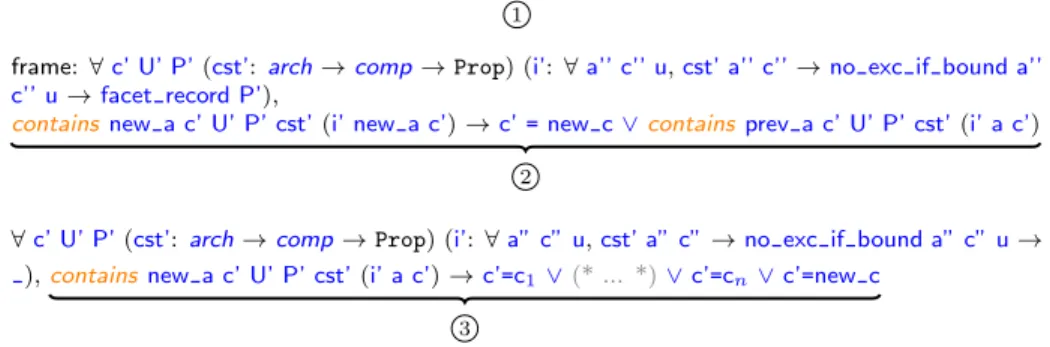
• From the previous architecture, prev H states that (see 1 of Figure 8 on the next page) if a component c’ is contained in the previous architec-tureprev a, it is one of the components previously created (here they are denotedc1 tocn).
• From the frame axiom, frame states that (see 2 of Figure8), in the new architecturenew a, any component is either the newly created component
new cor it was already contained in the previous architectureprev a. The tactic coalesces these two hypotheses into the equivalent single one presented at the bottom of the Figure 8 on the following page. Notice that 3 is now the combination of 1 and 2 and no longer refers to the previous stateprev aof the architecture. This coalesced hypothesis can be proved by the following proof script:
prev H: ∀c’ U’ P’(cst’:arch→comp→ Prop) (i’: ∀a” c” u,cst’ a” c”→no exc if bound a” c” u→ ),containsprev a c’ U’ P’ cst’(i’ prev a c’) →c’=c1 ∨(* ... *)∨ c’=cn
frame: ∀c’ U’ P’(cst’:arch→comp→ Prop) (i’: ∀a’’ c’’ u,cst’ a’’ c’’→no exc if bound a’’ c’’ u→facet record P’),
containsnew a c’ U’ P’ cst’(i’ new a c’) →c’ = new c ∨containsprev a c’ U’ P’ cst’(i’ a c’)
∀c’ U’ P’(cst’:arch→comp→ Prop) (i’: ∀a” c” u,cst’ a” c”→no exc if bound a” c” u→ ),containsnew a c’ U’ P’ cst’(i’ a c’) →c’=c1∨(* ... *)∨ c’=cn∨ c’=new c
1
2
3
Figure 8: Two hypotheses and their coalesced form.
introsc’ U’ P’ cst’ i’ new a contains c’.
destruct (frame new a contains c’) as [H|H]. - auto.
- destruct (prev H H); auto.
For each operation, we define the coalesced hypotheses such that the previ-ous state of the architecture is no longer referred to. As all of these coalesced hypotheses can be systematically proved, we developed a tool to generate auto-matically the tactics that apply the operations then coalesce the proof environ-ment.
Reconfiguration of the web server. The reconfiguration depicted in Figure7 on page 16 splits the serverHello component into two components: dynEngine, a generic engine that generates dynamic pages, anddynHello, the greetings han-dler. Since theserverFile component is not affected by this reconfiguration, it will continue to handle requests during the reconfiguration. The main idea is to temporarily hotswap the implementation of the dispatcher component such that it continues to serve the requests targeting theserverFile component while it enqueues those forserverHello. Since this step is manual in the process (see Figure3 on page 9), the reconfiguration developer can decide to design this new implementation. But if she/he attempts to use hotswap ondispatcher without any preparation, she/he would be unable to prove that the binding between
receiver anddispatcher remains well typed, as requested by Coq as part of the proof obligations. Indeed this binding would not be well typed anymore. This error highlights that eitherreceivermust be changed to accomodate the service provided by the new implementation ofdispatcher, or the change of dispatcher
must be reconsidered such that the type of its dispatch port is not modified. In our example, we choose the former fix: we modifyreceiver. The main steps of this reconfiguration are:
1. The implementation of thereceiver component is modified using hotswap
possible to suspend a thread to delay a request while the other requests are served with no delay.
2. Usinghotswap, the implementation of thedispatchercomponent is replaced by the following one: (1) it suspends the current thread (the request-handler thread) by using a global event object, if it receives a request for theserverHellocomponent, and (2) it works as before, if a request for the
serverFilecomponent is received.
3. Once the two previous steps are completed, the serveHello port of dis-patcher is no longer used: the web server is ready for the architectural changes. The binding between thedispatcher andserverHellocomponents is removed (unlink) then the componentserverHelloitself is removed ( de-stroy). ThedynEngineanddynHello components are instantiated (create) and bound (link), and then dynEngine is (hotswap) to add its provided port. Lastdispatcher is bound (link) todynEngine.
4. Lastly,dispatcher is (hotswap) back to its initial implementation and sus-pended threads are resumed.
The definition of this reconfiguration contains about 200 lines. It proves that the reconfiguration is correct and that requests targeting the serverFile com-ponent are handled immediately, even during reconfiguration. The complete reconfiguration script is available online at: http://coqcots.gforge.inria. fr/demojss/coqcots-coqdoc/Reconfiguration.html.
4.3. Extracting the reconfiguration script
Once we have obtained a valid Coqcots reconfiguration, we need to trans-forme it back to an executable Pycots script (step 3 of Figure3 on page 9).
The Coq extraction plugin translates the computational parts of Coq defi-nitions while leaving logical parts out. This plugin proceeds first to an interme-diate language MiniML, which is a variant of the λ-calculus with a fixed-point combinator, inductive and coinductive types, pattern matching, and a module and functor system. Then several backends generate concrete code for OCaml, Haskell and Scheme.
In this section, we present a new backend we have developed to target the Python language. The main problems to overcome in this backend concern (co)inductive types and pattern matching, which are missing features in the Python language.
Inductive and coinductive types. The approach we follow is based on the Scott encoding of data types into the λ-calculus [30]. With this approach, each induc-tive type defined by n constructors denoted {Ci}
n
i=1, where each constructor Ci has arity ai, is translated to the functions:
{λx1. . . λxaiλc1. . . λcn· cix1. . . xai}
n i=1. For instance, thelisttype defined by:
Inductive list (A: Type) : Type := | nil : list A
| cons : A→list A→list A.
is translated to the following Python functions:
1 nil = lambda if_nil, if_cons: if_nil()
2 cons = lambda head, tail, if_nil, if_cons: if_cons(head, tail)
Each function has the parameters of the corresponding constructor (none for
niland headand tailin the case ofcons) plus one functional parameter for each constructor of the type (if_nil and if_cons in this case). As result, the function calls the functional parameter corresponding to the constructor it encodes (nil calls if_nil; cons calls if_cons) with the parameters of the constructor. With this encoding, a value is a closure resulting from the partial application of the function, where theif_xxxparameters are not supplied. The closure stores the effective parameters of the constructor.
Pattern matching. Following Scott encoding of inductive types, pattern match-ing is encoded as a function call to the matched object (which is encoded as a closure). All the cases are rearranged in a decision tree, such that each test is performed at most once.
For instance, the following definition: Fixpoint count (A: Type) (l: list A) :=
matchlwith
|cons t⇒ 1 + count t
|nil⇒ 0 end.
is translated to the following Python function:
1 count=lambda l: l(lambda: 0, lambda _,t: 1+count(t))
The matching on list l is implemented by a call to the closure encoding this list. Each case is provided as a function whose parameters are the parameters of the constructor, i.e., no parameter in the nil case and the head and tail of the list in theconscase.
4.4. Develop DSU and glue the reconfiguration script to the application At step 4 of Figure 3 on page 9, the Python script extracted from the Coq code needs to be glued with the Pycots framework, as well as concrete Python objects (components, implementation objects and facets). The approach we follow is to wrap the script in a Coq functor, such that these objects are abstracted in module parameters. The script itself is a function parameterized by the reified architecture in Python, obtained as described in4.1then mapped to the Coqcots representation. Facets and implementation objects are mapped from Python classes: the class for a facet is a record type; the class for an implementation object is the class of the content object for a component.
The following code written by the reconfiguration developer shows the main tasks in the glue between the Coq-extracted script and Python. The functions
make_facet,make_impl_of_classandmake_archmap Python objects to data types extracted from Coq, calling their constructors. First the facets are pro-grammed as classes and mapped to their Coqcots representation (lines 1-9). Then the same is done with implementations (lines 11-16). Then the archi-tecture is reified and mapped to its Coqcots representation (lines 18-21). Last the reconfiguration script is called with all of these objects as parameters (lines 23-25).
1 # map facets 2 F = module("F")
3 class dispatcher_provfacet(object): 4 def __init__(self, dispatch): 5 self._dispatch = dispatch 6 def dispatch(self):
7 return self._dispatch
8 F.dispatcher__provfacet = make_facet(dispatcher_provfacet) 9 (F.dispatch,) = namedports_of_facet(F.dispatcher__provfacet) 10
11 # map implementation objects 12 I = module("I")
13 class Dispatcher(object): 14 def dispatch(self, req):
15 # ...
16 I.dispatcher__impl = make_impl_of_class(Dispatcher) 17
18 # map the architecture
19 r = reify(application.receiver)
20 components = dict((d.name,c) for (c,d) in r.iteritems()) 21 architecture = make_arch(architecture, components) 22
23 # apply the reconfiguration script
24 R = Reconfiguration.R(RCM, D).R(F).R(I).R(XF).R(XI) 25 R.reconfigure(architecture)
Thehotswap operation is handled specifically. Indeed this operation is ex-pected to dynamically hotswap the implementation of a component, i.e., to apply DSU to the implementation of the content object of the component as depicted in Figure 5. To do so we rely on Pymoult [14], a dynamic software updating platform for Python, i.e., reconfiguration at the function-and-object level. Pymoult advocates that, at this level, each reconfiguration may use spe-cific mechanisms in order to accomodate to spespe-cific requirements. To follow this recommendation, thehotswap operation looks up in a table for a specific hotswapper function provided by the glue code. That hotswapper function can use any of the Pymoult mechanisms to detect / force alterability, update the code, update data, update types and classes, and introspect / reboot / re-construct thread stacks. The hotswapper function includes all the objects it depends on, including new implementations and code blobs for the component.
In the implementation of the hotswapper, the reconfiguration developer is free to use any update mechanism on a per-operation basis. For instance, if quiescence is required when updating the dispatcher component, the recon-figuration developer can use Pymoult’s isClassInAnyStack predicate in or-der to detect whether its implementation class is active. If the ration developer prefers the behavior of Java Hotswap (i.e., the reconfigu-ration occurs immediately; new calls execute the new implementation while ongoing activities complet at the old implementation), she/he has to code the hotswapper accordingly. The following code implements an update func-tion for the latter alternative, the behavior of Java Hotswap. For any com-ponent running the Dispatcher implementation, and requested to swap to the Dispatcher_helloSuspended implementation, it uses Pymoult’s class re-linking mechanism (hotswap_implementation_class); and it completes when no method of the old Dispatcher implementation is on the runtime stacks
(isClassInAnyStack).
1 def hotswapper__dispatcher__impl_onlyfile(dispatcher): 2 updateDispatcher = BasicUpdate(manager,
3 lambda : True,
4 lambda : hotswap_implementation_class(dispatcher,
5 Dispatcher_helloSuspended)
6 lambda : not isClassInAnyStack(Dispatcher)) 7 updateDispatcher.setup()
8 updateDispatcher.apply() 9 updateDispatcher.wait_update()
10 register_hotswapper(Dispatcher, Dispatcher,
11 Dispatcher_helloSuspended,
12 hotswapper__dispatcher__impl_onlyfile)
4.5. Applying the reconfiguration
The purpose of the step 5 of our reconfiguration approach shown on Figure3 on page 9 is to apply the reconfiguration script obtained during the previous step to the target software system.
As already described, Pycots is depicted by Figure 5. The framework is composed of (1) a Component class, which is used to encapsulate components into black boxes, and (2) functions for reconfiguration operations. A component is basically an object that encapsulates its implementation, which is also an object. Each port is a method of this implementation object, which is either injected by the framework (used port) or coded by the developer (provided port). The provided ports are exposed through public proxy methods of the component object, which redirect method calls to their destinations.
With this framework, the link and unlink operations are as simple as field assignment. The two alternatives are: (1) when the used port is bound, the field is assigned to a stub function; (2) otherwise, it refers to the proxy of the provided port it is bound to.
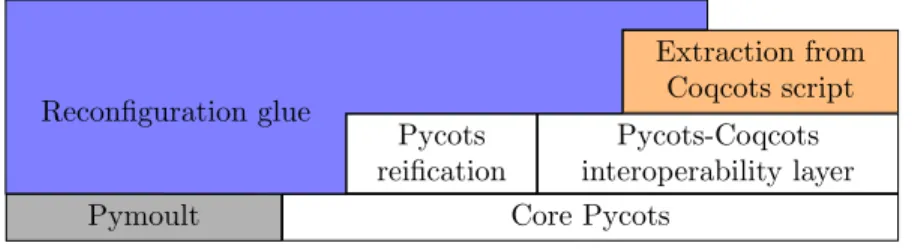
Core Pycots Pymoult Pycots-Coqcots interoperability layer Pycots reification Extraction from Coqcots script Reconfiguration glue
Figure 9: Architecture of Pycots.
Thehotswapoperation is splited in several primitive steps. First, added used ports are injected to the component and removed provided ports are erased. Then, the registered hotswapper function (see Section4.4) is executed to realize the DSU tasks within the component. Finally, the symmetric of the first step is applied: added provided ports are created and removed used ports are erased from the component. This sequence of operations ensures that at any time, all the provided ports are implemented and all the requirements of the implementa-tion exist as used ports. The primitive port manipulaimplementa-tion operaimplementa-tions (addiimplementa-tion and removal) are implemented using the native ability of Python to dynamically add and remove members to objects.
In summary, the overall structure of the framework is depicted by Figure9. The core Pycots provides the component concept and primitive operations; the Pycots-Coqcots interoperability layer makes the core functionalities available for code extracted from Coq; Pycots reification introspects a running system to build a representation of its architecture. Here Pymoult is used as a black-box toolset. The script is automatically extracted from the Coqcots reconfigura-tion script. The reconfigurareconfigura-tion glue is written by-hand to gather everything altogether and implement the design choices (especially regarding DSU steps) of the reconfiguration. It is important to notice that the Pycots framework is relieved from runtime verification of constraints, typing and invariants. Indeed, we assume that these issues have been proved with Coq. It results that the core Pycots framework is as tiny as 65 SLOC; the interoperability layer with Coq-extracted code is 205 SLOC; the architecture reification module is 335 SLOC.
5. Summary of the process
In summary, the process depicted on Figure3 on page 9is as follow. 1 The architecture of the application is first described as a Coq type denoting the set of architecturesa such that a given propositionP(a) holds. This proposition is built as the conjunction of the facts describing all the components and all the bindings in the architecture. It can be automatically generated. 2 In Coq, a reconfiguration is a function that applies the reconfiguration operations to an architecture. The Coq proof mode provides an interactive reconfiguration de-velopment environment, which generates proof obligations for each precondition
as well as for the preservation of architectural constraints requested by the com-ponents. Unprovable subgoals provide hints to the reconfiguration developer to decide what components and implementations could be designed in order to suc-cessfully implement the reconfiguration. The return type of the reconfiguration gives a specification of the resulting architecture, describing the components and bindings that are desired as the result of the reconfiguration. Again, Coq’s proof mode provides an interactive environment to ensure that the specification holds. In addition to the reconfiguration and its proof of correctness, the Coq code de-fines the types of the components and of their interfaces. These types can be considered a specification that can be later used when writing the Python code for the component implementations11. 3 Once the reconfiguration developer is
satisfied, she/he uses Coq’s automatic code extraction mechanism to generate the executable reconfiguration script. 4 Following the Coq specification, the reconfiguration developer has to develop Python code for the artifacts that are not programmed in Coq. These artifacts are mainly the implementations of the components as well as the behavior ofhotswap. 5 Last the reconfiguration is executed.
The web page http://coqcots.gforge.inria.fr contains the complete source code of Coqcots and Pycots. It also gives instructions to reproduce the web server scenario (reconfiguring from Figure 4 on page 10 to 7 on page 16) used as an example along Section4.
6. Related work
6.1. Component platforms supporting reconfiguration
OpenCOM [31], Fractal [27] and FraSCAti [32] are well-known component platforms with similar capabilities for managing and reconfiguring component assemblies at runtime. For each component, controller elements are responsible for managing the reconfiguration operations and ensure their safety and con-sistency. To achieve these guarantees, components can be stopped such that they are led to a quiescent state. A typical reconfiguration scenario is (1) stop affected components, (2) change bindings, and (3) (re)start components. Unaf-fected components are not stopped hence their services remain available during reconfiguration.
When a component A attempts to use a stopped component B, while the behavior is said undefined in the Fractal textual description, most implementa-tions suspend the calling thread until B is restarted. Even if A is not explicitly stopped, its services are unavailable and unavailability propagates back in the architecture. In our case study, at least the dispatcher component must be stopped. But even if thereceiver component is not stopped, its thread is sus-pended as soon as a request is received and until the end of the reconfiguration, thus preventing servicing the requests toserverFile. In practice the whole web
11The use of this specification is informal in the current version of Coqcots and Pycots. We consider improving in this regard in future work.
server is therefore disrupted. Alternatively, in the Boyer et al.’s work [6], a con-sistency invariant requires that mandatory dependencies of started components are bound to started components only: in this case, A must be stopped before B can be. While this approach is better founded, in practice applications are of-ten stopped entirely. In our case study, this invariant forces to stop thereceiver
component prior to stopping the dispatcher component. With this approach too the whole web server is disrupted. OSGi [33] proposes yet another alterna-tive: the framework-providedgetServicemethod, used by a bundle to resolve a dependency, informs the bundle when the dependency is missing. To some extent, OSGi supports only optional bindings. While this approach effectively avoids disruption, it is hard to satistify in practice as providing such component implementations that support any unsatisfied dependency is a difficult task. Furthermore, as already stated in this paper, it is not possible to foresee all the ways to avoid disruption when developing the application. Indeed, it highly de-pends on the currently available resources and the current operating conditions. For example, in our case study, if the current state of the server forbids to use ofserverHello, it is safe to apply the reconfiguration without modification of thedispatcher. Another very different situation would be the case when there are two instances of the dispatcher. In this case, we could elaborate a scheme to update a first instance by modifying the receiver so that it routes all the requests to the second dispatcher and then proceed equally for updating the second dispatcher.
6.2. Verification of reconfiguration
Regarding the verification aspect, none of OpenCOM, Fractal or FraSCAti initially addresses the problem. L´eger et al. [34] proposed a model of the se-mantics of Fractal using Alloy. They focus solely on the global consistency of architectural constraints, which is similar to the verification of the Coqcots in-variants as described in Section 4.1. For other aspects, L´eger et al. rely on the runtime verification of preconditions during the application of a reconfigu-ration script, while this verification is achieved statically when developing the reconfiguration with Coqcots.
FracL [35] is another formalization of Fractal for the Focal framework, which in turn relies on Coq. Similarly to L´eger et al. they define the invariants of the Fractal component model as well as the semantics of reconfiguration operations as pre-and-postconditions. Then they prove that these reconfiguration oper-ations preserve the invariants. While the invariants from L´eger et al. seem more precise (for instance FracL ignores optional ports), the list of invariants is similar. Coqcots is a bit simpler since we do not take into account composite components. In addition to the preservation of invariants, FracL allows specify-ing reconfiguration scripts by pre-and-postconditions, then develop them usspecify-ing a simple procedural language and prove their conformance. In Coqcots, the language we use is no more no less the Coq language with no restriction.
Still in the context of Fractal, Merle and Stefani [36] formalize the specifica-tion of the component model in order to prove that it is consistent. They encode the invariants of the component model as well as the dynamic behavior of the