Developing an Interactive Social-Emotional Toolkit for
Autism Spectrum Disorders
By
MASSACHUSETTS INSTITUTE OF TECH CLOGYDEC 16 2010
I IBPAPIPESMiriam A. Madsen
AR
S.B., C.S. M.I.T., 2009
Submitted to the Department of Electrical Engineering and Computer Science
in Partial Fulfillment of the Requirements for the Degree of
Master of Engineering in Electrical Engineering and Computer Science
at the Massachusetts Institute of Technology
August 2010
CHIVES
Copyright 2010 Massachusetts Institute of Technology All rights reserved.
Author
Department of Electrical Engineering and Computer Science August 20, 2010 Certified by Rosalind Picard Thesis Supervisor Certified by_ Rana el Kaliouby Thesis Co-Supervisor Dr. Christopher J. Terman Chairman, Department Committee on Graduate Theses Accepted by
Abstract
A development process consisting of participatory design and iterative implementation was carried out to create
a framework for interactive emotion-learning, the Interactive Social-Emotional Toolkit (iSET). iSET is a novel inter-vention consisting of live video recording and annotation software for use during social interactions as well as video review and discussion components. It is suitable for persons diagnosed with Autism Spectrum Disorders (ASDs) including Autistic Disorder (AD) and Pervasive Developmental Disorder-Not Otherwise Specified (PDD-NOS), the target groups for the intervention, as well as for persons with Asperger's Syndrome (AS). The iSET intervention was tested with a group of AD/PDD-NOS participants (n=20) with mean age 22.7 ± 8.55 years; these students were divided into an experimental group to test the iSET paradigm (n=10) and a control group following Golan and Baron-Cohen's Mind Reading DVD intervention approach (n=10). An age- and sex-matched group of neurotypi-cal participants (n=20) were also tested with the pretest measures. Preliminary results show an increasing ability to use the iSET materials and to capture videos that neurotypical teachers considered "good examples" of emotions considered in the intervention.
Acknowledgements
This material is based upon work supported by the National Science Foundation under Grant No. 0555411 and the Things That Think Consortium. Any opinions, findings, and conclusions or recommendations expressed in this material are those of the author(s) and do not necessarily reflect the views of the National Science Foundation. The hardware was generously provided by Samsung and Logitech, and the tracker used as a front-end for the face analysis software was provided by Google.
The author would like to thank the participants, teachers, and staff of the Groden Center, particularly Betsy Stratis, Eliza Lane, and Meghan Scrimgeour, with extra thanks to Daniella Aube. She would also like to thank Matthew Goodwin, Rana el Kaliouby, and Rosalind Picard for their incredible support during this project.
Contents
1 Introduction 7
1.1 Autism Spectrum Conditions . . . .. . . . . .. 7
1.2 Autism and Technology . . . .. . . . .. . . .. 7
1.3 Aims and Goals of Thesis . . . . 8
1.4 O utline . . . . 8
2 Related Work 9 2.1 Introduction ... ... ... .. ... ... . . - . .. ... 9
2.2 Existing Affect-Teaching Interventions... . . . . . . . . 10
2.3 Mind Reading DVD Intervention . . . . ... . . . .. 11
2.4 Shortcomings of Existing Affect-Teaching Interventions . . . . 11
2.5 C onclusion . . . . 12
3 Technology Development and Participatory Design 13 3.1 Introduction ... ... 13
3.2 iSET Interface Development and Samsung Ultramobile Hardware Use . . . . 13
3.3 The Emotion-Hunt Game . . . . 15
3.4 VidL Web Application Development . . . . 16
3.5 Iterations on the iSET Design . . . . 20
3.6 C onclusion . . . . 22 4 Experimental Design 23 4.1 Introduction . . . . 23 4.2 Hypotheses . . . . 23 4.3 Participants . . . . 23 4.4 Instruments . . . . 23 4.5 Procedure . . . . 25
4.5.1 iSET Group Procedure . . . . 25
4.5.2 Mind Reading Group Procedure . . . . 26
4.6 C onclusion . . . . 29
5 Construction and Administration of the VidL Pretest 30 5.1 Introduction . . . .. . . . . 30
5.2 Selection of Emotions for iSET Intervention . . . . 30
5.3 Labeling Process for Neurotypical Labelers . . . . 31
5.4 Collection of Naturalistic Video Data . . . . 31
5.5 Analysis of Pretest Data Collection . . . . 32
5.6 C onclusion . . . . 32
6 Pretest Results And Analysis 33 6.1 Administration of Pretests... . . . . . . . . 33
6.2 Results of Pretests . . . . 33
6.3 Analysis of Pretest Results and Correlations... . . . . . . . . 37
6.4 Conclusion... . . . . . . 39
7 Preliminary Intervention Data 40 7.1 Introduction ... ... ... ... 40
7.2 Increased Competence with Samsung Computer Use . . . . 40
7.3 Increased Labeling of Good Examples. . . . .. 41
7.4
Qualitative
Observations of Students . . . . 428 Conclusion 43
8.1 Design of the iSET Intervention . . . . 43
8.2 Pre-Intervention Data Collection . . . . 43
8.2.1 Design Considerations . . . . 43
8.2.2 Data Collection Findings . . . . 43
8.2.3 Information Learned During the iSET Intervention . . . . 44
8.3 Intended Analysis for Final iSET Results . . . . 44
8.4 Considerations For Future Work . . . . 44
9 Appendices 45 9.1 Pretest Data Collection . . . . 45
9.1.1 Instructions for NT labelers . . . . 45
9.1.2 Emotion Descriptions for NT Labelers . . . . 45
9.1.3 Foils for Neurotypical Labelers . . . . 46
9.1.4 Statistics on Pretest Data Collection . . . . 46
9.2 Pretest Administration . . . . 47
9.2.1 Pretest Instructions . . . . 47
9.2.2 Pretests Administered . . . . 47
9.3 PretestResults. . . . . 48
9.3.1 Autism Diagnosis Observation Schedule (ADOS) Results . . . . 48
9.3.2 Benton Face Recognition Test Results . . . . 48
9.3.3 Reading the Mind in the Eyes Test Results . . . . 49
9.3.4 Kaufman Brief Intelligence Test (KBIT-2) Results . . . . 50
9.3.5 Social Responsiveness Scale (SRS) Results . . . . 50
9.3.6 Toronto Alexithymia Scale (TAS-20) Results . . . . 51
9.3.7 VidL Naturalistic Videos Test Results . . . . 52
9.4 Intervention . . . . 53
9.4.1 Intervention Schedule . . . . 53
9.4.2 Emotion Descriptions for ASC and NT Participants . . . . 53
9.4.3 Recording Session Instructions (example for Week 01, Happy) . . . . 53
9.4.4 Recording Session Daily Log . . . . 58
9.4.5 Recording Session Fidelity Check . . . . 58
9.4.6 Viewing Session Instructions (example for Week 01, Happy) . . . . 59
9.4.7 Viewing Session Daily Log . . . . 61
9.4.8 Viewing Session Fidelity Check . . . . 61
9.4.9 Mind Reading DVD Session Instructions (example for Week 01, Happy) . . . . 61
9.4.10 Mind Reading DVD Session Daily Log . . . . 64
9.4.11 Mind Reading DVD Session Fidelity Check . . . . 64
9.4.12 Percentage of Videos Labeled by Teachers as "Good Examples" . . . . 64
1 Introduction
1.1
Autism Spectrum Conditions
Persons diagnosed with Autism Spectrum Disorders (ASDs) can face a variety of challenges during everyday tasks and activities. (The rest of this thesis will use the alternative language Autism Spectrum Conditions [ASCs] instead of Autism Spectrum Disorders [ASDs] to highlight the range of abilities and strengths associated with this population, including enhanced perception, increased systematizing skills, and sensory hypersensitivity [1, 2, 3, 4].) Some of the issues associated with ASCs are limited to non-social behavior such as stereotyped movements or restricted interests
[5]. However, ASCs are also characterized by deficits directly related to social communication and emotion-reading.
These deficits include: 1) issues in understanding the nonverbal cues and mental states of others [6, 7, 8, 9]; 2) reduced duration of facial feature fixation time (especially on the eyes) and atypical processing of eye gaze [10, 11, 12]; 3) difficulty in expression and comprehension of one's own feelings [13]; and 4) tendency toward monologuing and non-reciprocating conversation [14]. Persons on the spectrum have also reported issues with "mind reading" abilities, known as "Theory of Mind," which include understanding the beliefs, perspectives, and behavior of others [15].
For persons on the spectrum, many of whom have moderate to severe emotion-reading deficits, daily life and social interactions can be a continuous challenge. Like someone visiting a foreign country who does not speak the native language, a person diagnosed with an ASC such as Asperger's Syndrome (AS), Autistic Disorder (AD), or Pervasive Developmental Disorder-Not Otherwise Specified (PDD-NOS) may struggle to communicate with others, impeded
by a lack of a common interaction paradigm. As they misinterpret nonverbal communication, fail to issue socially
appropriate pleasantries, and miss important emotional cues, they may struggle to make friends, create meaningful emotional connections, and successfully navigate important settings such as the workplace.
There are a variety of methods to help people with social/communicative impairments. Many of these methods rely on predigested images, audio, and video packages designed by persons without any personal mental history of emotion-recognition impairment. This process can be like learning a foreign language in a classroom, using a textbook written entirely in the language of study; while some learning may occur, using that learning in daily interactions can be a difficult task, and many subtle points may be lost without an appropriate translation between the learning setting and a real-world practice setting. People who learn to read emotions from video clip lessons that claim a large smile means "happy" and a deep frown means "sad" may be left adrift in a world full of spontaneous expressions of interest, disgust, surprise and confusion. Real-time recognition of complex natural emotions produced during face-to-face conversations are nontrivial for most persons on the autism spectrum. One young adult user of the Mind Reading DVD intervention -a cutting-edge therapeutic approach that includes many different games and lessons illustrating a variety of emotions -told us that he became an expert user, acing all the quizzes on the DVD; however, he experienced almost none of this success in real-life emotion recognition. He needed technology that helped him in real life interactions
[16].
The Interactive Social-Emotional Toolkit (iSET) intervention provides a real-world practice setting as an integral part of the approach; rather than rote classroom practice, the iSET intervention teaches the ability to learn emotion in a context that involves all the complexity of real-world interactions. By allowing students to record, annotate, and review video of their peers and teachers, students can learn from videos of familiar people making expressions relevant to the students' own experiences. We hope to show that our mobile, in situ intervention represents a significant improvement over existing approaches to teaching emotion to people on the spectrum.
1.2 Autism and Technology
The Affective Computing Group at the MIT Media Lab works to improve the lives of persons on the spectrum through novel technology development. The group is leading a new area of research developing techniques to understand and address challenges faced by people on the spectrum and strives to integrate direct intellectual contributions from the autism community. Technologies are designed in conjunction with this community and their input is frequently sought during development of these devices. The iSET project applies these participatory design goals to the area of learning emotion reading.
iSET aims to make a severalfold contribution in this area. First, the project works to create a technology "partner" for persons on the spectrum. By creating a social "guide" that is repeatable, consistent, and calming (by reducing chaos and uncertainty in social interaction) -and perhaps even fun! -iSET will help its users learn to navigate their everyday difficulties in social interaction in a way that is meaningful and expressive rather than passive. Second,
the iSET project strives to create a meaningful assessment of social interaction ability. Bringing technology into the picture allows for creation of more objective measures. Rather than subjective evaluation by an occasional viewer of how much eye contact is made over time or how atypical a persons's expressions are, technology can help its users develop an objective and more meaningful measure of how social interactions are taking place, what factors affect social behavior, and how interactions can be better navigated. iSET seeks to quantify, simplify, and clarify emotion-reading social issues.
The solution of technology to a difficult problem, such as teaching emotion, is a new capability; in the past, com-puters equipped with onboard cameras were prohibitively expensive, meaning that subjective human-based assessment of social capabilities was the only feasible solution. Because of the current ubiquity of this type of technology, how-ever, the iSET approach shows promise as a way to teach emotion-reading in the natural environment of a person on the spectrum.
1.3 Aims and Goals of Thesis
This thesis will cover the participatory design, implementation, and clinical application that comprise the Interactive Social-Emotional Toolkit (iSET) intervention, conducted collaboratively between the Affective Computing Group of the Media Lab and the Groden Center of Providence, Rhode Island. The iSET intervention was developed in order to show the possible benefits to users on the spectrum of recording and viewing naturalistic video in an open-ended intervention. The iSET approach was contrasted in this study with the Mind Reading DVD approach [161. The Mind Reading DVD, an educational tool illustrating the expression of emotion through videos of actors expressing emotions, was tested with users by Golan and Baron-Cohen and acted as our standard for emotion-teaching tools [20}.
1.4 Outline
This thesis will be arranged as follows:
" Section 2: Related work. This section will describe related tools in emotion communication
(technology-mediated and otherwise), as well as other tools (which can be used for communication of emotion as well as other purposes) that were included as components of the iSET intervention.
" Section 3: Technology Development and Participatory Design. This section will introduce the iSET intervention,
including each of its software/web components (iSET Interface and VidL), the Emotion Hunt game used during the intervention, and the iterations on each component of the intervention that were part of the design process.
" Section 4: Experimental Design. This section will cover the hypotheses, participants, instructions, and
proce-dure of the iSET intervention.
" Section 5: Construction and Administration of the VidL Pretest. This section will discuss the creation of the
VidL pretest, a set of naturalistic and acted videos illustrating emotion expression.
" Section 6: Pretest Results and Analysis. This section will cover the goals and results of each pretest used in the
intervention, as well as correlations between the pretest results and possible clinical relevance.
2 Related Work
2.1 Introduction
The Interactive Social-Emotional Toolkit (iSET) intervention is designed as a technology-based paradigm that will allow users to understand emotions through recording, annotating, and viewing naturalistic clips of nearby persons expressing emotions.
In order to understand the potential impact of iSET, the field of existing approaches for social/pragmatic interven-tions must be more closely examined. Many approaches that exist to address the needs of people on the spectrum have usually been developed with a particular type of participant in mind; furthermore, the type of technology can vary for each intended participant group.
Interventions to teach emotion-reading usually address some, although not all, components of interpersonal com-munication. Figure 1 shows a diagram of the important nonverbal components of social interactions.
Figure 1: Nonverbal Components of Interpersonal Interactions. Each component shown here is crucial to success in everyday social interactions; leaving out any element, such as eye contact or affective response, can result in a negative social results and suboptimal communication.
Apprach
Eye
Affect
Affective
Emobon
contact
Processing::
Response
Elcitaon
These interventions can vary greatly on the question of whether technology is a major component of the interac-tions. Because of the relative recency of inexpensive and easily accessible technology, many current structures for teaching social skills do not include it. However, technology is increasingly included as a major component because it is fun and repeatable and may also be more scalable than existing approaches.
One variation across emotion-teaching interventions is degree of structure involved in the approach. These inter-ventions can usually be administered in a variety of ways; however, depending upon the approach's goals, directions for use may specify varying degrees of structure to be carried out by the caretaker of the user, the person administering the technology, or the user themself. For instance, in the application of one technology that will be discussed further, the Mind Reading DVD, participants were asked to spend a certain amount of time in each area of the software (so, for instance, they would avoid spending too much time in the Rewards area).
Another differentiator between emotion-teaching approaches is the degree of generalizability that can be applied. Emotion-reading teaching tools must take into account known difficulties in terms of generalization for these users. Baron-Cohen has found that people on the spectrum may instead have relative strengths in the area of systematizing
[19]; interventions that address emotion-reading deficits must therefore be evaluated partially on the opportunities they
give to develop systems pertaining to the information presented (rather than heuristics more suitable to generalizing strengths).
One important differentiation in the design of emotion-teaching interventions is the age group of the intended participant. Depending on the age and developmental stage of the participant, emotion-reading educational approaches may be designed differently and have different end goals. With young participants (and particularly with very young participants) there is a significant focus on "intervention" with a goal of training the user in a standard social paradigm, so that approximately normal social behavior will eventually take place.
In contrast, older users may have different goals. For adults, it may be more helpful to consider coping strategies for everyday interactions. Furthermore, both the chronological age and the mental age of the participants must be taken into account. Persons who are more independent or socially involved will have different needs than those who are in a caretaking setting for most of each day (such as the persons in our study). One facet of the iSET design was to create a technology that would be easy to use and relevant for people on the spectrum with a variety of ages and mental abilities.
Finally, approaches to help people on the spectrum learn to read emotion should incorporate information that occurs across the timespan of interpersonal interactions. Rather than addressing face-reading in a vaccuum, tools to teach this skill should assist with the other components of these interactions, such as approach, eye contact, and emotion elicitation. (See Figure 1.) iSET aims to address all of these elements in a single learning process.
2.2
Existing Affect-Teaching Interventions
A number of tools exist at the present time to facilitate communication and understanding of emotion. Some examples
are low-tech and have been incorporated across a variety of media; some are higher-tech and must be administered in a particular fashion for effective use; and some may be used in a variety of contexts, resulting from a fusion of lower-tech and higher-tech media.
" The Mind Reading DVD was designed and implemented at the University of Cambridge in a multi-year project
designed to collect a large and varied collection of emotion expressions in images and video, as well as through sound clips, written stories, and games. The DVD includes 24 basic categories encompassing 412 emotions total, each of which has many included video clips, images, and stories. The program can be used at multiple levels of complexity. A study of its efficacy was carried out by Golan and Baron-Cohen and replicated by LaCava et al. [20, 21]. (See Section 2.3 for more information.) The DVD can be purchased from Jessica Kingsley Publishers
[16].
" The SelfCam paradigm, which was the start of the iSET project and was created in the MIT Media Lab's
Affec-tive Computing Group in 2006, consisted of a wearable camera trained on the expressions of its wearer [22, 23]. This data could be read and analyzed in real time by the iSET Interface (see Section 3.2); the information gath-ered would be communicated back to the wearer in situ, allowing for dynamic reading of affect in interpersonal situations with an assist from technology. More information about the SelfCam project and previous iterations of iSET is in Section 3.5.
" Let's Face It is a piece of software designed to increase the efficacy of facial recognition in children on the
spectrum [26]. By enlisting "face tutors" and creating customized games suiting the deficits of a pilot group of children affected with face-reading deficits, Let's Face It aimed to produce an intervention suitable for use in early childhood that would improve the ability of people on the spectrum to improve face and emotion recognition.
" Framelt was a game developed by Eckhart and Picard at the MIT Media Lab in 2008 [24]. It is a
"tangible-digital" game which includes both physical puzzle pieces (showing parts of the eye area of the face) and a screen which correctly selects and renders the pieces used through RFID tag connection.
" The PECS (Picture Expression Communication System), which contains a variety of standardized images that
can be combined with words on cards and used across a variety of media, is perhaps the best known; it is frequently used in combination with the Boardmaker system [25]. This system can be used to communicate simple concepts word-by-word without use of verbal languages and in a simple, direct way for users who may have deficits in cognition or speaking. More recent systems usually incorporate a greater degree of technological sophistication. Direct descendants of the Boardmaker/PECS paradigm can be seen in devices used with persons who have communication difficulties.
" Social Stories are a series of text-based teaching activities oriented around the activities that a child might face in everyday life, e.g., strong feelings about where to stand in a classroom line [27]. By adapting a storytelling format to help people on the spectrum think through interpersonal interactions in their daily lives, Social Stories seeks to help people on the spectrum navigate social occasions with less stress.
" TeachTown is an environment simulating a real-world town suitable for use with children on the autism spectrum
[28]. The primary goal is to allow players to simulate many everyday reactions in a safe virtual environment. The
lifelike animations shown can be varied in naturalism from very abstract to very realistic (e.g., from geometric shapes approximating eye gaze to pictures of actual people in a joint attention exercise.)
" The Transporters is a software application designed to teach emotion-reading using lifelike images of animated
trains [29]. Similar to TeachTown, lifelike animations work to help persons on the spectrum, especially children, imitate and practice the skills needed for everyday interactions.
" FaceSay is an innovative new software package for teaching emotion reading and social skills [56]. It
incorpo-rates realistic-looking faces and a variety of social scenarios to teach the skills to navigate interpersonal situa-tions. FaceSay is unusual in that it has results indicating broad generalization, i.e., fewer negative interactions, more social behavior, and more person-to-person approach in a playground setting.
2.3 Mind Reading DVD Intervention
The Mind Reading DVD is a tool developed by Baron-Cohen et al. in order to facilitate learning of emotions and affective communication, particularly by people on the spectrum. By providing a form of interactive multimedia appropriate for several different levels of developmental ability, the DVD offers many audio, visual (both image- and video-based), and textual examples of a wide variety of emotions [16]. The Mind Reading DVD is also one of the few existing interventions to include emotions beyond the basic ones, including more complex cognitive states; this aspect made it a good comparison choice for the iSET intervention. The examples are presented dynamically (i.e. with facial gestures in video, rather than static images, illustrating an emotion), allowing it to serve as a control for other video-based interventions.
Baron-Cohen and Golan created an intervention to test the effects of consistent use with the Mind Reading DVD in both group and non-group situations. (See Table 1 for information about the intervention structure.) During their intervention, they focused on practice with persons diagnosed with AS and high-functioning autism (HFA). They included two groups of AS/HFA participants (one, the control group, participated in before and after assessments but did not use the DVD) as well as a matched group of neurotypical participants with no diagnosis or family history of ASCs.
The first experiment took place at home for each participant. After the initial assessment session, participants in the experimental group were asked to use the DVD for 10 hours total over a period of 10-15 weeks. In the second experiment, a similiar setup took place but the Mind Reading DVD ASC group (as well as the control ASC group) took part in a social skills workshop concurrently.
Table 1: Format of Golan/Baron-Cohen Mind Reading DVD Intervention. Each of the two experiments included two
AS/HFA and one NT participant group; the AS/HFA groups experienced either the experimental or the control setting,
including a social skills group (depending on the experiment), and NT groups were tested but not otherwise involved
in the intervention.
Experiment Participants Pretest Posttest Time with DVD DVD at home Social Skills Group
1 AS/HFA Experimental (n=19) yes yes 10 hours yes no
1 AS/HFA Control (n=22) yes yes - no no
1 NT Control (n=24) yes no - no no
2 AS/HFA Experimental (n=13) yes yes 10 hours yes yes
2 AS/HFA Control (n=13) yes yes - no yes
2 NT Control (n=13) yes no - no no
Before and after both experiments of the intervention, participants were asked to test their acquisition of emotion-reading knowledge across two modalities, audio and visual, and across three types of generalization: close
general-ization (video shown in Mind Reading, presented in a different format with different answers; feature-based distant generalization (similar video/audio not shown in Mind Reading), and holistic distant generalization (scenes from
feature films).
In both experiments, the AS/HFA groups who used the Mind Reading DVD improved from baseline in their abilities to recognize the Mind Reading DVD clips; however, they did not improve on either feature-based or holis-tic generalization tasks, suggesting that the time spent using the DVD was not directly useful to the parholis-ticipants in everyday face recognition tasks.
2.4 Shortcomings of Existing Affect-Teaching Interventions
Existing behavioral interventions to teach emotion-reading usually had some problematic characteristics that are ad-dressed in the design of the iSET intervention. (See Table 2 for comparison criteria across intervention technologies.) The main shortcomings common to these interventions are: a) lack of relevance to conversational partners that the stu-dent will encounter in day-to-day life; b) lack of relatedness to situations that the stustu-dent will encounter in day-to-day life, and c) stimuli that are significantly different than the stimuli presented in in situ emotion-reading interactions. These issues will be covered individually below.
Most interventions that teach emotion-reading skills to persons on the spectrum rely on hypothetical conversational partners so that the interventions can portray the interactions from a third person perspective. For instance, in the
BoardMaker kit, the user as well as any conversational partners are represented graphically by minimally expressive face images; in the Mind Reading DVD, users are asked to empathize with actors portraying various characters used throughout the program. The objects of emotion-reading in these interventions do not include nearby persons who would be included in real-life interactions.
Furthermore, the situations discussed in the interventions currently used to teach emotions cannot be customized in most cases to include particular subjects with which the user would be familiar. For instance, in the Mind Reading DVD, many interactions concern types of relationships that the user may not have had or many not be able to relate to (such as a boyfriend/girlfriend); similarly, while Boardmaker may be able to handle generic topics such as music or baseball while modeling day-to-day conversations, it would struggle to effectively include the specific topics of high interest to our participants, such as particular sports teams or bands. Relevance to personal interests and daily life to users is a critical part of a successful intervention, since relevance can significantly boost motivation and interest; this factor is particularly important to consider when working with persons on the spectrum, who may have had significant emotional issues with social interactions in the past.
Few of these interventions in any way address the critical need for eye contact, except through animated exercises; without a realistic practice setting and application for this skill, the success of an intervention is likely to be impaired. Eye contact is a valuable and often-required skill for everyday social interactions, and leaving out a direct application is problematic.
Finally, many of the stimuli presented in these artificially created interactions or situations lack many of the salient aspects of in situ interpersonal interactions. In the Mind Reading DVD, images and video are presented by actors with clear facial expressions wearing non-distracting clothing on white backgrounds; each actor only presents one emotion at a time in a given image or video.
Table 2: Comparison of iSET with Existing Affect-Teaching Interventions. The iSET intervention includes signif-icantly more practice of skills crucial to everyday reaction, including social approach and eye contact. Many other interventions do not show generalizability to real-life situations, such as through in situ significant observations or testing using stimuli that mimic everyday interpersonal interactions, e.g. naturalistic video. The iSET intervention was developed in participatory sessions with people on the spectrum across a variety of ages; many other interventions only show evidence of design and testing with children.
iSET FaceSay Mind Reading Transporters TeachTown Let's Face It Social Stories
Is Engaging yes yes yes yes yes yes yes
Is Designed for Children yes yes yes yes yes yes yes
Is Designed for Adults yes no no no no no no
Includes Basic Emotions yes yes yes yes yes yes yes
Includes Complex Emotions/Cognitive States yes no no no no no no
Includes Static Presentations of Emotions yes yes yes yes yes yes yes
Includes Dynamic Presentations of Emotions yes yes yes yes yes yes yes
Requires Social Approach yes no no no no no no
Requires/Encourages Eye Contact yes no no no no no no
Requires Emotion Elicitation yes no no no no no no
Includes Socializing in situ yes no no no no no no
Contextualizes everyday social interactions yes no no no no no no
Has evidence of real-life generalizability ? yes no no no no no
2.5
Conclusion
Current technologies for addressing emotion-learning in autism have been improving; however, many of them still assume significant generalization abilities on the part of their users, which is a known weakness for this population.
By addressing situations that may not be familiar to less-socialized target populations, these approaches may not be
well suited for their audiences. Existing interventions provided the inspiration behind the iSET Project; iSET addresses the ecological validity of these interventions and strives to create a better learning situation for emotion-reading skills that can be generalized to real-life interaction.
3 Technology Development and Participatory Design
3.1 Introduction
iSET, the Interactive Social-Emotional Toolkit, was developed through many rounds of collaborative iteration with users on the spectrum and their caregivers in order to create a tool that would facilitate the needs of users by improving their abilities to express, read, and understand facial affect and emotion cues. The overall structure of the experimental group's procedure in the iSET intervention consists of two main components:
1. Recording Sessions. In a recording session, the user first watched example video clips approved by neurotypical
labelers as demonstrating a particular emotion (see Section 5.3). These clips (as well as the clips in the viewing session) were watched in the VidL interface described in Section 3.4, and only one possible answer -the right one - was offered for each clip. Next, the participant worked with a caregiver to record video of the faces of nearby people, sometimes including the caregiver. During this time, the participant had an opportunity to annotate the faces that they are are recording with emotion labels during the real-time recording process. The software used for this component is the iSET Interface, a software component custom-designed for iSET at the Media Lab; this software is run on the Samsung Ultramobile computer platform, which is well-suited to the project because of its easily holdable size, large screen, and rear-facing camera ideal for recording faces of conversational partners (see Section 3.2). During a Recording Session, participants played the Emotion Hunt game in order to collect examples of emotions; this game is described in Section 3.3.
2. Viewing Sessions. In a viewing session, participants watch three types of clips through the VidL interface (see
Section 3.4).
" First, participants watched example clips approved by neurotypical labelers as representative of the
ex-pressed emotion. In the examples viewing, which is identical to the examples viewing during the recording session, only one option (the correct one) was given for each clip in order to provide an errorless learning environment conducive to motivated learning and engagement.
" Participants then watched preapproved clips; these came from the same corpus of pre-recorded and
NT-approved clips as the examples clips, except that starting in Week 05, these clips are shown with more than one possible choice. Participants were incentivized to make the right choice by the showing of customized Reinforcing Images.
" Finally, participants watched clips that they recorded of peers or nearby strangers during the most recent
recording session.
3.2 iSET Interface Development and Samsung Ultramobile Hardware Use
The iSET Interface allows for easy recording and annotation of video. The key components of the iSET Interface, which will be described individually, are a) the video display in the center of the window, in which real-time video is shown; b) the annotation buttons to the right of the video; c) the annotation notification area below the video; and d) the start/stop video recording button (see Figure 2). There is also a control panel in which settings which affect the display and processing can be altered. The iSET Interface is based on the FaceSense software created by el Kaliouby
[31].
The video display area shows video captured in real time from the camera on the reverse side of the Samsung ultramobile computer; thus, the video shown is what would be seen by the device user in the absence of the device if the user were looking forward. This format allows for a natural transition between device use and normal conversation, highlighting the naturalistic aspects of the software/hardware arrangement. The video display is in black-and-white until a face is recognized on the screen by Google Tracker, a face-tracking algorithm; when a face is recognized, the face is outlined in an orange box and the video display changes to full color until no face is recognized again.
Figure 2: The iSET Interface Screen for Recording Sessions with emotion buttons labeled Happy, Concentrating,
Thinking, and Interested. The display allows for toggling of the recording functionality and shows the
The annotation buttons to the right of the screen are fully customizable. During the iSET intervention, they consisted of one, two, or four of the following emotions (see Section 4.5 for more information): Happy, Concentrating,
Thinking, Interested. Each of these had a characteristic color (yellow, blue, red, and green, respectively); these colors
were associated with their respective emotion throughout all interfaces and reference material in the intervention. Note that in this section and all subsequent ones, the word "emotions" is used as a shorthand for "emotions and cognitive states"; of the four final "emotions" used, three are more traditionally regarded as cognitive states
(Concentrating, Interested, and Thinking) and only one is usually regarded as an "emotion" (Happy). The goal of the
iSET interaction was to improve processing by our participants with regard to affective communication conveyed on a daily basis, and as discussed in Section 5.2, of the set of 6 basic emotions and 6 cognitive states initially recorded, the four affective expressions seen most often were a combination of these two types of information. The iSET project discusses these as "emotions" both for simplicity and because understanding of these states frequently has emotional components and consequences.
3.3
The Emotion-Hunt Game
The emotion hunt game was the primary activity carried out during recording sessions. After viewing example videos for 5-10 minutes in VidL, partipants would go on to participate in 15-20 minutes of recording and labeling emotions with the iSET Interface as part of this game. See Figure 3 for an illustration.
Figure 3: An Illustration of the Emotion Hunt Game. During the Emotion Hunt game, the user of the Samsung/iSET Interface holds the computer with the camera facing their conversational partner. During the course of conversation, video of the partner appears on the screen and is recorded; the user can press labeling buttons to indicate the viewed emotion at any time.
During the Emotion Hunt game, participants follow this series of steps:
a Hold the Samsung with the screen facing the participant and the back-facing camera facing the converstional
partner.
" Activate video recording in the iSET Interface.
" Elicit emotional expression from the conversational partner. " Label expressions with emotions available in the iSET Interface.
In some cases, gross motor skills were not strong enough to allow holding of the Samsung computer, or fine motor skills were insufficient to allow pushing buttons while holding the device; in these cases, the caregiver(s) who partic-ipated in the sessions with the student would assist the student by holding the Samsung computer while the student pushed the labels on the touchscreen.
3.4 VidL Web Application Development
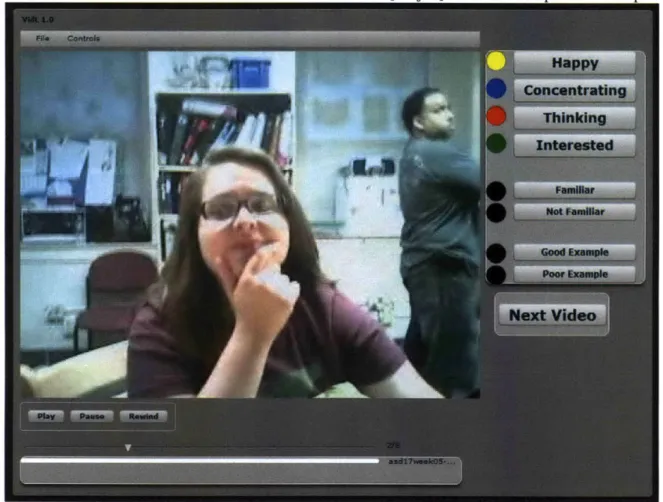
The VidL web application was developed by Eckhardt as way to easily label video and images on a web interface accessible from anywhere [42]. The VidL application consists of a browser window showing a video with annotation buttons and a "Next Video" button on the right, video play controls on the bottom left, and a video play timeline at the bottom right. The user clicks the "Next Video" button to trigger the next video, which begins playing automatically. The video can be annotated during or after playback with the labeling buttons on the right. After it plays, the user can click the "play" button at the bottom of the window to replay the video, and more labels can be added before or after replay. As each annotation button is clicked, the selected label is shown in large text at the bottom of the window to
confirm the user's choice.
VidL has fully customizable buttons and several different types of playback. Three major interfaces were
con-structed for use during iSET by Eckhardt and Madsen.
e
In the Example Videos interface (see Figure 4), one choice was presented for each video throughout the inter-vention; whenever that choice was clicked, the Reinforcing Image for that student on that day (see Figure 6) was displayed.Figure 4: Screenshot of the Example Videos interface in VidL. In the Example Videos interface, videos can be labeled with one possible label (the NT-labeler-approved one). Clicking this label activates the Reinforcing Image.
* In the Preapproved Videos interface (see Figure 5), students were able to click one label during Period 1 and two labels in Periods 2 and 3; if they clicked the correct label, the Reinforcing Image was shown (see Figure 6).
If an incorrect label is picked by the labeler (which is possible in Periods 2 and 3) then the "Try Again!" screen
is shown (see Figure 7). The correct label must be clicked in order to proceed, but if the incorrect label was chosen first, the "Correct!" screen is shown without the Reinforcing Image. (See Figure 8.)
Figure 6: Example of Reinforcing Image and "Correct!" screen that can appear during Example Videos and Preap-proved Videos Interfaces. Each student has customized Reinforcing Images which are changed each day; these images can appear in a variety of fashions, including multiple copies of the image showing at once, one copy of the image bouncing, and one copy of the image rapidly growing bigger and then smaller.
Correct!
Figure 7: The "Try Again!" screen shown after a wrong answer. This screen shows for a few seconds and then automatically disappears.
Figure 8: Choosing a Wrong Answer after a Right Answer in Periods 2 and 3. If a wrong answer is chosen after a right one, the wrongly chosen answer is grayed out; when the "Correct!" screen is shown, the Reinforcing Image does not avoear.
Correct!
* In the Student-Recorded Videos interface (see Figure 9), each video was shown with four emotion buttons to be clicked by the students and two other choices (Familiar/Not Familiar [Subject] and Good Example/Poor Example) to be made by the teacher. No reinforcing screen is presented during the Student-Recorded Video section.
Figure 9: Screenshot of Student-Recorded Videos interface in VidL. In this interface, the participant is asked to choose an emotion label and the teacher selects from Familiar/Not Familiar [Subiectl and Good Examnle/Poor Examnle.
3.5 Iterations on the iSET Design
Design of the iSET intervention took several successive forms, with some major development (such as from SelfCam to Emotion Bubbles and on to the current iSET Interface) and some minor ones (such as color, button size, and layout tweaking). Some of the factors taken into account in relation to use with a population on the spectrum have been reviewed at the ASSETS conference [43]; the design process and interactions with students were outlined at the CHI conference [44].
The underlying software used for iSET was FaceSense, a face reading algorithm developed by el Kaliouby [31]. FaceSense was used to automatically assess emotions shown in facial expressions. By tracking 22 feature points on the face and using Ekman's FAC (Facial Action Coding) system, the software automatically detected a range of "gestures" (such as head-tilt and lip-pucker) and translated those into a range of congitive states, which were Agreeing,
Concentrating, Disagreeing, Interested, Thinking, and Unsure [55].
In the original iteration of the iSET Interface, the iSET project used information from the FaceSense software to create a wearable technology that would allow the user to record and process their own emotional state, as conveyed through facial expression, in real time. This approach, called SelfCam, was self-oriented for its users, allowing them to focus on their own expressions as opposed to directly engaging with affective expression by conversational partners [22]. (See Figure 10 for an illustration.)
Figure 10: The Selfcam Apparatus and Output. The SelfCam is a portable device that focuses on the wearer's face; it produces a display that can signal cognitive states and facial gestures.
rMd
4 is sW2mn
While the SelfCam pilot focused on more-communicative individuals -many of whom had Asperger's Syndrome
-it became clear that this population might be able to benef-it from a broad range of approaches, some of which may not be suitable for individuals with a lower social comfort level. Thus, in order to serve the most people on the spectrum, it made sense to design a system for use by persons with AD/PDD-NOS and then adapt as necessary for persons with AS, rather than doing the more substantial adaption/reconceptualization in the opposite direction. It was also determined that understanding of one's own emotional presentation, the focus of the SelfCam project, was helpful for the learning and self-reflection process. However, that paradigm was insufficient for conversation-oriented learning of interpersonal affective cues.
A subsequent version of the iSET Interface for use at the Groden Center included a component created by the author
called Emotion Bubbles (see Figure 11.) In the Emotion Bubbles Interface, six emotions were chosen for automatic recognition by the FaceSense backend, and each was assigned a distinctive color. The three negative emotions assigned "warm" colors (indicating that the viewer of the Emotion Bubbles may want to change conversational style) were
Disagreeing (red), Thinking (orange), and Confused (yellow); the positive emotions assigned "cool" colors (indicating
current conversational success) were Interested (green), Concentrating (blue), and Agreeing (purple).
Figure 11: Emotion Bubbles Interface. The Emotion Bubbles reflected the cognitive states that were interpreted by the FaceSense Software: Agreeing, Concentrating, Interested, Disagreeing, Thinking, and Confused. These states were displayed in characteristic colors; the circles that represented them could be touched and dragged around the screen.
The Emotion Bubbles interface relied on the original FaceSense emotion-sensing algorithms [31]. However, al-though the Emotion Bubbles were engaging and interesting for the students to view, they did not involve any action other than directing the camera on the part of the students, and therefore did not require ongoing intellectual engage-ment. Furthermore, since the emotion-recognition algorithms were not consistently correct, the teachers sometimes orally corrected the "perception" of the software and undermined its claim to provide helpful information during interpersonal interactions.
The iSET project team determined through a series of participatory design interactions that, in addition to providing sometimes-incorrect information about emotion conveyed through the face, the FaceSense software back-end did not promote maximum engagement between the participant on the spectrum and the learning system.
The current iSET Interface was therefore adopted; it removed all of the automatic emotion-recognition components but retained the Google-Tracker-supported face tracking algorithm, allowing users to easily (through changes to and from a black-and-white display) understand whether or not a face was being tracked. The addition of large, colorful labeling buttons, added in a pattern of increasing complexity, encouraged engagement with the system and allowed for ongoing review of emotions between weeks of the intervention.
3.6
Conclusion
The Interactive Social-Emotional Toolkit is a multi-component system designed to facilitate the recording and anno-tation of affective information. The iSET system was refined and improved through many rounds of feedback from
ASC participants and their caregivers, resulting in components facilitating both naturalistic interpersonal interaction
and a reflection/discussion period of recorded observations in order to support the learning process.
4
Experimental Design
4.1 Introduction
The goal of the intervention was to determine the efficacy of iSET as a tool for learning emotions. The iSET interven-tion was designed to be as consistent with the Mind Reading DVD interveninterven-tion as possible, with the major differences derived from recording and review of live videos instead of viewing of prerecorded videos of acted emotion [20]. Consistency between the two interventions assisted with later comparison and increased ability to compare the two interventions on the basis of naturalistic vs. acted video and on the basis of on-computer vs. in situ affect-reading interactions.
4.2 Hypotheses
The primary hypotheses for the iSET intervention were as follows:
1. Persons on the spectrum will benefit from active involvement with their own emotion-learning intervention,
including with the design process; because of a lack of usability studies with persons on the spectrum in the literature, direct contact with target users during the design process will produce a more useful final intervention for emotion learning.
2. Naturalistic videos, recorded and viewed in situ and at a later time by the user, will carry more benefit in terms of terms of teaching the user to recognize emotions and affect in an environment similar to ones in which he/she will usually be asked to do so.
3. Teacher feedback and cooperative analysis of emotion videos is a stronger teaching tool for understanding of
these videos than non-social use of emotion-teaching software.
4.3 Participants
Two groups of participants took part in the intervention -a control group of neurotypical participants (n=20) and a group of participants on the spectrum with PDD-NOS or Autistic Disorder (n=20), recruited from the Groden Center's three sites. The ASC and NT participants were matched on gender and age (with the NT participants being ± 6 months older than than the ASC participants.)
The ASC group was further divided into two subgroups; one group (n=10) took part in a version of the original Mind Reading DVD intervention, and the other group (n= 10) took part in the iSET intervention. The two ASC groups were matched on the basis of gender, age, and scores on the KBIT-2 intelligence test (see Section 4.4, Instruments.)
4.4 Instruments
Several tests were used with the ASC participants only (for instance, autism-specific tests), and some were used with the matched NTs to compare the two groups. Some tests were used as both pretests and posttests with the ASC group, in order to gauge anticipated change over the course of the intervention, and some were used only during the pretest phase to assess factors not expected to change over the course of the intervention. None of the tests were used as posttests in the NT group. Table 3 shows the breakdown of standardized measure administration.
Tests used during the intervention included:
" Autism Diagnosis Observation Schedule (ADOS) [48]: a test for diagnosing and assessing autism, consisting of probes for social, communicative, and restricted & reptitive play and behavior. The ADOS is the gold-standard test for diagnosing autism from toddlerhood to adulthood. Evaluation takes place across a variety of social and communicative situations, including both activities and conversational settings.
" The Benton Facial Recognition Test[5 1]: the short form of this test (27 items) was used to test ability to compare
matching versus not-matching photos of faces, as well as to generalize facial recognition between multiple photographs of the same person. The test can be used for ages 6-74 years, and it is designed to be administered
* The Kaufman Brief Intelligence Scale (KBIT-2) [45]: a short assessment of intelligence similar to IQ testing, but covering a more limited scope of detail. There are two subscales for verbal and nonverbal scores as well as a composite scale. (Note that the KBIT-2 was used for brevity; however, Dawson has presented evidence that the Raven' Progressive Matrices test may be a better measure of the unique intelligences seen in autism [53].) * The Reading the Mind in the Eyes Test [49]: this test created by Dr. Simon Baron-Cohen includes one practice
question and 36 test questions, each showing a picture of a pair of eyes and suggesting four choices that could describe what is being thought or felt. The test-taker is instructed to choose the most suitable option. (This test was administered to teachers and neurotypical labelers evaluating the video corpus only; the purpose was to ensure an above-average level of facial-expression-based emotion recognition in persons crucial to the success of the intervention.)
" The Social Responsiveness Scale (SRS)[50}: a 65-question list of traits applicable to social interactions. Five
subscale scores are generated: Social Awareness, Social Cognition, Social Communication, Social Motivation, and Autistic Mannerisms. T-Scores are generated for each category as well as the overall test and may be used to evaluate particular deficits or overall impairment in the area of social interaction.
" The Toronto Alexithymia Scale (TAS-20)[46]: a 20-question inventory of traits related to alexithymia, the ability
to express self-awareness and personal emotion awareness. Three subscale scores are compiled in addition to the overall score: Difficulty Describing Feelings, Difficulty Identifying Feelings, and Externally Oriented Thinking. The TAS is intended to identify and quantify character traits related to minimization of internal emotional state and tendency to focus emotions in an external direction. The TAS-20 was administered by teachers and also taken directly by participants; whenever possible, the participants score was used in analysis.
" Customized VidL pretest containing videos of a study subject and his/her -self, peers, and teachers, as well as
some unfamiliar adults (other adults at the Groden Center.) See Section 5 for more information.
Table 3: Tests Administered to ASC Participants, NT Participants, and Teachers. NT participants did not participate in any post-tests, and teachers only participated in two tests for reasons for time. Major baseline measures such as the
KBIT-2 and autism-specific measures such as the ADOS were administered to the ASC group only.
Test ASC (pretest) ASC (posttest) Teachers
}
NTAutism Diagnosis Observation Schedule (ADOS)[48] yes no no no Benton Face Recognition Test [51] yes yes no yes
KBIT-2 [45] yes no no no
Reading the Mind in the Eyes test [49] no no yes no Social Responsiveness Scale (SRS) [50] yes yes no yes Toronto Alexithymia Scale (TAS-20) [46] yes yes no yes
VidL Naturalistic Videos Test yes yes yes yes
The pretests were not be readministered to NT participants; since they did not participate in the intervention, there is no need for gauging their progress during the time of the intervention.
Since both groups of ASC participants are engaging in full emotion-teaching interventions, it was necessary to gauge the relative progress of groups and individuals on these measures relative to the beginning of the intervention.
4.5
Procedure
The iSET intervention was 12 weeks long and consisted of three four-week periods of increasing complexity, with three to four sessions per week for each participant. Participants were accompanied by a teacher during each session and were prompted throughout, as per the instructions in Appendix 9.4.3 (recording sessions) and Appendix 9.4.6 (viewing sessions).
For all participants, one emotion was looked at per session in the first period; two emotions were looked at per session in the second period; and the four emotions of the study were looked at in the third period. (See Table 4 for a full schedule.) The emotions were chosen for each week as shown in Table 4. (The emotions for Period 1 were ordered from easiest to hardest by the Groden Center teachers; the emotions in Period 2 were selected in random pairs so that each was chosen twice during that time.)
Table 4: Emotion presention for iSET and MR participants during the iSET intervention. During Period 1, the same emotion was presented during each of the 3-4 sessions in a given week, and the emotion changed from week to week. In Period 2, a particular pair was selected for each week, and in Period 3, all emotions were looked at during each week and session.
Period Week #s Emotions/week Week 1 Week 2 Week 3 Week 4
1 1-4 1 Happy Thinking Concentrating Interested
2 5-8 2 Concentrating/Thinking Thinking/Interested Happy/Concentrating Happy/Interested
3 9-12 4 All emotions All emotions All emotions All emotions
Participants in the iSET group versus the MR group experienced different procedures.
4.5.1 iSET Group Procedure
During each week, each student experienced alternating recording and viewing sessions. In the 3-4 sessions per week, students always had at least a recording session and a viewing session, followed by another recording session; if scheduling permitted, another viewing session took place as well
Recording Sessions consisted of:
* 5-10 minutes of labeling videos from the corpus, called "Example Videos", through the VidL interface (see
Section 3.4). Each Example video had one label offered; this label was the label approved for the clip by the neurotypical labelers.
* 15-20 minutes of recording video through the Samsung hardware/iSET Interface (see Section 3.2) In Period
1, the iSET Interface had the emotion for that week available for live annotation; in Period 2, both emotions
being focused on that week were available for live annotation; and in Period 3, all emotions were available for labeling.
Viewing sessions consisted of:
* 5-10 minutes of labeling videos from the corpus, called "Example Videos", through the VidL interface (see
Section 3.4). Each Example video had one label offered; this label was the label approved for the clip by the neurotypical labelers.
* 5-10 minutes of labeling videos from the corpus, called "Preapproved Videos", through the VidL interface (see
Section 3.4). Each Preapproved video had 1 or two labels offered. In Period 1, one label (the correct one) was offered; in Period 2, both labels covered that week were offered; and in Period 3, two of the four labels in the intervention were offered (one was the correct one and one was selected randomly from the set of the other three.)
* 10-15 minutes of video clips recorded during the Recording Session. Videos shown during the the Viewing Session were the recorded clips (four seconds before and after a label), except for the clips in which the tracker in the iSET Interface did not successfully find a face at the time when the labeling button was pressed in the iSET Interface (see Section 3.2).
During both Recording and Viewing sessions, students received Reinforcing Images with different visual effects (e.g. bouncing, changing size, and appearing many times) whenever a right answer was chosen. These images were chosen
by students before and during the intervention and switched on a daily basis (with the same group of 10 images used
each week for each students.
4.5.2 Mind Reading Group Procedure
The Mind Reading DVD procedure was adapted from the procedure followed by Golan and Baron-Cohen [20]. In each session, students were asked to visit three components of the Mind Reading DVD for each emotion being covered that week. These sections were: Learning Center/Emotion Groups, Learning Center/Lessons, and Rewards.
* In the Emotion Groups section (part of the Learning Center), students watched a series of videos of actors illustrating that week's emotions. For instance, in Week 04 (Happy/Interested), students would watch videos from both the Happy and Interested emotion sets, found in the Happy and Interested groups, respectively. The students would then listen to their teachers read short stories from the software describing situations in which the emotion may be relevant. See Figure 12 for illustrations of the screens participants encountered.
Figure 12: Mind Reading DVD: Emotion Groups Area. In the Emotion Groups Area, students are shown videos illus-trating an emotion and statements about an emotion that illustrate how the emotion might look in social interactions and what the significance of seeing that emotion might be.
happy emotons
The HAPPY group is made up of many positive emotions about feeling happy and ok]
happ anxt on
* In Lessons (part of the Learning Center), students would re-watch those same videos; in this case, the videos would be preceded by more context about the overall group, as well as a series of written stories read by teachers at the end of the video showing. Some short quizzes (two questions about a presented video, each question having two choices) are also presented. See Figure 13 for an illustration of the Lessons Area.
Figure 13: Mind Reading DVD: Lessons Area. In the Lessons area of the Mind Reading DVD, students are shown a series of videos for practice and then asked to choose between representative and non-representative videos for a given emotion.
happy
*...
..
... ....
...
Sandra is happy siding in he garden ioomng at Ule kwrs.
awl rQ-4
happy
41196
watch the videos - who is feeling happy, 1 or 2?
. In the Rewards Center, students are able to see images that they earned in the Lessons area.
4.6 Conclusion
Two procedures were developed for the ASC participant groups. The procedures were designed to be as similar as possible across the two software interfaces, reflecting a desire to see the impact of adding naturalistic video and in-creased feedback and social interaction and controlling for number of emotions presented, audio input or lack thereof, and speed and complexity with which the two participant groups proceeded.