HAL Id: hal-00625847
https://hal.archives-ouvertes.fr/hal-00625847
Submitted on 22 Sep 2011
HAL is a multi-disciplinary open access
archive for the deposit and dissemination of
sci-entific research documents, whether they are
pub-lished or not. The documents may come from
teaching and research institutions in France or
abroad, or from public or private research centers.
L’archive ouverte pluridisciplinaire HAL, est
destinée au dépôt et à la diffusion de documents
scientifiques de niveau recherche, publiés ou non,
émanant des établissements d’enseignement et de
recherche français ou étrangers, des laboratoires
publics ou privés.
Performance evaluation of video streaming over mobile
WiMAX networks
Mengke Hu, Hongguang Zhang, Tien Anh Le, Hang Nguyen
To cite this version:
Mengke Hu, Hongguang Zhang, Tien Anh Le, Hang Nguyen.
Performance evaluation of video
streaming over mobile WiMAX networks. GLOBECOM 2010: IEEE international conference on
Global Communications Workshops, Dec 2010, Miami, United States. pp.898 -902,
�10.1109/GLO-COMW.2010.5700454�. �hal-00625847�
Performance Evaluation of Video Streaming over
Mobile WiMAX Networks
Mengke Hu, Hongguang Zhang, Tien Anh Le, Hang Nguyen
Wireless Networks and Multimedia Services DepartmentInstitut Telecom, Telecom SudParis Evry, France
[email protected], (hongguang.zhang, tien_anh.le, hang.nguyen)@it-sudparis.eu
Abstract—This paper considers the transmission performance of
multimedia streams, especially Scalable Video Coding (SVC), over mobile WiMAX networks. SVC supports temporal, spatial, and quality scalabilities at bit-stream level, which enables the easy adaptation of video by selecting the sub-sets of bit-stream. Thus, SVC streams are more suitable than non-scalable bit-streams in the mobile environment where network conditions are dynamic. In this work, we firstly set up a simulation platform, which integrates NS-2 WiMAX module with EvalSVC evaluation tool set. Then, we design scenarios involving multiple Mobile Stations (MS) and handover to evaluate the performance of video streaming. After intensive simulation tests, we compare the throughput and the packet delay in the different connection scenarios, and count the frame loss of the received video. The simulation results indicate that, in terms of frame loss, the number of MSs is critical to the performance of video transmission. Moreover, handover imposes great influence on video stream transmission.
Keywords- Video Streaming, Scalable Video Coding, WiMAX
I. INTRODUCTION
As the wireless multimedia communication services have been booming, the demands for real-time video streaming increase sharply. Recent development in high speed wireless networks has made it possible to provide real-time video streaming. Among those wireless standards, Worldwide Interoperability for Microwave Access (WiMAX) is prominent on the aspects of high-data rate and long-range coverage. The standard for mobile WiMAX networks is IEEE 802.16e that has come out for MBWA (Mobile Broad Band Wireless Access) in 2005. However, the bandwidth variation, handoff, and the transmission error of WiMAX are critical problems that impose a lot of interferences on video streaming. In this regard, Scalable Video Coding (SVC) has emerged as a promising video format. SVC is developed as an extension of H.264/MPEG-4 Advance Video Coding (AVC) [1]. SVC offers spatial, temporal and quality scalabilities at bit-stream level, which enables the easy adaptation of video by selecting a sub-set of the bit-stream. As a result, the SVC bit-streams can be easily truncated to meet various constraints of heterogeneous environments [2]. Thus, SVC streams realize a better allocation and usage of the available resource; and they are more suitable to be transmitted over unpredicted wireless networks [3]. Therefore, for mobile WiMAX transmission, SVC video stream is a good choice to make up the deficiencies
of mobile WiMAX networks including handover and bandwidth variation.
In this circumstance, it is necessary to evaluate the transmission performance of SVC streams over mobile WiMAX networks. However, the performance evaluation of real mobile WiMAX is expensive and inconvenient, because of the limited deployment of WiMAX and the proprietary nature of these deployments. In this regard, the computer-based simulation is a feasible solution. Unfortunately, the current simulation platform is neither complete nor comprehensive enough to evaluate SVC over WiMAX. For example, the widely-used evaluation tool set EvalVid [4] does not support SVC. Moreover, the mobile WiMAX module [5] for NS-2 platform has no interface to transmit real video streams.
In this work, we have combined the mobile WiMAX NS-2 with our EvalSVC [6] for real video stream transmission and evaluation. In order to evaluate the performance of SVC stream transmission over mobile WiMAX, we propose four connection scenarios depicted as follows:
One BS (Base Station) and one MS (Mobile Station) as streaming client.
One BS and multiple MS as streaming clients,
One BS Multiple MS as streaming servers,
One MS as streaming client handover between two BS These scenarios are implemented by NS-2 scripts including parameter settings, network construction, and video stream transmission. After simulation in each case, we reconstruct the received video stream, and then compare it with the original one, in order to evaluate the effects of different scenarios.
The remainder of this document is organized as follows: in Section II, we will explain our experiment environment, including the platform introduction and parameter settings. The four mobile WiMAX connection scenarios will be presented in Section III, and the correspondent results and analysis lie in Section IV. Finally, a brief conclusion will be drawn and the rest problem for the further research will be outlined in Section V.
II. EXPERIMENT ENVIRONMENT
In this section, we firstly present an overview of our experimental tools. Then, we will show the parameter settings in our simulation.
A. Platform Introduction
For the video evaluation, we use EvalSVC to calculate the QoS measurements. EvalSVC, derived from EvalVid, is our previous work that supports SVC video evaluation. EvalSVC tool set provide trace-based video evaluation. Precisely, it only needs all trace files, original SVC encoded bit-stream and a SVC decoder to generate QoS measurements such as end-to-end delay, jitter, loss rate, send-to-ender‟s and receiver‟s bit-rate.
For the simulation of mobile WiMAX networks, NIST has proposed WiMAX module for NS-2. Based on their work, we improve the SVC transmission interfaces in WiMAX NS-2. These interfaces are designed either to read the video trace file or to generate the data required to evaluate the video delivered quality. Besides, they can also inspect the network performance issues, including throughput and packet delay.
B. Parameter Settings 1) SVC Encoding
In our experiment, the video stream is encoded in SVC quality scalability. Precisely, we use MGS (Medium Grained Scalability), which any enhancement layer NAL (Network Abstract Layer) unit can by discarded from a quality scalable bit stream and thus packet based quality scalable coding is provided.
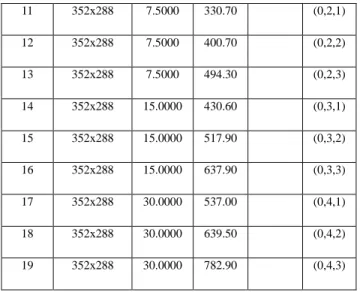
The original source file is „Foreman‟. After encoding in SNR scalability (MGS mode) by JSVM8.5, the video stream contains twenty layers. The details are showed in TABLE I.
TABLE I. CONTAINEDLAYERS
Layer ID Resolution Frame Rate Bit Rate Min Bite Rate D T Q 0 352x288 1.8750 110.30 110.30 (0,0,0) 1 352x288 3.7500 147.20 147.20 (0,1,0) 2 352x288 7.5000 190.30 190.30 (0,2,0) 3 352x288 15.0000 234.10 234.10 (0,3,0) 4 352x288 30.0000 280.00 280.00 (0,4,0) 5 352x288 1.8750 175.80 (0,0,1) 6 352x288 1.8750 217.90 (0,0,2) 7 352x288 1.8750 276.20 (0,0,3) 8 352x288 3.7500 244.70 (0,1,1) 9 352x288 3.7500 299.50 (0,1,2) 10 352x288 3.7500 374.20 (0,1,3) 11 352x288 7.5000 330.70 (0,2,1) 12 352x288 7.5000 400.70 (0,2,2) 13 352x288 7.5000 494.30 (0,2,3) 14 352x288 15.0000 430.60 (0,3,1) 15 352x288 15.0000 517.90 (0,3,2) 16 352x288 15.0000 637.90 (0,3,3) 17 352x288 30.0000 537.00 (0,4,1) 18 352x288 30.0000 639.50 (0,4,2) 19 352x288 30.0000 782.90 (0,4,3)
2) WiMAX module for NS-2
We have created several mobile WiMAX connection scenarios. These scenarios will be showed in detail in the next section, but all of them have the same parameter settings:
OFDM modulation with 64-QAM constellation rate, channel bandwidth 10M Hz.
TDD (Time Division Duplex).
Network topology X range: 1100m.
Network topology Y range: 1100m.
Diffusion radius: 500m.
Bit rate of Constant Bit Rate (CBR) traffic: 500 kbps. III. EXPERIMENT SCENARIOS
In this section, we describe the four connection scenarios in detail. Here, I have to mention that the frame loss, packet delay, throughput are obtained only from video streaming client.
A. One MS as streaming client
The video stream is transmitted from streaming server (wire-linked with one BS) to one MS as a streaming client. In this scenario, the only interference to the video transmission is bandwidth variation due to the mobile WiMAX network condition. Compare with other scenarios in the following parts, the frame loss, and packet delay would be the smallest, while the throughput would be the largest in this case.
B. Multiple MS as streaming clients
The video stream is transmitted from streaming server (wire-linked with one BS) to multiple MS as streaming clients. In this case, only one of these MSs is video streaming client that receives real video traffic and the rest of the MSs are interfering stations that receive Constant Bit Rate (CBR) traffic. In this circumstance, the increasing of MS would cause the shrink of available bandwidth for video streaming client, because the CBR flows would contend the bandwidth for video transmission. Thus, with the increasing of MS the frame loss,
and packet delay would increase, while throughput would decrease.
C. Multiple MS as streaming server
The video stream is diffused from streaming server (MS) to one BS, and transmitted to streaming client wire-linked with the BS. In this case, only one of these MSs is video streaming server that sends real video traffic, and the rest of the MSs are interfering stations that send CBR traffic. In this circumstance, the increasing of MS would cause the shrink of available bandwidth for video streaming server, because the CBR flows would contend the bandwidth for video transmission. Thus, with the increasing of MS the frame loss, and packet delay would increase, while throughput would decrease.
D. One MS as a streaming client over two BS
The video stream is transmitted from streaming server (wire-linked with both BSs) to two BS of different coordinate, and diffused to one MS as Streaming Client. In this case, we can only see that a MN is losing connection with its current BS and scans to find another point of attachment. The packet delay and throughput would fluctuate during searching for new attachment. The frame loss would be larger than scenario A.
IV. EXPERIMENTRESULTSANALYSIS In this section, we show our experiment results and make correspondent analysis. In the following figures, the „MN‟ in the legends is referred as Mobile Nodes. It is correspondent to MS. The „Sender‟ is referred as streaming server, while the „Receiver‟ is referred as streaming client.
A. 1 MS as streaming client
Figure 1. Cumulative Bit-rate at Sender and Receiver
Because the WiMAX bandwidth is various, the two curves in Fig.1 fluctuated. The „Receiver Bitrate‟ is smaller than „Sender Bit-rate‟, as the uplink and downlink are asymmetric. However, without the interference of CBR traffic, the transmission performs well, because receiver bit-rate never equals zero.
B. Multiple MS as streaming clients
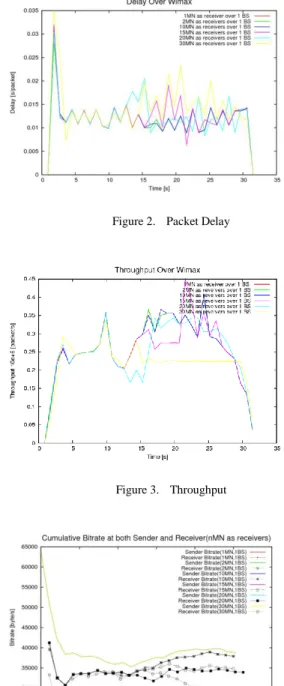
In this part, we simulate 1MN, 2 MN, 10 MN, 15 MN, 20 MN, and 30 MN respectively. The results depicted in the following figures compare the performance issues in these 6 cases.
Figure 2. Packet Delay
Figure 3. Throughput
Figure 4. Cumulative Bit-rate at Sender and Receiver
The Fig.2 and Fig.3 indicate that with the increasing number of MS, in general, the packet delay increases, while the throughput decreases. As for the bit-rate from Fig. 4, it is obviously larger at the sender part than at the receiver part. However, with the interference of CBR traffic, the transmission performs worse than the scenario A.
C. Multiple MS as streaming server
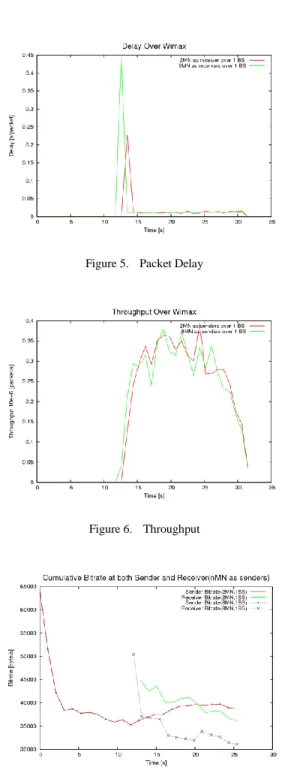
In this part, we simulate 2 MN and 8 MN respectively. The results depicted in the following figures compare the performance issues in these two cases. When the number of MNs is more than 9, the received video totally corrupts.
Figure 5. Packet Delay
Figure 6. Throughput
Figure 7. Cumulative Bit-rate at Sender and Receiver
In Fig.5 and Fig.6, they tell us the fact that with the increasing number of MS, in general, the packet delay increases, while the throughput decreases. However, compared with Scenario B, the performances are much worse. The reason is that the up-link bandwidth of MS is narrower than the one of wire-linked video server. From Fig.7, we can see that the bit-rate at both sender and receiver decrease sharply because of too much packet loss.
D. One MS handover between two BS
In this part, we simulate handover, as well as one MN as a streaming client. The results depicted in the following figures compare the performance issues in these two cases.
Figure 8. Packet Delay
Figure 9. Throughput
Figure 10. Cumulative Bit-rate at Sender and Receiver
From Fig.8 and Fig.9, we can see that at the 3sec and the 20 sec, handover happens, because the packet delay and throughput fluctuate severely. From Fig. 10, the bit-rate at both sender and receiver are much smaller than those in scenario A. From the figures in this part, the hand over effect the transmission a lot compared with scenario A.
E. Frame Loss after Reconstruction
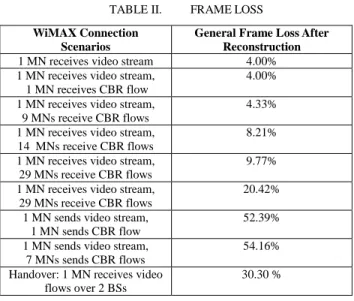
In this part, we reconstruct the received video and count the general frame loss in respect to the original one.
TABLE II. FRAMELOSS
WiMAX Connection Scenarios
General Frame Loss After Reconstruction
1 MN receives video stream 4.00% 1 MN receives video stream,
1 MN receives CBR flow
4.00% 1 MN receives video stream,
9 MNs receive CBR flows
4.33% 1 MN receives video stream,
14 MNs receive CBR flows
8.21% 1 MN receives video stream,
29 MNs receive CBR flows
9.77% 1 MN receives video stream,
29 MNs receive CBR flows
20.42% 1 MN sends video stream,
1 MN sends CBR flow
52.39% 1 MN sends video stream,
7 MNs sends CBR flows
54.16% Handover: 1 MN receives video
flows over 2 BSs
30.30 %
The TABLE II indicates that the number of MN referred as MS does affect the performance of video transmission. Besides, handover causes great frame loss, which would make the reconstruction failure.
V. CONCLUSION AND FUTURE WORK
In this paper, the transmission performance of SVC video streams over mobile WiMAX is investigated through our simulation platform. The results show that the number of MSs and the number of BSs (handover) does affect the video quality in terms of frame loss. The future work will be towards the SVC layer adaptation algorithm, which could further improve the performance of video streaming over mobile WiMAX.
REFERENCES
[1] H. Schwarz, D. Parpe, T. Wiegand “Overview of the Scalable Video Coding Extension of the H.264/AVC Standard” IEEE Trans. Circuits and Systems for Video Technology. Vol. 17, NO.9, September 2007 [2] J. M. Monteiro, C. T. Calafate, and M. S. Nunes “Evaluation of the
H.264 Scalable Video Coding in Error Prone IP Networks” IEEE Trans. Broadcasting. Vol.54,NO.3,September 2008
[3] J. Casasempere, P. Sanchez, T. Villameriel, and J. D. Ser “Performance Evaluation of H.264/MPEG-4 Scalable Video Coding over IEEE 802.16e Networks” IEEE International Symposium on Broadband Multimedia Systems and Broadcasting, 2009
[4] J. Klaue, B. Rathke, and A. Wolisz “EvalVid – A Framework for Video Transmission and Quality Evaluation”, 13th International Conference on Modelling Techniques and Tools for Computer Performance Evaluation, pp. 255-272, Urbana, Illinois, USA, September 2003
[5] R. Rouil, N. Golmie and N. Montavont, “IEEE 802.21 Transport Solution Using Cross-Layer Optimized Stream Control Transmission Protocol” IEEE 19th International Symposium on Personal, Indoor and Mobile Radio Communications, 2008. PIMRC 2008. 15-18 September. 2008, pp. 1-5
[6] T. Anh Le, H. Nguyen, and H. Zhang “EvalSVC - an evaluation platform for scalable video coding transmission” 14th International Symposium on Consumer Electronics (ISCE2010), Braunschweig, Germany, June 2010, pp. 85-90