HAL Id: hal-02278260
https://hal.archives-ouvertes.fr/hal-02278260
Submitted on 4 Sep 2019
HAL is a multi-disciplinary open access
archive for the deposit and dissemination of
sci-entific research documents, whether they are
pub-lished or not. The documents may come from
teaching and research institutions in France or
abroad, or from public or private research centers.
L’archive ouverte pluridisciplinaire HAL, est
destinée au dépôt et à la diffusion de documents
scientifiques de niveau recherche, publiés ou non,
émanant des établissements d’enseignement et de
recherche français ou étrangers, des laboratoires
publics ou privés.
PFed: Recommending Plausible Federated SPARQL
Queries
Florian Hacques, Hala Skaf-Molli, Pascal Molli, Sara El Hassad
To cite this version:
Florian Hacques, Hala Skaf-Molli, Pascal Molli, Sara El Hassad. PFed: Recommending Plausible
Federated SPARQL Queries. 30th International Conference on Database and Expert Systems
Appli-cations - DEXA 2019, Aug 2019, Linz, Austria. �hal-02278260�
SPARQL Queries
Florian Hacques2, Hala Skaf-Molli1, Pascal Molli1, Sara EL Hassad1
LS2N, University of Nantes, Nantes, France
(1){Hala.Skaf,Pascal.Molli,Sara.elhassad}@univ-nantes.fr, (2)[email protected]
Abstract. Federated SPARQL queries allow to query multiple
inter-linked datasets hosted by remote SPARQL endpoints. However, finding federated queries over a growing number of datasets is challenging. In this paper, we propose PFed, an approach to recommend plausible fed-erated queries based on real query logs of different datasets. The prob-lem is not to find similar federated queries, but plausible compprob-lementary queries over different datasets. Starting with a real SPARQL query from a given log, PFed stretches the query with real queries from different logs. To prune the research space, PFed proposes semantic summary to prune the query logs. Experimental results with real logs of DBpedia and SWDF demonstrate that PFed is able to prune drastically the logs and recommend plausible federated queries.
Keywords: Semantic Web, Federated SPARQL Query, Plausible,
Join-able.
1
Introduction
Following the Linked Open Data cloud (LOD) principles many datasets have been published. Federated SPARQL query engines [15,1] have been developed to query multiple interlinked datasets hosted by remote SPARQL endpoints. However, finding federated queries over a growing number of datasets is chal-lenging. This requires to fully understand the datasets and find potential joins among them. In this paper, we propose PFed, an original approach to recom-mend federated queries for end-users. Instead of using datasets to recomrecom-mend federated queries, PFed recommends federated queries using query logs of dif-ferent SPARQL endpoints. This is not a classical recommendation problem. In recommender systems [2], the problem is to recommend resources (or items) for users based on similar ones already seen by the users. In PFed, we start with a SPARQL query from a given log and we stretch this query with real queries from other existing query logs. The main advantage of using real logs rather than us-ing datasets is to produce plausible federated queries, i.e. queries that generated by combining real queries. This is useful, especially for data portal owners who can recommend federated queries for end-users. Imagine a data portal such as
Sage 1, or LodLaundromat2 hosting thousands of linked datasets. The portal owner can see that some users are looking for information about "United King-dom" in DBpedia, others are looking for conferences in SWDF dataset. Using PFed, the portal owner can suggest to extended conferences with information about country.
To illustrate, consider queries extracted from real SPARQL query logs of SWDF (SWDF 2012) and DBpedia (DBpedia 3.5.1)3 presented in Figure 1.
Q1S : SELECT ∗ WHERE { ? i n s t r d f : t y p e ? d C l a s s . ? i n s t f o a f : b a s e d _ n e a r ? p l a c e }# r e s u l t s : 5 0 2 5 Q3S : SELECT ∗ WHERE { {? p a p e r s w r c : a u t h o r ? a u t h o r } UNION {? p a p e r f o a f : maker ? a u t h o r } OPTIONAL {? p a p e r s w r c : a b s t r a c t ? a b s t r a c t } }# r e s u l t s : 2 1 6 4 9
(a) SWDF query log
Q1D : SELECT ∗ WHERE { ? c o u n t r y r d f s : l a b e l " U n i t e d Kingdom " @en . ? c o u n t r y dbp : c a p i t a l ? c a p i t a l . ? c a p i t a l g e o : l a t ? l a t . ? c a p i t a l g e o : l o n g ? l o n g }# r e s u l t s : 4 Q3D : SELECT ∗ WHERE { { d b p e d i a : P a r i s ? p r o p e r t y ? h a s V a l u e } UNION {? i s V a l u e O f ? p r o p e r t y d b p e d i a : P a r i s } }# r e s u l t s : 4 1 4 8 2
(b) DBpedia query log
Fig. 1: SPARQL queries from the logs of SWDF and DBpedia
Consider the Q1S from the log of SWDF, this query can be extended with the query Q1D from the log of DBpedia. The result is the SPARQL 1.1 federated Query Q1S1D given in Figure 2. Q1S1D is generated by joining the variable ?place of the query Q1S, i.e. the object of the predicate foaf:based_near with the variable ?country of the query Q1D, i.e. the subject of the predicates rdfs:label and dbpedia2:capital. The joined variable ?country has been renamed by ?place, in the generated query Q1S1D. The execution of this query over a federation of SWDF and DBpedia produces 1388 results.
The generated query Q1S1D can be recommended as a plausible federated query. In the same way, we can generate a more complex federated query such as the query Q2S2D shown in Figure 2b. Q2S2D is obtained by extending the query Q2S from the log of SWDF with the query Q2D from the log of DBpedia. The joining variable ?sameAs is renamed as ?person in Q2S2D.
Recommending plausible federated queries is challenging because the size of logs. The log of DBpedia contains 217 812 queries, and the log of SWDF contains 64 030 queries [12]. To overcome this problem, we propose a semantic summary that allows to reduce drastically the size of logs by excluding non joinable queries. The main contributions of the paper are:
– a new semantic summary for pruning query logs. – an algorithm to exclude non joinable queries from logs. 1
http://sage.univ-nantes.fr
2 http://lodlaundromat.org/
3
All information about logs, and prefixes are available at the project site: https: //github.com/GDD-Nantes/PFed
SELECT ∗ WHERE { SERVICE <h t t p : / / s w d f −2012> { ? i n s t r d f : t y p e ? d C l a s s . ? i n s t f o a f : b a s e d _ n e a r ? p l a c e SERVICE <h t t p : / / d b p e d i a −3.5.1 > { ? p l a c e r d f s : l a b e l " U n i t e d Kingdom " @en . ? p l a c e dbp : c a p i t a l ? c a p i t a l . ? c a p i t a l g e o : l a t ? l a t . ? c a p i t a l g e o : l o n g ? l o n g }}} #r e s u l t s = 1388 (a) Q1S1 Q1D SELECT ∗ WHERE { SERVICE <h t t p : / / s w d f −2012> { swc : tim−f i n i n r d f : t y p e f o a f : P e r s o n { swc : tim−f i n i n f o a f : name ? name1 } UNION
{ swc : tim−f i n i n r d f s : l a b e l ? name1 } OPTIONAL
{ swc : tim−f i n i n f o a f : mbox_sha1sum ? mbox_sha1sum } OPTIONAL
{ swc : tim−f i n i n f o a f : homepage ? homepage } OPTIONAL { swc : tim−f i n i n f o a f : p a g e ? p a g e } OPTIONAL { swc : tim−f i n i n o w l : sameAs ? p e r s o n SERVICE <h t t p : / / d b p e d i a −3.5.1 > { ? p e r s o n s k o s : s u b j e c t ? s u b j e c t . ? p e r s o n dbo : b i r t h D a t e ? b i r t h . ? p e r s o n f o a f : name ? name2 . ? p e r s o n r d f s : comment ? d e s c r i p t i o n FILTER ( l a n g ( ? d e s c r i p t i o n ) = " en " ) } } OPTIONAL { swc : tim−f i n i n r d f s : s e e A l s o ? s e e A l s o } }} #r e s u l t s = 178 (b) Q2S1 Q2D
Fig. 2: Plausible federated query generated from logs of SWDF and DBpedia in Figure 1
– an algorithm for generating plausible federated queries using the pruned logs. – an experimentation using real queries logs of SWDF 2012 and DBpedia 3.5.1.
This paper is organized as follows. Section 2 summarizes related works. Sec-tion 3 details PFed approach and algorithms. SecSec-tion 4 presents our experimen-tal results. Finally, conclusions and future work are outlined in Section 5.
2
Related Work
Many efforts have been done to automatically generate SPARQL queries, ei-ther for individual dataset [4,12] or multiple datasets as Splodge [7] and Fed-Bench [14]. Federated queries benchmarks have been proposed for evaluating the performance of federated query engine. Existing benchmark rely either on hand-crafted queries or on automatically generated ones.
FedBench [14] rely on hand-crafted queries. The datasets of FedBench are real datasets preselected from the Linked Data Cloud, e.g. Life Science, Cross domain. FedBench is commonly used for the evaluation of federated query en-gines. FedBench is not designed to recommend plausible federated queries over a federation of SPARQL endpoints. LargeRDFBench [11] attempts to generate more realistic federated queries. The benchmark comprises a total of 32 queries for SPARQL endpoint federation. Queries are ranging from simple queries ex-tracted from FedBench queries and large data queries created by the authors with the help of the expert domain. As FedBench, LargeRDFBench are designed for preselected datasets and queries are designed for specific domains and cannot be used for automatic generation of realistic federated queries.
Splodge [7] proposes heuristics for automatic query generation. Splodge gen-erates only conjunctive queries of triple patterns, i.e., Basic Graph Patterns
(BGP) with bound predicate, unbound subject and unbound object. Other SPARQL operators such as FILTER, OPTIONAL are not considered. However, recent analytical study of large SPARQL query logs [6] shows that 74.83% of studied queries have JOIN, FILTER and OPTIONAL and only 7.49% have JOIN alone (conjunctive queries). Consequently, the queries of Splodge cannot reflect the reality. Feta [8] is a federated query tracker that computes Basic Graph Pat-terns from a federated log. It supposes the existence of a federated query log. In this work, we want to build and recommend federated queries rather than analyzing federated query logs.
Existing approaches of automatic generation of federated queries do not re-flect reality and hand-crafted federated queries are designed for specific datasets with the purpose to stress the performance of a federated query engine. Bench-marks are not designed for recommending plausible federated queries.
3
Generation of Plausible Federated Queries
Intuitively, for generating a plausible federated query over n datasets, we propose to start by combing (joining) the query logs log1 and log2 of two datasets d1 and d2, respectively. Then, we generate new federated queries by joining the resulting queries and the log log3of the dataset d3. We repeat the same process iteratively until processing the n query logs.
In the following, for simplicity, we restrict our discussion to the case of two real query logs. Given two queries Q1and Q2 belong to different query logs, we want to build a plausible federated query F Q. We call F Q a plausible federated query because it is composed of two real queries. Our intuition is F Q is more likely to be a real query than a synthetic one.
3.1 Datasets capabilities
We can distinguish different type of join combinations: subject-subject or object-subject leading to different query structures star-shaped, path-shaped, or hybrid queries [14]. To find joinable predicates, one can rely on the Vocabulary Of Interlinked Datasets VoID [3]. This vocabulary describes metadata about RDF datasets and the linkset. A linkset is a collection of RDF links between two datasets4. An RDF link is an RDF triple whose subject and object are described in different datasets. This corresponds to the joinable predicates in the example of the Figure 2. However, we cannot use VoID to detect joinable predicates because a large number of RDF datasets do not provide VoID [16], only 13.65% of datasets5 (77/564) present a VoID description.
Another solution is to use the capabilities of data sources as defined in Hibis-cus [13] to check the possible existence of matching. According to [13], the data summary of a source d ∈ D is the set CA(d) of all capabilities of that source. In Hibiscus, this summary is used to remove endpoints during the source selection during federated query processing
4
https://www.w3.org/TR/void 5
[] a ds:Service ; ds:url <http://swdf-2012> ; ds:capability [ ds:predicate foaf:based_near ; ds:sbjAuthority <http://data.semanticweb.org> ; ds:objAuthority <http://dbpedia.org>, <http://www.w3.org>, <http://sws.geonames.org>, <http://data.semanticweb.org> ; ] ; ds:capability [ ds:predicate owl:sameAs ; ds:sbjAuthority <http://data.semanticweb.org> ; ds:objAuthority <http://dbpedia.org>, ...] ; ds:capability [ ds:predicate swc:hasLocation ; ds:sbjAuthority <http://data.semanticweb.org>; ds:objAuthority <http://data.semanticweb.org>, <http://dbpedia.org> ; ] ; ds:capability [ ds:predicate swrc:author ; ds:sbjAuthority <http://data.semanticweb.org> ; ds:objAuthority <http://data.semanticweb.org> ; ] ; ds:capability [ ds:predicate foaf:maker ; ds:sbjAuthority <http://data.semanticweb.org> ; ds:objAuthority <http://data.semanticweb.org> ; ] ; ds:capability [ ds:predicate swrc:abstract ; ds:sbjAuthority <http://data.semanticweb.org> ; ] ; ds:capability [ ds:predicate skos:prefLabel ; ds:sbjAuthority <http://dbpedia.org>, ...] ; (a) SWDF data summary
[] a ds:Service ; ds:url <http://dbpedia-3.5.1> ; ds:capability [ ds:predicate dbpedia2:capital ; ds:sbjAuthority <http://dbpedia.org> ; ds:objAuthority <http://dbpedia.org> ; ] ; ds:capability [ ds:predicate dbo:birthDate ; ds:sbjAuthority <http://dbpedia.org> ; ] ; ds:capability [ ds:predicate rdfs:comment ; ds:sbjAuthority <http://dbpedia.org> ; ] ; ds:capability [ ds:predicate foaf:name ; ds:sbjAuthority <http://dbpedia.org> ; ] ; ds:capability [ ds:predicate dbo:abstract ; ds:sbjAuthority <http://dbpedia.org> ; ] ; ds:capability [ ds:predicate dbo:thumbnail ; ds:sbjAuthority <http://dbpedia.org> ; ds:objAuthority <http://upload.wikimedia.org> ; ] ; ds:capability [ ds:predicate foaf:depiction ; ds:sbjAuthority <http://dbpedia.org> ; ds:objAuthority <http://upload.wikimedia.org> ; ] ; ds:capability [ ds:predicate dbpedia2:party ; ds:sbjAuthority <http://dbpedia.org> ; ds:objAuthority <http://dbpedia.org>, <http://www.xat.org> ; ] ;
(b) DBpedia data summary
[] a ds:Service ;
ds:url <http://swdf-2012> ; ds:capability [
predicate: foaf:based_near ; sbjClasses: foaf:Person, ...] ;
objClasses: dbo:Country, dbo:Place, dbo:PopulatedPlace, ...] ; ds:capability [
ds:predicate: owl:sameAs ;
objClasses: dbo:Person, dbo:Scientist, ...] ; ds:capability [
ds:predicate: skos:prefLabel ;
sbjClasses: foaf:Organization, foaf:Person, skos:Concept, swc:WorkshopEvent ; ] ; (c) SWDF classes summary [] a ds:Service ; ds:url <http://dbpedia-3.5.1> ; ds:capability [ ds:predicate: dbpedia2:capital ; sbjClasses: dbo:Country, dbo:Place, dbo:PopulatedPlace, ...] ; objClasses: dbo:City, dbo:Place, dbo:PopulatedPlace, ...] ; ds:capability [ ds:predicate: dbo:birthDate ; sbjClasses: dbo:Person,dbo:Scientist, ...] ; ds:capability [ ds:predicate: dbo:abstract ;
sbjClasses: foaf:Person, dbo:Ship, ...] ;
(d) DBpedia classes summary
Fig. 3: Sample of authorities and classes summaries of logs of SWDF and DBpe-dia
Definition 1 (Authority Capability). Given a source d, an authority capa-bility is a triple (p, SA(d, p), OA(d, p)), which contains (1) a predicate p in d, (2) the set SA(d, p) of all distinct subject authorities of p in d and (3) the set OA(d, p) of all distinct object authorities of p in d.
The total number of capabilities of a source is equal to the number of distinct predicates in it. The definition of the authorities of a subject or an object relies on the analysis of the Unified Resource Identifier (URI) syntax. The URI syntax consists of a hierarchical sequence of components referred to as the scheme,
authority, path, query, and fragment6. For example, the uri <http://dbpedia. org/ontology/Plant> contains a schema "http", an authority "dbpedia.org" and a path "ontology/Plant". To compute the set of capabilities for a source, the first two components (path, authority) are combined as the authority of the URI. Figure 3 presents a sample of the summary of SWDF 2012 and DBpedia 3.5.1. For instance, in Figure 3a, the first capability of SWDF data source is the predicate foaf:based_near, its subject authority is <http://data.semanticweb. org> and its object authorities are <http://dbpedia.org>, <http://www.w3. org>, <http://sws.geonames.org>, and <http://data.semanticweb.org>.
Authority summary allows to prune the query logs only if many predicates have different subjects or objects authority. However, this not always the case, especially for the subject authority. For instance, the majority of subjects of DBpedia have the authority <http://dbpedia.org>, only six predicates out of 39672 predicates of DBpedia 3.5.1 do not have <http://dbpedia.org> as a subject authority. Therefore, if a query Q1 in SWDF query log is joinable with a query Q2 in DBpedia query log on the subject authority <http://dbpedia. org>, then Q1 will be joinable with a large number of queries in the log of DBpedia. Therefore, for query logs of SWDF and DBpedia, authority summary will prune mostly queries with unbounded predicates.
To further prune the log, we define new data summary that considers seman-tic of subjects and objects for finding joinable predicates. Intuitively, a subject or an object from one dataset could be joinable with a subject or object from an-other dataset, if they share some common types. More precisely, we define a new summary called Class summary. A class summary is a set of classes capabilities.
Definition 2 (Class Capability). Given a source d, a class capability is a triple (p, SC(d, p), OC(d, p)), which contains (1) a predicate p in d, (2) the set SC(d, p) of all distinct subject classes of p in d and (3) the set OA(d, p) of all distinct object classes of p in d.
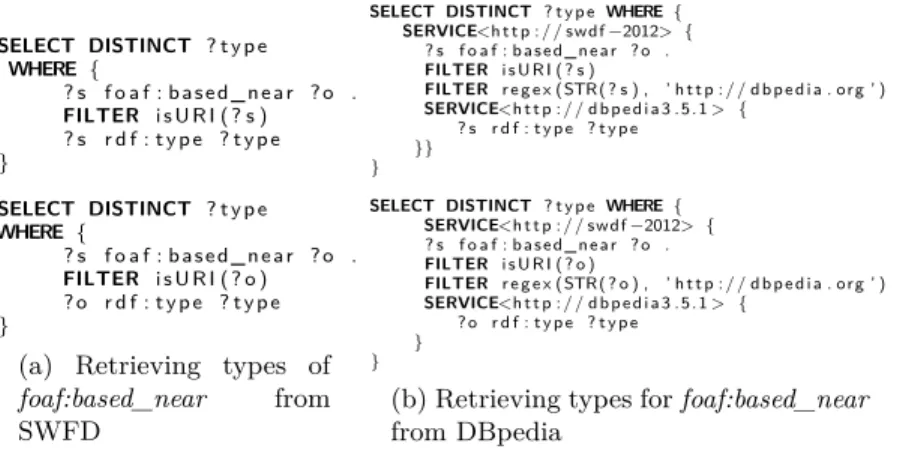
Classes capabilities can be computed using SPARQL queries. But since enti-ties are reused across datasets, types of the subjects and objects for predicates maybe not defined locally. Therefore, we need to perform a SPARQL federated query to compute classes capabilities. We use only the direct classes of subjects and objects to find common classes, we do not use inferences because schemas information are not always available [9], and we restrict the computation to
6
SELECT DISTINCT ? t y p e WHERE { ? s f o a f : b a s e d _ n e a r ? o . FILTER i s U R I ( ? s ) ? s r d f : t y p e ? t y p e } SELECT DISTINCT ? t y p e WHERE { ? s f o a f : b a s e d _ n e a r ? o . FILTER i s U R I ( ? o ) ? o r d f : t y p e ? t y p e }
(a) Retrieving types of
foaf:based_near from
SWFD
SELECT DISTINCT ? t y p e WHERE { SERVICE<h t t p : / / s w d f −2012> { ? s f o a f : b a s e d _ n e a r ? o . FILTER i s U R I ( ? s ) FILTER r e g e x ( STR ( ? s ) , ’ h t t p : / / d b p e d i a . o r g ’ ) SERVICE<h t t p : / / d b p e d i a 3 . 5 . 1 > { ? s r d f : t y p e ? t y p e }} }
SELECT DISTINCT ? t y p e WHERE { SERVICE<h t t p : / / s w d f −2012> { ? s f o a f : b a s e d _ n e a r ? o . FILTER i s U R I ( ? o ) FILTER r e g e x ( STR ( ? o ) , ’ h t t p : / / d b p e d i a . o r g ’ ) SERVICE<h t t p : / / d b p e d i a 3 . 5 . 1 > { ? o r d f : t y p e ? t y p e } }
(b) Retrieving types for foaf:based_near from DBpedia
Fig. 4: Class Capability for foaf:based_near predicate in SWDF
only used datasets. For instance, to compute the object classes of the predicate
foaf:based_near, we rely only on SWDF and DBpedia. We define the following
queries: Figures 3c and 3d present classes summaries for SWDF and DBpedia, respectively.
?s ?o1 ?o3
?o2
p1 p3
p2
(a) p1, p2 ∈ Q1, Q1∈ log1and p3∈ Q2,
Q2∈ log2 ?s ?o1 ?o3 ?o2 p1 p3 p2 (b) p1∈ Q1, Q1 ∈ log1 and p2, p3∈ Q2, Q2∈ log2
Fig. 5: Possible structures for hybrid federated queries
3.2 Pruning query logs
Based on authorities summaries and classes summaries, we can prune the logs of corresponding datasets by retaining only joinable queries.
Definition 3 (Joinable queries). Let D be a set of distinct data sources, d1, d2 ∈ D. Let log1 and log2 are the real query log of d1 and d2, respectively.
For two queries Q1 ∈ log1 and Q2 ∈ log2 with tp1 = (s1, p1, o1) ∈ Q1 and
tp2= (s2, p2, o2) ∈ Q2, we say that Q1 and Q2 are joinable if p1 and p2 have a predicate joinable path or predicate joinable star.
Definition 4 (Predicate Joinable Path). joinableP ath(p1, p2) = true,
if OA(d1, p1) ∩ SA(d2, p2) 6= ∅ and OC(d1, p1) ∩ SC(d2, p2) 6= ∅.
Definition 5 (Predicate Joinable Star). joinableStar(p1, p2) = true,
if SA(d1, p1) ∩ SA(d2, p2) 6= ∅ and SC(d1, p1) ∩ SC(d2, p2) 6= ∅.
The hybrid join pattern is built as a mix of a path join pattern and a star join pattern. Figure 5 presents possible structures of hybrid federated queries. The query generated in Figure 5a is built from the path query of p1∈ Q1, Q1∈ log1 and p3 ∈ Q2, Q2 ∈ log2. The query generated in Figure 5b built from the star query of p1∈ Q1, Q1∈ log1and p2∈ Q2, Q2∈ log2.
Algorithm 1: Joinable predicates
Input: AS1, CS1, AS2, CS2 . Authorities and classes summaries for the two datasets
Output: J P red . Set of joinable predicates
1 Function JoinPred(AS1, CS1, AS2, CS2):
2 J P red ←− ∅;
3 foreach cap1∈ AS1 do 4 foreach cap2∈ AS2 do
5 if AS1.objAuthority(cap1) ∩ AS2.sbjAuthority(cap2) 6= ∅ then 6 if CS1.objClasses(cap1) ∩ CS2.sbjClasses(cap2) 6= ∅ then
7 J P red ←− J P red ∪ (cap1.predicate, cap2.predicate);
8 end 9 end 10 end 11 end 12 return J P red; 13 End Function
The objective now is to prune query logs and conserve only joinable queries. First, the algorithm 1 uses summaries to conserve predicate joinable (predicate joinable path), then the algorithm 2 excludes non joinable queries from logs. For logs in Figure 3, the algorithm 1 keeps the couple (foaf:based_near,dbpedia2:capital) because they share http://dbpedia.org as object and subject authority, respec-tively, and they share Country, Place and PopulatedPlace as object and subject classes, respectively.
To compute predicate joinable star, we only need to modify conditions in lines 5-6 of the algorithm 1 to compare subjects parts of both capabilities. With this modification, the algorithm will keep the couple (skos:prefLabel,dbo:abstract) as they share same authorities and classes as subjects. The algorithm 1 can be iteratively called to compute predicate joinable path or star for more than two datasets.
We use the result of the algorithm 1 to exclude non joinable queries as shown in the algorithm2. After the execution of the algorithm 2 for joinable path, Q1S
Algorithm 2: Joinable queries
Input: log1, log2, J P red . Logs of both dataset and the set of corresponding joinable predicates
Output: f eds . Set of federated queries
1 Function GenFed(log1, log2, J P red):
2 f eds ←− ∅; 3 foreach Q1∈ log1do 4 foreach Q2∈ log2 do 5 if ∃(p1, p2)|p1∈ Q1, p2 ∈ Q2∧ (p1, p2) ∈ J P red then 6 f eds ←− f eds ∪ (Q1, Q2) 7 end 8 end 9 end 10 return f eds; 11 End Function
of SWDF and Q2D of DBpedia will be preserved, because they have the joinable predicates (foaf:based_near,dbpedia2:capital) as shown previously. We exclude
Q3S because it cannot be joined with any query from dbpedia, i.e. no predicate
in DBpedia has <http://data.semanticweb.org> as subject authority. We also eliminate Q3D because the capability of unbound predicate is undefined.
SELECT ∗ WHERE {
SERVICE <h t t p : / / s w d f −2012> {? o b j f o a f : b a s e d _ n e a r ? p l a c e . SERVICE <h t t p : / / d b p e d i a −3.5.1 >
{? p l a c e d b p e d i a 2 : c a p i t a l ? c a p i t a l }}}
(a) Path query by joining a triple pat-tern from Q1S and a triple patpat-tern from Q1D SELECT ∗ WHERE { SERVICE <h t t p : / / s w d f −2012> {? x r d f s : p r e f L a b e l ? o1 . SERVICE <h t t p : / / d b p e d i a −3.5.1 > {? x dbo : t h u m b n a i l ? o2 }}}
(b) Star query by joining a triple from QS4 and a triple pattern from Q4D
Fig. 6: Minimal federated queries generated from pruned logs of SWDF and DBpedia in Figure 3
3.3 Building plausible federated queries
We rely on the results of the algorithm 2 to build plausible federated queries. For sake of simplification, we start by illustrating the generating of minimal federated queries PFedmin. A minimal federated contains one triple from log1 and one triple from log2.
In order to construct a path (star) join, we substitute the object (subject) of
tp1object tp2 subject substitution value
?x ?y ?x
?x a a
a ?x a
a b null
Table 1: All substitution values possible to create path join. ?x, ?y are variables and a, b are constants (URIs or literals)
Figure 6a presents a minimal path-shaped federated query between foaf:based_near ∈ Q1S and dbpedia2:capital ∈ Q1D in Figure 3. Figure 6b presents a minimal star-shaped federated query between skos:prefLabel ∈ Q4S and dbo:thumbnail ∈ Q4D.
PFedmin are not required to generate plausible federated queries. But they
can help to reduce the number of potential joinable predicates by only keeping PFedminproducing results. They can also be used to navigate through datasets.
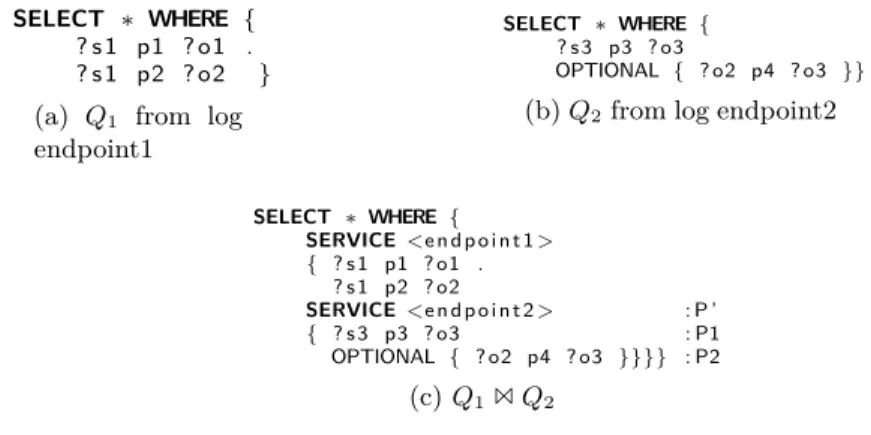
SELECT ∗ WHERE {
? s 1 p1 ? o1 . ? s 1 p2 ? o2 }
(a) Q1 from log
endpoint1
SELECT ∗ WHERE {
? s 3 p3 ? o3
OPTIONAL { ? o2 p4 ? o3 }}
(b) Q2from log endpoint2
SELECT ∗ WHERE { SERVICE <e n d p o i n t 1 > { ? s 1 p1 ? o1 . ? s 1 p2 ? o2 SERVICE <e n d p o i n t 2 > : P ’ { ? s 3 p3 ? o3 : P1 OPTIONAL { ? o2 p4 ? o3 }}}} : P2 (c) Q11 Q2
Fig. 7: A non well designed federated query
The construction of QPFed is tricky, if the original queries contain OP-TIONAL operator. We have to construct only correct plausible federated query. A plausible federated query is correct if it is well designed [10] and service-safeness [5].
Definition 6 (Well designed[10]). A graph pattern P is well designed if for every occurrence of a sub-pattern P’ = (P1 OPT P2) of P and for every variable ?X occurring in P, the following condition holds:
The federated query in Figure 7c is not well designed because the variable ?o2 occurs in P2 and outside the P’ (i.e. clause SERVICE <dataset2>), but it not occurs in P1.
The service-safeness provides condition that ensures that a SPARQL query containing SERVICE operator can be safely evaluated. Our generated queries ensure service-safeness because each SERVICE clause has only bounded service, i.e., during the construction the URI of the SPARQL endpoints are known.
The main issue is to build well designed queries to avoid cartesian products as illustrated in Figure 7c. If Q2does not have a mapping for ?o2, a result will still produced. To avoid this problem, we define the following strategy:
– If Q1 and Q2 are conjunctive queries (a.k.a BGPs) then QPFed = Q1 1
Q2, QPFed is a simple concatenation of queries (Q1 . Q2), as in figure 2,
Q1S1D = Q1S1 Q1D.
– If Q1contains binary operators like UNION or OPTIONAL, we distinct two
cases:
• If a joinable predicate is outside binary clauses of Q1, we add Q2 in the BGP part of Q1.
• If a joinable predicate of Q1is inside the UNION or OPTIONAL clauses, we append Q2inside this clause after the substitution of the join variables (subject or object of the triple) according to table 1.
– If a joinable predicate of Q2 is inside an OPTIONAL clause, we make sure
to not generate non well designed queries like query shown in 7c.
4
Evaluation
The objective of the evaluation is to answer empirically the following questions: Do authorities summaries prune non joinable predicates? Do classes summaries prune further non joinable predicates? Does PFed able to generate plausible federated queries?
All data, codes, and generated query are available at the project web page7.
dataset |triples| |dataset predicates| |original log| |SELECT queries| |log predicates| SWDF 242 256 170 64 030 37 592 201 DBPedia 232 542 405 39 672 217 812 127 812 247
Table 2: Real Datasets and real logs
4.1 Experimental Setup
Dataset and Queries: We use SWDF 2012 and DBPedia 3.5.1 datasets
and clean queries of Feasible8. We use only SELECT queries to construct plau-sible federated queries. Table 2 reports statistics about the datasets and query
7
https://github.com/GDD-Nantes/PFed 8
logs. It is strange that the query log of SWDF contains more predicates than the original dataset hosted at the SPARQL endpoint. Some queries in the logs use predicates that are not defined in the dataset. As they appear inside OPTIONAL or UNION, they do not stop queries from returning results. Using DBpedia to generate plausible federated queries is challenging because DBpedia dataset has a high number of predicates and the log of DBpedia has a high number of queries.
4.2 Experimental Results
path-shaped star-shaped
dataset |predicate joinable | |pruned log| % reduce |predicate joinable | |pruned log| % reduce
SWDF 6 14 003 62.75 3 21 495 42.82
DBPedia 230 125 078 2.15 229 125 070 2.15 Table 3: Logs pruning using authorities summaries
Do authorities summaries prune non joinable predicates ? Table 3 presents the
results of pruning using authorities summaries. As we can see, the reduction is 62.75% for SWDF query log for path-shaped queries (all path refers to path from SWDF to DBpedia) and by 42.82% for star-shaped. The reduction is only 2.15% for DBpedia log for both path-shaped queries and star-shaped generation. This reduction is not significant because most of predicates in DBPedia has the authority <http://dbpedia.org>.
path-shaped star-shaped
dataset |predicate joinable | |pruned log| % reduce |predicate joinable | |pruned log| % reduce
SWDF 3 9 355 75.12 3 21 495 42.82
DBPedia 139 36 522 71.42 83 36 449 71.48
Table 4: Logs pruning using authorities and classes summaries
Do classes summaries prune further non joinable predicates? We now use our
classes summaries on top of authorities summaries. We observe in Table 4 that the sizes of logs are reduced. The reduction is impressive for DBpedia, it is about 72 %. Therefore, classes summaries are affective for pruning non joinable queries. We observe also an important reduction in the number of minimal feder-ated queries PFedmin(Table 5). This reduction is important as each PFedmin
With Authorities With authorities and classes path-shaped star-shaped path-shaped star-shaped
1 146 687 352 432
Table 5: Number of PFedmin generated using Authorities and Classes
sum-maries
p1 |p1| p2 |p2| |PFed| |with result| % PFed path foaf:based_near 9 dbpedia2:capital 5 24 19 79.17
PFed star skos:prefLabel 3 dbo:thumbnail 14 42 14 33.33
Table 6: PFed path and star, p1∈ SWDF and p2∈ DBPedia
Does PFed generate plausible federated queries ? Due to the size of the pruned
logs, we can generate a large number of plausible federated queries. In our exper-imentation, we focus on the generation of path-shaped between foaf:based_near from SWDF and dbpedia2:capital from DBPedia. The pruned SWDF query log contains 2 866 queries that contains foaf:based_near. Many of these queries have the same structure but with different literals and variables. Therefore, instead of producing 2866 × 14 = 40124 queries where 14 is the number of queries that contains dbpedia2:capital in pruned DBpedia log, we define patterns for
foaf:based_near queries. We differentiate 9 patterns for foaf:based_near queries
and we generate 24 queries. All generated queries are executed correctly and 19 of these queries have non empty results set (see table 6).
We generate star-shaped plausible federated queries based on skos:prefLable from SWDF and dbpedia:thumbnail from DBPedia (see table 6). The 42 gener-ated queries are executed correctly and 28 of these queries produce results.
5
Conclusion and Future Work
We presented PFed an approach for automatic generation of plausible federated queries based on real query logs. PFed starts by pruning the logs to exclude non joinable queries using data summaries. The first one is based on the author-ities and the second is based on the type of subjects and objects of predicates. Experimentations with real query logs of SWDF and DBpedia demonstrate that PFed is able to prune considerably the logs and generate plausible federated queries.
As future work, we would like to experiment PFed with more real query logs and produce plausible federated queries over a large number of SPARQL end-points. Finally, we plan to extend PFed with statistical information to generate only queries that return results.
Acknowledgement
This work is part of the multidisciplinary project Sedela, funded by CominLabs, that brings together three laboratories: LS2N, CREAD and Lab-STICC.
References
1. Acosta, M., Vidal, M., Lampo, T., Castillo, J., Ruckhaus, E.: ANAPSID: an adap-tive query processing engine for SPARQL endpoints. In: International Semantic Web Conference. Lecture Notes in Computer Science, vol. 7031, pp. 18–34. Springer (2011)
2. Adomavicius, G., Tuzhilin, A.: Toward the next generation of recommender sys-tems: A survey of the state-of-the-art. IEEE transactions on knowledge and data engineering 17(6), 734–749 (2005)
3. Alexander, K., Cyganiak, R., Hausenblas, M., Zhao, J.: Describing linked datasets. In: LDOW (2009)
4. Aluç, G., Hartig, O., Özsu, M.T., Daudjee, K.: Diversified stress testing of RDF data management systems. In: The International Semantic Web Conference. pp. 197–212 (2014)
5. Arenas, M., Pérez, J.: Federation and navigation in sparql 1.1. In: Reasoning Web International Summer School. pp. 78–111. Springer (2012)
6. Bonifati, A., Martens, W., Timm, T.: An analytical study of large SPARQL query logs. PVLDB 11(2), 149–161 (2017), http://www.vldb.org/pvldb/vol11/ p149-bonifati.pdf
7. Görlitz, O., Thimm, M., Staab, S.: SPLODGE: systematic generation of SPARQL benchmark queries for linked open data. In: The Semantic Web ISWC 2012 -11th International Semantic Web Conference, Boston, MA, USA, November 11-15, 2012, Proceedings, Part I. pp. 116–132 (2012), https://doi.org/10.1007/ 978-3-642-35176-1_8
8. Nassopoulos, G., Serrano-Alvarado, P., Molli, P., Desmontils, E.: FETA: Federated QuEry TrAcking for Linked Data. In: International Conference on Database and Expert Systems Applications (DEXA). p. 0. No. 9828 in Lecture Notes in Computer Science (Sep 2016)
9. Neumann, T., Moerkotte, G.: Characteristic sets: Accurate cardinality estimation for rdf queries with multiple joins. In: Data Engineering (ICDE), 2011 IEEE 27th International Conference on. pp. 984–994. IEEE (2011)
10. Pérez, J., Arenas, M., Gutierrez, C.: Semantics and complexity of sparql. In: In-ternational semantic web conference. pp. 30–43. Springer (2006)
11. Saleem, M., Hasnainb, A., Ngonga Ngomo, A.C.: LargeRDFBench: A billion triples benchmark for sparql endpoint federation. In: Journal of Web Semantics (JWS) (2017), https://svn.aksw.org/papers/2017/LargeRDFBench_JWS/public.pdf 12. Saleem, M., Mehmood, Q., Ngomo, A.C.N.: Feasible: A feature-based sparql
bench-mark generation framework. In: International Semantic Web Conference. pp. 52– 69. Springer (2015)
13. Saleem, M., Ngomo, A.C.N.: Hibiscus: Hypergraph-based source selection for sparql endpoint federation. In: European Semantic Web Conference. pp. 176–191. Springer (2014)
14. Schmidt, M., Görlitz, O., Haase, P., Ladwig, G., Schwarte, A., Tran, T.: Fed-bench: A benchmark suite for federated semantic data query processing. In: In-ternational Semantic Web Conference. pp. 585–600 (2011), https://doi.org/10. 1007/978-3-642-25073-6_37
15. Schwarte, A., Haase, P., Hose, K., Schenkel, R., Schmidt, M.: Fedx: Optimization techniques for federated query processing on linked data. In: International Semantic Web Conference. pp. 601–616. Springer (2011)
16. Vandenbussche, P.Y., Umbrich, J., Matteis, L., Hogan, A., Buil-Aranda, C.: Spar-qles: Monitoring public sparql endpoints. Semantic Web 8(6), 1049–1065 (2017)