
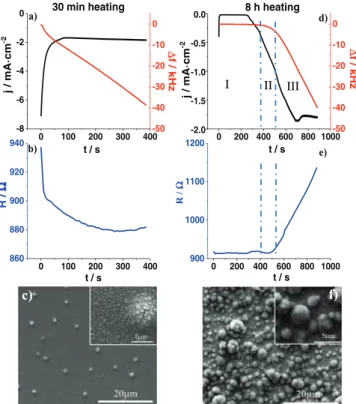
Non-Equilibrium Ionic Liquid-Electrode Interface at Elevated Temperature and Its Influence on Co2+Reduction Process
Texte intégral
Figure


Documents relatifs
La silice dans cette étude a été trouvé être un adsorbant efficace pour l’adsorption de colorant (RC) à partir des solutions aqueuses. Le taux
was developed and four factors (stirring speed, adsorbent dose initial concentration of the adsorbate and co-ion concentration) were evaluated based on ability of the absorbent to
Second, a strong correlation was detected between the Capon profiles at different polarization channels with the LVIS waveform and the distribution of the SFL data, opening prospects
bined with Descartes’s rule, the Bernstein basis, provides as well an efficient method for real root isolation, using De Casteljau’s algorithm, and make the link with more
(ii) Testing campaigns using tests for which the sum of the sensitivity and specificity is different from one, always allow a reliable estimation of the number of infected
Effects of dielectric confinement and electron-hole exchange interaction on excitonic states in semiconductor quantum dots. Theory of exciton doublet structures and polarization
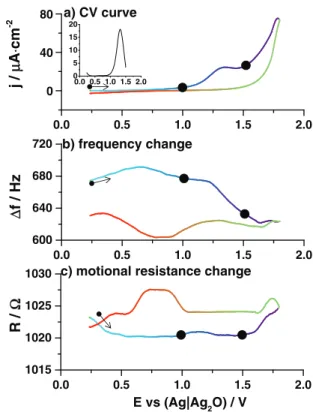
Sulfate or bisulfate anions adsorbed on the surface of an atomically flat Au(111) electrode in sulfuric acid is one of the most classical adsorption systems in the
Whereas for submicellar solution, common non-ionic surfactants molecules usually undergo a diffu- sion limited adsorption, we showed that the adsorption of free surfactants from
