HAL Id: hal-02148906
https://hal.archives-ouvertes.fr/hal-02148906
Submitted on 5 Jun 2019HAL is a multi-disciplinary open access archive for the deposit and dissemination of sci-entific research documents, whether they are pub-lished or not. The documents may come from teaching and research institutions in France or abroad, or from public or private research centers.
L’archive ouverte pluridisciplinaire HAL, est destinée au dépôt et à la diffusion de documents scientifiques de niveau recherche, publiés ou non, émanant des établissements d’enseignement et de recherche français ou étrangers, des laboratoires publics ou privés.
AN INTEGRATED APPROACH FOR IMAGE-BASED
COMPUTATION BASED ON THE X-FEM:
ACCURACY AND HIGH-ORDER APPROXIMATION
G Legrain, Patrice Cartraud, W Lian
To cite this version:
G Legrain, Patrice Cartraud, W Lian. AN INTEGRATED APPROACH FOR IMAGE-BASED COM-PUTATION BASED ON THE X-FEM: ACCURACY AND HIGH-ORDER APPROXIMATION. IV European Congress on Computational Mechanics (ECCM IV): Solids, Structures and Coupled Prob-lems in Engineering, May 2010, Paris, France. �hal-02148906�
Vienna, Austria, September 10-14, 2012
AN INTEGRATED APPROACH FOR IMAGE-BASED COMPUTATION
BASED ON THE X-FEM: ACCURACY AND HIGH-ORDER
APPROXIMATION
G. Legrain1
, P. Cartraud1
and W.D. Lian1 1
Lunam Universit´e - Ecole Centrale Nantes, Universit´e de Nantes - GeM Institute, UMR CNRS 6183 1, rue de la No¨e, 44321 Nantes
e-mail:{gregory.legrain,patrice.cartraud,weidong.lian}@ec-nantes.fr
Keywords: image-based computation, X-FEM, voxel-based Finite Elements
Abstract. In this contribution an integrated strategy is proposed for image-based computa-tions. Indeed, it is still difficult to handle the amount of geometrical information contained in the images produced by modern acquisition techniques such as microtomographs. Classically, voxel-based finite element models are used as the model can be automatically constructed by converting each voxel into a finite element. This approach leads to huge numerical models and a poor geometrical description if the resolution is not sufficient. An integrated computational approach was presented in [8] in order to circumvent these limitations. The proposed strategy is based on the X-FEM and levelsets in order to avoid the meshing of complex geometries. More recently [9], the approach was improved in order to uncouple the computational model from the geometrical one. Validations against the voxel-based Finite Elements is 2D and 3D proposed in order to assess the accuracy of the approach.
G. Legrain, P. Cartraud and W.D. Lian
1 INTRODUCTION
The democratization of high resolution acquisition techniques makes possible to obtain very accurate geometrical models from micro-structural problems. However, taking into account this amount of informations in computations is still problematic. The most widely used approach is based on the direct conversion of voxels into hexaedral finite elements [7, 3, 6], and is called voxel-based finite elements. Unfortunately, this approach leads to large computational models unless the images are downsampled and also to jagged geometries [2] (note that downsampling increases this pathological behavior).
One can also extract material interfaces from the image, then use them as an input for tetra-hedral meshing [14]. This allows the user to select mesh size (thus geometrical accuracy and size of the computational model). However, in some cases, meshing can be problematic because of the complex topology of the interfaces involved.
An alternative path is proposed here. The objective consists in simplifying the processing of image-based computations. The X-FEM [11] is used as a mean for freeing the approximation from its conformity requirement, thus avoiding the meshing process. The geometrical informa-tions are handled by a level-set function that is obtained after segmentation of the image [4], so that the output of the segmentation process can be directly used as an input for the calcula-tion. As the level-set carries the geometrical informations, the size of the finite element mesh will have a direct influence on the geometrical accuracy (like for voxel-based approaches). In order to decrease the computational cost, an octree database is used to build a mesh that is re-fined along the material interfaces, and coarsened in the volume in order to get a good balance between the geometrical accuracy and computational cost. The accuracy of the approach is compared to voxel-based approaches, in terms of both local and global quantities. Finally, in order to improve the computational efficiency, a high-order X-FEM approach is considered [9]. It allows to obtain accurate results on coarse meshes whose size is independent on the resolu-tion of the image. Thanks to this approach, approximaresolu-tion and geometrical representaresolu-tion are uncoupled.
2 COMPARISON BETWEEN VOXEL-BASED FINITE ELEMENTS AND X-FEM The accuracy of voxel-based FEM and X-FEM are compared, in terms of both local and global quantities of interest for a simple fiber-matrix 2D problem. These examples are based on those developed in [10].
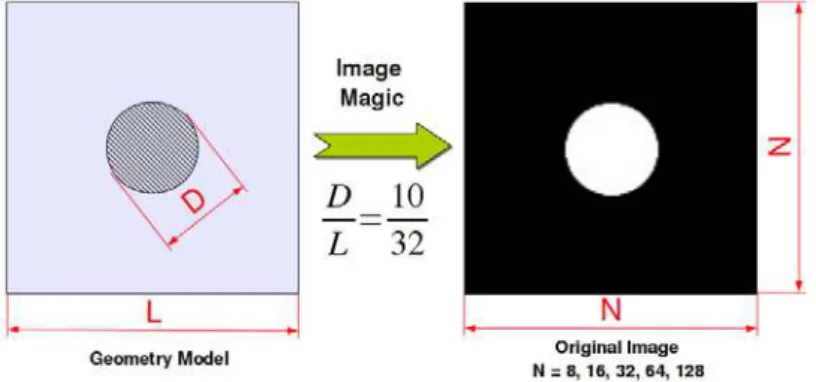
Figure 1: Cell geometry of a one fiber model
The geometry considered is shown in Figure 1. A square RVE with a circular inclusion is considered. From this geometry five images with different image resolutionsN ×N pixels (N =
8, 16, 32, 64, 128), are generated from ImageMagic [13] consideringD
L =
10
32as input parameter.
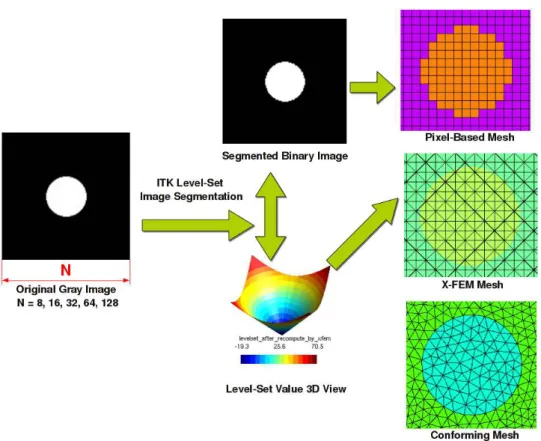
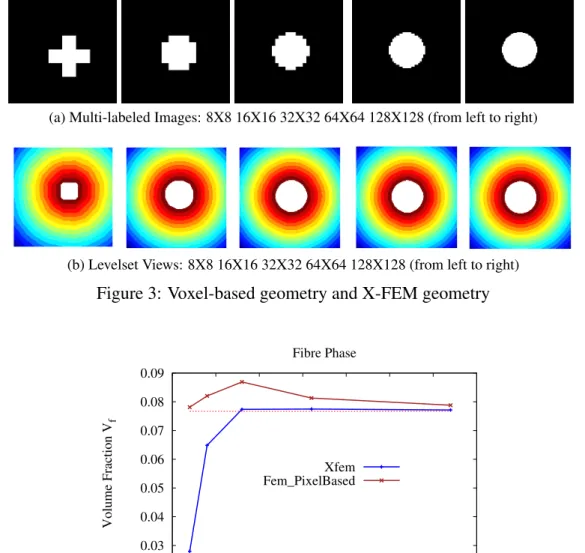
For each image, the corresponding levelset (input geometry for X-FEM, in Figure 3b) and the corresponding multi-labeled image (input geometry for voxel-based FEM, in Figure 3a) are produced through the same image segmentation procedure as mentioned in [8, 10]. Then for each image, a mesh is built with an element size h = 128
N . The modeling procedure is
shown in Figure 2. Note that a conforming mesh is also considered for validation purpose. In the following the solution obtained from this conforming mesh is considered as the reference solution.
Figure 2: Voxel-based FEM and X-FEM modeling procedure
Volume fraction is first considered to assess the geometrical error. The evolution of volume fraction as a function of mesh size is depicted in Figure 4. It can be seen that the levelset geometry for the X-FEM model is smoother than the voxel-based FEM one, since levelset leads to a piece-wise linear representation of geometrical interface. In addition, from the image N = 32, the volume fraction for X-FEM is very close to the reference one (Vff iber = 7.67%) while the voxel-based volume fraction converges very slowly. X-FEM coupling levelset is less sensitive to image resolution (mesh size) than voxel-based FEM. For a fixed accuracy, X-FEM could employ a coarser mesh than voxel-based FEM to decrease the computational cost.
Homogenization computations using X-FEM and voxel-based FEM are conducted here to study the influence of the image resolution on apparent bulk and shear moduli (under the plane strain assumption). In the parametric study, Poisson’s ratio of the two phases (matrix, inclusion) isνi = νm = 0.3, and the Young’s modulus for the matrix is (Em = 1 GPa). In order to study
different contrasts between the fiber and the matrix, the Young modulus of the inclusion is Ei = {0.001, 0.1, 10, 1000} GPa. Periodic boundary conditions are used here and apparent
G. Legrain, P. Cartraud and W.D. Lian
(a) Multi-labeled Images: 8X8 16X16 32X32 64X64 128X128 (from left to right)
(b) Levelset Views: 8X8 16X16 32X32 64X64 128X128 (from left to right)
Figure 3: Voxel-based geometry and X-FEM geometry
0.02 0.03 0.04 0.05 0.06 0.07 0.08 0.09 0 20 40 60 80 100 120 140 Volume Fraction V f Image Size N Fibre Phase Xfem Fem_PixelBased
Figure 4: Volume fraction of fibers as a function of image resolutionN
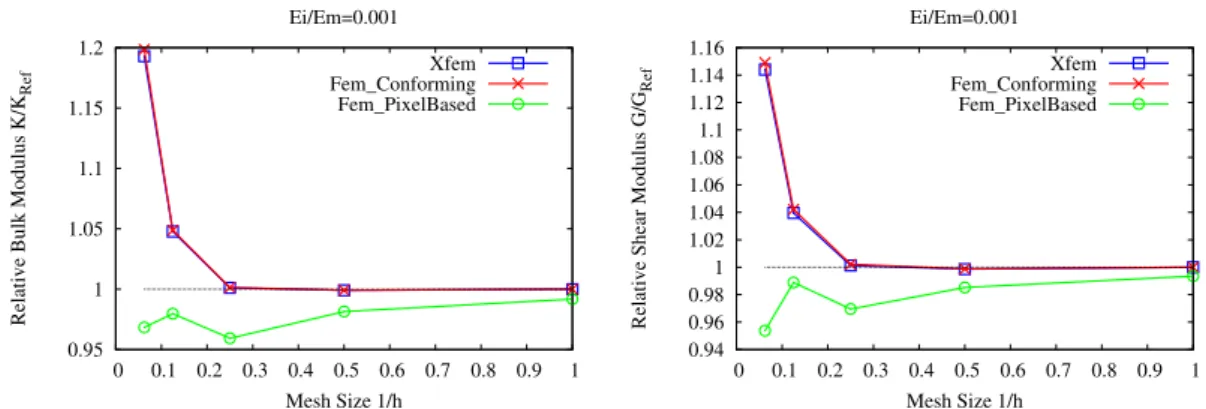
The numerical results are given in Figure 5 and Figure 6 where conforming FEM solution with the finest mesh is considered as the reference solution. The X-FEM results are very close to the conforming FEM results (the difference is less than 1%) for different mesh sizes. By contrast, a significant difference between pixel-based and conforming FEM results is observed. Obviously the main part of this difference comes from the geometrical error. As can be seen from Figure 4, using a pixel-based mesh leads to an overestimation of the volume fraction of the inclusion. Consequently, an overestimation of the macroscopic properties is observed in the case where the inclusion is stiffer than the matrix (see Figure 6). The reverse is found when the matrix is stiffer (see Figure 5). Thus, comparing to reference results, the X-FEM results are acceptable for the mesh sizeh ≤ 4 (corresponding to N = 32) whereas even with N = 128, the pixel-based results are less accurate.
3 HIGH-ORDER EXTENSION
It was demonstrated in the last section that the faster geometrical convergence of the levelset representation of the image with respect to voxel-based FE was leading to a better accuracy for
0.95 1 1.05 1.1 1.15 1.2 0 0.1 0.2 0.3 0.4 0.5 0.6 0.7 0.8 0.9 1
Relative Bulk Modulus K/K
Ref Mesh Size 1/h Ei/Em=0.001 Xfem Fem_Conforming Fem_PixelBased 0.94 0.96 0.98 1 1.02 1.04 1.06 1.08 1.1 1.12 1.14 1.16 0 0.1 0.2 0.3 0.4 0.5 0.6 0.7 0.8 0.9 1
Relative Shear Modulus G/G
Ref Mesh Size 1/h Ei/Em=0.001 Xfem Fem_Conforming Fem_PixelBased
Figure 5: Comparison between voxel-based FEM and X-FEM for macroscopic properties as a function of mesh sizeh on the contrast Ei/Em = 0.001
0.94 0.95 0.96 0.97 0.98 0.99 1 1.01 1.02 1.03 0 0.1 0.2 0.3 0.4 0.5 0.6 0.7 0.8 0.9 1
Relative Bulk Modulus K/K
Ref Mesh Size 1/h Ei/Em=10 Xfem Fem_Conforming Fem_PixelBased 0.94 0.96 0.98 1 1.02 1.04 1.06 0 0.1 0.2 0.3 0.4 0.5 0.6 0.7 0.8 0.9 1
Relative Shear Modulus G/G
Ref Mesh Size 1/h Ei/Em=10 Xfem Fem_Conforming Fem_PixelBased
Figure 6: Comparison between voxel-based FEM and X-FEM for macroscopic properties as a function of mesh sizeh on the contrast Ei/Em = 10
a fixed mesh resolution. However, optimal geometrical accuracy requires high mesh resolution, as the levelset is interpolated. This can lead to expensive models, especially in 3D (but not as much as voxel-based FEM), see Figure 7 for an illustration in 2D for a microstructure with pixel-size accuracy.
It was recently proposed in [9] an approach to uncouple the geometrical mesh from the computational one. The approach is based on a two meshes strategy: a coarse one defining the approximation, and an adapted one (finer near the interfaces) for the geometry. The two meshes are built using a common octree database, which means that the geometrical mesh is nested into the approximation mesh. The link between the two meshes is obtained naturally thanks to the common octree database. The support of the approximation is set as the coarse approximation mesh, while the description of the geometry is set on the geometrical mesh. In practice, finite elements that are not cut by any interface are treated like in the classical finite element method. On the contrary, the weak form is integrated on the geometrical mesh for the elements containing an interface. The principle of the approach is illustrated in Figure 8.
In order to be able to obtain a maximal accuracy on the coarse approximation mesh, a high-order approximation in the spirit of the Finite Cell Method [1, 12] is considered. The gence of the proposed approach was assessed in [9], and has shown that exponential conver-gence rates could be obtained.
The approach is illustrated with the example depicted in Figure 9: a square plate of length 2.0mm and drilled by 450 random holes of radius ranging from 2.10−3mm to 10−1mm, and
G. Legrain, P. Cartraud and W.D. Lian
Figure 7: (a) X-FEM octree adaptive mesh ; (b) Zoomed X-FEM octree adaptive mesh ; (c) Voxel-based octree adaptive mesh
-1.1 0 1.1 LS Geo X Y Z X Y Z Approximation mesh Geometrical mesh Octree-Quadtree database
Figure 8: Principle of the proposed approach
subjected to a x extension. The elements size of the approximation mesh is 0.125mm (level 4), as depicted in Figure 9. A reference solution is obtained by means of a level 10 mesh (h = 1.95 10−3mm) using X-FEM (linear approximation), and leading to 435 297 dofs. The
evolution of the deformation energy is studied when the polynomial order is increased, and the error with respect to the reference solution is plotted in Figure 10. It can be seen that exponen-tial converge is obtained and that less than 0.6% error can be achieved with 17% of the dofs needed by the reference solution. Note however that an extremely high order approximation was necessary to obtain this accuracy (degree 12). The displacement and stress fields associ-ated to this polynomial order are presented in Figure 11. The degree of smoothness of the stress field is highlighted.
4 CONCLUSION
An integrated approach is proposed for the treatment of image-based analysis. The approach tries to combine advantages from both voxel-based finite elements (automatic mesh generation) and eXtended Finite Element Method (non-conforming mesh, enrichment of the approxima-tion). The approach is seen to be less sensitive than voxel-based FE to mesh density. This leads to a faster convergence for both apparent material properties and local stress field with respect
Figure 9: Percolated domain: Geometry and approximation mesh
Figure 10: Percolated domain: p convergence with respect to the number of degrees of freedom.
(a) (b)
G. Legrain, P. Cartraud and W.D. Lian
to mesh density. The approach is then further improved thanks to the uncoupling of the geomet-rical representation and the approximation mesh. The use of a high-order approximation allows high accuracy despite of the use of coarse meshes.
REFERENCES
[1] A Duster, J Parvizian, Z Yang, and E Rank. The finite cell method for three-dimensional problems of solid mechanics. Computer Methods in Applied Mechanics and Engineering, 197(45-48):3768–3782, 2008.
[2] R E Guldberg, S J Hollister, and G T Charras. The accuracy of digital image-based finite element models. Journal of biomechanical engineering, 120(2):289–95, April 1998. [3] S.J. Hollister and N. Kikuchi. Homogenization theory and digital imaging: a basis for
studying the mechanics and design principles of bone tissue. Biotechnology and
Bioengi-neering, 43(7):586–596, 1994.
[4] L. Ibanez, W. Schroeder, L. Ng, and J. Cates. The ITK Software Guide. Kitware, Inc., 2005 edition, 2005.
[5] M. Jiang, I. Jasiuk, and M. Ostoja-Starzewski. Apparent elastic and elastoplastic behavior of periodic composites. International Journal of Solids and Structures, 39(1):199–212, January 2002.
[6] L. L. Mishnaevsky Jr. Automatic voxel-based generation of 3d microstructural fe models and its application to the damage analysis of composites. Materials Science and
Engi-neering: A, 407(1-2):11 – 23, 2005.
[7] J.H. Keyak, J.M. Meagher, H.B. Skinner, C.D. Mote, and Jr. Automated three-dimensional finite element modelling of bone: a new method. Journal of Biomedical Engineering, 12(5):389 – 397, 1990.
[8] G. Legrain, P. Cartraud, Perreard I., and N. Mo¨es. An x-fem and level set computational approach for image-based modelling: Application to homogenization. International
Jour-nal for Numerical Methods in Engineering, 86(7):915934, 2011.
[9] G. Legrain, N. Chevaugeon, and K. Dr´eau. High order x-fem and levelsets for complex microstructures: Uncoupling geometry and approximation. Computer Methods in Applied
Mechanics and Engineering, n/a:Accepted, 2012.
[10] W. Lian, G. Legrain, and P. Cartraud. Image-based computational homogenization and localization: comparison between x-fem/levelset and voxel-based approaches.
Computa-tional Mechanics, pages 1–15. 10.1007/s00466-012-0723-9.
[11] N. Mo¨es, J. Dolbow, and T. Belytschko. A finite element method for crack growth without remeshing. International Journal for Numerical Methods in Engineering, 46:131–150, 1999.
[12] Jamshid Parvizian, Alexander Duster, and Ernst Rank. Finite cell method - h and p ex-tension for embedded domain problems in solid mechanics. Computational Mechanics, 41(1):121–133, 2007.
[13] M. Still. The definitive guide to ImageMagick. Apress, 2005.
[14] D. Ulrich, B. van Rietbergen, H. Weinans, and P. Regsegger. Finite element analysis of trabecular bone structure: a comparison of image-based meshing techniques. Journal of