Stepwise Introduction of π-Electron Cross-Conjugation:
A Possible Access to [5]Radialenes?
Florence Geneste,
†Alec Moradpour,*
,†and Georges Dive*
,‡Laboratoire de Physique des Solides (UA2 of CNRS), Universite´ de Paris-Sud, F-91405 Orsay, France, and Centre d’Inge´nierie des Prote´ines, Institut de Chimie, B-4000 Sart-Tilman, Lie`ge, Belgium
Received January 22, 1997X
As starting points to the stepwise access to the corresponding [5]radialene, the unsaturated esters
14a and 18a have been prepared. These compounds have been isolated along with their isomers 14b and 18b, resulting from an intracyclic double-bond migration. Moreover a subsequent
base-catalyzed process mediated the total isomerization of these mixtures to the latter more stable compounds 14b and 18b. The energy contents of the various compounds, and the corresponding tri- and tetrasubstituted higher homologues 19 and 20, have been calculated at the ab initio level, using several minimal as well as extended basis sets, and the observed experimental results rationalized.
Radialenes are alicyclic compounds in which all ring atoms are sp2-hybridized and carry exocyclic double bonds.1 They are a class of compounds exhibiting very interesting structural and electronic properties;1 the cooperative involvement of the latter has also been considered1,2 in organic conducting, or ferromagnetic, solid-state.
Two main approaches for the synthesis of these com-pounds have been studied: (i) the olefin-forming reac-tions at an already existing cycloalkane ring; (ii) the metal-induced cyclooligomerization reactions of suitable [n]cumulenes. While a number of [3]-, [4]-, and [6]radi-alenes have been obtained, the preparations of [5]radi-alenes proved to be far more difficult. Thus, besides the aimed structures in this field, such as 1,3the number of isolated [5]radialenes is presently limited to 24and 3,5 the parent compound 4 (Chart 1) itself being still unknown.
Clearly, a general and versatile synthetic method is needed here. We therefore decided to investigate the possibility to obtain the [5]radialene skeleton, i.e. com-pound 5. The considered synthesis involved the stepwise introduction of a suitable substituent containing a double-bond forming radical Y by a sequence of reactions involving R-substitutions of the successively formed exocyclic double bonds (Scheme 1).
We wish to report here the experimental as well as the theoretical results of this study. We find that, as soon as two radial double-bonds have been formed, i.e. in compounds 14 and 18, an unexpected rearrangement to regioisomers 14b and 18b, containing one endocyclic double-bond, takes place. Our theoretical ab initio calculations (the results of the semiempirical AM1 ap-proach were not sufficiently accurate in this case) clearly
address this phenomena to the higher stability of the latter endocyclic regioisomers. The higher homologues
19 and 20 of the series, containing three and four such
double-bonds, also exhibit the same trends, in endocyclic vs radial exocyclic isomer stability.
Experimental Section
General. NMR spectra were obtained with a Bruker AC 400 MHz spectrometer operating at 100.6 MHz for the 13C resonance; other details of instrumentation have been reported recently.6
†Universite´ de Paris-Sud. ‡Institut de Chimie.
XAbstract published in Advance ACS Abstracts, July 15, 1997. (1) Hopf, H.; Maas, G. Angew. Chem., Int. Ed. Engl. 1992, 31, 931, and references cited therein.
(2) See for example: (a) Sugimoto, T.; Misaki, Y.; Yoshida, Z. I.; Yamauchi, J. Mol. Cryst. Liq. Cryst. 1989, 176, 259. (b) Takahashi, K.; Tarutani, S. Adv. Mat. 1995, 7, 639.
(3) Boese, R.; Bra¨unlich, G.; Gotteland, J.-P.; Hwang, J.-T.; Troll, C.; Vollhardt, K. P. C. Angew. Chem., Int. Ed. Engl. 1996, 35, 995.
(4) (a) Iyoda, M.; Otani, H.; Oda, M.; Kai, Y.; Baba, Y.; Kasai, N. J.
Chem. Soc., Chem. Commun. 1986, 1794. (b) Iyoda, M.; Mizusuna, A.;
Kurata, H.; Oda, M. J. Chem. Soc., Chem. Commun. 1989, 1690. (5) Yoshida, Z.; Sugimoto, J. Angew. Chem., Int. Ed. Engl., Adv.
Mater. 1988, 100, 1573.
Chart 1
Scheme 1
Compounds 67 and 78 were prepared according to the literature methods.
1,3-Cyclopentanediol Bis(4-methylbenzenesulfonate) (15). Into a solution of 1,3-cyclopentanediol (cis + trans, mainly cis, mixture from Aldrich) (59.49 mmol) in dry pyridine (60 mL) at 0 °C was added p-toluenesulfonyl chloride (23.3 g, 122 mmol); the mixture was stirred overnight at room tem-perature under argon. The obtained suspension was poured into a mixture of ice-water (300 g) containing concentrated HCl (70 mL), and the resulting solid was filtered and dried; recrystallization from absolute ethanol yielded 15 (13.9 g, 68%) as a colorless solid; mp)86-87 °C. 1H NMR: (δ H, CDCl3) 1.76-1.8 (m, 2H), 1.91-1.95 (m, 2H), 2.08 (m, 2H), 2.41, (s, 6H), 4.92-4.94 (m, 2H), 7.3, (d, J)8.2 Hz, 4H), 7.7 (d, J) 8.2 Hz, 4H); 13C NMR: 21.52, 30.71, 40.54, 82.07, 127.59, 129.87, 133.63, 144.85. Anal. Calcd for C19H22O6S2: C, 55.60; H, 5.40; O, 23.38; S, 15.62. Found: C, 55.51; H, 5.26; O, 23.41; S, 15.53. Compound 15 is the cis stereoisomer.
Nucleophic Substitution by the Anion from Diethyl (Phenylthio)malonate (7). General procedure. The Preparation of Sulfides 8, 12, and 16. Sodium hydride (0.66 g, 16.5 mmol, 60% dispersion in mineral oil) was suspended in anhydrous THF (50 mL), or DMF (25 mL) for 12, and diethyl (phenylthio)malonate (7) (4.02 g, 15 mmol) was added; the suspension was stirred under argon until hydrogen bubbling ceased. The needed amount of compound which had to be substituted (12 mmol, for 6 and 11; 6 mmol for 15) was added, and the mixture was refluxed (THF) for 24 h, or stirred at room temperature (DMF). The mixture was poured into water (200 mL) and extracted with dichloromethane (3× 50 mL). The extracts were dried over MgSO4and the solvent evaporated; the compounds were purified by flash-chromatog-raphy. The following were obtained:
Diethyl cyclopentyl(phenylthio)propanedioate (8): elut-ed with dichloromethane as a colorless liquid (2.26 g, 56%). 1H NMR: (δ
H, CDCl3) 1.45 (t, J)7 Hz, 6H), 1.75-1.95 (m, 6H), 2.13-2.18 (m, 2H), 2.86, (m, 1H), 4.38 (q, J)7 Hz, 2H), 4.39 (q, J)7 Hz, 2H), 7.55-7.63 (m, 3H), 7.80-7.82 (m, 2H). 13C NMR: 13.78, 25.76, 28.65, 44.05, 61.49, 68.65 (quaternary carbon), 128.43, 129.40, 130.77, 136.86, 168.22. MS(CI), m/e )337(MH)
+.
Diethyl 2-[2-[(phenylthio)dicarbethoxymethyl]cyclo-pentylidene]propanedioate (12): eluted with ethyl acetate/ cyclohexane (20:80 v/v) as a colorless liquid (2.24 g, 38%).1H NMR: (δH, CDCl3) 1.0-1.22 (m, 12H), 2.0-3.1 (m, 7H), 3.9 -4.2 (m, 8H), 7.12-7.32, (m, 3H), 7.32-7.5 (m, 2H). Anal. Calcd for C25H32O8S: C, 60.96; H, 6.55; O, 25.98; S, 6.51. Found: C, 60.76; H, 6.53; O, 25.55; S, 6.40. MS(CI), m/e: 493 (MH)+.
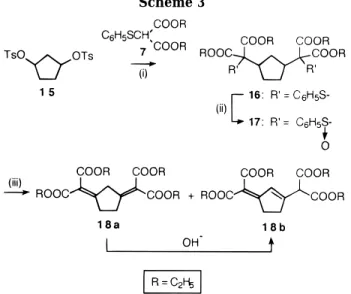
Tetraethyl 2,2′ -(1,3-cyclopentanediyl)bis[2-(phenyl-thio)propanedioate] (16): eluted with ethyl acetate/cyclo-hexane (35:65 v/v) as a liquid (2.6 g, 72%). 1H NMR: (δ H, CDCl3) 1.08-1.20 (m, 12H), 1.50-2.12 (m, 6H), 2.51-2.62 (m, 2H), 4.02-4.20 (m, 8H), 7.15-7.36, (m, 6H), 7.50-7.55 (m, 4H). 13C NMR: 13.87, 28.86, 30.37, 43.23, 61.71, 61.82, 68.20, 128.59, 129.64, 130.32, 137.05, 167.95. Diethyl 2-Cyclopentylidenepropanedioate (10).9 m-Chloroperoxybenzoic acid (the commercial sample containing ∼10% chlorobenzoic acid) was dissolved in CH2Cl2and dried over MgSO4, the solvent was evaporated, and the residue left under vacuum (0.1 mmHg) overnight) (90%, 1.3 g, 7 mmol) was added to CH2Cl2(100 mL) containing sulfide 8 (2.35 g, 7 mmol) at 0 °C. The mixture was stirred an additional 1 h at 0 °C and diluted with more CH2Cl2(100 mL). The dichlo-romethane solution was washed three times with saturated sodium bicarbonate (50 mL) and subsequently dried over MgSO4. The solvent was evaporated and the corresponding sulfoxide (2.2 g) dissolved, without further purification, in toluene (100 mL) and refluxed (∼2 h). The solvent was evaporated under vacuum and the residue purified by
flash-chromatography, eluting with dichloromethane. The com-pound 10 was obtained (the overall yield was not optimized) as a liquid (0.75 g, 50%) identical to the authentic sample.9
Diethyl 2-(2-Bromocyclopentylidene)propanedioate (11). NBS (2.31 g, 13 mmol) and dibenzoyl peroxide (0.05 g, 0.2 mmol) were added to CCl4(75 mL) containing 10 (2.94 g, 13 mmol), and the mixture was refluxed for 6 h. The suspension was cooled to room temperature, and the succin-imide was filtered off. The filtrate was evaporated, and flash-chromatography of the residue, eluting with ethyl acetate/ cyclohexane (15:85 v/v), led first to isolation of the corresponding 2,5-substituted dibromo compound (a liquid, 0.75 g, 15%);13C NMR: 13.88, 34.77, 48.01, 61.73, 127.52, 161.25, 163.70) and then to 11 as a liquid (2.38 g, 60%). 1H NMR: (δ H, CDCl3) 1.21-1.34 (m, 6H), 1.81-2.29 (m, 4H), 2.4-2.6 (m, 1H), 2.85 -3.05, (m, 1H), 4.10-4.40 (m, 4H), 5.45-5.55, (m, 1H). 13C NMR 14.04, 22.38, 30.99, 37.12, 50.55, 61.15, 61.35, 122.83, 163.86, 164.32, 164.78. MS(CI), m/e)(305, 307) (MH) + . Preparations of Compounds 14a,b and 18a,b by Ther-mal Dehydrosulfenylation. General Procedure. The sulfides 12 (1.97 g, 4 mmol) and 16 (2.4 g, 4 mmol) were dissolved in anhydrous dichloromethane (40 mL), the solutions were cooled, with stirring, to-35 °C, and m-chloroperoxyben-zoic acid (90%, 0.69 g, 4 mmol for 12; 1.38 g, 8 mmol for 16) was added slowly. The stirring was maintained for an additional 2 h at the same temperature. The reaction mixture was heated to room temperature, washed with a saturated sodium bicarbonate solution (3 × 20 mL), and dried over MgSO4. The solvent was evaporated, and the sulfoxides 9 and 17 were dissolved, without further purification, in the ap-propriate solvent for the next thermal dehydrosulfenylation step. Using toluene first, the mixtures were refluxed 2 h and evaporated under vacuum, and the residue was purified by flash-chromatography. The following were obtained:
Tetraethyl 2,2′ -(1,2-Cyclopentylidene)bis(propanedio-ate) (14a) and Diethyl 2-[2-(Dicarbethoxymethyl)cyclo-pent-2-enylidene]propanedioate (14b). Elution with ethyl acetate/cyclohexane (20:80 v/v) afforded the mixture 14a,b as a light yellow liquid (0.76 g, 50%). 1H NMR: (δ
H, CDCl3) 1.15 -1.32 (m), 1.80-1.89 (m), 2.52-2.56 (m), 2.65-2.71 (m), 2.96 -3.02 (m), 3.13-3.15 (m), 4.09-4.30 (m), 4.42 (s), 6.84 (s). Anal. Calcd for C19H26O8: C, 59.68; H, 6.85; O, 33.47. Found: C, 60.03; H, 6.88; O, 33.75. This mixture was dissolved in ethanol (20 mL), and KOH (0.1 g) was added. After 3 h stirring at room temperature, the solution was neutralized to pH 7 with dilute HCl, more water was added (100 mL), and the mixture was extracted with CH2Cl2(3× 50 mL). The organic extracts were dried over MgSO4 and evaporated to dryness. The residue (quantitative yield) corresponded to pure 14b. 1H NMR: 1.15-1.28 (m, 12H), 2.60-2.70 (m, 2H), 2.90-3.0 (m, 2H), 4.0-4.25, (m, 8H), 4.41 (s, 1H), 6.83, (s, 1H). 13C NMR: 13.88, 14.03, 31.17, 33.51, 54.95, 60.83, 62.01, 116.70, 129.96, 132.35, 156.25, 165.90, 166.29, MS(CI), m/e: 382 (M)+ . Tetraethyl 2,2′ -(1,3-Cyclopentylidene)bis(propanedio-ate) (18a) and Diethyl 2-[3-(Dicarbethoxymethyl)cyclo-pent-2-enylidene]propanedioate (18b). Elution with eth-anol/dichloromethane (3:97 v/v) afforded the mixture 18a,b as a light yellow liquid (0.87 g, 57%). 1H NMR: (δ
H, CDCl3) 1.0 -1.05 (m), 2.41-2.70 (m), 2.90-3.0 (m), 3.20-3.30 (m), 3.95 -4.25, (m), 4.41 (s), 6.83 (s). Anal. Calcd for C19H26O8: C, 59.68; H, 6.85; O, 33.47. Found: C, 59.88; H, 7.06; O, 33.78. After the same procedure as for 14a,b the pure isomer 18b was quantitatively isolated. 1H NMR: 1.15
-1.32 (m, 12H), 2.65 -2.71 (m, 2H), 2.96-3.02 (m, 2H), 4.09-4.20 (m, 8H), 4.42 (s, 1H), 6.84 (s, 1H). 13C NMR: 13.92, 14.08, 31.21, 33.55, 54.99, 60.58, 62.02, 116.7, 130.08, 132.38, 156.24, 165.86, 166.30. The same thermal dehydrosulfenylation step was also effected using CH2Cl2(with the inclusion of succinic anhydride),10and THF as solvent, as well as another run with toluene containing p-toluenesulfonic acid; in every case, the same mixtures of isomers 14a,b and 18a,b were isolated. The compositions of these 14a/14b and 18a/18b mixtures were estimated, by1H NMR, to be, respectively, 40/60 and 55/45.
(6) Gimbert, Y.; Moradpour, A.; Merienne, C. J. Org. Chem. 1990,
55, 5347.
(7) Drahowzal, F.; Klamann, D. Monatsh. 1951, 82, 460.
(8) Huntress, E. H.; Olsen, R. T. J. Am. Chem. Soc. 1948, 70, 2856; see also: Greengrass, C. W.; Hoople, D. W. T. Tetrahedron Lett. 1981,
22, 1161.
(9) Lehnert, W. Tetrahedron 1973, 29, 635.
(10) Hermann, J. L.; Berger, M. H.; Schlessinger, R. H. J. Am. Chem.
Calculations. Full geometry optimizations were performed for compounds 1, 14a,b, 18a,b, 19a-c and 20a,b (Figures 1 and 2) at the semiempirical AM111and at ab initio level within the MINI-1 minimal basis set of Huzinaga,12as well as the 6-31G double basis set and the 6-31G*13for compounds 14a,b and 18a,b; the 6-31G* basis set with polarization functions is known to give excellent results when applied to conjugated systems. The 6-31G basis set has also been used with compounds 19a-c. For the higher 67-atom homologues 20a,b at such a level of calculation (6-31G), a 421 basis function was needed; the corresponding calculations are as yet intractable and were not attempted. The equilibrium structures have first been investigated by an AM1 conformational analysis around the rotatable ester single bonds, either by fixed rotors or by reoptimizations of the other degrees of freedom. The highly overcrowded esters’ environment resulted usually in a single minimum located on the maps. Such computed equilibrium structures are true minima, as shown by the positive
eigen-values of the corresponding analytical second-derivative ma-trix. It is worth noting that the full geometry optimizations, found to be highly dependent on the basis set expansions, aimed primarly to minimize the significant electrostatic repul-sions involving the ester-group oxygens and resulted in significant out-of-plane distorted conformations of the latters. The ∆G free-energy values (Table 1) were calculated as ∆G(T) ) ∆E + ∆E(T) + P∆V - T∆S(T) (∆E is the usual energy content and ∆E(T) its thermal dependence, P∆V is negligible,14 and ∆S(T) values were calculated, at 298.15 K, by the usual statistical mechanic formulas,15a,bby the Gaussian 9416 pro-gram). The calculations have been effected on the CIP computers, mainly on a Cray FPS 522 EA and Digital Alpha 8400 8-processor server, using the Gaussian 94 (Rev. B and D) package.16
Results
Synthesis. The known starting alkene 109was alter-natively synthesized from the tosylate 6, by a three-step
(11) Dewar, M. J. S.; Zoebisch, E. G; Healy, E. F.; Stewart, J. J. P.
J. Am. Chem. Soc. 1985, 107, 3902.
(12) Tatewaki, H.; Huzinaga, S. J. Comput. Chem. 1980, 1, 205. (13) Hehre, W. J.; Ditchfield, R.; Pople, J. A. J. Chem. Phys. 1972,
56, 2257.
(14) Dive, G.; Dehareng, D.; Peeters, D. Int. J. Quant. Chem. 1996,
58, 85.
(15) (a) McQuarrie, D. A. Statistical Thermodynamics; Harper and Row: New York, 1973. (b) Daudel, R.; Leroy, G.; Peeters, D.; Sana, M.
Quantum Chemistry; Wiley: New York, 1983.
(16) Gaussian 94, Revision D.4, M. J. Frisch, G. W. Trucks, H. B. Schlegel, P. M. W. Gill, B. G. Johnson, M. A. Robb, J. R. Cheeseman, T. Keith, G. A. Petersson, J. A. Montgomery, K. Raghavachari, M. A. Al-Laham, V. G. Zakrzewski, J. V. Ortiz, J. B. Foresman, J. Cioslowski, B. B. Stefanov, A. Nanayakkara, M. Challacombe, C. Y. Peng, P.Y. Ayala, W. Chen, M. W. Wong, J. L. Andres, E. S. Replogle, R. Gomperts, R. L. Martin, D. J. Fox, J. S. Binkley, D. J. Defrees, J. Baker, J. P. Stewart, M. Head-Gordon, C. Gonzalez, and J. A. Pople, Gaussian, Inc. Pittsburgh, PA, 1995.
Table 1. AM1 and ab Initio Calculated Energy
Contentsaof Compounds 14a,b, 18a,b, 19a
-c, and 20a,b
∆E(∆G) energy (free energy) contentsa
compounds AM1 MINI 1 6-31G 6-31G*
14a 0 0.68 (0.93) 4.20 (3.37) 4.54 (3.88) 14b 2.88 0 0 0 18a 0 1.66 (2.17) 3.31 (3.14) 5.86 (5.43) 18b 5.23 0 0 0 19a 0 1.49 (2.02) -0.73 (0.36) 19b 0.49 0 0 19c 15.67 4.90 (6.98) 3.67 (6.56) 20a 0 1.75 (2.03) 20b 0.33 0
aThe energies are expressed in kcal mol-1
by reference (∆E and ∆G) 0) to the energy-minimized more stable isomers in each series.
Scheme 2
Scheme 3
procedure (Scheme 2): a nucleophilic substitution reac-tion involving the malonic phenylthio substituted ester
78and a subsequent oxidation by m-chloroperbenzoic acid yielded 9 containing a double-bond forming sulfoxide group;17a moderate heating of the latter compound led to 10. The compound 13, containing the same sulfoxide group, was then prepared by a similar sequence of reactions, from the bromo diester 11. However, the thermal double-bond formation reaction from 13, in boiling toluene, led to a mixture containing the desired compound 14a, together with the endocyclic isomer 14b. Modified experimental procedures, such as lower elimi-nation-reaction temperature and/or addition of an acid to the medium (p-toluenesulfonic acid), invariably led to a mixture (around 40/60 compositions) of compounds 14a and 14b. Moreover, a base-catalyzed process, efficiently isomerized the former mixtures to the pure, undesired, more stable regioisomer 14b.
This unexpected result prompted us to investigate a similar double-bond formation process, but in a 1,3 regiochemistry on the cyclopentane ring. Therefore we synthesized the disubstituted compound 17 (Scheme 3) from the ditosylate 15. The corresponding disulfoxide 17 led, in boiling toluene, to a 55/45 mixture of the unsatur-ated compounds 18a and 18b; the latter mixture was also easily transformed to the pure and more stable isomer
18b.
The knowledge of the respective thermodynamic sta-bilities of these various regioisomers was needed, in order to account for these results; we also were anxious to forsee the behavior of the higher, tri- and tetrasubstituted homologues of this series, before the corresponding syntheses were attempted. We therefore computed the properties of these compounds using the semiempirical AM1, as well as ab initio methods.
Calculations. We have calculated the relative
ener-gies of the energy-minimized geometries of the various 1,2- and 1,3-disubstituted isomers18 14a,b and 18a,b (Schemes 2 and 3, respectively), using the AM1 and ab initio methods (Table 1). The same calculations were also effected for the higher homologues 19 and 20 (Scheme 4), as well as for compound 1 (AM1). The calculated stabilities by the semiempirical AM1 method 19 were always in favor of the seemingly more stable radial double-bond isomers 14a and 18a. But the ab initio calculations led to values that are in closer agreement with the experimental results obtained for compounds
14 and 18: the endocyclic isomers 14b and 18b are found
to be more stable than the exocyclic ones 14a and 18a,
(17) Trost, B. M.; Salzmann, T. N.; Hiroi, K. J. Am. Chem. Soc. 1976,
98, 4887.
(18) The less time-consuming calculations with the methyl esters were effected for 14, 18, 19, and 20.
(19) The widely used AM1 method and the corresponding ZDO approximation probably lead to an underestimation of the important electrostatic repulsion forces involved in the present highly over-crowded systems, and these effects are not counterbalanced by the parametrization of the other terms of the Fock matrix. However, as calculated by a referee, and we gratefully acknowledge him for this, the molecular mechanics force field PC model using VESCF charges correctly find 14b to be more stable that 14a by 7.3 kcal mol-1, and
18b to be more stable by 11 kcal mol-1(both in ∆H); the twist angle
between the two exocyclic double-bonds of 14a (torsion angle C7-C1 -C2-C9, Figure 1) is about 39° with this approach.
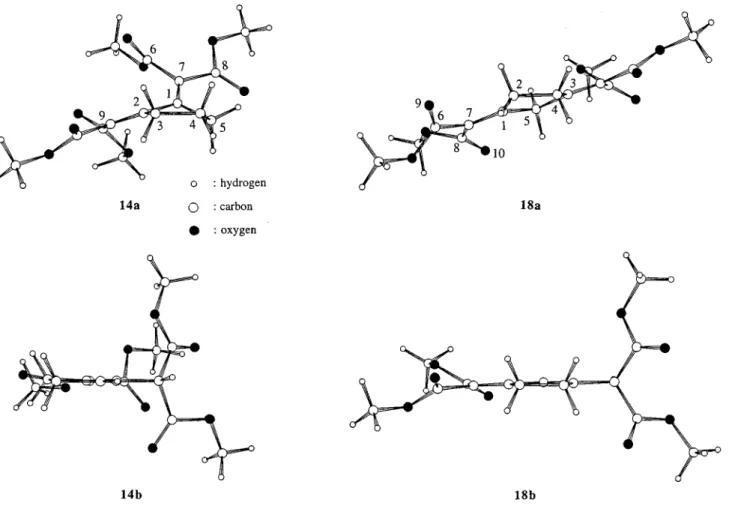
Figure 1. Views of the optimized energy-minimum conformations of the 1,2- and 1,3-disubstituted isomers 14a,b and 18a,b, obtained by the ab initio MINI-1 calculations. The values of the torsion angle C9-C2-C1-C7remarkably increased as a function of the calculations accuracies from 42.60° (AM1), 49.04° (MINI-1), 55.33° (6-31G) to 57.95° (6-31G*) for 14a. For 18a the O9 -C6-C7-C1dihedral angle is found to be-129.09° (AM1),-117.35° (MINI-1),-127.24° (6-31G),-133.37° (6-31G*), and the O10 -C8-C7-C1angle is 29.12° (AM1), 21.51° (MINI-1), 24.96° (6-31G), and 28.38° (6-31G*).
though the values of the computed free energy differ-ences, with the extended basis 6-31G* set, are still small (≈5 kcal mol-1). For the higher, not synthesized homo-logues 19 and 20 (Scheme 4), the radial double-bond-containing isomers 19a and 20a are also found to be less stable than the corresponding endocyclic isomers 19b,c and 20b, though by vanishingly small amounts of energy. The views of the calculated (MINI 1 level) energy-minimized conformations for compounds 1 (AM1 level),
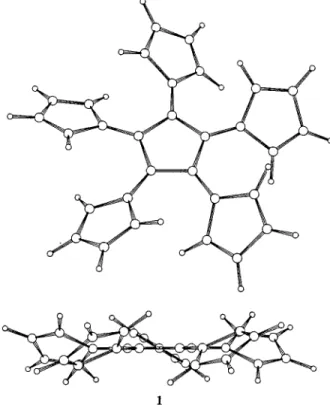
14a,b, and 18a,b are depicted in the Figures 1 and 2.
Similar trends, due to several rather severe overcrowd-ing problems, are obtained for both the 1,2- and 1,3-disubstituted compounds 14a and 18a: (i) the steric hindrance of the two ester groups on the same sp2carbon result in important out-of-plane distortions of the latters as long as the corresponding alkene plane is considered (Figure 1, see the O9-C6-C7-C1 and O10-C8-C7-C1 dihedral angles for 18a); this effect is also reflected by noticeable out-of-plane deformations of the central five-membered rings mediated by these squeezings of the radial double-bonds; (ii) additional dramatic distortions, related to the overcrowding of the esters on two neigh-boring radial alkenes, are observed for the 1,2-disubsti-tuted compound 14a; thus, the butadiene fragment (the torsion angle C9-C2-C1-C7, Figure 1) is highly twisted by almost 58°, as found by 6-31G* calculations; this effect is also illustrated by the nice propeller-like conformation of the pentafulvalene compound 1 (Figure 2).20 On the other hand, the intracyclic double-bond migrations lead-ing to 14b and 18b result in almost complete flattenlead-ing of the central rings (Figure 1).
Comparable, though more attenuated, effects on the conformation of the central rings, by the moving-in of the double-bonds, are also observed for 19a,c and 20a,b (see Supporting Information).
Discussion
Our present results identify a thermodynamic dead-lock, with the isolation of the more stable endocyclic isomers 14b and 18b, in the projected double-bond step-by-step formation sequence. The calculations allow an adequate rationalization of these experimental results, considering the steric effects controlling the relative stabilities of the various isomers. The driving forces for these double-bond rearrangements are clearly mediated by the minimizations of the steric constraints and simultaneously by the conjugation enhancements within the carbon-carbon bond π-systems: (i) in the 1,3 regio-chemistry on the central ring, as in 18a (Figure 1), the radial double-bonds are hardly conjugated to the ester groups that are highly distorted out of the alkenes planes, and conjugation is obtained due to an intracyclic bond migration toward the formation of 18b; (ii) in the 1,2 regiochemistry, as for 14a, the butadiene fragment built on the exocyclic double-bonds are significantly twisted (see the C9-C2-C1-C7 angle for 14a, Figure 1) due to the constraint of the neighboring ester groups, and the conjugation within the π-system is obtained by the intracyclic migration of one double-bond (see the simul-taneous flattening of the central ring in 14b, Figure 1). These effects therefore clarify the formation of 14b and
18b that precludes an acceptable synthesis of 14a and 18a. The synthesis of higher homologues, probably exhibiting the same endocyclic double-bond isomeriza-tion, as shown by calculations, was presently not at-tempted.
These results emphasize the difficulties related to the stepwise creation of cross-conjugation on a cyclopentane ring, as a way to [5]radialenes. Consequently, specific solutions to such problems will probably be needed for such a synthetic approach to this family of compounds. For example, if an alternative pentasubstitution of the central ring is first carried out, the subsequent forma-tions of the missing unsaturaforma-tions, leading to the desired structure, might be complicated by the formation of similar undesired endocyclic intermediates.
Acknowledgment. A.M. gratefully acknowledges
the CNET for financial support of this work, also
supported partly by the Belgian Program on
Interuni-versity Poˆles of Attraction initiated by the Belgian State,
Prime Minister’s Office, Services Fe´de´raux des Affaires
Scientifiques, Techniques et Culturelles (PAI no. 19),
and the Fonds de la Recherche Scientifique Me´dicale
(contract no. 3.4531.92). G.D. is chercheur qualifie´ of
the FNRS, Brussels.
Supporting Information Available: The views of the ab initio (MINI 1) computed energy-minimized conformations of the compounds 19a-c, 20a,b (3 pages). This material is contained in libraries on microfiche, immediately follows this article in microfilm version of the journal, and can be ordered from the ACS; see any current masthead page for ordering information.
JO970107D
(20) The synthesis and thermal stability of compound 1 remains an open question for the moment; see for example: Sauter, H.; Gallen-kamp, B.; Prinzbach, H. Chem. Ber. 1977, 110, 1382; a theoretical study of this aspect will be published in a forthcoming article.
Figure 2. Upper and side views of the optimized conformation of the compound 1, obtained by AM1 calculations.