1 INTRODUCTION
This numerical study on the clinching joining system is part of a large European research project on joining systems for the automated production of light gauge steel elements. For clinching, the objectives are to develop an analytical function to predict the resistance and the stiffness of clinched connections. Generally, joints are composed of several components. In order to determinate the behaviour of joints, the component method [1] recommends isolating each component and studying their behaviour separately. The resistance of the joint corresponds to the maximum strength of the weakest component. In clinched joint, all the components are identical, i.e. a clinch point submitted to shear. So, the analysis of the behaviour of one clinch is essential to determine the behaviour of a full clinch joint. In order to study this component, 32 tests have been performed at the University of Liège with different sheet thickness, yield strength and position of clinch. But this limited number of tests is not enough to determine the influence of the parameters defining the behaviour of the clinch. Numerical models have then to be developed in order to determine more precisely the impact of the different parameters. The test results will be used to validate the FEM models.
2 GENERAL FEATURES OF CLINCHING
2.1 What is clinching
Clinching is a joining method in which sheet metal parts are deformed locally and soldered together without any additional element such as glue or bolts. Clinching is a promising joining method since it can be used for various materials and thickness. Other advantages are that it is done without any heat added, it is cheap and flexible. The method could, if fully understood, work as a substitute for spot-welding.
2.2 Clinching process
The equipment includes a set of tools (punch and die), with which clinched joints can be made. The principle of clinching is shown in figure 1. The sheet thickness typically varies between 0,2 and 4mm. Both sheets do not need to be of the same thickness. A clinched joint is characterised by a pit on the punch side, and a rise on the die side. The force required for joining depends on the material and the size of the tool, and normally lies between 10 and 100 kN.
ABSTRACT: The clinching process, also known as “press joining”, is a mechanical joining technique for sheet metal. Its basic principle is to clamp together several metal sheets by an impact extrusion between a punch and a die. The joint is formed by a localized cold plastic deformation. Forming is used as a joining method. Within the context of this research, University of Liège is developing numerical models, with the FEM code LAGAMINE, that simulate the clinching process. On the other hand, shear tests on simple joints with one or two clinches were realized and their behaviour is reproduced numerically with LAGAMINE. This work opens the way to the analytical formulation of the behaviour of clinched joints. The article will focus on comparisons between experiments and numerical simulations. First, the identification of model parameters will be explained. Then, the predicted failure modes will be analysed by comparison with the experiments.
Key words: joining, clinching, FEM simulations, failure modes
Clinching joining system: validation of numerical models
C. Pietrapertosa, L. Zhang, A.M. Habraken (FNRS), J.P. Jaspart (FNRS)
University of LiègeDepartment M&S
Institute of Mechanics and Civil Engineering 1, Chemin des Chevreuils
B-4000 LIEGE 1 Belgium
URL: http://www.ulg.ac.be/matstruc/ e-mail: [email protected]; [email protected] [email protected]; [email protected]
Fig. 1. Principle of clinching
The most common shapes of clinches are square and round. Only round clinches are dealt with in the frame of this research. A micrograph of a clinch is shown in figure 2.
Fig. 2. Micrograph of a clinch
3 EXPERIMENTAL TESTS
3.1 Objectives
The main objective of these tests is the calibration of the FEM software for numerical simulations of clinches under shear loading from the first loading steps until failure. Through these tests, the influence of some important parameters governing the connection response is investigated.
The set-up of the shear tests is shown in figure 3.
Fig. 3. Shear test set-up
3.2 Tensile tests
Tensile tests were performed on samples taken from
the different steel sheets (two steel grades: S235 and S350) used to make the specimens. These tests give the actual σ-ε curves of each steel, which are introduced in the numerical models.
3.3 Shear tests results
3.3.a Load-displacement curves
The three main characteristics of a joint can be evaluated from the load-displacement curves: initial stiffness, maximum strength and deformation capacity. These characteristics are discussed according to several parameters (thickness of sheets, geometry of the clinch, yield strength, etc…). But because of the limited number of tested specimens, conclusions can not be drawn and a numerical parametrical study is imperative. Tests curves are mainly used to calibrate numerical models.
3.3.b Failure modes
The tests also enable to detect the different failure modes according to the different test specimens. The failure mode influences significantly the ductility of the joint. There are failure modes more brittle than others. That is why it is important to be able to predict the failure mode of a joint. Three different failure modes have been observed:
1) pull out of the punch side sheet out of the die sheet without any crack for the 1,0 mm sheets, 2) partial shear of the punch side sheet followed by
a pull out for the 1,5 mm sheets,
3) full shear failure with a deformed punch strip button remaining in the die side strip for double clinched joints with 1,5mm thick sheets. These three failures modes are presented in figure 4.
Fig. 4. Failure modes
The three failure modes correspond to three specific shapes for the load-displacement curves where the tests on joints with one clinch or two clinches are also differentiated. These failure modes are described in a report from Linköping University [2].
Failure mode 1)
4 FEM SIMULATIONS
4.1 Objectives
The final goal of the numerical studies is to simulate the shear test of a clinched joint in order to determine its mechanical behaviour and to extend the use of these simulations to a parametric study.
4.2 Numerical details
All the steps of the numerical simulations are performed with the FEM software LAGAMINE. The actual mechanical properties of the steel and geometry of the specimen have been introduced in the models. The two parts of the joint are simulated by mechanical 3D elements in large strain (element JET3D in LAGAMINE [3]). Three-dimensional mechanical contact element called CFI3D [4] is used where the two steel sheets are in contact. A Coulomb friction contact law is associated to this element.
4.3 Main procedure
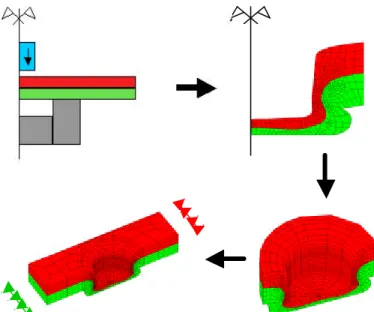
Because of the symmetry conditions, the initial simulation of a one-clinch joint is performed on a half of the structure. To simulate the shear test numerically, a full set of data is required as far as the clinch is concerned: actual deformed geometry, residual stresses and deformations resulting from the clinching process itself. To have a good estimation of these data, the best way is to simulate the clinching process. The first step consists therefore in the numerical simulation of the clinching process. As a preliminary assumption, an axisymmetric analysis is carried out. The next step consists in taking the results of the FEM simulation of the clinching process (geometry, stresses and deformations) and in introducing them in a 3D model for the simulation of the shear test. This requires obviously to “expand” the results obtained from the 2D axisymmetric simulation to a 3D FEM mesh. For the simulation of the shear test, three types of data should be taken into account: the deformed shape, the residual stresses and the strains. But the shear test is not symmetric. On one side of the clinch the sheets remain in contact but on the other side a gap appears between the sheets. This explains why the mesh is refined where the contact is important and coarse where the sheets separate. The last step consists in adding some elements
around the 180° mesh to obtain a kind of rectangular box volume. Using such a box allows to have a mesh closer to an actual clinch specimen and to better distribute the stresses in the joint. The shear forces are applied at the edge of the box. These three steps are shown in figure 5.
Fig. 5. Three steps of the numerical simulation
4.4 FEM simulations of the clinching process
The die is divided in two semi-circle and when the punch penetrates the die, this one opens itself (figure 6) and this behaviour has to be well taken into account. It is clear that in reality the die is not fully free to translate and an extensional spring is therefore used to restraint the lateral movement of the die. In the clinching tool, this restraint is due to a rubber ring. As its stiffness is unknown, simulations have been carried out with different assumed values. It appears that the stiffness coefficient should vary during the process.
Fig 6. Lateral motion of the die components
A real die has been observed and it has given precious information to simulate its behaviour. Until now, no good result has been obtained for this first step and the 3D mesh has been realised from the micrographs of the clinch (figure 2) and initial stress free conditions are assumed.
Half-die Half-die Clinched material Translation direction of the die
5 RESULTS
5.1 Comparisons with test results
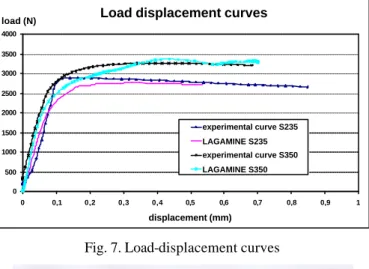
At this state of the research, two tests have already been simulated and it can be established that the numerical models are reliable. Indeed, the comparison between the experimental load-displacement curves and the numerical ones shows that the shapes are quite similar (figure 7). The difference may result from the assumptions made in the models (initial stress state and strain hardening not taken into account). The two tests simulated have only one different parameter: yield strength is 235MPa and 350MPa. These two corresponding experimental tests have shown the same failure mode i.e. partial shear + pull out (2). The numerical models recover this failure mode. Furthermore, the numerical simulations enable to know the stress and strain states inside the sheared clinch , which is impossible to know from the experimental test results. Figure 8 shows the levels of equivalent stress in the clinch. The maximum stress appears where the clinch is sheared and the other side of the clinch is being pulled out. This stress state is taken for the S350 case when the load reaches 3000N.
Load displacement curves
0 500 1000 1500 2000 2500 3000 3500 4000 0 0,1 0,2 0,3 0,4 0,5 0,6 0,7 0,8 0,9 1 displacement (mm) load (N) experimental curve S235 LAGAMINE S235 experimental curve S350 LAGAMINE S350
Fig. 7. Load-displacement curves
Fig. 8. Equivalent stress in the clinch
5.2 Influence of parameters
According to the tests results, some conclusions may be drawn about the influence of some parameters. The thickness of the sheets has a great influence on the behaviour : the strength increases when the
thickness is increased (an average raise of 30% in strength when the thickness goes from 1mm to 1,5mm). The failure mode is different depending on the sheet thickness. The yield stress σy of the steel
has not a very important influence on the behaviour of the clinch. It contributes to the increase of the strength but this increase is not proportional. The geometrical properties of the specimen (position of the clinch) have very little influence on the general shape of the load-displacement curves. The parametric study that will be performed thanks to the numerical models developed with LAGAMINE will enable to know the real influence of each parameter in any case, and then to determinate the parameters to introduce into analytical functions.
6 CONCLUSIONS
The identification of the key driving parameters is important to elaborate analytical functions to model the behaviour of such joining process in terms of strength or stiffness. Developing a numerical tool is essential to perform this step. According to the good results of the comparison tests-numerical simulations, the numerical models can be considered as reliable. In the future, the parametric study will enable to identify the parameters influence on the strength or stiffness of the clinch. We hope also to succeed in simulating the clinching process. The influence of the initial stress introduced in the clinch during the process would then be studied.
ACKNOWLEDGEMENTS
As Senior Research Associate and Research Director of National Fund for Scientific Research, AM Habraken and JP Jaspart thank this Belgian research fund for its support.
REFERENCES
1. J.P. Jaspart, Semi-rigid behaviour of civil engineering
structural connections. Document COST C1, Université
de Liège, 1999.
2. A. Arvidsson, Niklas Köppen, Clinching of Stainless Steel –
Study of Hardness and Strength, Linköping universitet.
3. K.P. Li, S. Cescotto, P. Jetteur, An Element with
Hourglass Control for the Large Deformation Analysis in Three-Dimension. Proc. of 3rd Int. Conf. on
Computational Plasticity, Fundamentals and Applications, 6-10 April 1992, Barcelona, Spain.
4. A.M. Habraken, S. Cescotto Contact between deformable
solids, the fully coupled approach. Mathematical and