HAL Id: tel-02301297
https://pastel.archives-ouvertes.fr/tel-02301297
Submitted on 30 Sep 2019
HAL is a multi-disciplinary open access archive for the deposit and dissemination of sci-entific research documents, whether they are pub-lished or not. The documents may come from
L’archive ouverte pluridisciplinaire HAL, est destinée au dépôt et à la diffusion de documents scientifiques de niveau recherche, publiés ou non, émanant des établissements d’enseignement et de
Ahmed Ousman Abani
To cite this version:
Ahmed Ousman Abani. Electricity market design for long-term capacity adequacy in a context of energy transition. Economics and Finance. Université Paris sciences et lettres, 2019. English. �NNT : 2019PSLEM018�. �tel-02301297�
Préparée à MINES ParisTech
Electricity market design for long-term capacity
adequacy in a context of energy transition
Architectures des marchés de l'électricité pour la
sécurité d'approvisionnement à long terme dans un
contexte de transition énergétique
Soutenue par
Ahmed OUSMAN ABANI
Le 24 juin 2019
Ecole doctorale n° 396
ECONOMIE, ORGANISATION,
SOCIETE
Spécialité
ECONOMIE ET FINANCE
Composition du jury :
Anna, CRETIProfesseur, Université Paris-Dauphine Présidente
Laurens, DE VRIES
Professeur, TU Delft Rapporteur
Richard, GREEN
Professeur, Imperial College London Rapporteur
Marcelo, SAGUAN
Economiste, EDF R&D Examinateur
François, LEVEQUE
(Disclaimer)
L’Université Paris Sciences et Lettres (PSL), Mines ParisTech et la société Deloitte n’entendent donner aucune approbation ni improbation aux opinions émises dans
cette thèse. Les propos et opinions doivent être considérées comme propres à leur auteur. Ils n’engagent en rien la responsabilité du cabinet Deloitte, ni a
Abstract
The ongoing energy transition, partly characterized by the massive deployment of renewables, has reignited a long-lasting debate on the best market design options to provide adequate investment incentives and ensure capacity adequacy in liberalised electricity markets. To choose the appropriate market design, policymakers need to assess and compare the economic performances of available solutions in terms of effectiveness and cost-efficiency.
This dissertation complements the existing literature on market design for long-term capacity adequacy by focusing on three research topics: (i) understanding how electricity markets perform under different assumptions regarding investors’ risk preferences, (ii) analysing the compatibility of private agents’ incentives to mothball capacity resources with security of supply objectives and (iii) assessing the economic performance of different market designs in a context of a high penetration of renewables. To this end, the System Dynamics modelling framework is applied to represent long-term dynamics resulting from private agents’ decisions in liberalised electricity markets. The dissertation is organised in three chapters corresponding to each of the topics mentioned above. The main results are outlined below.
Firstly, capacity remuneration mechanisms are necessary to deal with the detrimental effects of investors’ risk aversion. Energy-only markets are significantly affected by this phenomenon as they experience reduced investment incentives and higher levels of shortages. Capacity markets are more resilient to private investors’ risk aversion. However, this resilience depends on the level of the price cap in the capacity auctions. For such a market design to provide satisfactory outcomes in terms of capacity adequacy, this price cap should account for the investment risk faced by market participants.
Secondly, when market participants have the possibility to mothball their capacity resources, these mothballing decisions can potentially modify investment and shutdown dynamics in the long run. Furthermore, in a world with capacity lumpiness (i.e. indivisibilities), mothballing increases the level of coordination needed to ensure capacity adequacy. This is especially true in energy-only markets, where mothballing increases the level of shortages to an extent that seems to outweigh the cost savings it generates at system level. Capacity markets can provide the required coordination to ensure capacity adequacy in a world with mothballing.
Thirdly, among proposed market designs in the literature, capacity markets appear as the preferable solution to ensure capacity adequacy from a social welfare point of view. Nevertheless, from a private investor’s perspective and under certain conditions related to high penetration of renewables, capacity markets with annual contracts do not entirely remove the so-called “missing money” problem. The results indicate that granting multiannual capacity contracts alleviates the problem.
Key words: capacity adequacy, electricity market design, investment incentives, renewables, System Dynamics modelling.
Résumé
La transition énergétique, en partie caractérisée par le déploiement massif des énergies renouvelables, a relancé un débat de longue date sur les architectures de marché fournissant les meilleures incitations aux investissements dans les marchés libéralisés de l’électricité. Ces incitations sont essentielles pour garantir la sécurité d’approvisionnement à long terme. Pour choisir l’architecture de marché adéquate, les décideurs publics doivent évaluer et comparer les performances économiques des solutions disponibles.
La présente thèse complète la littérature sur les incitations aux investissements et la sécurité d’approvisionnement en étudiant trois aspects importants : (i) le comportement des marchés de l'électricité en présence d’acteurs averses au risque, (ii) la compatibilité entre les incitations des acteurs à mettre leurs actifs sous cocon et les objectifs de sécurité d’approvisionnement et (iii) les performances économiques de différentes architectures de marché dans un contexte de forte pénétration des énergies renouvelables. Pour ce faire, une modélisation de type System Dynamics est utilisée pour représenter les dynamiques de long terme résultant des décisions des acteurs dans un marché libéralisé. La thèse est organisée en trois chapitres correspondant à chacun des points mentionnés ci-dessus. Les principaux résultats sont les suivants :
Premièrement, les mécanismes de capacité sont nécessaires pour faire face aux effets néfastes de l’aversion au risque des investisseurs. Ce phénomène affecte de manière significative les marchés de l’énergie de type energy-only, qui subissent alors une baisse des investissements et des pénuries plus importantes. Les marchés de capacité résistent mieux à l’aversion au risque des investisseurs. Cependant, cette résilience dépend du plafond des prix dans les enchères de capacité. Pour qu'une telle architecture de marché donne des résultats satisfaisants en termes de sécurité d’approvisionnement, ce plafond de prix doit tenir compte du risque d'investissement supporté par les acteurs.
Deuxièmement, si les acteurs du marché en ont la possibilité, leurs décisions de mettre leurs actifs sous cocon peuvent modifier les dynamiques d'investissement et de fermeture à long terme. En outre, dans un monde caractérisé par des actifs indivisibles, cette possibilité augmente le niveau de coordination nécessaire pour assurer la sécurité d’approvisionnement. Cela est particulièrement vrai pour les marchés de type energy-only, dans lesquels la mise sous cocon augmente le
nécessaire pour assurer la sécurité d’approvisionnement même lorsque les acteurs ont la possibilité de mettre leurs actifs sous cocon.
Troisièmement, parmi les architectures de marché proposées dans la littérature, les marchés de capacité apparaissent comme la meilleure solution du point de vue du surplus social. Néanmoins, du point de vue des investisseurs, et dans certaines conditions liées à une forte pénétration des énergies renouvelables, les marchés de capacité avec des contrats annuels ne suppriment pas entièrement le problème dit de missing money. Les résultats indiquent que l'attribution de contrats de capacité pluriannuels atténue le problème.
Mots clés : sécurité d’approvisionnement, architecture des marchés de l'électricité, incitations aux investissements, énergies renouvelables, modélisation System Dynamics.
Remerciements
Mes remerciements vont en premier lieu à mon directeur de thèse, François Lévêque, qui a accepté d’encadrer mon travail durant ces quelques années. Ses conseils, son attention ainsi que ses encouragements ont beaucoup contribué à la réussite de ce travail.
Je tiens également à remercier chaleureusement Marcelo Saguan et Vincent Rious qui m’ont accompagné durant cette thèse. Les discussions que j’ai pu avoir avec eux, leurs conseils avisés, notamment durant la relecture de ce manuscrit, et leur expérience m’ont été d’une aide très précieuse. Je voudrais aussi remercier Yannick Pérez qui était le premier à susciter en moi un intérêt pour la recherche et qui a toujours été disponible lorsque j’avais besoin de conseils.
Pour la réalisation de cette thèse, j’ai eu la chance d’être accompagné financièrement par Microeconomix, devenu Deloitte Economic Advisory. Je tiens en cela à remercier sincèrement Gildas de Muizon pour la confiance qu’il m’a accordée et pour m’avoir permis de mener à bien ces travaux dans un cadre optimal. Je remercie également à ce titre Johannes Trüby qui a su créer les conditions nécessaires pour me permettre de mener à terme ce projet.
Je tiens par ailleurs à remercier tous ceux et celles qui m’ont aidé, de près ou de loin, dans ma réflexion, dans la rédaction de ce manuscrit, dans la réalisation de ce projet qui me tenait à cœur, que ce soit lors des formations, des conférences, ou d’autres cadres d’échanges.
Pendant ces années de thèse, j’ai eu le plaisir de côtoyer des collègues formidables. Tous ces moments passés ensemble à échanger et partager ont rendu ces années d’autant plus agréables. Merci beaucoup pour votre bonne humeur et vos encouragements. Merci à toutes et à tous, en particulier à : Angela, Antoine, Ariane, Joanna, Nicolas et Sébastien.
Je remercie très sincèrement tous mes amis pour leur soutien indéfectible. Merci en particulier à Sam, Muriel, Maryam, Franck, Elham, Yacine, Frédéric et Bastien. Merci aussi à Bernadette, André, Pierre-Yves, Xavier, Isabelle, Nicolas, Claire, Anne-Lise, Caroline, et Sophia pour leur accueil extraordinaire et pour leur soutien depuis mon arrivée en France. Vous êtes ma deuxième famille comme je le dis souvent. Merci également à tous ceux que je n’ai pas cités mais qui m’ont d’une façon ou d’une autre soutenu durant ces années.
Enfin je remercie ma famille pour son soutien infaillible et continu. Merci à vous, Abakar, Karim, Mami et Lalla, qui avez toujours trouvé le moyen de m’encourager et qui m’avez donné une raison de me surpasser.
Merci aussi à toi « tonton » Hannafi pour tes conseils, tes encouragements, mais surtout pour nos discussions interminables sur les statistiques des joueurs de basket ou la meilleure équipe de NBA (qui n’est pas GS au passage !).
Merci à toi Malika, d’avoir été présente tout au long de ces années. Merci de m’avoir accompagné dans cette aventure, d’avoir supporté mes absences et de m’avoir constamment encouragé.
J’ai une pensée très spéciale pour mes parents et grands-parents qui, malgré la distance, ont su à chaque instant me donner la force d’aller jusqu’au bout. Je n’en serai pas là sans votre soutien inconditionnel et c’est avec une grande émotion que je vous dédie cette thèse. Je ne saurais vous remercier assez pour ce que vous faites pour nous tous.
Contents
Abstract 5 Résumé 8 Remerciements 11 Contents 14 List of figures 21 List of tables 26 Abbreviations 29 General introduction 311. Liberalisation of electricity sector and recent developments 31
2. Market failures and regulatory issues interfering with the long-term
coordination function 35
1.1. Long-term coordination of investment in theory 35
2.1. Missing money induced by price caps in energy markets 36
2.2. Public good features of capacity adequacy 38
2.3. Asymmetrical investment incentives due to inelasticity of peak demand
and lumpiness of investments 39
2.4. Incompleteness of markets, imperfect information and risk aversion 40
3. Alternative market designs to ensure capacity adequacy 41
3.1. Capacity remuneration mechanisms and their rationale 41
3.2. The Clean Energy Package: European Commission’s “last-resort”
philosophy about CRMs 44
3.3. Important aspects to consider in the assessment of market designs for
capacity adequacy 47
4. Research questions and methodology 49
Impact of investors’ risk aversion on capacity adequacy 55
1. Introduction 59
1.1. Context and motivation 59
1.2. Existing literature on risk aversion and capacity adequacy 61
1.3. Research question 63
2. A single-technology model for market design comparison 64
2.1. General structure of the model 64
2.2. Uncertainties and agents’ forecasts 66
2.3. Profitability assessment 68
2.4. Modelling of risk preferences 71
2.5. Description of the studied market designs 75
Energy-only market (EOM) 75
Capacity market (CM) 76
Strategic reserve mechanism (SRM) 79
3. Simulations setup and indicators 82
3.1. Preliminary remarks on calibration and simulations 82
3.2. Parameters of the simulations 82
4. Discussion on the performance of the studied market designs under different
risk attitudes 85
4.1. Impact of risk aversion on the performances of the studied market designs 85 4.2. Comparative analysis of the market designs in presence of risk aversion
88
5. Sensitivity analysis 91
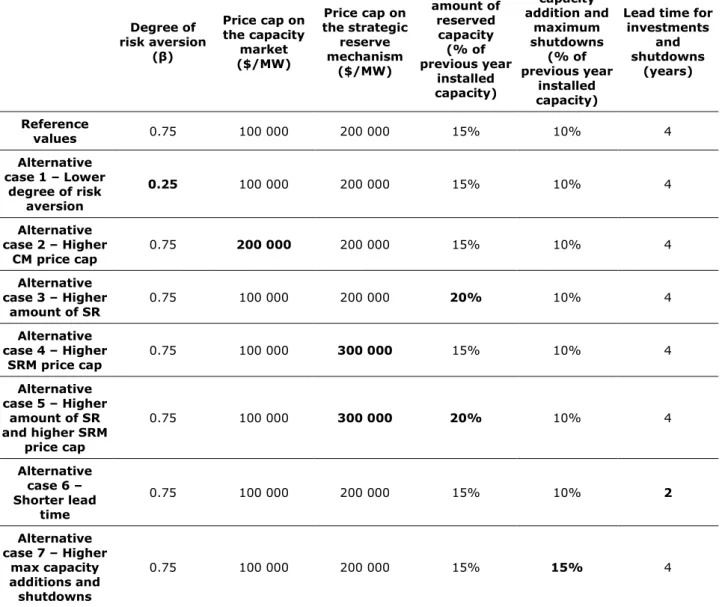
5.1. CRMs’ effectiveness is constrained in face of highly risk averse agents 94
5.2. Lead time effects 95
5.3. Sensitivity to maximum capacity additions and maximum shutdowns 95
Mothballing in power markets: conflicting private incentives and
capacity adequacy objectives 100
1. Introduction 105
1.1. Context and motivation 105
1.2. Power plant mothballing in the literature 107
1.3. Research question 109
2. A multi-technology model to better capture long-term dynamics 112
2.1. General description 113
Structure 113
Short-term energy market 115
Uncertainties and agents’ forecasts 116
Modelling of risk preferences 121
Modelling plant aging 122
2.2. Energy-only market (EOM-PCap and EOM-SP) 123
Overview of the modelling 123
Shutdown and mothballing decisions in energy-only markets 127
2.3. Capacity market with annual contracts (CM-AC) 131
Capacity bids from new plants in CM-AC auction 132
Capacity bids from existing plants in CM-AC auction 134
Capacity demand in CM-AC auction and clearing 139
3. Simulations setup and indicators 143
3.1. Preliminary remarks on calibration and simulations 143
3.2. General setup and indicators 143
3.3. Electricity demand 147
3.4. Initial generation mix 149
Fundamental dynamics related to mothballing 150 In energy-only markets, neglecting mothballing could lead to a misrepresentation of shutdowns and investments levels in a context of high
demand uncertainty 154
4.2. Mothballing tends to increase shortages and electricity prices 157 4.3. From a social welfare perspective, mothballing increases the need for coordination of private agents’ decisions to ensure capacity adequacy 160 4.4. Remarks on the magnitude of the results and methodological limitations
163
4.5. Sensitivity analysis 163
Higher energy price caps exacerbate the effects of mothballing on
energy prices and security of supply 163
Lower residual demand volatility limits the effects of mothballing 166
Variation of mothballing and restart costs 169
5. Analysing mothballing in capacity markets 173
5.1. In capacity markets, mothballing can modify the arbitrage between
existing and new capacities in capacity auctions 173
5.2. In capacity markets, mothballing has limited impact on shortages, energy
prices and capacity prices 175
5.3. From a social welfare perspective, capacity markets realign private agents’
incentives with capacity adequacy objectives 178
5.4. Sensitivity analysis 179
6. Chapter conclusions 183
Capacity adequacy in a context of non-increasing demand and high
renewable penetration: a discussion on market design options 187
1. Introduction 192
1.1. Context and motivation 192
1.2. Existing literature on market designs comparison based on modelling 196
Non-equilibrium models (agent-based modelling and system dynamics) 198
1.3. Research question 200
2. Model extensions for the representation of strategic reserves and capacity
markets with multiannual contracts 205
2.1. Strategic reserve mechanism (SRM) 205
Bids from existing plants in SRM auction 206
Capacity demand in SRM auction and clearing 207
2.2. Modelling capacity markets with multiannual contracts (CM-MAC) 209
3. Case study and simulations 212
3.1. Preliminary remarks on the calibration and simulations 212
3.2. General setup and indicators 212
3.3. Electricity demand 216
3.4. Initial generation mix 218
4. Performance of the studied market designs 220
4.1. Capacity mechanisms are superior to scarcity pricing in terms of social
welfare 220
Average results over simulation horizon 220
Breakdown of the social welfare variations 222
4.2. Security of supply 228
4.3. Costs for consumers 231
4.4. Investment risk and profitability of assets 232
Investment risk 232
Profitability of assets 236
Potential failure of capacity markets to ensure cost recovery 239
5. Sensitivity analysis 246
General conclusion 254
Appendix A. Nomenclature 263
Appendix B. Formal definition of a coherent risk measure 265
Appendix C. Computation of VaR and CVaR 266
Appendix D. Details on shutdown and mothballing rationales 268
Appendix E. Additional details on the model 275
Appendix F. Suggestions for an improved design of capacity markets 279
F.1 Recalling the theoretical background for capacity market design 279
F.2 Enhancing capacity market design 282
List of figures
Figure 1. Taxonomy of main CRMs ... 43 Figure 2. European Commission’s framework for capacity remuneration mechanisms ... 45 Figure 3. Simplified causal loop diagram of the model ... 65 Figure 4. Agents’ forecast of peak load ... 68 Figure 5. Revenue curve from energy market ... 69 Figure 6. Aging curve – O&M costs ... 71 Figure 7. Illustration of the modelling of risk aversion ... 72 Figure 8. Capacity addition curve ... 76 Figure 9. Capacity auction ... 79 Figure 10. Interpretation of results ... 83 Figure 11. Impact of risk aversion on the performances of the studied market
designs 85
Figure 12. Comparative analysis of the market designs without risk aversion . 89 Figure 13. Comparative analysis of the market designs in presence of risk aversion 90
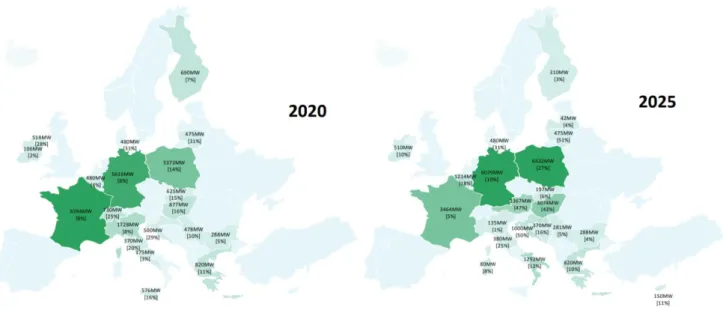
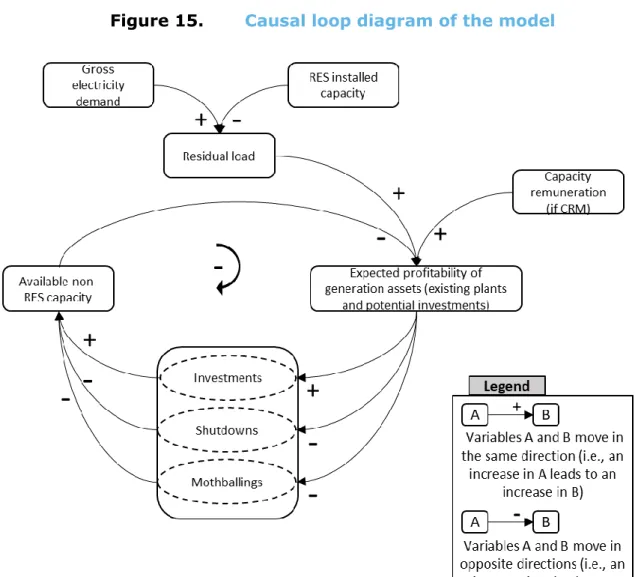
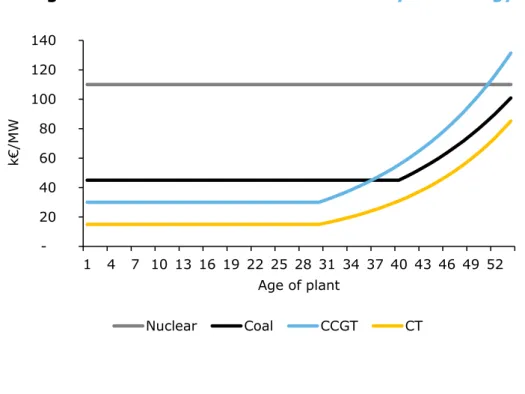
Figure 14. Generation capacity at risk of being mothballed in 2020 and 2025 according to data collected by ENTSOE ...107 Figure 15. Causal loop diagram of the model ...114 Figure 16. Impact of RES generation on residual load ...117 Figure 17. Forecast of peak load scenarios ...119 Figure 18. Forecast of installed capacity ...120 Figure 19. Illustration of the modelling of risk aversion ...122 Figure 20. Evolution of O&M costs by technology ...123 Figure 21. Investment procedure for new plants in the energy-only market ..125 Figure 22. Shutdown/mothballing procedure for existing plants in EOM-PCap/EOM-SP ...126 Figure 23. Illustration of shutdown procedure (without mothballing) ...128 Figure 24. Illustration of shutdown procedure (with mothballing) ...130 Figure 25. Illustration of shutdown procedure (with mothballing) ...131 Figure 26. Investment procedure for new plants in CM-AC ...134 Figure 27. Shutdown/mothballing procedure for existing plants in CM-AC ...135
Figure 28. Bidding strategy in the capacity market for an active plant (when mothballing is considered) ...137 Figure 29. Bidding strategy in the capacity market for a mothballed plant (when mothballing is considered) ...139 Figure 30. Capacity market auction ...141 Figure 31. RES penetration scenario in case study ...148 Figure 32. Initial generation mix for simulations of chapter II ...149 Figure 33. Illustration of expected outcome 𝑬𝑶𝟐 of mothballing ...151 Figure 34. Illustration of expected outcome 𝑬𝑶𝟑 of mothballing ...152 Figure 35. Illustration of expected outcome 𝑬𝑶𝟒 of mothballing ...153 Figure 36. Impact of mothballings on shutdown and investment dynamics in energy-energy-only markets ...154 Figure 37. Impact of mothballings on shortages in energy-only market ...158 Figure 38. Impact of mothballings on energy prices in energy-only market ...159 Figure 39. Impact of mothballing on shutdown and investment dynamics with a higher energy price cap (focus on CTs) ...165 Figure 40. Impact of mothballing on long run dynamics with lower demand uncertainty 168
Figure 41. Impact of mothballing on long run dynamics with alternative mothballing/restart costs assumptions ...171 Figure 42. Impact of mothballings on shutdown and investment dynamics in capacity markets ...174 Figure 43. Impact of mothballings on shortages in capacity market ...176 Figure 44. Impact of mothballings on capacity prices in capacity market ...177 Figure 45. Impact of mothballings on energy prices in capacity market ...178 Figure 46. Impact of mothballing on long run dynamics with lower capacity price cap 181
Figure 47. Shutdown/mothballing procedure for existing plants in SRM ...207 Figure 48. Strategic reserve auction ...209 Figure 49. RES penetration trajectory in case study ...217 Figure 50. Illustrative evolution of residual LDC during simulations ...218 Figure 51. Initial generation mix for simulations of chapter III ...219
Figure 54. Average investments by technology over simulation horizon (compared to EOM-PCap) ...225 Figure 55. Comparison of market designs in terms of security of supply ...229 Figure 56. Average level of scarcity hours throughout simulations ...230 Figure 57. Difference in consumers’ total costs (compared to EOM-PCap) ...232 Figure 58. Risk-adjusted weighted average cost of capital ...233 Figure 59. Illustration of perceived energy revenue volatility in investment appraisal in capacity markets (CM-AC/CM-MAC) and energy-only markets (EOM)
234
Figure 60. Decomposition of generation assets’ profitability (only for new investments made over the simulation horizon) ...237 Figure 61. Illustration of cost recovery issue in capacity markets ...240 Figure 62. Average capacity price in CM-AC vs fixed cost of a CT ...241 Figure 63. Evolution of net profits for new CTs by vintage class (AC vs
CM-MAC) 243
Figure 64. Distribution of the variations of social welfare compared to EOM-PCap in case of lower demand uncertainty ...247 Figure 65. Variations of social welfare compared to EOM-PCap in case of risk neutral agents ...249 Figure 66. Shutdown algorithm in energy-only markets (when mothballing is not possible) 269
Figure 67. Shutdown algorithm in energy-only markets for an active plant (when mothballing is possible) ...270 Figure 68. Shutdown algorithm for mothballed plants in energy-only markets (when mothballing is possible) ...271 Figure 69. Computation of capacity bids for existing plants in capacity markets (when mothballing is not possible) ...272 Figure 70. Computation of capacity bids for active plants in capacity markets (when mothballing is possible) ...273 Figure 71. Computation of capacity bids for mothballed plants in capacity markets (when mothballing is possible) ...274 Figure 72. Illustration of profitability scenarios computation in capacity markets with annual contracts (CM-AC) ...276 Figure 73. Illustration of profitability scenarios computation in capacity markets with multiannual contracts (CM-MAC) ...277
List of tables
Table 1. Variables and parameters for simulations (Chapter I) ... 84 Table 2. Sensitivity analysis scenarios ... 92 Table 3. Results of the sensitivity analysis ... 93 Table 4. Cash flows considered (active plant) ...129 Table 5. Cash flows considered (mothballed plant) ...131 Table 6. Technical and economic characteristics of thermal technologies ...146 Table 7. Variables and parameters for simulations (Chapter II) ...147 Table 8. Impact of mothballing on system costs in an energy-only market (based on the considered simulation parameters) ...162 Table 9. Intensity of mothballing with a higher energy price cap ...164 Table 10. Impact of mothballing on shortages and energy prices with a higher energy price cap ...166 Table 11. Intensity of mothballing with lower demand uncertainty ...167 Table 12. Impact of mothballing on shortages and energy prices with lower demand uncertainty ...169 Table 13. Intensity of mothballing with alternative mothballing/restart costs assumptions ...170 Table 14. Impact of mothballing on shortages and energy prices with alternative mothballing/restart costs assumptions ...172 Table 15. Impact of mothballing on system costs in a capacity market (based on the considered simulation parameters) ...179 Table 16. Intensity of mothballing with lower capacity price cap ...180 Table 17. Impact of mothballing on shortages, capacity prices and energy prices with lower capacity price cap ...182 Table 18. Description of market designs for generation adequacy ...194 Table 19. Summary of literature review ...202 Table 20. Technical and economic characteristics of thermal technologies ...213 Table 21. Variables and parameters for simulations (Chapter III) ...215 Table 22. Comparison of average social welfare variations between market designs
Table 25. Comparison of average social welfare variations between market designs (with respect to EOM-PCap) in case of lower demand uncertainty ...248 Table 26. Comparison of average social welfare variations between market designs (with respect to EOM-PCap) in case risk neutrality ...250 Table 27. Variables and parameters of the model ...263 Table 28. Proposed design for capacity market with multiannual contracts ...286
Abbreviations
Abbreviation Full form
CCGT Combined Cycle Gas Turbine
CEP Clean Energy Package
CM / CM-AC / CM-MAC Capacity Market / Capacity Market with Annual Contracts / Capacity Market with Multiannual Contracts
CRM Capacity Remuneration Mechanism
CT Combustion Turbine
CVaR Conditional Value at Risk
EC European Commission
EOM / EOM-PCap / ECO-SP
Energy-only Market / Energy-only Market with Price Cap / Energy-only Market with Scarcity Pricing
IRR Internal Rate of Return
LOLE Loss of Load Expectation
LOLP Loss of Load Probability
MS Member State
NPV Net Present Value
O&M Operation and Maintenance
OCF Operational Cash Flow
PI Profitability Index
PV Present Value
RES Renewable Energy Sources
SD System Dynamics
SO System Operator
SoS Security of Supply
SRM Strategic Reserve Mechanism
TSO Transmission System Operator
UK United Kingdom
USA United States of America
VaR Value at Risk
VoLL Value of Lost Load
General introduction
The liberalisation of electricity markets around the world has revealed problems of incentives regarding long-term investments in capacity resources (generation and demand response). The ability of energy-only markets with price caps to provide adequate investment signals has been particularly questioned in this regard. To deal with this issue, the literature has proposed various alternative market designs ranging from small adjustments – consisting for instance of removing price caps – to the introduction of capacity remuneration mechanisms or CRMs, in different forms (strategic reserves, capacity markets, etc.). The choice of the appropriate market design requires for policymakers to assess and compare the economic performances of available solutions. The ongoing transition in electricity systems, partly driven by the penetration of renewables, complexifies even more policymakers’ mission by raising additional concerns about investment incentives in thermal technologies and demand response.
In the following sections, a general overview of the recent developments in the European electricity sector is provided to contextualise the main issues that are currently debated with respect to capacity adequacy. This also sets the ground for the motivation of this dissertation as explained subsequently.
1. Liberalisation of electricity sector and recent
developments
Electricity markets around the world, especially in Europe and the USA, underwent an important transformation a few decades ago as they were progressively liberalised to introduce competition notably in the generation segment. This transformation resulted in a complete shift of paradigm regarding the way investments in capacity resources are made. In the previous monopolistic systems, investments were essentially decided on a centralised level by utilities which could forecast the demand and make the required level of investments to ensure long-term security of supply (i.e., capacity adequacy). After liberalisation, investments in capacity became the result of individual competing firms’ decisions. These firms
relied on their own anticipations of demand as well as decisions from their competitors since these may affect the profitability of their own investments. Capacity adequacy which used to be achieved through a centralised planification of investments therefore became a market-based outcome dependent on private agents’ decisions.
In the new paradigm (i.e., liberalised markets), investment decisions are ultimately decided based on the private agents’ anticipations about profitability. In this setup, electricity prices which are the main signal for investments are fundamental in market participants appraisal of investment opportunities. Moreover, a variety of other factors which were less relevant in the former monopolistic setup, are now crucial when it comes to investment decisions. Among these factors, are the uncertainties and risks involved in any decision. Uncertainty is important in at least two regards: first it inherently complicates investors’ forecasts and second, the allocation of the associated risks between market participants matters for the way investors react to it.
There are several sources of uncertainty that can affect the profitability of a capacity resource in liberalised electricity markets. Assessing the expected cash flows to be generated by a potential investment entails a wide range of forecasts related to costs (fuel costs, technology costs, CO2 price, etc.), market conditions (gross demand, electricity prices, other sources of revenues) and production levels (impact of renewable infeed, outages, etc.). These forecasts are made over the lifetime of the asset which can range from twenty to sometimes more than sixty years.
In a liberalised setup, most of the aforementioned parameters are uncertain, especially those which are dependent on political or regulatory decisions such as climate policy or environmental constraints (CO2 price, emission restrictions, out-of-market subsidies for renewables, etc.). Investors therefore make their decisions based on imperfect information which is both incomplete because of their limited foresight and uncertain as explained above. At the same time, they bear most of the risks associated with their forecast mistakes. For instance, if they overestimate demand and invest too much, they create a situation of overcapacity which
The fact that investment in capacity resources now depends on private agents operating in an uncertain environment, with limited foresight, raises an issue of coordination in liberalised markets. To ensure security of supply, electricity markets should provide the right investment signals and coordinate individual decisions towards a social optimum. This long-term coordination function is at the centre of all debates on capacity adequacy in liberalised markets, whether it is in Europe or in other similar systems such as those in the USA (Batlle and Rodilla, 2010; Cramton and Stoft, 2006; Creti and Fabra, 2007; Finon, 2011; Finon and Pignon, 2008; Green, 2006; Hogan, 2005, 1998; Joskow, 2008, 2006; Lévêque, 2006; Stoft, 2002).
With the ongoing energy transition, new challenges emerge as electricity systems are being transformed to accommodate high shares of low-carbon technologies such as renewables. The push towards low-carbon systems impacts investment signals in power markets. Because of the variability of their generation, renewable energy sources (RES) increase the volatility of electricity prices. Moreover, they create the well-known “merit order” effect which reduces the operation hours of thermal plants, thereby limiting the possibility for them to recoup their fixed costs (Sensfuß et al., 2008). The penetration of RES therefore affects the profitability of thermal technologies. It is paradoxical because the integration of high shares of RES requires more flexibility in the system to cope with their variability. As long as large-scale demand response and storage remain limited, this flexibility will mainly come from thermal generation (gas-fired plants for instance).
There is therefore a legitimate concern that the push for RES may reduce incentives to invest in yet needed thermal technologies, which could in turn undermine security of supply (De Sisternes and Parsons, 2016; Gerres et al., 2019; Newbery et al., 2018; Sisternes and others, 2014). Advocates of the energy-only market – where producers derive most of their revenues from selling electricity generated – argue that it can ensure capacity adequacy and therefore should remain the preferred market design (Hirst and Hadley, 1999; Hogan, 2005; Shuttleworth, 1997). On the other hand, a rich literature has been developed on the limits of the energy-only market design highlighting the existence of several market failures or regulatory issues which can interfere with its ability to achieve capacity adequacy. This literature proposed alternative market designs consisting in the introduction of the so-called capacity remuneration mechanisms (CRMs) to
complement energy-only markets (Cramton and Stoft, 2006; De Vries and Heijnen, 2008; Finon, 2011; Finon and Pignon, 2008; Joskow, 2006; Keppler, 2017).
2. Market failures and regulatory issues
interfering with the long-term coordination
function
1.1. Long-term coordination of investment in theory
The energy-only market is the reference market design for liberalised systems. Coordination of capacity resource investments in this market design is done through price signals in short-term markets (Caramanis, 1982; Stoft, 2002). The theory of spot pricing introduced by Caramanis (1982) shows how short-term electricity prices coordinate long-term investment decisions in liberalised systems. In fact, under spot pricing, perfect competition between private agents in a liberalised system should in theory yield the same long-run equilibrium as would a benevolent planner seeking to maximize social welfare (Caramanis, 1982; Rodilla and Batlle, 2012).
Spot pricing in liberalised markets suggests that electricity prices are set each hour by the short-term marginal cost of the last capacity resource mobilised to satisfy the demand (i.e., the marginal capacity). When existing capacity resources are insufficient to satisfy demand, prices are set the Value of Lost Load1 or VoLL (this is referred to as scarcity pricing or VoLL pricing). To satisfy demand at the lowest cost, capacity resources are selected on an economic merit-order basis, meaning that capacities are selected by increasing order of marginal cost.
The hours during which electricity prices reach the VoLL due to demand exceeding supply are called scarcity hours. Similarly, the revenues earned during these hours are called scarcity revenues (or scarcity rents) and are crucial for the profitability of capacity resources. Scarcity revenues are particularly important for peaking units for which they constitute the only way to recover fixed costs. During the other hours (i.e., when supply is sufficient to satisfy demand), all selected capacities at the exception of the one setting the price earn inframarginal rents
1 The VoLL is the price that an average consumer would be willing to pay to avoid an involuntary interruption of electricity supply.
which also contribute to recovering fixed costs. In the pricing system described above, microeconomic theory indicates that all agents cover their fixed cost in the long-run equilibrium. Agents will progressively adjust capacity in each technology so that each capacity earns just enough profits to cover its fixed costs, including an appropriate rate of return on investment (Caramanis, 1982; Stoft, 2002). The functioning of electricity markets described above rely on a set of important assumptions such as perfect competition, perfect foresight of the future by agents, market completeness in terms of risk allocation instruments, the possibility for electricity prices to rise to the VoLL during scarcity hours, the absence of economies of scale and the absence of lumpiness in investments (Rodilla and Batlle, 2012). However, some of these assumptions do not hold in real-world electricity markets as explained below. Four factors in particular impede the theoretical functioning of energy-only markets and at the same time their ability to perform their long-term coordination function:
• The missing money problem induced by low price caps in short-term markets;
• The public good features of capacity adequacy;
• Asymmetrical investment incentives created by peak demand inelasticity and discrete size of investments;
• Incompleteness of markets, imperfect information and agents’ risk aversion.
2.1. Missing money induced by price caps in energy markets
The most debated issue regarding the theoretical setup of the energy-only market is the assumption that electricity prices can reach the VoLL during scarcity hours. Implementing a VoLL pricing in real power systems is challenging for at least two reasons2: first, it is very difficult to estimate the VoLL because it depends on many circumstantial parameters3 and second, there is a risk that some agents exercise
market power during scarcity hours to make super profits. Here the focus is made on the second point4.
To limit the risks of market power exercise, regulators often impose limitations on the maximum value of electricity prices in short-term markets. For instance, in France, prices on the day-ahead market5 are capped at 3 k€/MWh while the Transmission System Operator (TSO) estimates the VoLL at around 26 k€/MWh (RTE, 2011). These price restrictions limit scarcity rents which are yet critical for peaking units to recover their fixed costs (Joskow, 2006).
Furthermore, even if prices can reach the VoLL (assuming it is properly defined), system operators (SOs) often perform actions6 to limit the occurrence of scarcity hours because they ultimately translate into shortages (rolling blackouts). This is a fundamental issue in the applicability of scarcity pricing in practice. Public authorities and SOs are averse to shortages because of their impact on the society, and this is regardless of economic efficiency. The aforementioned actions performed by SOs are not valued through any market while at the same time affecting scarcity rents.
All this leads to a “missing money” issue (Cramton and Stoft, 2006; Lévêque, 2006). The missing money problem refers to the situation where capacity resources fail to recover their fixed costs when there is an adequate level of installed capacity. Spot pricing theory indicates that energy-only markets can provide an adequate level of security of supply (i.e., socially optimal level of installed capacity) and ensure full cost recovery for all capacities. However, this is only true when there is no interference in the price formation mechanism in short-term markets7. If prices are capped below the VoLL, then the socially optimal level
4 The first point about the estimation of the VoLL is not a market or regulatory failure. It rather complexifies the implementation of the VoLL pricing. In reality, the SO can define a desirable level of security of supply and then calculate a level of VoLL that is consistent with the defined reliability criterion. Then the problem becomes the definition of the optimal level of security of supply from a social point of view. The advantage of the rigorous VoLL pricing is that it reveals this optimal level through market fundamentals, rather than it being exogenously defined by SOs or other relevant entities.
5 It should be noted that price caps in intraday markets are usually higher but still below the VoLL. For instance, in France the price cap in intraday and balancing markets is equal to 10 k€/MWh.
6 They can reduce the voltage of the system to decrease consumption for instance. 7 Prices are allowed to reach the VoLL every time there is a scarcity of supply.
and mix of capacity will create a missing money for some plants, particularly peaking units. This is due to the fact that they do not earn sufficient scarcity rents (since the prices are below the VoLL).
The missing money problem currently discussed in the literature is a temporary missing money in the sense that it should disappear at equilibrium in the long run. Indeed, in a perfectly competitive market with free entry and exit, agents will adjust their capacity in order to guarantee cost recovery, thereby eliminating the missing money issue. However, this would be at the expense of security of supply since they will essentially adjust their capacity until there are enough scarcity hours to allow them to recover their fixed costs. The lower the price cap in the energy market, the higher the required number of scarcity hours to ensure fixed cost recovery at equilibrium. It is therefore a serious impediment to the ability of energy-only markets to provide an adequate level of security of supply.
2.2. Public good features of capacity adequacy
Capacity adequacy presents some features of classic public goods in economic theory. More specifically, it meets the non-excludability criterion as discussed by several authors (De Vries, 2004; Finon and Pignon, 2008; Keppler, 2017; Stoft, 2002). Capacity adequacy benefits to all consumers regardless of who is providing it. If an investor decides to build a power plant for instance, this plant will contribute to improving capacity adequacy. However, given the current state of the technology, it is impossible for the investor to select which consumers will benefit from the improvement of capacity adequacy. All consumers who are connected to network can benefit from capacity adequacy improvement, even if they are not direct clients of the investor.
This creates a problem of under-provision of capacity adequacy, in the sense that private agents’ decisions would result in a provision of capacity that is lower than the social optimum (Keppler, 2017; Oren, 2003). Indeed, any capacity addition leads to a positive externality for all consumers as explained above. The fundamental issue at hand is that private agents’ benefits from improving capacity adequacy are lower than the corresponding social benefit as highlighted by Keppler
under provision. Current markets and state of technology do not allow them to do so.
It is important to keep in mind that this market failure can be mitigated in the future if technological change enables private agents to restrict consumption to those clients who have a stated willingness to pay that is higher than the private cost of capacity provision. Private agents’ incentives will therefore be aligned with the social value of capacity provision. The deployment of smart meters could contribute to creating such systems with the possibility of individual curtailment of consumers.
Another factor exacerbates the under-provision problem and that is the inelasticity of peak demand which, combined with the lumpiness of investments, produces another market failure on the supply side as explained hereafter.
2.3. Asymmetrical investment incentives due to inelasticity of
peak demand and lumpiness of investments
There is a structural asymmetry of incentives between overinvestment and underinvestment in capacity. This asymmetry stems from two factors: (i) the inelasticity of peak demand and (ii) the lumpiness of investments.
Peak demand inelasticity and lumpiness of investment have been widely discussed in the literature as a source of market failure (De Vries and Heijnen, 2008; Keppler, 2017; Rodilla and Batlle, 2012; Stoft, 2002). Since investments are only available in discrete size (50, 150 or 450 MW for instance), private agents cannot adjust capacity to exactly match peak demand. They are confronted with an arbitrage between investing in a discrete (marginal) capacity with the risk of creating a situation of overcapacity or not investing in that marginal capacity, which could create costly shortages for society. If peak demand is inelastic as it is the case in most systems, then the outcome between the two decisions are quite different, resulting in asymmetric incentives.
If private agents invest too much, they eliminate scarcity rents but if they underinvest, scarcity rents are potentially significant. Any rational investor, even in a context of perfect competition and perfect information will prefer to underinvest because it is the option that maximizes its profits. If demand was
elastic, underinvesting would lead to a reduction of demand until it intersects with supply and the scarcity rents will therefore be limited. In other words, and as stated by Keppler (2017): “With elastic demand, there would be no policy relevant market failure even in the presence of discretely-sized increments in investment, as underinvestment would be just as costly, in terms of profits foregone, as overinvestment”. The lumpiness of investments alone is thus not a source of market failure. What makes it one is its combination with an inelastic peak demand. This adds to the issue of under provision of capacity adequacy in liberalised energy-only markets.
2.4. Incompleteness of markets, imperfect information and risk
aversion
Completing the set of market failures interfering with the long-term coordination function of energy-only market is the combination of private agents’ risk aversion, imperfect information and incompleteness of markets. Investments in capacity resources are highly capital-intensive and subject to various uncertainties (see discussion above). In this context, private agents tend to be risk averse (De Sisternes and Parsons, 2016; Meunier, 2013; Tietjen et al., 2016). Risk aversion is not an issue per se as long as agents are able to trade their risk by contracting appropriate hedging instruments (Léautier, 2016). However, current electricity and financial markets do not provide enough hedging instruments to cover all types of risks faced by investors. This is where the notion of incomplete markets emerges in the debate on capacity adequacy (Abada et al., 2017; Finon, 2011; Neuhoff and De Vries, 2004; Willems and Morbee, 2010).
Because of risk aversion and the incompleteness of existing markets, private agents will adjust the valuation of their investment opportunities to internalise their perceived risk. This is done through a cut-off on the purely probabilistic expected value of their investments to represent the risk that is not tradable (De Maere d’Aertrycke et al., 2017). The concrete impact in terms of capacity adequacy is that risk averse agents tend to postpone their investments or even reduce them compared to risk neutral agents, especially regarding peaking units (Abani et al.,
3. Alternative market designs to ensure capacity
adequacy
3.1. Capacity remuneration mechanisms and their rationale
The previous sections highlighted several market failures which can prevent energy-only markets, even in their form with scarcity pricing (i.e., VoLL pricing) from delivering adequate levels of capacity. To overcome the problem, alternative market designs commonly called capacity remuneration mechanisms (CRMs) or capacity mechanisms have been proposed in the literature. The fundamental difference between CRMs and the traditional energy-only market is that CRMs explicitly recognize capacity as a tradable good. They provide a revenue based on available capacity in addition to the revenues earned on the energy markets (which are based on energy sales).
A wide literature has been developed around CRMs (Abani et al., 2018; Assili et al., 2008; Bhagwat et al., 2016a; Cepeda and Finon, 2011; Cramton et al., 2013; Cramton and Stoft, 2005; De Vries, 2004; De Vries and Heijnen, 2008; Fernando Olsina et al., 2014; Hary et al., 2016; Hasani and Hosseini, 2011; Hobbs et al., 2007; Joskow, 2006; Petitet et al., 2017). Among all market and regulatory failures mentioned in the previous section, missing money has been the most cited justification for the introduction of CRMs. In addition to providing justifications for CRMs, the existing literature has also focused on the design of these mechanisms to ensure their effectiveness in providing capacity adequacy and their cost-efficiency. CRMs can be characterized following at least two dimensions: (i) quantity-based vs. price-based and (ii) targeted vs. market-wide.
The first dimension relates to the signal used to express the demand for capacity. A quantity-based approach consists of the definition of a capacity target to be contracted while a price-based approach sets a capacity price (which is to be properly determined) and rely on the market to provide the right quantity of capacity. The two approaches are equivalent in theory if there is perfect information and no uncertainty (Weitzman, 1974). However, if these conditions
are not satisfied then there may be a preference for one approach over the other8. For capacity adequacy questions, Finon and Pignon (2008) argue that quantity-based mechanisms are preferable, but in practice both approaches have been implemented.
The second dimension pertains to the scope of the CRM in terms of beneficiaries. A CRM can be market-wide, meaning that all capacity resources can benefit from it9. Conversely, a targeted CRM only benefit a restricted set of capacity resources (for instance only new plants or only old plants that are about to be decommissioned). In general, the choice of the scope is inherent to the choice of CRM, which in turn depends on various factors as discussed subsequently (see section 3.3).
Other dimensions can be considered to further characterize CRMs. For instance, the mode of definition of the capacity needs or the mode of procurement can constitute additional layers of characterization. Regarding the definition of the capacity needs, it could be done by a central authority such as the SO, or by individual suppliers with an ex post verification of a central authority. Similarly, the procurement of the capacity resources could be either centralised and performed by a single authority such as the SO or decentralised (each supplier oversees the procurement of its own capacity needs). Figure 1 below highlights the main CRMs currently discussed in the literature.
Figure 1. Taxonomy of main CRMs10
Price-based CRMs consist of capacity payment schemes where a fixed price, determined administratively, is paid to capacity resources. Some capacity payment schemes only target specific resources while others are market-wide.
Quantity-based CRMs are more varied as illustrated on Figure 1. Within this category of CRMs, those which are “targeted” are either focused towards existing capacities or new capacities. Strategic reserve mechanism (SRM) is generally reserved for old existing plants in order to keep them longer in the system in case of emergency. On the other hand, there could be special tenders only for new investments.
The rest of quantity-based CRMs are market-wide. They include centralised capacity auctions, decentralised capacity obligations (or capacity certificates/credits) and reliability options. The first two are variants of what is commonly called a “capacity market”. The main difference between capacity auctions and capacity obligations is the mode of procurement and of determination of capacity needs as described above (centralised vs decentralised).
Reliability options correspond to a centralised market-wide CRM in which the products are not physical capacity contracts – as it is the case for all other CMRs – but rather financial call options. A central authority determines the strike price of the call options which effectively acts as a price cap on energy markets. Every time the price on the energy market rises above the strike price, holders of the call options pay the difference between the strike price and the market price. Reliability options incentivize capacities to be available during scarcity hours and protect consumers from high electricity prices (Bidwell, 2005).
3.2. The Clean Energy Package: European Commission’s
“last-resort” philosophy about CRMs
The debate on CRMs has attracted significant attention from policymakers as well. In Europe, the country-level discussions around CRMs take place within broader framework defined at the European level by the European Commission (EC). It lays out the conditions for the implementation of CRMs and oversees the validation process. The most recent piece of legislation regarding energy policy at the European level is the Clean Energy Package (CEP) presented in its initial version in November 2016 (European Commission, 2016a).
Despite the rich literature supporting the need for CRMs in liberalised markets such as those in Europe, the EC has displayed a strong preference for the energy-only market design, arguing that CRMs may pose competition issues between technologies and distort cross-border trade (European Commission, 2016b; Meeus and Nouicer, 2018; Newbery, 2015). It promotes market reforms aiming at removing the failures of the energy-only market (for instance allowing prices to reach the VoLL during scarcity hours). CRMs are considered by the EC as a last resort means to ensure capacity adequacy. Figure 2 below provides an overview of EC’s framework for CRMs (Meeus and Nouicer, 2018).
Figure 2. European Commission’s framework for capacity remuneration mechanisms11
The framework established by the EC applies to all member states (MS). First the relevant entities in the MS should perform an adequacy assessment to establish the existence or not of adequacy concerns12. If the assessment reveals adequacy concerns, then the MS should identify the market failures or regulatory distortions at the origin of the adequacy concerns and undertake reforms to remove them. In doing so, they should propose a clear plan of reforms to be reviewed and approved by the EC13. Potential reforms to be considered include implementation of actual scarcity pricing (with energy prices rising to the VoLL during scarcity hours), increased use of interconnectors, promotion of demand side flexibility. If a MS can demonstrate that adequacy concerns will persist despite such reforms, they it can be authorized to implement a CRM, under certain conditions. In this respect, the
11 Adapted from Meeus and Nouicer (2018).
12 The assessment could be limited to the national level but there is a preference for a EU-wide assessment. 13 This phase includes part of the state Aid process.
CEP highlights three aspects that a MS should carefully consider when implementing a CRM: (i) non-discrimination between existing and new solutions, (ii) impacts on climate change goals and (iii) cross-border effects.
Non-discrimination between existing and new solutions for capacity adequacy relates particularly to demand-side response (DSR)14, which still faces barriers for participation to CRMs in some European countries (European Commission, 2016b). A recent example with respect to that is the suspension of UK’s capacity market by the General Court of the European Union (European Union - The General Court, 2018). The decision of the General Court followed a complaint related to the discriminatory aspect of the mechanism regarding DSR providers.
The second important aspect is the impact of CRMs on environmental targets. In the CEP, specific CO2 emissions limits are proposed for existing and new generation capacities in order for them to be eligible to a CRM. For instance, the recommendations in the CEP propose that new capacities emitting more than 550 gCO2/kWh should not be eligible to CRMs. For existing capacities emitting above this threshold, it is suggested that their commitment in a capacity mechanism must be limited to a maximum of five years (after the entry in force of the new regulation). EC expects these measures to align CRMs with climate policies. Finally, any MS contemplating the implementation of a CRM should assess and limit its potential impact on neighbouring markets. Cross-border impacts of CRMs represent a major concern for European policymakers as they may undercut the efforts of creation of a single internal market. Hence, EC recommends the participation of cross border capacities to national capacity mechanisms to ensure efficient signals and avoid capacity leakage15. It also promotes a high level of coordination between neighbouring countries for an adequate design of the mechanisms so that they do not limit cross-border trade or introduce unnecessary market distortions.
3.3. Important aspects to consider in the assessment of market
designs for capacity adequacy
Whether the debate on market design for capacity adequacy is tackled from a pure academic perspective or in the context of the European Commission’s policy framework, it is crucial to assess the merits and limitations of available market design options. This assessment heavily on models that aim to capture the characteristics of liberalised electricity markets (Abani et al., 2018; Bhagwat et al., 2016b, 2017c, 2017b; Bublitz et al., 2019; Cepeda and Finon, 2011; De Vries and Heijnen, 2008; FTI CL - Energy, 2016; Hary et al., 2016; Hasani and Hosseini, 2011; Mastropietro et al., 2016; Petitet et al., 2017; RTE, 2018; THEMA Consulting Group et al., 2013; UFE et al., 2015; UK Department of Energy & Climate Change, 2014a). Three characteristics are particularly important to consider when addressing capacity adequacy issues in the current context of energy transition, using such models:
(i) Cyclical tendency of electricity markets;
(ii) Private agents’ behaviour (attitude towards risk, tendency to mothball assets in periods of high uncertainty, herd behaviour, etc.);
(iii) Impact of renewables on investment incentives for thermal technologies or demand response.
As illustrated by Arango and Larsen (2011) Ford (1999), electricity markets exhibit a propensity to capacity cycles, leading to a succession of over and under-capacity phases. These cycles present a threat to security of supply as they increase uncertainty and distort investment signals (Green, 2006). Because of this cyclical tendency, electricity markets usually operate out of equilibrium. An analysis of electricity markets from a dynamic perspective is therefore needed to account for these out-of-equilibrium phases.
Moreover, analysing capacity adequacy by the means of electricity market models requires that all agents’ decisions that may affect the level of installed capacity are properly represented. Agents’ decisions should be endogenous with respect to their expectations. These decisions include not only investments and shutdowns but also mothballings (Abani et al., 2017; Arango et al., 2013). As discussed in section 2.4 of this general introduction, imperfect information, risk aversion and markets incompleteness can affect private agents’ decisions (Meunier, 2013;
Neuhoff and De Vries, 2004; Ousman Abani et al., 2018). They can also display symptoms of herd behaviour as illustrated in some studies (Hary et al., 2016; Olsina et al., 2006). All these factors play a crucial role in agents’ decision making and ultimately on capacity adequacy.
At last, another aspect is becoming more and more crucial and that is the impact of RES deployment on investment incentives (De Sisternes and Parsons, 2016; Gerres et al., 2019; Newbery et al., 2018; Pinho et al., 2018; Tietjen et al., 2016). Indeed, the integration of high shares of RES affects the profitability of thermal generation technologies which are still needed to ensure security of supply in the absence of large-scale storage or highly flexible demand response.
In addition to the above-mentioned dimensions, policymakers are also particularly concerned with the impact of CRMs on consumers’ welfare or issues such as revenue volatility and investment risk. These are important for the sustainability of the mechanism.
4. Research questions and methodology
4.1. Research questions
This dissertation complements the existing literature on market design for long-term capacity adequacy by focusing on three important issues: (i) understanding how electricity markets perform under different assumptions regarding investors’ risk preferences, (ii) analysing the compatibility of private agents’ incentives to mothball capacity resources with security of supply objectives and (iii) assessing the economic performance of different market designs in a context of a high penetration of renewables. The corresponding research questions are presented hereafter.
How does investors’ risk aversion affect the effectiveness and cost-efficiency of capacity remuneration mechanisms?
Several authors have highlighted the importance of risk aversion for investments in competitive electricity markets (Abani et al., 2018; Fan et al., 2012; Meunier, 2013; Neuhoff and De Vries, 2004; Petitet et al., 2017). The issue is gaining more and more interest due to the many changes currently occurring in the electricity sector (climate policies, deployment of renewables, electric vehicles, etc.), which introduce a lot of uncertainty for investors.
Risk aversion modifies the way investors react to market signals and can lead to sub-optimal decisions in situations of market incompleteness (Abada et al., 2017; Willems and Morbee, 2010). The current state of electricity markets does not provide investors with enough options to trade the risks that they face, which is precisely a case of incomplete markets (Newbery, 2015). The concerns about risk aversion and its impact on investors’ behaviour are therefore justified. The first research question aims at providing a discussion on the impact of risk aversion on the performances of different market designs, from a capacity adequacy perspective. Two of the most discussed capacity remuneration mechanisms are analysed (the market-wide capacity market and the strategic reserve mechanism), in addition to the benchmark energy-only market.
Are private agents’ incentives for mothballing compatible with security of supply objectives?
Recent evolutions in European power markets has led to waves of mothballing of generation assets (Caldecott et al., 2014; Eurelectric, 2016; EY, 2014). Mothballing consists of a temporary closure of power plants in situations of difficult economic conditions. Its main objective is to protect power plants owners from expected losses while giving them the option to reactivate their plants if market conditions improve. Therefore, it provides an interesting flexibility compared to a permanent shut down.
Mothballing appears as a legitimate recourse for private agents who are seeking to protect their investments. Since 2010, and especially during the period covering 2012 to 2014, power utilities in Europe have mothballed several gigawatts of thermal plants, mainly gas-fired ones (Caldecott et al., 2014). Their decisions were triggered by a combination of unfavourable factors including: a situation of overcapacity due to a slowdown of electricity demand growth, an underestimation of the deployment of renewables which further reduced the residual demand for thermal generation, and a switch of competitiveness between gas coal which made gas-fired generation less profitable.
In case of systemic overcapacity, this would just be an expected response from a competitive market. Nevertheless, some argue that, regardless of overcapacity, the high penetration of renewables would make mothballing a recurrent practice (ENTSOE, 2017). In any case, it remains unclear whether this practice is compatible with capacity adequacy objectives and if it has other long-run impacts. On the one hand it avoids losses for private agents and leads to cost savings in operation and maintenance. On the other hand, it essentially removes capacity from the market, which means that it reduces available capacity. The second research question of the dissertation covers this subject from an economic perspective. It analyses mothballing rationales and their impact on power systems under two paradigms: an energy-only vision and a capacity remuneration mechanism vision.