RESULTS
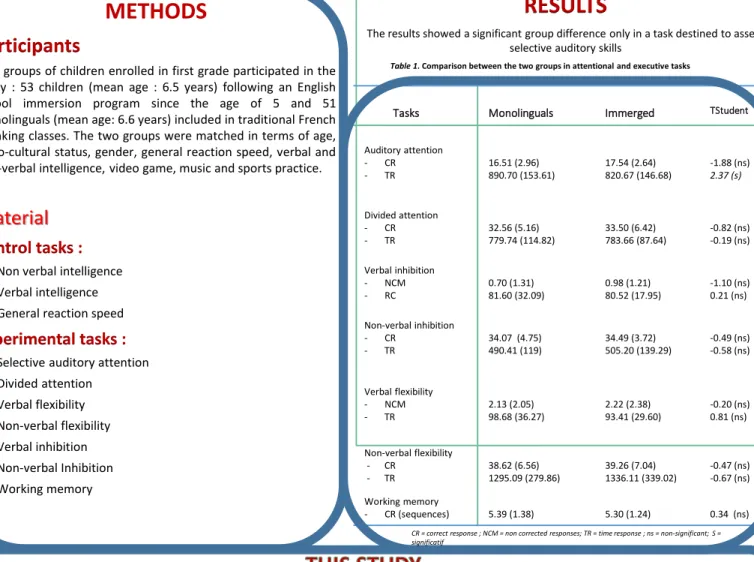
The results showed a significant group difference only in a task destined to assess selective auditory skills
Table 1. Comparison between the two groups in attentional and executive tasks
METHODS
Participants
Two groups of children enrolled in first grade participated in the study : 53 children (mean age : 6.5 years) following an English school immersion program since the age of 5 and 51 monolinguals (mean age: 6.6 years) included in traditional French speaking classes. The two groups were matched in terms of age, socio-cultural status, gender, general reaction speed, verbal and non-verbal intelligence, video game, music and sports practice.
Material
Control tasks :
- Non verbal intelligence - Verbal intelligence
- General reaction speed
Experimental tasks :
- Selective auditory attention
- Divided attention - Verbal flexibility - Non-verbal flexibility - Verbal inhibition - Non-verbal Inhibition - Working memory
Tasks Monolinguals Immerged TStudent
Auditory attention - CR - TR 16.51 (2.96) 890.70 (153.61) 17.54 (2.64) 820.67 (146.68) -1.88 (ns) 2.37 (s) Divided attention - CR - TR 32.56 (5.16) 779.74 (114.82) 33.50 (6.42) 783.66 (87.64) -0.82 (ns) -0.19 (ns) Verbal inhibition - NCM - RC 0.70 (1.31) 81.60 (32.09) 0.98 (1.21) 80.52 (17.95) -1.10 (ns) 0.21 (ns) Non-verbal inhibition - CR - TR 34.07 (4.75) 490.41 (119) 34.49 (3.72) 505.20 (139.29) -0.49 (ns) -0.58 (ns) Verbal flexibility - NCM - TR 2.13 (2.05) 98.68 (36.27) 2.22 (2.38) 93.41 (29.60) -0.20 (ns) 0.81 (ns) Non-verbal flexibility - CR - TR 38.62 (6.56) 1295.09 (279.86) 39.26 (7.04) 1336.11 (339.02) -0.47 (ns) -0.67 (ns) Working memory - CR (sequences) 5.39 (1.38) 5.30 (1.24) 0.34 (ns)
Previous studies have shown that children enrolled in an second language immersion school program (at least 50% of academic subjects are taught in the second language) for a period of 3 years outperform monolinguals in tasks assessing alerting, non-verbal flexibility, divided and selective auditory attention skills. The aim of this study was to determine to what extent the same effects are observed after only one year of immersion school program. Two groups of children enrolled in first grade participated in the study : 53 children (mean age : 6.5 years) enrolled in an English school immersion program and 51 French speaking children (mean age: 6.6 years) included in traditional French learning classes. The two groups were matched in terms of age, verbal and non-verbal intelligence, socio-cultural status, gender, general reaction speed, video game, music and sports practice. Participants conducted a series of tasks destined to assess selective auditory attention, divided attention, non-verbal flexibility, non-verbal flexibility, non-non-verbal inhibition, non-verbal inhibition and working memory skills. Results shown that immerged children outperform monolinguals only in a task destined to assess selective auditory skills. These results are discussed in terms of cognitive processes (such as selective auditory attention) engaged in first stages of L2 learning. The absence of between group difference concerning the other attentional and executive measures applied is explained in terms of the decreased level of L2 knowledge of the immerged group.
Previous studies have shown that early bilingualism (acquiring a L2 before the age of three) seems to have a positive impact on the development of certain attentional and executive functions such as inhibition. However, the impact of early bilingualism acquired in the specific context of school immersion programs (second language is used to teach at least 50% of classroom courses) on the developement of these types of fonctions has been poorly explored until now. Nicolay and Poncelet (2013) have shown that children enrolled in an L2 immersion school program in English for a period of 3 years outperform their monolingual peers in tasks assessing alerting, divided attention, selective auditory attention and non-verbal flexibility skills.
The aim of this study was to determine to what extent the same effects would be observed after only one year of L2 exposure in a school immersion program by comparing first grade immerged children to monolinguals matched in terms of age, verbal and non-verbal intelligence, socio-cultural status, gender, general reaction speed, video-game, music and sports practice.
Results showed a significant difference (TR) only in a task destined to assess selective auditory skills. A possible hypothesis for these outcomes would be that in first stages of L2 learning immerged children use extensively their auditory skills (for instance in order to understand L2 messages). Concerning the other attentional and executive measures applied, we hypothesize that subjects are not enhanced enough in their L2 level for cognitive advantages to emerge. A extensive exposure and pratice of L2 would be necessary for advantages in these types of tasks to be observed.
Références
Bialystok, E., & Barac, R. (2012). Emerging bilingualism: Dissociating advantages for metalinguistic awareness and executive control. Cognition, 122, 67-73. Carlson, S.M., & Meltzoff, A.N. (2008). Bilingual experience and executive functioning in young children. Developmental science, 11, 282-298.
CR = correct response ; NCM = non corrected responses; TR = time response ; ns = non-significant; S = significatif