• Aucun résultat trouvé

CO2 emission from mangroves’ surrounding waters

N/A
N/A
Protected

Academic year: 2021

Partager "CO2 emission from mangroves’ surrounding waters"

Copied!
1
0
0

Texte intégral

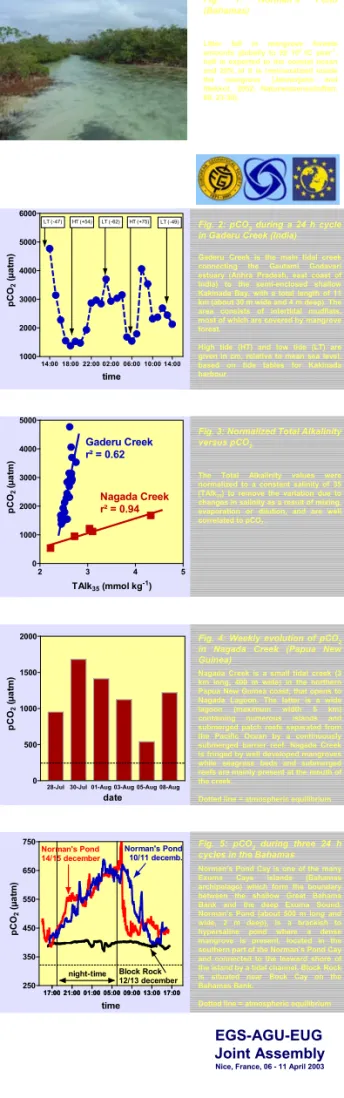
(1)CO2 emission from Mangroves’ surrounding waters. Fig. 1: Norman’s (Bahamas). Pond. Litter fall in mangrove forests amounts globally to 92 106 tC year-1, half is exported to the coastal ocean and 25% of it is remineralized inside the mangrove (Jennerjahn and Ittekkot, 2002, Naturwissenschaften, 89, 23-30).. Alberto Vieira Borges, Bruno Delille and Michel Frankignoulle. Abstract: 6000 LT (-47). HT (+54). LT (-62). HT (+75). LT (-49). Fig. 2: pCO2 during a 24 h cycle in Gaderu Creek (India). 5000. pCO2 (µatm). The partial pressure of CO2 (pCO2) was obtained at daily and weekly time scales in the waters surrounding mangrove forests in Papua New Guinea (Nagada Creek), the Bahamas (Norman=s Pond) and India (Gaderu Creek, delta of the Gautami Godavari estuary). The pCO2 values range from near atmospheric equilibrium to 4800 µatm. Therefore, we can conclude that overall oversaturation of CO2 with respect to atmospheric equilibrium in surface waters seems to be a general rule in tropical and subtropical mangrove ecosystems, in agreement with the net ecosystem heterotrophic status of both water column and sediments. The CO2 atmospheric fluxes computed, at the three study sites converge to about +50 mmol m-2 day-1. If this conservative estimate is extrapolated for worldwide mangrove ecosystems, the global emission of CO2 to the atmosphere would be about 50 million tons of carbon per year. Mangroves= surrounding waters would then be an additional CO2 source of about 12% to the one of open oceanic waters in tropical and subtropical latitudes, with a surface area about one thousand times smaller. Based on this tentative estimate, mangrove surrounding waters appear to be a relatively significant source of CO2 to the atmosphere and should be more thoroughly investigated, especially at seasonal time scale. However, our results also show that the daily variability of dissolved inorganic carbon is very high. It results from the combination of the diel cycle of photosynthesis and respiration and the periodical tidal inundation of the mangrove that affects water column chemistry by the input of porewater with high CO2 and Total Alkalinity (TAlk) contents.. Gaderu Creek is the main tidal creek connecting the Gautami Godavari estuary (Anhra Pradesh, east coast of India) to the semi-enclosed shallow Kakinada Bay, with a total length of 11 km (about 30 m wide and 4 m deep). The area consists of intertidal mudflats, most of which are covered by mangrove forest.. 4000 3000 2000 1000. High tide (HT) and low tide (LT) are given in cm, relative to mean sea level, based on tide tables for Kakinada harbour.. 14:00 18:00 22:00 02:00 06:00 10:00 14:00. Introduction:. time. Methods:. 5000. Fig. 3: Normalized Total Alkalinity versus pCO2. Gaderu Creek r² = 0.62. 4000. pCO2 (µatm). Mangroves are among the most productive coastal intertidal ecosystems in the world, confined to the tropics and subtropics, that dominate approximately 75% of the world’s coastline between 25°N and 25°S, and are estimated to occupy between 0.17 and 0.20 106 km2. Although the mangrove ecosystem as a whole (aquatic, below- and above-ground compartments) is net autotrophic, aquatic primary production is limited by high turbidity, canopy shadow and large changes in salinity. In addition, the water column and sediments receive important quantities of leaf and wood litter from the overlying canopy. Moreover, export of labile organic carbon from mangroves to adjacent aquatic systems, although variable from one site to another, can be low. Thus, the water column and the sediment metabolisms are largely net heterotrophic, and, consequently, the mangrove surrounding waters should act as a net source of CO2 to the atmosphere, although no attempt has been made so far to estimate its magnitude.. The Total Alkalinity values were normalized to a constant salinity of 35 (TAlk35) to remove the variation due to changes in salinity as a result of mixing, evaporation or dilution, and are well correlated to pCO2 .. 3000. Nagada Creek r² = 0.94. 2000 1000. In Nagada Creek in Papua New Guinea (July-August 2000) pH, Total Alkalinity (TAlk), salinity and water temperature were sampled every second day around 10:00 (local time), during 2 weeks. In Norman’s pond (Fig. 1) in the Bahamas (December 2000), we used a floating equilibrator system (FES) to carry out three 24 hours cycles of pCO2, water temperature and wind speed measurements, with an one minute sampling interval. The FES consists of an equilibrator mounted on a buoy, including batteries, a solar panel, air and water temperature probes, an anemometer and a data logger. A non-dispersive infrared gas analyser (Li-Cor, Li-6262) was used to measure pCO2 by equilibration (Frankignoulle, Borges and Biondo, 2001, Water Res. 35: 1344-1347). In India (June 2001), we carried out a 24 h cycle in Gaderu Creek with measurements of pH, TAlk, salinity, temperature sampled with a hourly frequency. For a detailed description of the pH and TAlk measurement methods, the computations of pCO2 from pH and TAlk and the calibration procedure of the Li-6262 refer to Frankignoulle and Borges (2001, Aquat. Geochem. 7: 267-273). Note that the measurements of pCO2 by equilibration and the computed values of pCO2 from pH and TAlk are consistent within ±1.5%.. 0. 2. 3. 4. 5. TAlk35 (mmol kg-1). Results: Fig. 2 shows that, during the 24 h cycle in Gaderu Creek, the lowest pCO2 values are observed at high tide while the highest are observed at low tide. Fig. 3 shows that TAlk and pCO2 are well correlated. To explain this, we suggest the following mechanism: during ebb and at low tide, creek water is strongly affected by the mixing with inflowing mangrove porewater, and, during the flow the migration of porewater towards the creek decreases until the sediment surface is inundated, when it stops. The same process can explain the weekly variability of pCO2 and TAlk in Nagada Creek (Fig. 4). Indeed, the highest pCO2 values were observed either at low tide or during the ebb and pCO2 and TAlk are also well related (Fig. 3). The reason why porewater TAlk is high is unclear. Porewater TAlk can increase in mangrove forest sediments from sulfate reduction, that, along with aerobic respiration, account for almost all the diagenetic carbon degradation in mangroves. The other process that can increase porewater TAlk in mangroves is the dissolution of calcium carbonates (CaCO3) as suggested by Middelburg et al. (1996, Biogeochemistry, 34, 133-155) to interpret the low porewater pH values and the very low to nil CaCO3 content of the sediments of a Kenyan mangrove.. pCO2 (µatm). • TAlk and pCO2 dynamics depend on porewater inputs. 2000. Fig. 4: Weekly evolution of pCO2 in Nagada Creek (Papua New Guinea). 1500. Nagada Creek is a small tidal creek (3 km long, 400 m wide) in the northern Papua New Guinea coast, that opens to Nagada Lagoon. The latter is a wide lagoon (maximum width 5 km) containing numerous islands and submerged patch reefs separated from the Pacific Ocean by a continuously submerged barrier reef. Nagada Creek is fringed by well developed mangroves while seagrass beds and submerged reefs are mainly present at the mouth of the creek.. 1000. 500. 0. The daily change of pCO2 during the two 24 hours cycles in the Bahamas (Fig. 5) follows the general pattern expected from the diel alternation between photosynthesis and respiration. No significant pCO2 signature is associated to low or high tides (not shown). This could be due to the fact that, in this semienclosed system, the tidal amplitude is smaller than outside the pond and the input of porewater is therefore less marked and less dependent on tidal inundation as described for Nagada Creek and Gaderu Creek. Note that the pCO2 values are much higher than at Block Rock. These differences are most probably related to the absence of mangrove forest on Bock Cay and the fact that this cycle was carried out in the open waters of the Bahamas.. The CO2 air-water fluxes were computed from wind speed measurements using the gas transfer velocity formulated by Carini et al. (1996, Biol. Bull., 191, 333-334, 1996). This formulation was preferred to those used for open oceanic waters because mangrove systems are relatively similar to estuary ones from a physical point of view (shallow and relatively sheltered). The computations yield 43.6 ± 33.2 (sd) mmol m-2 day-1 for Nagada Creek, 56.0 ± 100.9 (sd) mmol m-2 day-1 for Gaderu Creek and 13.8 ± 8.3 (sd) mmol m-2 day-1 for Norman’s Pond. We can speculate that oversaturation of CO2 with respect to atmospheric equilibrium is the general rule in the waters surrounding mangrove forests. The computed CO2 air-water fluxes converge to a value of about 50 mmol m-2 day-1. If we extrapolate this conservative value to the surface area of worldwide mangrove ecosystems (-0.2 106 km2) the global emission of CO2 to the atmosphere would be about 50 106 tC year-1. The subtropical and tropical open oceanic waters behave as a net source of CO2 of about 0.43 GtC year-1, between 32°N and 32°S, based on Takahashi et al. (1997, Proc. Nat. Acad. Sci. USA, 94, 8292-8299). Thus, mangrove surrounding waters would be an additional CO2 source of about 12% to the one of open oceanic waters, in tropical and subtropical latitudes, with a surface area about one thousand times smaller.. www.ulg.ac.be/oceanbio/co2/ Acknowledgements: Fonds National de la Recherche Scientifique (Belgium) (contracts numbers 2.4521.96, 2.4594.01, 2.4596.01, 2.4545.02). date. 750. Dotted line = atmospheric equilibrium. Norman's Pond 10/11 decemb.. Norman's Pond 14/15 december. 650. pCO2 (µatm). • Mangroves’ surrounding waters are significant sources of CO2 to the atmosphere. 28-Jul 30-Jul 01-Aug 03-Aug 05-Aug 08-Aug. 550 450 350 night-time 250. Block Rock 12/13 december. 17:00 21:00 01:00 05:00 09:00 13:00 17:00. time. Fig. 5: pCO2 during three 24 h cycles in the Bahamas Norman’s Pond Cay is one of the many Exuma Cays islands (Bahamas archipelago) which form the boundary between the shallow Great Bahama Bank and the deep Exuma Sound. Norman’s Pond (about 500 m long and wide, 2 m deep), is a brackish to hypersaline pond where a dense mangrove is present, located in the southern part of the Norman’s Pond Cay and connected to the leeward shore of the island by a tidal channel. Block Rock is situated near Bock Cay on the Bahamas Bank. Dotted line = atmospheric equilibrium. EGS-AGU-EUG Joint Assembly Nice, France, 06 - 11 April 2003. Université de Liège, MARE, Unité d’Océanographie Chimique, Belgium ([email protected]).

(2)

Figure

Fig. 2 shows that, during the 24 h cycle in Gaderu Creek, the lowest pCO 2 values are observed at high  tide while the highest are observed at low tide

Références

Documents relatifs

CENTER FOR INTERDISCIPLINARY RESEARCH ON MEDICINES 10 Reactor sc CO 2 Lipids in aqueous buffer in supercritical conditions Reactor Liposomes suspension Legend

Des troubles neurologiques sont plus fréquents chez les enfants atteints d’une morphée «en coup de sabre» et chez les adultes présentant la morphée atrophique hémifaciale

Le pharmacien ou l’étudiant en 6 ème année de pharmacie doit prendre rendez-vous avec un patient ayant un traitement avec les anticoagulants oraux directs.

Anthony Riffe1 110 Teachers meet researchers Benjamin

Here we take the external field of the host galaxy NGC1052 into account to predict the expected velocity dis- persion of NGC1052-DF2 in MOND.. This range of variation follows

Afin de comprendre pourquoi la durée du jour affecte le développement de la culture (par exemple la durée du cycle) et semble ne pas affecter les rendements, nous avons