1
Specialized Discourse in Language Tests Axe: 1
Nom: NAOUA Prénom: Mohammed
Université Chahid Hamma Lakhdhar- Eloued - Algerie Faculté des Lettres et Langues
Département des lettres et langue anglaise
Adresse électronique : [email protected] Téléphone: +213558396495
Abstract
Assessing languages for specific purposes refers to the process of making inferences about test takers' language abilities, and about the capacity of using these languages in constrained academic or occupational domains. To make sure that the scores emerging from these tests will reflect the abilities to be measured and nothing else, three types of correspondence need to be provided. First, the characteristics of test takers need to be comparable to those of language users. Second, the constructs intended to be tested should bear some similarities to the competencies of real language users. Finally and most importantly, the test input needs to form a special instance of the specialized discourse related to the examinees' fields of specialty. The main aim of this paper is to highlight the role of specialized discourse in maximizing the interaction between test takers' background knowledge and the test input, which reinforces the concept of construct validity in language tests.
2
Introduction
Tests measuring specialized discourse refer to the instruments that are administered for eliciting information about candidates' capacity of using language in contexts relevant to their own fields of interest, whether academic or occupational (Bachman, 1990; Bachman & Palmer, 1996; Douglas, 2000, 2001, 2005, 2013). According to language testers, this process requires the availability of three types of authenticity. In the first place, the characteristics of test takers should be delimited with respect to the characteristics of real life language users in the target contexts (Bachman, 1990; Douglas, 2000, 2001; Purpura, 2004). Second, the test content should be informed from an extensive analysis of the examinees' specialized discourse relevant to the assessment in question (Basturkmen, 2006, 2010; Basturkmen & Elder, 2004; Hyland, 2006; Widdowson, 1984). Thirdly, the test task characteristics need to be delineated according to the tasks in the target language use domains. The provision of these types of authenticity enables us to build tests, which can validly reflect the abilities intended to be measured (Bachman, 1991; Bachman & Palmer, 1996).
1. Definition of Specialized Discourse
Specialized discourse can be understood as the "the verbal and non-verbal realization of the communicative system" (Widdowson, 1979, p. 43) of a given field of interest. In this context, we can speak of literary discourse, political discourse, scientific discourse, or technology, and technological discourse (Strevens, 1971, 1972). Since this paper is concerned with building tests measuring test takers' abilities in the domain of English for science and technology, we intend to narrow the scope of this research within the discourse of science and technology. Scientific discourse can be defined as "a set of rhetorical acts like giving instructions, defining, classifying, exemplifying, and so on, but the manner in which these acts are related one with the other and the manner in which they are linguistically realized may be restricted by accepted convention" (p. 16). However, before talking about scientific discourse, and its incorporation in language tests, let us first provide some definitions for terms such as English for specific purposes and English for science and technology.
3 1.2. Scientific Discourse
Halliday and Martin (1993) define scientific discourse as a "semiotic space within which there is a great deal of variability at any one time, as well as continuing diachronic evolution" (p. 59). Concerning the diatypic variation, the authors highlight three aspects: field, tenor, and mode. The term 'field' implies that knowledge is ''extended, transmitted, or explored in the physical, biological, or social sciences" (p. 59). 'Tenor' suggests that the transmission of knowledge occurs amongst specialists in the same domain. The mode refers to the channel, which can be phonic or graphic with different rhetorical functions. As for the 'continuing diachronic evolution', this means that scientific discourse is a subject to continuous changes connected with the development that occurs in the field of science or technology.
2. Definition of ESP
Applied linguists incorporate a number of features in the delineation of ESP (Hutchinson & Waters, 1987; Swales, 1990, 1993; Dudley-Evans & St. John, 1998; Basturkmen, 2006, 2010). These include, for instance, outlining the discourse to be taught, specifying the characteristics of the discourse community, describing the target language situations to be encountered by the discourse community, delimiting learners' needs with their instructional material, measuring the gap between learners' needs, and what they need to do so as to attain the learning goals; as well as deciding whether these ESP courses are to be provided during pre-severe or in-service training. The aim is, of course, to provide learners with the instruments, which can help them deal appropriately with the requirements of the target situation, be it academic or vocational (Widdowson, 1979, 1984). Building upon Strevens, 1971, 1972; Widdowson, 1979, 1984, 2000; Hutchinson and Waters, 1987; Swales, 1990, 1993; Dudley-Evans and St. John, 1998, Basturkmen and Elder (2004) define ESP as:
The teaching and research of language in relation to the communicative needs of speakers of a second language in facing a particular workplace, academic, or professional context. In such contexts[,] language is used for a limited range of communicative events…Analysis of language in such events generally reveals that language is used in constrained and fairly predictable ways…LSP courses usually focus on the specific language needs of fairly homogeneous groups of learners in regard to one particular context referred to as the target situation…The aim of such courses is to help the learners deal with the linguistic demands of their academic, workplace, or professional target situations. LSP courses can be “pre-experience” or “post-experience” (pp. 672-3).
4 2.1. Division of ESP
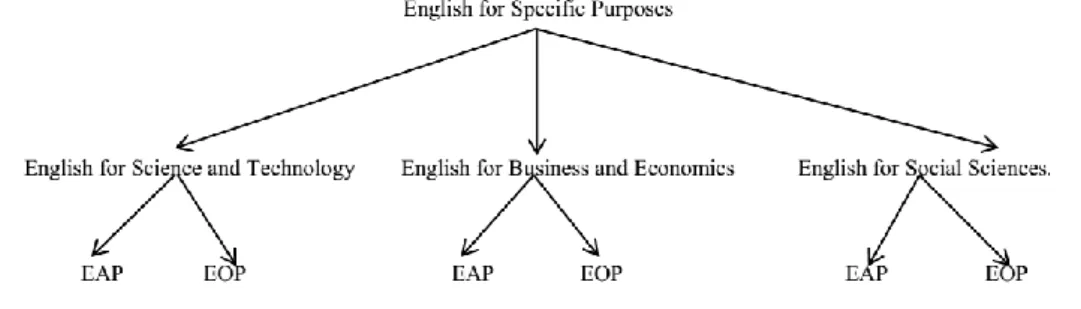
Hutchinson and Waters (1987) organize ESP into three broad sets (see fig. 1): English for science and technology, English for business and economics, and English for social sciences. Within each of these sets, we can identify further subdivisions, such as English for Academic Purposes (EAP) and English for Occupational Purposes (EOP). The former "concerns the learners who need the language for educational purposes such as pursuing studies in a given academic field of interest [while] the second category 'EOP' refers to the use of language with the intention of performing part or all of a job (Douglas, 2000)" (Naoua, 2016, pp. 22-23). EAP, for instance, covers domains such as computer science, engineering, economics, exact sciences, psychology, literature, and so on, and EOP can include discourses for technicians, pilots, medical personnel, car mechanics, and the like (Hutchinson & Waters, 1987; Strevens 1971; Widdowson, 1973).
Fig: 1. Hutchinson and Waters' (1987) Division of ESP
Source: Hutchinson and Waters, 1987, p. 17
2.2. Key Feature of LSP Courses
Two fundamental features that distinguish ESP learning from general instruction. These include needs analysis and target language situations analysis. The first process describes learners' present competency levels; the learning ultimate goals; and what leaners need to do to bridge the gap between their present levels, and what they are supposed to achieve in terms of learning goals by the end of the training courses. The second one outlines the target language situations that learners may encounter during their formal education or in their occupational positions (Hyland, 2006; Widdowson, 1983).
5 2.2.1. Needs Analysis
'Needs analysis' refers to the methods and techniques used for gathering information about the communicative demands of learners engaging in formal or in vocational training courses (Basturkmen & Elder, 2004). This process, which starts with this question: "Why do these learners need to learn [language]? (Hutchinson & waters, 1987, p. 53) attempts to identify two types of needs: target needs and learning needs. The former attempts to identify what learners need to do in the target domain, while the latter describes what learners are required "to do in order to learn" (p. 53). The present situation analysis enables us to identify learners' current language proficiencies, and what they lack in terms of tasks and skills so that they can function effectively in the target situation. Needs analysis seeks "to identify the gap between what students know and can do at the present point of time and what they need ideally to be able to do in the target situation" (Basturkmen & Elder, 2004, p. 674). Douglas (2010) points out that needs analysis techniques include register analysis, discourse analysis and learning needs analysis. The first type focuses on "technical and sub-technical vocabulary and grammatical features" (p. 11). The second type describes the "specific language forms associated with various language use" (p. 11). However, learning needs analysis attempts to highlight "the end product, learning skills for independent learning and language use" (p. 11).
2.2.2. Target Language Situations
Before talking about the analysis of target language situations, let us first define the term register and genre. According to Widdowson (1983), register attempts to describe "areas of use in terms of formal linguistic categories and aims at producing a specification of linguistic competence" (p. 9). However, Genre can be understood as a "communicative event with a goal or set of goals mutually understood by the participants in that event…Such studies (i.e. of genre) differ from traditional register or sub-register analysis in the importance they attach to communicative purposes within a communicative setting (Swales 1981, as cited in Widdowson, 1983, p100). Despite the fact that register, or genre describe the type of language, which is more or less specific to a given discourse community, in the context of LSP we see that the term 'target language contexts, or situations' can refer to other subdivisions within the register or genre themselves, because they delimit the analysis to the
6
specific target tasks within the situations that learns may encounter during their academic studies or in their professional life.
2.3. English for Science and Technology
Building upon the definitions that applied linguists suggest for ESP, we can say that English for science and technology (EST) refers to the teaching and learning, which content and methodology derive from the analysis of registers and or genres relevant to real world participants working, or studying in fields connected to scientific or technology domains. By science, we mean the knowledge that is "concerned with understanding, describing and explaining the nature of the universe, (including, of course,,,, Man). [However,] technology is concerned with how to design, operate and control machines, devices and instruments" (Strevens, 1972, p. 6).To distinguish between the terms 'technology' and 'technical', Strevens explains that the latter is "concerned with how to construct and maintain the devices invented by technology according to the principles established in science" (p. 6). Accordingly, Strevens provides a clear distinction between 'scientific English' and 'technological English'. According to the author the former "uses the full range of general and scientific concepts, philosophical as well as methodological; it uses the stock of international scientific terminology based on Greek and Latin roots, the terms of particular branches of science, and other coinings" (p. 6). However, technological English makes less use of general conceptual language than does scientific English "but it makes full use of special vocabulary and is strong in its use of numerical quantification and mathematical symbols; there is more reference to the concrete and the practical" (p.6).
3. Specialized Discourse Tests
Specialized discourse tests refer to the instruments, which are administered to test takers for the purposes of gathering information about their specific language abilities and about using these abilities in specific target contexts (Alderson & Palmer, 2000-2006; Bachman, 1990, 1991; Bachman & Palmer, 1996; Douglas, 2000, 2001, 2005, 2012). These tests develop their content and method from the analysis of learners' needs, and the measurement to which these needs can correspond to tasks in target situations to which the test scores are to be generalized. The authenticity between learners' needs and the target contexts, which they may encounter, enables test takers' language and background knowledge
7
to interact positively with the test content, leading to the production of more valid and reliable measurement instruments. This is, of course, what Douglas refers to when he writes:
3.1. Main Features of LSP Tests
Applied linguists and language testers distinguish three features that characterize specialized discourse tests: specificity of content, authenticity of task, and interaction between background knowledge and the test input. The first aspect delimits learners' specific target needs in order to specify the content in question. Of course turning to subject specialist informants can help us include the more specific material clues; and the latter can help test developers "ensure that test takers will engage an appropriate discourse domain" (Douglas, 2000, p. 90). This because "the more highly specialized test content becomes, the greater the influence of specific purpose background knowledge" (p. 90). The second feature 'authenticity of task' results from measuring the extent of correspondence between the test tasks and the target language contexts to which test scores will be generalized, or the situations that test takers may encounter in their academic or occupational life. Language testers emphasize that construct validity as a unitary concept "can only be said to have been achieved if there is a demonstrable correspondence between the task on a test and the corresponding target language use situation, such that the task succeeds in engaging the relevant language abilities of the test-taker" (Basturkmen & Elder, 2004, p. 685). Concerning background knowledge and its interaction with the test input, this is what distinguishes ESP tests from general language ability tests (Bachman & Palmer, 1996; Basturkmen, 2006, 2010; Basturkmen & Elder, 2004; Douglas, 2000, 2001, 2005, 2010; 2012; Hutchinson & waters, 1987). This is because in general language ability tests background knowledge is considered as a construct irrelevant variance, which leads to higher or lower invalid scores. Conversely, in specialized discourse tests learners are supposed to be homogeneous and specific material helps their background knowledge to be engaged by the test specific input (Douglas, 2000, 2001, 2005, 2010).
A specific language test is the one in which content and method are derived from an analysis of specific purpose target language use situation, so that test tasks and content are authentically representative of tasks in the target situation, allowing for an interaction between the test takers' language ability and specific purpose content knowledge, on the one hand, and the test tasks on the other. Such a test allows us to make inferences about test takers' capacity to use language in the specific purpose domain. (Douglas, 2000, p. 19)
8
3.2. Characteristics of Specialized Discourse Tasks
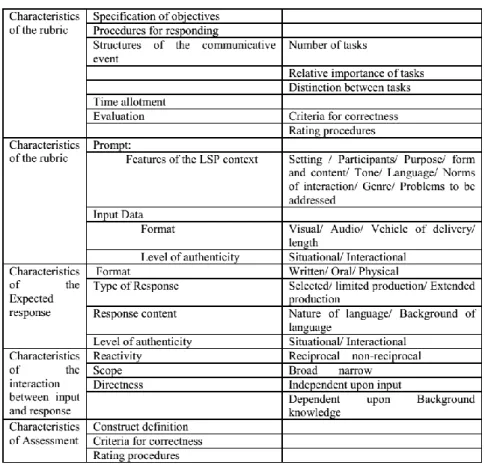
Building upon Bachman (1990, 1991) and Bachman and Palmer (1996), Douglas (2000) outlines a framework of test task characteristics, which can be used as a checklist for developing operational tests. This framework includes characteristics of the rubric, the input, the expected response, the interaction between input and response, and characteristics of the assessment (see Table 1). The first feature specifies the way that examinees "are expected to proceed in taking the test" (Bachman, 1990, p. 118). Concerning the input, we can explain it with reference to both target language situations, and testing contexts. In relation to the former, it can be defined as "the specific purpose material…that language users process and respond to" (Douglas, 2000, p. 56). However, in assessment, it can refer to "the information contained in a given test task, to which the test taker is expected to respond" (Bachman, 1990, p. 125). The expected response refers to "the physical response we are attempting to elicit by the way the instructions have been written, the task designed and by the kind of input provided" (Bachman and Palmer, 1996, p. 53). Language testers distinguish between expected responses and actual responses (Bachman, 1990, Bachman and Palmer, 1996, Douglass, 2000, Purpura, 2004). The former "refer to what item writers expect of test takers to respond; while the latter may include unexpected information on the part of test takers" (Naoua, 2016, p. 88). The fourth feature of test tasks, which measures the extent of interaction between input and response, is explained with respect to three factors: reactivity, scope, and directness (Bachman and Palmer, 1996, Douglass, 2000, Luoma, 2004, Weigle, 2000). Bachman and Palmer (1996) define reactivity as "the extent to which the input or the response directly affects subsequent input and responses" (p.55). The scope of the relationship delineates the range of information that test takers need to proceed so that they can respond in the way that it is expected (Bachman and Palmer, 1996, Douglass, 2000). The scope can be defined as 'broad' if test takers process a lot of input, and it can be delineated as 'narrow' in case the amount of input is restricted. The fifth feature is assessment, which is "derived from an analysis of the specific purpose TLU situation, this time focusing on the definition of the construct, the features of specific purpose language ability necessary for performing TLU tasks, and the procedures for carrying out the assessment" (Douglas, 2000, p. 67).
9
Table 1: Test Task Characteristics
Source: Douglass, 2000, pp. 51-52
Conclusion
Tests measuring specialized discourse can be defined as the tools, which are administered for gathering information about learners' levels of specific language competence, and about using this competence in real-world interaction (Bachman & Palmer, 1996). Building these measures results from an extensive analysis of the situations that these learners may encounter in their vocational life, or during their further studies. This analysis leads us to ensure three types authenticity. We can consider the test input as a special instance of real language use. Tasks in the test will bear similarity to tasks in real contexts; and finally yet importantly, the characteristics of test takers will be delineated on the basis of real life participants. The availability of these features enables us to build more valid and reliable tests.
10 Reference List
Alderson, J, C., & Bachman, L. F. (Eds.). (2000–2006). The Cambridge language assessment
series. Cambridge: Cambridge University Press.
Bachman, L. F. (1990). Fundamental Considerations in Language Testing. Oxford: Oxford University Press.
Bachman, L. F. (1991). What does language testing have to offer? TESOL Quarterly, 25 (4), 671-704. From http://www.jstor.org.www.sndl1.arn.dz/stable/pdfplus/3587082.pdf. Bachman, L. F., & Palmer, A. S. (1996). Language testing in practice. Oxford: Oxford
University Press.
Basturkmen , H. (2010). Developing courses in English for specific purposes . Basingstoke, UK : Palgrave/ Macmillan.
Basturkmen, H. (2006). Ideas and Options in English for Specific Purposes. Mahwah, NJ: L. Erlbaum Associates.
Basturkmen, H., & Elder, C. (2004). The practice of LSP. In A. Davies & C. Elder (Eds.), The
handbook of applied linguistics (pp. 672–694). Oxford: Blackwell.
Douglas, D. (2000). Assessing Languages for Specific Purposes. Cambridge: Cambridge University Press.
Douglas, D. (2001). Three problems in testing language for specific purposes: Authenticity, specificity and inseparability. In C Elder et al (Eds). Experimenting with uncertainty:
Essays in honour of Alan Davies (pp. 45-51). Cambridge: Cambridge University
Press.
Douglas, D. (2005). Testing Language for Specific Purposes. (2005).In H. Hinkel (ed.),
Handbook of research in second language teaching and learning. (pp.857-868).
Douglas, D. (2010). Understanding Language Testing. London: Hodder Education. Mahwah, NJ: London,, UK: Lawrence Erlbaum Associates Publishers.
Douglas, D. (2013). ESP and assessment. In B, Paltridge & S, Starfield (Eds). The handbook
of English for specific purposes, (pp. 367-383). England, Chichester: John Wiley &
Sons, Inc
Dudley-Evans, T., & St. John, M. (1998). Developments in English for Specific Purposes. Cambridge: Cambridge University Press.
Fulcher, G., & Davidson, F. (2007). Language testing and Assessment. An advanced resource
11
Fulcher, G., & Davidson, F. (2009). Test architecture, test retrofit. Language Testing, 26 (1) 123–144. http://ltj.sagepub.com/cgi/content/abstract/26/1/123
Halliday, M. A. K., McIntosh A., &. Strevens P. (1964).The Linguistic Sciences and Language Teaching. (Longmans' Linguistic Library.) London: Longman.
Halliday, M. A. K., & Hasan, R. (1985). Language, Context, and Text: Aspects of Language
in a Social-semiotic Perspective. Geelong, Vic.: Deakin University Press.
Halliday, M.A.K., & Martin, J.R. (1993). Writing science: Literacy and discursive power.
London, UK: The Falmer Press.
Halliday, M.A.K., & Martin, J.R. (1993). Writing science: Literacy and discursive power. London: The Falmer Press.
Hutchinson, T., & Waters, A. (1987). English for Specific Purposes: A learning-centered
approach. Cambridge: Cambridge University Press.
Hyland, K. (2006) English for academic purposes: An advanced resource book (London: Routledge).
Luoma, S. (2004). Assessing speaking. Cambridge: Cambridge University Press.
Mumby, J. (1978). Communicative syllabus design. Cambridge, UK: Cambridge University Press.
Naoua, M. (2016). An evaluation of English language testing in the Baccalaureate
examination.Unpublished Ph.D. Thesis. Mentouri Brothers University, Constantine
Strevens, P. (1969). The Medium of instruction (mother-tongue/second language) and the formation of scientific concepts. Document Resume. Washington: U.S. Department of Health, Education and Welfare Office of Education.
Strevens, P. (1972). Technical, technological, and scientific English (TTSE). Paper presented at the international association of teachers of English as a foreign language conference in London. Document Resume. Washington: U.S. Department of Health, Education and Welfare Office of Education.
Strevens, P., et al. (1971). Science and Technology in a Second Language: Papers from a Seminar Held at the University of Birmingham from 27th to 29 March. Document Resume. London: Centre for Information on Language Teaching.
Swales , J. M. ( 1990 ). Genre Analysis: English in Academic and Research Settings. Cambridge: Cambridge University Press.
Swales, J. (2000). Languages for specific purposes. Annual Review of Applied Linguistics 20, 59–76. From http://dx.doi.org/10.1017/S026719050020
12
Weigle, S, C. (2000). Assessing writing. Cambridge: Cambridge University Press.
Widdowson, H. G. (1973). An applied linguistic approach to discourse analysis. Unpublished Ph.D. thesis. University of Edinburgh, Edinburgh.
Widdowson, H. G. (1978). Teaching language as communication. Oxford: Oxford University Press.
Widdowson, H. G. (1979). Explorations in Applied Linguistics1. Oxford: Oxford University Press.
Widdowson, H. G. (1983). Learning purpose and language use. London: Oxford University Press
Widdowson, H. G. (1984). Explorations in Applied Linguistics 2. Oxford: Oxford University Press
Widdowson, H. G. (2001). Communicative language testing: The art of the possible. In C.A. Elder., et al (eds.). Experimenting with uncertainty: Essays in honour of Alan Davies (pp. 12- 21). Cambridge, UK: Cambridge University Press; UCLES
Widdowson, H. G. (2003). Defining Issues in English Language Teaching. Oxford: Oxford University Press.
Widdowson, H. G. (2004). Text, context, pretext Critical issues in discourse analysis. Oxford: Blackwell Publishing Ltd.