Material and Methods
Since 1998, the Belgian surveillance program has assessed the contamination with E. coli of meat from beef, pork, layers, broilers, turkeys and fish. The following matrixes were sampled for E. coli:
- swabs of: beef and calf carcasses (4 zones on a half beef carcass for about 400 cm2in 1998 and 1600cm2since 1999), pork carcasses (4 zones on a half pork carcass for about 600 cm2)
- minced meat of beef, retail cuts and minced meat of pork, skin and boneless breast of broilers, skin of layers and turkeys and, in 2000 meat products (ham, pâté, salami).
In 2001, the contamination level of beef and pork carcasses, and meat products with Enterobacteriaceae has been assessed. In 2001, the total plate count was also realised from beef and pork carcasses.
The E. coli count (in cfu/g or cm2) has been realised with the AFNOR validated SDP-07/1-07/93 using the chromogenic Rapid E. coli 2 medium (Bio-Rad) with an incubation during 24h at 44°C. The total plate count followed the NF-V-08-051 method (PCA at 30°C during 48-72h) and the enumeration of Enterobacteriaceae was realised using the NF-V-08-054 method (VRBG at 30°C during 24h).
Introduction
The faecal contamination is likely the main source of potential human pathogens including Salmonella, Campylobacter and enterohemorrhagic
Escherichia coli on animal carcasses and in meat. Leakage from the gastrointestinal tract or contact with the animal skin could cause widespread
contamination. In warm-blooded animals, the best indication of faecal contamination is Escherichia coli. This microorganism is widely present in the gastrointestinal tract and survives under refrigerated conditions but temperatures below 7°C prevent its growth.
The USDA has chosen E. coli as indicator of faecal contamination and the enumeration of E. coli has to be done mandatory for all industries commercialising meat in United States of America.
In its Decision of 8 June 2001 (2001/471/EC), the European Commission lays down the Enterobacteriaceae and total viable counts as regular checks on general hygiene in establishments producing and marketing fresh meat. However, after establishing appropriate criteria, E. coli counts may be used instead of Enterobacteriaceae counts.
The Belgian meat surveillance between 1998 and 2001 has allowed the evaluation of the sampling method and has proposed criteria for E. coli,
Enterobacteriaceae and total plate counts.
This study was financially supported by the Institute of Veterinary Expertise (Public Health).
Assessment of microbiological criteria for regular checks of faecal contamination
and general hygiene in Belgian establishments producing meat
Y. Ghafir1, M. Cornelis4, M. Jouret4, K. Dierick2, L. De Zutter3, G. Daube1
1Food Microbiology, Faculty of Veterinary Medicine, University of Liege, Liege 3Food Microbiology, Faculty of Veterinary Medicine, University of Gent 2Public Health Institute - Louis Pasteur, Brussels, Belgium 3Food Microbiology, Faculty of Veterinary Medicine, University of Gent, 4Institute of Veterinary Expertise (Public Health), Brussels, Belgium
Results and discussion
This study of E. coli contamination allowed the estimation of the sanitary level of Belgian companies and the follow-up of each establishment since 1998. In poorly contaminated matrixes (cattle and pork), as a general rule, the prevalence of pathogens is directly linked to the E. coli level of the establishment. This in not the case for poultry, which is highly contaminated with Salmonella and Campylobacter.
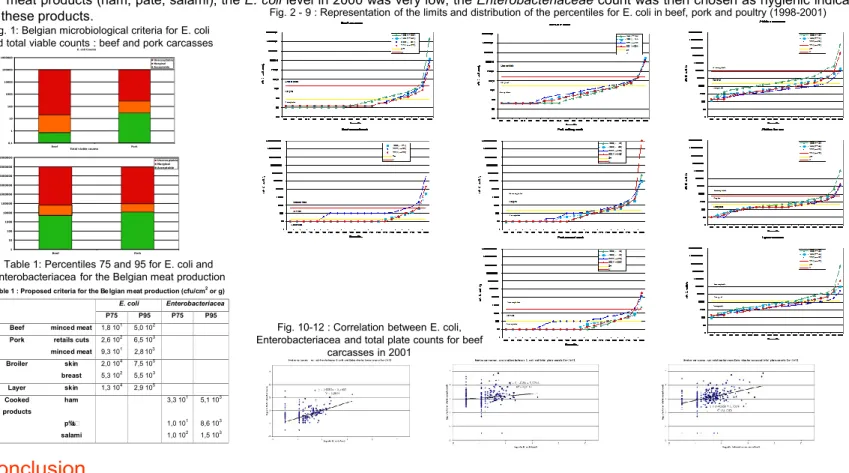
The proposed criteria for E. coli, Enterobacteriaceae and total plate counts are based on the percentiles 75 and 95 of the screening plans of 2000 and/or 2001 and are showed in Table 1. The criteria for pork and bovine carcasses (Fig. 1) are these of the Belgian legislation, according to the Decision of 8 June 2001 (2001/471/EC). The representation of the E. coli percentiles from 1998 to 2001 (Fig. 2-9) is showing that the fecal contamination in Belgian establishment is stable and the monitoring plans representative of the Belgian situation.
The determination of the correlation between E. coli, total plate count and Enterobacteriaceae in beef and pork carcasses (Fig. 10-12 : example of beef carcasses) showed that there is a clear relation between E. coli and Enterobacteriaceae counts, but that there is no relation between the counts of E. coli or Enterobacteriaceae and the total plate counts.
Because of the specificity of E. coli as faecal indicator and of the fact that the Enterobacteriaceae counts are integrated in the total plate count, the
E. coli and total plate counts have been chosen respectively as faecal and global hygienic indicators for beef and pork carcasses.
For meat products (ham, pâté, salami), the E. coli level in 2000 was very low; the Enterobacteriaceae count was then chosen as hygienic indicator for these products.
Conclusion
E. coli and total plate counts are a good mean to evaluate hygienic measure efficacy in meat industry, especially for abattoirs. For internal quality
control, companies should use the same sampling method and criteria. They will allow an evaluation of the contamination level of each industry, and of preventive measure efficacy.
Fig. 1: Belgian microbiological criteria for E. coli and total viable counts : beef and pork carcassesE. coli Counts
0,1 1 10 100 1000 10000 100000 1000000 Beef Pork Unacce ptable Marginal Acceptable
Table 1: Percentiles 75 and 95 for E. coli and Enterobacteriacea for the Belgian meat production
Fig. 2 - 9 : Representation of the limits and distribution of the percentiles for E. coli in beef, pork and poultry (1998-2001)
Fig. 10-12 : Correlation between E. coli, Enterobacteriacea and total plate counts for beef
carcasses in 2001
Table 1 : Proposed criteria for the Be lgian meat production (cfu/cm2 or g) E. coli Enterobacteriacea
P75 P95 P75 P95
Beef minced meat 1,8 101
5,0 102 Pork retails cuts 2,6 102
6,5 103 minced meat 9,3 101 2,8103 Broiler skin 2,0 104 7,5 105 breast 5,3 102 5,5 103 Layer skin 1,3 104 2,9 105 Cooked products ham 3,3 101 5,1 103 p‰t 1,0 101 8,6 103 salami 1,0 102 1,5 103
Total viable counts
1 10 100 1000 10000 100000 1000000 10000000 100000000 1000000000 10000000000 Beef Pork Unacce ptable Marginal Acceptable