HIDDEN COOPERATION:
How Nuclear Antagonists Collaborated on Counter-Narcotics
Efforts in Iran from 2007 to 2011
Mémoire
Myriam Ménard
Maîtrise en études internationales
Maître ès arts (M.A.)
Québec, Canada
RÉSUMÉ
L'Iran est depuis longtemps considéré comme un État paria sur la scène internationale en raison de son programme nucléaire. Pourtant, les mêmes États qui ont publiquement dénoncé les ambitions nucléaires de l'Iran ont collaboré avec les autorités iraniennes à la lutte anti-drogue. Cette recherche explore comment les membres de la communauté internationale ont formulé leur discours public sur l'Iran afin de justifier à la fois leur coopération avec l‟Iran contre les stupéfiants et leur dénonciation du programme nucléaire. Les déclarations politiques de sept gouvernements ayant fourni une assistance à la lutte anti-drogue de l‟Iran de 2007 à 2011 ont été systématiquement analysées à l'aide de l'analyse de contenu qualitative et de l'analyse de discours. Notre analyse a révélé que ces pays ont entretenu des représentations contradictoires, construisant l‟Iran simultanément comme un ennemi et un partenaire. Ces résultats suggèrent que la confrontation nucléaire avec l'Iran résulte des pratiques discursives d‟acteurs internationaux.
ABSTRACT
Iran has long been considered as a pariah state in international affairs due to the development of the country‟s nuclear program. Yet, the very same states that have denounced Iran‟s nuclear ambitions and pushed for the imposition of international sanctions have collaborated with Iranian authorities on counter-narcotics issues. This research explores how members of the international community framed their public discourse on Iran in order to justify both counter-narcotics cooperation with Iran and denunciation of the country‟s nuclear program. The political statements of seven governments that provided assistance to Iran‟s counter-narcotics efforts from 2007 to 2011 were systematically analysed with the help of Qualitative Content and Discourse analyses. Our analysis revealed that these donor countries held contradictory representations of Iran, constructing it simultaneously as an enemy and a partner. These findings suggest that nuclear confrontation with Iran is not inevitable but rather results from the discursive practices of international actors.
TABLE OF CONTENTS
RÉSUMÉ III
ABSTRACT V
TABLE OF CONTENTS VII
LIST OF TABLES XI
LIST OF FIGURES XIII
LIST OF ABBREVIATIONS XV
ACKNOWLEDGEMENTS XVII
CHAPTER 1
ANTAGONISTIC PARTNERS: HOW NUCLEAR OPPONENTS COLLABORATED ON
COUNTER-NARCOTICS ISSUES FROM 2007 TO 2011 1
1. RESEARCH PROBLEM CONTEXTUALIZED:COUNTER-NARCOTICS INVOLVEMENT AND NUCLEAR NON
-PROLIFERATION IN SOUTH WEST ASIA 1
1.1 THE AFGHAN OPIUM TRADE PROBLEM:PROVIDING INTERNATIONAL ASSISTANCE TO IRAN’S COUNTER
-NARCOTICS EFFORTS 2
1.2 THE IRANIAN NUCLEAR ISSUE:OPPOSING DEVELOPMENTS OF IRAN’S NUCLEAR PROGRAM 6
2. RESEARCH QUESTION 10
3. RESEARCH OBJECTIVES 11
4. ORGANIZATION 12
CHAPTER 2
THE MAKING OF A PARADOX: NUCLEAR DEVELOPMENT AND DRUG CONTROL IN IRAN,
2007-2011 13
1. POLICY RESPONSES TO THE IRANIAN NUCLEAR ISSUE:THE INFLUENCE OF INTERESTS,ALLIANCES AND
PERCEPTIONS 13
1.1 EUROPEAN UNION-IRAN RELATIONS:YO-YOING BETWEEN ENGAGEMENT AND CONFRONTATION 14
1.2 FRANCE-IRAN RELATIONS:ADISPLAY OF FRANCE’S ASPIRATION TO BE A KEY PLAYER IN INTERNATIONAL
AFFAIRS 15
1.3 UK-IRAN RELATIONS:CONSTRAINED BY TRANSATLANTIC RELATIONS AND DOMESTIC POLITICS 17 1.4 US-IRAN RELATIONS:AMUTUAL ANIMOSITY THAT DICTATES THE CONDUCT OF INTERNATIONAL AFFAIRS
1.5 JAPAN-IRAN RELATIONS:MAINTAINING A DELICATE BALANCE BETWEEN ENERGY AND MILITARY SECURITY
20 2. THE IRANIAN NUCLEAR CRISIS:COMPETING ANALYSES FROM THE PERSPECTIVE OF THE NEO-REALIST,NEO
-LIBERAL AND CONSTRUCTIVIST THEORIES OF INTERNATIONAL RELATIONS 22
3. DRUG CONTROL IN IRAN:PROBLEMS AND POLICY REPONSES 25
4. INTERNATIONAL COOPERATION IN DRUG CONTROL:AFIELD OF STUDY THAT REMAINS LARGELY OVERLOOKED
30
4.1 THE INTERNATIONAL DRUG CONTROL REGIME:APROHIBITIONIST FRAMEWORK THAT CONSTRAINS POLICY
OPTIONS FOR NATIONAL GOVERNMENTS 31
4.2 THE MERIDA INITIATIVE:ASECURITY PARTNERSHIP THAT PRESENTS SIMILARITIES TO THE CASE OF
COUNTER-NARCOTICS COOPERATION WITH IRAN 34
CHAPTER 3
UNDERSTANDING PUBLIC DISCOURSE: CONSTRUCTIVISM, QUALITATIVE CONTENT ANALYSIS
AND DISCOURSE ANALYSIS 37
1. THEORETICAL FRAMEWORK 37
1.1 ON THE SOCIAL CONSTRUCTION OF INTERNATIONAL RELATIONS 37 1.2 ON THE SOCIAL CONSTRUCTION OF CRIME 41 1.3 THEORETICAL JUSTIFICATION:PUSHING ANALYSIS BEYOND MATERIAL CAPABILITIES AND EXOGENOUS
INTERESTS 43
2. METHODOLOGICAL FRAMEWORK 45
2.1 QUALITATIVE CONTENT ANALYSIS 46
2.2 DISCOURSE ANALYSIS 46
2.3 METHOD OF DATA COLLECTION 48
2.4 ANALYSIS GRID 56
CHAPTER 4
THE POLITICS OF NUCLEAR ISOLATION AND COUNTER-NARCOTICS COOPERATION WITH IRAN,
2007-2011 59
1. THE POLITICS OF NUCLEAR CONFRONTATION:QUALITATIVE CONTENT ANALYSIS OF DONOR COUNTRIES’
POLITICAL STATEMENTS ON THE IRANIAN NUCLEAR ISSUE 59
1.1 2007:“NORMALIZED”LEVEL OF POLITICAL TENSIONS 60
1.2 2008:NUCLEAR TALKS PROVE INCONCLUSIVE 62
1.3 2009:STALEMATE AND SHATTERED CONFIDENCE 64
1.4 2010:ESCALATING RHETORIC AGAINST IRAN’S NUCLEAR PROGRAM 66 1.5 2011:POLITICAL TENSIONS RISE TO NEW HEIGHTS 68
2. THE POLITICS OF COUNTER-NARCOTICS COOPERATION:QUALITATIVE CONTENT ANALYSIS OF DONOR
COUNTRIES’POLITICAL STATEMENTS ON THEIR ASSISTANCE TO IRAN’S COUNTER-NARCOTICS EFFORTS 69
2.1 ITALY:FAVOURABLE TO STRONG COUNTER-NARCOTICS COOPERATION WITH IRAN 70 2.2 GERMANY:CONVEYING POSITIVE REPRESENTATIONS OF IRAN’S COUNTER-NARCOTICS EFFORTS 73 2.3 FRANCE:CAREFUL DISCRETION HINTING AT THE LEGITIMACY OF MULTILATERALISM 76 2.4 THE UK,JAPAN,BELGIUM AND IRELAND:COMPLETE RADIO SILENCE 78
3. QUALITATIVE CONTENT ANALYSIS OF IRAN’S RESPONSE TO NUCLEAR ISOLATION AND COUNTER-NARCOTICS
COOPERATION 79
3.1 IRAN’S RESPONSE TO NUCLEAR ISOLATION:INCREASING CONFRONTATIONAL RHETORIC 79 3.2 IRAN’S RESPONSE TO COUNTER-NARCOTICS COOPERATION:REITERATED COMPLAINTS ABOUT POOR
INTERNATIONAL ASSISTANCE 85
CHAPTER 5
CONFLICTING REPRESENTATIONS OF IRAN 89
1. DISCOURSE ANALYSIS OF DONOR COUNTRIES’POLITICAL STATEMENTS ON THE IRANIAN NUCLEAR ISSUE:
CARRYING NEGATIVE REPRESENTATIONS OF IRAN 89
1.1 FRAME 1:IRAN’S NUCLEAR PROGRAM AS SECURITY THREAT 89 1.2 FRAME 2:IRAN’S NUCLEAR PROGRAM AS A BREACH IN INTERNATIONAL OBLIGATIONS 91 1.3 FRAME 3:IRAN AS A CUNNING ACTOR 93
1.4 FRAME 4:IRAN AS NON-COOPERATIVE ACTOR 94 1.5 FRAME 5:NUCLEAR ISOLATION AS INEVITABLE AND NECESSARY 96 2. DISCOURSE ANALYSIS OF DONOR COUNTRIES’POLITICAL STATEMENTS ON COUNTER-NARCOTICS
COOPERATION WITH IRAN:CONVEYING POSITIVE REPRESENTATIONS OF IRAN 97
2.1 FRAME 1:IRAN’S COUNTER-NARCOTICS EFFORTS AS GOOD PRACTICES 98
2.2 FRAME 2:IRAN AS A STRATEGIC PARTNER IN THE FIGHT AGAINST THE AFGHAN DRUG TRADE 99
2.3 FRAME 3:INTERNATIONAL COUNTER-NARCOTICS COOPERATION WITH IRAN AS POSITIVE YET CHALLENGING
100
CHAPTER 6
THE PARADOX OF CONFLICTING DISCOURSES EXPLAINED: DISCUSSING THE IMPACTS OF
STRATEGY, INSTITUTIONS, MANICHAEISM, POWER AND CONTEXT 103
1. CONFLICTING REPRESENTATIONS OF IRAN:AVOLUNTARY,CALCULATED AND STRATEGIC PARADOX? 103 2. CONFLICTING REPRESENTATIONS OF IRAN:APARADOX DUE TO THE MULTIPLICATION OF POLITICAL ACTORS
AND INSTITUTIONS? 106
3. CONFLICTING REPRESENTATIONS OF IRAN:APARADOX CREATED BY MANICHEAN DISCOURSES? 109 4. CONFLICTING REPRESENTATIONS OF IRAN:THE DISTRIBUTION OF POWER 110
CHAPTER 7
CONCLUSION 123
1. FINDINGS:THE POWER OF SILENCE AND THE SHIELD OF MULTILATERALISM 123
2. CONTRIBUTIONS TO THE FIELD:FILLING THE GAPS 125
3. AVENUES FOR FURTHER RESEARCH 127
ANNEX 1
COMPARATIVE TIMELINE OF THE POLITICS OF NUCLEAR CONFRONTATION AND
COUNTER-NARCOTICS COOPERATION WITH IRAN, 2005-2011 129
LIST OF TABLES
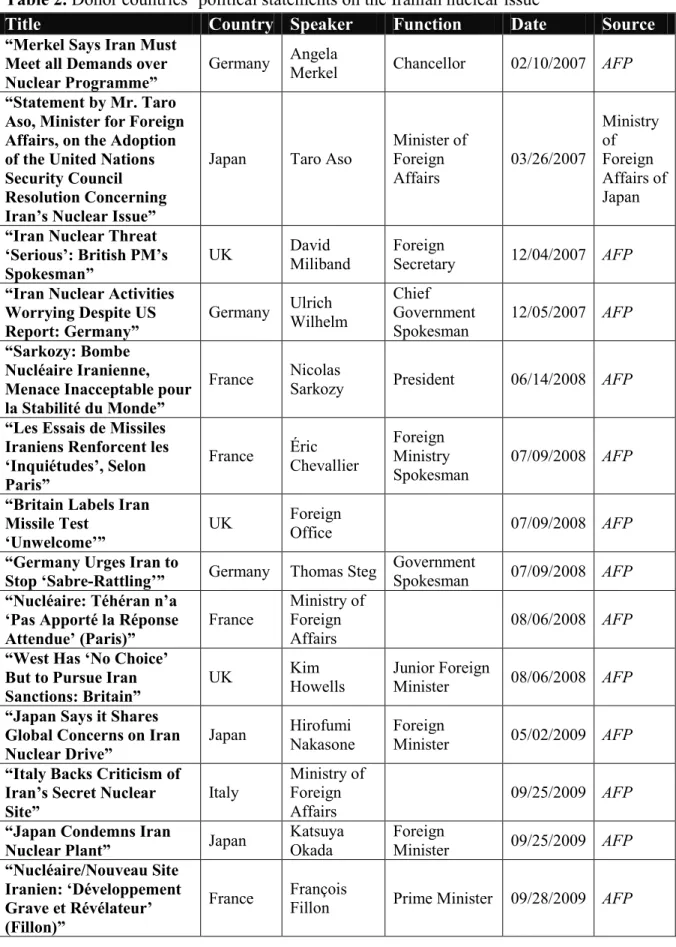
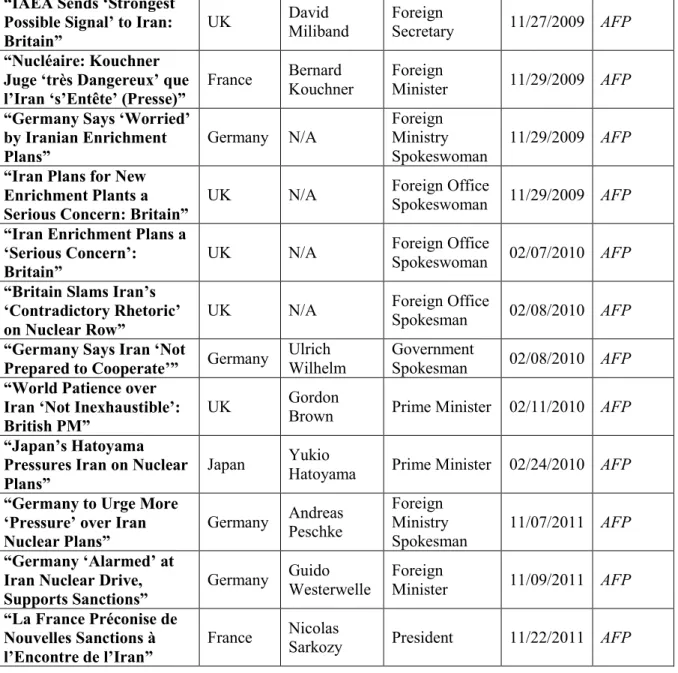
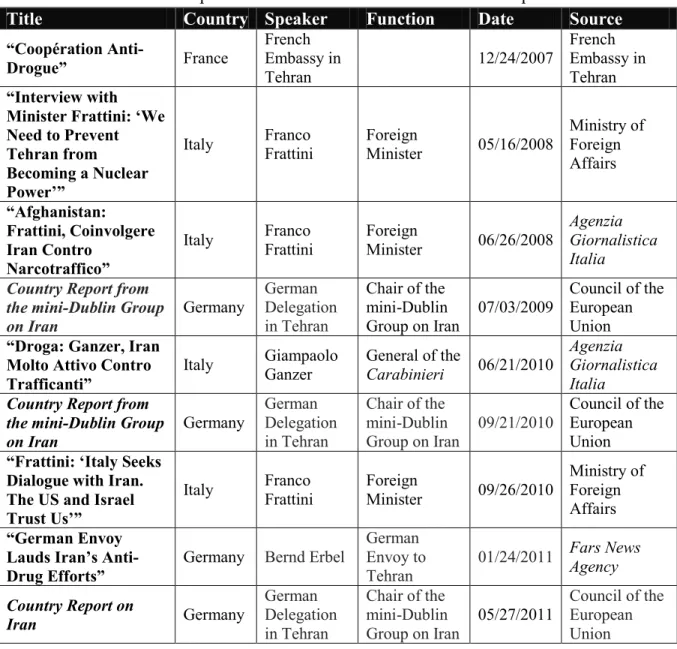
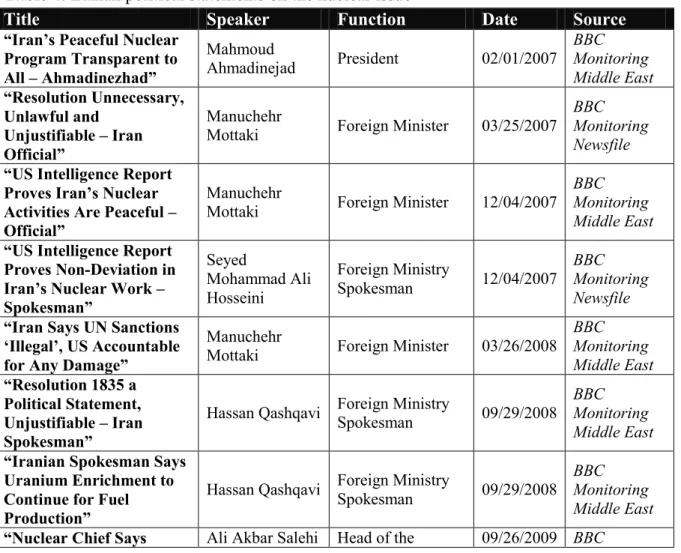
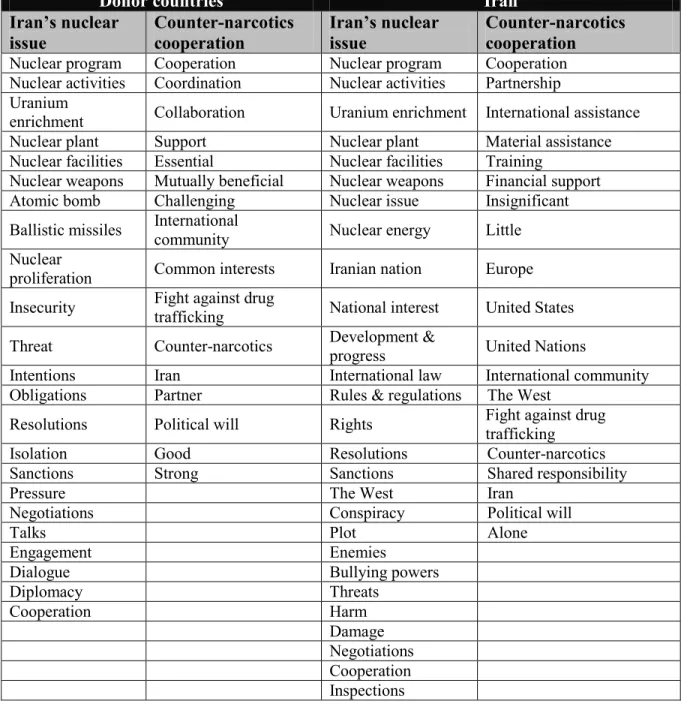
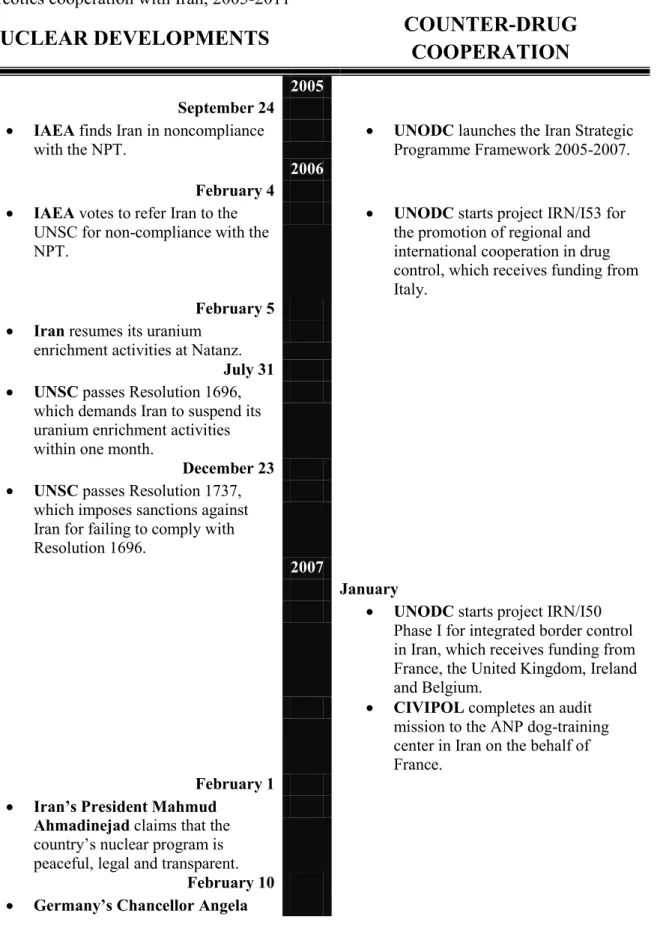
Table 1. Financial requirements for the UNODC Iran Strategic Programme Framework 2005-2007 _______ 4 Table 2. Donor countries‟ political statements on the Iranian nuclear issue __________________________ 51 Table 3. Donor countries‟ political statements on counter-narcotics cooperation with Iran ______________ 53 Table 4. Iranian political statements on the nuclear issue ________________________________________ 54 Table 5. Iranian political statements on the international assistance to Iran‟s counter-narcotics efforts ____ 56 Table 6. Analytical codes _________________________________________________________________ 57 Table 7. Comparative timeline of the politics of nuclear isolation and international counter-narcotics
LIST OF FIGURES
LIST OF ABBREVIATIONS
AEOI Atomic Energy Organization of Iran
ANP Anti-Narcotics Police
BLO Border Liaison Offices
CERIUM Centre d‟études et de recherches internationales de l‟Université de Montréal
CND Commission on Narcotic Drugs
DCHQ Drug Control Headquarters
DLO Drug Liaison Officers
DTOs Drug Trafficking Organizations
ECO Economic Cooperation Organization
EU European Union
E3 France, Germany and the United Kingdom
GPG All-Party Parliamentary Group for the Prevention of Genocide and Other Crimes Against Humanity
G8 Group of Eight
G20 Group of Twenty
IAEA International Atomic Energy Agency
IR International Relations
IRN/I50 Integrated Border Control in Iran
IRN/I52 Promotion and Strengthening of Intelligence-Led Investigations Capacities
IRN/I53 Promotion of Regional and International Cooperation in Drug Control
IRN/I55 Nationwide Drug Prevention Measures in the Islamic Republic Iran
LEF Law Enforcement Forces
MDG Mini-Dublin Group
MIGS Montreal Institute for Genocide and Human Rights Studies
MoU Memorandum of Understanding
NCRI National Council of Resistance in Iran
NPT Nuclear Non-Proliferation Treaty
P5+1 Five Permanent Members of the UNSC plus Germany
QCA Qualitative Content Analysis
ROS Raggruppamento Operativo Speciale UK United Kingdom
UN United Nations
UNGA United Nations General Assembly
UNODC United Nations Office on Drugs and Crime
UNSC United Nations Security Council
US United States
WWII World War II
ACKNOWLEDGEMENTS
This thesis is the result of two years of active research, writing and editing. It could not have been successfully completed without the help of my two supervisors, Professors Aurélie Campana and Stéphane Leman-Langlois. I am grateful for their patience, dedication and support. Their constructive feedbacks were instrumental in the development and completion of this research.
I would also like to thank my family and friends for being supportive throughout this academic journey. Special thanks to Sami joon for instilling courage in times of doubts, giving me space in times of effervescent inspiration and for his incommensurable patience as I rode the rollercoaster of research practice.
Lastly, I would like to thank Columbia University for granting me borrowing privileges and access to their libraries. More than any other locations, the Lehman Library provided me with a safe heaven from which I could escape the busy life of New York City to work intensively towards the completion of this research.
CHAPTER 1
ANTAGONISTIC PARTNERS: HOW NUCLEAR
OPPONENTS COLLABORATED ON
COUNTER-NARCOTICS ISSUES FROM 2007 TO 2011
Since January 2012, I have been researching and reporting on crimes against humanity and serious human rights violations in Iran on the behalf of the Montreal Institute for Genocide and Human Rights Studies (MIGS) and the All-Party Parliamentary Group for the Prevention of Genocide and Other Crimes Against Humanity (GPG). As part of my work with theses two organizations, I review, on a daily basis, reports published by Iranian newspapers and translate relevant ones into English. What I have consistently noted over the past two years is that not a single day passes by without my coming across news reports about tons of narcotic drugs being seized, hundreds of drug traffickers being arrested, tens of drug convicts being executed and descriptions of how Iran is engaging in active counter-narcotics collaboration with regional and international states. Interestingly enough, these events are totally left out from the Western media coverage of Iran. In fact, the coverage of the press is centered almost exclusively on Iran‟s nuclear program. Drug trafficking and counter-narcotics efforts are not topics that have been traditionally associated with Iran in Western media. Yet, combating illicit drugs is one of the top priorities on the domestic and foreign policy agendas of Iranian authorities. The present research aims at bringing a new perspective on the role played by Iran in international affairs and on how middle powers have been antagonistic partners of Iran in the fight against illicit drugs from 2007 to 2011.
1. Research Problem Contextualized: Counter-Narcotics
Involvement and Nuclear Non-Proliferation in South West
Asia
The Islamic Republic of Iran is located in a precarious geopolitical environment. It is bordered by two notorious failed states: Iraq and Afghanistan. It is the sole Shi‟a theocracy in a sea of Sunni countries. Most important of all, it is the immediate neighbour of
Afghanistan, the world‟s largest producer of opium poppies, the plant from which opiates are derived.1 This situation negatively impacts on the country. Iran stands both as a consumer market and a transit route for drugs originating from Afghanistan. It has one of the highest rates of drug addiction per capita in the world, with 20 % of the country‟s adult population using illicit drugs and 9 to 16 % of them injecting drugs.2 Nearly 40% of Afghanistan‟s heroin and morphine production transits through Iran every year, the majority of which is destined to European markets.3 In Western Europe, four countries emerge as the most important consumers of Afghan heroin: the United Kingdom (19mt), Italy (18mt), France (10mt) and Germany (7mt).4
Iranian authorities have implemented aggressive drug control efforts to counter the adverse consequences of the Afghan drug trade. In order to deter drug traffickers from entering the country, they have dug 688 km of trenches, constructed 477 km of embankments, built an 85 km concrete wall, installed 125 km of barbed wires, constructed new roads, erected observation towers and deployed 35,000 anti-narcotics police forces along its eastern border.5 The Iranian government had reportedly spent over $1 billion for the implementation of these measures by 2011.6 In addition to investing its own financial and human resources, the Iranian government has received financial and technical assistance from members of the international community in order to support its counter-narcotics efforts.
1.1 The Afghan Opium Trade Problem: Providing International
Assistance to Iran‟s Counter-Narcotics Efforts
Since its inception in Iran in July 1999, the United Nations Office on Drugs and Crime (UNODC) has been a key actor in the fight against illicit drugs in the region, enabling
1 United Nations Office on Drugs and Crime, World Drug Report 2012 (Vienna: UNODC, 2012), 27; and
United Nations Office on Drugs and Crime, Afghanistan Opium Survey 2011 (Vienna: UNODC, 2011), 1.
2 United Nations Office on Drugs and Crime, World Drug Report 2010 (Vienna: UNODC, 2010), 59. 3 Ibid., 54.
4 Ibid., 41.
5 United States Department of State, International Narcotics Control Strategy Report: Volume I Drug and
Chemical Control (Washington: DoS, March 2012), 268; and United Nations Office on Drugs and Crime, World Drug Report 2011 (Vienna: UNODC, 2011), 9.
6 United States Department of State, International Narcotics Control Strategy Report: Volume I Drug and
counter-narcotics cooperation to take place between the government of Iran and donor countries. To this date, the UNODC has designed and implemented a total of three country programs on technical assistance on drugs and crime to Iran.7 Of particular interest to us is the UNODC Iran Strategic Programme Framework 2005-2007.
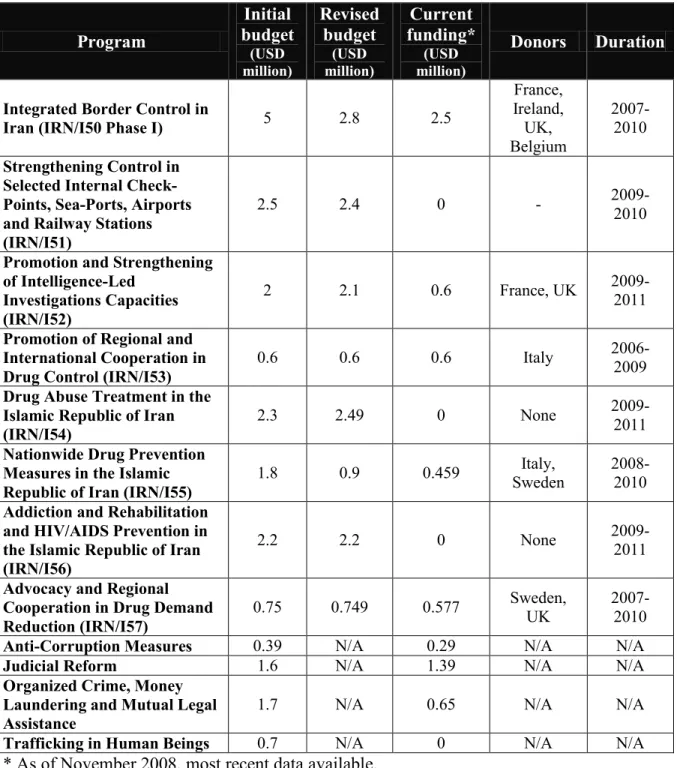
The UNODC 2005-2007 country program was built on three operational targets: 1) assisting Iranian authorities in reducing narcotic drugs trafficking; 2) contributing to the development of effective prevention, treatment and rehabilitation measures in drug abuse and HIV/AIDS; and 3) promoting the rule of law through strengthened crime prevention measures and the provision of legal assistance.8 An initial budget totalling $22,245,000 was established for the implementation of the UNODC country program.9 However, due to difficulties encountered in securing the required funds, the UNODC Strategic Programme Framework was extended until 2011 and its budget and time frame were revised. For instance, the project Integrated Border Control in Iran (IRN/I50), which was only initiated in 2007, was divided into phases and its budget was reduced from $5,000,000 to $2,800,000.10 Similarly, the Nationwide Drug Prevention Measures in the Islamic Republic Iran (IRN/I55) saw its budget shrunk from $1,785,400 to $900,000 and its start date pushed into 2008.11 Table 1 shows the planned and revised budgets for the UNODC Iran Strategic Programme Framework 2005-2007.
7 “History and Achievements,” United Nations Office on Drugs and Crime, accessed April 4, 2013, http://www.unodc.org/islamicrepublicofiran/en/history-and-achievement.html.
8 United Nations Office on Drugs and Crime, Strategic Programme Framework I.R. Iran, 2005-2007 (Vienna:
UNODC, 2005), 7-9.
9 Ibid., 11.
10 United Nations Office on Drugs and Crime, Op. Cit., (2005), 11; and United Nations Office and Drugs and
Crime, Afghanistan, Iran and Pakistan: Border Management Cooperation in Drug Control (Vienna: UNODC, 2008), 15.
11 United Nations Office on Drugs and Crime, Op. Cit., (2005), 11; and United Nations Office and Drugs and
Crime, Preventing and Treating Opiates Addiction and HIV/AIDS Epidemics in Afghanistan and
Table 1. Financial requirements for the UNODC Iran Strategic Programme Framework 2005-2007 Program Initial budget (USD million) Revised budget (USD million) Current funding* (USD million) Donors Duration
Integrated Border Control in
Iran (IRN/I50 Phase I) 5 2.8 2.5
France, Ireland, UK, Belgium 2007-2010 Strengthening Control in
Selected Internal Check-Points, Sea-Ports, Airports and Railway Stations (IRN/I51)
2.5 2.4 0 -
2009-2010 Promotion and Strengthening
of Intelligence-Led Investigations Capacities (IRN/I52)
2 2.1 0.6 France, UK
2009-2011 Promotion of Regional and
International Cooperation in Drug Control (IRN/I53)
0.6 0.6 0.6 Italy
2006-2009 Drug Abuse Treatment in the
Islamic Republic of Iran (IRN/I54)
2.3 2.49 0 None
2009-2011 Nationwide Drug Prevention
Measures in the Islamic Republic of Iran (IRN/I55)
1.8 0.9 0.459 Sweden Italy, 2008-2010 Addiction and Rehabilitation
and HIV/AIDS Prevention in the Islamic Republic of Iran (IRN/I56)
2.2 2.2 0 None 2009-2011
Advocacy and Regional Cooperation in Drug Demand Reduction (IRN/I57)
0.75 0.749 0.577 Sweden,
UK
2007-2010
Anti-Corruption Measures 0.39 N/A 0.29 N/A N/A
Judicial Reform 1.6 N/A 1.39 N/A N/A
Organized Crime, Money Laundering and Mutual Legal Assistance
1.7 N/A 0.65 N/A N/A
Trafficking in Human Beings 0.7 N/A 0 N/A N/A
* As of November 2008, most recent data available.
Source: UNODC, Strategic Programme Framework, 8-10; UNODC, The Green Paper, 15; and UNODC, The Indigo Paper, 43.
France, Ireland, the United Kingdom (UK), Belgium and Japan have collectively provided US$3.4 million from 2007 to 2011 for the UNODC project Integrated Border Control in the Islamic Republic of Iran (IRN/I50). The funds were reportedly employed to establish Border Liaison Offices (BLO), supply body scanners and provide material resources, such as sniffer dogs, vehicles and testing kits.12 The French and British governments also provided over US$720,000 from 2010 to 2011 for the UNODC project Promotion and Strengthening of Intelligence-Led Investigations Capacities (IRN/I52). The funds were reportedly employed to strengthen the investigation capacities of the Iranian Anti-Narcotics Police (ANP), the Customs Administration and other law enforcement agencies through the provision of trainings, equipment and support for joint border operations between Iran, Pakistan and Afghanistan.13
Italy donated US$600,000 from 2006 to 2009 for the implementation of the UNODC project Promotion of Regional and International Cooperation in Drug Control (IRN/I53). However, further information on how the Italian funds were spent could not be found. France provided more than 50 sniffer dogs and trained the Iranian ANP on multiple occasions from 2007 to 2011. It is not clear though whether this assistance was part of the UNODC Strategic Programme Framework or of another multilateral initiative.14 For its part, Germany provided financial assistance to Iran in 2009 to help legislative and judiciary authorities strengthen their capacity to tackle organized crime, money laundering and to promote mutual legal assistance. The amount donated by the German government is also unknown. 15 The German Embassy in Tehran also made arrangements in 2010 for Iranian authorities to visit dog-training centres in Hessen, Germany, to “familiarise themselves
12 International Harm Reduction Association, Partners in Crime: International Funding for Drug Control and
Gross Violations of Human Rights (London: Harm Reduction International, 2012), 14.
13 International Harm Reduction Association, Op. Cit., 14.
14 “Coopération Anti-Drogue.” Ambassade de France à Téhéran, December 24, 2007, accessed February 15,
2013, http://www.ambafrance-ir.org/Cooperation-anti-drogue; “Coopération Cynotechnique,” CIVIPOL, accessed February 15, 2013, http://www.civipol.fr/fr/operations/cooperation-cynotechnique; “Coopération Cynotechnique pour la Lutte contre le Trafic de Stupéfiants,” CIVIPOL, accessed February 15, 2013,
http://www.civipol.fr/fr/operations/cooperation-cynotechnique-pour-la-lutte-contre-le-trafic-de-stupefiants; “ Lutte Contre le Trafic de Stupéfiants,” CIVIPOL, accessed February 15, 2013,
http://www.civipol.fr/fr/operations/lutte-contre-le-trafic-de-stupefiants; and “La France Équipe la Police Iranienne,” IRIB, October 20, 2011, accessed February 15, 2013, http://french.irib.ir/info/iran-actualite/item/148322-la-france-équipe-la-police-iranienne.
15 German Delegation, Country Report from the mini-Dublin Group on Iran (Brussels: Council of the
with the most scientific techniques to use sniffing dogs.16” These four examples highlight that a lot of the funding provided by European governments to support Iran‟s counter-narcotics efforts has remained unaccounted for.
The UNODC Iran Strategic Programme Framework 2005-2007 has been replaced with the Technical Cooperation Programme in the Islamic Republic of Iran 2011-2014. The UNODC Technical Cooperation Programme is centered on the same three pillars than the 2005-2007 Strategic Programme.17 The UNODC 2011-2014 country program is currently funded by the governments of Norway, Denmark and Germany. The exact financial contributions made by these three donor countries are nonetheless unknown.18
Over the course of the past 30 years, the United States (US) have not provided assistance to Iran‟s counter-narcotics efforts. However, as fervent defenders of the global drug prohibition regime, the US have welcomed Iran‟s aggressive drug control policies and encouraged international cooperation against illicit drug trafficking in South West Asia. The US government also claims that it has worked hand in hand with Iranian authorities on counter-narcotics issues in international forums such as the Commission on Narcotic Drugs (CND).19 It is important to mention the position of the US towards international counter-narcotics cooperation with Iran since they play a role of critical importance in shaping both international drug control policy and the regime of international sanctions imposed on Iran with regard to the nuclear dossier.
1.2 The Iranian Nuclear Issue: Opposing Developments of Iran‟s Nuclear
Program
The Iranian nuclear crisis was initiated in 2002 when Iran‟s secret nuclear program was uncovered by the National Council of Resistance in Iran (NCRI), an opposition group based in the US. On the occasion of a press briefing made in Washington, D.C. on August 14, 2002, the NCRI spokesman announced that Iranian authorities had concealed the fact that they had been running a nuclear program parallel to their „official‟ program and
16 International Harm Reduction Association, Op. Cit., 10.
17 United Nations Office on Drugs and Crime, Technical Cooperation on Drugs and Crime in the Islamic
Republic of Iran 2011-2014 (Vienna: UNODC, 2011), 3-5.
18 “Funds and Partnership,” United Nations Office on Drugs and Crime, accessed April 4, 2013, http://www.unodc.org/islamicrepublicofiran/en/funds-and-partnership.html.
revealed the existence of two secret nuclear plants located south of Tehran, near Natanz and Arak.20 Although Iran, as a signatory of the Nuclear Non-Proliferation Treaty (NPT), was lawfully entitled to develop a nuclear program for civilian purposes, its rights to nuclear energy were contingent on the respect of its international obligations under the NPT. 21
The issue of nuclear rights and obligations has been and remains a source of much contention between Iran and the international community. On the one hand, Iranian authorities have claimed that their nuclear program has been completely peaceful and respectful of their obligations under the NPT. Iran has also contended that the nuclear crisis has been nurtured by “certain states” that wanted to prevent the progress and development of the Iranian nation.22 On the other hand, the members of the international community have questioned the peaceful and civilian nature of Iran‟s nuclear program and have contended that Iran has not complied with the NPT. The governments of France, Germany, the UK and, of course, the US have been particularly vocal in denouncing Iran‟s nuclear program. Their suspicions and fears have arisen from the fact that: 1) Iran had conducted nuclear activities in secrecy; 2) the Iranian government had been reluctant to provide information to the International Atomic Energy Agency (IAEA) regarding its undisclosed nuclear activities; 3) Iranian authorities have refused to halt their nuclear program despite the repeated demands of the international community and have failed to engage in meaningful dialogues with the France, the UK and Germany (E3) and the five permanent members of the United Nations Security Council plus Germany (P5+1) to resolve outstanding issues; 4) Iran‟s uranium enrichment program had been out of proportion for purely civilian purposes and the nuclear technology it had acquired could have dual uses; and 5) Iran had developed a ballistic missile program parallel to its nuclear program.23
20 Yonah Alexander and Milton Hoenig, The New Iranian Leadership: Ahmadinejad, Terrorism, Nuclear
Ambition, and the Middle East (London: Praeger Security International, 2008), 119.
21 Emanuele Ottolenghi, Iran: The Looming Crisis: Can the West Live With Iran’s Nuclear Threat? (London:
Profile, 2010), 5.
22 “Basic Facts About Iran‟s Peaceful Nuclear Activities,” The Embassy of the Islamic Republic of Iran in
Oslo, accessed April 19, 2013, http://iranembassy.no/en/6.htm.
23 “Iran‟s Nuclear Program,” European Union External Action, accessed April 19, 2013, http://eeas.europa.eu/iran/nuclear_en.htm; Joachim Krause and Charles King Mallory IV, “Strategic Implications of the Iranian Nuclear Program,” in Iran’s Nuclear Programme: Strategic Implications, ed. Joachim Krause (London: Routledge, 2012), 12-13; Wyn Q. Bowen and Jonathan Brewer, “Iran‟s Nuclear Challenge: Nine Years and Counting,” International Affairs 87, no. 4 (2011), 926; Yonah Alexander and Milton Hoenig, Op. Cit., 113-114; and Alexei G. Arbatov, “The Inexorable Momentum of Escalation,” in
Double Trouble: Iran and North Korea as Challenges to International Security, ed. Patrick M. Cronin
The members of the international community have responded to what they perceived as a threat to international security and to the nuclear non-proliferation regime by adopting a dual-track policy, balancing between constructive engagement with the Iran and its isolation through the imposition of international sanctions.24 Engagement prevailed over isolation from 2003 to 2006. Upon the discovery of Iran‟s secret nuclear program, the governments of France, the UK and Germany first sought to negotiate with the Iranian regime to obtain the suspension of its controversial nuclear program and the improvement of the country‟s transparency with regard to its past nuclear activities.25 The political negotiations between Iran and the E3 resulted in Iran‟s agreement to sign the Additional Protocol on Nuclear Safeguards on October 21, 2003 and the conclusion of the Paris Agreement on November 14, 2004. Under these arrangements, Iran accepted to suspend its nuclear enrichment activities, to fully disclose its clandestine nuclear activities and to allow for more thorough inspections by the IAEA. 26 However, the two agreements had a very short life span.
On August 8, 2005, Iran resumed its uranium enrichment activities at the Isfahan uranium conversion center, breaking the agreements it had previously concluded with the E3.27 Following this affront, the three European governments rallied to the position of the US on the Iranian nuclear issue and agreed to transfer the matter to the United Nations Security Council (UNSC). In exchange, the US guaranteed to join the E3 in their nuclear negotiations with Iranian authorities.28 Almost one year later, the UNSC adopted its first resolution on Iran by a vote 14-1-0 (Against: Qatar). The governments of France, the UK, Japan voted in favour of the resolution. Resolution 1696 called on Iran to suspend its nuclear enrichment and reprocessing activities within one month or else it would face the imposition of economic and diplomatic sanctions.29
24 “Iran‟s Nuclear Program,” Op. Cit.
25 Zehra Nilufer Karacasulu and Irem Askar Karakir, “Attitudes of the International Community Toward
Iran‟s Nuclear Puzzle,” Journal of International and Area Studies 15, no. 2 (2008), 6-7.
26 Patrick M. Cronin, “The Trouble with Iran,” in Double Trouble: Iran and North Korea as Challenges to
International Security, ed. Patrick M. Cronin (London: Praeger Security International, 2008), 14-15.
27 Semira N. Nikou, “Timeline of Iran‟s Nuclear Activities,” United States Institute of Peace, accessed April
19, 2013, http://iranprimer.usip.org/resource/timeline-irans-nuclear-activities.
28 Florent Pouponneau, “Une Division Internationale du Travail Diplomatique: Analyse de la Politique
Étrangère Française autour du Problème du Nucléaire Iranien,” Revue Française de Science Politique 63, no. 1 (2013), 52.
29 “Security Council Demands Iran Suspend Uranium Enrichment by 31 August, Or Face Possible Economic,
A few days before the deadline given to Iran by the UNSC, President Mahmud Ahmadinejad inaugurated a heavy-water reactor plant in Arak.30 This event sent a strong signal to the members of the international community that Iran was not willing to respond to their demands. Consequently, the UNSC members unanimously adopted Resolution 1737 on December 23, 2006. Resolution 1737 imposed a first round of sanctions against Iran, including a ban on the import and export of sensitive nuclear material and a freeze of the financial assets of persons and entities affiliated with Iran‟s nuclear program.31 Resolution 1737 was soon followed by Resolution 1747, which was adopted by a vote 15-0-0 on March 24, 2007. The governments of France, the UK, Belgium and Italy all voted in favour of the resolution. Resolution 1747 toughened the sanctions regime by imposing an arms embargo on Iran and freezing the assets and restricting the travel of individuals that participated in the country‟s nuclear program.32 On March 8, 2008, the UNSC adopted Resolution 1803 by a vote 14-0-1 (Abstention: Indonesia). Resolution 1803 extended the freeze of financial assets of persons and entities that supported Iran‟s nuclear program and called on all states to inspect cargos to and from Iran and to exercise vigilance over the activities of Iranian banks.33
The track of “constructive” dialogue resumed in July 2008 when the P5+1 met with Iran in Geneva to engage in talks over the country‟s nuclear program. The July 2008 Geneva talks were inconclusive as Iranian authorities refused to negotiate on the suspension of their enrichment activities.34 This failure led to the adoption of a new UNSC resolution on September 29, 2008. Resolution 1835, which was passed by a unanimous vote, reaffirmed earlier UNSC resolutions on Iran and called on the Iranian government to
http://www.un.org/News/Press/docs/2006/sc8792.doc.htm.
30 “Timeline of Iran‟s Nuclear Program,” The New York Times, April 18, 2013, accessed April 21, 2013,
http://www.nytimes.com/interactive/2013/03/20/world/middleeast/Iran-nuclear-timeline.html?_r=0#/#time243_7169.
31 “Security Council Imposes Sanctions on Iran for Failure to Halt Uranium Enrichment, Unanimously
Adopting Resolution 1737 (2006),” Security Council, December 23, 2005, accessed April 21, 2013,
http://www.un.org/News/Press/docs/2006/sc8928.doc.htm.
32 “Security Council Toughens Sanctions Against Iran, Adds Arms Embargo, with Unanimous Adoption of
Resolution 1747 (2007),” Security Council, March 24, 2007, accessed April 21, 2013,
http://www.un.org/News/Press/docs/2007/sc8980.doc.htm.
33 “Security Council Tightens Restrictions on Iran‟s Proliferation-Sensitive Nuclear Activities, Increases
Vigilance over Iranian Banks, Has States Inspect Cargo,” Security Council, March 3, 2008, accessed April 21, 2013, http://www.un.org/News/Press/docs/2008/sc9268.doc.htm.
comply with its international obligations “fully and without delay.35” The governments of France, the UK, Belgium and Italy all voted in favour of the new resolution.
In October 2009, the P5+1 met with Iran in Geneva for a second round of talks on the nuclear issue. A proposal was made according to which Iran would send uranium to Russia for enrichment. A consensus was even reached between the P5+1 and Iran and set down in a draft agreement. However, the Iranian negotiating team was forced to back down due to domestic opposition to the conclusion of a nuclear deal.36 The UNSC approved a new round of sanctions against Iran on June 9, 2010. Resolution 1929, which was adopted by a vote 12-2-1 (Against: Brazil and Turkey; Abstention: Lebanon), expanded the arms embargo imposed on Iran and tightened the financial restrictions imposed on entities that took part in Iran‟s nuclear program.37 The governments of France, the UK and Japan voted in favour of this new resolution.
In January 2011, the P5+1 met with Iran in Istanbul to resolve the Iranian nuclear issue. The Istanbul talks failed after Iran imposed two preconditions to nuclear negotiations: 1) the international community should recognize Iran‟s right to uranium enrichment; and 2) the United Nations (UN) should drop sanctions against Iran. The P5+1 rejected Iran‟s preconditions and a deadlock was reached, once again.38 This brief review of the development of the Iranian nuclear crisis highlights that the very same countries that provided assistance to Iran‟s counter-narcotics efforts from 2007 to 2011 opposed the development of the country‟s nuclear program during the same timeframe.
2. Research Question
The current research is centered on the paradox of the international community‟s policies of counter-narcotics cooperation and nuclear isolation of Iran. On the one hand, countries like
35 “Security Council Reaffirms Earlier Resolutions on Iran‟s Uranium Enrichment, Calls on Country to
Comply with Obligations Fully and Without Delay,” Security Council, September 27, 2008, accessed April 21, 2013, http://www.un.org/News/Press/docs/2008/sc9459.doc.htm.
36 Semira N. Nikou, Op. Cit.
37 “Security Council Imposes Additional Sanctions on Iran, Voting 12 in Favour to 2 Against, with 1
Abstention,” Security Council, June 9, 2010, accessed April 21, 2013,
http://www.un.org/News/Press/docs/2010/sc9948.doc.htm.
38 Michael Adler, “Why the Istanbul Talks Failed,” United States Institute of Peace, January 23, 2011,
France, the UK, Japan, Italy and Germany provided a significant amount of financial and technical assistance to Iran‟s counter-narcotics efforts via the UNODC from 2007 to 2011. On the other hand, the very same countries confronted Iranian authorities over the nuclear issue and imposed punitive sanctions against Iran. Reinforcing the contradiction, these two processes occurred simultaneously.
In order to problematize the aforementioned paradox, the following research question has been formulated: how did members of the international community frame their public discourse in order to justify both cooperation with Iran in its counter-narcotics efforts and denunciations of its nuclear program? In the process of providing an answer to this research question, a set of three sub-questions will be addressed:
1) How was the Iranian nuclear issue framed in the political statements of governments that provided counter-narcotics assistance to Iran?
2) How was international assistance to Iran‟s counter-narcotics efforts justified by donor countries?
3) How did Iran respond to both nuclear isolation and counter-narcotics cooperation?
3. Research Objectives
In order to uncover the paradox of the international community‟s nuclear isolation and drug cooperation with Iran, this research adopts a constructivist outlook and employs both qualitative content and discourse analyses. These theoretical and methodological choices bring us to analyse in depth the political statements of seven donor countries to uncover how the Iranian nuclear issue and international counter-narcotics cooperation with Iran were framed and how these frames allowed for certain courses of action to take place. Our research endeavour is highly interdisciplinary in nature, combining research questions, literatures, theories and methodologies that relate both to the fields of International Relations (IR) and Criminology. It should be taken note that the objective of this research is not to provide yet another security analysis of the Iranian nuclear issue. The nuclear crisis is presented only as a contextual background against which we can better understand the
puzzling phenomenon of international nuclear confrontation and counter-narcotics cooperation with Iran.
4. Organization
Our study is divided into seven chapters. Chapter two provides a review of the literature on bilateral relations between donor countries and Iran, the Iranian nuclear crisis, drug control in Iran and international cooperation in drug control. Chapter three consists in the presentation of the theoretical and methodological frameworks adopted in the course of this work. The results of our qualitative content and discourse analyses are presented in details in chapters four and five and their significance is discussed in chapter six. Finally, the findings of our research are summarized in chapter seven.
CHAPTER 2
THE MAKING OF A PARADOX:
NUCLEAR DEVELOPMENT AND DRUG CONTROL
IN IRAN, 2007-2011
Since the revealing of the existence of Iran‟s covert nuclear program in August 2002, numbers of policy papers, op-eds and academic articles analysing an infinity of aspects of the Iranian nuclear crisis and this, from different theoretical perspectives, have been published on a regular basis. As a matter of fact, not a single day passes by without new material on the nuclear issue being published in the press. In contrast, the issue of international counter-narcotics cooperation in Iran has completely passed under the radar. Only a handful of scholars have addressed the question, most of them being Iranian academics and professionals. Despite the repeated attempts made by Iranian diplomats to raise awareness on their country‟s drug problem and policies, the issue has failed to attract the attention of Western policy-makers and scholars alike. First things first, our research endeavour begins by mapping the state of research on nuclear development and drug control in Iran.
1. Policy Responses to the Iranian Nuclear Issue: The Influence
of Interests, Alliances and Perceptions
The Iranian nuclear issue presents one of the most important political challenges encountered by contemporary foreign policy-makers. They have been divided over their understanding of the problem and over what constitute the best policy options to resolve it. Yet, they have managed to present a “concerted” response to Iran‟s nuclear challenge despite their divergences. The policy responses offered by donor countries have been influenced by their national self-interests, the balance of power and their shared understandings of the Iranian nuclear issue.
1.1 European Union-Iran Relations: Yo-yoing Between Engagement and
Confrontation
Since the establishment of the Islamic Republic of Iran in 1979, bilateral relations between Europe and Iran have been characterized by complexity and fluctuation. Indeed, European Union (EU)-Iran relations have been punctuated by cycles of engagement and crisis.39
Europe entered in a “Cold Peace” with Iran in the immediate aftermath of the Islamic Revolution.40 “Cold Peace” is an expression that was initially employed by Ziba Moshaver to designate the restrained relations that occurred between Europe and Iran from 1979 to 1989.41 The “Cold Peace” was followed by a period of political and economic engagement. Under the “Critical Dialogue”, which was initiated by the European Council in 1992, European states built economic ties with Iran while demanding the country to improve its policies to the fields of human rights, terrorism and conventional arms trade.42 However, the relations between Europe and Iran were severed following the discovery of Iran‟s sponsorship of the assassination of Kurdish exiles in Germany in 1996.43
Diplomatic engagement soon resumed as European governments staged a “Comprehensive Dialogue” with Iran in 1998. However, this rapprochement was once again brought to an end with the discovery of Iran‟s secret nuclear program in 2002.44 This event proved to be a watershed in the history European-Iranian relations. Indeed, Iran‟s nuclear program, which, up to 2002, had not been a source of concern to European policy-makers in dealing with their Iranian counterparts, came to the forefront of their bilateral relations.45 Although EU members actively sought to engage with Iranian authorities to persuade them to halt their controversial nuclear enrichment activities, their diplomatic
39 Johan Bergenas, “The European Union‟s Evolving Engagement with Iran,” The Nonproliferation Review
17, no. 3 (2010), 500-504; Ruth Hanau Santini, “European Discourses and Practices on the Iranian Nuclear Programme,” European Security 19, no. 3 (2010), 467; and Ziba Moshaver, “Revolution, Theocratic Leadership and Iran‟s Foreign Policy: Implications for Iran-EU Relations,” The Review of International
Affairs 3, no. 2 (2003), 294.
40 Johan Bergenas, Op. Cit., 500. 41 Ziba Moshaver, Op. Cit., 292. 42 Johan Bergenas, Op. Cit., 501. 43 Ibid.
44 Ibid., 502.
45 Lynne Dryburgh, “The EU as a Global Actor? EU Policy Towards Iran,” European Security 17, no. 2-3
(2008), 259; and Walter Posch, “The European Union and Iran: What Next?” The International Spectator:
efforts have failed short of their objectives.46 Despite the conclusion of two agreements with the E3 on the suspension its enrichment program, Iran went on with the conversion and enrichment of uranium.47 Iran‟s violation of the terms of the agreements it had concluded led the EU to alter its approach towards the Iranian nuclear issue. European policy-makers adopted a dual-track approach, offering Iranian authorities “carrots” while threatening them with the “stick”.48 However, this second approach also failed to provide the desired outcomes. In the face of growing pressure to suspend its nuclear enrichment program, Iran simply accelerated the pace of its development.49
Up to this date, the EU has failed to secure a major breakthrough in the Iranian nuclear dossier.50 Nonetheless, despite mounting tensions, the EU members have remained committed to diplomatic engagement with Iran to address outstanding issues and have rejected military intervention as a solution to the nuclear crisis.51
1.2 France-Iran Relations: A Display of France‟s Aspiration to Be a Key
Player in International Affairs
The past two years have been marked by the emergence of an academic literature that specifically analysed France‟s foreign policies towards Iran. Four authors have distinguished themselves by the analyses they offered.
Florent Pouponneau, a researcher at the Centre d‟études et de recherches internationales de l‟Université de Montréal (CERIUM), has analysed how the international environment has shaped the foreign policy orientation of the French government towards the Iranian nuclear issue from 2003 to 2006. During the period understudy, France, along with the UK and Germany, actively sought to resolve the Iranian nuclear issue by engaging in a dialogue and in negotiations with Iranian authorities. As a result, the three European governments have managed to conclude two accords with Iran in 2003 and in 2004.52
46 Tom Sauer, “Struggling on the World Scene: An Over-ambitious EU versus a Committed Iran,” European
Security 17, no. 2-3 (2008), 273.
47 Ibid., 275-276.
48 Ruth Hanau Santini, Op. Cit., 472. 49 Tom Sauer, Op. Cit., 278.
50 Ibid., 282.
51 Lynne Dryburgh, Op. Cit., 267; Zehra Nilufer Karacasulu and Irem Askar Karakir, Op. Cit., 12-13; and
Ruth Hanau Santini, Op. Cit., 467.
However, the author pointed out, their successes were mitigated by the fact that they did not secure the support of the US in their nuclear agreements with Iran.53 Pouponneau explained that the motivation of French policy-makers in securing these two nuclear agreements with Iran was, in addition to prevent the proliferation of nuclear weapons, to show that the French government could play a key role in international affairs [“cette action extérieure est aussi l’occasion d’afficher leur prétention à « compter » dans la régulation des affaires politiques internationales.54”] Furthermore, France‟s policy towards the Iranian nuclear issue displayed the pretentiousness to “lecture” US policy-makers on “effective multilateralism.55” Yet, despites all of their pretentions and ambitions, French policy-makers were unable to secure viable and lasting nuclear agreements with Iran due to their incapacity to gain US support. Indeed, Pouponneau underlined that the E3 were tied by US unilateral sanctions against Iran, thus limiting their ability to act independently of the US in resolving the Iranian nuclear issue.56 Understanding that their capacity to play a key role on the Iranian nuclear dossier was constrained by US-Iran relations, France, along with the UK and Germany, rallied the position of the US from February 2006 onwards.57
Clément Therme has analysed how France‟s firm opposition to the development of Iran‟s nuclear program is due to the country‟s Middle East policy, which conflicts with Iran‟s regional ambitions.58 The author argued that France is opposed to the development of Iran‟s nuclear program because it compromises its interests in the region.59. The argument made by Clément Therme was very superficial and not convincing at all. The author has put too much emphasis on France‟s Middle East policy as a determinant of its nuclear diplomacy with Iran and completely left out the international dimensions of the crisis. Yet, as Pouponneau‟s article underlined, any explanation of France‟s policy towards the Iranian nuclear issue is incomplete without a consideration of the role played by the US.
Similarly to Clément Therme, Pirooz Izadi has made the argument that conflictual relations between France and Iran are due to their divergent approaches to foreign policy.
53 Florent Pouponneau, Op. Cit., 51. 54 Ibid., 52.
55 Ibid., 64. 56 Ibid., 66. 57 Ibid., 52.
58 Clément Therme, “La Diplomatie Française à l‟Épreuve de l‟Iran,” Revue Internationale et Stratégique 85,
no. 1 (2012), 29.
However, Izadi went a step further than Therme by articulating his argument with the help of the neo-realist theory of IR.60 The author pointed out that, due to its size, resources and geostrategic location, Iran has the potential of becoming a regional hegemonic power.61 Iran‟s acquisition of nuclear power would therefore make this situation inevitable. According to Izadi, this is an outcome that the French government strives to prevent by all means. Indeed, Iran‟s rise as a regional hegemonic power would pose a serious threat to France‟s interests in the region, thus explaining the country‟s “intransigence” with regard to the Iranian nuclear issue.62
For his part, Benoit Pelopidas has explained France‟s policy towards the Iranian nuclear issue with the help of the country‟s nuclear idiosyncrasy. The author argued that there exists a French idiosyncrasy which influences French regional nuclear policies. This idiosyncrasy is based on four beliefs about nuclear weapons: the “sanctuarizing” power of nuclear weapons; the rationalizing virtue of nuclear weapons; the equalizing power of nuclear weapons and the idea that nuclear energy is safe and clean.63 France‟s fears about Iran‟s potential acquisition of nuclear weapons arise from these four beliefs.64 Accordingly, French policy-makers have been pursuing a policy that has opposed Iran‟s nuclear development in order to prevent a “cascade” of nuclear proliferation they believe would result from Iran‟s acquisition of nuclear weapons.65
1.3 UK-Iran Relations: Constrained by Transatlantic Relations and
Domestic Politics
The literature on the United Kingdom‟s policy towards Iran and the nuclear issue is slightly less developed than its French counter-part. Andrea Ellner, a lecturer at London King‟s College, wrote an article on the British nuclear non-proliferation policies towards Iran and the Middle East in which she argued that the UK‟s regional nuclear non-proliferation
60 Pirooz Izadi, “French-Iranian Relations: A New Realistic Perspective,” Iranian Review of Foreign Affairs
3, no. 1 (2012), 37.
61 Ibid., 39. 62 Ibid., 40.
63 Benoît Pelopidas, “French Nuclear Idiosyncrasy: How it Affects French Nuclear Policies Towards the
United Arab Emirate and Iran,” Cambridge Review of International Affairs 25, no. 1 (2012), 143.
64 Ibid., 158. 65 Ibid.
policies have had limited impacts due to the country‟s alliances, its status as a nuclear weapons power state and its pursuit of self-interest in the region.66 According to the author, the British policy with regard to the Iranian nuclear issue is deeply imbedded in its alliances with international actors and cannot be understood independently of this context.67 Furthermore, she insisted that the UK has a limited influence in the Middle East, which is dependent on its historical legacy as a colonial power and its relationship with the US.68 Accordingly, Ellner pointed out, the UK is dependent on its joint-diplomacy with the US to have a weight in regional affairs.69
Chris Kitchen and Rhiannon Vickers have approached the UK‟s policy towards the Iranian nuclear issue from the perspective of domestic politics. The authors analysed how the British government‟s response to the challenges created by the Iranian nuclear issue was influenced by the Labour Government‟s traditions of international order, interest and community.70 The authors argued that the Labour governments of Tony Blair and Gordon Brown have framed the threat presented by Iran‟s nuclear program and the policy responses they adopted based on their political party‟s traditions of international order, interests and community.71 They underlined that the UK‟s nuclear policy towards Iran was informed by five core traditions: support for international institutions; belief in an international interest towards which each state has a responsibility to work; faith in democratic principles and universal moral norms, which the British government has the “moral leadership” to uphold; need for collective security, which can only be secured through multilateral solutions; and notions of anti-militarism.72 The UK‟s policy responses to the Iranian nuclear issue have evolved in three stages which all reflected the Labour‟s internationalist traditions: support for international relations; multilateral diplomatic engagement; and multilateral sanctions.73
66 Andrea Ellner, “British Nuclear Non-Proliferation Policies Towards Iran and the Middle East,” Cambridge
Review of International Affairs 26, no.1 (2013), 225.
67 Ibid. 68 Ibid., 228. 69 Ibid.
70 Chris Kitchen and Rhiannon Vickers, “Labour Traditions of International Order and the Dilemma of Action
Towards Iran,” The British Journal of Politics and International Relations 15, no. 2 (2013), 299.
71 Ibid. 72 Ibid., 300. 73 Ibid., 305.
1.4 US-Iran Relations: A Mutual Animosity that Dictates the Conduct of
International Affairs
The history of US-Iran relations is a very complex one. Prior to the establishment of the Islamic Republic of Iran in 1979, Iran had been a close ally of the US in the Middle East.74 Pahlavi Iran received substantial economic, military and technical assistance from the US to help the Shah strengthen his regime and prevent the expansion of communism and Arab nationalism in the region.75 In fact, Iran‟s nuclear program was originally initiated in the mid-1950s with the help of US technical expertise.76
However, these positive developments were reverted due to the US Embassy Hostage crisis.77 Following the assault on their embassy in Tehran, the US broke diplomatic relations with the newly established Islamic regime and revoked all the agreements they had previously concluded with Iran.78 US policy-makers also adopted a first set of economic sanctions against Iran at the time.79 These took the form of Executive Order 12170, which blocked all the properties of the Iranian government in the US, and of Executive Orders 12205 and 12211, which prohibited commercial transactions with Iran.80 The adoption of unilateral sanctions soon became a central element of the US policy on Iran, which authors Reza Simbar and Arsalan Ghorbani Sheikhneshin have coined as a policy of confrontation.81 The US policy of confrontation with Iran has aimed to bring about change in Iranian policies that have been deemed a threat to US interests in the Middle East.82 Accordingly, the threat of military intervention, the use of economic sanctions and diplomatic pressure have been consistently employed by US officials to achieve this end.83 Although an opportunity for rapprochement occurred during the
74 Mustafa Kibaroglu, “Iran‟s Nuclear Ambitions from a Historical Perspective and the Attitude of the West,”
Middle Eastern Studies 43, no. 2 (2007), 223.
75 Ibid., 224. 76 Ibid., 225. 77 Ibid., 233.
78 Zehra Nilufer Karacasulu and Irem Askar Karakir, Op. Cit., 4.
79 Arsalan Ghorbani Sheikhneshin, “Iran and the US: Current Situation and Future Prospects,” Journal of
International and Area Studies 16, no. 1 (2009), 98.
80 Sasan Fayazmanesh, “The Politics of the U.S. Economic Sanctions Against Iran,” Review of Radical
Political Economics 35, no. 3 (2003), 221.
81 Reza Simbar, “Iran and the US: Engagement or Confrontation,” Journal of International and Area Studies
13, no. 1 (2006), 74; and Arsalan Ghorbani Sheikhneshin, Op. Cit., 97.
82 Adam Tarock, “Iran‟s Nuclear Program and the West,” Third World Quarterly 27, no. 4 (2006), 646-647. 83 Brandon M. Boylan, “Moving Beyond Coercive Diplomacy: A New Policy Approach Toward Iran‟s
Presidency of Mohammad Khatami in the late 1990s, the US failed to seize this opportunity and with the election of Mahmud Ahmadinejad to Iran‟s presidency in 2005, US-Iran relations were marked, once again, by heightened tensions.84
The tense relations between the US and Iran have borne consequences of critical importance on the diplomatic efforts of the international community to resolve the Iranian nuclear crisis. UNSC Debates have been dominated by the position of the US and US allies have been strongly pressurized to impose draconian sanctions against Iran.85 However, US policy-makers have encountered the resistance of Russia and China, both permanent members of the UNSC.86
1.5 Japan-Iran Relations: Maintaining a Delicate Balance Between
Energy and Military Security
Japan‟s relations with Iran have been shaped by a number of internal and external factors. These included Japan‟s booming economy and its voracious energy needs, regional (in)security, the country‟s strategic alliance with the US and normative factors.87 Since the end of World War II (WWII), Japan‟s economy has been flourishing. Japan became a major economic power in the 1960s and has since then rose to the position of the world‟s second largest economy.88 However, the Japanese economic “miracle” has come with a heavy price. With virtually no domestic energy resources, Japan has long sought to secure access
84 Adam Tarock, Op. Cit., 647; Zehra Nilufer Karacasulu and Irem Askar Karakir, Op. Cit., 5; and Brandon
M. Boylan, Op. Cit., 94.
85 Zehra Nilufer Karacasulu and Irem Askar Karakir, Op. Cit., 14; and Nikolay A. Kozhanov, “U.S. Economic
Sanctions against Iran: Undermined by External Factors,” Middle East Policy 18, no. 3 (2011), 149.
86 Zehra Nilufer Karacasulu and Irem Askar Karakir, Op. Cit., 13; Nikolay A. Kozhanov, Op. Cit., 150; and
David Hasting Dunn, “Real Men Want to Go to Tehran: Bush, Pre-emption and the Iranian Nuclear Challenge,” International Affairs 83, no. 1 (2007), 26.
87 Yukikio Miyagi, “Japan‟s Middle East Policy: Still Mercantile Realism,” International Relations of the
Asia-Pacific 12, no. 2 (2012), 292; Mandana Tishehyar, “Japan and Indian Energy Security Towards Iran,” Iranian Review of Foreign Affairs 3, no. 3 (2012), 187-188; Mohammad Abo-Kazleh, “Transformation in
Japanese Foreign Policy Toward the Middle East: From Low to More Active Political Engagement,” USAK
Yearbook 3, (2010), 267; and Jonathan A. Czin, “Japanese Foreign Policy in the Middle East: Balancing
Economy and Security,” Asian Security 4, no. 2 (2008), 213.
88 Mandana Tishehyar, Op. Cit., 177; Mohammad Abo-Kazleh, Op. Cit., 273; and Elaheh Koolaee and
Mandana Tishehyar, “China and Japan‟s Energy Security Approaches in the Central Asia: A Comparative Study,” China Report 45, no. 4 (2009), 268.
to cheap and stable energy in order to sustain its rapid economic growth.89 It was in this context that Japan developed strong bilateral relations with Iran.90
Japan‟s interest in the Iranian energy sector emerged in the 1970‟s as a result of the 1973 oil crisis.91 Japan, which had relied almost exclusively on the “Majors” for its oil supply, saw its energy security jeopardized as a result of the crisis.92 Accordingly, the Japanese government sought to secure contracts directly with oil-producing countries in order to circumvent this problem.93 This strategy led to the development of a joint venture between the Iranian National Oil Company and the Japanese company Mitsui for the construction of a petrochemical complex in Bandar-e Shahpour in 1973.94 However, the project was brought to an abrupt end due to the destruction of the complex‟s facilities during the Iran-Iraq War.95
More recently, Japan concluded an agreement with Iran in 2004 for the development of the Azadegan oil field.96 However, this move brought Japan under US pressure to abrogate its agreement and halt its economic relations with Iran, in a bid to isolate the Iranian government from the international community.97 Japan resisted US pressure until late 2006 but was ultimately forced to reduce its stakes in the Azadegan oil field as a result of growing tensions regarding Iran‟s nuclear program.98
With the unraveling of the Iranian nuclear crisis, the Japanese government faced an acute dilemma. On the one hand, Iran represented a critical commercial partner to Japan, guaranteeing access to energy resources and markets for Japanese commodities.99 On the other hand, Iran‟s nuclear enrichment activities represented a threat to the nuclear non-proliferation regime of which Japan, as a victim of nuclear weapons during WWII, was a
89 Mohammad Abo-Kazleh, Op. Cit., 273; Elaheh Koolaee and Mandana Tishehyar, Op. Cit., 268; and Raquel
Shaoul, “An Evaluation of Japan‟s Current Energy Policy in the Context of the Azadegan Oil Field Agreement Signed in 2004,” Japanese Journal of Political Science 6, no. 3 (2005), 413.
90 Mandana Tishehyar, Op. Cit., 179.
91 Yukikio Miyagi, Op. Cit., 296l and Mandana Tishehyar, Op. Cit., 182.
92 Yukikio Miyagi, Op. Cit., 296; Mandana Tishehyar, Op. Cit., 178-179; and Mohammad Abo-Kazleh, Op.
Cit., 274.
93 Yukikio Miyagi, Op. Cit., 296; and Mandana Tishehyar, Op. Cit., 179.
94 Yukikio Miyagi, Op. Cit., 297; Mandana Tishehyar, Op. Cit., 182; and Raquel Shaoul, Op. Cit., 426. 95 Mandana Tishehyar, Op. Cit., 182.
96 Yukikio Miyagi, Op. Cit., 306; Mandana Tishehyar, Op. Cit., 188; Brendan Taylor, Sanctions as a Grand
Strategy (Abingdon: Routledge, 2010), 80; and Jonathan A. Czin, Op. Cit., 208.
97 Yukikio Miyagi, Op. Cit., 306; Brendan Taylor, Op. Cit., 82; and Jonathan A. Czin, Op. Cit., 210. 98 Yukikio Miyagi, Op. Cit., 306; Brendan Taylor, Op. Cit., 80; and Jonathan A. Czin, Op. Cit., 210. 99 Yukikio Miyagi, Op. Cit., 306; and Jonathan A. Czin, Op. Cit., 213.