Bisphenot A in
our
food: sârnê toxicotogicat
studies
but
different
risk
assessment and
risk
management decisions around the
world
Marie-Louise Scippo, Department of Food Sciences, Faculty of veterinary medicine, University of Liège, Belgium
INTRODUCTION
BisphenoI
A
tBPA]
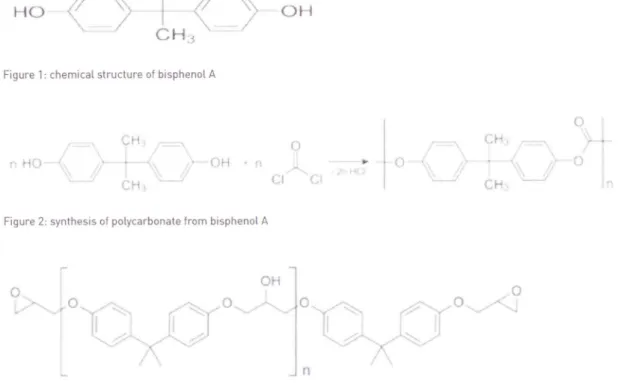
[2,2-bis-(4-hydroxy-phenytl propane, CAS no 80-05-71 [figure'il
is
an industriat
chemicaI compound synthesized from the condensation of two phenot groups and one acetone molecute [the A in bispheno[ A stands for acetone).Other
synonymsfor
bisphenoI
A
areL,4' -dihydroxy-2,2-diphenytpropane loff
i-ciat
IUPAC nomenctaturel,4,4'-{propan-I Food Science A Law 2Ol'l Os.rndd I
I
2-ytidenel diphenot, p,
p'-isopropytidene-bisphenoI
or
4,4'-isopropytidenediphe-
no[-It
is used as a monomer in the manufac-turing of potymers such as polycarbonate lfigure 2] and the epoxy resins lfigure 3], as wett as antioxidant and inhibiter of endol
potymerizationin
potyvrnyl ch[oride ptastics {PVCI. The potycarbonate is usedin materia[s intended to come into contact
with food, [ike certain
reusabte ptasticMarie-Louise Scippo
bottles, feeding botttes, plates, gobtets, cups, etc., white the epoxy resins are used in
the
internaI coating of cans. However,onty 3 % of at[ the potycarbonate produced as
well as
10 0/o ofthe
epoxy resins areused
in
materiats intendedto
come into contactwith
foodstuffs (Ptastics Europe, 20071. Theother
usesare sun
gtasses, buitding materials, CD-R0M, medicat de-vices, etc.5âmenvâtting
Bisphenot A [BPAI [2,2-bis-t4-hydroxyphenytlpropaan. CAS n" 80-05-7] is een industriëte chemische stof, gesyntheti-seerd uit de condensatie van twee fenotgroepen en één aceton motecu[e [de A in bisphenot A staat voor aceton). Andere synoniemen voor bisphenot A zijn 1+,4'-dihydroxy-2,2-diphenytpropane {officieet IUPAC-nomenclatuur}, 4,4'-[propan-2-ytidenel difenot, p, p'-isopropytidenebispheno[, of4,4'-isopropytidenediphenot.
Het wordt gebruikt ats een monomeer bij de productie van potymeren zoals polycarbonaat en de epoxyharsen, atsook ats antioxidant en polymerisatie-inhibitor binnen potyvinytchtoride IPVC]. Het polycarbonaat wordt gebruikt in mate-riaten die bedoetd zijn om in contact te komen met voeding, zoats bepaalde herbruikbare ptastic flessen, zuigf[essen, borden, drinkbekers, kopjes, enz. terwijI de epoxyharsen gebruikt worden ats dektagen van voedse[- en drankblik.jes. Niettemin wordt stechts 3 o/o van alte geproduceerde potycarbonaat en 10 o/o van de epoxyharsen gebruikt in materiaten
die bedoeld zijn om in contact te komen met levensmiddelen lPlastics Europe, 2007]. Andere toepassingen zijn zonne-britten, bouwmaterialen, cd's, medische hulpmiddeten, enz.
Résumé
Le bisphénol A IBPAI [2,2-bis-[4-hydroxyphényUpropane, CAS
n'
80-05-71 est un composé chimique industriel issu de [a condensation de deux groupes de phénotet
une motécule d'acétone lte A de bisphénot A réfère à ['acétone]. D'autres synonymespour
[e bisphénol A sont 4,4'-dihydroxy-2,2-diphénytpropane {nomenclature officielte IUPAC],4.4'-tpropan-2-ytidène)diphénot, p, p'-isopropytidènebisphénot, ou 4,4'-isopropytidènediphéno[.
Le bisphénot A est utitisé comme monomère pour [a fabrication de potymères tets que [e potycarbonate et tes résines
époxy, comme antioxydant et comme inhibiteur de po[ymérisation dans [e potychtorure de vinyte [PVC]. Le potycarbo-nate est utitisé dans tes matériaux qui entrent en contact avec les denrées alimentaires, comme certaines bouteilles en ptastique réutitisabtes, des biberons, des assiettes, des gobetets, des tasses etc., tandis que les résines époxy sont utitisées comme revêtement intérieur des boîtes de conserves.
Tout de même, ce n'est que 3 o/o de [a production totate du potycarbonate et 10 % des résines époxy qui sont
utitisés dans des matériaux destinés à entrer en contact âvec tes denrées alimentaires IPtastics Europe, 2007]. D'autres appti-cations sont les lunettes de soteit, les matériaux de construction, tes CD, les moyens médicaux, etc.
9
os,ou I
HCI
Figure
l:
chemica[ structure of bispheno[ Aci-1..
| '//
\\
Ll / \''r t ",- )|\,,'
CH,
ÜH
r', H[-r,:-|l
a- F{Fiqure 2: synthesis of potycarbonate from bisphenot A
o
()
UH
:
A kind of
controversy exists since 2008about the
good decisionto
take
about bisphenotA in
baby feeding botttes. Ca-nada and some states of the USA banish it since 2008, while inthe
European Union,the
decision hasjust
been takenlEuro-pean
Commision, 2011)and
witl
enter in force on 1 "i March 201 1, for the ban ofmanufacture of feeding bottles containing BPA, and
on 1"
June 2011,for the
banof ptacing on
the
market feeding botttes containing BPA.This kind of decision is a part of the risk management process,
which has
to
beconducted by pubtic authorities.
The
previousstep
beforêrisk
manage-ment is risk assessment, which is a scien-tific evatuation. Risk assessment is basedon toxicotogica[ studies, as welt as expo-sure studies, in the aim to assess the risk, for the consumer, [inked to the ingestion
of the substance of interest via food.
Here
betoware
presentedthe risk
as-sessment studies performedfor
BPA invarious countries untit now.
It
witLbe
shownthat different risk
as-sessment conclusions and different risk manâgement decisions resuttèd from the evaluation of the same toxicotogicat stu-dies published in the literature.0pinion on BPA oî the Scientific committêe on Food ISCFI and the European food
sa-fetyauthoriÿ
IEFSAIThe toxic effects of BPA were eva[uated for the
first
time in 1984 by the SCF lScienti-fic committee on food-
SCF, 1986), which established a tolerable daity intake lTDl)ch.
ülr
{l
fl
of 0.05 mg/kg of body weight, on the
ba-sis of
chronicoral
exposure studies {?0days) carried out in rats and mice. A "no adverse effect levet" (NOAEL)
of
25 mg/ kg body weightlday was found, related to a reduction in the body weight of the ani-mats, to which a factor of uncertainty of 500 had been apptied because of incom-plete data.The
risks
for
heatth retâtedto the
BPAwere then re-evatuated in 2002 by the SCF
which established this time â provisionâl TDI
of
0.01mg/kg
bodyweight, on
the basis of studies carriedout in rats
[oral exposure during 90 days, study on 3 ge-nerations). The N0AEL, stitt retated to the body weight, was of 5 mg/kg boy weight/day ICSAH, 2002].
ln
2006,the
EFSA estabtisheda
TDI for BPAof
0.05mg/kg
body weight, on the basis of an unchanged NOAEL, compared to the preceding opinion, of 5 mg/kg bodyweight/day, but to which a factor of uncer-tainty
of
100 instead of 500 was apptied, becausethe
databases were more com-plete than in 2002 {EFSA, 2006).ln 2008, the EFSA pubtished an opinion on
the
toxicokineticsof
BPA and confirmedthe
TDIof
0.05 mg/kg body weight. Theopinion stated that the differences in toxi-cokinetics according to
the
age betweenanimals and
humansdid not justify io
increase the factor of uncertainty, on the basis that newborns woutd be abte to me-tabotize BPA
[this
deduction came fromstructure
-
activity relationship studies]IEFSA, 2008].
i,rH
]
,:
Y
'''
lr l. L _,;ü
"--
ô
r'
'-l'
iil
_,i--
...:.)Figure 3: chemical structure of an epoxy resin
It is wett known that chemicaI substances
can be
reteasedfrom ptastic
materiats and articles intended to come into contactwith food, and [imits
of
migration
are mentioned in the European Legistation fora[t
permitted substancesin
such plastic materiats. At the momeni, the [egistationstill in
forceis the
Directive 200217218CIEC, 2002], transposed
in
Betgium in theRoyat Decree of 3 Juty 2005 which witt be
reptaced, on 1't May 201 1, by the Reguta-tion [EU)
N'10/2011
tEU.2011]. For BPA, a specific [rmit of migration [SLM) is fixed since 2004 to 0.6 mg/kg food product, andis not changed in the new regulation.
BPA is described as an endocrine
disrup-tor
because many studies showedthat
it has estrogenic properties.lt
is in
parti-cular able to bind and activate the humanestrogen receptor but, with
a
capacity1,000
to
5,000times
less thanthe
endo-genous 178-oestradiot, the naturaI tigandof this receptor IFASFC, 2009].
BPA
is
ctassifiedas a
substance repro-poison of category 3 la[arming substance for the ferti[ity of the mankind-
INSERM,20 1 0).
Because
of
that
characteristic,the
BPAhas a very bad reputation. BPA was very often cited in the media these last months, mainty about potycarbonate baby feeding botttes, which can retease BPA when their content is heated lwhich correspond to a
normal use of these botttes] however the amounts released are
far
[ower than the SLM {De Coensel et al., 2009J. The conse-quence of this retease is the exposure ofthe baby to an endocrine disrupting che-micat, which is not very reassuring for the mothen 'tt- i.
il
JIn
IO
I
ræo Scienæ a uw 2011{s.indd 10 7/06/11 O9:a6Very recentty, on September 30th, 2010,
the
EFSA publishedits
most recentopi-nion
basedon an
evatuationwhich
hadbeen carried with 3 distinct objectives:
1J
to
evatuatethe
studY Pubtished by Stump and co-workers in 2009'concerning
the
devetoPmentaI neurotoxicity of BPA in the rat;2)
to re-examine the reLent scientificliterature,
in
orderto
re-evatuate the risk related to BPA and the de-termination of its TDI;3)
to give an opinion on the riskeva-tuation reatized bÿ
the
nationaI food institute, TechnicaI University of Denmark IDTU, æ10] and totry
to
substantiate
tlç
subsequent banishment,in
Derlmark.of
BPAin the feeding bott[es.
With regard to item '1, fottowing an
etabo-rate statistical expertise {EFSA. 2010}, the
ËFSA conctuded that
the
study of Stump and co-workers [2009] does atLow to drawconclusions.
i
With
regard
to
item
2,
the
foltowing conctusions were emitted: I-
the studies of the toxicokinetics o{ BPAshowed
that
BPAwas
etifninated more quicktyin the primates than in the
ro-dents. The prematurechildren are
able to metabolize and excrete tsPA efficientiy. The same conclusionis
atLo emitted forthe "s[ow
metabolisers" [i:eopte among whomthe
isoenzymesof
Fletabotisation are lessactivel.
:- the exposure of the fetus ln utero and the infant nursed by his mother seems [imi-ted.
-
recent
epidemiotogical §tudies having shown a link between the €rxposure to the BPA lestimatedon the
basisof
urinary concentration)and effects on the
aduttheatth
Ion
the
cardiovascutar system andthe
reproductive apparatus) and onthe
behaviourof
younggirts,
cannot betaken into account in
the risk
evaluation, because of weaknesses in these studies.-
the
studiesof the toxic
effectsof
low doses of BPA[.
NOAELI on development and reproduction, carried out in rats, can-not be regarded as vatid.- according to a study on the sexuaI beha-viour of femates rats, the BPA in viro does
not seem
to
havean
estrogenic effect (contraryto the rats
treatedwith
estro-gens used as positive controtsJ. - two recent studies indicate that the BPA,fotlowing
an
exposureduring
Iactation [Jenkins et a{.. 2009]or
in uferolBetan-court et at.,
20101,woutd
increase the sensitivityof
mammary gtandto
devetopcancer, after
exposureto
carcinogenic substances. The two studies present [imi-tations and cannot be taken into account butthe
EFSA indicatesthat
the potential effects announced shou[d befurther
stu-died.
-
severaI studies showed effectsof
BPAon
the
immune system,but
they cannot be validated because of experimental [i-mitations.-
severalin
vitro and ln vivo studies [butnot
correspondingto the criteria
setec-ted
bythe
panelof
expertsof
EFSA to be taken into account in therisk
eva[ua-I fooascience&Law2o1l-Os.indd 1t
I
tionl showed modifications Irncluding low doses) on
the
[eve[of
receptors, on the immune system, thece[
protiferation, the apoptose, and at a genomic andepigene-tic
tevet. These modifications are in reta-tion to the potential endocrine disturbing effect of BPA. These studies present [imi-tations and it is difficutt to deduce a ctear mode of action at low doses as we[[ as aneffect on the human health.
With regard to the
third
point, the DTU in Denmark had advanced three arguments IDTU,2010]:-
the
uncertainty retatedto the
effect ofBPA on
the
capacity of learning Istudy of Stump et al., 20091;-
the existence of a doubt about the mo-notonous propriety of the dose-response curve of the BPA [which does not take into account the effects at low doses];-
certain effectswere not
studied:trai-ning and memory, anxious behaviour and
gender-specif ic behaviour lsexuaI dimor-phisml.
For the reasons mentioned above Iconcer-ning the
first
2 pointsl,the
EFSA did not regardthe
arguments advancedby
theOTU as retevant.
This opinron of the EFSA {EFSA, 20 1 0} atso
mentions a minority opinion of an expert from the CEF panel {panet on food contact materiats, enzymes, f[avourings and pro-cessing aidsl who wished to mark its dis-sension with the conctusions of the
maio-rity
of the other experts published in the opinion on BPA IEFSA, 201 0] and to inform of its concern with respect to the possibte effect of BPA on the human heatth, taking into account of some uncertainties in re-centty pubtished toxicologicaI studies.ùpinion on BPA
of
the ANSES, thelormer
EFSA (French Agency
for
Food, Environ-mental and Ùccupational Health & Safetyl The ANSES pubtished on opinion, on0c-tober
20th, 2009,in the aim to
answer three questions;1 ] Does the study of the toxicity of BPA on
the
nervous system development[Ame-rican
Chemistry Counci[, 2009], carried out accordingto
guidetinen"
426 of the Organizationfor
Economic Co-operation and Devetopment (OECDI, show negative effects of BPA on the offspring consecu-tive to BPA exposure during gestation andbreast-feedi ng?
The experts estimate that this study does
not show any neurotoxic effect
in
the offs-pring of mothers treated with doses of BPAcorresponding to the N1AEL. But at higher doses, the study does
not
altowto
draw conclusions,taking
into accountthe
ab'sence of investigation on the origin
of
theconvu[sions observed in same rats.
2)
Doesthis
study at[owto
assess the lack of toxicity ofthe
BPAat
tow doses, onthe
neurologicaI and behaviouraI de-vetopment? Do the recentliterature
dataconfirm atarming effects in terms of
pu-btic health, after
exposureto
very
low doses of BPA? Do these data resutt inmo-difying the
toxicotogical reTerence doseretained to estabtish the TDI?
ln
the studiesof
the literature, the effectsobserved with very low doses of BPA
cor-respond
ta
subtte functional modifications {ne,urological, hormonalor
metabolicl andare to be interpreted as warning signal
be-cause their fatal consequences for the hu-man heatth are not established. However,
these studles display important
methodo-togicaL blas and do not aLlow to establish a
dose-response retatianship nor to define a toxicotogicaL dose
of
reference to establlsh a newTDt. ln the current position of knowle-dge,it is
not possible to correlate the dataof exposure recorded
in
humanswith
theeffects observed in vivo in animals, because of i nsuf f ici e nt t oxico k i netics data.
3)
ln a
more general way, isthe
metho-dotogyof risk
evatuation basedon
the concept of the TDI wetl adapted to endo-crine disruptors, such as BPA?The TDI corresponds to the maximum quan' tity of
a
contaminant which can be consu'med
daityduring the
wholelife
without harmfut effects for the human heatth. ln thecase
of
endocrine disruptors compounds,being able to exert different effecB accor-ding
to
the stageof
development {critical windows of exposure during which harmfuLeffects can appear,
in
particuLarthe
pre-natal period), the TDI does not appear tobe the best approach for risk eva[uation. ln addition, the guideline no 426 of 1ECD does not appear entirely adapted to characterize subtle eflects on the nervous system, such as they could be observed with endocrine disruptors and in particular with BPA.
ln its
oprnion,the
ANSES indicates the presence of warning signa[s observed tnin vitro and m vivo studies,
with
âmounts tower than the NOAEL [5 mg/kg Pc/day), whose significance should be determined. The ANSES recommends to use the prtn-ciple of the M0E [Margin0f
Exposure] to evatuate therisk
retated to the exposureto
BPA,but for that, it
would be neces-sary to determinethe
significance of thewarning
signats andto
possibly re-exa-minethe
toxicological doseof
reference IANSES,20lO}.ùpinion on BPA of the German federal
ins'
tituta tor risk
assessment: BîR(Bunde-sin stitut f ü r Ri si kobewertu ng
I
0n Juty 29th, 2010, BfR published an opi-nion concerning the studies of Stump and
collaborators [2009]
and
of
Ryanet
al. (20 1 0). The purpose of the study of Stumpet al. was to measure thê neurotoxicity of the BPA and its effects on the behaviour in rats,
after
exposureto
various amounts, inctuding tow doses- The studyof
Ryânand co-workers aimed
to
measure the oestrogenic effects in the offspring of fe-male rats whose mothers had been trea-tedwith
BPA during gestation and lacta-tion.According to BfR, none of the two studies brings substantiaI proof of a specific toxic effect of BPA tBfR. 2010).
s
II
7/06/11 oera6
The conclusion of the BfR is in agreement
with that of
EFSA,who
atso invalidated the study of Stump ef al., fotlowing a tho-roughstatistical
anatysiswhich
showed weaknessesin the
experimental design{EFSA. 2010}. With regard to thë study of
Ryan et ai.,
the
EFSA concludedthat
the study was vatid andthat
it did
not show any effect of low doses of BPA on the de-velopment of an abnormat sexual beha-viour in female rats.0pinion on BPA of Hêalth Canada
ln
2008, Heatth Canada publisheda
risk evaluation about the neurobehaviorat toxi-city of BPA. Heatth Canada conctuded that evidences of the neurotoxicity of the BPAwere timited.
Onthe
websitèof
Heatth Canadait
can be foundthat
["Heatth Ca-nada's Food Diràcroràte has concludêd thatthe current dietàr,y exposure to BPA through
food packaging uses is not expected to pose
a
heatth risk to the general population,in-cLuding newborrs
and
infants". However,by measure of precaution and to timit the exposure of the infants Iapptication of the principle
of
exposure -ALARA"-
As Low As Reasonabty Achievabte), the Canadian government prohibited the use of potycar-bonatefor the
manufacturingof
feeding bottles {coming into effect of this prohibi-tion on March 11th.2010].Opinion
on
BPAof
the^ratioral
Japanese
institute
of
AdÿAncedlndustrial
Science and Technology lAlSTlln 20û5, the AlSTprbtished a risk evalua-tion of
the
BPAbn human heatth, on the basisof the
toxicotogicalprofite of
theBPA leffects on
the
body weight, the tiver and reprotoxicityl and on estimates of the human exposure.For
the 3
typesof
effects observed, theNOAEL or BenchMark Dose Limit IBMDL] varied
from
5 to 50 mg/kg PC/day, with a MOEfrom
85,0û0to
1,800,000.ln
an ex-treme scenario lworst case), the M0E was> 1,000. The AIST thus conctuded that the levels
of
exposureto
BPAdid not
posean
unacceptable heatthrisk for
human heatth.opinion on BPA of the National Toxicology
Program
-
Centerlor
thê
Eveluationof
Risks to Human Reproduction
NfP -
CE-RHN IUSAI
The NTP indicates
that the
possib[e ef-fects of BPA onthe
brain,the
behaviour and the prostate in the foetus, the youngchildren and the chitdren exposed to the BPA
are worrying ["the
NTPhas
some concern" l.The effects
on
mammary gland and the developmentof an
earty puberty.in
thefetus, infants and the chitdren
exposedto
BPA,are
stighttyworrying
{"minimalconcern ").
or the growth of the chitd are regarded as
negtigibte {"negtigibte concern"). The effects
of
BPAon the
reproductionare
regardedas negtigibte
["negtigibte concern")for the
non occupâtlonatly ex-posédèdùtts and not very worrying {"mi-nimaI concern") for the professionatty ex-posed adutt INTP-CERHR, 2008j.Opinion
on
BPAol
the Foodand 0rgani'
zation Agriculture
[FAol and the
WorldH ea lth 0 rga nization lW H 0
I
A
joint
FAOÀVHO expert meeting was or-ganizedin
Ottawa, Canada,from
1to
5November 201 0, in order 1o review toxico-togical and heatth aspects of bisphenot A. Even if, at that time, we coutd read in the media [Le Soir,1211112010) that fottowing
that
meeting,the WH0
considered thatit
was too early to ban bisphenol A from baby feeding botttes,the summary
re-port
ofthe
meetrng [WHO, 2018] ctearty "identified a number of gaps in knowledge and provided a range of recommendationsfor
the generationof further
information and the design of new studies to better un' derstand the risk to human heaLth posed byBPA'.
Apinion
on
BPAof
the
Belgian Superior Health CouncilRecentty, to answer
a
question from the Minister of Public Heatth, the BetgianSu-perior
Heatth CounciI recommended the decrease, to a tevet as low as possibte ofthe
exposureof
young chitdrento
BPÀ ISHC, 20101, on the basis of uncertainties about toxic effects of BPA, in particular to low doses.c0NcLustoNs
The questions here below seem to remain strtt without answers.
What about the effects of Low doses af BPA?
Ctassica[ty,
the toxic effects retated
toa
chemical substance fottowto a
Iinear dose-response curve.It is
notthe
samefor
substances actingon
receptors lsuch
as the
endocrinedisruptors)
becausethe
receptors
canbe actrvated with low doses and inhibited
with
stronger
concentrations.ln
these cases,the
dose-response curves appear "bett-shaped" instead of [inear. Such ef-fectswith
low doses were described for BPA,but
in
studies
disptaying certain weaknesseswhich do not
altowto
va[i-datethe
resuttsin order to
re-examine downwards the TDI IEFSA, 2010J.Which aLternatives
to
BPAin
plastic ma-teriaI are intended to come in contact with food?A tot "BPA free" baby feeding bottles are atready found
on the
European market, evenif the
BPA banishment is not yet inThe potycarbonate botttes can be replaced
by
sulfonic
potyetheror
potypropytene botttes.ln its
recent opinion {BfR, 2010),BfR
pointedout that the
potypropytene can release more substances in the foodthan potycarbonate, and
that
the toxicityof
sulfonic
potyetherwas less
studied than that of BPA. The best a[ternative thus remains the gtass baby feeding bottte.What about the other ways of exposure to BPA than materials in contact with food?
Other ways
of
exposure [e.9.toys
andother objects
in
potycarbonateor
PVCIrepresent
a
considerabte sourceof
ex-posureto the
BPA. Thisremark is
atsostressed in the study of Geens etal. [2010),
who have shown that the urinary concen-tration of BPA in human is not completety explained by
the
exposure through BPAcontaining food consumption, suggesting that other way of exposure are not negti-gible. A recent study showed for example
the
possible absorptionof
BPAfrom
adermal exposure {Zatko et al., 2010). This derma[ exposure could occur through for exampte
thermal
paper coatedwith
bis-phenot A used for store receipts [Bieder-man eta1.,2010).It is clear that
further
research is neededto ctarify the effects on heatth of
bisphe-nol
A, aswetl
asto
assesthe
safety of atternativesof
BPAin
ptastic materia[s intended to come in contact with food. It is rmportant, in particular, to c[artfy the effects of [ow doses of BPA and to deter-minethe
best approachfor risk
assess-ment {TDl or margin of exposurel. Finatty,the other ways
of
exposure to BPA than food consumption shou[d be in-vestigated, knowingthat
onty 3 % of the potycarbonate is used in plastic materiat intendedto
come
in
contactwith
food {Ptastics Ëurope, 2007).REFERENCES
AIST {nationat
institute of
Advanced ln-dustria[ Science and Technotogy, Japan){2005). Bispheno[ A Risk Assessment
Do-cument. Japan: Avaitable from lsummary
in
Engtishl:
http://unit.aist.go"jplriss/ crm/mainmenu/BPA_Summary_Eng tish. pdfAmerican Chemistry Councit {2009i. DNT
study:
A
dietary
devetopmental neuro-toxicity study of bisphenot A in rats,WIL-186056, September 2009, 4796 p.
ANSES lFrench Agency
for
Food,Envi-ronmental
and occupationat Heatth
&Safety) [2010). Avis du 29 janvier 2010 de
l'Agence française
de sécurité
sanitairedes
atimentsretatif
à
['analyse critique des résuttats d'une étude de toxicité surte
dévetoppementdu
système nerveuxainsi
que d'autres données pubtiées ré-cemmentsur
les effets toxiques du bis-phénotA.
Paris:
Availabtefrom http://
www.anses.fr/.
T2
The consequences of the exposure of
the
apptication.pregnant woman to BPA on fetal
morta[i-
The question is: are these atternativesto
Betancourt, A.M., Mobtey, J.A.. Russo, J.ty,thereductionof
theweighttothebirth,
BPAsafe?
and Lamartiniere, C.A. [2010a].'Proteo-mic
anatysisin
mammary gtandsof
ratI
ræOScienceaUw2Oll-Os.indd 12 7/06t11 Os:a6offspring exposed ln utero to bisphenoI A", J o u rna I of P roteom i cs', 73 : 1 2l+1 - 1 253.
Betancourt, A.M., Eltoum, LA., Desmond,
R.4.,
Russo,J.
and Lamartiniere,
C.A.[2010b). "/n utero Exposure
to
Bisphenol A Shifts the Window of Susceptibitity forMammary
Carcinogenesisin
the
Rat", Environmental Health Perspectives, [Epub ahead of printl.BfR
-
Bundesrnstitut für Risikobewertung {2010}. BisphenotA:
Studiesby
Stump etal.
(20101 and Ryan et a{. [2010]pro-vide no
indicationsfor
adverse effectson
neurological devetopmentand
beha-viour. BfR Opinion Nr. 035/2010. Arraitabtefrom:
http://urww.bfr.bund.de/cml290/bisphenot_a_studys*by_stump_et_
at_20 1 0_and_ryan-et_at_20 1 0. Pdf "
Biedermann,
S.. Tschudin.'lP, Grob,
K.[2010]. "Transfer
of
bisphenoIA
fromthermaI printer
paperto the skin",
AnalBioanat Chem. 398;571
-576.
..De
Coenset,N.,
David, F., Sandra,
P{2009). "Study on the migration of
bisphe-nol A from baby botttes by stir bar sorptive
extraction-thermaI
desorption-capittary GC-MS", J. Sep. Sci. 32:382?-3836.DïU
[Danmarks Tekniske Universitet fo-devareinstituttets) [20'101. ."Eva[uation bythe
DTU Foodlnstitute of the
industry'snew
developmental neurotoxicity study {DNT, 0ECDfG
426llof
bisphenoI A and the significance of the study for the Foodlnstitute's
assessmentofithe
potentiaI harmfuI effects of bisphenôt A on the de-vetopment of the nervous system and be-haviour. Avartable from:
http ://www.food.dt u.dk/Ad min/Pub IiclD own toad. aspx?f it e=Fites%2f Fiter%2f Nyheder%2fVu
rderi
ng_BPA-stud ie. pdf.
EFSA lEuropean Food Safety Authority).
0pinion of the
Scientific Panelon
FoodAdditives, Ftavourings, Processrng Aids and Materials
in
Contactwith
Food on arequest
from the
Commission retated to 2,2. BIS(4.HYDROXYPH ENYL} PRO PAN E[Bisphenot
A].
Ouestionnumber
EFSA-0-2005-100,
The
EFSAJournat
2006;42811-75.
Availab[e
from:
http://www.ef sa. europa.eu/f r/scdocs/scdoc I 428.htm. EFSA (European Food Safety Authority). Toxicokinetics of Bisphenol A
-
Scientific Opinionof the
Panelon
Food additives, Ftavourings, Processingaids and
Mate-riats in Contact with Food [AFC]. The EFSAJournal
2008; 759:1-10. Availabte from: http://www. efsa. eu ro pa. eu/frlscdocs/sc-doc/759.htm.
EFSA (European Food Safety Authorityl. Scientific opinion on BisphenoI A: evatua-tion of a study investigating its neurodeve-topmentaI toxicity, review of recent scien-tific [iterature on its toxicity and advice on
the Danish risk assessment of Bisphenot A. The EFSA Journal 2010; 8:1829. Avai-[abte from: http://www.ef sa.europa.eu/frl scdocs/doc/1
829.pdf-EFSA lEuropean Food Safety Authority].
Scientific
report. StatisticaI
re-analysisof
the Biet
maze dâtaôf the
Stump etal.
t20'l0l study:
"DevelopmentaI neu-rotoxicity study of dietary bisphenoIA
inSprague-Dawtey rats". The EFSA Journal 2010;8:1836.
European Commission [2002).
Commis-sion Directive
200217218Cof
6
August 2002 retating to ptastic materials andar-ticles intended to come into contact with foodstuffs. 0fficial Journa[; L 220:1 8-58. European Commission. Updated Risk As-sessment Report of
4'-lsopropylidenedi-phenot IEis4'-lsopropylidenedi-phenot-Al {human
heatthJ.FinaI
approvedversion awaiting
pubti-cation, Aprit 2008. Avaitabtefrom: http://
ecb. jrc. it/docu m ents/Exist in gc hem icaIs/ RISK_ASSESSM ENT/ADDEN DU
M/bis-phenota_add_325.pdf.
European Commission {2011}. Regu-tation [EU]
N"
10/2011of
14 January201 1 on ptastic materiats and artictes intended
to
come into
contact with food. 0JL
12, 15.1.7011, p. 189European Commission [2011).
Com-mission
Directive
201118/EU
of28 .January 2011 amending Directive
20021721EC as regards the restriction of use of BisphenoI A in plastic infant feeding bottles. 0J L 26,29.1.2011, p. 11 -1 4.
FASFC {Federat agency
for the
safety of the food chain). Risques chimiques émer-gents-
Etude de cas:les
perturbateurs endocriniens (dossier Sci Com 2007/07bis:auto-saisine). Bruxe[[es:
AFSCA; 2009.Avaitabte
from:
http://www.afsca.be/co-mitescientif ique/avis/2009.asp.Geens, T., Goeyens, L. and Covaci, A. Are non-food sources
important for the
hu-man exposure to bisphenot-A? 30th lnter-nationaI symposium on ha[ogenated per-sistent organic poltutants IPOPsJ. Dioxin;20'10 Sep 12-17; San Antonio, USA.
Heatth Canada 1201'l) Food and nutrition
-
BisphenotA.
http://www.hc-sc.gc.calfn -a n/securit/packag -embatt/bpa/i ndex-eng.php.
INSERM
Ilnstilut
Nationat de ta Santé Etde [a Recherche Médicate]. Bisphénol. A:
Effets
sur
[a reproduction. Rapport préti-minaire. Paris: INSERM; 2010.Jenkins, S., Raghuraman, N., Eltoum, 1.,
Carpenter,
M.,
Russo,J.
and
Lamarti-niere,
C.A.Ora[
Exposureto
BisphenotA
lncreases
Dimethylbenzanthracene-lnduced Mammary Cancerin
Rats.En-vironmentaI Heatth
Perspectives 2009;1 17:910-5.
NTP-CERHR INationat Toxicologicat Pro-gram
-
Center for the Evatuation of Risksto
Human Reproduction, 2008). NTP-CE-RHR Monograph on the Potentiâl Human Reproductive and Devetopmentat Effectsof
BisphenolA.
NIH Pubtication No.0B-5994; 2008. Avaitabte
from:
http://cerhr.niehs.nih. gov/evals/bisphenot/bisphenot.
pdf.
OECD {Organization
for
EconomicCo-operation and DevelopmentJ. 0ECD
Gui-detines
for
the
Testingof
Chemicats/
Section
4:
Health Effects, Test No. 426:DevetopmentaI Neurotoxicity Study.
Avai-[ab[e
from;
http://www.oecdbookshop.orgloecd/di sptây.asp?ci d=sou rceoecd & [a
ng=fr&sf 1 =Dl&st1 =5L4FG25J9WZR.
P[astics
Europe (2007i.
Applicationsof
BisphenotA.
Availabtefrom: http://
www. bisphenot-a -europe. o rglu p[oad
s/
B PAo/oa pp Ii cat i o n s. Pdf .Royal Decree (2005].
Arrêté royal du
3 juiLl.et 2005retatif
aux matériâuxet
aux objets en matière plastique destinés àen-trer
en contact avec les denrées atimen-taires. Moniteur betge, 29.VI1.2005, ed. 2, pp. 33608-33638.Ryan, 8.C., Hotchkiss, 4.K., Crofton, K.M.
and Gray, L.E. Jr. /n utero and lactationaI exposure
to
bisphenolA, in
contrast to ethinyt estradiol, does notâtter
sexually dimorphic behavior, puberty, fertiIity, andanatomy of femate LE rats. Toxico[ogicat Sciences 2010; 1 14:133-48.
SCF {Scientific Committee
on
Foodlt1986). EUR 10778 Report of the Scientific Committee for Food {17th series}. Luxem-bourg:
0ffice for 0fficiat
Pubtications ofthê
European Communities. CatatogueNo
CD-NA-10778-EN-C. Avaitable from: http:l/ec.europa.eu/food/f
s/sc I sct I re-ports_en.print. htmt.
SCF {Scientific Committee on Food) (2002).
0pinion of the
Scientific Committee onFood
on
BisphenolA.
Brussets; CSAH, 2002. Avaitabte f rom: http:l/ec.europa.eu/food/f s/sc/scf/out 1 28-en.pdf.
SHC [Superior Heatth Counci[]
t2010]Avis
n'
8697 sur [e bisphéno[ A. Avaitabtef
rom:
http://www.heatth.betgium.be/eportat/Aboutu s/related institutions/Su pe-riorHeatthCouncil/pubtications/index.htm.
Stump, 0.G., Beck, M.J.,
Radovsky, A.,Garman, R.H.,
Freshwater,L.,
Sheets.L.P et
al.
DevetopmentaI neurotoxicity study of dietary bisphenol Ain
Sprague-Dawley rats. Toxicotogical Sciences 2û10; 115:1 67 -82.U.S. FDA (Food and Drug Administrationl [20'l0b]. Update
on
BisphenolA for
Usein
Food Contact Apptications. Avaitabtefrom:
http://www.fda.gov/NewsEvents/ PubticHeatthFocus/ucm 1 97739.htm.WHO [20101
Joint
FAO/WH0 ExpertMee-ting
to
Review ToxicotogicaIand
Heatth Aspects of Bisphenot A. Summary report. Avaitabte from:
http://www.who.int/food-safety/chem/ch emica Is/b isphen
ot_re-tease/en/index. htmt.
Zatko, D., Jacques, C., Duptan, H., Bruel,