Morphological analysis of agricultural entrepreneurship in Algeria using
Morphol method
BALOULI Houssame Eddine1* CHINE Lazhar2 1. PhD student at ENSSEA (Algeria)
2 . Boumerdes University (Algeria)
Received: 31/07/2018 Accepted: 23/06/2019 Published: 31/07/2019
Abstract:
This paper aims to explore the different scenarios of the agricultural entrepreneurship in Algeria using Morphol method. The results of structural analysis, using MICMAC method, and actors’ strategy analysis, using MACTOR method, represent the base of the morphological analysis. After the decomposition of the system into sub-systems, in order to simplify the analysis, we associate each component to a set of configurations. The different combinations allow us to identify specific scenarios after the application of preference and exclusion criteria. Four scenarios are identifying for the future of the agricultural entrepreneurship in Algeria by 2031.
Keywords: Agricultural entrepreneurship; Algeria; Foresight; Morphol. Jel Classification Codes: O13;O38
Roa Iktissadia REVIEW, University of El Oued, Algeria, V09, N01, 2019.
114
I. Introduction:
The agricultural entrepreneurship is considered as one of the newest areas of research in the entrepreneurship field. It is a transition from traditional agriculture to modern agriculture. This transition required strategic plans that address the factors curb rural development such as low income, rural migration, limited investments in science and technology, low levels of education and professional training, isolation and old infrastructure.
The research work carried out in the agricultural entrepreneurship has proposed several definitions, but a single definition summarizes everything. Generally, we can define the agricultural entrepreneur as a person who see his firm as a business and a tool of earing profit. He is passionate about his firm business and take calculated risk to make his firm profitable and his business grow.
Since the economic opening in the 90s, the Algerian government has made considerable efforts to promote entrepreneurship in general and agricultural entrepreneurship in particular through reforms and laws that facilitate the creation of enterprises. Unfortunately, these efforts are considered as alternative to the hydrocarbons sector.
We try through this study to explore the several scenarios of the development agricultural entrepreneurship in Algeria by 2031 using Morphol method.
II –Methods and Materials:
Fritz Zwicky developed the Morphological analysis, or General Morphological Analysis (GMA), as a method for structuring and investigating the total set of relationships contained in multi-dimensional, non-quantifiable, problem complexes (Zwicky 1966, 1969; Zwicky and Wilson, 2012). He applied it to such various fields, as the classification of astrophysical objects, the development of jet and rocket propulsion systems, and the legal aspects of space travel and colonization. Zwicky is the founder the Society for Morphological Research and enthusiastically advanced the "morphological approach" for some 30 years - between the 1940's until his death in 1974 (Greenstein and Wilson, 1974). A number of researchers in the USA and Europe published many morphological analyses in the field of policy analysis and futures studies (e.g. COATES and Godet, 1994; Rhyne, 1995; Coyle & McGlone, 1995; Ritchey, 1997).
The origin of the concept Morphology is the Greek word (morphe) and it means the study of “shape” or “form” .It related to the structure and arrangement of parts of an object. The object can be physical (an organism, ecology, etc.), social (an organization, social system, etc.) or mental (linguistic forms, concepts or systems of ideas, etc.) (Ritchey, 2011).
1–Description of the method:
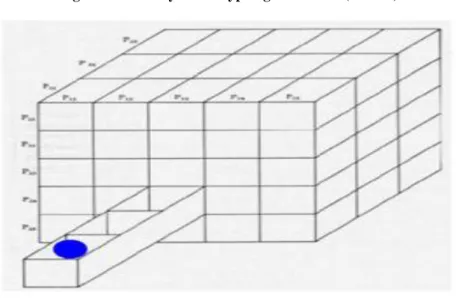
We begin by identifying and defining the parameters (or dimensions) of the problem complex to be investigated, and assigning a relevant values or conditions of each parameter . A morphological box or "Zwicky box" is constructed by setting the parameters against each other in an n-dimensional matrix.
Each cell of the n-dimensional box contains one particular "value" or condition from each of the parameters, and thus marks out a particular state or configuration of the problem complex.
2–Morphological analysis and “La prospective”:
Morphological analysis has long been used in technological forecasting and relatively little in economic or sectorial prospective. Yet, it lends itself well to the construction of scenarios. A global system can be decomposed into demographic, economic, technical, social or organizational dimensions or components, with for each of these components a certain number of possible states (hypotheses or configurations).
The key variables of the structural analysis and the key issues of the actors ‘strategy analysis are grouped into components and subsystems. Their combinatory will be the subject of morphological analysis. A system of five components each having four configurations represents no less than six hundred and twenty-five possible combinations (5× 5 × 5 × 5 = 625). This field of possibilities is also called "morphological space".
Previously, Scenario construction was generally limited to a few combinations, which appeared most likely, assumptions on the key dimensions of the analysis, four or five maximum. Adding other components and other assumptions (hypothesis) is depending on the nature of the system under study. In the example proposed by E. Jantsch (1967) on thrusters, there were more than ten components which included two to four possible configurations each, and whose number of conceivable solutions amounted to 36 864. Fortunately, there exists constraints, technical incompatibilities especially that make several families of solutions impossible and reduce the morphological space.
3–Previous studies:
Many recent studies in the agriculture field using Morphol technique are published in peer reviews. We mention the following:
3.1. Prospective Agriculture Énergie 2030 (Vert and Portet, 2010): Agriculture Energy 2030 was
one of the first major projects of the Center for Studies and Foresight (CEP). Based on a working group of about forty experts from various disciplines, this exercise led to the formulation of four scenarios for the evolution of French agriculture and its links with energy issues over the next twenty years. The aim of the work is to consider the interactions between French agriculture and energy not as a causal, isolated and one-way relationship, but as part of a complex system, involving other factors and not only technical or economic factors. The method used is the scenario method whose Morphol method is included. Four scenarios are elaborated: Territorialization and sobriety in the face of the crisis, Dual agriculture and energy realism, Agriculture-health without strong energy constraint and, Ecological agriculture and control of the energy. As a result of the study, Energy in agriculture is too often considered as a secondary or cyclical issue. It is in fact a question of major future because of its economic consequences for farms, its links to environmental and climatic issues and its influence on the organization of sectors and the development of territories.
3.2. Foresight analysis of agricultural sector at regional level (Gómez-Limón et al, 2009) :The
aim of this studyis to realize a foresight analysis of the agricultural sector in Castilla y Leo´n (Spain) for the horizon 2020 using la prospective as a methodology. We first identify the key driving forces (key variables) that characterize the evolution of the system under study using a structural analysis. We then carried out a morphological analysis in order to build global scenarios. Four global scenarios are remained regarding to their truly representative of the future development of the agricultural sector in the region of Castilla y Leo´ n: Baseline scenario, triumph of the market scenario, Regional sustainability scenario and European sustainability scenario.
3.3The future of the beet sugar-sugar industry in Picardie (Kotbi et al, 2011): This project aims
to analyze and understand the factors influencing the productive dynamics of the beet sugar industry in Picardy, in order to develop scenarios for the future. The construction of three scenarios by 2020,
Roa Iktissadia REVIEW, University of El Oued, Algeria, V09, N01, 2019.
116
method of the French School of Foresight.
3.4 Danish Green Technological Foresight on Environmental Friendly Agriculture (Borch, 2007) : The Danish Green Technological Foresight (GTF) on agriculture aims to examine the
environmental challenges agriculture will face in the future and dictating how Danish agriculture will develop by 2024. The result of this foresight exercise is a catalogue of technologies capable of improving the sustainability of agriculture such as societal investments in new technologies.
III- Results and discussion :
The morphological analysis or General morphological analysis, using Morphol method, is the third step of La prospective after the structural analysis using MICMAC method and the actors ‘strategy analysis using MACTOR method (Godet, 2001). The goal of the two first methods is the construction of the base: the key variables and the main issues of the system under study and its environment, as well as the principal actors. The key variables are export of petrol and gas, economic growth, business climate, human capital, information and communication technology, territory development, motivation of the entrepreneur, export promotion, markets organization and partnership (CHINE and BALOULI, 2017). The key actors are logistic companies, Universities and research centers, Chambers of agriculture and commerce, regulators, consumers, investors, fertilizer suppliers, breeders, anglers, equipment suppliers, formal farmers, informal farmers, importers of agriculture products, exporters of agriculture products, banks and insurances and agri-food suppliers (BALOULI and CHINE, 2018). The main issues are integration of informal farmers in the Algerian agricultural system and social security systems, encouragement of the export of the Algerian agricultural products while meeting domestic demand, reduction of agricultural imports especially grain and the establishment of a tax system that enables the return of significant funds while not affecting agricultural exports (BALOULI and CHINE, 2018). According the results of the two first techniques, we will construct the morphological space.
We will decompose our morphological space (system) into four components (subsystems): agricultural entrepreneurship environment, agricultural support, finance and economy. Each component is decomposed into two or three configuration. The combination of these configurations give us scenarios of the first component. In this case 3x3x3x3x2x3x2x2 = 1942 possibilities. The preference and exclusion criteria allow us to select three scenarios: (*) professional agricultural entrepreneurship due to the perfect environment, (-) complicated and unsuitable environment and (/) traditional environment suitable to the traditional agriculture.
Perfect environment to practice agricultural entrepreneurship: The entrepreneur is motivated, qualified, and causes change with a positive view of the community that the agricultural entrepreneur is the motor of development and growth. The universities, research centers and training centers contribute on the improvement and accompaniment of the agricultural entrepreneur by the organization of conferences and seminars to enrich the knowledge of new entrepreneurs.
Complicated environment unsuitable to practice of the agricultural entrepreneurship: The agricultural entrepreneur is discouraged because the lack of technology, the bad situation of infrastructure, massive rural exodus, the backward look of the society against him, and the asymmetry of the information about prices and markets.
Traditional environment to practice traditional agriculture and some kinds of
agricultural entrepreneurship: It is extends of the current situation.
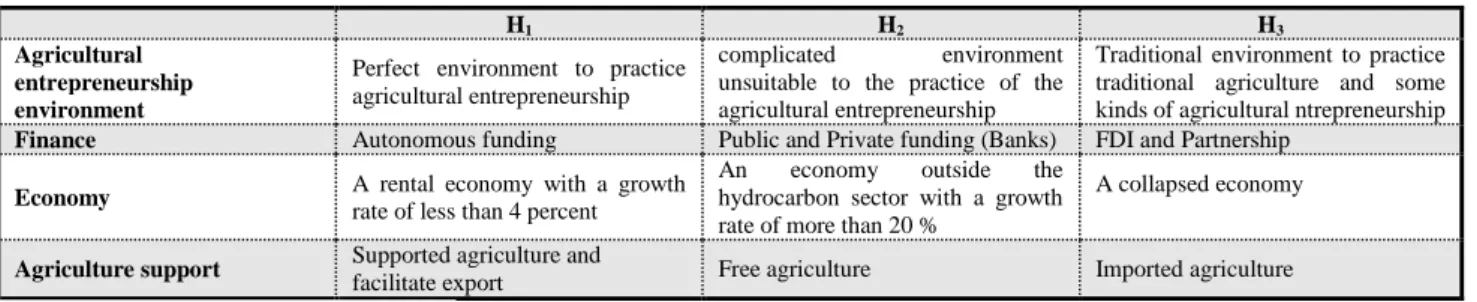
We realize the same methodology to the other components. The final morphological space is the following:
According to the morphological space, we have eighty-one 3*3*3*3 = 81 scenarios. Using preference and exclusion criteria, we identify four scenarios:
Algerian Agricultural Silicon Valley (1:1, 2:3, 3:2, 4:1): this scenario is the most preferred. A considerable contribution of the agriculture on the economic growth (more than 20% outside hydrocarbons). Agricultural projects are funded through Foreign Direct Investment (FDI) with a technology transfer. The agricultural entrepreneur benefiting from state subsidies and facilitating exportation of agricultural products that meet the requirements of the European Union and the Gulf States in addition to the satisfaction of the domestic demand. The environment is perfect with regard to the personal characteristics of the agricultural entrepreneur. Algeria will be a major player in the export of high quality of the Citrus dates and some vegetables such as potatoes and tomatoes in addition to some fruits.
Opportunities (1:1, 2:2, 3:1, 4:2): it is an acceptable scenario. The growth is dependent to the export of petrol and gaz. The motivated agricultural entrepreneur, if faced a difficulties and obstacles such as the access to the funding, will be controlled by banks. The subsidies are directed to specific areas.
Recession (1:2, 2:1, 3:3, 4:3): It is an unfavorable scenario. The agricultural entrepreneur is discouraged because the bureaucracy, the corruption, and the bad environment. There is no petrol and gas to export in addition to the food dependency to the exterior.
Risk (1:2, 2:1, 3:1, 4:2): It is an unfavorable scenario. The export of petrol and gas is not sufficient to finance expenditures that may lead to external borrowing in addition to the food dependency to the exterior in the basic foods especially Cereals.
IV- Conclusion:
The development of the Algerian agricultural sector, through the introduction of the entrepreneurship, is an issue of the authorities because it is an alternative of the export of hydrocarbons. Morphol method is based on the results of the structural analysis, using MICMAC method, and the actors’ strategy analysis, using MACTOR method. These results represent the morphological space. Reducing uncertainty through preference and exclusion criteria allows us to identify four possible scenarios without calculating the probability of realization for each scenario. The most preferred scenario is the Algerian agricultural Silicon Valley in which the country realize a great leap towards the improvement of the agricultural entrepreneurship, as an alternative of the hydrocarbons, and the satisfaction of the local need. The second scenario is acceptable because it is an improvement of the current situation. The two other scenarios are unfavorable for the country because they characterized by food dependency to the exterior in addition to the insufficient of the export of hydrocarbons.
The actual method allows us to define scenarios but without calculating the probability of occurrence for each scenario. The Smic-Prob Expert is the subject of the next phase of the scenarios method.
Roa Iktissadia REVIEW, University of El Oued, Algeria, V09, N01, 2019.
118
Borch, K. (2007). Emerging technologies in favor of sustainable agriculture. Futures, 39(9), 1045-1066.
CHINE, L; BALOULI, H, E, L. (2017). Agricultural entrepreneurship in Algeria Prospective Structural analysis using MICMAC method. MÂAREF. 23(2). 65-80.
BALOULI, H, E ; CHINE, L. (2018). Agricultural entrepreneurship in Algeria Actors’ strategy analysis using MACTOR method. Revue d’économie et de statistique appliquée. 15(1). 198-199.
COATES, J. F. P., & GODET, M. (1994). From anticipation to action: a handbook of strategic prospective. UNESCO publishing.
Coyle, R. G., & McGlone, G. R. (1995). Projecting scenarios for South-east Asia and the South-west Pacific. Futures, 27(1), 65-79.
Godet, M. D. (2001). Manuel de prospective stratégique: l’art et la méthode [Strategic prospective manual: The art and method]. Paris: Dunod.
Godet, M., & Monti, R. (1997). Manuel de prospective stratégique (Vol. 2). Paris : Dunod.
Gómez-Limón, J. A., Gómez-Ramos, A., & Fernandez, G. S. (2009). Foresight analysis of agricultural sector at regional level. Futures, 41(5), 313-324.
Greenstein, J. L., & Wilson, A. G. (1974). Remembering Zwicky. Engineering and Science, 37(5), 15-19. JANTSCH E. (1967): Technological Forecasting in Perspective, OCDE.
Kotbi, G., Muyuala, G. K., & Sauvee, L. (2011, Octobre). La méthode des scénarios appliquée aux territoires. L'exemple de l'avenir de la filière Betterave-Sucre de Picardie. In 1ère Conférence Intercontinentale d'Intelligence Territoriale" Interdisciplinarité dans l'aménagement et développement des territoires" (p. 11).
Morphol software is developed by the Institute of IT Innovation for the Company 3IE for Laboratory of Investigation in Prospective, Strategy and Organization LIPSOR.
Rhyne, R. R. (1995). Evaluating Alternative Indonesian Sea-sovereignty Systems: An Exercise in Soft Technology Transfer. Institute for Operations Research and the Management Sciences.
Ritchey, T. (1997). Scenario Development and Risk Management Using Morphological Field Analysis: Research in Progress. In ECIS (pp. 1053-1059).
Ritchey, T. (2011). General Morphological Analysis (GMA). In Wicked problems–Social messes (pp. 7-18). Springer Berlin Heidelberg.
ROUBELAT, F. C., MONTI, R. C., & GODET, M. (1997). Manuel de prospective stratégique. 2 : l'art et la méthode. Vert J., Portet F., (coord.), Prospective Agriculture Énergie 2030. L’agriculture face aux défis énergétiques, Centre
d’études et de prospective, SSP, Ministère de l’Agriculture, de l’Alimentation, de la Pêche, de la Ruralité et de l’Aménagement du Territoire, 2010.
Zwicky, F., & Wilson, A. G. (2012). New methods of thought and procedure: Contributions to the symposium on methodologies. Springer Science & Business Media.
- Appendices:
Figure 01: Zwicky box in typological format (5X5X3)
Source: (Ritchey, 2011)
Figure 02: THE SCENARIOS METHOD
Roa Iktissadia REVIEW, University of El Oued, Algeria, V09, N01, 2019.
120
Component Variables Configurations
A B C Th e en v ir o n m en t o f t h e ag ric u ltu ra l e n tr ep re n eu rsh ip Professional training The organization of conferences and seminars to enrich the knowledge of new
entrepreneurs
Increase in the number of agricultural entrepreneurs due
to professional training programs launched
decrease in the number of agricultural entrepreneurs due to
youth reluctance to enroll in training centers Innovation and
technology
Entrepreneur causes change to improve competitiveness (entrepreneurship cause
innovation)
The innovation in the agricultural sector contribute and improve the effectiveness
of the agricultural entrepreneurship
Lack of innovation due to brain drain and lack of research centers and no transfer of technology Entrepreneur
motivation
The agricultural entrepreneur is motivated and qualified to
do his job
The agricultural entrepreneur undertake and desire to face
new challenges
The agricultural entrepreneur is discouraged due to the unsuitable
climate Infrastructure and
logistic
The road network is in full development due to modernization programs due to a large number of projects
Bad situation of the infrastructures and the quality
of logistic
Algeria becomes a major player in the production of electricity from solar photovoltaic and solar thermal Information and
Communication Technology
A performing ICT systems allows to good circulation of
information on the sector
Information asymmetry and no contribution of ICT in the improvement of the agricultural
entrepreneurship Human Capital
A massive rural exodus and many agricultural entrepreneurs leave their land
to other sectors
A qualified agricultural entrepreneurs but in small
effective
Increase in agricultural labor as a result of state incitement
Local culture
Society remains committed to traditional ideas about the
farmer
The society changes the ideas about the agricultural entrepreneur and sees him as an
motor of growth
Scenarios of the first component Perfect environment to practice agricultural entrepreneurship complicated environment unsuitable to the practice of the
agricultural entrepreneurship
Traditional environment to practice traditional agriculture and some
kinds of agricultural entrepreneurship Source: realized using ©LIPSOR-EPITA-MORPHOL software outputs
Table 02: the morphological space of the agricultural entrepreneurship in Algeria
H1 H2 H3
Agricultural entrepreneurship environment
Perfect environment to practice agricultural entrepreneurship
complicated environment unsuitable to the practice of the agricultural entrepreneurship
Traditional environment to practice traditional agriculture and some kinds of agricultural ntrepreneurship Finance Autonomous funding Public and Private funding (Banks) FDI and Partnership
Economy A rental economy with a growth rate of less than 4 percent
An economy outside the hydrocarbon sector with a growth rate of more than 20 %
A collapsed economy
Agriculture support Supported agriculture and facilitate export Free agriculture Imported agriculture Source: realized by the foresight team
How to cite this article by the APA method:
BALOULI Houssame Eddine, CHINE Lazhar. (2019). Morphological analysis of agricultural entrepreneurship in Algeria using Morphol method, Roa Iktissadia Review, 09 (01), Algeria: University Eloued, pp 113-120.
The copyrights of all papers published in this journal are retained by the respective authors as per the Creative
Commons AttributionLicense.