HAL Id: hal-02480680
https://hal.archives-ouvertes.fr/hal-02480680
Submitted on 16 Feb 2020
HAL is a multi-disciplinary open access
archive for the deposit and dissemination of
sci-entific research documents, whether they are
pub-lished or not. The documents may come from
teaching and research institutions in France or
abroad, or from public or private research centers.
L’archive ouverte pluridisciplinaire HAL, est
destinée au dépôt et à la diffusion de documents
scientifiques de niveau recherche, publiés ou non,
émanant des établissements d’enseignement et de
recherche français ou étrangers, des laboratoires
publics ou privés.
VERSATILE VIDEO CODING AND
SUPER-RESOLUTION FOR EFFICIENT DELIVERY
OF 8K VIDEO WITH 4K
BACKWARD-COMPATIBILITY
Charles Bonnineau, Wassim Hamidouche, Jean-Francois Travers, Olivier
Deforges
To cite this version:
Charles Bonnineau, Wassim Hamidouche, Jean-Francois Travers, Olivier Deforges. VERSATILE
VIDEO CODING AND SUPER-RESOLUTION FOR EFFICIENT DELIVERY OF 8K VIDEO
WITH 4K BACKWARD-COMPATIBILITY. International Conference on Acoustics, Speech, and
Sig-nal Processing (ICASSP), May 2020, Barcelone, Spain. �hal-02480680�
VERSATILE VIDEO CODING AND SUPER-RESOLUTION FOR EFFICIENT DELIVERY OF
8K VIDEO WITH 4K BACKWARD-COMPATIBILITY
Charles Bonnineau
?†‡, Wassim Hamidouche
?‡, Jean-Franc¸ois Travers
†and Olivier D´eforges
‡?
IRT b<>com, Cesson-Sevigne, France,
†
TDF, Cesson-Sevigne, France,
‡
Univ Rennes, INSA Rennes, CNRS, IETR - UMR 6164, Rennes, France
ABSTRACT
In this paper, we propose, through an objective study, to com-pare and evaluate the performance of different coding approaches allowing the delivery of an 8K video signal with 4K backward-compatibility on broadcast networks. Presented approaches in-clude simulcast of 8K and 4K single-layer signals encoded using High-Efficiency Video Coding (HEVC) and Versatile Video Coding (VVC) standards, spatial scalability using SHVC with 4K base layer (BL) and 8K enhancement-layer (EL), and super-resolution applied on 4K VVC signal after decoding to reach 8K resolution. For up-scaling, we selected the deep-learning-based super-resolution method called Super-Resolution with Feedback Network (SRFBN) and the Lanczos interpolation filter. We show that the deep-learning-based approach achieves visual quality gain over simulcast, espe-cially on bit-rates lower than 30Mb/s with average gain of 0.77dB, 0.015, and 7.97 for PSNR, SSIM, and VMAF, respectively and out-performs the Lanczos filter in average by 29% of BD-rate savings.
Index Terms— 8K, HEVC, VVC, SHVC, Super-Resolution 1. INTRODUCTION
With the deployment of the latest Ultra High Definition Television (UHDTV) system [1], it is projected to improve the Quality of Expe-rience (QoE) through the introduction of new features to the existing High Definition Television (HDTV) system [2], such as High Dy-namic Range (HDR), wider color gamut, High Frame-Rate (HFR) and higher spatial resolutions including 4K (3840x2160) and 8K (7680x4320). The delivery of such video formats on current broad-cast infrastructures is a real challenge and requires efficient compres-sion methods to reach the available throughput while ensuring high video quality.
Recent studies on 8K contents coding [3, 4] have shown that a bandwidth of approximately 80Mb/s is required to reach a significant visual quality improvement over 4K video format using the High Efficiency Video Coding (HEVC) [5] standard. The Joint Video Ex-ploration Team (JVET) established by the International Telecommu-nication Union (ITU-T) and Motion Picture Experts Group (MPEG) has investigated the development of the next generation video cod-ing standard, called Versatile Video Codcod-ing (VVC). This standard, scheduled to be finalized in late 2020, should make the delivery of new video formats, including 8K, more affordable as it is projected to offer 30-50% of bit-rate savings over HEVC [6].
On the other hand, to ensure service continuity, backward com-patibility with UHD-1 signals shall be supported as a first step to pro-vide both 4K and 8K resolutions. Simulcasting 4K and 8K single-layer signals would be the simplest solution as no additional con-straint is added to the decoder. However, available bandwidth can
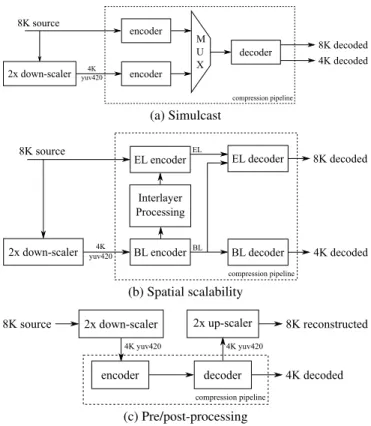
vary depending on the exploited transmission network, reducing the number of use-cases that can be covered using this approach. For instance, in the context of terrestrial transmission, the bandwidth is limited in the range 30-40Mb/s using practical DVB-T2 [7] channels while satellite infrastructures allow a bandwidth up to 80Mb/s re-laying on a complete DVB-S2X [8] transponder or multiple bonded transponders. Other coding approaches, such as spatial scalabil-ity using the scalable extension of HEVC called Scalable High Ef-ficiency Video Coding (SHVC) [9], can be considered for hybrid mechanism with base and enhancement layers to receive either 4K and 8K resolutions. To avoid using scalable-compliant decoders, an-other solution would require pre and post-processing steps into the classical transmission pipeline, as described in Figure 1. With the progress in Deep Learning for image processing, learning-based spa-tial up-scalers [10, 11, 12] have outperformed classical interpolation methods such as bicubic [13] or Lanczos [14] filters allowing a high resolution to be more accurately recovered from a lower resolution.
In this paper, we investigate the performance of these three approaches to transmit 8K video contents while ensuring back-ward compatibility with 4K devices. This study will focus on the performance of VVC for the simulcast and pre/post-processing ap-proaches. As scalability is not yet integrated into the VVC test model, despite being planned to be released in the first version of the standard [15], we are also considering HEVC and SHVC for simulcast and spatial-scalability to estimate its possible benefits in the considered context. For the experiments, the coding performance is assessed with objective quality metrics, including PSNR, SSIM and VMAF [16]. Although VMAF is optimized for visual quality estimation of 4K contents, it can be relevant to add this evaluation method in the experiment as it proposes a high correlation with sub-jective test ratings. For the pre/post-processing pipeline, we use the deep-learning-based method Super-Resolution with Feedback Net-work (SRFBN) [17], which enables good performance in both visual quality improvement and runtime. We have trained the model using compressed data to propose a fair evaluation of this method on con-tents presenting compression artefacts. For VVC, this study shows that, for bit-rates lower than 30Mb/s, the tested super-resolution method offers an average gain over simulcast of 0.77dB, 0.015, and 7.97 regarding PSNR, SSIM, and VMAF, respectively. Moreover, this method outperforms the Lanczos filter by offering about 29% of BD-rate savings in PSNR. Thus, this approach is particularly effective for the transmission of 8K contents with 4K backward compatibility using existing terrestrial infrastructures.
The remainder of this paper is organized as follow. Section 2 presents the different tested coding schemes. Section 3 gives the video sequences and the test conditions. Results are then presented and analyzed in Section 4. Finally, Section 5 concludes this paper.
encoder encoder 2x down-scaler 8K source 8K decoded 4K decoded 4K yuv420 decoder compression pipeline M U X (a) Simulcast BL encoder EL encoder 2x down-scaler 8K source 8K decoded BL decoder 4K decoded 4K yuv420 Interlayer Processing EL decoder compression pipeline BL EL (b) Spatial scalability encoder 2x down-scaler 2x up-scaler 8K source decoder 8K reconstructed 4K yuv420 4K yuv420 compression pipeline 4K decoded (c) Pre/post-processing
Fig. 1. Coding approaches that enable 8K signal to be delivered with 4K backward-compatibility.
2. BACKWARD-COMPATIBLE APPROACHES FOR 8K VIDEO CODING
A mechanism for 8K transmission that enables backward compati-bility with existing UHD-1 receivers might help to increase audience reach. Solutions illustrated in Figure 1, namely simulcast, spatial-scalability, and pre/post-processing, allow the delivery of both 4K and 8K signals. This section aims at presenting these approaches by introducing tools that enable each pipeline to be set-up. First, simulcast of two single-layer signals approach is presented. Then, spatial-scalability using scalable-compliant codec such as SHVC is developed. Finally, we present a pre/post-processing pipeline that enables both resolutions to be provided from a unique 4K signal. 2.1. Simulcast
Contributions to compression standards like HEVC or its successor VVC, scheduled to be released in 2020, enable video signal com-pression to be continuously improved through the MPEG standard-isation body. Simulcast is the process of transmitting several ver-sions of an input signal encoded with single-layer coding approaches such as HEVC or VVC to cover different target outputs. Although HEVC has brought a significant bit-rate reduction for 4K delivery, its efficiency is not sufficient for 8K applications. For instance, the studies conducted in [3, 4] have shown that the bit-rate required by HEVC for 8K applications in 60Hz and 120Hz (temporally scalable) is around 80Mbps. In practice, HEVC codecs have been used for satellite broadcasting in Japan, where HEVC codec for 8K 120Hz has been developed [4, 18]. For satellite transmission with DVB-S2X, bandwidth in the range 70-80Mb/s can be reached with the use
of a complete transponder or multiple bonded transponders. For ter-restrial transmission, such bandwidth requirements prevent the de-ployment of 4K and 8K simultaneously, as practical DVB-T2 [19] channels offer bandwidth in the range 30-40Mb/s over an 8MHz channel.
2.2. Spatial scalability
To increase the coding efficiency, one possibility is to take advan-tage of the existing correlations between 4K and 8K signals by using a spatially-scalable codec with a base and enhancement layer model. In the case of SHVC for spatial scalability, a base-layer (BL) signal (low resolution) encoded with HEVC is used as a reference by an inter-layer processing module to encode the enhancement-layer (EL) signal (high resolution). The EL signal is described by the use of ad-ditional High-Level Syntax (HLS) and needs a scalable-compliant decoder to be decoded. Several standardization bodies such as the Advanced Television Systems Committee (ATSC) [20] or the Dig-ital Video Broadcasting consortium (DVB) [21] consider SHVC as a candidate for solving compatibility issues brought by new formats introduction. However, due to codec compatibility issues caused by a late integration of the HEVC scalable extension, spatial-scalability is not much present in the current broadcast ecosystem. To tackle these obstacles and make the deployment of this technology more likely in the future, scalability is planned to be integrated into the first release of the next generation video coding standard VVC.
2.3. Pre and post-processing
To cover a wide range of compatible UHD-1 or UHD-2 receivers, one solution would be to apply down-scaling and up-scaling opera-tions to the signal outside the coding pipeline. Thus, the bandwidth is limited to broadcast 4K only while both resolutions can be dis-played by the receiver. In the image processing field, the process of estimating a high-resolution version of a low-resolution content is referred to as super-resolution. In the last past years, learning-based super-resolution approaches have outperformed state-of-the-art methods through the last progress in the Artificial Intelligence (AI) field. The objective of these methods is to learn the non-linearity that exists between low-resolution images (LR) and their high-resolution version (HR) by analysing local statistics. For our study, we have selected the Feedback Network for Super-Resolution (SRFBN) as the up-scaling operator, which provides good performance in both visual quality enhancement and runtime. This approach is based on an end-to-end Convolutional Neural Network (CNN) coupled with a feedback mechanism that aims to output the best high-resolution (HR) version of the input low-resolution (LR) content. This method is optimized to recover details from uncompressed LR images by iterative minimization of L1 loss between the reconstructed HR im-age and the corresponding HR ground truth to increase its accuracy over training steps. Initially, the data-sets used to train the network are the publicly-available super-resolution image data-sets Flickr2K and DIV2K [22]. However, the low-resolution sequences used for our study can present strong compression artefacts after decoding, making the baseline SRFBN network not adapted to the target task. Thus, to perform a fair evaluation, we have trained the model by us-ing the initial data-sets DIV2K and Flickr2K encoded with VTM in All-Intra coding configuration. More details on the training process are provided in Section 3.2.2.
0 50 100 150 200 250 300 350 400 450
SI
0 50 100 150 200 250TI
SteelPlant
JapaneseMaple
Festival1
Expressway
Umbrella
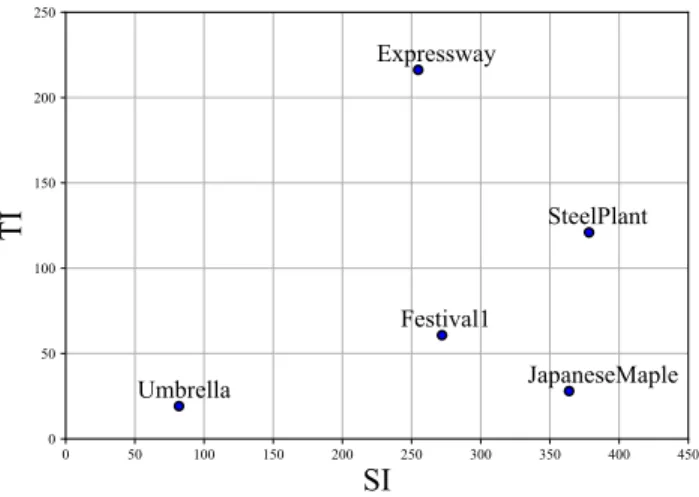
Fig. 2. SI-TI graph of the tested video sequences.
Table 1. Standard verification models specification Standard VVC HEVC SHVC Reference Softw. VTM-5.0 SHM-9.0 (BL) SHM-9.0 Profile next main10 main10
GOP Size 16 16 16
3. EXPERIMENTAL SETTINGS
This section gives details of the experiment. First, the sequences selected for the study and their specifications are presented. Then, the codec specifications and super-resolution settings are detailed. 3.1. Test sequences
For the experiment, we have selected five 8K sequences of 5 seconds. These sequences were provided by The Institute of Image Informa-tion and Television Engineers. The spatial and temporal informaInforma-tion (SI-TI) [23] of these sequences is plotted in Figure 2. This 2D-plan shows that the contents selected for the study have various spatial and temporal features. The objective is to have a diversity of con-tents and analyse the coding efficiency regarding their features. The sequences in 4K resolution are generated by a bicubic down-scale and the SHM down-scaling filter described in [9] for the pre/post-processing and spatial-scalability approaches, respectively. 3.2. Test conditions
3.2.1. Verification models
Verification software models provide a reference implementation of different compression standards representing their maximal perfor-mance offered with a moderate level of optimization. For the experi-ment, the Common Test Conditions for VTM [24] and SHM [25] are used to provide a fair rate/distortion estimation. HEVC simulcast is simulated using the SHM base-layer mode to ensure a fair compar-ison over spatial-scalability. The coding configurations are summa-rized in Table 1 for both codecs. Each test sequence is encoded in Random Access coding configuration with Quantization Parameter
Table 2. BD-rate (%) for SHVC compared to HEVC simulcast
Sequence PSNR-Y SSIM VMAF Expressway -8.86 -8.23 -8.47 Festival1 -12.97 -12.07 -12.19 JapaneseMaple -12.93 -11.65 -13.42 SteelPlant -16.40 -14.86 -12.66 Umbrella -17.88 -18.73 -14.13 Average -13.81 -13.11 -12.17
(QP) values of 22, 27, 32, and 37. QP of 17 and 42 are added to the parameter-set for the pre/post-processing and simulcast evaluations, respectively, to cover a similar range of bit-rate. To assess the visual quality, objective metrics, including PSNR-Y, SSIM, and VMAF, are used to measure the distortion between the decoded or reconstructed 8K signal and the original one. To quantify the average gain in bit-rate or visual quality offered by a tested method over another, we use the Bjøntegaard delta (BD) method described in [26]. For pre/post-processing, the bit-rate is assessed on the 4K single-layer signal. For simulcast and spatial-scalability, the measured bit-rate corresponds to the sum of both 8K and 4K bitstreams.
3.2.2. Super-resolution settings
The baseline version of SRFBN provided by the author in [17] is trained to recover the high-resolution version of uncompressed low-resolution data. In our case, we focus on assessing this method on video presenting compression artefacts. Learning-based super-resolution being very sensitive to the nature of the training data, a fair evaluation of this approach is not possible with the provided learned parameters. To propose a fair evaluation of the model, we have fine-tuned the baseline network using a compressed version of the initial image datasets DIV2K and Flickr2K. First, we have gen-erated pairs of LR/HR images by applying a bicubic down-scaling filter with a scale-factor of 2 from HR images. Then, each LR image has been encoded using the All Intra configuration of the VTM with five QP values, including 17, 22, 27, 32 and 37 to cover a large panel of distortions. These coded samples, representing different levels of compression distortions, are used to fine-tune the network. To eval-uate the performance of SRFBN, we have also compared results ob-tained with a Lanczos filter applied on the low-resolution sequences.
4. RESULTS
In this section, we present and analyze the results of the simulations conducted using the verification models and the settings described in Section 3 for the three approaches presented in Section 2. First, we compare simulcast and spatial scalability using SHM. Then, we evaluate the pre/post-processing pipeline over simulcast with VTM. 4.1. Simulcast and spatial scalability
One objective of this study is to estimate the potential gain of spa-tial scalability over simulcast of 8K and 4K. Since VVC does not yet support spatial scalability, we compare the simulcast of 4K and 8K in HEVC and SHVC with 4K base-layer and 8K enhancement-layer as a first step. Table 2 gives the BD-rate results of SHVC with respect to the HEVC simulcast configuration for the five video sequences. Inter-layer predictions enable 13.81%, 13.11%, and 12.17% of av-erage BD-rate savings over simulcast for PSNR, SSIM, and VMAF, respectively. However, scalable-compliant decoders will still be re-quired to decode the SHVC bitstream.
0 25 50 75 100 125 bitrate mb/s 32 33 34 35 36 37 38 39 psnr_y simulcast_VTM postproc_VTM_SRFBN postproc_VTM_lanczos (a) PSNR-Y 0 25 50 75 100 125 bitrate mb/s 0.84 0.86 0.88 0.90 0.92 0.94 ssim simulcast_VTM postproc_VTM_SRFBN postproc_VTM_lanczos (b) SSIM 0 25 50 75 100 125 bitrate mb/s 40 50 60 70 80 90 vmaf simulcast_VTM postproc_VTM_SRFBN postproc_VTM_lanczos (c) VMAF
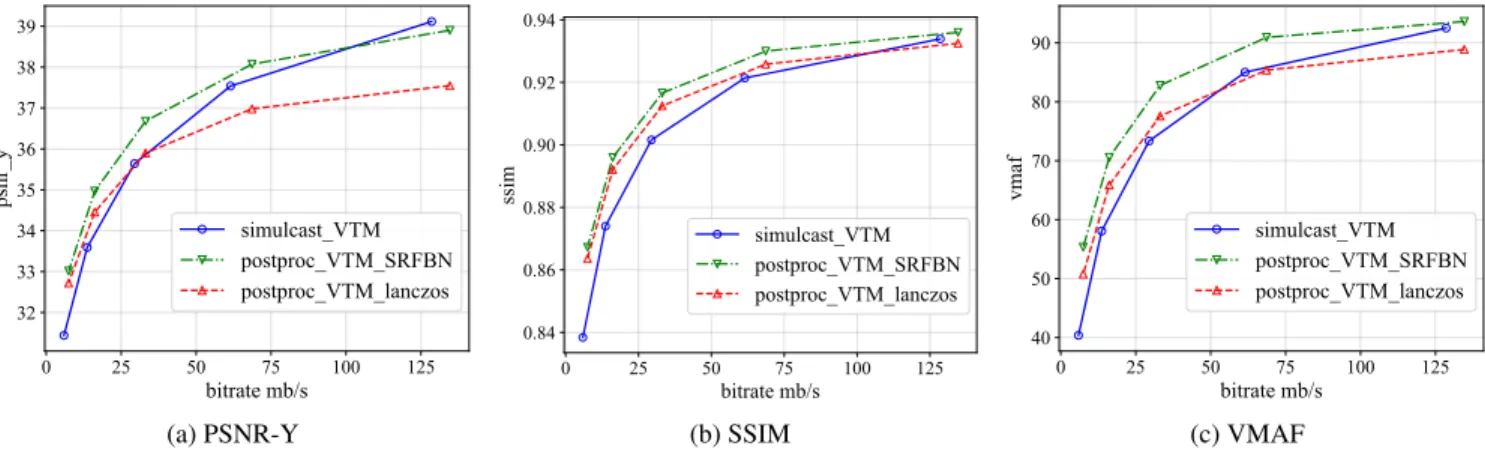
Fig. 3. Average rate-distortion curves on the five 8K video sequences of simulcast and pre/post-processing approaches.
Table 3. BD-metric results per bit-rate interval (Mb/s) for pre/post-processing with VVC compared to simulcast with VVC.
Lanczos SRFBN Sequence Interval BD-PSNR BD-SSIM BD-VMAF BD-PSNR BD-SSIM BD-VMAF Expressway -30 -1.67 0.001 -3.01 -0.12 0.004 3.10 30-80 - - - -+80 - - - -Festival1 -30 0.92 0.018 6.44 1.42 0.022 10.63 30-80 -0.41 0.005 1.03 0.6 0.009 5.59 +80 -1.44 0 -2.53 -0.11 0.003 1.74 JapaneseMpl -30 0.79 0.029 5.01 1.09 0.036 9.19 30-80 0.61 0.02 4.96 1.19 0.027 9.61 +80 -0.45 0.004 1.54 0.70 0.012 6.76 SteelPlant -30 0.52 0.007 3.34 1.01 0.011 10.65 30-80 0.29 0.007 2.38 1.14 0.012 10.78 +80 -0.67 0.003 -1.75 0.59 0.009 6.68 Umbrella -30 0.42 0.003 4.17 0.47 0.004 6.29 30-80 - - - -+80 - - - -Average -30 0.2 0.011 3.19 0.77 0.015 7.97 30-80 0.1 0.006 1.67 0.59 0.01 5.2 +80 -0.51 0.001 -0.55 0.24 0.005 3.04
4.2. Pre and post-processing
In this section, we analyse the benefit of using a pre/post-processing pipeline instead of a simulcast approach for the delivery of 8K with 4K backward compatibility using VVC. First, a rate-distortion eval-uation has been conducted using objective visual quality metrics, in-cluding PSNR, SSIM, and VMAF. The results for the average perfor-mance over all the tested sequences are illustrated in Figure 3. For all considered metrics, SRFBN enables average gain over Lanczos up to 29.02%, 14.40%, and 28.53% of BD-rate savings regarding PSNR, SSIM and VMAF metrics, respectively. It can be noticed that the performance gap between SRFBN and Lanczos increases propor-tionally with the bit-rate increase. Although SRFBN is trained on compressed data, rough training methodology, as described in Sec-tion 3, cannot allow the model to accurately recover details from LR sequences comprising strong compression artefacts. For broadcast, such artefacts can appear when the allocated bit-rate is not sufficient. To tackle this, it is possible to increase the efficiency for this use case by considering advanced training methods [27] and/or adapted archi-tecture to optimize the model for the target task.
The pre/post-processing pipeline is more efficient than simulcast until high bit-rate values (about 100Mb/s and 125Mb/s for SRFBN regarding PSNR and SSIM/VMAF, respectively). Regarding PSNR, SRFBN and Lanczos have better performance over simulcast until approximately 100Mb/s and 30Mb/s, respectively. Regarding SSIM and VMAF, SRFBN is more efficient than simulcast for all the pre-sented bit-rate range. For VMAF, it can be explained by the use of detail loss metrics, namely, DLM [28] and VIF [29], in the fi-nal score computation. To evaluate the performance of SRFBN and Lanczos according to the bit-rate, we have computed the average vi-sual quality gain for each metric over simulcast per tested sequence by using the BD-rate evaluation method. Three bit-rate intervals are considered: lower than 30Mb/s, from 30Mb/s to 80Mb/s, more than 80Mb/s. Results are presented in Table 3. We have computed ad-ditional QP points for some sequences to cover at least four points per bit-rate range. We can notice that the performance gap between SRFBN and Lanczos is more significant for the most complex se-quences. Although being classified as a non-trivial sequence by the SITI graph, no results are collected after 30Mb/s for Expressway due to global motion, making the scene easy to predict by the encoder.
5. CONCLUSION
Three approaches allowing the transmission of both 8K and 4K over broadcast networks have been assessed, including simulcast, spatial-scalability, and pre/post-processing. Waiting for more details on VVC scalable mode, a preliminary test using HEVC and its scal-able extension SHVC was conducted. Experimental results have shown that spatial-scalability achieves 13.81% of BD-rate savings compared to simulcast regarding PSNR.
We have also demonstrated by a fair evaluation that the tested super-resolution method allows a bit-rate reduction of approximately 29% in PSNR compared to Lanczos. This experiment also con-firms that up-scaling 4K signal after decoding outperforms 4K and 8K simulcast using VVC, especially at bit-rates lower than 30Mb/s. Indeed, the BD evaluation demonstrates an average visual quality improvement over VVC simulcast of 0.77dB, 0.015, and 7.97 for PSNR, SSIM, and VMAF, respectively, on this bit-rate interval. Ter-restrial broadcast limitations being in this range of bit-rate, the pre and post-processing approach may be preferred. However, the com-plexity of deep-learning-based tools is to be considered as it is added at the decoder-side. Future works will consider the VVC spatial scal-ability and subjective evaluation to consolidate the objective results.
6. REFERENCES
[1] ITU-R, “Recommendation BT.2020-1: Parameters Values of Ultra-High Definition Television Systems for Production and International Programme Exchange,” .
[2] ITU-R, “Recommendation BT.709-5: Parameters Values for the HDTV Standards for Production and International Pro-gramme Exchange,” .
[3] Atsuro Ichigaya and Yukihiro Nishida, “Required bit rates analysis for a new broadcasting service using hevc/h. 265,” IEEE Transactions on Broadcasting, vol. 62, no. 2, pp. 417– 425, 2016.
[4] Yasuko Sugito, Shinya Iwasaki, Kazuhiro Chida, Kazuhisa Iguchi, Kikufumi Kanda, Xuying Lei, Hidenobu Miyoshi, and Kimihiko Kazui, “A study on the required video bit-rate for 8k 120-hz hevc/h. 265 temporal scalable coding,” in 2018 Picture Coding Symposium (PCS). IEEE, 2018, pp. 106–110. [5] Gary J Sullivan, Jens-Rainer Ohm, Woo-Jin Han, and Thomas
Wiegand, “Overview of the high efficiency video coding (hevc) standard,” IEEE Transactions on circuits and systems for video technology, vol. 22, no. 12, pp. 1649–1668, 2012.
[6] N. Sidaty, W. Hamidouche, P. Philippe, J. Fournier, and O. D´eforges, “Compression Performance of theVersatile Video Coding: HD and UHD Visual Quality Monitoring,” in IEEE Picture Coding Symposium (PCS2019), Novomber 2019. [7] ESTI, “Digital Video Broadcasting (DVB); Implementation
guidelines for a second generation digital terrestrial television broadcasting system (DVB-T2),” .
[8] ESTI, “Digital Video Broadcasting (DVB); Second generation framing structure, channel coding and modulation systems for Broadcasting, Interactive Services, News Gathering and other broadband satellite applications; Part 2: DVB-S2 Extensions (DVB-S2X),” .
[9] Jill M Boyce, Yan Ye, Jianle Chen, and Adarsh K Ramasubra-monian, “Overview of shvc: Scalable extensions of the high efficiency video coding standard,” IEEE Transactions on Cir-cuits and Systems for Video Technology, vol. 26, no. 1, pp. 20– 34, 2015.
[10] Chao Dong, Chen Change Loy, Kaiming He, and Xiaoou Tang, “Image super-resolution using deep convolutional networks,” IEEE transactions on pattern analysis and machine intelli-gence, vol. 38, no. 2, pp. 295–307, 2015.
[11] Wenzhe Shi, Jose Caballero, Ferenc Husz´ar, Johannes Totz, Andrew P Aitken, Rob Bishop, Daniel Rueckert, and Zehan Wang, “Real-time single image and video super-resolution us-ing an efficient sub-pixel convolutional neural network,” in Proceedings of the IEEE conference on computer vision and pattern recognition, 2016, pp. 1874–1883.
[12] Christian Ledig, Lucas Theis, Ferenc Husz´ar, Jose Caballero, Andrew Cunningham, Alejandro Acosta, Andrew Aitken, Alykhan Tejani, Johannes Totz, Zehan Wang, et al., “Photo-realistic single image super-resolution using a generative ad-versarial network,” in Proceedings of the IEEE conference on computer vision and pattern recognition, 2017, pp. 4681– 4690.
[13] Robert Keys, “Cubic convolution interpolation for digital im-age processing,” IEEE transactions on acoustics, speech, and signal processing, vol. 29, no. 6, pp. 1153–1160, 1981.
[14] Claude E Duchon, “Lanczos filtering in one and two dimen-sions,” Journal of applied meteorology, vol. 18, no. 8, pp. 1016–1022, 1979.
[15] Jianle Chen Ye-Kui Wang, Hendry, “Document JVET-O0135: Scalability for VVC - general,” July 2019.
[16] Anne Aaron Zhi Li, “Toward a Practical Perceptual Video Quality Metric,” in Netflix TechBlog, June 2016.
[17] Zhen Li, Jinglei Yang, Zheng Liu, Xiaomin Yang, Gwang-gil Jeon, and Wei Wu, “Feedback network for image super-resolution,” in The IEEE Conference on Computer Vision and Pattern Recognition (CVPR), June 2019.
[18] Y Sugito, K Iguchi, A Ichigaya, K Chida, S Sakaida, H Sakate, Y Matsuda, Y Kawahata, and N Motoyama, “Hevc/h. 265 codec system and transmission experiments aimed at 8k broad-casting,” 2015.
[19] Inaki Eizmendi, Manuel Velez, David G´omez-Barquero, Javier Morgade, Vicente Baena-Lecuyer, Mariem Slimani, and Jan Zoellner, “Dvb-t2: The second generation of terrestrial digital video broadcasting system,” IEEE transactions on broadcast-ing, vol. 60, no. 2, pp. 258–271, 2014.
[20] W. Husak, “ISO/IEC JTC1/SC29/WG11-M37372: ATSC liai-son on SHVC,” .
[21] DVB, “DVB Fact Sheet: Introduction to the DVB Project,” May 2014.
[22] Eirikur Agustsson and Radu Timofte, “Ntire 2017 challenge on single image super-resolution: Dataset and study,” in The IEEE Conference on Computer Vision and Pattern Recognition (CVPR) Workshops, July 2017.
[23] ITU-R, “Recommendation BT.910: Subjective video quality assessment methods for multimedia applications,” .
[24] Frank Bossen, Jill Boyce, Karsten Suehring, Xiang Li, and Vadim Seregin, “Jvet common test conditions and software reference configurations for sdr video,” March 2019.
[25] Xiang Li, Jill Boyce, Patrice Onno, and Yan Ye, “Common SHM test conditions and software reference configurations,” April 2013.
[26] Gisle Bjontegaard, “Document VCEG-M33: Calculation of Average PSNR Differences Between RD- Curves,” April 2001. [27] Radu Timofte, Rasmus Rothe, and Luc Van Gool, “Seven ways to improve example-based single image super resolu-tion,” 2015.
[28] Songnan Li, Fan Zhang, Lin Ma, and King Ngi Ngan, “Image quality assessment by separately evaluating detail losses and additive impairments,” IEEE Transactions on Multimedia, vol. 13, no. 5, pp. 935–949, 2011.
[29] Hamid R Sheikh and Alan C Bovik, “Image information and visual quality,” IEEE Transactions on image processing, vol. 15, no. 2, pp. 430–444, 2006.