• Aucun résultat trouvé

Supplemental Information Detection and quantification of free sulfhydryls in monoclonal antibodies and other recombinant proteins using maleimide labeling and mass spectrometry

N/A
N/A
Protected

Academic year: 2021

Partager "Supplemental Information Detection and quantification of free sulfhydryls in monoclonal antibodies and other recombinant proteins using maleimide labeling and mass spectrometry"

Copied!
8
0
0

Texte intégral

(1)

Supplemental Information

Detection and quantification of free sulfhydryls in monoclonal antibodies and other recombinant proteins using maleimide labeling and mass spectrometry

Anna C. Robotham

1

* and John F. Kelly

1

1

Human Health Therapeutics Research Centre, National Research Council of Canada, Ottawa, Ontario, Canada K1A 0R6

* Corresponding author: Anna C. Robotham at Human Health Therapeutics Research Centre, National Research Council of Canada, 100 Sussex Drive, Ottawa, Ontario, Canada K1A 0R6.

Tel.: +1 613 991 9203

E-mail: [email protected]

(2)

Table S1. Amount of label loss and degree of reduction observed for maleimide-PEG

2

- biotin labeled β-lactoglobulin A treated with TCEP under different conditions. Degree of reduction is determined based on the mass observed for the unlabeled and labeled protein.

Reduction of the 2 disulfide bonds of β-lactoglobulin A increases the mass by 4 Da.

Condition

Mass of Unlabeled (Da)

Mass of Labeled (Da)

Effective Reduction

Percentage Unlabelled Observed (%)

Unlabeled, non-reduced 18362 - NA 100

Unlabeled, reduced 18366 - Yes 100

Labeled, non-reduced - 18888 NA 0

Labeled, reduced with 5mM TCEP,

15 min @ 37°C 18366 18892 Yes 6.4

Labeled, reduced with 5mM TCEP,

15 min @ 37°C (replicate) 18367 18892 Yes 5.4

Labeled, reduced with 5mM TCEP,

4 h @ 37°C 18367 18892 Yes 5.5

Labeled, reduced with 5mM TCEP,

15 min @ RT 18367 18890 Partial 3.9

Labeled, reduced with 5mM TCEP,

75 min @ RT 18366 18891 Yes 4.3

Labeled, reduced with 20mM TCEP,

15 min @ 37°C 18367 18892 Yes 6.0

Labeled, reduced with 1mM TCEP,

10 min @ RT 18366 18888 No 0.77

Labeled, reduced with 5mM TCEP,

15 min @ 37°C, pH 4 18365 18890 Partial 4.2

Labeled, reduced with 5mM TCEP, 15 min @ 37°C then TCEP removed by buffer exchange before MS

18364 18891 Partial 6.2

(3)

Table S2. Free sulfhydryl levels observed for each peptide quantified in the 3 replicates.

Peptides are organized by cysteine site. Peptides not observed above the minimum signal threshold, or are observed with >2% co-eluting signal, are indicated with ND (not detected).

Average percentage of d

0

-NEM labeling observed is reported for each peptide across multiple

replicates and for each cysteine site across multiple peptide forms (bolded).

(4)

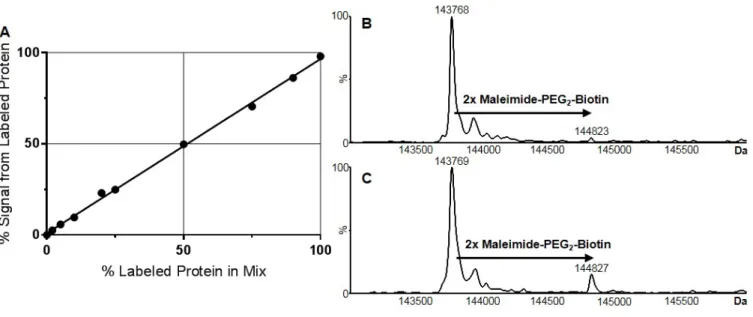
Figure S1. (A) Amount of labeled SigmaMAb observed in the deconvoluted mass spectrum when 0% labeled SigmaMAb and 98% labeled SigmaMAb were mixed in various ratios. Linear regression is y = 0.9561x + 0.9862, R

2

=0.9984. (B) Example of the deconvoluted mass spectrum for a mix containing 2% labeled SigmaMAb, the lowest proportion of labeled SigmaMAb tested.

(C) Example of the deconvoluted mass spectrum for a mix containing 10% labeled SigmaMAb.

(5)

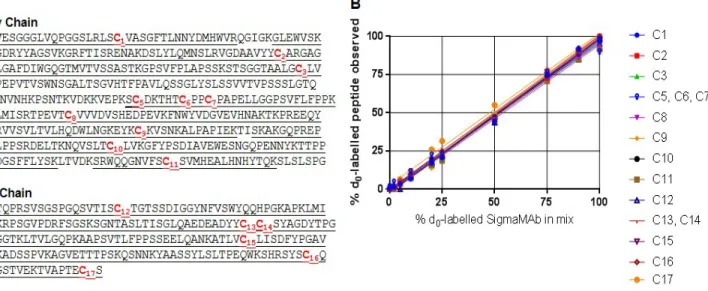
Figure S2. (A) The amino acid sequence for the heavy chain and light chain of SigmaMAb.

Cysteines are labeled in red and numbered sequentially. Peptides identified using MASCOT and

manually confirmed by inspection are underlined. (B) The percentage of peptide labeled with d

0

-

NEM observed in different trypsin-digested mixes of fully d

0

-NEM labeled and fully d

5

-NEM

labeled SigmaMAb. The average percentage of d

0

-NEM labeled peptide observed, for all peptide

forms containing the indicated cysteine(s), is plotted. The slopes of the lines vary from 0.96 to

1.03 and goodness of fit is R

2

>0.99 for all linear regressions.

(6)

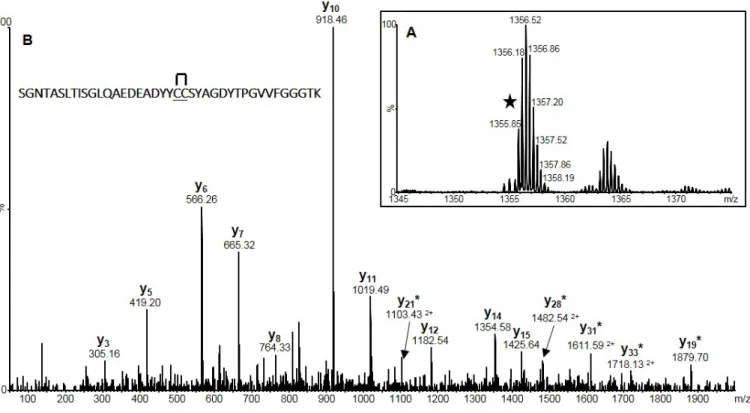
Figure S3. (A) When the tryptic digest of non-reduced SigmaMAb was analyzed by mass spectrometry, a 3+ ion was observed corresponding to the peptide

SGNTASLTISGLQAEDEADYYCCSYAGDYTPGVVFGGGTK with Cys 90 and Cys 91 internally disulfide bonded (marked with a star). (B) MS/MS spectrum confirming the identity of the internally disulfide bonded peptide

SGNTASLTISGLQAEDEADYYCCSYAGDYTPGVVFGGGTK. The y-ions marked with * are

expected to include the internal disulfide bond.

(7)

Figure S4. Standard curves prepared for the NPM-based fluorescence assay using 3 potential standards, each which have 1 free sulfhydryl (N-acetyl cysteine, β-lactoglobulin A and BSA).

The fluorescence for each standard at 376nm after NPM labeling was measured, with (open

shapes) or without (closed shapes) pepsin cleavage to disrupt protein structure.

(8)

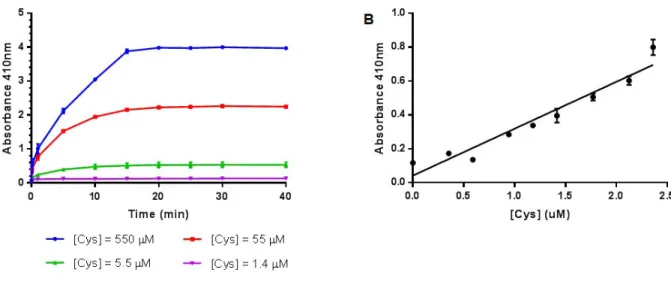
Figure S5. (A) p-nitroaniline production from L-BAPNA by papain-SSCH3 over time, as measured by change in absorbance at 410 nm, when papain-SSCH3 is activated by different concentrations of L-cysteine. All curves plateau within 20 minutes of addition of L-BAPNA, regardless of the proportion of papain-SSCH3 that is activated by L-cysteine. (B) Standard curve prepared for the colorimetric assay using L-cysteine standards. The absorbance of each standard was measured at 410 nm twice, 50 minutes and 102 minutes after the addition of L-BAPNA.

Linear regression is y = 0.28x + 0.04, R

2

=0.9365.

Figure

Table S1. Amount of label loss and degree of reduction observed for maleimide-PEG 2 - -biotin labeled β-lactoglobulin A treated with TCEP under different conditions
Figure S1. (A) Amount of labeled SigmaMAb observed in the deconvoluted mass spectrum  when 0% labeled SigmaMAb and 98% labeled SigmaMAb were mixed in various ratios
Figure S2. (A) The amino acid sequence for the heavy chain and light chain of SigmaMAb
Figure S3. (A) When the tryptic digest of non-reduced SigmaMAb was analyzed by mass  spectrometry, a 3+ ion was observed corresponding to the peptide
+3

Références

Documents relatifs

We report here the complementarity of native mass spectrometry (MS), ion mobility (IM) and collision induced unfolding (CIU) experiments for the structural characterization of

Before the elementary production cross sections in pn reactions are not determined and be- fore the cross sections for baryonic resonances are not better known heavy ion data do

Even though a causal relationship between uridylation and mRNA decay has yet to be demonstrated in Arabidopsis and many molecular details remain to be solved to fully understand

The primary goal of this project was to design and build a 1 / 3 0 th scale, free-running model of the David Taylor Model Basin hull for hydrodynamic visualization

TABLE 1 | Peptide selection: starting from 22 validated peptides of CSF tau protein obtained with high resolution mass spectrometry in PRM mode (Barthelemy, under review), the

Nous étions seulement au mauvais endroit, et en plus ce n'était même pas notre voiture.... Ma belle-sœur a fait entre temps opposition sur sa carte bleue et son chéquier, et

Mais comme l’écrit en 1951 André Lebois dans son article, « Pierre Reverdy ou le vertige de la pureté » publié dans le numéro 58 de la revue l’Age Nouveau, l’ambition

signal regions are due to the size of the eµ data sample in CR-FS, used to provide the flavour-symmetric background estimate, the combined systematic uncertainty in the same