Dorothea Schumann* and Rugard Dressler
Development of an extraction system for the
separation of dubnium from rutherfordium using
MIBK and HCl
/HF solutions
DOI 10.1515/ract-2015-2398
Received February 12, 2015; accepted August 28, 2015; published online November 4, 2015
Abstract: A chemical separation system was developed to
separate group 4 and 5 elements using extraction from HCl/HF solution into methyl-isobutyl-ketone (MIBK). The system is proposed to be applied for a confident assign-ment of the spontaneous fissioning radionuclide produced as decay product of element 115 either as dubnium (Db, 𝑍 = 105) or rutherfordium (Rf,𝑍 = 104). Moreover, extrac-tion systems are proposed allowing the investigaextrac-tion of chemical properties of Db in comparison to the properties of its lighter homologs Nb and Ta.
Keywords: Superheavy elements, dubnium, liquid–liquid
extraction, relativistic effects.
1 Introduction
The application of fusion reactions using a48Ca beam on actinide targets at Joint Institute for Nuclear Research (Dubna, Russia), the so-called “hot fusion”, opened new dimensions in the field of synthesis and characterization of new superheavy elements (SHE) [1]. Unfortunately, most of the detected decay chains have ended in so far unknown spontaneous fissioning radionuclides, resulting in doubts on the findings within the International Union of Pure and Applied Chemistry at the time of their discovery.
In this respect, the discovery of the elements 115 and 113 in 2003 [2], followed by a confirmation experiment in 2004 [3,4], was an important milestone regarding the ac-ceptance of the Russian results. In [2], three chains as-signed to the decay of288115were found using the Dubna gas-filled recoil separator (DGFRS), which all were termi-nated by a long-lived spontaneous fissioning component
*Corresponding author: Dorothea Schumann, Paul Scherrer Institute, 5232 Villigen, PSI, Switzerland, e-mail: [email protected]
Rugard Dressler: Paul Scherrer Institute, 5232 Villigen, PSI, Switzerland
with a half-life of around 30 h. The confirmation exper-iment [3,4] was based on a radiochemical separation of this terminating radionuclide supposed to be 268Db (or
268Rf, in the case that EC decay takes place prior to the
terminating SF event) from all other contaminations, es-pecially actinides. This experiment – although accepted as the first independent prove of the synthesis of super-heavy elements in48Cainduced nuclear reactions – had two weak points: (a)𝛼-spectra had not been shown, due to the high𝛽-background rendering impossible the iden-tification of a possible actinide contamination and (b) no differentiation between Db and Rf could be made because of their similar behavior in the selected chemical separa-tion system, so that the assignment of the terminating iso-tope to a certain atomic number and, therewith, the end of the decay chain was eventually unclear [5]. The first prob-lem had been solved by measuring the𝛼-spectra and SF events of a representative sample again 3 years after the experiment and demonstrating the absence of any possi-ble actinide contamination [6].
For the second point, a final assignment decision is up to now lacking. The probability, that electron capture of268Dbto268Rf takes place prior to the terminating SF event, has been discussed by several authors [1,7]. Reli-able theoretical predictions of the half-life of such an EC are not yet available. General trends in EC half-life sys-tematics, as reviewed in [8] show no evidence for half-lives larger than1000 s. In contradiction, the calculated half-lives for the268Rf 𝛼-decay and/or SF do not exceed 104s[9,10], thus making the EC decay unlikely. In the here reported work we propose a chemical separation system which can distinguish between group 4 and 5 elements. Four possible outcomes of such an experiment have to be considered: (1) In the case that no EC decay takes place, all events will be found in the group 5 fraction. (2) This could also happen, if the EC decay is long-lived and the
268Rf SF half-life is short. (3) If the SF events are found
in the group 4 fraction, then EC decay occurred shortly af-ter the creation of268Db, followed by a SF decay of268Rf with a comparable long half-life. (4) The events could also be distributed more or less equally between the two frac-tions, which would mean that also the two half-lives are
comparable. Only option one is not in contradiction with the theoretical estimations.
The chemical system applied in [3] allows for a safe, quick and complete isolation of the members of the groups 4 and 5 from actinides by dissolving the recoils collected on a copper catcher inHCl/HNO3, followed by several separation steps and ending up with2 mLof1 MHF so-lution, which quickly had been evaporated to dryness and transferred into the measurement device.
To separate group 4 and 5, a second chemical separa-tion step has to be applied, fulfilling the following require-ments: (1) mixing of the final1 MHF solution containing the isotopes of interest with the applied medium should be possible to get the necessary starting concentration, (2) only one single and fast separation step should be applied (3) both fractions should easily be transferable into sam-ples for𝛼- and SF spectrometry.
To meet these boundary conditions, we have selected liquid-liquid extraction from HF/HCl containing aqueous solutions into MIBK to be best suited to fulfill these re-quirements and tested the system with the lighter ho-mologs Zr, Hf, Nb and Ta.
The first aim of the studies was to find experimental conditions where the members of group 4, Zr and Hf, re-main in the aqueous solution, and Ta and Nb are com-pletely extracted into the organic phase. The similar be-havior of Nb and Ta is extremely important, since earlier experiments studying the chemical properties of Db using the short-lived isotopes262/263Dbindicated a more Nb-like behavior of dubnium than similarities with its direct ho-mologue Ta [11]. Therefore, the system should not be sen-sitive for changes in concentration over a relatively wide range. Only in this case, a clear assignment of the long-lived isotope either as Db or Rf can be guaranteed.
The second objective of this work is related to the al-ready mentioned results of earlier experiments, where Db showed chemical properties more similar to the lighter homolog Nb than to Ta. At that time, the only known isotopes were262/263Db, having half-lives of∼ 30 s. It is not yet proved whether the observed unexpected chemi-cal behavior of Db is caused by relativistic effects as pro-posed in [11] or kinetically founded. The discovery of the long-lived268Db(𝑇1/2= 26 h) now opens possibilities for systematic investigations. For this task, chemical systems have to be applied where Nb and Ta behave clearly differ-ent.
2 Experimental
The isotopes181Hf(𝑇1/2= 42.39 d),182Ta(𝑇1/2= 114.43 d) and95Zr(𝑇1/2 = 64.0 d) were produced by neutron acti-vation of the stable elements using the neutron actiacti-vation facility at SINQ (PSI).95Nb(𝑇1/2= 34.97 d) is produced as the decay product of95Zr. Stock solutions containing less than10−6Mof the stable elements were prepared in order to simulate low carrier conditions like in the real super-heavy element experiments.
All reagents were of p.a. grade. Concentration ranges from0.5–20 M HFand0–5 M HClwere studied by shak-ing10 mLof the aqueous solution with up to10 mLMIBK within1 min.
The distribution of the radionuclides in both phases was determined by𝛾-spectrometry using a coaxial HPGe detector (ORTEC) with 18% relative efficiency using an acquisition interface module based measurement chain in combination with the GENIE2000 software from CAN-BERRA. All samples were measured in the same geometry and identical distance from the detector during5 min. The uncertainties of the single measurements are then only de-pendent on the counting statistics and the uncertainties in the volume measurement.
3 Results
To obtain quantitative information on the studied extrac-tion systems (given that all samples were measured in the same geometry), the distribution ratios of the radionu-clides under study can be calculated using Equation (1):
𝐷 = 𝐴(MIBK) 𝑉(MIBK)
𝑉(H2O)
𝐴(H2O) (1)
where 𝐴(MIBK),𝐴(H2O)denotes the activity of the ra-dio isotope in the MIBK phase and aqueous phase, respec-tively, and𝑉(MIBK),𝑉(H2O)the volumes of the phases.
Since our primary goal was to find experimental con-ditions where radionuclides of one group are preferably completely separated from the others, we detected the ac-tivity in most of the cases in one of the phases only. The𝛾 -spectra were evaluated according to the guidelines given in the international standard ISO 11929:2010 [12] as well as in the German DIN ISO national annex [13]. All spec-tra were treated as counting spectrometric measurements with a linear background in the vicinity of the𝛾-peaks of interest to overcome problems with the huge differences in the recorded count rates in the particular phases. Based on the deduced background count rate of the used regions of interest for the individual isotopes under investigation, the
detection limit and the quantification limit with a5% prob-ability error for type I and II, respectively, were calculated. The detection limit was used as an upper limit in the case that the obtained net count rate was lower as this value. In the case the net count rate was in between the detec-tion limit and the quantificadetec-tion limit, the average of these limits was used as an estimate of the count-rate with an uncertainty covering the range between these limits. Oth-erwise, symmetrical confidence limits covering95%were calculated. In Figure1the region of interest for95Nband
95Zris plotted together with the result of a24 hblank
mea-surement (blue line). The data results from the measure-ment of the MIBK phase (red line) and the aqueous phase (green line) in the case of an extraction with0.5 M HFand 5 M HCl. The regions used for the background determina-tion of the individual peaks are marked as blue filled areas. It is obvious that all peaks in the aqueous phase are well above the detection- and quantification limit, whereas in the MIBK phase this is only true for the95Nbpeak. The first
95Zrpeak is slightly above the detection limit but well
be-low the quantification limit, but the second95Zrexceeds the quantification limit only by a factor of two.
The following 𝛾-lines were used: 95Nb 765.8 keV;
95Zr 724.2 keVand756.7 keV;181Hf 133.0 keV,345.9 keV
and482.2 keV; 180Ta 100.1 keV, 222.1 keV, 1121.3 keV, 1189.0 keV,1221.4 keVand1231.0 keV. The distribution coefficients were calculated independently for each used 𝛾-line and with exception of 95Nb afterwards averaged for the individual isotopes. The uncertainty of the given distribution values results from a propagation of the
ob-Fig. 1: Selected part of𝛾-spectra taken from extraction experiments with0.5 M HF and 5 M HCl. The count-rates of the MIBK phase (red) and aqueous phase (green) recorded within5 min are compared with the count rate of a24 h long term blank measurement. In addition the used regions to determine the background count rates are indicated in blue (for more details see text).
tained uncertainties of the count rates to the particular val-ues and finally to the averaged value. They represent com-bined standard uncertainties extended to a coverage factor 𝑘 = 1.96, corresponding to coverage of95%.
It shall be noted that only for Zr, Hf and Nb distribu-tion ratios could be calculated in all experiments. Due to the strong extraction of Ta into MIBK under the selected experimental conditions, the180Ta 𝛾-peaks fall in most of the experiments below the detection limit in the aqueous phase. In these cases, the𝐷value of a particular𝛾-line was calculated using the detection limit as an upper limit of the count rate, resulting in a lower limit for the𝐷value. The minimum of all𝐷values obtained in one measure-ment was finally used as conservative lower limit, keeping in mind that the real values can be much higher.
3.1 Dependence of the extraction efficiency
on the HF concentration
1 M HF solution was first tested, because it would have been the ideal case to extract the group 5 members directly from the final solution of the first separation step.
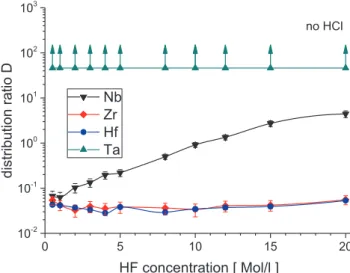
Figure2 shows the distribution coefficients 𝐷 ob-tained in these extraction experiments. As can be seen Ta is the only complete extractable element under these con-ditions, while Nb is not extracted. The signals of all180Ta 𝛾-peaks fall below the detection limit. Therefore, only lower limits of the𝐷-values were obtained. The displayed values represent the minimum of all these𝐷-values.
Fig. 2: Extraction of the group 4 and 5 elements Zr, Hf, Nb and Ta into MIBK in dependence on the HF concentration.10 mL of aqueous and MIBK phase were used, respectively. The lines are Akima
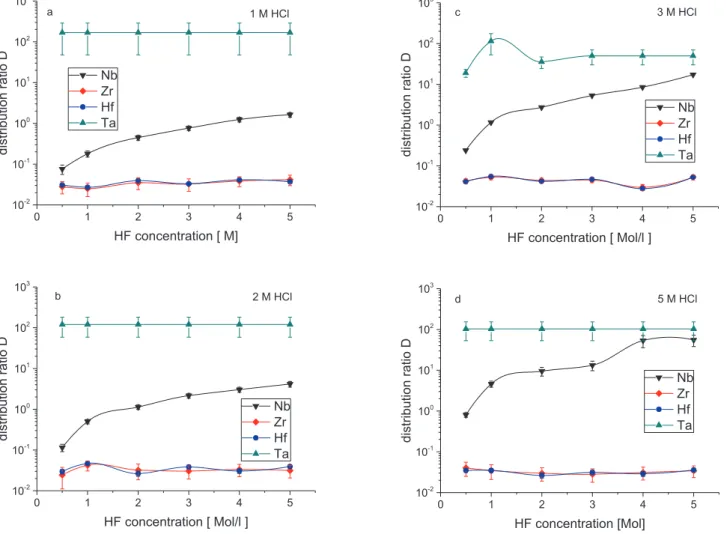
Fig. 3: (a–d) Extraction of the group 4 and 5 elements Zr, Hf, Nb and Ta into MIBK in dependence on the HF concentration at various HCl concentrations.10 mL of aqueous and MIBK phase were used, respectively. The lines are Akima interpolations [14] for a better guide for the eyes.
Increasing the HF concentration results in a better ex-traction performance for Nb, but only at comparable high HF concentrations above15 Macceptable amounts are re-moved from the aqueous phase. This high acid concen-tration is not suitable for the further processing of the fractions for sample preparation. HF concentrations above 5 Mshould not be used due to environmental problems with evaporation during the final sample preparation step. For distinguishing between group 4 and 5, this system is not suitable, but extraction from1 MHF solution into MIBK directly after the first separation is excellently suited for the studies of the chemical properties of Db concerning its similarity either with Nb or with Ta.
3.2 Dependence of the extraction efficiency
on the HF and HCl concentration in
mixed solutions
Figure3a–d shows the extraction behavior of the four ele-ments in dependence on the HF concentration in the pres-ence of different HCl concentrations.
From the depicted graphs it is clearly visible, that with increasing HCl concentration the extraction ability of Nb is much improving with increasing HF content. In5 MHCl, already1 M HF is enough to reach a sufficiently high𝐷 value for Nb. Ta is completely extracted in all cases. Group 4 elements do not extract over the entire studied concen-tration ranges. Mixtures of at least 5 M HCl/1 M HF or 5 MHF/2 MHCl and above are applicable for a separation of group 4 from group 5 elements. These concentrations can easily be reached by mixing the2 mLof the final1 M
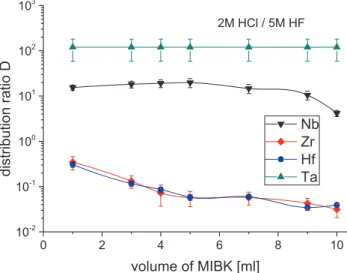
Fig. 4: Extraction efficiency of Zr, Hf, Nb and Ta, in dependence of the MIBK volume using2 M HCl/5 M HF. 10 mL of aqueous phase were used. The lines are Akima [14] interpolations for a better guide for the eyes.
HF solution from the first separation with the required amounts of concentrated acid and water.
3.3 Dependence of the extraction efficiency
on the MIBK volume
In order to minimize the volumes, which have to be evap-orated for preparing the measurement samples, we finally studied the influence of the volume ratio of the aqueous and organic phase. In Figure4, the dependence of the ex-traction performance of all four elements on the volume of MIBK with10 mLaqueous phase is shown for a selected HCl/HF mixture. Ratios of1 : 2(MIBK : aqueous phase) or higher are suitable for a sufficient extraction of group 5 el-ements.
4 Discussion
The extraction behavior of Nb and Ta into organic sol-vents from HF-containing acid solutions is well-known from mineral processing and extractive metallurgy [15–17]. Usually, MIBK is used as extractant together with acids like H2SO4,HNO3orHClcontaining various contents of HF for an industrial-scale production and purification of nio-bium. The separation efficiency from tantalum is based on the different chemical properties of Ta and Nb. This means: Ta is being extracted asH2TaF7over a broad concentra-tion range, whereas Nb is hydrolyzed under similar condi-tions toH2NbOF5, which is not extractable [18]. The
ex-tractability of both elements is dependent on the HF and the acid concentration, but to a much more extend for Nb than for Ta. However, despite of the well-developed met-allurgical technology, these systems cannot be fully ap-plied to our special task without further checking, because they use macro amounts of metal (in [17] around20 g/L were applied), and we have to operate in the range of non-carrier added (n.c.a.) amounts of metal, in the case ofDb/Rfeven one-atom-at-a-time-chemistry has to be ap-plied. Therefore, a careful and extended investigation of the extraction behavior of all involved elements was nec-essary under our special conditions.
The HCl/HF extraction system had been studied in [17] very systematically. In principal, we reproduce the general trend – higher concentrations of acid suppress the hydrol-ysis of Nb and lead to a better extraction efficiency – as well as the increase of the HF concentration does. How-ever, for the extractability of Ta in pure HF solutions, we found100%in all cases whereas the authors in [17] report a maximum for Ta of∼ 60%over the entire range of con-centration (1–16 M). This is caused by the high fluoride excess in the case of n.c.a. radionuclides and a probable formation of inert fluoride complexes. Group 4 elements are not extracted in all studied concentration ranges.
The question, whether relativistic effects change the chemical properties of transactinides in comparison to their lighter homologs or not, has been a hot topic in the SHE community already for many years [19–21]. Dubnium was the first SHE element, where such effects had been dis-cussed. The first studies on the chemistry of Db have been performed in 1988 investigating its extraction into MIBK with a mixture of3.8 M HNO3+ 1.1 MHF [22]. As a – at that time – very surprising result, Db did not extract into MIBK under these conditions like tantalum, but remained, similar to Nb, in the acid solution. This non Ta-like behav-ior was confirmed later on in a second experiment using extraction of halide complexes with TiOA from an aque-ous medium of12 MHCl+ 0.03 MHF [23]. On the other hand, an ARCA-II (Automated Rapid Chemistry Appara-tus [24, 25]) experiment using cation exchangers and𝛼 -hydroxy isobutyric acid (𝛼-HIB) as the eluent showed that Db, together with Nb and Ta are eluted promptly from the column while tri- and tetravalent ions are sorbed [26]. In this experiment, Db was clearly identified as a member of group 5.
Chemical experiments with SHE are generally chal-lenging not only due to the low production rates, result-ing in “one-atom-at-a-time-chemistry”, but also due to the short half-lives, requiring simple and fast separation sys-tems. Therefore, in systems where kinetic effects have to be expected, experiments using short-lived isotopes could
give contradictory results, if the reaction time is much longer than the half-life. With the discovery of the long-lived isotope268Db, unique possibilities have opened for systematic investigations of the chemical and physico-chemical properties of this superheavy element.
One first attempt in this direction was started in 2005 in Dubna using the same nuclear reaction as in [2–4] and two different modified wet chemistry procedures allowing for the isolation of three fractions: group 4 fraction, Ta-fraction and Nb-Ta-fraction [27]. The authors used lanthanum as carrier and HF to precipitateLaF3carrying the actinides and group 4 elements, while group 5 elements stay as flu-oride complexes in solution. Afterwards ion exchange or extraction into MIBK was used for further fractionation. Unfortunately; no𝛼-spectra are shown, no total kinetic en-ergies and neutron multiplicities are given, and there is no description how the group 4 fraction – containing all ac-tinides after precipitation with HF – was chemically pro-cessed to get an actinide-free sample. Nevertheless, the authors claim to observe 5 SF events from total 8 irradi-ations in the Ta-fraction, and no one in the other two, which would be in direct contradiction to the earlier find-ings in [22]. In a second paper [28], the authors studied the proposed chemical system using MIBK extraction in de-tail, but without any improvement of the drawbacks given above. Although the system was on-line tested with the
243Am + 48Careaction, there are no information on
ac-tinide separation and possible contamination. It is doubt-ful if this system is generally suitable to doubt-fulfill the require-ments of a complete actinide separation. Moreover, since it is well-known that rutherfordium forms stable anionic flu-oride complexes [27–31] already at low HF concentrations, a differentiation between Rf and Db using precipitation of LaF3in HF containing solution is clearly not possible us-ing this system.
5 Conclusions
Since the pioneering experiments in 2004 the production of268Dbas decay product of288115was reproduced sev-eral times at the DGFRS [34,35] and was confirmed in an independent experiment at the TransActinide Separator and Chemistry Apparatus (TASCA) (GSI) [36–38]. In addi-tion, in the reaction249Bk +48Caa second long lived dub-nium isotope270Dbwas discovered at the DGFRS [39,40] (for reviews of these results see [41,42]).
However, the assignment to the atomic number of the members of the registered decay chains remains puz-zling. In a very ambitious nuclear spectroscopy experi-ment using the multicoincidence spectroscopy TASISpec
(TASCA in Small Image mode Spectroscopy) detector setup (GSI) [43] it was searched for characteristic x-ray finger-prints of the members in the288115 decay chain. Unfor-tunately, only in one out of 23 decay chains a pair of 𝛾 -rays was observed which are consistent with the K-x--rays of element meitnerium (Mt, 𝑍 = 109) [44–46]. However, this assignment is rather week and the authors discuss the possibility of randomly caught scattered photons in [44]. Nevertheless, this experiment shows that nuclear spec-troscopy has the potential to directly determine the atomic number in region of superheavy elements. In addition it was discussed in [44] that for289115and285113 experi-mental evidence for an electron capture decay branch was found. This supports new theoretical results of a “narrow pathway” of possible EC/𝛽+decaying isotopes towards the middle of the island of stability [47]. With these results the definitive assignment to an atomic number of the mem-bers in the observed superheavy element decay chains be-comes disputable. Nuclear chemistry experiments could be able to support such assignments in the case of the longer lived isotopes.
To assign the long-lived SF activity terminating the de-cay chain of 115 [2] either to group 4 or 5, one should use for the first separation step the chemical system which was applied successfully in the first chemistry experi-ment [3,4].
No evidence for contamination with actinides was found in a long-term post examination of the sample with the highest observed SF-event rate [6] proving that the se-lected separation system worked proper and reliable.
We propose for the additional extraction step a mixture of5 MHCl/2 MHF – a system providing a clear distinction between group 4 and 5 within one min contact time.
For studies of the chemical behavior of Db in com-parison to its lighter homologs – assuming that there is no short-lived EC-branch of 268Db – pure 1 M HF solu-tion or a mixture of 1 M HCl/1 M HF is suitable. To get a more complete picture, the extraction behavior of the pseudo homologue Pa shall be included as well in further investigations. Moreover, the kinetic aspects have to be addressed in more detail. While for the proposed system, one minute contact time was obviously sufficient to reach equilibrium, this has not necessarily to be the case for ev-ery system. In particular, when ARCA-II was used, equilib-rium conditions cannot be supposed due to the short con-tact time of only some seconds. Therefore, extended time-dependent studies, both considering shorter contact times and longer ones will be necessary to investigate the influ-ence of kinetic effects.
For the future,268Dbmay be used for extended and systematic studies of the chemical properties of dubnium, complementary to those started already several years ago very successful in Japan (see for example [32,33]).
Acknowledgement: We would like to thank Alexander
Vögele for performing the neutron activations. Our very gratefull thanks go to T. Stowasser and S. Lüthi for the lab-oratory work.
References
1. Oganessian, Y.: Heaviest nuclei from48Ca-induced reactions. J. Phys. G34, R165 (2007).
2. Oganessian, Y. T., Utyonkov, V. K., Dmitriev, S. N., Lobanov, Y. V., Itkis, M. G., Polyakov, A. N., Tsyganov, Y. S., Mezentsev, A. N., Yeremin, A. V., Voinov, A. A., Sokol, E. A., Gulbekian, G. G., Bogomolov, S. L., Iliev, S., Subbotin, V. G., Sukhov, A. M., Buklanov, G. V., Shishkin, S. V., Chepygin, V. I., Vos-tokin, G. K., Aksenov, N. V., Hussonnois, M., Subotic, K., Za-grebaev, V. I., Moody, K. J., Patin, J. B., Wild, J. F., Stoyer, M. A., Stoyer, N. J., Shaughnessy, D. A., Kenneally, J. M., Wilk, P. A., Lougheed, R. W., Gaggeler, H. W., Schumann, D., Bruchert-seifer, H., Eichler, R.: Experiments on the synthesis of element 115 in the reaction243Am(48Ca, 𝑥𝑛)291−𝑥115. Phys. Rev. C 69, 021601(R) (2004).
3. Dmitriev, N. S., Oganessyan, Y. T., Utyonkov, V. K., Shishkin, S. V., Yeremin, A. V., Lobanov, Y. V., Tsyganov, Y. S., Chepygin, V. I., Sokol, E. A., Vostokin, G. K., Aksenov, N. V., Hussonnois, M., Itkis, M. G., Gaggeler, H. W., Schumann, D., Bruchertseifer, H., Eichler, R., Shaughnessy, D. A., Wilk, D. A., Kenneally, J. M., Stoyer, Wild, J. F.: Chemical identification of dubnium as a decay product of element 115 produced in the reaction
48Ca +243Am. Mendeleev Commun. 15, 1 (2005).
4. Schumann, D., Bruchertseifer, H., Eichler, R., Eichler, B., Gaggeler, H. W., Dmitriev, S. N., Oganessian, Yu. Ts., Utyonkov, V. P., Shishkin, S. V., Yeremin, A. V., Lobanov, Yu. V., Tsyganov, Y. S., Chepygin, V. I., Sokol, E. A., Vostokin, G. K., Aksenov, N. V., Hussonnois, M., Itkis, M. G.: Chemical procedure applied for the identification of Rf/Db produced in the48Ca +243Am reaction. Radiochim. Acta93, 727 (2005).
5. Gupta, M., Burrows, T. W.: Nuclear Data Sheets for𝐴 = 266−294. Nuclear Data Sheets106, 251 (2005), Errata. Nuclear Data Sheets107, 789 (2006).
6. Dressler, R., Eichler, R., Schumann, D., Shishkin, S.: Long-term 𝛼- and spontaneous fission measurement of a Rf/Db sample chemically prepared in a48Ca on243Am experiment. Phys. Rev. C79, 054605 (2009).
7. Karpov, A. V., Zagrebaev, V. I.: Decay properties and Stability of the heaviest elements. Int. J. Modern Physics E21, 1250013 (2012).
8. Hofmann, S., Münzenberg, G.: The discovery of the heaviest elements. Rev. Mod. Phys.72, 733 (2000).
9. Warda, M., Egido, J. L.: Fission half-lives of superheavy nuclei in a microscopic approach. Phys. Rev. C86, 014322 (2012).
10. Santhosh, K. P., Biju, R. K., Sahadevan, S.: The systematic study of spontaneous fission versus alpha decay of superheavy nuclei. J. Phys. G36, 115101 (2009).
11. Kratz, J. V., Zimmermann, H. P., Scherer, U. W., Schädel, M., Brüchle, W., Gregorich, K. E., Gannett, C. M., Hall, H. L., Hen-derson, R. A., Lee, D. M., Leyba, J. D., Nurmia, M. J., Hoffman, D. C., Gäggeler, H., Jost, D., Baltensperger, U., Ya, N.-Q., Türler, A., Lienert, Ch.: Chemical Properties of Element 105 in Aqueous Solution: Halide complex formation and anion exchange into triisoctyl amine. Radiochim. Acta48, 121 (1989).
12. DIN-ISO 11929:2010: Determination of the characteristic lim-its (decision threshold, detection limit and limlim-its of the con-fidence interval) for measurements of ionizing radiation – Fundamentals and application. International Organization for Standardization, Geneva (2010).
13. DIN ISO 11929 Bestimmung der charakteristischen Grenzen (Erkennungsgrenze, Nachweisgrenze und Grenzen des Ver-trauensbereichs) bei Messungen ionisierender Strahlung – Grundlagen und Anwendungen. Deutsches Institut für Nor-mung, Berlin (2010).
14. Akima, H.: A New Method of Interpolation and Smooth Curve Fitting Based on Local Procedures. J. Assoc. Computing Ma-chinery17, 589 (1970).
15. El-Hussaini, O. M., El-Hakam Mahdy, M. A.: Extraction of Nio-bium and Tantalum from Nitrate and Sulfate Media by Using MIBK. Mineral Processing and Extractive Metallurgy Review22, 633 (2002).
16. Htet Htike Htwe, Kay Thi Lwin: Study on Extraction of Niobium Oxide from Columbite–Tantalite Concentrate. World Academy of Science, Engineering and Technology2, 112 (2008). 17. Werning, J. R., Higbie, K. B., Grace, J. T., Speece, B. F., Gilbert,
H. L.: Separation of Tantalum and Niobium by Liquid-Liquid Extraction. Engineering, Design, and Process Development46, 644 (1954).
18. Yagodin, G. A., Sinergribova, O. A.: Processes for Zirconium-Hafnium and Niobium-Tantalum. Chapter 25.14 of Handbook of
Solvent Extraction. John Wiley and Sons New York, 812 (1983).
19. Pershina, V., Sepp, W.-D., Bastug, T., Fricke, B., Ionova, G. V.: Relativistic Effects in Physics and Chemistry of Element 105 III. Electronic Structure of Hahnium Oxyhalides as Analogs of Group 5 Elements Oxyhalides. J. Chem. Phys.97, 1123 (1992). 20. Pershina, V., Sepp, W. D., Fricke, B., Kolb, D., Schädel, M.,
Ionova, G. V.: Relativistic Effects in Physics and Chemistry of Element 105 II. Electronic Structure and Properties of Group 5 Elements Bromides. J. Chem. Phys.97, 1116 (1992).
21. Pershina, V., Sepp, W.-D., Fricke, B., Rosen, A.: Relativistic Effects in Physics and Chemistry of Element 105 I. Periodicities in Properties of Group 5 Elements. Electronic Structure of the Pentachlorides. J. Chem. Phys.96, 8367 (1992).
22. Gregorich, K. E., Henderson, R. A., Lee, D. M., Nurmia, M. J., Chasteler, R. M., Hall, H. L., Bennett, D. A., Gannet, C. M., Chadwick, R. B., Leyba, J. D., Hoffman, D. C., Herrmann, G.: Aqueous chemistry of element 105. Radiochim. Acta43, 223 (1988).
23. Zimmermann, H. P., Gober, M. K., Kratz, J. V., Schädel, M., Brüchle, W., Schimpf, E., Gregorich, K. E., Türler, A., Czerwin-ski, K. R., Hannink, N. J., Kadkhodayan, B., Lee, D. M., Nurmia, M. J., Hoffman, D. C., Gäggeler, H. W., Jost, D., Kovacz, J.,
Scherer, U. W., Weber, A.: Chemical Properties of Element 105 in Aqueous Solution: Back extraction from triisooctyl amine into0.5 M HCl. Radiochim. Acta 60, 11 (1993).
24. Schädel, M., Brüchle, W., Jäger, E., Schimpf, E., Kratz, J. V., Scherer, U. W., Zimmermann, H. P.: ARCA II – A New Apparatus for Fast, Repetitive HPLC Separations. Radiochim. Acta48, 171 (1989).
25. Schädel, M.: Aqueous chemistry of transactinides. Radiochim. Acta89, 721 (2001).
26. Schädel, M., Brüchle, W., Schimpf, E., Zimmermann, H. P., Gober, M. K., Kratz, J. V., Trautmann, N., Gäggeler, H., Jost, D., Kovacs, J., Scherer, U. W,. Weber, A., Gregorich, K. E., Türler, A., Hannink, N. J., Czerwinski, K. R., Kadkhodayan, B., Lee, D. M., Nurmia, M., Hoffman, D. C.: Chemical Properties of Element 105 in Aqueous Solution: Cation Exchange Separation With 𝛼-Hydroxyisobutyric Acid. Radiochim. Acta 57, 85 (1992). 27. Stoyer, N. J., Landrum, J. H., Wilk, P. A., Moody, K. J., Kenneally,
J. M., Shaughnessy, D. A., Stoyer, M. A., Wild, J. F., Lougheed, R. W., Dmitriev, S. N., Oganessian, Yu. Ts., Shishkin, S. V., Aksenov, N. V., Tereshatov, E. E., Bozhikov, G. A., Vostokin, G. K., Utyonkov, V. K., Yeremin, A. A.: Chemical Identification of a Long-Lived Isotope of Dubnium, a Descendant of Element 115. Nuclear Physics A787, 388c (2007).
28. Wilk, P. A., Landrum, J. H., Shaughnessy, D. A., Kenneally, J. M., Stoyer, N. J., Stoyer, M. A., Moody, K. J., Aksenov, N. V., Bozhikov, G. A., Tereshatov, E. E., Vostokin, G. K., Shishkin, S. V., Dmitriev, S. N.: Separation of group five elements by reversed-phase chromatography. Journal of Radioanalytical and Nuclear Chemistry275, 651 (2008).
29. Ishii, Y., Toyoshima, A., Tsukada, K., Asai, M., Toume, H., Nishinaka, I., Nagame, Y., Miyashita, S., Mori, T., Suganuma, H., Haba, H., Sakamaki, M., Goto, S., Kudo, H., Akiyama, K., Oura, Y., Nakahara, H., Tashiro, Y., Shinohara, A., Schädel, M., Brüchle, W., Pershina, V., Kratz, J. V.: Fluoride complexation of element 104, rutherfordium (Rf), investigated by cation-exchange chromatography. Chem. Lett.37, 288 (2008). 30. Toyoshima, A., Haba, H., Tsukada, K., Asai, A., Akiyama, K.,
Goto, S., Ishii, Y., Nishinaka, I., Sato, T. k., Nagame, Y., Sato, W., Tani, Y., Hasegawa, H., Matsuo, K., Saika, D., Kitamoto, Y., Shinohara, A., Ito, M., Saito, J., Kudo, H., Yokoyama, A., Sakama, M., Sueki, K., Oura, Y., Nakahara, H., Schädel, M., Brüchle, W., Kratz, J. V.: Hexafluoro complex of rutherfordium in mixedHF/HNO3solutions. Radiochim. Acta96, 125 (2008). 31. Haba, H., Tsukada, K., Asai, M., Toyoshima, A., Akiyama, K., Nishinaka, I., Hirata, M., Yaita, T., Ichikawa, S., Nagame, Y., Yasuda, K., Miyamoto, Y., Kaneko, T., Goto, S., Ono, S., Hirai, T., Kudo, H., Shigekawa, M., Shinohara, A., Oura, Y., Nakahara, H., Sueki, K., Kikunaga, H., Kinoshita, N., Tsuruga, N., Yokoyama, A., Sakama, M., Enomoto, S., Schädel, M., Brüchle, W., Kratz, J. V.: Fluoride Complexation of Element 104, Rutherfordium. J. Am. Chem. Soc.126, 5219 (2004).
32. Tsukada, K., Haba, H., Asai, M., Toyoshima, A., Akiyama, K., Kasamatsu, Y., Nishinaka, I., Ichikawa, S., Yasuda, K., Miyamoto, Y., Hashimoto, K., Nagame, Y., Goto, S., Kudo, H., Sato, W., Shinohara, A., Oura, Y., Sueki, K., Kikunaga, H., Ki-noshita, N., Yokoyama, A., Schädel, M., Brüchle, W., Kratz, J. V.: Adsorption of Db and its homologues Nb and Ta, and the pseudo-homologue Pa on anion-exchange resin in HF solution. Radiochim. Acta97, 83 (2009).
33. Kasamatsu, Y., Toyoshima, A., Asai, M., Tsukada, K., Li, Z. J., Ishii, Y., Toume, H., Sato, T. K., Kikuchi, T., Nishinaka, I., Nagame, Y., Haba, H., Kikunaga, H., Kudou, Y., Oura, Y., Akiyama, K., Sato, W., Ooe, K., Fujisawa, H., Shinohara, A., Goto, S., Hasegawa, T., Kudo, H., Nanri, T., Araki, M., Kinoshita, N., Yokoyama, A., Fan, F. L., Qin, Z., Düllmann, Ch. E., Schädel, M., Kratz, J. V.: Anionic fluoro complexes of element 105, Db. Chem. Lett.38, 1084 (2009).
34. Oganessian, Yu. Ts., Abdullin, F. Sh., Dmitriev, S. N., Gos-tic, J. M., Hamilton, J. H., Henderson, R. A., Itkis, M. G., Moody, K. J., Polyakov, A. N., Ramayya, A. V., Roberto, J. B., Rykaczewski, K. P., Sagaidak, R. N., Shaughnessy, D. A., Shi-rokovsky, I. V., Stoyer, M. A., Subbotin, V. G., Sukhov, A. M., Tsyganov, Yu. S., Utyonkov, V. K., Voinov, A. A., Vostokin, G. K.: New Insights into the243Am +48Ca Reaction Products Previ-ously Observed in the Experiments on Elements 113, 115, and 117. Phys. Rev. Lett.108, 022502 (2012).
35. Oganessian, Yu. Ts., Abdullin, F. Sh., Dmitriev, S. N., Gos-tic, J. M., Hamilton, J. H., Henderson, R. A., Itkis, M. G., Moody, K. J., Polyakov, A. N., Ramayya, A. V., Roberto, J. B., Rykaczewski, K. P., Sagaidak, R. N., Shaughnessy, D. A., Shi-rokovsky, I. V., Stoyer, M. A., Stoyer, N. J., Subbotin, V. G., Sukhov, A. M., Tsyganov, Yu. S., Utyonkov, V. K., Voinov, A. A., Vostokin, G. K.: Investigation of the243Am +48Ca reaction products previously observed in the experiments on elements 113, 115, and 117. Phys. Rev C87, 014302 (2013).
36. Semchenkov, A., Brüchle, W., Jäger, E., Schimpf, E., Schädel, M., Mühle, C., Klos, F., Türler, A., Yakushev, A., Belov, A., Belyakova, T., Kaparkova, M., Kukhtin, V., Lamzin, E., Sytchevsky, S.: The TransActinide Separator and Chemistry Apparatus (TASCA) at GSI – Optimization of ion-optical struc-tures and magnet designs. Nucl. Instrum. Methods B266, 4153 (2008).
37. Schädel, M.: Superheavy element chemistry at GSI – status and perspectives. Eur. Phys. J. D45, 67 (2007).
38. Khuyagbaatar, J., Yakushev, A., Düllmann, Ch. E., Ackermann, D., Andersson, L.-L., Asai, M., Block, M., Boll, R. A., Brand, H., Cox, D. M., Dasgupta, M., Derkx, X., Di Nitto, A., Eberhardt, K., Even, J., Evers, M., Fahlander, C., Forsberg, U., Gates, J. M., Gharibyan, N., Golubev, P., Gregorich, K. E., Hamilton, J. H., Hartmann, W., Herzberg, R.-D., Heßberger, F. P., Hinde, D. J., Hoffmann, J., Hollinger, R., Hübner, A., Jäger, E., Kindler, B., Kratz, J. V., Krier, J., Kurz, N., Laatiaoui, M., Lahiri, S., Lang, R., Lommel, B., Maiti, M., Miernik, K., Minami, S., Mistry, A., Mokry, C., Nitsche, H., Omtvedt, J. P., Pang, G. K., Pa-padakis, P., Renisch, D., Roberto, J., Rudolph, D., Runke, J., Rykaczewski, K. P., Sarmiento, L. G., Schädel, M., Schausten, B., Semchenkov, A., Shaughnessy, D. A., Steinegger, P., Steiner, J., Tereshatov, E. E., Thörle-Pospiech, P., Tinschert, K., Torres De Heidenreich, T., Trautmann, N., Türler, A., Uusi-talo, J., Ward, D. E., Wegrzecki, M., Wiehl, N., Van Cleve, S. M., Yakusheva, V.:48Ca +249Bk Fusion Reaction Leading to Element 𝑍 = 117: Long-Lived 𝛼-Decaying270Db and Discovery of266Lr.
Phys. Rev. Lett.112, 172501 (2014).
39. Oganessian, Yu. Ts., Abdullin, F. Sh., Bailey, P. D., Benker, D. E., Bennett, M. E., Dmitriev, S. N., Ezold, J. G., Hamilton, J. H., Henderson, R. A., Itkis, M. G., Lobanov, Yu.V., Mezent-sev, A. N., Moody, K. J., Nelson, S. L., Polyakov, A. N., Porter, C. E., Ramayya, A. V., Riley, F. D., Roberto, J. B., Ryabinin, M. A., Rykaczewski, K. P., Sagaidak, R. N., Shaughnessy, D. A.,
Shi-rokovsky, I. V., Stoyer, M. A., Subbotin, V. G., Sudowe, R., Sukhov, A. M., Tsyganov, Yu. S., Utyonkov, V. K., Voinov, A. A., Vostokin, G. K., Wilk, P. A.: Synthesis of a New Element with Atomic Number𝑍 = 117. Phys. Rev. Lett. 104, 142502 (2010). 40. Oganessian, Yu. Ts., Abdullin, F. Sh., Bailey, P. D., Benker,
D. E., Bennett, M. E., Dmitriev, S. N., Ezold, J. G., Hamilton, J. H., Henderson, R. A., Itkis, M. G., Lobanov, Yu. V., Mezent-sev, A. N., Moody, K. J., Nelson, S. L., Polyakov, A. N., Porter, C. E., Ramayya, A. V., Riley, F. D., Roberto, J. B., Ryabinin, M. A., Rykaczewski, K. P., Sagaidak, R. N., Shaughnessy, D. A., Shi-rokovsky, I. V., Stoyer, M. A., Subbotin, V. G., Sudowe, R., Sukhov, A. M., Taylor, R., Tsyganov, Yu. S., Utyonkov, V. K., Voinov, A. A., Vostokin, G. K., Wilk, P. A.: Eleven new heaviest isotopes of elements𝑍 = 105 to 𝑍 = 117 identified among the products of249Bk +48Ca reactions. Phys. Rev C 83, 054315 (2011).
41. Oganessian, Yu.: Synthesis of the heaviest elements in48 Ca-induced reactions. Radiochim. Acta99, 429 (2011).
42. Oganessian, Yu. Ts., Utyonkov, V. K.: Super-heavy element research. Rep. Prog. Phys.78, 036301 (2015).
43. Andersson, L.-L., Rudolph, D., Golubev, P., Herzberg, R.-D., Hoischen, R., Merchán, E., Ackermann, D., Düllmann, Ch. E., Eberhardt, K., Even, J., Gerl, J., Heßberger, F. P., Jäger, E., Khuyagbaatar, J., Kojouharov, I., Kratz, J. V., Krier, J., Kurz, N., Prokopowicz, W., Schädel, M., Schaffner, H., Schausten, B., Schimpf, E., Semchenkov, A., Türler, A., Wollersheim, H.-J., Yakushev, A., Thörle-Pospiech, P., Hartmann, W., Hübner, A., Lommel, B., Kindler, B., Steiner, J.: TASISpec – A highly effi-cient multi-coincidence spectrometer for nuclear structure investigations of the heaviest nuclei. Nucl. Instrum. Methods A622, 164 (2010).
44. Rudolph, D., Forsberg, U., Golubev, P., Sarmiento, L. G., Yaku-shev, A., Andersson, L.-L., Di Nitto, A., Düllmann, Ch. E., Gates, J. M., Gregorich, K. E., Gross, C. J., Heßberger, F. P., Herzberg, R.-D., Khuyagbaatar, J., Kratz, J. V., Rykaczewski, K., Schädel, M., Åberg, S., Ackermann, D., Block, M., Brand, H., Carlsson, B. G., Cox, D., Derkx, X., Eberhardt, K., Even, J., Fahlander, C., Gerl, J., Jäger, E., Kindler, B., Krier, J., Kojouharov, I., Kurz, N.,
Lommel, B., Mistry, A., Mokry, C., Nitsche, H., Omtvedt, J. P., Papadakis, P., Ragnarsson, I., Runke, J., Schaffner, H., Schausten, B., Thörle-Pospiech, P., Torres, T., Traut, T., Traut-mann, N., Türler, A., Ward, A., Ward, D. E., Wiehl, N.: Spec-troscopy of Element 115 Decay Chains. Phys. Rev. Lett.111, 112502 (2013).
45. Forsberg, U., Rudolph, D., Golubev, P., Sarmiento, L. G., Yaku-shev, A., Andersson, L.-L., Di Nitto, A., Düllmann, Ch. E., Gates, J. M., Gregorich, K. E., Gross, C. J., Heßberger, F. P., Herzberg, R.-D., Khuyagbaatar, J., Kratz, J. V., Rykaczewski, K., Schädel, M., Åberg, S., Ackermann, D., Block, M., Brand, H., Carlsson, B. G., Cox, D., Derkx, X., Eberhardt, K., Even, J., Fahlander, C., Gerl, J., Jäger, E., Kindler, B., Krier, J., Kojouharov, I., Kurz, N., Lommel, B., Mistry, A., Mokry, C., Nitsche, H., Omtvedt, J. P., Papadakis, P., Ragnarsson, I., Runke, J., Schaffner, H., Schausten, B., Thörle-Pospiech, P., Torres, T., Traut, T., Traut-mann, N., Türler, A., Ward, A., Ward, D. E., Wiehl, N.: Spectro-scopic Tools Applied to Element𝑍 = 115 Decay Chains. EPJ Web of Conferences66, 02036 (2014).
46. Forsberg, U., Rudolph, D., Andersson, L.-L., Di Nitto, A., Düll-mann, Ch. E., Gates, J. M., Golubev, P., Gregorich, K. E., Gross, C. J., Herzberg, R.-D., Heßberger, F. P., Khuyagbaatar, J., Kratz, J. V., Rykaczewski, K., Sarmiento, L. G., Schädel, M., Yaku-shev, A., Åberg, S., Ackermann, D., Block, M., Brand, H., Carls-son, B. G., Cox, D., Derkx, X., Dobaczewski, J., Eberhardt, K., Even, J., Fahlander, C., Gerl, J., Jäger, E., Kindler, B., Krier, J., Kojouharov, I., Kurz, N., Lommel, B., Mistry, A., Mokry, C., Nazarewicz, W., Nitsche, H., Omtvedt, J. P., Papadakis, P., Ragnarsson, I., Runke, J., Schaffner, H., Schausten, B., Yue Shi, Thörle-Pospiech, P., Torres, T., Traut, T., Trautmann, N., Türler, A., Ward, A., Ward, D. E., Wiehl, N.: Recoil-𝛼-fission and recoil-𝛼-𝛼-fission events observed in the reaction48Ca +
243Am. arXiv:1502.03030 [nucl-ex] 10 February 2015, submitted
to Phys. Rev. C.
47. Zagrebaev, V. I., Karpov, A. V., Greiner, W.: Possibilities for synthesis of new isotopes of superheavy elements in fusion reactions. Phys. Rev C85, 014608 (2012).