1 Neurobiology of Learning and Memory 145 (2017) 181–189
1
http://dx.doi.org/10.1016/j.nlm.2017.10.009 2
3
Modulating influences of memory strength and sensitivity of the retrieval test on the detectability 4
of the sleep consolidation effect. 5
Sarah F. Schocha, Maren J. Cordib,c, Björn Raschb,c* 6
7 8 9
a. University of Zurich, CRPP Sleep and Health, Zurich, Switzerland
10
b. Zurich Center for Interdisciplinary Sleep Research (ZiS), University of Zurich, Zurich,
11
Switzerland
12
c. University of Fribourg, Department of Psychology, Division of Biopsychology and
13
Methods, Fribourg, Switzerland
14 15 16 17 18 19 20 21 *Corresponding author: 22
Björn Rasch, University of Fribourg, Department of Psychology, Division of Biopsychology and
23
Methods, Rue P.A. de Faucigny 2, 1700 Fribourg, Phone: +41 26 300 7637, Fax: +41 26 300 9712,
24
Email: [email protected]
25
26
27
Running title: Detecting the sleep benefit
28 29 30
31 32 33
Abstract 34
Emotionality can increase recall probability of memories as emotional information is highly relevant
35
for future adaptive behavior. It has been proposed that memory processes acting during sleep
36
selectively promote the consolidation of emotional memories, so that neutral memories no longer
37
profit from sleep consolidation after learning. This appears as a selective effect of sleep for emotional
38
memories. However, other factors contribute to the appearance of a consolidation benefit and
39
influence this interpretation. Here we show that the strength of the memory trace before sleep and
40
the sensitivity of the retrieval test after sleep are critical factors contributing to the detection of the
41
benefit of sleep on memory for emotional and neutral stimuli.
42
228 subjects learned emotional and neutral pictures and completed a free recall after a 12-hour
43
retention interval of either sleep or wakefulness. We manipulated memory strength by including an
44
immediate retrieval test before the retention interval in half of the participants. In addition, we
45
varied the sensitivity of the retrieval test by including an interference learning task before retrieval
46
testing in half of the participants. We show that a “selective” benefit of sleep for emotional
47
memories only occurs in the condition with high memory strength. Furthermore, this “selective”
48
benefit disappeared when we controlled for the memory strength before the retention interval and
49
used a highly sensitive retrieval test. Our results indicate that although sleep benefits are more
50
robust for emotional memories, neutral memories similarly profit from sleep after learning when
51
more sensitive indicators are used. We conclude that whether sleep benefits on memory appear
52
depends on several factors, including emotion, memory strength and sensitivity of the retrieval test.
53 54 55 56 57 58 59 60 61 62 63 64 65
3 66
Keywords: sleep-dependent memory consolidation, declarative memory, memory strength, emotion,
67
sleep benefit, selectivity
68 69
1. Introduction 70
Emotion is important for the encoding and consolidation of memories. Numerous studies have
71
shown that emotional content is remembered better than neutral content for words (e.g. Adelman
72
and Estes, 2013; Kensinger and Corkin, 2003), stories (e.g. Cahill and McGaugh, 1995; Heuer and
73
Reisberg, 1990) and pictures (e.g. Blake, Varnhagen, and Parent, 2001; Harris and Pashler, 2005). The
74
strengthening effect of emotion on memory is linked to the activation of emotion-related brain
75
regions including the amygdala, which modulates encoding and consolidation of memories in the
76
hippocampus (e.g. Canli, Zhao, Brewer, Gabrieli, and Cahill, 2000; Phelps, 2004).
77 78
In addition to emotion, sleep also fosters memory consolidation after learning. Numerous studies
79
have provided compelling evidence that sleep occurring shortly after learning results in an
80
improvement of later memory retrieval performance as compared to a retention interval filled with
81
wakefulness (see Rasch and Born, 2013 for a comprehensive review). Importantly, sleep’s role in
82
memory is considered active: According to the active system consolidation hypothesis, recently
83
learned memories are spontaneously reactivated during sleep and thereby stabilized and integrated
84
into neocortical memory networks for long-term storage. This system consolidation critically depends
85
on several sleep-specific oscillatory brain signals, including hippocampal sharp-wave ripples, sleep
86
spindles and slow-oscillations (Born and Wilhelm, 2012). Thus, according to this notion, sleep is not
87
passively providing a shelter for temporary memory maintenance, but actively supports
88
consolidation processes.
89 90
One important additional assumption in support of an active role of sleep for memory is that
91
consolidation processes during sleep are selective (e.g. Rasch and Born, 2013; Stickgold and Walker,
92
2013). For example, it is assumed that sleep selectively consolidates memories that are relevant for
93
the future, including emotional memories and memories associated with a reward. Regarding the
94
selective consolidation of emotional memory content Hu, Stylos-Allan, and Walker (2006) showed
95
that sleep after learning enhanced recognition performance only for emotional but not neutral
96
images. Along similar lines, Payne and colleagues showed that a full night’s sleep (Payne, Stickgold,
97
Swanberg, and Kensinger, 2008) but also a brief nap (Payne, Kensinger, Wamsley, Spreng, Alger,
98
Gibler, Schacter, and Stickgold, 2015) enhanced the recognition of central emotional objects in a
99
scene, but not central neutral objects or the neutral backgrounds of that scene. Furthermore,
Wagner, Gais, and Born (2001) reported that only emotional texts benefited from three hours of
101
REM-rich sleep, but neutral texts did not.
102 103
Interestingly, in these studies the selective benefit of sleep for emotional memories is typically
104
accompanied by a reduced or absent benefit of sleep for neutral memories. This is a puzzling finding,
105
as numerous studies have consistently observed a sleep benefit for memory when using only neutral
106
learning materials, including words, word-pairs and even senseless syllables (e.g. Jenkins and
107
Dallenbach, 1924; Plihal and Born, 1997). Payne et al. (2008) have explained this paradox by arguing
108
that when both emotional and neutral stimuli are presented together, a “trade-off” mechanism
109
preferentially consolidates the emotional stimuli, as they are biologically more relevant. Bennion,
110
Payne, and Kensinger (2015) suggest an early “emotional tagging” mechanism as a basis for this
111
trade-off which selects memories for preferential consolidation. This could lead to a sleep-dependent
112
alteration of brain activation as Payne and Kensinger (2011) report a strengthened connection
113
between the amygdala, the hippocampus and the ventromedial prefrontal cortex during retrieval of
114
emotional, but not neutral content after sleep compared to wakefulness.
115 116
However, not all studies find a prioritized consolidation of emotional items over neutral ones (Baran,
117
Pace-Schott, Ericson, and Spencer, 2012; Lehmann, Seifritz, and Rasch, 2016; Lewis, Cairney,
118
Manning, and Critchley, 2011). Baran et al. (2012) explain these divergent findings by highlighting the
119
different experimental designs used across studies including variation of stimuli, range of emotional
120
variance and presentation times. Bennion et al. (2015) discuss that besides the emotionality of the
121
content, there are other important factors for the tagging mechanism such as stimulus novelty, state
122
of the individual experiencing the event and neurochemical processes accompanying the emotional
123
reaction.
124
Apart from methodological issues and tagging, an alternative explanation is that the benefit of sleep
125
for memory is rather dependent on the strength of memory traces before sleep. Emotional
126
memories are typically remembered better than neutral ones already during immediate recall
127
attempts. Thus, sleep might simply require a certain threshold of memory strength during encoding
128
to ensure that consolidation mechanisms during sleep can stabilize and integrate these new
129
memories into long-term storage. One could argue that in some previous studies, emotional
130
memories – which are more strongly encoded before sleep – pass the threshold for being
131
consolidated during sleep, while weaker neutral memories do not. In contrast, when neutral material
132
is repeatedly learned or studied until a certain criterion (e.g. 60%), a sleep benefit is observed also
133
for solely neutral learning material (see e.g. Drosopoulos, Schulze, Fischer, and Born, 2007). Please
134
note that the same study also reported that learning to a very high criterion (i.e., 90%) abolishes the
5
beneficial effect of sleep on memory. This pattern of results suggests that the benefit of sleep on
136
memory might be maximal at medium memory strengths, with lower or no effects for very weakly or
137
very intensively encoded memories.
138 139
One possible way to increase memory strength in studies using emotional and neutral learning
140
material is inserting an immediate retrieval right before the retention interval. Implementation of
141
immediate recall of memories before the retention period should enhance the accessibility of these
142
memories through a mechanism of effortful processing (Rowland, 2014), a phenomenon known as
143
the testing effect (Sutterer and Awh, 2015). Thus, if the benefit of sleep relies on memory strength,
144
we would expect that the neutral memories also benefit from sleep when their memory strength is
145
enhanced due to immediate retrieval testing. This testing right after learning also enhances memory
146
strength by changing the expectancy of the future relevance of this memory (Wilhelm, Diekelmann,
147
Molzow, Ayoub, Molle, and Born, 2011), as subject’s attention might be shifted towards the memory
148
aspect of the task in contrast to the conditions without immediate recall. This offers the opportunity
149
for an intentional reconsolidation after learning to the advantage of memory strength.
150 151
Another explanation for the divergent findings in the literature might be the sensitivity of the
152
retrieval test. Several studies in this field used recognition measures, although very few studies have
153
successfully observed sleep benefits on recognition using different kinds of learning material (see
154
Diekelmann, Wilhelm, and Born, 2009). The authors of the review concluded that cued or free recall
155
tests detect sleep benefits much more reliably than recognition tests (Diekelmann et al. 2009). While
156
the reasons are still unclear, one might argue that sleep mostly facilitates retrieval access by
157
reactivating memories during sleep which is less relevant for recognition, particularly with respect to
158
familiarity judgements. Another possible reason is that recognition performance is typically very
159
high, which might be less ideal to successfully detect sleep-benefits on memory. To increase the
160
sensitivity of retrieval testing even further, an interference learning block can be inserted before the
161
retrieval task. For example, Ellenbogen, Hulbert, Stickgold, Dinges, and Thompson-Schill (2006)
162
showed that interference before retrieval testing resulted in a larger benefit of sleep for memory of
163
neutral word-pairs. These findings were replicated even when controlling for circadian factors and
164
using a more refined behavioral paradigm (Ellenbogen, Hulbert, Jiang, and Stickgold, 2009), as well as
165
in both younger and older adults (Sonni and Spencer, 2015). However, some divergent findings have
166
also been reported, where interference reduced or nullified the sleep benefit (Barsky, Tucker, and
167
Stickgold, 2015; Deliens, Schmitz, Caudron, Mary, Leproult, and Peigneux, 2013), though the
168
interference paradigm used in Deliens et al. (2013) was based on emotional interference rather than
169
interference of another learning set. Thus, if the observation of the benefits of sleep on memory
depends on the sensitivity of the retrieval testing, it might be possible to reveal sleep benefits on
171
neutral memories even in the presence of emotional memories by inserting interference before
172
retrieval testing.
173 174
Here we tested these two possibilities by systematically varying memory strength and the sensitivity
175
of the retrieval testing. Participants viewed emotional and neutral pictures and freely recalled them
176
after a 12-hour retention interval filled with either sleep or wakefulness (see Figure 1 for overview of
177
the task design and experimental procedure). Half of the participants immediately recalled the
178
pictures additionally before the interval, and the other half did not. Furthermore, half of the
179
participants performed interference learning before free recall testing after the retention interval
180
and the other half did not. We hypothesize that the appearance of the beneficial effect of sleep
181
depends on both the memory strength and the sensitivity of the retrieval testing. Thus, we expect to
182
observe a selective effect of sleep for emotional memories only when the memory strength of
183
neutral memories is low (i.e. without immediate retrieval testing). In addition, we expect that the
184
observed selectivity of sleep for emotional memories will disappear when the sensitivity of the
185
retrieval test is increased (i.e. with interference learning before retrieval).
186 187
2. Materials and Methods 188
189
2.1 Participants 190
In total, 235 healthy subjects (158 female, mean age SD = 24.42 4.11) participated in the
191
experiment. Seven subjects were excluded from analysis due to non-compliance with either task
192
instruction (n=1) or study protocol (n=3), technical difficulties (n=1) or being an outlier in the
193
memory task (> 3 standard deviations of the overall mean; n = 2). This left a total of 228 subjects
194
between 18 and 35 distributed across four experimental groups, each split into a sleep and a wake
195
condition (see Figure 1). Participant characteristics for each experimental group are reported in Table
196
1. Group IV has previously been reported as the pilot study in Ackermann, Hartmann,
197
Papassotiropoulos, de Quervain, and Rasch (2015). The experimental groups differed neither in their
198
distribution of age, gender, sleep characteristics (sleep quality as indicated by subjective rating
199
between 1 and 10, sleepiness, sleep disturbances) nor mood before the task (all P ≥ .09). None of the
200
subjects had a night shift or time zone shift of more than 6 hours within 6 weeks before participation
201
in the experiment. Participants were instructed to abstain from caffeine and alcohol during the day(s)
202
of the experiment. Subjects were not asked to follow a regular sleep schedule and adhered to their
203
own sleep schedule in the night between the sessions. The study was approved by the ethics
204
committee of the Department of Psychology, University of Zurich, and all subjects gave written
7
informed consent prior to participating. Subjects received 15CHF per hour for participating in the
206
experiment (between 30CHF and 45CHF in total).
207 208
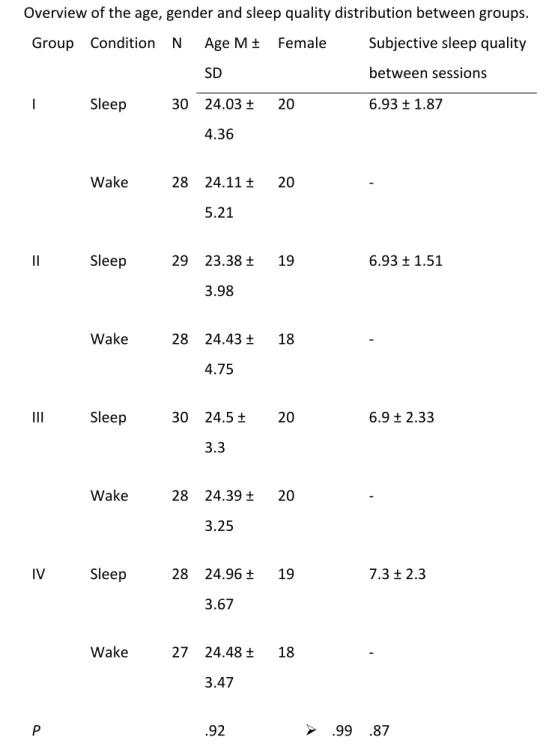
Table 1. Participant characteristics. 209
Overview of the age, gender and sleep quality distribution between groups.
210
Group Condition N Age M ±
SD
Female Subjective sleep quality
between sessions I Sleep 30 24.03 ± 4.36 20 6.93 ± 1.87 Wake 28 24.11 ± 5.21 20 - II Sleep 29 23.38 ± 3.98 19 6.93 ± 1.51 Wake 28 24.43 ± 4.75 18 - III Sleep 30 24.5 ± 3.3 20 6.9 ± 2.33 Wake 28 24.39 ± 3.25 20 - IV Sleep 28 24.96 ± 3.67 19 7.3 ± 2.3 Wake 27 24.48 ± 3.47 18 - P .92 .99 .87
Note. Table 1 presents mean age (M) ± standard deviation (SD), the number of female subjects per
211
group and mean subjective sleep quality which had been rated on a 10 point scale with higher scores
212
reflecting better sleep quality. P values indicate group main effects.
213 214
[Please insert Figure 1 here]
215 216
2.2 Picture Memory Task 217
The task was taken from Rasch, Spalek, Buholzer, Luechinger, Boesiger, Papassotiropoulos, and de
218
Quervain (2009), and was originally designed to be used in an MRI scanner, while MRI was not used
219
in this study. A total of 72 neutral, negative, and positive images from the International Affective
220
Picture Set (IAPS, see supplementary for image numbers, Lang, Bradley, and Cuthbert, 2008) were
221
presented in a quasirandomized order (24 per valence, see Figure 1A). This allowed for separate
222
analyses of positive and negative items (see supplementary material). The participants were
223
instructed to rate these pictures on valence and arousal, but were left naïve about the later retrieval
224
of the images (incidental encoding). In each trial, a fixation cross was displayed for 500 ms, then the
225
image was presented for 2.5 s before participants were asked to rate its emotional valence (1 =
226
positive , 2 = neutral, 3 = negative) and arousal (1 = high, 2 = medium, 3 = low) each on a
three-point-227
scale. Twenty-four images of geometrical figures on a scrambled background were interleaved (due
228
to the MRI design of the task). Participants were asked to rate their form (wide, quadratic, high) and
229
size (small, medium, large). Intertrial intervals varied between 9 and 12 seconds, including the time
230
for the rating. Two additional neutral images were presented at the beginning and at the end,
231
respectively, which were not analyzed to account for primacy and recency effects. The interference
232
set used an additional 72 IAPS images with matched content (similar content but easily
233
distinguishable) interleaved with 24 geometrical images, presented in a quasirandomized order, with
234
the same valence distribution. The sets were the same for all the participants. The participants rated
235
the valences of the pictures as significantly different (F(2, 214) = 3540.02, P < .001, p2 = 0.94) on a 1-3
236
scale, with the negative images averaging at 2.79 (SEM: 0.01), the neutral images at 1.9 ( 0.01)
237
and the positive images at 1.26 ( 0.01). There was also a trend effect of set, F(1,104) = 3.9, P = .05, p2
238
= 0.04 showing that overall, the interference set was rated less negative.
239
The emotional pictures also significantly differed in arousal rates (on a scale of 1-3 with 1 as the most
240
arousing), F(1,214) = 742.43, P < .001 (p2 = 0.78). Negative images were rated most arousing 1.7 (
241
0.03), and positive images were more arousing 2.2 ( 0.04) than neutral images, 2.62 ( 0.03), t(215) =
242
20.6, P < .001. Again there was also a significant effect of set, with the interference set being rated
243
more arousing F(1,106) = 7.96, P = .006 (p2 = 0.07).
244
For both immediate and delayed retrieval, participants were instructed to use keywords to describe
245
as many images from picture memory task as possible within a maximum of 20 minutes. Participants
246
that saw the interference image set recalled it immediately together with the delayed retrieval of the
247
first set within a time limit of 25 minutes. Two independent raters decided for each described image
248
whether it was present in the image set. When the two raters disagreed (agreement rate 80% - 89%),
249
a third independent rater was consulted. At the end of the experiment, subjects were asked to
250
indicate whether they had expected a later recall of the images during learning (0 = did not expect, 1
9
= expected). As the immediate retrieval test has not been announced before learning, there was no
252
difference in expectancy between groups with and without immediate retrieval (M = 0.1 ± 0.03 and
253
M = 0.06 ± 0.02 respectively) P = .25. We also tested if the mean of all groups was significantly 254
different from 1 (expected recall) and found a significant difference t(222) = -50.28, P < .001.
255
Therefore, we can assume that learning was incidental for most participants (overall only 7.9%
256
participants said they expected a recall). However, including an immediate recall seemed to increase
257
the expectation of another recall in session two as participants in group 4 compared to participants
258
of group 3 showed greater expectation of recalling the images presented in session 1 in session 2 (M
259
= 0.2 ± 0.06 and M = 0.05 ± 0.03) t(105) = 2.34, P = .02, d = 0.47). However, the mean of group 4 was
260
still significantly different from 1 t(48) = -13.68 P < .001. Therefore, it seems that most participants
261
(70.9 %) did not expect another recall of the images. Groups 1 and 2 had not answered this question.
262
In the recognition task, 144 images were presented. Half of them were the same as in the first
263
session; the others were unfamiliar (evenly distributed between the positive, negative and neutral
264
images). Participants had to indicate whether the image was new, familiar or if they explicitly
265
remembered the image. After a fixation cross was displayed for 500 ms the images were presented
266
for 1 s.
267 268
2.3 Working Memory Task 269
The working memory task consisted of alternate blocks of 0- and 2-back tasks (versions of the n-back
270
working memory task), and was originally adapted to be used in an MRI scanner. In the 0-back blocks
271
participants were asked to indicate whether an X was presented by either pressing “b” or “n” on the
272
keyboard. In the 2-back blocks subjects had to press “b” when the currently displayed letter matched
273
the letter presented two items before and otherwise press “n”. This task requires maintenance and
274
updating of two stimuli in the working memory. The task was used in all groups after the learning of
275
the picture memory task and if applicable, before the retrieval and served as a distraction.
276 277
3. Experimental Design 278
Each participant was invited to two sessions with an interval of approximately 12 hours between
279
sessions (Min: 10 h Max: 13.5 h, M = 11.96 h 0.47, see Figure 1, for an overview of the procedure).
280
The sessions took place between 7 – 10 am and 7 – 10 pm. Half of the participants completed the
281
first session in the morning (n= 111) and stayed awake between sessions and the other half started in
282
the evening (n= 117) and slept between sessions. At the beginning, participants filled out a
283
demographic questionnaire. Afterwards, all subjects completed the picture memory task and a
284
working memory task. Participants were assigned to one of four groups (see Figure 1B), each split
285
evenly into a wake and sleep condition. Only participants in groups II and IV completed an immediate
retrieval of the learned content at the end of the first session. The second session began with
287
questionnaires after which groups III and IV completed the picture memory task with different
288
images (interference). After 10 minutes of working memory task all participants did a delayed
289
retrieval of the image sets of the first session. Groups III and IV were also asked to recall the images
290
of the Interference set. Groups I and II additionally performed a recognition task of the images they
291
had learned in the first session. A recognition test was added to the design in group I and II due to
292
the expected low performance levels in the free recall task after the retention interval. The session
293
concluded with a post experiment questionnaire. Each session lasted between 1 and 1.5 hours.
294 295
4. Calculation 296
The data were analyzed in SPSS (Version 20.0.0.2) using repeated measure analyses of variance
297
(rANOVAS). Emotion (emotion vs. neutral images) was used as within-subjects factor, interference
298
(interference vs. no interference), condition (sleep vs. wake) and immediate recall (immediate recall
299
vs. no immediate recall) were included as between-subjects factors. In some analysis additionally a
300
between-subjects factor of expected recall was added. In case of significant main effects or
301
interactions, follow-up analyses were performed with ANOVAs and t-tests. For the two nights with
302
immediate retrieval a relative retention performance was calculated for the images remembered at
303
session two with learning performance in session one set to 100%. To ensure that groups did not
304
differ in covariates, several analyses were done using one-way ANOVAs. To examine the correlation
305
of memory performance and sleep quality, we used spearman correlations. The level of significance
306 was set to P = .05. 307 308 5. Results 309 310
5.1 Delayed free recall 311
As expected, emotional pictures were remembered better after the 12 hour retention interval
312
compared to neutral ones (M = 29.7 0.7% of 48 emotional pictures vs. M = 16.3 0.6% of 24 neutral
313
pictures correctly recalled, respectively F(1,220) = 430.7 , P < .001; p2 = 0.66, see Table 1 for an
314
overview and supplementary results for further effects independent of sleep vs. wake). Interestingly,
315
we did not find a main effect of sleep as compared to wakefulness in our overall analysis of variance
316
(F(1,220) =1.21, P = .27, p2 = 0.005).
317
However, we did find a highly significant three-way interaction between the factors emotion
318
(emotional / neutral), condition (sleep/wake) and immediate retrieval (yes/no) (F(1,220) = 7.18, P =
319
.008, p2 = 0.03). In the following sections we will explore this three-way interaction in more detail.
320 321
11 322
Table 2. Mean Performances on the picture memory task. 323
Overview of the performance on the Picture Memory Task per group and condition for both the
324
emotional and neutral images.
325
Group Condition N Immediate Recall Recall session 2
Emotional Images Neutral Images Emotional Images Neutral Images
M (%) SEM M (%) SEM M (%) SEM M (%) SEM
I Sleep 30 31.32 ± 1.62 15.69 ± 1.42 Wake 28 31.92 ± 1.77 15.92 ± 1.98 II Sleep 29 45.19 ± 1.87 25.43 ± 1.62 44.9 ± 1.99 23.13 ± 1.89 Wake 28 45.01 ± 2.11 29.02 ± 2.25 41.29 ± 2.37 26.64 ± 2.17 III Sleep 30 14.79 ± 1.88 7.92 ± 1.46 Wake 28 16.82 ± 1.87 7.14 ± 1.47 IV Sleep 28 42.49 ± 2.07 24.85 ± 2.25 31.7 ± 20.4 18.75 ± 2.2 Wake 27 40.82 ± 2.16 24.38 ± 2.08 24.23 ± 1.99 14.81 ± 1.89
Note: Standard error of the means (SEM) are reported.
326 327
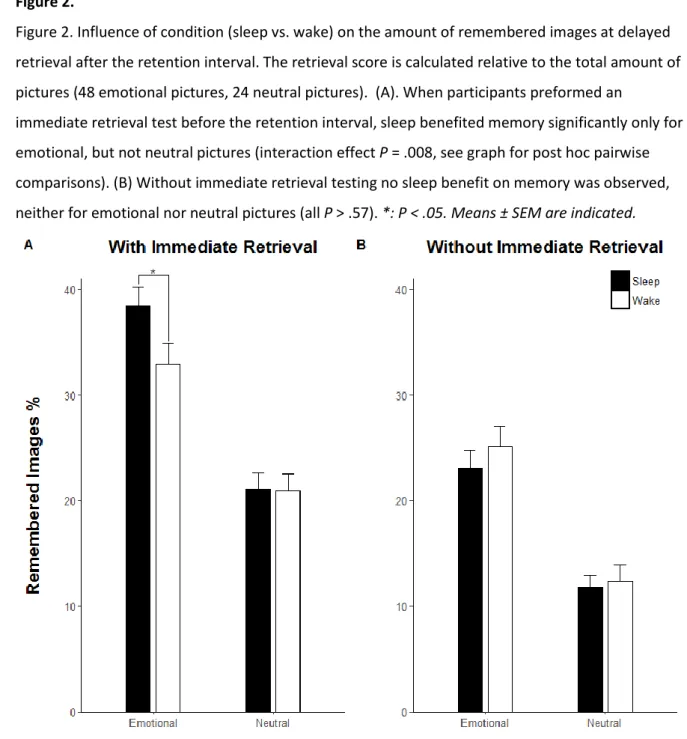
To further explore the three-way interaction we first tested our hypothesis on the dependency of the
328
selective emotional memory effect of sleep on memory strength. Therefore, we analyzed the groups
329
with and without immediate retrieval separately (i.e., high vs. low memory strength, respectively). In
330
contrast to our hypothesis, we observed a significant two-way interaction between the factors
331
emotion and condition for participants with a high memory strength due to immediate retrieval
332
before sleep (F(1,110) = 7.3, P = .008, p2 = 0.06).
333
Post-hoc t-tests confirmed that in the groups with immediate retrieval, sleep only benefited memory
334
for emotional images (sleep vs. wake: 38.41% 1.66% vs. 32.92% 1.92%, t(110) = 2.17, P = .03, d =
335
0.41) but not for neutral images (P = .94, see Figure 2A). This result pattern has been taken as
336
evidence for a “selective” effect of sleep on emotional memories. However, in contrast with the
337
existing literature, the selective benefit of sleep vanished when the pictures were encoded with a low
338
memory strength: Participants without an immediate recall showed no sleep benefit (all P ≥ .57),
339
neither for emotional nor for neutral images (see Figure 2B). Thus, the “selectivity” of sleep for
emotional memories only appeared at a certain memory strength. Interference learning before
341
retrieval after sleep did not interact with the sleep benefit in this analysis (all interactions involving
342
both factors conditions and interference P > .17). Rerunning this analysis with the additional factor
343
emotional valence (negative vs. positive pictures) did not alter the general result pattern (all
344
interactions with emotional valence P > .22, please see supplementary results for separate analyses
345
for negative vs. neutral and positive vs. neutral images). Neither did adding the factor of expected
346
recall (all interactions with expected recall P ≥ .13).
347 348
[Please insert Figure 2 about here]
349 350
5.2 Controlling recall performance for memory strength 351
Results from the delayed free recall test suggested that the sleep benefit is selective for emotional
352
pictures only when memory strength is high (i.e., with immediate retrieval). However, emotional
353
arousal influences the strength of the memory trace already at encoding. Thus, already during
354
immediate recall testing, emotional pictures are much better retrieved than neutral ones (F(1,108) =
355
277.78, P < .001, p2 = 0.72). Furthermore, immediate and delayed retrieval performance are highly
356
correlated (emotion: r = .68; neutral: r = .79; both P < .001). Even more problematic, the sleep group
357
that learned in the evening showed a slightly increased emotional memory already during immediate
358
recall testing as compared to the wake group, although this potential circadian confound did not
359
reach significance (interaction emotion * condition during immediate recall testing F(1,110) = 1.4, P =
360
.24, p2 = 0.01). Note that independent of emotion, sleep and wake groups did not differ in their
361
immediate recall performance (P > .90).
362 363
Due to the emotion-related difference in memory strength during the encoding phase and the
364
potential confounding of circadian time, we re-analyzed our data including only groups that
365
performed immediate retrieval before the retention interval (group II and IV, see Figure 1B). We
366
defined the retention score as the relative change in retrieval performance across the retention
367
interval, with immediate retrieval performance set to 100%. Importantly, relative retention scores
368
did not correlate with immediate retrieval performance anymore (emotional: r = -.02. P = .87;
369
neutral: r = .0, P > .99). In contrast to our previous analyses, emotion did not influence the retention
370
score when controlling for memory strength at encoding, resulting in similar retention levels for
371
emotional and neutral pictures (82.03 1.75% vs. 80.4 2.79%; F(1,106) < 1, P = .59). Furthermore, the
372
sleep benefit was no longer specific for emotional pictures, but sleep generally improved retention
373
scores for both emotional and neutral pictures, resulting in a significant main effect of condition
374
(sleep: M = 86.66 2.47%; wake M = 75.77 2.51%, F(1,106) = 9.57, P = .003, p2 = 0.08). The
13
interaction between emotion and condition (sleep/wake) was not significant anymore (F(1,106) = 0.08,
376
P = .78). Interestingly in this analysis, the interaction between condition and interference nearly
377
gained significance (F(1,106) = 3.71, P = .057, p2 = 0.03).
378
Post hoc tests revealed a larger sleep effect when interference learning was introduced before
379
delayed retrieval (sleep M = 75.43 3.18% vs. wake: M = 59.36 3.5%; t(53) = 3.4, P = .001, d = 0.92),
380
while the effect of sleep on memory for pictures was smaller without interference learning (sleep M
381
= 97.55 2.25% vs. wake: M = 91.84 2.82%, t(55) = 1.59, P = .12, d = 0.43). Thus, interference
382
learning before delayed retrieval testing more than doubled the effect size of sleep on memory.
383
Exploratory pair-wise comparisons suggested that sleep benefited memory for emotional and neutral
384
pictures robustly and equally when interference learning was performed before retrieval (emotional:
385
t(53) = 2.73, P = .008, neutral: t(52) = 2.27, P = .027). The effect sizes of sleep on memory were highly
386
comparable in this condition between emotional (d = 0.74) and neutral pictures (d = 0.62, see Figure
387
3A). In contrast, without interference, only the sleep benefit for emotional pictures reached
388
significance (t(55) = 2.06, P = .045, d = 0.55, see Figure 3B), while no effect of sleep on memory for
389
neutral pictures was observed in this condition (P > .99). However, please note that three-way
390
interaction between emotion, interference and condition did not reach significance (3-way
391
interaction P = .29), indicating that the effect of interference on the sleep benefit of memory was not
392
significantly modulated by emotional arousal. We additionally calculated the ANOVA with the factor
393
expected recall in the second session, however neither the main effect, nor any interaction with
394
expected recall was significant (P ≥ .38). On average, participants that expected a recall performed
395
slightly worse (M = 65.11 % ± 7.08% vs M = 67.51% ± 3.38%). In addition to free recall, we also tested
396
recognition in these two groups. However, we only found a trend for a main effect of condition
397
(sleep M = 83.4 1.5 vs. wake M = 79.8 1.5, P = .096), suggesting that recognition testing is less
398
sensitive to capture sleep benefits on memories for pictures.
399 400
5.3 Correlation with subjective sleep quality 401
We calculated the correlation between the subjective sleep quality reported for the retention
402
interval and the free recall memory performance. We found that subjective sleep quality correlated
403
negatively with percentage of remembered emotional (rs(114) = -0.18, P = .049) and neutral pictures
404
(rs(114) = -0.19, P = .042). The correlation with relative retention performance in groups II and IV with
405
immediate recall was not significant (P > .29).
406 407
6. Discussion 408
Here we show that the previously reported benefit of sleep on emotional memory is highly sensitive
410
to experimental manipulations of memory strength and sensitivity of the retrieval test. First, a
411
selective sleep benefit for emotional pictures is only observed if the memory strength before the
412
retention interval is sufficiently high (i.e., with immediate retrieval). Second, when controlling for
413
differences in memory strength before the retention interval between emotional and neutral
414
pictures, the advantage of emotional pictures disappears entirely, particularly when a more sensitive
415
way of retrieval testing is used (i.e., challenging the memory trace with interference learning before
416
retrieval). Thus, our results indicate that the effect of emotion on sleep dependent memory
417
consolidation is only apparent under certain circumstances. To investigate factors that tag memories
418
for consolidation, memory strength and retrieval test sensitivity have to be taken into account as
419
they can influence detectability of effects. These results were all obtained using free recall measures.
420
In the recognition task we did not find any significant effects of sleep. It seems that this retrieval test
421
was not sensitive enough to uncover the sleep-related processes, as performance was very high
422
across all participants.
423 424
Our result pattern first suggested that only emotional pictures with immediate recall had reached a
425
sufficiently strong trace to benefit from sleep (immediate recall emotional pictures: 43.46 ± 1.0 % ,
426
neutral pictures: 26.02 ± 1.1 % ). However, when controlling for differences in memory strength
427
before the retention interval, the selectivity of sleep for emotional memories was no longer
428
significant. Thus either both, emotion and immediate recall have contributed to detect the sleep
429
benefit or memory strength acts as a moderator: As emotion influences memory strength, we
430
consider it possible that not emotion per se influences consolidation, but that emotional events
431
increase the chance of consolidation via their influence on memory strength. When memory
432
performance level for emotional items without immediate recall was comparable to neutral items
433
after immediate recall, both did not benefit from sleep. This could also explain why the sleep benefit
434
seems absent for neutral items when emotional memories are interleaved. Memory strength for
435
emotional content is stronger and increases the chances of sleep to benefit memory. Consequently,
436
other factors that influence memory strength should show preferential consolidation as well. As
437
literature shows, memory strength is influenced by several factors such as emotionality, intention
438
and expectation. However, if memory strength is the deciding factor for memory consolidation
439
during sleep, then whatever influences memory strength also alters the chance of detecting the sleep
440
benefit. Besides mere effects on the detection of the benefit that are related to the way of testing,
441
sleep might additionally differentially process weaker and stronger memory traces. Some studies
442
have shown that a certain threshold has to be reached before consolidation in sleep can take place
443
(Tucker and Fishbein, 2008). Conversely, Drosopoulos et al. (2007) have reported that also intense
15
encoding (> 90% correct before sleep) abolishes the sleep benefit of memory, while reliable sleep
445
effects are observed at a medium memory strength (e.g. 60% correct before the retention interval).
446
This conclusion was also drawn by Creery, Oudiette, Antony, and Paller (2015) demonstrating limited
447
cueing benefits for nearly perfectly remembered items. The sleep benefit might indeed depend on an
448
inverted U-shaped curve of memory strength before sleep, with maximal benefits of sleep in a
449
medium range and lower or even no sleep effect in the cases of low or high encoding intensity.
450
Interestingly, while additional retrieval testing enhances the benefit of sleep in our study, Bauml,
451
Holterman, and Abel (2014) reported in a series of studies that retrieval practice before sleep
452
abolishes the sleep effect on memory. How can this apparent contradiction be concealed? Again, we
453
would argue that the different outcome is due to the difference in initial memory strengths in both
454
studies. In our study, retrieval practice increased memory strengths from 11-24% to 20-38 %. In the
455
study of Bauml et al. (2014), retrieval practice increased initial memory strength from 75% to almost
456
90%. %. Thus, according to our model, retrieval practice can induce a sleep benefit or attenuate it
457
depending on the initial location on the inverted U-shaped curve (e.g. low (11-38%) vs. high
(75-458
90%)) describing the association between initial memory strength and the sleep benefit. Please note
459
that some studies have reported small benefits of sleep on memory even with very high encoding
460
levels (see e.g. Ellenbogen et al., 2006; Jenkins and Dallenbach, 1924), indicating that the detection
461
of sleep-benefits on memory might still be possible at high initial encoding levels under certain
462
circumstances (e.g. short word lists, low level of integration etc.). However, these examples might
463
also indicate that immediate recall levels are possibly not the best estimator to determine initial
464
memory strength, as these measures might be confounded by short-term memory and immediate
465
retrieval processes in case sufficient initially not remembered items are close enough to the
466
threshold to benefit from sleep.
467 468
What brain mechanisms could underlie the influence of initial memory strength on consolidation
469
processes during sleep? First, involvement of the hippocampal system during encoding might be a
470
necessary condition to trigger later sleep-dependent memory consolidation. For example in the
471
context of motor memories, hippocampal activity as well as connectivity during encoding predict
472
later consolidation during sleep (Albouy, King, Maquet, and Doyon, 2013; Albouy, Sterpenich,
473
Vandewalle, Darsaud, Gais, Rauchs, Desseilles, Boly, Dang-Vu, Balteau, Degueldre, Phillips, Luxen,
474
and Maquet, 2013). Similarly, for declarative memories, hippocampal activity at encoding predicts
475
later sleep-consolidation in a directed forgetting paradigm (Rauchs, Feyers, Landeau, Bastin, Luxen,
476
Maquet, and Collette, 2011). In addition, fast mapping of associative memories does not profit from
477
sleep after learning, presumably because of direct cortical access during encoding with less
478
hippocampal involvement (Himmer, Muller, Gais, and Schonauer, 2017).
Thus, one could argue that a certain level of encoding is needed to induce sufficient hippocampal
480
activity and plasticity, which in turn is necessary to trigger later sleep-related memory consolidation.
481
Furthermore, a certain degree of initial hippocampal-cortical connections during encoding might
482
simultaneously be required to set the stage for successful systems consolidation during sleep.
483
However, if memory traces are already strongly stored in cortical storage sites (for example by
484
excessive training, several repetitions or overlearning), the benefit of sleep might be attenuated and
485
only visible using highly sensitive retrieval procedures or longer time intervals. In sum, we would
486
predict that benefits of sleep on memory are maximal when a) hippocampal and
hippocampal-487
cortical involvement during encoding pass a certain threshold and b) strength of
hippocampal-488
cortical and cortico-cortical memory traces is low. How can this interpretation be applied to the
489
existing literature? Although in Payne et al. (2015), nap and wake groups did not differ in neutral
490
memory performance, more SWS in the nap groups was still associated with better neutral object
491
memory. The alternative explanation that neutral objects were just too weakly encoded to benefit
492
from sleep to such an extent that it would withstand the between-group analysis cannot be ruled out
493
by these findings. Indeed, in both studies (Payne et al., 2008; Payne et al., 2015) the only significant
494
group effects were shown for emotional objects, which were remembered better than neutral
495
objects as well as the backgrounds. Thus, possibly, the sleep effect only appeared for the negative
496
object items as only they achieved a certain memory strength threshold that enabled preferential
497
sleep-dependent consolidation.
498
Wagner et al. (2001) also found preferential consolidation of emotional texts compared to neutral
499
content. However, they reported that subjects had rated the emotional texts as more
500
comprehensible and that the narrative character of the emotional texts might have evoked
501
differences in encoding levels. Additionally, the emotional texts were also rated as being easier, more
502
arousing, more interesting and more important. This makes it hard to determine whether
503
emotionality per se elicited the effect whether these components affected memory strength. In Hu
504
et al. (2006) the pre-sleep learning level was not tested as recognition only followed after the
505
retention interval. However, one might assume that memory strength of emotional pictures was
506
higher as compared to neutral pictures already before the retention interval. Thus, differences in
507
memory strength between emotional and neutral pictures might again explain the result pattern.
508
Additionally, it is quite puzzling why the authors observed the sleep benefit only for “know”
509
judgements and not for “remembered” judgements.
510
Thus, for all studies that found superior consolidation for emotional memory (Hu et al., 2006; Payne
511
et al., 2015; Wagner et al., 2001) memory strength as a confounding variable cannot be excluded.
512
Although our results of the current study support a role of initial memory strength, we cannot (and
513
do not want to) exclude additional selective consolidation processes acting during sleep. For
17
example, Bennion et al. (2015) provided the idea that information might be tagged before sleep
515
rendering this marked content more likely to be consolidated during sleep. It is possible that
516
relevance tagging and initial memory strength both act and interact with respect to later
517
consolidation processes during sleep.
518 519
Besides memory strength, increasing sensitivity of retrieval test additionally enhanced the
520
detectability of the sleep benefit for neutral items. It is very important to note that the benefits of
521
sleep on memory (and also the mechanisms acting on the memory trace during sleep) do of course
522
not depend on the choice of a specific retrieval procedure, as consolidation during sleep occurs
523
before the retrieval test. However, the statistical detection of the sleep benefit strongly does. For
524
example, adding interference before delayed recall in the current study did not change the sleep
525
mechanism per se. But it revealed that sleep did strengthen memory for neutral items. This fact has
526
strong implications for the interpretation of the results: For example, if the difference between a
527
sleep and wake group is not significant, sleep might still have strengthened the underlying memory
528
trace. In other words, the sleep effect might be masked by the specific retrieval procedure. Thus, the
529
results of a retrieval task after sleep are not always indicative for mechanisms acting during sleep,
530
but might be related to the sensitivity of a specific retrieval procedure.
531 532
Several limitations need to be considered regarding our study. First, our study used different
533
experimental procedures and material than previous studies, which renders direct comparisons to
534
other studies difficult. Our retrieval test differed for instance from Payne et al. (2009). While they
535
used only recognition testing, we focused on free recall with and without interference using
536
recognition only in a subset of groups. Free recall usually leads to lower memory performance
537
compared to recognition and therefore recall is lower in our sample compared to other studies. The
538
performance in the recognition task was rather high, compared to other studies, due to recognition
539
being completed after the free recall.
540
Second, different from other studies, we included an immediate recall in half of our participants
541
before the retention interval. While learning for all groups was incidental, this changed the
542
expectation of participants about having to recall the images in the future. However, on average the
543
expectancy was still low and we did not find a main effect or interaction with expected recall. It is
544
therefore unclear, if the memory strengthening effect depends on a reconsolidation during the
545
testing or on a change of expectations. It was however not the intent of the current study to identify
546
the mechanism involved in the testing effect, which has been discussed in several other studies (see
547
van den Broek, Takashima, Segers, Fernandez, and Verhoeven, 2013) but to demonstrate that the
548
detection of the sleep benefit is influenced by memory strength. Thus, while immediate retrieval has
enhanced memory as demonstrated by the data, the mechanism how this enhancement happened is
550
unclear.
551
Third, while most studies have focused on negative and neutral items to test effects of emotion on
552
memory, we included positive items as well. While it has been argued that sleep-dependent
553
consolidation works differently on items of different affect (Jones, Schultz, Adams, Baran, and
554
Spencer, 2016) and that using both valences at the same time can blur effects of emotionality, we
555
could still demonstrate effects of emotion on sleep-dependent consolidation when not accounting
556
for pre-sleep levels. Because we used both positive and negative images, we had a higher total of
557
emotional than neutral images. However, as we always used percentages (of the total amount of
558
images and of previously remembered images) we controlled for this. Furthermore we tested the
559
two emotional valences (positive and negative) compared to neutral separately (see supplementary
560
material) and found the effects where similar in both valences, however did not always reach
561
significance in both.
562
Fourth, we did not measure any objective sleep data, but only asked for a subjective assessment of
563
sleep quality between the sessions.
564 565
7. Conclusion 566
In sum, our results show that whether a sleep-dependent memory consolidation effect is detected in
567
the data does not only depend on actual sleep consolidation processes. Several factors such as memory
568
strength and sensitivity of the retrieval test can influence traceability of the sleep benefit. Neutral
569
memories for instance also benefit from sleep, but the detection of these benefits depends on
570
sufficient memory strength and sensitive retrieval testing procedures.
571
Given a certain memory strength and a sensitive retrieval measure, the sleep effect on emotional
572
and neutral pictures results in the same effect size. These results add to the notion of a preferential
573
consolidation of emotional memories during sleep although the preference for consolidation of
574
emotional memory during sleep is not due to emotion alone, but also because emotion influences
575
memory strength. Our results demonstrate that it is vital to determine factors that influence the
576
appearance of the sleep benefit in order to avoid confounding variables and unclear conclusions. The
577
appearance of a sleep benefit in behavioral measures alone is not sufficient to draw strong
578
theoretical or mechanistic conclusions.
579 580
Acknowledgments
581
This work was supported by the Clinical Research Priority Program ‘Sleep and Health’ and of the
582
University of Zurich and a grant from the Swiss National Science Foundation (SNF 100014_162388).
19
We thank Manuela Steinauer for assistance in data collection and Arlette Bär, Clemens Schröder,
584
Fiona Hart-Hönig and Tobias Egli for help in analyzing the data.
585 586 587
References 588
Ackermann, S., Hartmann, F., Papassotiropoulos, A., de Quervain, D. J. F., & Rasch, B. (2015). No 589
Associations between Interindividual Differences in Sleep Parameters and Episodic Memory 590
Consolidation. Sleep, 38, 951-U263. 591
Adelman, J. S., & Estes, Z. (2013). Emotion and memory: A recognition advantage for positive and 592
negative words independent of arousal. Cognition, 129, 530-535. 593
Baran, B., Pace-Schott, E. F., Ericson, C., & Spencer, R. M. (2012). Processing of emotional reactivity 594
and emotional memory over sleep. Journal of Neuroscience, 32, 1035-1042. 595
Barsky, M. M., Tucker, M. A., & Stickgold, R. (2015). REM sleep enhancement of probabilistic 596
classification learning is sensitive to subsequent interference. Neurobiology of Learning and 597
Memory, 122, 63-68. 598
Bauml, K. H. T., Holterman, C., & Abel, M. (2014). Sleep Can Reduce the Testing Effect: It Enhances 599
Recall of Restudied Items but Can Leave Recall of Retrieved Items Unaffected. Journal of 600
Experimental Psychology-Learning Memory and Cognition, 40, 1568-1581. 601
Bennion, K. A., Payne, J. D., & Kensinger, E. A. (2015). Selective effects of sleep on emotional 602
memory: What mechanisms are responsible? Translational Issues in Psychological Science, 603
1, 79. 604
Blake, T. M., Varnhagen, C. K., & Parent, M. B. (2001). Emotionally arousing pictures increase blood 605
glucose levels and enhance recall. Neurobiology of Learning and Memory, 75, 262-273. 606
Born, J., & Wilhelm, I. (2012). System consolidation of memory during sleep. Psychological Research-607
Psychologische Forschung, 76, 192-203. 608
Cahill, L., & McGaugh, J. L. (1995). A novel demonstration of enhanced memory associated with 609
emotional arousal. Consciousness and Cognition, 4, 410-421. 610
Canli, T., Zhao, Z., Brewer, J., Gabrieli, J. D. E., & Cahill, L. (2000). Event-related activation in the 611
human amygdala associates with later memory for individual emotional experience. Journal of 612
Neuroscience, 20. 613
Creery, J. D., Oudiette, D., Antony, J. W., & Paller, K. A. (2015). Targeted Memory Reactivation during 614
Sleep Depends on Prior Learning. Sleep, 38, 755-763. 615
Deliens, G., Schmitz, R., Caudron, I., Mary, A., Leproult, R., & Peigneux, P. (2013). Does Recall after 616
Sleep-Dependent Memory Consolidation Reinstate Sensitivity to Retroactive Interference? 617
Plos One, 8. 618
Diekelmann, S., Wilhelm, I., & Born, J. (2009). The whats and whens of sleep-dependent memory 619
consolidation. Sleep Medicine Reviews, 13, 309-321. 620
Drosopoulos, S., Schulze, C., Fischer, S., & Born, J. (2007). Sleep's function in the spontaneous 621
recovery and consolidation of memories. Journal of Experimental Psychology-General, 136, 622
169-183. 623
Ellenbogen, J. M., Hulbert, J. C., Jiang, Y., & Stickgold, R. (2009). The Sleeping Brain's Influence on 624
Verbal Memory: Boosting Resistance to Interference. Plos One, 4. 625
Ellenbogen, J. M., Hulbert, J. C., Stickgold, R., Dinges, D. F., & Thompson-Schill, S. L. (2006). 626
Interfering with theories of sleep and memory: Sleep, declarative memory, and associative 627
interference. Current Biology, 16, 1290-1294. 628
Harris, C. R., & Pashler, H. (2005). Enhanced memory for negatively emotionally charged pictures 629
without selective rumination. Emotion, 5, 191-199. 630
Heuer, F., & Reisberg, D. (1990). Vivid Memories of Emotional Events - the Accuracy of Remembered 631
Minutiae. Memory & Cognition, 18, 496-506. 632
Himmer, L., Muller, E., Gais, S., & Schonauer, M. (2017). Sleep-mediated memory consolidation 633
depends on the level of integration at encoding. Neurobiology of Learning and Memory, 137, 634
101-106. 635
Hu, P., Stylos-Allan, M., & Walker, M. P. (2006). Sleep facilitates consolidation of emotional 636
declarative memory. Psychological Science, 17, 891-898. 637
Jenkins, J. G., & Dallenbach, K. M. (1924). Obliviscence during sleep and waking. American Journal of 638
Psychology, 35, 605-612. 639
Jones, B. J., Schultz, K. S., Adams, S., Baran, B., & Spencer, R. M. C. (2016). Emotional bias of 640
sleep-dependent processing shifts from negative to positive with aging. Neurobiology of Aging, 641
45, 178-189. 642
Kensinger, E. A., & Corkin, S. (2003). Memory enhancement for emotional words: Are emotional 643
words more vividly remembered than neutral words? Memory & Cognition, 31, 1169-1180. 644
Lang, P. J., Bradley, M. M., & Cuthbert, B. N. (2008). International affective picture system (IAPS): 645
Affective ratings of pictures and instruction manual. Technical report. 646
Lehmann, M., Seifritz, E., & Rasch, B. (2016). Sleep benefits emotional and neutral associative 647
memories equally. Somnologie, 20, 47-53. 648
Lewis, P., Cairney, S., Manning, L., & Critchley, H. (2011). The impact of overnight consolidation upon 649
memory for emotional and neutral encoding contexts. Neuropsychologia, 49, 2619-2629. 650
Payne, J., Stickgold, R., Swanberg, K., & Kensinger, E. (2008). Sleep preferentially enhances memory 651
for emotional components of scenes. International Journal of Psychology, 43, 735-735. 652
Payne, J. D., & Kensinger, E. A. (2011). Sleep Leads to Changes in the Emotional Memory Trace: 653
Evidence from fMRI. Journal of Cognitive Neuroscience, 23, 1285-1297. 654
Payne, J. D., Kensinger, E. A., Wamsley, E. J., Spreng, R. N., Alger, S. E., Gibler, K., Schacter, D. L., 655
& Stickgold, R. (2015). Napping and the Selective Consolidation of Negative Aspects of 656
Scenes. Emotion, 15, 176-186. 657
Phelps, E. A. (2004). Human emotion and memory: interactions of the amygdala and hippocampal 658
complex. Current Opinion in Neurobiology, 14, 198-202. 659
Plihal, W., & Born, J. (1997). Effects of early and late nocturnal sleep on declarative and procedural 660
memory. Journal of Cognitive Neuroscience, 9, 534-547. 661
Rasch, B., & Born, J. (2013). About Sleep's Role in Memory. Physiological Reviews, 93, 681-766. 662
Rasch, B., Spalek, K., Buholzer, S., Luechinger, R., Boesiger, P., Papassotiropoulos, A., & de 663
Quervain, D. J. F. (2009). A genetic variation of the noradrenergic system is related to 664
differential amygdala activation during encoding of emotional memories. Proceedings of the 665
National Academy of Sciences of the United States of America, 106, 19191-19196. 666
Rauchs, G., Feyers, D., Landeau, B., Bastin, C., Luxen, A., Maquet, P., & Collette, F. (2011). Sleep 667
contributes to the strengthening of some memories over others, depending on hippocampal 668
activity at learning. Journal of Neuroscience, 31, 2563-2568. 669
Rowland, C. A. (2014). The Effect of Testing Versus Restudy on Retention: A Meta-Analytic Review of 670
the Testing Effect. Psychological Bulletin, 140, 1432-1463. 671
Sonni, A., & Spencer, R. M. C. (2015). Sleep protects memories from interference in older adults. 672
Neurobiology of Aging, 36, 2272-2281. 673
Stickgold, R., & Walker, M. P. (2013). Sleep-dependent memory triage: evolving generalization 674
through selective processing. Nature Neuroscience, 16, 139-145. 675
Sutterer, D. W., & Awh, E. (2015). Retrieval practice enhances the accessibility but not the quality of 676
memory. Psychonomic Bulletin & Review, 1-11. 677
Tucker, M. A., & Fishbein, W. (2008). Enhancement of declarative memory performance following a 678
daytime nap is contingent on strength of initial task acquisition. Sleep, 31, 197-203. 679
van den Broek, G. S. E., Takashima, A., Segers, E., Fernandez, G., & Verhoeven, L. (2013). Neural 680
correlates of testing effects in vocabulary learning. Neuroimage, 78, 94-102. 681
Wagner, U., Gais, S., & Born, J. (2001). Emotional memory formation is enhanced across sleep 682
intervals with high amounts of rapid eye movement sleep. Learning & Memory, 8, 112-119. 683
Wilhelm, I., Diekelmann, S., Molzow, I., Ayoub, A., Molle, M., & Born, J. (2011). Sleep selectively 684
enhances memory expected to be of future relevance. Journal of Neuroscience, 31, 1563-685 1569. 686 687 Figure 1 688 689
Figure 1. Task design (Adapted from Rasch et al., 2009) and experimental procedure. A) A schematic
690
representation of one trial of the Picture Memory Task. After the fixation cross an image of the IAPS
691
was presented for 2.5s and subsequently rated on valence and arousal. The intertrial interval
692
including the ratings varied between 9 and 12 seconds. B) Participants were assigned to one of four
693
groups and within this group to either the wake (white) or sleep condition (black).
21 695
Figure 2. 696
Figure 2. Influence of condition (sleep vs. wake) on the amount of remembered images at delayed
697
retrieval after the retention interval. The retrieval score is calculated relative to the total amount of
698
pictures (48 emotional pictures, 24 neutral pictures). (A). When participants preformed an
699
immediate retrieval test before the retention interval, sleep benefited memory significantly only for
700
emotional, but not neutral pictures (interaction effect P = .008, see graph for post hoc pairwise
701
comparisons). (B) Without immediate retrieval testing no sleep benefit on memory was observed,
702
neither for emotional nor neutral pictures (all P > .57). *: P < .05. Means ± SEM are indicated.
703
Figure 3. 705
Figure 3. Influence of interference learning before retrieval on retention of emotional and neutral
706
pictures across sleep vs. wakefulness. Retention scores are calculated with learning performance
707
before the retention interval set to 100%, thereby controlling for differences in memory performance
708
at encoding. (A) With interference learning before delayed retrieval, both emotional and neutral
709
pictures similarly benefited from sleep as compared to a retention interval filled with wakefulness.
710
The interaction between condition (sleep/wake) and interference learning (yes/no) was significant (P
711
= .05), whereas no significant three-way interaction with the factor emotional arousal emerged (P =
712
.26). Thus, enhancing retrieval sensitivity by including interference did not lead to a difference
713
between emotional and neutral pictures concerning the sleep benefit. (B) Without interference
714
learning before delayed retrieval after the retention interval, the sleep benefit was only significant
715
for emotional, but not neutral pictures. **: P < .01; *: P < .05. Means ± SEM are indicated.
716