HAL Id: halshs-02095697
https://halshs.archives-ouvertes.fr/halshs-02095697
Submitted on 10 Apr 2019HAL is a multi-disciplinary open access archive for the deposit and dissemination of sci-entific research documents, whether they are pub-lished or not. The documents may come from teaching and research institutions in France or abroad, or from public or private research centers.
L’archive ouverte pluridisciplinaire HAL, est destinée au dépôt et à la diffusion de documents scientifiques de niveau recherche, publiés ou non, émanant des établissements d’enseignement et de recherche français ou étrangers, des laboratoires publics ou privés.
Edith Archambault
To cite this version:
Edith Archambault. FOUNDATIONS IN FRANCE. Foundations in Europe. Society,management and law, 2001. �halshs-02095697�
Edith ARCHAMBAULT*
* Professor of Economics - Director of the Laboratoire d’économie sociale - University of Paris 1 Sorbonne.
1. Introduction:
Among European countries, France has no doubt the less developed foundation sector, contrasting with a vibrant and dynamic associative life. Currently there is less than 500 state-approved foundations (fondations reconnues d'utilité publique, or RUP foundations), 44 corporate foundation and some 450 endowments sheltered by the
Fondation de France, that are little foundations with an asset below FF 5 million
(762,200 Euros), the minimum required to apply as a RUP foundation. More French foundations in the average are of rather limited importance, because of a lower asset than those of comparable countries.
Why are the French foundations so scarce and so weak? This situation has at least three related causes:
- a historical origin: in a country with a deeply rooted Jacobin tradition, foundations were always suspicious to the State either during the Old Regime, or more recently during nineteenth and twentieth century. According to this tradition, the State has the monopoly of serving public purpose and the foundations are viewed as inefficient competitors secluding mortmain property from the economic flows. That is why heavy restrictions on the creation and activity of foundations existed till recently. France is a well-functioning and affluent society in which foundations have played virtually no role over 200 years.
-a juridical origin: before 1987 there was no law ruling foundations. Two recent laws, 1987 on state approved foundations and 1990 on corporate foundations filled this legal gap. More over the process to create a RUP foundation is very long and burdensome and leads often to a failure. This fact contrasts with the simplicity of creating an association and explains why foundation creations are very scarce when association creations are more than 60,000 each year.
- a sociological origin: the man in the street ignores what a foundation is and the wealthiest have no idea to create a foundation either alive or by will. The individual giving behaviour is rather low and oriented toward associations. Grant giving foundations are so scarce that they are unknown, with the exception of Fondation de
France and Fondation pour la recherche médicale. Corporate giving also is low and the
few existing corporate foundations are linked mainly to public corporations or former public corporations.
To these three causes of the scarcity of foundations in France, we add that till the nineties, the government didn't encourage foundations as it did for nonprofit membership organisations. We can add also that umbrella organisations of "social economy" such as Comité national de liaison des activités mutualistes, coopératives et
associatives (CNLAMCA) or political agencies such as Délégation interministérielle ˆ l'économie sociale (DIES) didn't include foundations because they have no members
and therefore they are not democratically managed. This situation may change, through the European channel, as the European definition of social economy, adopted in 1998 in Manchester, includes cooperatives, mutuals, associations and foundations (CMAF).
According to the common definition of this book, a foundation is an asset managed by an identifiable organization which is simultaneously private, self-governing, nonprofit distributing and serving a public purpose. The few French foundations meet no doubt these five criteria. In a civil law country, a foundation is a legal person, subjected to rights and obligations, as soon as it has been approved by the government. So the "organisation" criterion is met. The second criterion is also fulfilled: any kind of foundation is non-governmental as public authorities cannot create foundations. More foundations are not instruments of central or local governments, despite the fact that government officials may sit in boards up to one third of total board members of RUP foundations. That implies "self-governance", the third criterion: in RUP Foundation boards, private administrators have the majority, and corporate foundations are structurally separate from the funding corporation. The two last conditions, "non-profit distribution" and "public purpose" are prerequisites to the authorization or renewal of a foundation by public authorities, which verify these conditions are fulfilled.
The following chapter outlines the historical background of foundations and analyses their legal position as well as the differences between the three kind of foundations: state-approved foundations (fondations reconnues d'utilité publique), corporate foundations (fondations d'entreprise), and nonautonomous foundations (fondations abritées). After describing the size, scope, structure, and evolution of the French foundation sector, we conclude by discussing the contradictory nature of government policy toward foundations, with its mix of encouragements and restrictions and speculating on the future of foundations in France.
2. Historical development:
Throughout the Middle Ages, foundations developed in France much like in other Continental European countries mostly in form of hospitals and asylums to provide care to the poor, the sick, or the elderly under the auspices of the Catholic Church. The Church and some monastic orders, such as the Benedictine and Franciscan orders, successfully acquired bequests and donations, both in kind and in money, for the creation of such foundations. Accordingly, under the Ancien Régime, many poorhouse foundations, foundations supporting poor students and ecclesiastics, but also magnificent abbeys, churches and schools in foundation form existed in France.
However, the wealth that some foundations acquired through legacies and donations began to arouse the suspicion of the state early on, which questioned the accumulation of inalienable property and power beyond the direct control of the state. Soon suspected by the French monarchs as a means to evade royal taxes, Louis XIV and Louis XV began to restrict the rights of existing foundations and prohibited the creation of new ones (Pomey, 1980). The negative attitudes towards the creation of large patrimonies at that time is perhaps most clearly expressed in Turgot's entry in the Great Encyclopaedia edited by Diderot: "A founder is a man who wants to eternalise his will... No manmade work is everlasting. As foundations, multiplied by vanity, would absorb in the long run all funding and individual property, it is necessary to destroy them (Quoted in Pomey, 1980, p. 35).
The fight against foundations reinforced during the Le Chapelier Act proclaiming the State's monopoly on activities in the general interest, which was primarily directed against foundations as well as corporations, guilds and other forms of intermediate entities. The ensuing struggle between State and Church led to further substantial consequences for the foundation field, as the property of the clergy and Church-related foundations were seized, and many schools and charitable institutions had to close, while hospitals were nationalized. So foundations had lost their legal status and virtually disappeared until the end of the nineteenth century.
The Institut Pasteur was among the first and most notable foundations to mark a limited reappearance of the foundation idea in the late nineteenth century. Following Pasteur's lead, a select number of other operating foundations were created before WWI, including the still existing Fondation Thiers (1893), the Musée social (1894), and the Institut Océanographique (1906). Others, such as the Fondation Curie (1921),
Rothschild (1921), Deutsch de la Meurthe (1922), followed in the inter-war period.
However, the endowments of many of the institutions that emerged in this first renewal of the foundation sector in France proved vulnerable to the prolonged inflationary trends. As a result, interest in this institutional form ceased again until the mid-1960s.
After 1965, some foundations were created in the field of culture such as the RUP fondations Belem, Cziffra, Louis Voulard, Maeght. Over the last few years, some large corporations have created company-sponsored foundations in new fields such as environment, sports or arts and culture. In this last field, foundations are mainly supporting exhibitions, or artistic creation especially in the area of painting and cinema. The recent emphasis on the arts has in part been due to the activities of Jack Lang, Minister of Culture in the Socialist governments of the 1980s, who tried to extend available resources for arts through the promotion of mécénat, or private sponsorship. Very favorable tax-exemptions for individuals or corporations giving to the film production, are at the origin of the vitality of the French cinema industry, the second in the world after USA for the number of new films. Conversely the proposal in 1995 of the Minister of Culture to create a Heritage Foundation, inspired by the British example, was a failure.
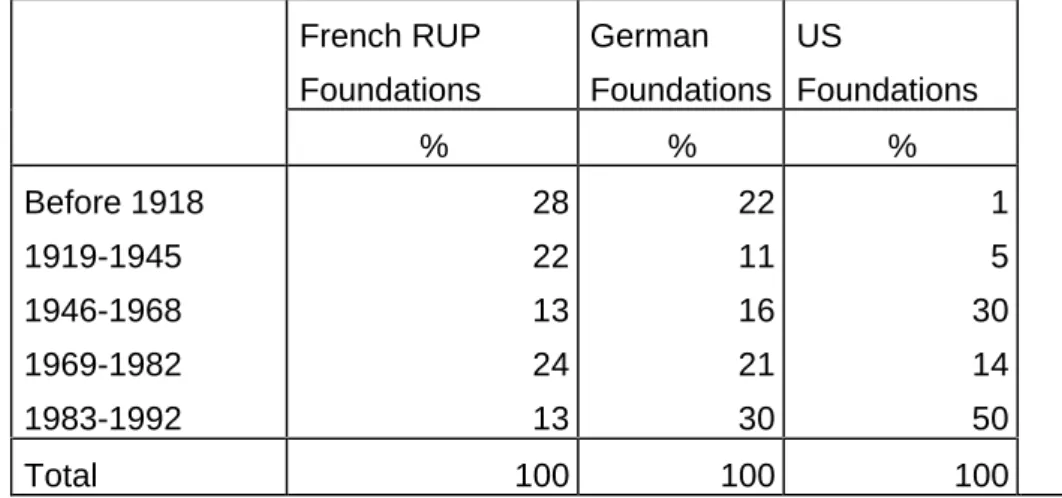
Table 1 compares the 358 RUP Foundations founding periods to the German and American ones (Anheier and Romo, 1999) calculated on 2,799 German foundations and 16,221 American foundations.
Table 1. Founding periods of French, German and US Foundations
French RUP Foundations German Foundations US Foundations % % % Before 1918 1919-1945 1946-1968 1969-1982 1983-1992 28 22 13 24 13 22 11 16 21 30 1 5 30 14 50 Total 100 100 100
Source: France author's calculation following GAFA 1995, Germany and US in Anheier and Romo, 1999.
When France and German have old foundations, US appears as the New World. Why did France miss the recent foundation renewal observed in Germany and US, while associations are booming? No doubt that the legal environment is essential to understand the underdevelopment of foundations in France.
3. The legal position:
As said before, the legislation concerning the foundation sector is still in the first phases of implementation, since there was no body of law specifically governing foundations until 1987, only general regulations, applicable to a range of nonprofit organizations, were in place. Although foundations were eligible for recognition by the state as a matter of administrative practice, foundations did not exist as a specific legal form and did not enjoy legal status.
Currently, foundations are governed by two laws, the Law of July 23, 1987 and the Law of July 4, 1990. The first one aiming at foundations established by individuals, provided for the first time a legal definition, according to which, a foundation is "the legal act through which one or several individuals or legal entities decide the irrevocable allocation of estate, rights or resources for a nonprofit making activity of general interest". This definition emphasizes the fact that foundations are based on goods or estates earmarked for public benefit aims as opposed to associations, which are member-based. The subsequent Law of July 4th 1990 spells out the specific conditions under which corporations may create foundations.
In contrast to other countries, the term "foundation" is now legally protected in France and can only be used for organizations covered under either of the two laws: the fondation reconnue d'utilité publique (state-approved foundation) or the fondation
d'entreprise (corporate foundation). However, non-autonomous foundations without
legal personality distinct from the one of the organization which administers or "shelters" it also exists as a hybrid form. In the following, we will briefly outline the legal regulation applicable to these three types of foundations.
The establishment of a fondation reconnue d'utilité publique (RUP), is a lengthy, complicated, and centralized process involving highest state authorities. More specifically, founders must first seek preliminary state authorization signed by the Prime Minister and the Home Office. After this is granted, legal personality is granted through a decree issued by the Conseil d'Etat 1, or State Council, and published at the
Journal Officiel. The Conseil d'Etat also has the power to impose by-laws and to determine whether the endowment suffices to pursue the aim of the foundation. In any case, a minimum endowment of FF 5 million (euro 762,200) is required. Initially, a RUP foundation could only be established inter vivos. Since 1990, however, it is also possible to create such a foundation by will.
Generally, the legal treatment of state-approved foundations is much stricter and provides considerably more controls than the laws governing other types of nonprofit organizations, especially the 1901 Act on associations. Associations may simply register in a Préfecture and are under no obligation to invite representatives of public authorities to join their board.
While state-approved foundations face close supervision and control, they also enjoy a number of special privileges in exchange. The first set of privileges refers to the legal capacity of these foundations which is much wider than that of associations. While associations cannot own buildings or real estate, except if directly used for their operations, foundations face no such restrictions. Foundations may also receive gifts and legacies, but certain transactions are subject to state supervision.
The second set of privileges relates to the tax treatment. RUP foundations are allowed to engage in commercial activities, although profits are subject to regular taxation, and activities directly linked with the foundation's aim are generally exempt of V.A.T. or Corporation Tax. Individuals making donations to RUP fondations and registered associations that hold intermediary accounts with such foundations are entitled to a tax credit of 50 percent of the contribution on the taxes owed by the tax-payer up to six percent of the taxable income (Law of 24 June 1996). Legacies are exempt from heritage tax. Private companies can deduct donations up to 0.325 percent of their annual business turnover.
Governed by the 1990 Act, corporate foundations, or fondations d'entreprise, can be founded for nonprofit activities of public interest by one, or several, private or public corporations, cooperatives or mutual societies. While corporate foundations also need administrative authorization, the process is less demanding than in the case of RUP foundations. A corporate foundation receives legal personality either through explicit authorization by the administration or through tacit consent in case of administrative silence within a period of four months after preliminary application.
In contrast to private, state-approved foundations, corporate foundations are initially only authorized for a period of five years, although the authorization may be repeatedly renewed thereafter. Corporate foundations must be established with a minimum endowment of approximately one-fifth of projected five-year programmatic expenditures, which must amount to a five-year total endowment of at least FF one million (Art. 19-6, Law of 23 July 1987). The governing board must include at least two employees of the founding corporation. The legal capacity of corporate foundations is as limited as that of declared associations, meaning that they can only own real estate used to carry on their activities. According to the Law of 24 June 1996, the founding company can deduct endowment payments from corporate tax for up to 0.225 percent of the annual business turnover. Corporate foundations cannot receive donations and legacies.
Finally, non-autonomous foundations do not have their own separate legal status, but are "sheltered" or hosted by other institutions. About 1,000 of such foundations are administered by the Institut de France2 as a result of specific bequests to this venerable institution. With very few exceptions, such as the Kodak and Fiat Foundations, the endowments of these foundations are negligible. The vast majority of such foundations that do have economically significant endowments are "sheltered" by the Fondation de France. This includes about 450 non-autonomous foundations. The advantage of non-autonomous foundations is that neither minimum endowments nor annual funding commitments are required by law. The drawback, however, is the dependence on a host institution. Non-autonomous foundations can be created either by individuals -inter vivos or by last will- or by corporations. Indeed, about fifty corporate foundations are administered by the Fondation de France.
Of course it is questionable if non-autonomous foundations are self-governing. These foundations have their own boards, including a minority of representatives of the host institution, which decide of grants and operations. But the financial management of the assets is done by the host institution.
4. Foundations in France: a profile
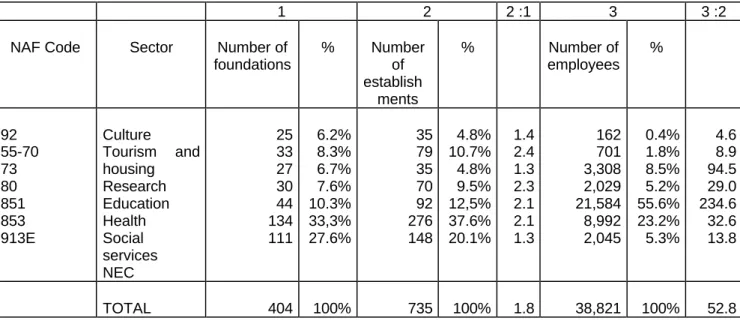
As indicated earlier, due to the jacobin tradition to favor the monopolization of the public interest by the State, foundations have remained rare organizational forms in France. In January 1996, the SIRENE file3 recorded 404 foundations, running 735
establishments, that is 1.8 establishment per foundation on average, with little variation among the activities (Table 2).
Foundations thus constitute only a very small part of the French nonprofit sector. According to our very tentative estimates, total operating expenditures of the foundation sector in 1995 may amount to some FF 10 billion, that is 4 percent of the operating
Table 2: Number of Foundations and Foundation Employment in 1996
1 2 2 :1 3 3 :2
NAF Code Sector Number of foundations % Number of establish ments % Number of employees % 92 55-70 73 80 851 853 913E Culture Tourism and housing Research Education Health Social services NEC 25 33 27 30 44 134 111 6.2% 8.3% 6.7% 7.6% 10.3% 33,3% 27.6% 35 79 35 70 92 276 148 4.8% 10.7% 4.8% 9.5% 12,5% 37.6% 20.1% 1.4 2.4 1.3 2.3 2.1 2.1 1.3 162 701 3,308 2,029 21,584 8,992 2,045 0.4% 1.8% 8.5% 5.2% 55.6% 23.2% 5.3% 4.6 8.9 94.5 29.0 234.6 32.6 13.8 TOTAL 404 100% 735 100% 1.8 38,821 100% 52.8
Source: SIRENE File, January 1996
expenditures of the French nonprofit sector as a whole (Archambault, 1997). Similarly, foundation employment is less than 3 percent of the whole employment of the nonprofit sector. As table 2 shows, the 735 foundations establishments had 38,821 employees, which compares to 1,390,000 employees of 288,500 associations as recorded in the SIRENE file.
On average, foundations employ more staff than associations. The average foundation establishment has a staff of 53 employees compared to an average of five employees for associations recorded in SIRENE file. A breakdown of total employment by main foundation activities shows that more than half of foundation employment is in the health sector, mainly in hospitals created before 1950. These hospitals are generally large organizations, averaging 235 employees. Social services account for nearly one quarter of the employment with an average of 33 employees. Other sectors
of some economic importance include research, education, and tourism and housing. The extremely small share of arts and culture both in terms of numbers of foundations devoted to this field appears to be most remarkable, as arts and culture are among the growth fields in the foundation sectors of other European countries (see, f.i., Strachwitz and Toepler, 1996). The implication here is that the strong dominance of the central government in the cultural area has so far stifled private foundation initiative and that recent legislative encouragements especially targeted at the cultural area have not taken root yet.
Not only is the French foundation sector relatively small, it also shows no signs of accelerated growth. As borne out in Table 3, no significant growth can be observed for state-approved foundations, despite the recent legislation. Over the last six years, the number of RUP foundations grew from 383 in 1989 to only 468 in 1998, or on average by approximately nine new foundations per year. This lack of significant growth is often attributed to the discouraging effects of the lengthy authorization and approval process and the high minimal endowment requirement.
Table 3. Number of fondations reconnues d'utilité publique, 1989-1998
Year 1989 1990 1991 1992 1993 1994 1995 1996 1997 1998
Number 383 393 402 417 430 438 445 454 466 468
Creation 10 9 15 13 8 7 9 12 2
Source: Unpublished data provided by the Ministry of Interior
Table 4. Number of Foundations Sheltered by Fondation de France
1990 1991 1992 1993 1994 1995 1996 1997 1998
326 351 358 364 395 404 420 466 487
Source: Fondation de France
In addition, the development of corporate foundations has been even more stagnant. Only forty-four have been created since 1990, and some of those are not really new as they are reorganized associations or quasi-corporate entities established prior to the 1987 law on foundations.
As indicated in Table 4, non-autonomous foundations administered by the Fondation de France grew at the slightly higher rate of 43 percent in the eight-year period between 1990 and 1998. This growth rate is twice the growth rate of state-approved foundations over the same period, demonstrating that the high level of minimum endowments required for state-approved foundations might indeed have discouraging effects on potential founders, whether individuals or corporations.
Overall, the impact of the Fondation de France on the French foundation field is most significant. Its total assets amount to about FF 2.5 billion. Annual grant expenditures totalled more than FF 400 million. The Fondation de France raises more than FF 300 million in donations and legacies. As a multipurpose grant-maker, it distributes around 50 percent of its annual grants to social service field; around 17 percent to health, 16 percent to culture and arts, 13 percent to research and education, a rising purpose, and around 5 percent to international activities and the environment. Another noteworthy grantmaker is the Fondation pour la recherche médicale, which reported an annual revenue of more than FF 127 millions in 1993 (Guide Annuaire des Fondations et des Associations; 1995).
The localisation of foundations in France reflects its high level of centralization: half of state-approved foundations are in the Parisian area which gather only one-fifth of the French population. The North-western, the North-eastern and the south-eastern part of France gather 13 to 15 percent of the total, while only 8 percent are in the south-western part of France, which is more consistent with the French population distribution.
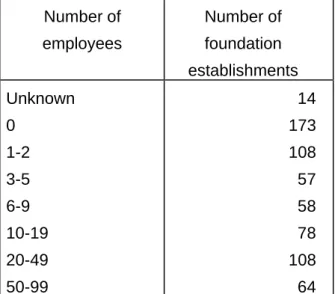
Table 5: Size distribution of foundations, by employment.
Number of employees Number of foundation establishments Unknown 0 1-2 3-5 6-9 10-19 20-49 50-99 14 173 108 57 58 78 108 64
100-199 200-499 500-999 1000-5000 > 5000 Total 31 26 15 2 1 735
In Table 5, we observe a bimodal distribution of foundations with a maximum number of establishments in the no employee category and another one in the 20-49 employees category. The first ones are mainly grant-making or price-giving. The second ones are operating foundations. The very large foundations, over 1,000 employees are two hospitals and Institut Pasteur.
5. Recent trends: An ambiguous relationship between
foundations and government.
Despite their limited number, foundations are coming on the forefront now in France, as in-many European countries. A foundations' renewal seems to be under way, but the position of the government toward foundations is not yet clear.
On one hand, this revival has been encouraged by the central government. The first encouragement was the creation of the Fondation de France in 1969 on the initiative of General de Gaulle and André Malraux. The first FF. 16 million (Euro 2.2 millions) endowment was given by the Caisse des Dépôts et Consignations, a public agency which gathers the funds of public savings banks and finance local governments investment and social housing and by 17 other public and private banks. Independent from the government but with some civil servants as board trustees, the Fondation de
France has two missions: encouraging philanthropy and sheltering individual or
corporate foundations. Indeed, Fondation de France initiated a completely new and sophisticated concept: a multipurpose foundation, in comparison with narrowly defined objects.
Most of the foundations created at the turn of the seventies have departed traditional sectors, and have been successful in their achievements ; they have good reputation, but their size and their assets are limited, and most of them have to ask for periodic private or public subsidies to develop projects or to overcome financial difficulties. During the eighties, with the socialist government, an unexpected attention
has been paid to corporate involvement in public interest topics. The government encouraged companies patronage especially on arts and culture. Following the model of the English-speaking countries, the development of French foundations has been accelerated thanks to the action of the government and especially to the intervention of the Ministry of culture. Indeed, during the late eighties, it initiated the law of 1990 in the general framework of helping and promoting the patronage of organizations or businesses to diversify cultural financial resources. Of the 44 corporate foundations established since then some are committed to arts and culture totally (Cartier, Caisse
des Dépôts, GAN) or partially (Gaz de France, Air France) but other support first
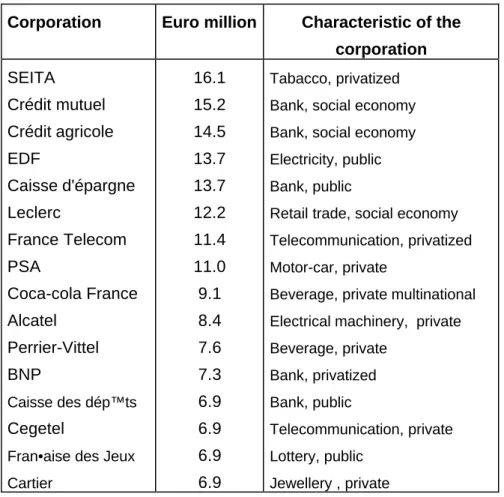
sports, environment and more recently services intended to the most deprived. Table 6 shows the top-list of grant-making corporate foundations ; we observe that public corporations or formerly public enterprises, recently privatized, were first in creating corporate foundations, as were also cooperative banks. But private forprofit companies follow shyly. In fact, the traditional view was that corporations should not be involved in public-interest activities as the endowment of corporate foundations and corporate
Table 6 : Total grants of corporate foundations in 1998
Corporation Euro million Characteristic of the corporation SEITA Crédit mutuel Crédit agricole EDF Caisse d'épargne Leclerc France Telecom PSA Coca-cola France Alcatel Perrier-Vittel BNP Caisse des dép™ts Cegetel
Fran•aise des Jeux Cartier 16.1 15.2 14.5 13.7 13.7 12.2 11.4 11.0 9.1 8.4 7.6 7.3 6.9 6.9 6.9 6.9 Tabacco, privatized Bank, social economy Bank, social economy Electricity, public Bank, public
Retail trade, social economy Telecommunication, privatized Motor-car, private
Beverage, private multinational Electrical machinery, private Beverage, private Bank, privatized Bank, public Telecommunication, private Lottery, public Jewellery , private
giving in general was seen as an improper diversion of resources that could either be used to increase wages or shareholder dividends. While the Law of 1990 departed from this traditional approach and promoted a newer trend toward a socially responsible "citizen enterprise" culture in the French business sector, which is not yet widespread.
Contrasting with these government encouragements to corporate foundations, we may observe an everlasting suspicion of public powers toward their principal competitors, the state-approved foundations. The law of 1987 raises many problems quoted before: a minimum endowment ten times higher than in Belgium, a long and uncertain process of recognition, the presence of officials in the board. The French administration continues to harbor suspicions vis-à-vis foundations, their management, and sometimes their activities, and the administrative culture is still deeply entrenched with an unabashed belief in the superiority of governmental provision for public needs and a distrust of independent privately controlled institutions. Confronted with an administrative culture that has not yet fully adapted to the complex reality of philanthropy, foundations find themselves at a cross road between two conflictuous cultures.
The suspicion of jacobin civil servants against foundations could have been reduced if community foundations have existed. They are forbidden by 1987 law; however, we have seen that Fondation de France by some of its characteristics have similarities with a community foundation. Another example is the Fondation Agir contre
l'exclusion created in 1995 by Martine Aubry, former and future Minister of Labor : this
foundation gathers public and private money and employs corporate and official volunteers to help long-term unemployed to join the mainstream. No doubt that the vitality of the associative sector in the last decades benefited from the mix of nonprofit leaders and local government representatives in many endeavours provoked by the 1983 Decentralization Acts. The same mix does not exist for the foundation sector and may be it is an explanation to the very low growth of the foundation sector.
In 2000, the touchstone of the relationship between foundations and the administration will be the application of the September 1998 fiscal Act, which suppress the automatic tax-exemption of associations, foundations and congregations and bind these organizations to the three business taxes (VAT, corporate tax, local tax), if they produce services in the same conditions of price and publicity and for the same public than standard businesses. A more than one year delay between the Act and its
application exists to clarify the situation of the nonprofit organizations. But there will be no appeal against the final decision of the fiscal authority: to tax or not to tax.
6. Conclusion:
We may expect that the application of this new fiscal law will incite foundations to come out of the shadow. All the existing foundations will be likely tax-exempted according to the criterion of 1998 Act. But we may discover that some foundations are no more alive.
Beyond this clarification, what may we speculate on the future of foundations in France? The concentration of corporations nowadays affords larger resources for corporate giving and the globalization disseminates the pattern of corporate foundations. Therefore we assume that corporate foundations, now still on the starting blocks, will progress rapidly and be part of the non-price competition between large corporations. The forecast is less easy for RUP foundations: with a relaxed legal status, a lower minimum endowment, a more democratic governance, more cooperation with government, association umbrellas and the cooperative bank network, they may fill the gap with other European countries, as associations did during the last three decades. If these conditions are not fulfilled, they will be on a stationary state and they will be regarded as strange aristocratic institutions coping with last century's human needs.
The development of community foundations, linked to local governments and included in the Town's policy is a major issue. The creation of a "council of foundations", an umbrella which would be a partner of public and European authorities is another challenge.
Notes:
1. The Conseil d'Etat is the highest court in France, ruling on the interpretation of legislation.
2. The Institut de France is not a foundation itself, but a state-approved public institution created in 1795 that houses the five academies (the French academy; science; letters; arts; and moral and political science).
3. SIRENE is the main register of economic activity in France: every enterprise, upon creation, receives an identification number which is referred to at every administrative operation; in this way, the register is automatically kept up to date. SIRENE data cover name and address, legal status, economic activity category, and number of employees.
For nonprofit organizations, SIRENE records only those that have employees, pay VAT or are subsidized by the central government.
References:
Alfandari, E. and Nardone, A.: Les associations et les fondations en Europe: régime juridique et fiscal, Brussels: Librairie Européenne-Juris-Service, 2nd Ed, 1994.
Archambault, E.: The nonprofit sector in France, Manchester: Manchester University Press, 1997.
Archambault, E., Boumendil, J. and Toepler, S.: Foundations in France in: Anheier, H. and Toepler, S. (Ed.), Private Funds, Public Purpose: Philanthropic Foundations in an International Perspective: Plenum Press, New York, 1999, pp.185-198.
Castro, S.: France, in: Salamon, L. M., The International Guide to Nonprofit Law, New York: John Wiley & Sons, 1997.
Courtois, G.: Les fondations en France, Paris: Guide annuaire des fondations et des associations, 1995.
Debbasch, C. and Langeron, P.: Les fondations, Paris: PUF-collection, Que-sais-je, 1992.
Delsol, X.: Mécénat et parrainage : guide juridique et fiscal, Lyon: SA2 - Juris-Service, 1991.
Dupuy, R-J.: Le droit des fondations en France et ˆ l'étranger, in: Notes et études documentaires, 4879, La Documentation Fran•aise, 1985.
Fondation de France: Rapports d'activité, years 1990 to 1998.
GAFA: Guide Annuaire des Fondations et des Associations, Paris, SA2, 1995.
Perrin, A.: Cultural Sponsorship-150 Years in the Service of Creation, in: Alliance-Critical Journal of Corporate Citizenship Worldwide, 2, pp. 10-15.
Pomey, M.: Traité des fondations d'utilité publique, Paris: P.U.F., 1980.
Strachwitz, R. and Toepler, S.: Traditional Methods of Funding: Foundations and Endowments, in: Doyle, L. (Ed.), Funding Europe«s Solidarity, Brussels: Association for Innovative Cooperation in Europe, 1996, pp. 100-108.
Résumé
Cet article doit constituer un chapitre d'un ouvrage collectif sur les Fondations en Europe (sous la direction d'Helmut Anheier, Editions Bertelsmann).
Après avoir souligné la répression que l'Etat a toujours exercée en France à l'égard des fondations, répression qui explique l'apparition tardive, en 1987 et 1990, de formes juridiques proches de celles des autres pays européens, on donne un aperçu de la situation actuelle des fondations en France et de son évolution récente. Enfin on montre que l'attitude des pouvoirs publics envers les fondations reste ambigü, oscillant entre encouragements, incitations favorables et contrôle d'organisations qui entament leur "monopole de l'intérêt général", ce qui explique sans doute que les fondations n'aient pas en France le même rôle qu'ailleurs en Europe.
Mots clefs : fondations, organisations sans but lucratif, jacobinisme, mécénat, biens publics.
JEL : L3
________________________
Abstract
This paper is a chapter in a collective book on Foundations in Europe (H. Anheier editor, Bertelsmann publisher).
This paper shows that the French government, whatever its form, has fighted foundations since the Ancien Régime. As a consequence of this repression, the legal status of foundation is still in the first phases of implementation. Then a profile of foundations is sketched, highlighting that the foundation sector is less developed in France than elsewhere in Europe ; moreover it is growing very slowly. Finally the ambiguous relationship between foundations and governmental encouragement to corporate foundations, we observe everlasting suspicions of jacobin civil servants towards independent foundations involved in public interest activities. May be it is the reason why foundations do not have the same role in France than elsewhere in Europe.
Keywords : foundations, nonprofit organizations, jacobinism, sponsorship, collective goods.