HAL Id: hal-00389417
https://hal.archives-ouvertes.fr/hal-00389417
Submitted on 2 Jun 2021
HAL is a multi-disciplinary open access
archive for the deposit and dissemination of
sci-entific research documents, whether they are
pub-lished or not. The documents may come from
teaching and research institutions in France or
abroad, or from public or private research centers.
L’archive ouverte pluridisciplinaire HAL, est
destinée au dépôt et à la diffusion de documents
scientifiques de niveau recherche, publiés ou non,
émanant des établissements d’enseignement et de
recherche français ou étrangers, des laboratoires
publics ou privés.
Knottin cyclization : impact on structure and dynamics
Annie Heitz, Olga Avrutina, Dung Le-Nguyen, Ulf Diederichsen,
Jean-François Hernandez, Jérôme Gracy, Harald Kolmar, Laurent Chiche
To cite this version:
Annie Heitz, Olga Avrutina, Dung Le-Nguyen, Ulf Diederichsen, Jean-François Hernandez, et al..
Knottin cyclization : impact on structure and dynamics. BMC Structural Biology, BioMed Central,
2008, pp.1-19. �10.1186/1472-6807-8-54�. �hal-00389417�
Open Access
Research article
Knottin cyclization: impact on structure and dynamics
Annie Heitz
1,2, Olga Avrutina
3,4, Dung Le-Nguyen
5, Ulf Diederichsen
3,
Jean-François Hernandez
6, Jérôme Gracy
1,2, Harald Kolmar
4and
Laurent Chiche*
1,2Address: 1CNRS, UMR5048, Université Montpellier 1 et 2, Centre de Biochimie Structurale, 34090 Montpellier, France, 2INSERM, UMR554, 34090
Montpellier, France, 3Institute for Organic and Biomolecular Chemistry, Georg-August University, Göttingen, Germany, 4Clemens-Schöpf Institute
of Organic Chemistry and Biochemistry, University of Technology, Darmstadt, Germany, 5CNRS, FRE3009, SysDiag, 34093 Montpellier, France
and 6CNRS, UMR5247, 34093 Montpellier, France
Email: Annie Heitz - [email protected]; Olga Avrutina - [email protected]; Dung Le-Nguyen -
[email protected]; Ulf Diederichsen - [email protected]; Jean-François Hernandez - [email protected]; Jérôme Gracy - [email protected]; Harald Kolmar - [email protected]; Laurent Chiche* - [email protected] * Corresponding author
Abstract
Background: Present in various species, the knottins (also referred to as inhibitor cystine knots)
constitute a group of extremely stable miniproteins with a plethora of biological activities. Owing to their small size and their high stability, knottins are considered as excellent leads or scaffolds in drug design. Two knottin families contain macrocyclic compounds, namely the cyclotides and the squash inhibitors. The cyclotide family nearly exclusively contains head-to-tail cyclized members. On the other hand, the squash family predominantly contains linear members. Head-to-tail cyclization is intuitively expected to improve bioactivities by increasing stability and lowering flexibility as well as sensitivity to proteolytic attack.
Results: In this paper, we report data on solution structure, thermal stability, and flexibility as
inferred from NMR experiments and molecular dynamics simulations of a linear squash inhibitor EETI-II, a circular squash inhibitor MCoTI-II, and a linear analog lin-MCoTI. Strikingly, the head-to-tail linker in cyclic MCoTI-II is by far the most flexible region of all three compounds. Moreover, we show that cyclic and linear squash inhibitors do not display large differences in structure or flexibility in standard conditions, raising the question as to why few squash inhibitors have evolved into cyclic compounds. The simulations revealed however that the cyclization increases resistance to high temperatures by limiting structure unfolding.
Conclusion: In this work, we show that, in contrast to what could have been intuitively expected,
cyclization of squash inhibitors does not provide clear stability or flexibility modification. Overall, our results suggest that, for squash inhibitors in standard conditions, the circularization impact might come from incorporation of an additional loop sequence, that can contribute to the miniprotein specificity and affinity, rather than from an increase in conformational rigidity or protein stability. Unfolding simulations showed however that cyclization is a stabilizing factor in strongly denaturing conditions. This information should be useful if one wants to use the squash inhibitor scaffold in drug design.
Published: 12 December 2008
BMC Structural Biology 2008, 8:54 doi:10.1186/1472-6807-8-54
Received: 26 August 2008 Accepted: 12 December 2008 This article is available from: http://www.biomedcentral.com/1472-6807/8/54
© 2008 Heitz et al; licensee BioMed Central Ltd.
This is an Open Access article distributed under the terms of the Creative Commons Attribution License (http://creativecommons.org/licenses/by/2.0), which permits unrestricted use, distribution, and reproduction in any medium, provided the original work is properly cited.
BMC Structural Biology 2008, 8:54 http://www.biomedcentral.com/1472-6807/8/54
Background
The knottins are fascinating miniproteins present in many species and featuring various biological actions such as toxic, inhibitory, antimicrobial, insecticidal, cytotoxic, anti-HIV, or hormone-like activities [1]. They share a unique knotted topology of three disulfide bridges, with one disulfide penetrating through a macrocycle formed by the two other disulfides and interconnecting peptide backbones. The KNOTTIN database http://knot tin.cbs.cnrs.fr provides standardized data on sequences, structures and other information on known knottins, also referred to as "inhibitor cystine knot" (ICK) proteins [2,3]. The main knottin features are a remarkable stability due to the cystine knot, a small size making them readily accessi-ble to chemical synthesis, and an excellent tolerance to sequence variations. Knottins therefore appear as appeal-ing leads or scaffolds for peptide drug design [1,4-8]. The knottin scaffold is found in almost 30 different protein families among which conotoxins, spider toxins, squash inhibitors, agouti-related proteins and plant cyclotides are the most populated families. Cyclotides are knottins from plants in the Rubiaceae and Violaceae families that, until recently, were always shown to be head-to-tail macrocy-clic peptides [9-11]. In contrast, all known structurally similar squash inhibitors were linear knottins [12]. This difference held many years until the discovery of the first macrocyclic squash inhibitors Momordica cochinchinensis trypsin inhibitor (MCoTI)-I and -II [13], and, more recently, of a linear cyclotide [14]. The oxidative folding of squash inhibitors and cyclotides has been thoroughly studied [15-20]. In both cases, the folding has been shown to occur via a two-disulfide intermediate whose structure is very native-like. This intermediate is the direct precursor of the three-disulfide knotted miniprotein for the squash inhibitors but not for the cyclotide kalata B1. It is now clear that both cyclic and linear variants can exist in different knottin families, but the reasons for this, and the impact of the cyclization, are still poorly understood. Macrocyclic peptides are expected to display improved stability, better resistance to proteases, and reduced flexi-bility when compared to their linear counterparts, hope-fully resulting in enhanced biological activities. On the other hand, although peptide, and, more specifically, knottin cyclization has been shown to be accessible to chemical synthesis [21] and biosynthesis [22], the cost for the cyclization should not be neglected in view of poten-tial pharmaceutical applications of the knottin scaffold. It is thus of interest to carefully evaluate the role and impor-tance of the cyclization in the different knottin families. Despite several studies, the impact of the cyclization in the cyclotide series is still unclear since linearization of kalata B1 was shown to eliminate hemolytic activity [23], whereas a naturally occurring linear cyclotide displayed a reduced but not suppressed hemolytic activity [14]. In both cases, the structures were essentially conserved but
higher flexibilities of the linear compounds were described. However, no large differences in thermal and enzymatic stability were described between kalata B1 and acyclic permutants [24]. On the other hand, very little is known on the difference between linear and cyclic squash inhibitors beside the fact that they share similar 3D struc-tures [25,26]. Nevertheless, it has been stated recently that the rigidifying cyclic backbone of MCoTI-II contributes enhanced stability in comparison to the simpler linear squash inhibitors, prompting the development of improved methods for cyclic knottin production [27]. In this study, we report on structure, stability, and dynam-ics of cyclic and linear squash inhibitors and analogs. Fig-ure 1 shows the scaffold and the amino acid sequences of the cyclic squash inhibitor, MCoTI-II, of the synthetic lin-ear variant used in this work, lin-MCoTI, and of the natu-rally occurring linear squash inhibitor, Ecballium elaterium trypsin inhibitor (EETI)-II. The solution structure of the linear analog of MCoTI-II, lin_MCoTI and a refined solu-tion structure of EETI-II were first determined and com-pared to the MCoTI-II structure. These structures were then used to evaluate the impact of the cyclization on the flexibility and on the stability through NMR experiments, molecular dynamics simulations, and thermal unfolding simulations. We show that, in contrast to what could have been intuitively predicted and has been explicitly stated [27], the head-to-tail cyclization has minimal impact on structure and flexibility of MCoTI-II in standard condi-tions, possibly explaining why most squash inhibitors are linear. This finding raises the question as to why few squash inhibitors have evolved into cyclic compounds. However, although all compounds are remarkably stable and rigid at room temperature, we also show that the cyclic compound can endure heat better than the linear ones in high temperature simulations.
Results
Solution structures of lin-MCoTI and of EETI-II
To compare solution structures of free linear squash inhibitors to the solution structure of the cyclic squash inhibitor MCoTI-II, we selected wild type EETI-II and the synthetic linear analog of MCoTI-II, i.e. lin-MCoTI. As the solution structure of EETI-II currently available in the Pro-tein Data Bank [28] (PDB ID: 2eti) was determined in 1989 using NMR data from 360 MHz spectra and corre-sponds to a crude distance geometry structure without molecular mechanics refinement [29,30], a new refined EETI-II solution structure was determined. NMR spectra of EETI-II and of lin-MCoTI were therefore recorded to deter-mine their three-dimensional structures. The sequences are displayed in Figure 1 along with the numbering scheme used in this study that follows the MCoTI-II sequence with numbers from 1 to 34.
The assignment of all the 1H and 13C resonances present
in the spectra was achieved using well-established tech-niques [31] and part of the 1H sequential assignment for
lin-MCoTI is provided as additional file 1: NMR spectra of lin-MCoTI. 1H and 13C chemical shifts are available from
additional file 2: Chemical shifts in ppm for lin-MCoTI. Figure 2 summarizes the sequential and medium range nuclear Overhauser effects (NOEs), 3J
HN-H coupling
con-stants, slowly exchanging amide protons and the C chemical shift differences from random coil values for the lin-MCoTI peptide [32,33]. The observation of two small
3J
HN-H coupling constants for residues Asp18 and Ser19,
and the dNN(i, i+2), dN(i, i+2) and dN(i, i+3) NOEs in
the region 16–21 shows the presence of a short 310 helix
which is generally detected between the second and the third cysteine of squash inhibitors. The nuclear magnetic resonance (NMR) parameters measured in the region 22– 25 are in agreement with a -turn (dN(i, i+2) NOE and
slowly exchanging amide proton of residue 25). It is now well-established that squash inhibitors share a common structural motif with other knottins. This Cystine Stabi-lized -sheet (CSB) motif is essentially made of an
anti-parallel triple-stranded -sheet [1,34]. The CSB motif is well-defined in EETI-II and lin-MCoTI and is similar to the corresponding region in cyclic MCoTI-II [26]. The three regions of the sequence involved in this motif are 13–15, 26–28 and 32–34. Large 3J
HN-H coupling constants and
slowly exchanging amide protons measured in these parts of the sequence are in agreement with this structure. In addition, all the characteristic inter-strand NOEs were detected. Region 26–34 is a -hairpin with a -turn involving residues 28–31 that was ascertained by the pres-ence of dNN(i, i+2) and dN(i, i+2) NOEs.
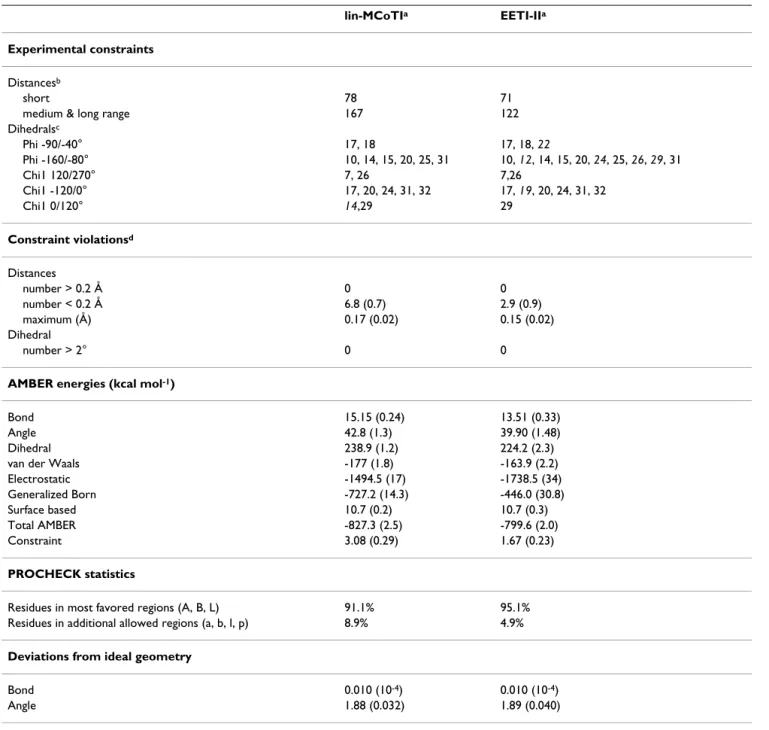
The three-dimensional structures of lin-MCoTI and EETI-II were determined from NMR data using the same strat-egy previously used for structural studies of the cyclic wild type MCoTI-II [26]. The NMR study led to 78 and 71 sequential and 167 and 122 medium and long range NOEs for lin-MCoTI and EETI-II, respectively. Eight (lin-MCoTI) and thirteen (EETI-II) angles were determined
from the 3J
HN-H coupling constants, and stereospecific
assignment of the H protons was achieved for 9 residues
(Figure 2 and Table 1). The connectivity of the disulfide
The knottin fold
Figure 1
The knottin fold. (Top) Stereoscopic view of a schematic representation of MCoTI-II, a head-to-tail cyclized squash inhibitor.
The head-to-tail linker is shown in blue. Disulfide bridges are shown as ball-and-stick representations. The cystine knot is shown in green (the disulfide macrocycle) and orange (the penetrating disulfide). -strands are shown as flat arrows and the 310-helix turn is shown in magenta. Cysteines are numbered. (Bottom) Sequences of the squash inhibitors used in this work. Numbering follows MCoTI-II. The disulfide bridge coloring scheme follows the one used in the structure. The colors used in the three-dimensional structure are shown using a colored line below the MCoTI-II sequence. Peptide cyclization is displayed as a black line for MCoTI-II.
BMC Structural Biology 2008, 8:54 http://www.biomedcentral.com/1472-6807/8/54
bonds for lin-MCoTI was deduced on the basis of the very strong sequence similarity with the parent compound. It is also strongly supported by the similarity between the NMR data sets for MCoTI-II and lin-MCoTI. Moreover, no alternative disulfide connectivity has yet been reported for miniproteins with the knottin fold [35-37]. The NMR data were converted into distance and angle constraints and the three-dimensional (3D) structures were obtained as described in Methods. The 30 lowest energy (molecular mechanics plus restraint energy) structures were selected to represent the NMR structures of lin-MCoTI and of EETI-II. The statistics for constraint violations and for molecu-lar mechanics energies are shown in Table 1. Twenty lin-MCoTI solution structures are displayed in Figure 3. The calculated structures of lin-MCoTI and of EETI-II sat-isfy the NMR data very well with no distance and dihedral violation larger than 0.2 Å or 5°, respectively (Table 1). Statistical analyses using the PROCHECK-NMR software [38] show that the overall stereochemistry of the
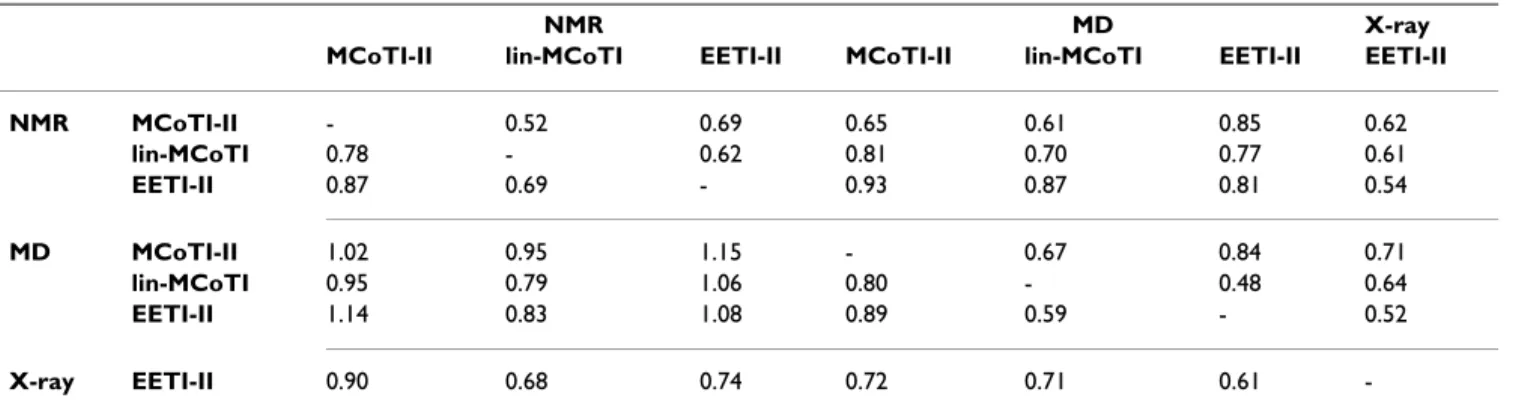
lin-MCoTI and EETI-II solution structures is correct with all non-glycine and non-proline residues lying in the most favored and additional allowed regions of the Ramachan-dran map (Table 1). As expected, the refined models also display large negative molecular mechanics energies. The lin-MCoTI and EETI-II solution structures are well-resolved with pairwise RMS deviations of 0.26 Å and 0.34 Å for superimposition of backbone atoms of residues 8– 33, respectively (Table 2). The two average solution struc-tures are close to the EETI-II X-ray structure (PDB ID: 1w7z[39]) with RMS deviations of 0.68 and 0.74 Å for backbone atoms of residues 8–33, i.e. all residues except the C-to-N linker (Table 3). The structures are also close to the cyclic MCoTI-II structure with RMS deviations of 0.78 Å and 0.87 Å, respectively. The EETI-II, lin-MCoTI and MCoTI-II solution structures are available from the Pro-tein Data Bank [28] under PDB IDs 2it7, 2it8, and 1ha9, respectively. The refined EETI-II solution structure described here (PDB ID 2it7) significantly differs from the
NMR data summary for lin-McoTI
Figure 2
NMR data summary for lin-McoTI. Data on sequential and medium range NOE connectivities, 3JHN-H coupling constants
and slowly exchanging amide protons observed for lin-MCoTI are summarized. The height of the bars correspond to the strength of the NOEs. The values of the 3J
HN-H coupling constants are indicated by (< 4 Hz) and (> 8.5 Hz). Open and
filled squares indicate backbone amide protons that were still observed after 3 and 24 h, respectively, in 2H
2O. The deviations
distance geometry structure published in 1989 (PDB ID 2eti) with RMS deviations of 1.9 Å for backbone atoms of residues 8–33. The main difference lies in the inhibition loop (residues 8–14) as shown by the much lower RMS deviation of 1.0 Å obtained when the loop is omitted from the superimposition.
Molecular dynamics simulations of MCoTI-II, lin-MCoTI and EETI-II
Rather than comparison of the structures, one major goal of our study was to determine to which extent the mini-protein flexibility is affected by the circularization. There-fore, the lowest energy solution structures of MCoTI-II, lin-MCoTI and EETI-II were submitted to 22ns-long unre-strained molecular dynamics (MD) simulations in peri-odic boxes of explicit water molecules at 300 K using the program AMBER [40]. RMS deviations and positional
Table 1: Statistics on geometry, energy and NMR data of the EETI-II and lin-MCoTI solution structures
lin-MCoTIa EETI-IIa
Experimental constraints Distancesb
short 78 71
medium & long range 167 122
Dihedralsc Phi -90/-40° 17, 18 17, 18, 22 Phi -160/-80° 10, 14, 15, 20, 25, 31 10, 12, 14, 15, 20, 24, 25, 26, 29, 31 Chi1 120/270° 7, 26 7,26 Chi1 -120/0° 17, 20, 24, 31, 32 17, 19, 20, 24, 31, 32 Chi1 0/120° 14,29 29 Constraint violationsd Distances number > 0.2 Å 0 0 number < 0.2 Å 6.8 (0.7) 2.9 (0.9) maximum (Å) 0.17 (0.02) 0.15 (0.02) Dihedral number > 2° 0 0
AMBER energies (kcal mol-1)
Bond 15.15 (0.24) 13.51 (0.33)
Angle 42.8 (1.3) 39.90 (1.48)
Dihedral 238.9 (1.2) 224.2 (2.3)
van der Waals -177 (1.8) -163.9 (2.2)
Electrostatic -1494.5 (17) -1738.5 (34) Generalized Born -727.2 (14.3) -446.0 (30.8) Surface based 10.7 (0.2) 10.7 (0.3) Total AMBER -827.3 (2.5) -799.6 (2.0) Constraint 3.08 (0.29) 1.67 (0.23) PROCHECK statistics
Residues in most favored regions (A, B, L) 91.1% 95.1%
Residues in additional allowed regions (a, b, l, p) 8.9% 4.9%
Deviations from ideal geometry
Bond 0.010 (10-4) 0.010 (10-4)
Angle 1.88 (0.032) 1.89 (0.040)
aValues in parentheses indicate standard deviations. bNumber of constraints. cResidue numbers. Residues in italic correspond to constraints that are
BMC Structural Biology 2008, 8:54 http://www.biomedcentral.com/1472-6807/8/54
atomic fluctuations were computed on all saved confor-mations after structural superimposition and are detailed in Table 2, Figure 4 (green lines), and Figure 5 (top). For each simulation, the conformation closest to the average structure was used for comparison with other structures (Table 3 and Figure 6).
The average solution structures are slightly closer to the X-ray EETI-II structure than the MD average structures (Table 3). The fact that no experimental restraints were applied during the dynamics might explain part of the difference. The EETI-II NMR structure is closer from the X-ray struc-ture than the MCoTI-II and lin-MCoTI strucstruc-tures for the 15–33 region (i.e. the CSB motif), but not for the 8–33 region with RMS deviations of 0.54 Å and 0.74 Å, respec-tively (Table 3). The RMS deviations are displayed in Fig-ure 4, green lines. All three compounds display low deviations from the initial conformation, close to 1 Å.
Interestingly, the linear EETI-II showed the lowest devia-tion for the CSB motif (residues 15–33).
To evaluate the flexibility of each compound, the per-res-idue atomic fluctuations in the three simulations have been plotted and are displayed in Figure 5 (top). The most striking feature is that the head-to-tail linker in cyclic MCoTI-II is by far the most flexible region. Clearly, the cyclization does not modify the flexibility significantly. This observation is consistent with previous NMR struc-ture calculations [25,26]. Except for the linker, the three compounds display similar flexibilities. But, interestingly, data in Table 2 and Figure 5 (top) show that the two linear peptides display the lowest average fluctuations although differences remain limited. Lin-MCoTI appears slightly more mobile than EETI-II in the 8–21 region correspond-ing to the inhibitory loop and the 310 helical loop. The fact that the linear EETI-II is the less flexible compound
Stereoview of the 20 lowest energy solution structures of lin-McoTI
Figure 3
Stereoview of the 20 lowest energy solution structures of lin-McoTI. Structures have been superimposed for their
C atoms. The coloring scheme is as follows: whole backbone and proline, black; hydrophobic and aromatic residues, green;
polar residues, magenta; acidic residues, red, basic residues, blue; disulfide bridges, orange. Cysteines and N- and C-termini are labeled.
Table 2: Structural variations of backbone atoms (N, C, C, O) in NMR and MD conformational ensembles
Lin-MCoTI MCoTI-II EETI-II
Residues 8–33 15–33 1–34 8–33 15–33 8–33 15–33 NMRa, b 0.26 (0.12) 0.15 (0.06) 1.18 (0.36) 0.51 (0.16) 0.28 (0.09) 0.34 (0.13) 0.13 (0.06) MDc 300 K 0.61 0.48 0.91 0.68 0.46 0.53 0.40 400 K 0.97 0.64 1.26 0.80 0.58 1.10 0.64 500 K 2.04 1.61 1.97 1.25 0.82 1.67 1.33
strongly suggests that head-to-tail cyclization is not a key element of structure stabilization in these conditions. Hydrogen bonding in the simulations are summarized in Table 4. Analysis of hydrogen bonding reinforces previous analyses since the percent occurrences and the average donor-acceptor distances are not significantly affected by the cyclization.
Experimental and simulated thermal unfolding
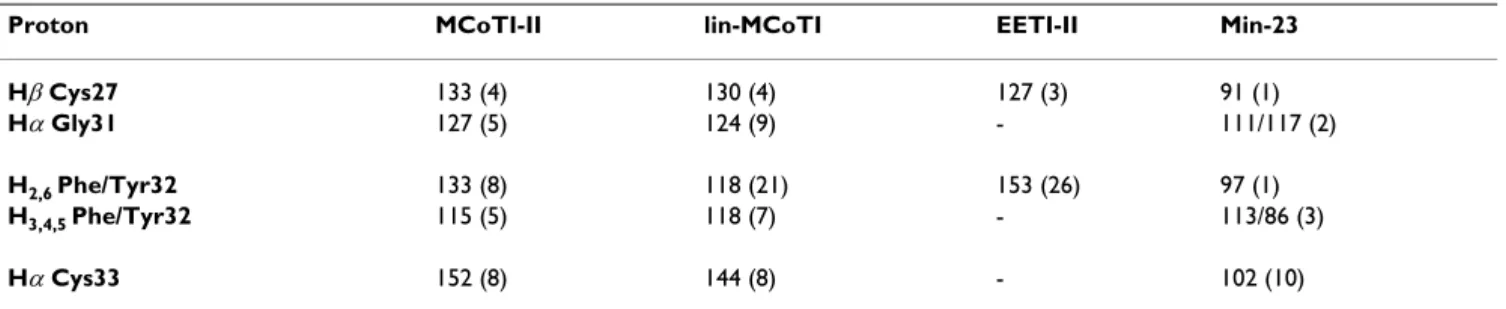
NMR thermal unfolding experiments were performed on wild type circular MCoTI-II and on the linear analog. In these analyses, the chemical shift variations due to tem-perature increases between 10°C and 80°C are consid-ered to result solely from a simple two-state unfolding mechanism. It is worth noting that the thermal unfolding has been studied without reduction of disulfide bridges since reduced squash inhibitors are essentially unstruc-tured [16]. The chemical shift for the theoretical fully unfolded species is approximated as the random coil val-ues for short peptides. Protons that could be followed in accumulated spectra at various temperatures were used to compute Tm values [34,41]. Unfolding curves calculated for the H proton of Cys27 in cyclic MCoTI-II and its linear
analog are displayed in Figure 7, and Tm values calculated from data recorded for few protons are tabulated in Table 5. Data from previous experiments on linear EETI-II and on a shorter analog Min-23 [34], a derived two-disulfide peptide containing the CSB motif (Figure 1), have been included for comparison. As expected, the shorter two-disulfide Min-23 peptide consistently displays lower Tm values by approximately 30°C [34]. On the other hand, the differences between the three other compounds appear to be marginal and to fall within experimental errors, thus precluding any detailed comparisons. Although no large stability increase due to cyclization is apparent from unfolding experiments no definitive con-clusion could be drawn.
To provide further information, unfolding simulations were performed using molecular dynamics simulation at
high temperature (400 K and 500 K). The RMSDs from the starting conformations are shown in Figure 4 (blue and orange-red curves), and a nativeness score, the Q-score [42], in Figure 8. The Q-score has been used as a measure of structural similarity to the native conformation and indicates the fraction of native non-bonded contacts. In the Q-score implementation used here, C inter-residue
distances are used as contact measures. The use of other implementations based on all heavy atom distances led to very similar results (data not shown). A Q-score equal to 1 means that the structure is fully native whereas a Q-score below 0.4–0.6 means that the structure is significantly unfolded or incorrectly folded. Average RMSDs and Q-scores plotted as a function of temperature are displayed in Figure 9. The RMSD from the starting structure and the nativeness Q-score criterion are not independent and dis-play similar profiles. While the two linear knottins disdis-play close results with almost identical slopes for variation of RMSD or Q-score with temperature, the cyclic MCoTI-II appears less sensitive to temperature increase (Figure 9). It is likely that the constraints imposed by the covalent con-nection between the N- and C-termini, in addition to the disulfide bridges, slow down the unfolding process during the highest temperature (500 K) simulation. Comparison of the RMSDs of the Cystine-Stabilized Beta-sheet motif in the simulations at 500 K (orange curves in Figure 4) high-lights drastic differences between the linear and the cyclic compounds. Despite the constraints imposed by the con-served disulfide bridges, significant unfolding of the CSB motif (residues 15–33) is apparent for the linear com-pounds with average RMSD values between 2 and 3 Å. In contrast, the CSB motif of the cyclic compound is essen-tially conserved in the simulation at 500 K with RMSD values that remain as low as 1 Å.
Discussion
The 3D structure of squash inhibitors is known since the late 1980s [29,30,43]. They were soon recognized as a prototypic member of a structural class of disulfide-rich miniproteins known as the knottins or Inhibitor Cystine
Table 3: RMS deviations between average structures
NMR MD X-ray
MCoTI-II lin-MCoTI EETI-II MCoTI-II lin-MCoTI EETI-II EETI-II
NMR MCoTI-II - 0.52 0.69 0.65 0.61 0.85 0.62 lin-MCoTI 0.78 - 0.62 0.81 0.70 0.77 0.61 EETI-II 0.87 0.69 - 0.93 0.87 0.81 0.54 MD MCoTI-II 1.02 0.95 1.15 - 0.67 0.84 0.71 lin-MCoTI 0.95 0.79 1.06 0.80 - 0.48 0.64 EETI-II 1.14 0.83 1.08 0.89 0.59 - 0.52 X-ray EETI-II 0.90 0.68 0.74 0.72 0.71 0.61
BMC Structural Biology 2008, 8:54 http://www.biomedcentral.com/1472-6807/8/54
Knots (ICK) [44,45]. The first cyclic knottin, kalata B1, was described shortly after, in which the N- and C-termini are connected through a regular peptide bond, yielding a head-to-tail macrocyclic and knotted peptide. Although this circularization could have been an exception, it soon appeared that macrocyclic knottins were common in plants in the Rubiaceae and Violaceae families, constituting the large cyclotide family [10,11,46]. The only other example of macrocyclic knottin has been found more
recently in the squash inhibitor family which otherwise contains more than thirty linear miniproteins [1,3,13]. Until now, the structural and functional impact of the cir-cularization remains poorly understood, and very little is known on dynamics and thermal stability of cyclic squash inhibitors when compared to their linear counterparts. This prompted us to investigate structures, dynamics and stabilities of cyclic and linear squash inhibitors and ana-logs.
Root mean square deviation from the NMR conformation along the MD simulations
Figure 4
Root mean square deviation from the NMR confor-mation along the MD simulations. Reported values are
for backbone atoms (N, C, C, O) of residues 8 to 33 at 300 K (green), 400 K (blue) and 500 K (red). Conformations were superimposed for residue ranges 8–33 (heavy colors) and 15–33 (light colors).
Root mean square positional atomic fluctuations in the 300 K, 400 K and 500 K MD simulations
Figure 5
Root mean square positional atomic fluctuations in the 300 K, 400 K and 500 K MD simulations. Reported
values are for backbone atoms (N, C, C, O) and per resi-due: MCoTI-II (green line), lin-MCoTI (blue line), EETI-II (red line).
NMR experiments and molecular dynamics simulations evidence a limited impact of cyclization on structure and dynamics
The average NMR structures of the three studied com-pounds are close from each other with most RMS devia-tions lying below 0.9 Å for backbone atoms of residues 8– 33 (Table 3). The differences between NMR and MD struc-tures are only slightly higher and mostly remain near 1.0 Å, a reasonably low value. Moreover, all NMR and MD structures are close to the EETI-II X-ray structure with RMS deviations below 0.9 Å. MD simulations are expected to provide a more energetically rigorous conformational sampling than NMR structure determination. This is mainly because NOE averaging on the NMR time scale emphasizes short distances and because instantaneous and continuous application of these average constraints biases the conformational sampling towards shorter dis-tances. Since no unrealistic deviation occurred during the simulations, the MD conformations were used for com-parisons and assessment of flexibilities.
A superimposition of the average MD structures from sim-ulations at 300 K onto the EETI-II X-ray structure is dis-played in Figure 6. The only significant difference between EETI-II and MCoTI-II, beside the cyclization, concerns the 22–25 turn. A PROMOTIF [47] analysis indicates that this
-turn is of type I in EETI-II but of type II' in MCoTI-II and lin-MCoTI. This modification is likely a consequence of the different turn sequences (LAGC and PGAC in EETI-II and MCoTI-II, respectively). Interestingly, despite their
flexibility, the inhibitory loops of EETI-II, MCoTI-II and lin-MCoTI (residues 8–15) remain reasonably close to the conformation in the EETI-II X-ray structure (Figure 6). In all three compounds, the Asp20 side chain forms strong
hydrogen bonds with amides of residues 16 and 17, but, surprisingly, the percent occurrences are lower in MCoTI-II and lin-MCoTI (Table 4). It is worth noting, however, that in MCoTI-II and lin-MCoTI, Asp20 is surrounded by
four positively charged residues at positions Lys13, Lys14,
Arg16 and Arg17. Instead of Lys13 and Arg17, corresponding
residues in EETI-II are Met and Gln, respectively. Examina-tion of Asp20 interactions in MCoTI-II and lin-MCoTI
(Table 4) shows that, beside interactions with backbone amides of residues 16 and 17, Asp20 is also interacting
with the Arg17 side chain in both compounds (percent
occurrences 23.2 and 5.3, respectively), and with Arg16 or
Lys13 in lin-MCoTI and MCoTI-II, respectively (percent
occurrence 21.5 and 10.1). The latter interaction, which necessitates a small displacement of the Asp20 carboxylate,
supports a higher flexibility of lin-MCoTI in this region, in agreement with the residue fluctuations shown in Figure 5. In contrast to the stronger Asp20-amides interactions in
EETI-II, the hydrogen bonding of the Asp18 side chain
with the amide of residue 27 is much weaker in EETI-II (22%) than in the two other compounds (94 and 91% in MCoTI-II and lin-MCoTI, respectively). This might be related to the H-bonding in the 3–10 helix, with both stronger (N20-O17, 97.7%) and weaker (N21-018, 70.6%) interactions in EETI-II.
Stereoview of average structures from the 300 K simulations
Figure 6
Stereoview of average structures from the 300 K simulations. Structures were superimposed on top of the EETI-II
X-ray structure (PDB ID: 1w7z[39]), shown in grey, for backbone atoms of residues 15–33. EETI-II is shown in green, MCoTI-II in red, and lin-MCoTI in blue. Cysteines and N- and C-termini of lin-MCoTI are labeled. Disulfide bridges are shown as orange ball-and-stick representations.
BMC Structural Biology 2008, 8:54 http://www.biomedcentral.com/1472-6807/8/54
In general, there are no large differences in hydrogen bonding (percent occupancy and average distance) between MCoTI-II and lin-MCoTI. However, in MCoTI-II, the Arg28 side chain is hydrogen bonding 50% of the time
with the carbonyl of Ser1 (Table 4), a residue which does
not exist in lin-MCoTI. Instead, in lin-MCoTI, Arg28 is
hydrogen bonding with the carbonyl of Cys33 and, to a
minor extent, Tyr32 (Table 4). There is no such interaction
in EETI-II since residue 28 is a glycine. The 310 helix region also differ slightly with weaker N21-O18 and N17-Asp20
hydrogen bonds in the linear compound (Table 4). This
difference is surprising because MCoTI-II and lin-MCoTI sequences are strictly identical on this side of the mole-cule. It thus appears that the modifications near the N-and C-termini propagate toward the 310 helix, probably via subtle modifications of the hydrogen bonding scheme due to modified charges and hydrogen bond acceptors near the C-terminus. This observation is consistent with the fact that the amide proton of residue Arg17 is
exchanged more rapidly in lin-MCoTI than in MCoTI-II. In fact several other amide protons display a similar behavior, in particular those of Arg28, Gly31 and Gly34, that
Table 4: Hydrogen bond occurrences during the molecular dynamics simulations
Local structure Residues MCoTI-II lin-MCoTI EETI-II
3-stranded -sheet N33-O13 68.7 3.03 97.6 2.98 99.7 2.95
N15-O31 98.7 2.94 98.9 2.93 98.8 2.97 N26-O34 99.9 2.88 99.9 2.90 100.0 2.74 N34-O26 99.5 2.91 99.6 2.89 97.2 2.98 N28-O32 95.9 2.98 91.7 3.02 93.5 3.01 -turns N25-O22 88.8 3.06 92.3 3.05 89.6 3.13 N25-O23 7.5 3.20 5.1 3.21 21.6 3.22 N31-O28 97.0 3.03 96.4 3.04 96.7 3.06 3-10 helix N20-O17 83.8 3.15 87.2 3.13 97.7 3.05 N21-O18 81.9 3.17 67.8 3.19 70.6 3.19 N21-O19 - - 5.6 3.15 0.2 3.35 C to N linker N6-O3 36.5 3.15 - - - -N6-O4 15.7 3.18 - - - -Others N10-08 8.6 2.99 N11-O9 51.2 2.93 73.4 2.94 29.2 3.03 N13-O11 13.5 3.12 22.1 3.19 9.2 3.06
Side chains N16-Asp20 76.1 2.90 81.6 2.94 98.7 2.88
N17-Asp20 71.7 3.01 50.5 3.02 88.3 3.04
N27-Asp18 93.7 2.90 90.9 2.92 22.0 2.97
Arg16-Asp20 - - 21.5 3.00 5.8 2.99
Arg17-Asp20 23.2 2.97 5.3 2.95 (Gln17)
Lys13-Asp20 10.1 2.96 - - (Met13)
N32-Asn30 68.8 3.16 70.1 3.16 79.6 3.15
Lys13-O20 32.1 2.89 44.2 2.89 (Met13)
Lys13-O14 15.8 2.93 30.8 2.94 (Met13)
Lys14-O30 - - - - 7.3 3.02
Lys14-O31 - - - - 7.4 3.09
Lys10-O8 - - - - 6.6 2.96
Arg16-O15 10.3 2.95 - - -
-Arg28-O1 50.5 3.01 - - (Gly28)
Arg28-O32 22.7 3.14 (Gly28)
Arg28-O33 12.2 3.03 55.9 3.05 (Gly28)
For each hydrogen bond, the percentage of occurrence is followed by the average distance between heavy atoms (in Å). Only hydrogen bonds that occur more than 5% of the time are reported using 3.5 Å and 120° as distance and angle cut-offs, respectively. Bold numbers indicate the highest percentages in each row. Nx and Ox refer to the amide and carbonyl groups of residue x, respectively. When side-chains are involved, the residue is indicated using the three letter code.
all belong to the triple-stranded -sheet (Figure 2 and [26]), indicating a slightly higher flexibility of the sheet in lin-MCoTI.
Cyclic and linear squash inhibitors exhibit close thermal stabilities
With the hope to better evaluate the influence of cycliza-tion on stability, we have performed NMR-monitored thermal unfolding experiments on MCoTI-II and lin-MCoTI. Due to the extremely high stabilities of the com-pounds, only limited unfolding could be achieved at tem-peratures compatible with NMR experiments which resulted in large uncertainties in curve fitting and calcula-tion of thermodynamics parameters. From results in Table 5, it appears that, as expected [34], the shorter two-disulfide Min-23 peptide is clearly less stable than the three-disulfide compounds with Tm values lowered by about 10–40°C. In contrast, differences between Tm val-ues for the three-disulfide knottins are smaller than stand-ard deviations and may not be significant. Nevertheless, most calculated Tm values for the circular MCoTI-II are slightly higher than those calculated for the linear analog, suggesting a small stability increase in the circular com-pound. This would be consistent with the results of the MD simulations that showed a small flexibility increase in lin-MCoTI, and with the NMR data indicating a faster exchange of several amide protons in this compound. However, (i) even the highest temperature used for NMR unfolding experiments remained too low to achieve a sig-nificant overall unfolding, (ii) the thermodynamics data are scarce and, (iii) more importantly, the two-state unfolding hypothesis and the use of the random coil val-ues for chemical shifts of the unfolded species may not be valid in this case, especially because of the high disulfide bridge content. It is worth noting also that, for the cyclo-tide kalata B1, no significant changes were observed in cir-cular dichroism spectra in absence or presence of 8 M urea and in the temperature range 5–90°C [24]. Therefore, to get further information on stability while avoiding the experimental limitations, we have used high temperature molecular dynamics simulations that make possible to
study processes that are difficult to investigate experimen-tally.
Cyclic MCoTI-II displays better thermoresistance to unfolding
It has been suggested that molecular dynamics simula-tions at high temperature accelerate protein unfolding without changing significantly the unfolding pathway and provide useful information on thermal events [48-51]. Therefore, in addition to the simulations at 300 K (22 ns), simulations at 400 K (30 ns) and 500 K (30 ns) were performed for the two linear knottins EETI-II and lin-MCoTI and for the cyclic compound lin-MCoTI-II. The curves in Figure 4, 5 and 8 suggest that the unfolding of MCoTI-II at 500 K is approximately similar to what is displayed by the linear compounds at 400 K, strongly suggesting a better resistance to temperature for the cyclic compound. This can be compared to recent reports on family 11 xyla-nase where MD simulations at 600 K, but not 300 K, revealed significant differences between mesophilic and thermophilic enzymes [51].
Nevertheless, all three studied compounds displayed high stabilities and no significant structure or flexibility differ-ences between linear and cyclic compounds appeared in simulations at room temperature or in NMR experiments up to ~80°C. Rather, there are sequence differences that seem to be as or more important than circularization for structure and flexibility in standard conditions. For exam-ple, the sequence and type of the 22–25 -turn differ in EETI-II and lin-MCoTI resulting in flexibility differences in this area (Figure 5), with EETI-II displaying lower flexi-bilities at 300 K and 500 K. Also, the addition of a charged residue (Lysine) in MCoTI-II and lin-MCoTI at position 13 induces transient salt bridging with Asp20 thus
perturb-ing the Asp20-O17 hydrogen bonding at the N-terminus of
the 3–10 helix. This may be, at least partly, responsible for the lower flexibility at 300 K of the 3–10 helix in EETI-II in comparison to lin-MCoTI. More generally, the charged termini in linear compounds can in principle provide additional stabilizing electrostatic interactions when com-pared to cyclic analogs. As an example, a salt-bridge
Table 5: Estimated Tm values from NMR thermal unfolding
Proton MCoTI-II lin-MCoTI EETI-II Min-23
H Cys27 133 (4) 130 (4) 127 (3) 91 (1)
H Gly31 127 (5) 124 (9) - 111/117 (2)
H2,6 Phe/Tyr32 133 (8) 118 (21) 153 (26) 97 (1)
H3,4,5 Phe/Tyr32 115 (5) 118 (7) - 113/86 (3)
H Cys33 152 (8) 144 (8) - 102 (10)
Mean Tm values in °C, obtained from hundred calculations using randomly picked chemical shifts within a -0.02/+0.02 range around the experimental values, are reported. Standard deviations are shown within parentheses.
BMC Structural Biology 2008, 8:54 http://www.biomedcentral.com/1472-6807/8/54
between the C-terminus and the side chain of an arginine in position 7 (Figure 1 numbering) has been reported in several linear squash inhibitors [43,52-54]. There is no such interaction here because both EETI-II and lin-MCoTI lack the Arg7, and, moreover, lin-MCoTI is uncharged at
the C-terminus due to amidation.
Therefore circularization does not seem to be a key ele-ment of the squash inhibitors structure or flexibility in standard conditions. The cystine knot itself appears as the
main factor responsible for the high stability and cycliza-tion or sequence modificacycliza-tions seem to only induce mar-ginal modifications. This does not hold however in high temperature simulations (500 K) where cyclization slowed the unfolding significantly, indicating that the cyclic squash inhibitor is more thermoresistant than lin-ear counterparts. Despite the high flexibility of the head-to-tail linker in MCoTI-II, the cyclization is therefore likely to enhance resistance to strongly unfolding condi-tions.
Thermal unfolding curves
Figure 7
Thermal unfolding curves. The fraction unfolded calculated from the chemical shift (see Methods) is plotted as a function of
Comparison of cyclization in squash inhibitors and in cyclotides
Comparisons of solution structures suggested that the cir-cularization in cyclotides provides a reduction of the flex-ibility, and this was supposed to be at the origin of the cancellation [23] or reduction [14] of the hemolytic activ-ity in wild type or synthetic linear cyclotides. However it
has been mentioned that the hemolytic activity could be related to hydrophobicity [55], and that the wild type lin-ear cyclotide, violacin A, is less hydrophobic than other cyclotides [14]. It is thus unclear which of the linear or hydrophilic feature of violacin A is responsible for the reduced hemolytic activity. On the other hand, the linear synthetic cyclotides lacked few residues that could have impact on hemolytic activity [23,56], and to which extent linearization itself is involved in reduced activity remains to be determined. Moreover, stabilities of kalata B1 and acyclic permutants were shown to be very similar [24], suggesting that it is indeed the cystine knot rather than the circularization that provides most of the stability in cyclo-tides. It would be interesting to examine carefully the structural/functional differences between circular cyclo-tides and linear standard (hydrophobic) wild cyclotide when one is discovered.
Although the conclusions regarding the cyclization impact in the cyclotide family are roughly consistent with our results, it is worth noting that the head-to-tail linker in cyclotides is significantly different from the one in the
Q-scores of conformations explored in the unfolding simula-tions
Figure 8
Q-scores of conformations explored in the unfolding simulations. The minimized starting NMR conformation is
used as the reference native structure. For each compound, the Q-score evolution is shown at 300 K (green), 400 K (blue) and 500 K (red).
Variation of the mean Root Mean Square deviations and Q-scores with temperature
Figure 9
Variation of the mean Root Mean Square deviations and Q-scores with temperature. MCoTI-II is shown as
BMC Structural Biology 2008, 8:54 http://www.biomedcentral.com/1472-6807/8/54
cyclic squash inhibitor MCoTI-II. While the latter includes four glycines and no proline out of eight residues, the linker in most cyclotides includes one proline but only one glycine out of seven residues (see residues with num-bers < 20 or > 100 in standardized alignments of cyclo-tides provided in the KNOTTIN database at knottin.cbs.cnrs.fr [2,3]). These sequence differences are probably sufficient to explain why this region is by far the most flexible part in MCoTI-II but not in the cyclotides since glycines are the most flexible residues and prolines the most rigid ones. One could then hypothesize that this well-structured linker is an integral part of the cyclotide structure possibly explaining why all cyclotides but one are circular. Conversely, the flexible linker in MCoTI-II is probably nothing more than an additional and very flexi-ble loop, consistent with the fact that most squash inhib-itors are linear. The presence of the linker in MCoTI-II could possibly provide extra contacts with the protease as well as protection to degradations by exoproteases or resistance to denaturing conditions.
Biological role of knottin cyclization
The observations that the head-to-tail linker in MCoTI-II is the most flexible part of the molecule, and that linear squash inhibitors (e.g. EETI-II) can be as rigid as the circu-lar MCoTI-II in standard conditions strongly suggests that the biological role of the circularization in squash inhibi-tors is not to reduce flexibility or to render the molecule more rigid. Nevertheless, better affinities for trypsin were achieved by circular squash inhibitors [Ki = 3.10-11 M for
MCoTI-II vs. 3.10-10 M for lin-MCoTI and 8.10-11 M for
EETI-II [57]]. From the results in this work, it is unlikely that the improved affinity arises from conformational effects, either directly, or by reducing the flexibility of the free inhibitor, hence lowering the entropic loss due to binding. Our work rather suggests that the enhanced affinity of the circular compound could be due to direct binding of the head-to-tail linker with trypsin, as previ-ously suggested by molecular modeling of the complex [13]. If this is the case, then the linker would have mini-mal impact in engineered squash inhibitor-based knottin variants, except in such particular cases where the linker bears a supplementary interaction site.
It is tempting to speculate that the biological role of the cyclization in squash inhibitors is for enzymatic rather than for thermodynamic reasons, and it has been sug-gested earlier that cyclization could prevent degradation by exoproteases [13,24]. The enzymatic stability of several knottins has been reported recently and both circular cyclotides and linear squash inhibitors were shown to dis-play excellent resistance to proteases, except for the enzymes specific to the miniprotein, as e.g. serine pro-teases for squash inhibitors [4,24]. Even the naturally occurring linear cyclotide, violacin A, was shown to
sur-vive for 6 h in presence of trypsin or thermolysin reinforc-ing the idea that cyclization is not the main determinant for resistance to endoproteases [14]. Individual sequences may however display different enzymatic stabilities, and an example is provided by the human agouti-related pro-tein that was shown to be proteolized more rapidly than squash inhibitors [4]. Interestingly, reduced cyclic kalata B1 has been shown to be more resistant to proteolysis than reduced linear conotoxin PVIIA [24]. This suggests that cyclization could also have some influence by slow-ing down enzymatic degradation of reduced knottins. Sensitivity of knottins to exoproteases, however, has not yet been systematically studied. Certainly, macrocyclic knottins will remain unaffected by exoproteases, but to which extent various linear knottins are sensitive to exo-proteases remains to be determined. Both N- and C-termi-nal segments before and after the first and last well-structured half-cystines are rather short in many knottins, and it is unclear if these will be very sensitive to exopro-teases. To our knowledge the only reported example comes from the linear cyclotide violacin A [14]. Violacin A was shown to be proteolysed by aminopeptidase M, which cleaved only the first two N-terminal residues. The third and fourth residues that precede the first cysteine of the knot were not cleaved, most likely because of their proximity to the cystine knot [14]. It can thus be hypoth-esized that many linear knottins with short N- and C-ter-mini will not be easily degraded by exoproteases. Moreover, limited degradation of longer termini might not always be very deleterious since active residues are mostly located in inter-cysteine loops rather than in the termini. An example of this is provided by the minimized 34-residue agouti-related protein (AGRP) analog contain-ing only the cystine knot domain, and which maintains the melanocortin receptor pharmacological profile of AGRP(87–132) [58]. Beside stability or protease resist-ance, cyclization was shown to facilitate in vitro oxidative folding of Kalata B1 that otherwise needs a hydrophobic environment to attain the native fold [21]. However it is worth noting that (i) in vivo, the formation of disulfide bridges is generally assumed to occur prior cyclization, thus bringing the termini close to each other for subse-quent cyclization, and (ii) the phenomenon is specific to cyclotides since, in contrast, there is no need of cyclization or particular environment in the oxidative folding of squash inhibitors. The positive impact of cyclization on folding and/or resistance to denaturing conditions might well be important when membrane crossing is involved.
Conclusion
We have shown that only small conformational differ-ences are displayed by circular squash inhibitors and that linear compounds may display sufficient stabilities with-out the need for cyclization.
The cyclization observed in MCoTI-II, with no strong impact on thermodynamic or enzymatic stability, might therefore be an exceptional event rather than a general process in the squash family. One can even wonder if the increased affinity towards trypsin afforded by the cycliza-tion (see above) is important for the plant itself since the affinities displayed by the linear compounds are already quite strong. Indeed, determining to which extent cycliza-tion of squash inhibitors is a general process must await further large-scale studies in search of naturally occurring cyclized squash inhibitors in cucurbit seeds.
Protein circularization has been proposed as an interest-ing tool to stabilize engineered peptides in drug design studies [59-61]. Thanks to their small size, knottins have been shown to be readily accessible to chemical synthesis and routes to macrocyclic knottins are available [1,21,59,62,63]. Interestingly macrocyclic knottins were also recently shown to be accessible from bioengineering or biomimetic routes [22,27]. Nevertheless, peptide cycli-zation induces constraints on peptide synthesis and is expected to significantly lower the yields, especially when engineered sequences, that could be non-optimal for native-like folding, will be grafted onto the knottin scaf-fold. Thus the cost increase should be taken into account along with the potential benefit of circularization, if any, when considering circular knottin-based engineered mol-ecules in drug design studies, since linear scaffolds with similar features are available, e.g. the squash inhibitor EETI-II. However, it is possible that stability can vary from one sequence to the other and that in particular cases cir-cularization will be one good option to increase stability. But in many cases, the knottin scaffold itself and sequence optimization might be sufficient to insure high stabilities of linear compounds based on the squash inhibitor scaf-fold. An excellent example of knottin sequence optimiza-tion has been provided by incorporaoptimiza-tion of pairwise -sheet stabilizing residues that improved folding and sta-bility of the C-terminal knottin fold of the agouti signal-ing protein [64]. Nevertheless, the high temperature simulations we have performed suggest that the head-to-tail cyclization might help to stabilize squash inhibitors in strongly denaturing conditions and this may be important for membrane crossing. It is worth reminding also that when using the squash inhibitor scaffold in drug design, degradation by specific enzymes should generally be avoided. This can be easily achieved by mutating the pro-tease sensitive site [44,57].
Finally, it can be concluded that the cystine knot is the main determinant for stability and for resistance to prote-olysis of knottins. Then the specific sequence can help increasing both stability and resistance to proteolysis. Cir-cularization can probably enhance resistance to strongly denaturing conditions and possibly facilitate in vitro
fold-ing in particular cases. Circularization may not be how-ever a general prerequisite in knottin based drug design, especially when using the squash inhibitor scaffold.
Methods
Peptide synthesis
Wild type MCoTI-II was purified from seeds of the Gâc fruit (Momordica cochinchinensis) collected in Vietnam [13]. The linear variant lin-MCoTI was chemically synthe-sized using Fmoc solid phase peptide synthesis [57,65]. EETI-II was chemically synthesized as previously described [66].
NMR experiments
Samples were prepared by dissolving peptides in either 90% H2O/10% 2H
2O (v/v) or 100% 2H2O to a
concentra-tion of approximately 1.2 mM with the pH adjusted to 3.0 by addition of dilute HCl or NaOH. NMR spectra were recorded on a Bruker Avance-600 spectrometer equipped with a triple resonance inverse Cryoprobe with a single axis z gradient. Data were acquired at 12°C and 27°C, and TSP-d4 was used as an internal reference. All two-dimen-sional (2D) experiments, correlated spectroscopy (COSY), total correlated spectroscopy (TOCSY) and nuclear Over-hauser effect spectroscopy (NOESY), were performed according to standard procedures [31] using quadrature detection in both dimensions with spectral widths of 6849.3 Hz in both dimensions. The carrier frequency was centred on the water signal and the solvent water reso-nance was suppressed by using the WATERGATE [67] method for experiments in H2O and by applying
continu-ous low power irradiation during the relaxation delay and during the mixing time for NOESY spectra for experiments in 2H
2O. The 2D spectra were obtained using 2048 or
4096 points for each t1 value, and 512 t1 experiments were acquired for COSY, TOCSY and NOESY experiments. TOCSY spectra were recorded with spin lock times of 30 and 60 ms. The mixing time was 150 and 300 ms in NOESY spectra. Spectra were processed using XWINNMR (Bruker). The t1 dimension was zero filled to 1024 points and /3 or /4 shifted sine bell functions were applied in t1 and t2 domains, respectively, prior to Fourier trans-form. 3J
NH-Hcoupling constants were measured on
one-dimensional (1D) spectra. The exchange of amide protons with deuterium was studied at 12°C on samples lyophi-lized from H2O at pH 3.0 and dissolved in 2H
2O. A series
of 1D, TOCSY, and NOESY spectra were acquired over a 48-h period. 1H-13C hetero single quantum coherence
spectroscopy (HSQC) and 1H-13C HSQC TOCSY spectra
[68,69] were recorded on the samples in 2H
2O. Spectral
widths were 6849.3 Hz and 25000 Hz in the 1H and 13C
dimensions respectively. 2048 data points were acquired with 512 t1 increments.
BMC Structural Biology 2008, 8:54 http://www.biomedcentral.com/1472-6807/8/54
Structure calculations
All calculations and analyses were performed on PC Linux boxes. The structures were displayed and analyzed using PyMOL (Warren L. DeLano "The PyMOL Molecular Graphics System." DeLano Scientific LLC, San Carlos, CA, USA. http://www.pymol.org). The NOE intensities were classified as strong, medium, and weak, and converted into distance constraints as previously described [26]. When necessary, the distance constraints were corrected for pseudoatoms [70]. angles of residues with small or large 3J
HN-H coupling constants (< 4 Hz or > 8.5 Hz) were
constrained into the -90° to -40° or -160° to -80° ranges, respectively. 1 angles of residues for which stereospecific attribution of the protons could be achieved were
con-strained in the corresponding range. Disulfide bridges were imposed through distance constraints of 2.0–2.1, 3.0–3.1, and 3.75–3.95 Å on Si-Sj, Si-Cj and Sj-Ci, and Ci-Cj distances, respectively. No hydrogen bond was imposed. Three hundred 3D structures were obtained as previously [26] from the distance and angle restraints using the torsion angle molecular dynamics method avail-able in the CYANA program [71]. The fifty structures with the lowest violation of the target function were submitted to molecular mechanics energy refinement with the SANDER module of the AMBER 8 program [40], using the ff03 force field [72] and the GB/SA implicit solvation scheme [72]. During the restrained molecular dynamics runs the covalent bond lengths were kept constant by applying the SHAKE algorithm [73] allowing a 2 fs time step to be used. Distance and angle NMR restraints were applied using square bottom wells with parabolic sides. The sides become linear for large deviations [26]. When no stereospecific assignment could be achieved for methyl or methylene protons, an < r-6 > -1/6 averaging scheme was
used instead of pseudo-atoms. No constraints were applied to the disulfide bridges. Five thousand cycles of restrained energy minimization were first carried out fol-lowed by a 100-ps long simulated annealing procedure in which the temperature was raised to 900 K for 40 ps then gradually lowered to 300 K. During this stage, the force constant for the NMR distance and dihedral restraints were gradually increased from 3 to 30 kcal.mol-1.Å-2 or
kcal.mol-1.rad-2.
Thermal unfolding
The thermal unfolding was monitored using 1D NMR data obtained on samples in 2H
2O previously used for
exchange experiments. The temperature within the NMR samples was calibrated with ethylene glycol and varied between 10°C and 80°C. Chemical shifts for fully unfolded species U could not be attained experimentally and were taken as random coil chemical shifts of the cor-responding protons [74-76]. Since we could not precisely determine chemical shifts for fully folded species F, these were obtained from fitting experimental (T), the
chemi-cal shift at temperature T, to a simple two-state unfolding mechanism [34,41] using Kaleidagraph (Synergy Soft-ware, Reading):
(T) = F + (1-) U where = 1/1 + e-G|RT
Then the two-state equilibrium constant for thermal unfolding,
and
was determined at each experimental temperature (fU,
fraction unfolded). The Tm values for reversible thermal unfolding of the peptides were calculated by linear fitting of versus T for each proton.
The statistical error on experimental chemical shifts was estimated to ± 0.02 ppm. To obtain a rough estimate of the corresponding error on the calculated thermodynam-ics parameters, the above calculations were repeated 100 times with chemical shifts randomly picked in the range of x ± 0.02 ppm, where x is the experimentally determined value. From the resulting distributions of parameters, mean values of Tm, and associated standard deviations were calculated and are reported in Table 5.
Molecular dynamics simulations
Molecular dynamics simulations were carried out on an AMD Opteron cluster using the PGI compilers (The Port-land Group, Inc., PortPort-land, USA) and the AMBER 8.0 pro-gram [40]. The starting models were immersed into a truncated octahedron of TIP3P explicit water models [77], with minimal distances of 15 Å between any protein atom and the box boundaries. Periodic boundary conditions were imposed and the total charge of the system was com-pensated for by using a neutralizing plasma. Lennard-Jones and electrostatic interactions were calculated using the Particle-mesh Ewald (PME) summation scheme [78], with a cut-off of 8 Å for the separation of the direct and reciprocal space summation.
Water molecules were first energy minimized while restraining the protein atoms. Then, the whole system was equilibrated for 0.5 ns at the target temperature and 1 bar using the weak coupling algorithm (temperature and pres-sure relaxation times = 2 ps) [79]. For production runs, the temperature was regulated using the Langevin dynam-ics with a collision frequency of 3 ps-1, and bonds
involv-KUthermal = fU (1−fU)=
(
F −( )
T)
(
( )
T −U)
ΔGUthermal = −RTlnKUthermal
ing hydrogen atoms were constrained using the SHAKE algorithm [73]. The conformations were stored every 1 ps, and the trajectories were analyzed with the Ptraj program of the Amber 8.0 suite. Room temperature molecular dynamics simulations were performed at 300 K for 22 ns. Unfolding simulations were performed at higher temper-atures (400 K and 500 K) for 30 ns. The structural criteria used to monitor protein unfolding were the RMSD and a nativeness score, the Q-score. The Q-score was computed using the MMTSB tool available at http://mmtsb.org. It is calculated using a Gaussian function of the inter-residue C distance centered at zero with standard deviation of |j-i|0.15 and normalized by the number of
non-bonded-con-tacts [42]
Authors' contributions
AH participated in the design of the study, carried out the NMR study and helped to draft the manuscript. OA car-ried out the chemical synthesis of lin-MCoTI. DLN carcar-ried out the chemical synthesis of EETI-II and helped to draft the manuscript. UD supervised the synthesis of lin-MCoTI. JFH participated in the design of the study and drafted the manuscript. JG implemented computer tools, carried out simulations and helped to draft the manu-script. HK conceived the study and participated in its design and coordination. LC conceived the study, partici-pated in its design and coordination, carried out simula-tions, and drafted the manuscript.
Additional material
References
1. Chiche L, Heitz A, Gelly JC, Gracy J, Chau PT, Ha PT, Hernandez JF, Le-Nguyen D: Squash inhibitors: from structural motifs to
macrocyclic knottins. Curr Protein Pept Sci 2004, 5(5):341-349.
2. Gracy J, Le-Nguyen D, Gelly JC, Kaas Q, Heitz A, Chiche L:
KNOT-TIN: the knottin or inhibitor cystine knot scaffold in 2007.
Nucleic Acids Res 2004, 36(Database issue):D314-9.
3. Gracy J, Le-Nguyen D, Gelly JC, Kaas Q, Heitz A, Chiche L:
KNOT-TIN: the knottin or inhibitor cystine knot scaffold in 2007.
Nucleic Acids Res 2007.
4. Werle M, Schmitz T, Huang HL, Wentzel A, Kolmar H, Bernkop-Schnurch A: The potential of cystine-knot microproteins as
novel pharmacophoric scaffolds in oral peptide drug deliv-ery. J Drug Target 2006, 14(3):137-146.
5. Reiss S, Sieber M, Oberle V, Wentzel A, Spangenberg P, Claus R, Kol-mar H, Losche W: Inhibition of platelet aggregation by grafting
RGD and KGD sequences on the structural scaffold of small disulfide-rich proteins. Platelets 2006, 17(3):153-157.
6. Souriau C, Chiche L, Irving R, Hudson P: New binding specificities
derived from Min-23, a small cystine-stabilized peptidic scaf-fold. Biochemistry 2005, 44(19):7143-7155.
7. Hosse RJ, Rothe A, Power BE: A new generation of protein
dis-play scaffolds for molecular recognition. Protein Sci 2006, 15(1):14-27.
8. Craik DJ, Cemazar M, Daly NL: The cyclotides and related
mac-rocyclic peptides as scaffolds in drug design. Curr Opin Drug
Dis-cov Devel 2006, 9(2):251-260.
9. Craik DJ, Daly NL, Mulvenna J, Plan MR, Trabi M: Discovery,
struc-ture and biological activities of the cyclotides. Curr Protein Pept
Sci 2004, 5(5):297-315.
10. Craik DJ, Daly NL, Bond T, Waine C: Plant cyclotides: A unique
family of cyclic and knotted proteins that defines the cyclic cystine knot structural motif. J Mol Biol 1999, 294(5):1327-1336.
11. Wang CK, Kaas Q, Chiche L, Craik DJ: CyBase: a database of
cyclic protein sequences and structures, with applications in protein discovery and engineering. Nucleic Acids Res 2008, 36(Database issue):D206-10.
12. Otlewski J, Krowarsch D: Squash inhibitor family of serine
pro-teinases. Acta Biochim Pol 1996, 43(3):431-444.
13. Hernandez JF, Gagnon J, Chiche L, Nguyen TM, Andrieu JP, Heitz A, Trinh Hong T, Pham TT, Le Nguyen D: Squash trypsin inhibitors
from Momordica cochinchinensis exhibit an atypical macro-cyclic structure. Biochemistry 2000, 39(19):5722-5730.
14. Ireland DC, Colgrave ML, Nguyencong P, Daly NL, Craik DJ:
Discov-ery and characterization of a linear cyclotide from Viola odo-rata: implications for the processing of circular proteins. J
Mol Biol 2006, 357(5):1522-1535.
15. Le-Nguyen D, Heitz A, Chiche L, el Hajji M, Castro B:
Characteri-zation and 2D NMR study of the stable [9–21, 15–27] 2 disulfide intermediate in the folding of the 3 disulfide trypsin inhibitor EETI II. Protein Sci 1993, 2(2):165-174.
16. Heitz A, Chiche L, Le-Nguyen D, Castro B: Folding of the squash
trypsin inhibitor EETI II. Evidence of native and non-native local structural preferences in a linear analogue. Eur J Biochem
1995, 233(3):837-846.
17. Heitz A, Le-Nguyen D, Castro B, Chiche L: Conformational study
of a native monodisulfide bridge analogue of EETI-II. Lett in
Pep Sci 1997, 4:245-249.
18. Daly NL, Clark RJ, Craik DJ: Disulfide folding pathways of cystine
knot proteins. Tying the knot within the circular backbone of the cyclotides. J Biol Chem 2003, 278(8):6314-6322.
19. Cemazar M, Daly NL, Haggblad S, Lo KP, Yulyaningsih E, Craik DJ:
Knots in rings. The circular knotted protein Momordica cochinchinensis trypsin inhibitor-II folds via a stable two-disulfide intermediate. J Biol Chem 2006, 281(12):8224-8232.
20. Cemazar M, Joshi A, Daly NL, Mark AE, Craik DJ: The structure of
a two-disulfide intermediate assists in elucidating the oxida-tive folding pathway of a cyclic cystine knot protein. Structure
2008, 16(6):842-851.
21. Daly NL, Love S, Alewood PF, Craik DJ: Chemical synthesis and
folding pathways of large cyclic polypeptides: studies of the cystine knot polypeptide kalata B1. Biochemistry 1999, 38(32):10606-10614.
22. Camarero JA, Kimura RH, Woo YH, Shekhtman A, Cantor J:
Biosyn-thesis of a fully functional cyclotide inside living bacterial cells. Chembiochem 2007, 8(12):1363-1366.
23. Barry DG, Daly NL, Clark RJ, Sando L, Craik DJ: Linearization of a
naturally occurring circular protein maintains structure but eliminates hemolytic activity. Biochemistry 2003,
42(22):6688-6695.
Additional file 1
NMR spectra of lin-MCoTI. 600 MHz spectra at 300 K in 90% H2O/
10% 2H
2O at pH 3.0 (Top) TOCSY spectrum. Amino acid spin systems
are labeled. (Bottom) Fingerprint region of the NOESY spectrum showing sequential connectivities between the residues for the 10–21 and 23–34 regions.
Click here for file
[http://www.biomedcentral.com/content/supplementary/1472-6807-8-54-S1.png]
Additional file 2
Chemical shifts in ppm for lin-MCoTI. 1H chemical shifts (12 and
27°C) and 13C chemical shifts (27°C) in ppm for lin-MCoTI. Values
were measured at pH 3.0 in H2O/D2O (1H) or in D
2O (13C) relative to
TSP-d4 as internal reference. The numbering starts at 1 for the first resi-due and does not follow the numbering used in the text and shown in Fig-ure 1.
Click here for file
[http://www.biomedcentral.com/content/supplementary/1472-6807-8-54-S2.pdf]
![Figure 2 summarizes the sequential and medium range nuclear Overhauser effects (NOEs), 3 J HN-H coupling con-stants, slowly exchanging amide protons and the C chemical shift differences from random coil values for the lin-MCoTI peptide [32,33]](https://thumb-eu.123doks.com/thumbv2/123doknet/14697870.563787/4.918.74.839.123.522/figure-summarizes-sequential-overhauser-coupling-exchanging-chemical-differences.webp)