HAL Id: hal-01627709
https://hal.archives-ouvertes.fr/hal-01627709
Submitted on 2 Nov 2017
HAL is a multi-disciplinary open access archive for the deposit and dissemination of sci-entific research documents, whether they are pub-lished or not. The documents may come from teaching and research institutions in France or abroad, or from public or private research centers.
L’archive ouverte pluridisciplinaire HAL, est destinée au dépôt et à la diffusion de documents scientifiques de niveau recherche, publiés ou non, émanant des établissements d’enseignement et de recherche français ou étrangers, des laboratoires publics ou privés.
version).
Ludovic Henrio, Justine Rochas
To cite this version:
Ludovic Henrio, Justine Rochas. Multi-active Objects and their Applications (extended version).. [Research Report] I3S. 2017. �hal-01627709�
INFORMATIQUE, SIGNAUX ET SYSTÈMES DE SOPHIA ANTIPOLIS UMR 7271
Multi-active Objects and their Applications
(extended version).
Ludovic Henrio, Justine Rochas EQUIPE COMRED Rapport de Recherche
November 2017
Laboratoire d’Informatique, Signaux et Systèmes de Sophia-Antipolis (I3S) - UMR7271 - UNS CNRS 2000, route des Lucioles — Les Algorithmes - bât. Euclide B — 06900 Sophia Antipolis — France
(extended version).
1Ludovic Henrio2, Justine Rochas3
EQUIPE COMRED November 2017 - 63 pages
Abstract : In order to tackle the development of concurrent and distributed systems, the active object programming model provides a high-level abstraction to program concurrent be-haviours. There exists already a variety of active object frameworks targeted at a large range of application domains : modelling, verification, efficient execution. However, among these frame-works, very few consider a multi-threaded execution of active objects. Introducing controlled parallelism within active objects enables overcoming some of their limitations. In this paper, we present a complete framework around the multi-active object programming model. We present it through ProActive, the Java library that offers multi-active objects, and through MultiASP, the programming language that allows the formalisation of our developments. We then show how to compile an active object language with cooperative multi-threading into multi-active objects. This paper also presents different use cases and the development support to illustrate the practical usability of our language. Formalisation of our work provides the programmer with guarantees on the behaviour of the multi-active object programming model and of the compiler.
Key-words: Programming languages, distributed systems, active objects.
1. This article is an extended version of an article published in Logical Methods in Computer Science. 2. Laboratoire I3S – CNRS – [email protected]
LUDOVIC HENRIO AND JUSTINE ROCHAS Universit´e Cˆote dAzur, CNRS, I3S, France
e-mail address: [email protected] Universit´e Cˆote dAzur, CNRS, I3S, France e-mail address: [email protected]
Abstract. In order to tackle the development of concurrent and distributed systems, the active object programming model provides a high-level abstraction to program concur-rent behaviours. There exists already a variety of active object frameworks targeted at a large range of application domains: modelling, verification, efficient execution. However, among these frameworks, very few consider a multi-threaded execution of active objects. Introducing controlled parallelism within active objects enables overcoming some of their limitations. In this paper, we present a complete framework around the multi-active ob-ject programming model. We present it through ProActive, the Java library that o↵ers multi-active objects, and through MultiASP, the programming language that allows the formalisation of our developments. We then show how to compile an active object lan-guage with cooperative multi-threading into multi-active objects. This paper also presents di↵erent use cases and the development support to illustrate the practical usability of our language. Formalisation of our work provides the programmer with guarantees on the behaviour of the multi-active object programming model and of the compiler.
1. Introduction
Systems and applications nowadays run in a concurrent and distributed manner. In gen-eral, existing programming models and languages lack adequate abstractions for handling the concurrency of parallel programs and for writing distributed applications. Two well-known categories of concurrency bugs are associated with synchronisation. On the one hand, deadlocks appear when there is a circular dependency between tasks. On the other hand, data races correspond to the fact that several threads access a shared resource with-out proper synchronisation. In object-oriented programming, allowing several threads of control to execute methods breaks the encapsulation property of objects. Industrial pro-gramming languages generally do not enforce by default a safe parallel execution nor o↵er a programmer-friendly way to program concurrent applications. In Actors and active object languages, an application is designed as a set of independent entities only communicating
1998 ACM Subject Classification:
D.3.2. Programming languages. Language Classifications. Concurrent, distributed, and parallel languages; D.3.3. Programming languages. Language Constructs and Features. Concurrent programming structures.
Key words and phrases: Programming languages, distributed systems, active objects.
LOGICAL METHODS
IN COMPUTER SCIENCE DOI:10.2168/LMCS-??? Creative Commons© Ludovic Henrio and Justine Rochas
by passing messages. This approach makes the programming of distributed and concurrent systems easier.
The active object programming model [9] reconciles object-oriented programming and concurrency. Each active object has its own local memory and cannot access the local memory of other active objects. Objects can only exchange information through message passing, implemented with requests sent to active objects. This characteristic makes object accesses easier to trace, and thus it is easier to check their safety. Also, the absence of a shared memory between active objects makes them well-adapted to a distributed execution. Section 2 will give an overview of active-object languages.
Active object models however have limitations in terms of efficiency on multicore en-vironments and of deadlocks. Concerning deadlocks, one solution is to allow the currently executing thread to be released and allow the current active object to handle another re-quest. This approach is called cooperative multi-threading and is used in several languages like for example ABS (abstract behavioral specification) language [35].
However cooperative multi-threading relies on the programmer’s expertise to place re-lease points which is not always realistic. Additionally, cooperative multi-threading does not solve the problem of the inefficiency in distributed architectures made of several multicore machines. This leads us to the design of a new model based on active objects: multi-active objects [30]. This model enables local multi-threading inside an active object. In active object models, an activity is the unit of composition of the model: an activity is a set of entities evolving independently and asynchronously from other objects. In classical active-object models, an activity is a set of active-objects associated with a request queue and a single thread. In the multi-active object an activity is a single active object equipped with a request queue, it may serve one or several requests in parallel. This programming model relies on the notion of compatibility between requests, where two compatible requests can safely be run in parallel. Groups of methods are introduced to easily express compatibility between requests: two requests can run in parallel if they target methods belonging to two compatible groups. MultiASP [30], is a calculus that formalises the multi-active objects.
Concerning the definition of MultiASP, compared to [30], this article presents a new version of the operational semantics of the language, and includes an extension that deals with thread management; this article also presents a new debugging tool for multi-active objects. This article is a follow up of the article presented at Coordination 2016 [33]. Compared to [33], one contribution of this article is a full overview on the multi-active programming model including the di↵erent programming tools that we provide for this pro-gramming model. The strongest improvement featured by this article compared to [33] is the formalisation of the translation and the correctness of the translation from ABS pro-grams into multi-active objects, and in particular the definition of the relationship between ABS configurations and their translation in MultiASP. A brief summary of the proof is presented in the body of the paper and the details of the proof can be found in the appen-dix. From a practical point of view, the multi-active object model is distributed as part of the ProActive Java library1 that supports the distributed execution of active objects.
The proof allows us to provide more precise conditions of applicability of the equivalence between ABS programs and their translation. We summarise below our main contributions. ● We introduce the multi-active object programming model, together with the library that supports it, ProActive, and with its formalisation language, MultiASP.
This language is also equipped with advanced features regarding the scheduling of requests: thread management and priority of execution. The operational semantics of MultiASP is presented in two parts: the base semantics of the calculus, and an extension dealing with thread management.
● We show the practical usability of the language in two ways. First, we illustrate the programming model with a case study based on a distributed peer-to-peer system. Second, we show a tool that displays the execution of multi-active objects and that helps in debugging and tuning multi-active object-based applications.
● We present an approach for encoding cooperative active objects into multi-active objects. We specify a backend translator and prove the equivalence between the ABS program and its translation in MultiASP2.
Section 2 details the background of this paper, the active object programming model; it provides a comparison of active object languages and positions our contribution on multi-active objects. Section 3 introduces our multi-multi-active object framework, its semantics, and the semantics of the thread management functionality. Section 4 presents the automatic translation of ABS programs into ProActive programs, shows the properties of the trans-lation, and provides a discussion relating this work with the other ABS backends and other related works. Section 5 concludes this article.
2. Background: Active Objects
After a brief introduction to active objects and actors, this section provides an analysis of the characteristics that can be used to classify active-object languages. Then ASP, ABS, and Encore are presented in more details. These languages have been chosen for the following reasons: ASP is the language that we extend in our multi-active object model, ABS is the language for which we provide a backend in Section 4, and Encore features a few novel features including some controlled parallelism inside active objects. We refer to [9] for a precise description of other active object models including JCoBox, AmbientTalk, and Creol. The section concludes by a focus on the related works featuring some form of multi-threaded active objects.
2.1. Origins and Context. The active object programming model, introduced in [38], has one global objective: facilitate the correct programming of concurrent entities. The active object paradigm derives from actors [1]. Actors are concurrent entities that communicate by posting messages to each other. Each actor has a mailbox and a thread that processes the messages of the mailbox. Only the processing of a message can have a side e↵ect on the actor’s state. Once a message is posted to an actor, the sender continues its execution, without knowing when the message will be processed. This way the interaction between actors is asynchronous, allowing the di↵erent entities to perform tasks in parallel.
Active objects are the object-oriented descendants of actors. Like an actor, each active object has an associated thread and we call activity a thread together with the objects that are accessible by this thread. Active objects communicate using asynchronous method invocations: when an object invokes a method of an active object, this creates a request that is posted in a mailbox (also called request queue) on the callee side. On the invoker
side, the execution continues while the request is being processed. On the callee side, the request is dropped in the request queue and waits until its turn comes to be executed.
Like in object-oriented programming, the invocations of methods on active objects can return a result. Since these invocations are asynchronous, their result cannot be known just after the invocation. To represent the expected result and to allow the invoker to continue its execution asynchronously, a placeholder is created for the result of the request. This place holder is called a future, which is a promise of response that will be later filled by the result of the request. A future is resolved when the value of the future is computed and available. Futures have seen their early days in MultiLisp [27] and ABCL/1 [46]. They have been formalised in ABCL/f [44], in [23], and, more recently, in a concurrent lambda calculus [39], and in the Creol language [17]. In summary, active objects and actors enforce decoupling of activities: each activity has its own memory space, manipulated by its own thread. This strict isolation of concurrent entities makes them locally safe and also suited to distributed systems.
2.2. Design of Active Object Languages. Existing implementations of the active object programming model make di↵erent design choices for four main characteristics that we have extracted and listed below, as answers to design questions.
How are objects associated to activities? We distinguish three di↵erent ways to map objects to threads/activities in active object languages:
Uniform object model: all objects are active objects with their own execution thread. All communications between them necessarily create requests. This model is simpler to formalise and reason about, but leads to scalability issues in practice.
Creol [36, 17] and Rebeca [43] are uniform active object languages.
Non uniform object model: some objects are not active objects; they are called pas-sive objects and are only accessible by one active object. This model is scalable as it requires less communication and less threads, but it is trickier to formalise and reason about because some of the objects are only locally reachable and an addi-tional mechanism is necessary to transmit them between active objects. Reducing the number of activities also reduces the number of globally accessible references in the system, and thus enables the instantiation of a large number of objects. Non-uniform active objects reflect better the design of efficient distributed applications where many objects are created but only some of them are remotely accessible.
ASP [12], AmbientTalk [19, 15], and Joelle [14] are typical non-uniform active-object languages. Orleans [7] is a recent industrial active active-object language with a non-uniform active object model.
Object group model: an activity is made of a set of objects sharing an execution thread, but all objects can be invoked from another activity. This approach has a good scalability and propensity to formalisation, but the addressing of all ob-jects in distributed settings is difficult to maintain because it requires a distributed referencing system able to handle a large number of objects.
ABS [35] and JCoBox [40] have concurrent object groups but JCoBox addi-tionally allows data sharing for immutable objects. in JCoBox, the object groups are called coboxes, while they are called cogs (concurrent object groups) in ABS.
(a) Configuration 1. (b) Configuration 2.
Figure 1. Cooperative scheduling in Creol.
How are requests scheduled? We distinguish three request scheduling models:
Mono-threaded scheduling: within an active object, requests are executed sequen-tially without interleaving. This model is simple to reason about and has some strong properties but is the most prone to deadlock and potential inefficiency be-cause one activity is blocked as soon as a synchronisation is required.
ASP [12], AmbientTalk [19, 15], and Rebeca [43] feature Mono-threaded schedul-ing but Rebeca and AmbientTalk perform no synchronisation and have no deadlock.
Cooperative scheduling: a running request can explicitly release the execution thread to let another request progress. Requests are not processed in parallel but they might interleave. While no data races are possible, the status of an object might be difficult to predict when a request is restored after a release point if the cooperatively scheduled requests modify the object state.
Creol [36, 17], JCoBox [40], and ABS [35] are typical examples of cooperative scheduling languages. Figure 1 illustrates cooperative scheduling, based on a Creol example. It shows two objects a and b each with a queue of awaiting tasks (rectan-gles). The currently executed task is shown below the object. In Figure 1a, object a does an asynchronous method invocation on object b, and then awaits for the result. As the future fut is not yet resolved when the await statement executes, this suspends the execution of the current task TaskA that returns to the pending task queue. At this point, another request for this object can start or resume; in the example a new active task is TaskX is started. Figure 1b shows a later con-figuration, after several steps of execution; taskA is still in the queue of object a, taskXis running. In object b, TaskY finished and the next task has started. Finally, when TaskB and taskX finish, taskA can resume and retrieve the value computed by TaskB with a blocking call to .get(), shown at the end of taskA in Figure 1a.
Multi-threaded scheduling: several threads are running in parallel in the same actor or active object. Either several requests can be served in parallel, or a data-level parallelism allows a request to be processed by several threads. In this context, an activity becomes a set of threads together with the objects they manipulate: there is one activity per active object or per object group. Consequently, data races are possible but only within an activity. An additional mechanism is necessary to control which threads can run in parallel. Parallelism provides efficiency at the expense of possible data-races. Somehow, similarly to cooperative multithreading, efficiency and expressiveness are gained at the expense of some possible incoherency in the
object state. However, the two approaches o↵er di↵erent trade-o↵s: in cooperative multithreading incoherences can be limited by removing release points, while in multi-threaded scheduling incoherences can be limited by controlling which threads can run in parallel. On the other hand, multithreading enables parallelism internally to an active object which is more efficient in some cases like in a multicore setting. MultiASP and parallel actor monitors [41] feature multi-threaded scheduling where several requests can be served in parallel by the same active object. Multi-threaded actors [5] feature multi-threading, but with each thread hosted by a di↵er-ent active-object (an actor contains several active objects in the terminology of [5]). Section 2.6 discusses in more details multithreading in active objects and actors. How much is the programmer aware of asynchronous aspects? Some active object languages use a specific syntax for asynchronous method calls and a specific type for futures. This makes the programmer aware of where synchronisation occurs in the program. When the asynchronous invocation is explicit, there often exists a special type for future objects, and an operator to access the future’s value. On the contrary, asynchronous method calls and futures can also be implicit: this enables transparency of distributed aspects, and facilitates the transmission of future references (sometimes called first-class futures [31]). In this case, there is almost no syntactic di↵erence between a distributed program with asynchronous invocations and usual objects, consequently writing simple distributed programs is easier. On the other hand, explicit manipulation of futures allows the programmer to better control the program execution, but also requires a better programming expertise.
Creol [36, 17], JCoBox [40], ABS [35], and Encore [10] have explicit future types and explicit asynchronous invocations contrarily to ASP [12] where there is no specific type for futures or active objects.
How are handled the results of asynchronous method invocations? What distinguishes ac-tive objects from actors is the fact that communication between activities is performed by invocation of methods, according to the object’s interface, and not through send and re-ceive operations. This distinction in the terminology is also highlighted in Akka [45] where “actors” are distinguished from “typed actors” that are in fact active objects. The di↵erent languages propose di↵erent ways to handle method results:
No return value: In some languages the methods of an active object cannot return any value. This is for example the case of Rebeca or Scala actors [26].
Futures: The most classical approach is to use a future to represent the expected result of an asynchronous method call. When the returned value is needed, the pro-gram is interrupted until the value becomes available. The futures can be explicitly visible to the programmer like in ABS or transparent like in ASP. In the second case there is no need for a specific instruction to wait for the future, the current thread is automatically blocked when the value associated to a future is needed. This mechanism is called wait-by-necessity. In languages with cooperative scheduling, it is possible to let another request execute while the future is awaited (e.g. using the await statement in ABS).
Asynchronous futures: Some languages use a future to represent the expected re-sult of an asynchronous method call but provide no synchronisation on futures. Instead a continuation is triggered upon the resolution of the future. This continua-tion can be more or less explicit depending on the language. Akka and AmbientTalk feature asynchronous futures. For example, in AmbientTalk, a future access creates
g∶∶=b � x? � g ∧ g′ guard s∶∶=skip � x=z � suspend � await g � return e � if e { s } else { s } � s ; s statement z∶∶=e � e.m(e) � e!m(e) � new [local]C(e) � x.get expression with side e↵ect e∶∶=v � x � this � arithmetic-bool-exp expression
v∶∶=null � primitive-val value
Figure 2. Syntax of the concurrent object layer of ABS (definition of method, class, and types omitted).
1 BankAccount ba = new BankAccount();
2 Transaction t = new local Transaction(ba);
3 WarningAgent wa = new WarningAgent();
4 Fut<Balance> bfut = ba!apply(t);
5 await bfut?;
6 Balance b = bfut.get;
7 wa!checkForAlerts(b);
8 b.commit()
Listing 1. ABS program code.
Figure 3. ABS program execution.
and asynchronous invocation that will be triggered after the future has been re-solved. The event-based execution of the di↵erent activities makes sequences of actions more difficult to enforce. However, an AmbientTalk program is always par-titioned into separate event handlers that maintain their own execution context, making the inversion of control easier to handle.
2.3. Abstract Behavioural Specification. ABS [35] is an object-oriented modelling lan-guage based on active objects. ABS takes its inspiration in Creol for the cooperative scheduling and in JCoBox for the object group model. It uses explicit asynchronous method calls and futures. ABS is intended for modelling and verification of distributed applications. The object group model of ABS is represented by Concurrent Object Groups (cogs). A cog manages a request queue and a set of tasks that have been created as a result of asynchronous method calls to any of the objects inside the cog. Inside a cog, only one task is active at any time. New objects can be instantiated in a new cog with the newkeyword. In order to instantiate an object in the current cog, new local must be used instead. In the example, the transaction t is instantiated in the cog that is running the current (main) method. Contrarily to JCoBox, ABS makes no di↵erence on the object kind: all objects can be referenced from any cog and all objects can be invoked either synchronously or asynchronously. Listing 1 shows an ABS program that creates two new cogs and performs asynchronous method calls. Note the specific syntax (!) for asynchro-nous method invocation and the await instruction on Line 5 that releases the current task if the future stored in bfut is not yet available. Figure 3 pictures the sending of the apply request to the remote cog. In the illustration, cogs are large rectangles with round angles, request queues are depicted at the top of cogs, and objects are symbolised by circles. The concurrent object part of the syntax of ABS is shown in Figure 2. In this syntax, x range
1BankAccount ba = PAActiveObject.newActive(BankAccount.class, null, node) ;
2Transaction t = new Transaction(ba);
3WarningAgent wa = PAActiveObject.newActive(WarningAgent.class, null, node);
4Balance b = ba.apply(t); // t is deeply copied
5wa.checkForAlerts(b); // if b is a future it is passed transparently
6b.commit(); // a wait-by-necessity is possible here
Listing 2. An example of ProActive program. node is not defined here.
over variable names, the overline notation (e) is used for lists, arithmetic-bool-exp range over arithmetic and boolean expressions, and primitive-val stands for primitive (integer and boolean) values. The most significant statements and constructs have been described in the example. Note that field access is restricted to the current object (this).
ABS comes with numerous engines (see http://abs-models.org/) for verification of concurrent and distributed applications: a deadlock analyser [24], a resource consumption analyser [37], a termination and cost analyser COSTABS [3, 2], and a verifier for generic program properties KeY-ABS [20, 21]. In addition to verification tools, ABS tools also com-prise a frontend compiler and several backends that translate ABS programs into Maude, Java, or Haskell [8]. This work is partially based on the Java backend.
2.4. Asynchronous Sequential Processes. ASP [13] is an active object language with a non uniform active object model; it is intended to be close to realistic implementations of distributed systems. ASP features mono-threaded scheduling and futures are implicitly cre-ated from asynchronous remote method calls. ASP features a wait-by-necessity behaviour upon access to an unresolved future. ASP has proven determinism properties and formalises object groups and software components [12]. Communications ensure causal ordering of re-quests. ProActive [6] is the Java library that enforces the ASP semantics. As the active object model of ASP is transparent, ProActive active objects follow as much as possible the syntax of standard Java. The only syntactic di↵erence is the newActive primitive that is used to create an active object. Listing 2 shows the same example as in the ABS above, written in ProActive. Nevertheless, the semantics of the two programs is di↵erent since in ABS the future is always resolved when the checkForAlerts request is sent.
ProActive is intended for distribution, it forms a complete middleware that supports the deployment of applications on distributed infrastructures such as clusters, grids, and clouds. To this end, when an active object is created, it is registered in the Java RMI registry, RMI being the main communication layer used in ProActive. Consequently, passive objects are deeply copied when communicated between activities, the di↵erent copies are then handled independently and can be in an inconsistent state. The advantage of this approach is its scalability and its coherency with the mechanism of RMI, and consequently its practical e↵ectiveness. Because ProActive is a Java API, it must be integrated with the standard Java programming language. Proxies are created to represent generalised pointers to futures and active objects; consequently futures and active object cannot be of primitive type and a method that returns a primitive type would be called synchronously.
2.5. Encore. Encore [10] has an active object programming model mixed with other paral-lel patterns. Encore is essentially based on a non-uniform object model but uses capacities
to handle the concurrent access to passive objects, thus enabling shared references to pas-sive objects. Encore uses cooperative scheduling of requests that is similar to Creol and ABS. Futures are explicitly typed and their value must be retrieved via a get construct. Encore natively features parallel constructs other than asynchronous method invocations. Internal parallelism can be spawned explicitly through async blocks, or implicitly through parallel combinators [22]. Encore unifies all its parallel constructs with the use of futures for handling asynchrony. A chaining operator� can add a callback to a future, in order to execute it when the future is resolved. Thus Encore features both synchronisation on futures and asynchronous futures. Cooperative scheduling and future chaining mix explicit and au-tomatic synchronisation, and save the programmer from the burden of precisely placing all the release points in the program.
2.6. Multi-threaded Actors and Active Objects. In this paper, we focus on multi-threaded active objects [30], that are characterised by a controlled parallelism within an activity. Contrarily to Encore, parallelism does not occur inside a request, but between requests, and under the control of the programmer since only requests tagged as compatible can run in parallel. Comparing multi-threaded scheduling to cooperative scheduling is more complex as the concurrency model is much di↵erent: on one hand cooperative scheduling prevents race conditions that might occur within multi-threaded active objects (e.g. if the wrong requests are declared compatible), but on the other hand multi-threaded active objects provide a parallel execution that is more efficient and allow the programmer to control which requests run in parallel. Section 4 shows how cooperative scheduling can be faithfully encoded with multi-threaded active objects and provides a deeper technical insight on the comparison between the two approaches.
In [29] the authors enable automatic parallel execution of requests inside actors. They use transactional memory to undo local side-e↵ects that may be conflicting. However this work supports actors interacting only by asynchronous messages; it does not take into account any other form of synchronisation, like futures in active objects.
Other works introduced multi-threading inside actors or active objects. Parallel actors monitors [41] (PAM) was designed at the same time as MultiASP; it provides an interface to schedule the parallel service of requests in an actor. The framework is richer and allows the programmer to express any scheduling of request and fully control the request treatment. On the contrary, multi-active objects only allow the programmer to state which requests can be served in parallel, possibly depending on dynamic criteria. Multi-active objects feature a higher level of abstraction where the programmer is unable to reorder request or cancel some of them, overall multi-active objects preserve more guarantees of the original actor and active-object programming model. In fact, compatibility annotations could be used to generate a specific PAM scheduler that would simulate the behaviour of multi-active objects. More recently, multi-threaded actors have been proposed [5]. This approach is quite di↵erent from multi-active objects or PAM because each active object is mono-threaded but several active objects share the same request queue. The parallel treatment of requests in the same request queue is similar to the approach presented in this paper, but the fact that those requests are served by di↵erent actors makes a significant di↵erence. On one side the approach of [5] ensures the absence of race-conditions but on the other side, it gives no guarantee on which object will serve which request. This approach is well adapted to stateless objects, but not adapted to stateful objects, as di↵erent requests can be handled by di↵erent objects. Indeed consider two requests targeting a multi-threaded actor, if the
first one modifies the state of one of the actor’s object and the second request is handled by a di↵erent object, then the state modification will not be visible by the second request.
3. The Multiactive Object Framework
This section presents the Multiactive object programming model, its formal model called MultiASP, and its implementation and support inside the ProActive library. Even if the works were realised independently, the concurrency and annotation system of multi-threaded active objects shares some similarities with JAC (Java annotations for concurrency) [28].
3.1. Programming Model and Language.
3.1.1. Principles. Multi-active objects enable local parallelism inside active objects. To this end, the programmer can annotate the class of an active object with information about concurrency by defining a compatibility relationship between requests. The principle is to allow two independent requests to execute in parallel, but prevent requests that could conflict on some resources to run concurrently.
In the RMI style of programming, every remote invocation to an object will be run in parallel with no synchronisation. As a result, data-races can happen on concurrently accessed resources. A classic approach to solve this problem is to protect concurrent ex-ecutions with a lock, but this approach is too fine-grained to be scalable, and possibly error-prone. By nature, active objects materialise a much safer model where no inner con-currency is possible. However, we aim at a programming model that is locally concurrent and more flexible than the mono-threaded active objects, but more constrained and less error-prone than bare synchronisation of threads. The principle relies on the notion of com-patible requests. Only requests that are declared comcom-patible can run in parallel. To start serving a new request, a multi-active object first checks that it is compatible with all the currently served requests, and with the requests that should be served before3.
Multi-active objects extend active objects by assigning each method to at most one group. These groups define a compatibility relationship between requests: only the requests that target methods belonging to compatible groups can be executed in parallel, whereas the others will be guaranteed not to run concurrently. Since the groups and their compatibilities are defined with annotations, the application logic is not mixed with concurrency features. Two groups should be made compatible if their methods do not access the same data, and if the methods of the two groups can be executed in any order. Compatibility is a commutative, non-transitive relation. A group may be declared to be compatible with itself. We base our multi-active object framework on active objects `a la ASP. An active object can be turned into a multi-active object by applying the following design methodology:
● Without annotations, a multi-active object behaves identically to a mono-threaded active object, no race condition is possible, but no local parallelism is possible either. Methods assigned to no group are incompatible with all the methods: by default methods are conflicting, and no data-race is possible.
● If some parallelism is desired, for efficiency reasons or because of potential deadlocks, each remotely invocable method can be assigned to a group. Then compatibility between the groups can be defined based on the fields accessed by each method.
● If even more parallelism is desired, the programmer has two non-exclusive options: protect the access to the fields by a locking mechanism and declare more groups as compatible, or define a compatibility function that decides at runtime which requests are compatible, depending on the request parameters or on the object state. In all cases, we assume that the programmer defines the groups and their compatibilities correctly. Dynamic checks or static analysis should be added to ensure that no race condition appear at runtime, but this is out of scope of this paper.
Multi-active objects provide a customisable trade-o↵ between gaining some parallelism at the intra-object level, removing some deadlocks, and loosing some safety in terms of absence of data races (compared to classical active objects where the absence of data races is guaranteed). Compatibilities must be defined carefully to prevent safety problems.
3.1.2. Multi-active objects in Practice. ProActive o↵ers an implementation of the multi-active object programming model as an extension of its multi-active object implementation. A set of Java annotations can be used for the specification of multi-active object notions. The annotations are processed at runtime, which enables to decide dynamically on the compatibility of requests. The three main annotations are the following:
● A @Group annotation can be declared on top of a class to define a group of requests. Request in the same group share the same compatibility requirements.
● A @MemberOf annotation can be defined on top of a method definition, and specifies the group to which the method belongs.
● A @Compatible annotation can be used to declare the groups that are compatible, i.e. to declare the requests that can be run in parallel safely.
As an example, consider a distributed peer-to-peer system implemented with multi-active objects. The purpose of this application is to o↵er a high performance distributed system for data storage. Each peer is represented by a multi-active object that is instan-tiated from a Peer class. The Peer class is partially shown in Listing 3. A peer has operations that are related to the structure of the peer-to-peer system, as well as operations that are related to data management. In the annotation DefineGroup, four groups are defined (Lines 1 to 6). They correspond to the di↵erent concerns addressed by the class. All the groups except broadcasting are self compatible: they allow several requests of the same group to be run in parallel. Then compatibility rules are defined between those groups (in the annotation DefineRules), for example Line 8 declares that the methods of groups gettersOnImmutable, broadcasting, and dataManagement can be executed in par-allel. One can notice that the join method does not belong to any group: a join request will always be executed alone, it is incompatible with all other requests. On the contrary requests on method getIdentifier can be executed in parallel with any other request.
3.1.3. MultiASP. MultiASP is the active object programming language that extends ASP for the support of multi-active objects. MultiASP formalises the multi-active ob-jects that are implemented in ProActive, and allows us to reason on the execution of ProActive programs. A seminal version of MultiASP is given in [30]. This paper shows an updated version based on classes instead of object instances. In this paper, we also extend the operational semantics with advanced scheduling capabilities. MultiASP is an imperative programming language, whose syntax is inspired from object-oriented core lan-guages resembling to Featherweight Java [34]. As can be seen in Figure 4, the syntax of
1@DefineGroups({ 2 @Group(name="gettersOnImmutable", selfCompatible=true), 3 @Group(name="dataManagement", selfCompatible=true), 4 @Group(name="broadcasting", selfCompatible=false), 5 @Group(name="monitoring", selfCompatible=true) 6}) 7@DefineRules({
8 @Compatible({"gettersOnImmutable", "broadcasting", "dataManagement"}),
9 @Compatible({"gettersOnImmutable", "monitoring"})
10})
11public class Peer implements Serializable, RunActive {
12 private LongWrapper identifier;
13 private Zone zone;
14
15 @MemberOf("gettersOnImmutable")
16 public LongWrapper getIdentifier() { ... }
17
18 public BooleanWrapper join(Peer p, int dimension) { ... }
19
20 @MemberOf("dataManagement")
21 public AddResponse add(AddQuery query) { ... }
22
23 @MemberOf("broadcasting")
24 public void broadcast(Key constraint, RoutingPair message) { ... }
25}
Listing 3. The Peer class of the fault tolerant broadcast application.
P ∶∶= C { x s } program
S ∶∶= m(x) method signature
C ∶∶= class C(x) { x M } class
M ∶∶= S{ x s } method definition
s ∶∶= skip � x = z � return e � s ; s statement
z ∶∶= e � e.m(e) � new C(e) � newActive C(e) expression with side e↵ects e ∶∶= v � x � this � arithmetic-bool-exp expression
v ∶∶= null � primitive-val value
Figure 4. The class-based static syntax of MultiASP.
MultiASP is also close to ProActive programs. A program consists of a set of classes and one main method. Classes, methods, and statements are standard. In the syntax, x ranges over variable names, C over class names, and m over method names. We char-acterise a list of elements with the overlined notation. The list x denotes local variables when it appears in method bodies and object fields in class declarations. In MultiASP, as in ProActive, there are two ways to create an object: new creates a new object in the current activity (a passive object), and newActive creates a new active object. Also, no syntactic distinction exists between local and remote invocations, e.m(e) is the generic method invocation, that triggers an asynchronous method invocation if the targeted object
cn ∶∶= elem
elem ∶∶= fut(f, v, ) �fut(f, �) �act(↵, o, , p, Rq)
v ∶∶= o � ↵ � null � primitive-val Storable ∶∶= [���⇀x� v] � v � f
s ∶∶= x = ● � skip � x = z � return e � s ; s z ∶∶= e � e.m(e) � new C(e) � newActive C(e) e ∶∶= v � x � this � arithmetic-bool-exp E ∶∶= {` � s} F ∶∶= E � E ∶∶ F q ∶∶= (f, m, v) p ∶∶= ���⇀q� F Rq ∶∶= � � q ∶∶ Rq ∶∶= �������⇀o� Storable ` ∶∶= this � v, ���⇀x� v
Figure 5. The runtime syntax (e and z similar to the static syntax).
is active or a local synchronous method invocation if it is passive. Similarly, as synchronisa-tion on futures is transparent and handled through wait-by-necessity, there is no particular syntax for interacting with a future. Variables in ASP refer either to a local variable of the current method or to a field of the current object. A special variable, this, enables access to the current object. The sequence operator is associative with a neutral skip element: a sequence of instructions can always be rewritten as s; s′, with s not a sequence.
The runtime syntax of MultiASP is shown in Figure 5. The set of elements of a MultiASP configuration cn are of two kinds: activities and future binders. We rely on three infinite sets: object locations in the local store, ranged over by {o, o′, . . .}; active objects names, ranged over by {↵, , . . .}; and future names, ranged over by {f, f′, . . .}. Additionally, the following terms are defined:
● There are two kinds of runtime values. Simple values (v) can be either values of the static syntax (null, primitive-val), the location of an object in the local store (o), or active object names (↵). Storable values (Storable) are either objects, futures, or simple values. An object is a mapping4 from field names to their values: [���⇀x� v]. ● A local environment ` mapping local variables (including this) to simple values. ● A thread F is a stack of methods being executed, where each method execution E
consists of a local environment and a statement s to execute. The first method of the stack is actually executing, the others have been put in the stack due to local synchronous method calls. A special statement x = ● allows us to remember the current execution point when a new element is added to the stack.
● Activities are of the form act(↵, o, , p, Rq). An activity contains terms that define:
– ↵, the name of the activity.
– o, the location of the active object in .
– , a local store mapping object locations to storable values. – Rq, a FIFO queue of requests, awaiting to be served.
– p, a set of requests currently served : a mapping, associating to each currently served request the corresponding thread F.
● Future binders are of two forms. The form fut(f, �) means that the value of the
future has not been computed yet: it is unresolved. The form fut(f, v, ) is used
when the value of the future has been resolved. The future value can be either a primitive value or a reference to an active or passive object. If the future value references a passive object, then the piece of store defines the content of this object. As only active objects are remotely accessible, the part of the store referenced by
4We denote mappings by ��⇀� , and use union ∪ (resp. disjoint union �) over mappings. Mapping updates
are written [x � v], updating the value associated to x in . dom is the domain of a mapping. Additionally, for any vectors y and v of the same length,[���⇀y� v] maps the elements of one vector to the other.
[[primitive-val]]( +`)�primitive-val [[null]]( +`)� null
[[↵]]( +`)�↵
[[e ⊕ e′]]
( +`)�[[e]]( +`)⊕ [[e′]]( +`) if[[e]]( +`) and[[e′]]( +`) are primitive values
[[x]]( +`)�[[`(x)]]( +`) if x∈ dom(`)
[[x]]( +`)�[[`(this)(x)]]( +`) if x∉ dom(`)
[[o]]( +`)�o if (o) = f � [���⇀x� v]
[[o]]( +`)�[[ (o)]]( +`) if (o) = o′� ↵ � null � primitive-val
Figure 6. Evaluation function
this location must also be transmitted when the future’s value is sent back to the caller. This step involves a serialisation mechanism explained below. Note that the store can contain references to other futures.
An object location is fresh if it does not exist in the store where it is added. A future or an activity name is fresh if it does not exist in the configuration, we use the following auxiliary functions:
● fields(C) returns the fields as defined in the declaration of the class named C. ● bind instantiates and initializes a method execution. If o is of class C and M is a
method of C with the signature m(y) and body {x s}, then: bind(o, m, v′) = {���⇀y� v′, �����⇀x� null, this � o � s}
● [[e]]( +`)returns the value of e by computing the arithmetic and boolean expressions
and retrieving the values stored in or `, this evaluation function is defined in Figure 6. ⊕ stands for any arithmetic or binary binary operator (unary operators can be expressed similarly). If one member of an arithmetic expression is an unresolved future, the function is undefined. [[e]]( +`) returns a value and, if the value is a reference to a location in the store, it follows references recursively; it only returns a location if it points to an object5. [[e]]( +`) returns the tuple of values of e. ● ready is a predicate that decides whether a request q is ready to be served. We will
use ready(q, p, Rq) where p the requests currently served and Rq the requests that have been received before q; it is true if q is compatible with all requests in p and in Rq: ready(q, p, Rq) = (∀q′∈(dom(p) ∪ Rq) .compatible(q, q′)).
In the semantics, compatibility is expressed between requests. This is expressive enough to encode the compatibility relations that can be written in ProActive, including compatibility depending on method parameters. It is also easy to extend it in order to define compatibility depending on object state. Compatibility on request can be derived from group compatibility by stating that two requests are compatible if they target methods belonging to compatible groups.
● Serialisation reflects the communication happening in Java RMI. All references to passive objects are serialised when communicated between activities, so that they are always handled locally. We formalise a serialisation algorithm that marks and copies the objects to serialise recursively. The function serialise takes a value v and a store and returns a sub-store of containing the serialisation of v. It is defined as the mapping verifying the following (co-inductive) constraints:
serialise(o, ) = (o � (o)) ∪ serialise( (o), ) serialise([���⇀x� v], ) = �v′∈vserialise(v′, )
serialise(f, )=serialise(↵, )=serialise(null, )=serialise(primitive-val, )=�
Serve ready(q, p, Rq) q= (f, m, v) bind(o, m, v) = {` � s} act(↵, o, , p, Rq ∶∶ q ∶∶ Rq’) →act(↵, o, , {q � {`�s}} � p, Rq ∶∶ Rq’) Assign-Local x∈ dom(`) v= [[e]]( +`) act(↵, o, , {q � {` � x = e; s} ∶∶ F} � p, Rq) →act(↵, o, , {q � {`[x � v] � s} ∶∶ F} � p, Rq) Assign-Field
`(this) = o x∈dom( (o)) x∉dom(`) ′= [o � ( (o)[x � [[e]]( +`)])]
act(↵, o↵, ,{q � {` � x = e; s} ∶∶ F} � p, Rq) →act(↵, o↵, ′,{q � {` � s} ∶∶ F} � p, Rq)
New-Object
fields(C) = y o fresh [[e]]( +`)= v ′= ∪ {o � [���⇀y� v]}
act(↵, o↵, ,{q � {` � x = new C(e); s} ∶∶ F} � p, Rq) →act(↵, o↵, ′,{q � {` � x = o; s} ∶∶ F} � p, Rq)
New-Active
fields(C) = y o, fresh [[e]]( +`)= v ′= {o � [���⇀y� v]} ∪ serialise(v, )
act(↵, o↵, ,{q � {` � x = newActive C(e); s} ∶∶ F} � p, Rq)
→act(↵, o↵, ,{q � {` � x = ; s} ∶∶ F} � p, Rq)act( , o, ′,�, �)
Invk-Active
[[e]]( +`)= [[e]]( +`)=v f, o fresh
1= ∪ {o�f} (vr, r)=rename ′(v, serialise(v, )) ′′= ′∪ r
act(↵, o↵, ,{q � {` � x = e.m(e); s} ∶∶ F} � p, Rq)act( , o , ′, p′, Rq′)
→act(↵, o↵, 1,{q � {` � x = o; s} ∶∶ F} � p, Rq)act( , o , ′′, p′, Rq′∶∶ (f, m, vr))fut(f, �)
Invk-Active-Self
[[e]]( +`)=↵ [[e]]( +`)=v f, o fresh 1= �{o�f}
(vr, r) = rename 1(serialise(v, ))
′= r∪ 1
act(↵, o↵, ,{q�{`�x = e.m(e); s} ∶∶ F} � p, Rq)
→act(↵, o↵, ′,{q � {` � x=o; s}∶∶F} � p, Rq∶∶(f, m, vr))fut(f, �)
Invk-Passive
[[e]]( +`)= o [[e]]( +`)= v bind(o, m, v) = {`′� s′}
act(↵, o↵, ,{q � {` � x = e.m(e); s} ∶∶ F} � p, Rq) →act(↵, o↵, ,{q � {`′� s′} ∶∶ {` � x = ●; s} ∶∶ F} � p, Rq)
Return-Local
v= [[e]]( +`)
act(↵, o, , {q � {` � return e; sr} ∶∶ {`′� x=●; s} ∶∶ F} � p, Rq) →act(↵, o, , {q � {`′� x=v; s} ∶∶ F} � p, Rq)
Return
v= [[e]]( +`)
act(↵, o, , {(f, m, v) � {` � return e; sr}} � p, Rq)fut(f, �)
→act(↵, o, , p, Rq)fut(f, v, serialise(v, ))
Update (o) = f (vr, r) = rename (v, ′) ′′= [o � v r] ∪ r act(↵, o↵, , p, Rq)fut(f, v, ′) →act(↵, o↵, ′′, p, Rq)fut(f, v, ′)
Figure 7. Semantics of MultiASP.
● The function rename (v, ′) renames the object locations appearing in ′ and v,
making them disjoint from the object locations of ; it returns the renamed set of values v′ and another store ′′, as a pair of the form (v′, ′′).
Figure 7 shows the semantics of MultiASP as a transition relation between configu-rations. The rules only show the activities and futures involved in the reduction, the rest of the configuration is kept unchanged. Most of the rules are triggered depending on the shape of the first statement of an activity’s thread. The reduction rules are described below:
● Serve picks the first ready request in the queue (i.e. compatible with executing requests and with older requests in the queue) and allocates a new thread to serve it. It fetches the method body and creates the execution context.
● Assign-Local assigns a value to a local variable. If the statement to be executed is an assignment of an expression that can be reduced to a value, then the mapping of local variables is updated accordingly.
● Assign-Field assigns a value to a field of the current object (the one pointed to by this). It is similar to the previous rule except that it modifies the local store. ● New-Object creates a new local object in the store at a fresh location, after
evaluation of the object parameters. The new object is assigned to a field or to a local variable by one of the two rules above.
● New-Active creates a new activity that contains a new active object. It picks a fresh activity name, and assigns the serialised object parameters: the initial local store of the activity is the piece of store referenced by the parameters. The freshness of the location of the new active object ensures that it is not in the serialised store. ● Invk-Active performs an asynchronous remote method invocation on an active object. It creates a fresh future with undefined value. The arguments of the invo-cation are serialised and put in the store of the invoked activity, possibly renaming locations to avoid clashes. The special case ↵= requires a trivial adaptation with the rule Invk-Active-Self.
● Invk-Passive performs a local synchronous method invocation. The method is retrieved and an execution context is created; the thread stack is extended with this execution context. The interrupted execution context is second in the stack; the result returned by the method will replace the ● when it is computed. Note that the distinction between synchronous and asynchronous calls depends on the kind of the reference to the invoked object: an active object is invoked synchronously if it is invoked through its local reference.
● Return-Local handles the return value of local method invocation. It replaces the● in the second entry of the stack by the returned value. The return corresponds to a local invocation because it is not the only execution context in the stack. ● Return occurs when a request finishes. It stores the value computed by the request
as a future value. Serialisation packs the objects referenced by the future value. ● Update updates a future reference with a resolved value. This is performed at any
time when a future is referenced and the future value is resolved.
The local rules reflect a classical object oriented language: New-Object and Assign-Field modify the local store, and Invk-Passive and Return-Local a↵ect the local execution context. The other rules deal with parallelism and communication. Given a program P = C { x s }, executing P requires to create an initial configuration with a sin-gle activity that serves one request containing the main block s with local variables x: cn0 =act(↵, o, �, {q � {�����⇀x� null, this � o � s}}, �). Classically →∗ denotes the transitive
closure of →. In [30], it was proven that this semantics ensures that request services are scheduled such that parallelism is maximised while preventing two incompatible requests from being served in parallel. Safe parallelism can be formalised as follows
1@DefineThreadConfig(threadPoolSize=2, hardLimit=false)
2@Group(name="monitoring", selfCompatible=true, minThreads=1, maxThreads=2)
Listing 4. An example of annotations for thread management.
Theorem 3.1 (Safe parallelism). Any two requests served in parallel are compatible: if cn0 is the initial configuration and cn0 →∗ act(↵, o, , {q � {` � s} ∶∶ F} � {q′� {`′� s′} ∶∶
F′} � p, Rq) Q with q = (f, m, v), q′= (f′, m′, v′) then compatible(q, q′).
3.2. Request Scheduling Extension. The semantics presented above ensures that any ready request can be served immediately, which maximizes parallelism. While this property is strong and valuable, such a scheduling policy might reveal inefficient in practice and some additional mechanism is needed to control the number of threads running in parallel. To control the parallelism the programmer can limit the number of executing threads globally or per group. We detail below the annotations provided in ProActive for thread limitation and extend the semantics to model this aspect.
3.2.1. Controlling thread creation in ProActive. To customise scheduling inside multi-active objects we introduce scheduling annotations. The @DefineThreadConfig annotation allows the programmer to control two aspects:
● The maximum number of threads used by a multi-active object. This is the thread limit of the multi-active object. It prevents a potential thread explosion at runtime. This limit is checked whenever a thread is to be created or activated. ● The kind of thread limit. It can be of two kinds: either soft of hard. A soft thread
limit counts, in the thread limit, only the threads that are currently active, i.e. that are not blocked in wait-by-necessity. On the contrary, a hard thread limit counts, in the thread limit, all the created threads, even the ones that are in wait-by-necessity. The @DefineThreadConfig annotation is illustrated in Listing 4, Line 1. A multi-active object created with this annotation has two threads at maximum to process its requests. Since the configuration specifies a soft thread limit, additional threads can be created to compensate threads that are blocked in wait-by-necessity. The thread limit and the kind of thread limit can also be changed programmatically and dynamically through the API.
In addition to the global thread limitation that applies per multi-active object, a mech-anism controls the number of threads allocated to a given group. This mechmech-anism first reserves some threads for the processing of the requests of the group. Second, it specifies the maximum number of threads that can be used by the requests of the group at the same time. Since these specifications apply to groups of requests, we extend the @Group annota-tion with two opannota-tional parameters. Line 2 of Listing 4 shows a group definiannota-tion where one thread is reserved for the group and this group cannot use more than two threads.
When the number of threads is limited, requests compete for thread resources. Due to the limited number of threads, there might exist requests ready for execution (because they fulfil compatibility conditions), but that cannot be executed because all threads of the multi-active object are busy. Such requests form the ready queue of a multi-active object. By default, the ready queue is, like the reception queue, ordered according to the order of reception. We introduce a priority mechanism that allows the programmer to
1@DefinePriorities({ 2 @PriorityHierarchy({ 3 @PrioritySet({"gettersOnImmutable"}), 4 @PrioritySet({"broadcasting", "dataManagement"}), 5 @PrioritySet({"monitoring"}) 6 }) 7})
Listing 5. An example of priority annotations.
determine an order of importance in the execution of requests. Priorities applies on the ready request queue, and thus on compatible requests. We extend the set of multi-active object annotations with priority annotations that relate groups of requests. We represent the priority dependencies with a graph structure, that allows a partial ordering of requests. A @PriorityHierarchy annotation creates an ordering on groups. The order in which the groups are declared defines the priority dependencies, like group1 > group2 > group3. Several groups can belong to the same priority level. Listing 5 shows an example of priority annotations applied to the Peer class of Listing 3. It states that methods of the group gettersOnImmutableshould be served in priority compared to other methods, monitoring methods have the lowest priority, and there is no order between the two other groups.
Overall, the advanced scheduling annotations for priorities and manipulation of threads o↵er a high-level specification mechanism to deal with fine-grained optimisation of multi-active object-based applications. The ProActive API also allows the programmer to switch between hard and soft thread limit at runtime, for the current active object.
3.2.2. The semantics of request scheduling. We formalise in MultiASP the management of threads in multi-active objects. Our approach is to introduce in the semantics additional qualifiers on activities and requests to record scheduling informations. First, we extend the syntax of MultiASP so that the thread limit mechanism can be programmatically changed between a soft limit and a hard limit. The syntax is extended with two new statements:
s ∶∶= ... � setLimitSoft � setLimitHard
Then, we extend the MultiASP semantics with request scheduling aspects. We sup-pose that the group of a request q can be retrieved through an auxiliary function group(q). Additionally, a filtering operator p�g returns the requests from group g among the set of threads p. The thread limit of a group g can be retrieved withLg. To indicate the status of
each thread, we qualify each of the currently served requests as either actively served: qA,
or passively served: qP. Each entry in the current request queue is now either qA� F or
qP � F. Passively served requests are requests that have been blocked in wait-by-necessity.
The auxiliary function Active(p) returns the number of actively served requests in the set of threads p. Each activity has either a soft limit status written act(. . .)S, or a hard limit
status writtenact(. . .)H. An activity has by default a soft limit status when it is created.
sh is used as a variable ranging overSandH: sh∶∶= S � H. Finally, we modify the reduction rules of the operational semantics as follows:
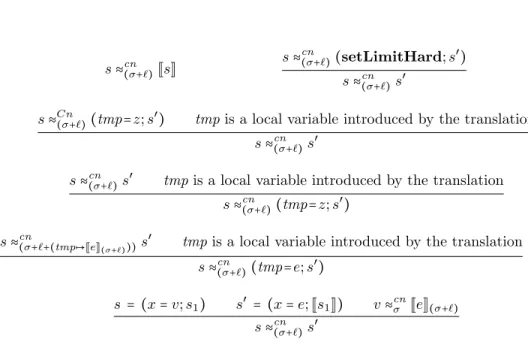
● We add a rule Activate-Thread for activating a thread. It looks at the group of the considered request and checks if this group has not reached its thread limit.
The sh variable is used so that the kind of thread limit is kept unchanged.
Activate-Thread
group(q) = g Active(p�g) < Lg
act(↵, o, , {qP� F} � p, Rq)sh →act(↵, o, , {qA� F} � p, Rq)sh
● Each rule allowing a thread to progress requires that the request processed by this thread is active. To this end, q is replaced by qA in all MultiASP reduction rules
except for Serve and Update.
● The Serve rule is only triggered if the thread limit of the request group is not reached, i.e. if: Active(p�group(q)) < Lg.
● We add two additional rules, Set-Hard-Limit and Set-Soft-Limit, for changing the kind of thread limit of an activity:
Set-Hard-Limit
act(↵, o, , {qA�{` � setLimitHard; s} ∶∶ F} � p, Rq)sh →act(↵, o, , {qA�{` � s} ∶∶ F} � p, Rq)H
Set-Soft-Limit
act(↵, o, , {qA�{` � setLimitSoft; s} ∶∶ F} � p, Rq)sh→act(↵, o, , {qA�{` � s} ∶∶ F} � p, Rq)S
● A wait-by-necessity occurs only in case of method invocation on a future, since field access is only allowed on the current object this. We add a rule Invk-Future that passivates the current thread when a method invocation is performed on a future that has not been updated locally yet. This rule is only applied for activities in soft thread limit and when a method is invoked on a reference to a future.
Invk-Future
[[e]]( +`)= o′ (o′) = f
act(↵, o, , {qA�{` � x = e.m(e); s} ∶∶ F} � p, Rq)S →act(↵, o, , {qP�{` � x = e.m(e); s} ∶∶ F} � p, Rq)S
In summary, four rules are added to MultiASP semantics, and the terms for activities and requests are qualified with thread indicators to take into account advanced scheduling mechanisms of multi-active objects. Note that the thread limit is only checked upon thread activation, thus when switching from soft to hard limit, there may be interrupted passive threads in the set of currently executed requests. In other words, it is not always true that, when the current limit is hard, there is no passivated currently executed request. This corresponds to the behaviour of ProActive that checks thread limit only upon creation or activation of a thread. Though the semantics allows for activation/passivation loops for the same thread, in practice useless activations are avoided by monitoring the status of the futures and activating, by a notification mechanism, a thread that can progress.
3.3. Development Support. We conclude this section by presenting a visualisation tool dedicated to multi-active objects. Its purpose is to help the programmer understand the behaviour of his multi-active object applications and to debug concurrent programs easily.
3.3.1. Viewing executions. The multi-active object programming model is designed such that there is a minimum specification to be written by the programmer. However, multi-active objects are very good for programming systems that involve complex coordination of entities and massive parallelism. For these advanced cases, being able to observe the behaviour of the application is crucial, either to debug it or to improve its performance.
We present a debugger that o↵ers a visualisation of multi-active object executions based on a post mortem analysis. The user of this tool can observe the application execution while
Figure 8. The debugger tool: deadlock scenario (screenshot).
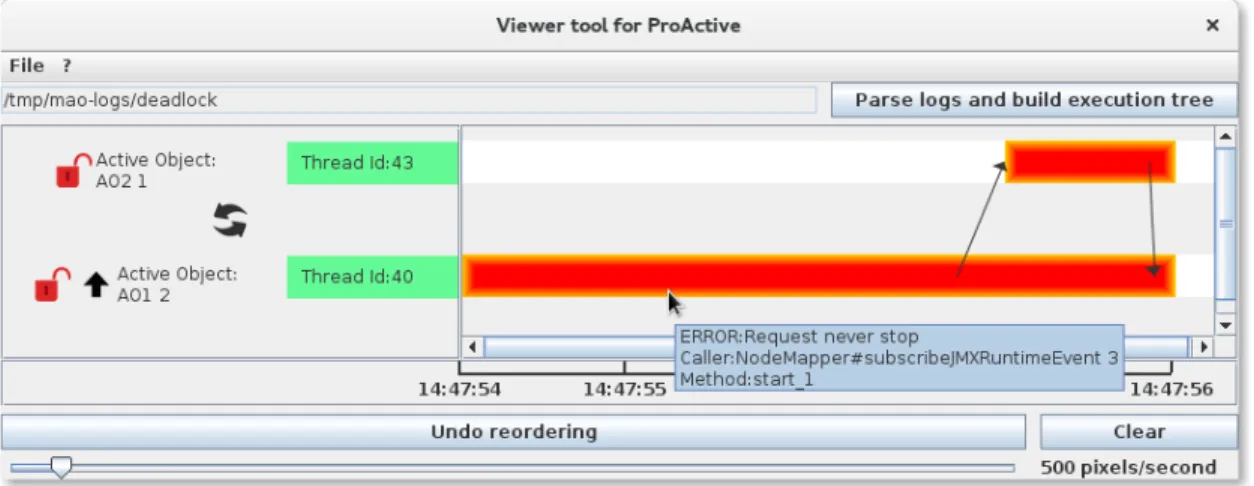
being exposed to a view that corresponds to the notions he manipulates when programming. In the main frame, a thread is represented by a sequence of requests on a time line. A screenshot of the debugger tool is provided in Figure 8. In this example, two single-threaded active objects are displayed. Arrows represent the request sending between multi-active objects. The length of an element is representative of its duration. A mouse-over on a request displays the name of the request, the identity of the sender, and the timestamp of its reception. The debugger highlights the compatibility of the selected request with respect to others. A precise listing of requests can also be viewed based on a particular timestamp, distinguishing the requests that are being executed, the ones in the queue, the completed ones, and the ones that will be received later.
3.3.2. Use case. In active objects, a deadlock is generally caused by a circular dependency of requests. With multi-active objects, a deadlock can be due to two constraints: a lack of compatibility or a lack of threads. We show in Figure 8 the debugger tool in a scenario where it helps the programmer to identify a deadlock in a multi-active object execution (red requests). The debugger produces in this case the ‘request never ends’ error, informing the user of a potentially faulty execution. The representation of communications shows that there is a circular request dependency between multi-active objects First and Second. For example, if the request received by First was not compatible with the request that executes, then it would never execute. Here the deadlock is instead due to a lack of threads: no more thread can be created. This case only happens if the soft thread limit is not activated, else another thread could compensate the thread that is in wait-by-necessity.
Besides deadlocks, the debugger also shows the sequence of actions that occurred in a particular execution, and thus help in spotting race conditions that can happen, typically the concurrent sending of requests to the same target object that would create non-deterministic behaviour. This tool is part of the ProActive framework.
4. Encoding of Cooperative Active Objects into Multi-active Objects We present in this section a particular application of multi-active objects that consists in encoding the cooperative active object language ABS into the multi-active objects of
1Class COG {
2 UUID freshID()
3 UUID register(Object x, UUID id)
4 Object retrieve(UUID id)
5 Object execute(UUID id, MethodName m, params) {
6 w=this.retrieve(id); x=w.m(params); return x}
7 Object execute_condition(UUID id, MethodName cm, params) {
8 w=this.retrieve(id); x=w.cm(params); return x}
9}
Listing 6. The COG class in MultiASP
MultiASP/ProActive. In other words, we present here a ProActive backend for ABS that translates ABS code to Java programs that use the ProActive library and o↵ers a distributed execution of ABS programs. We also formalise and prove the correctness of the translation from ABS to MultiASP programs.
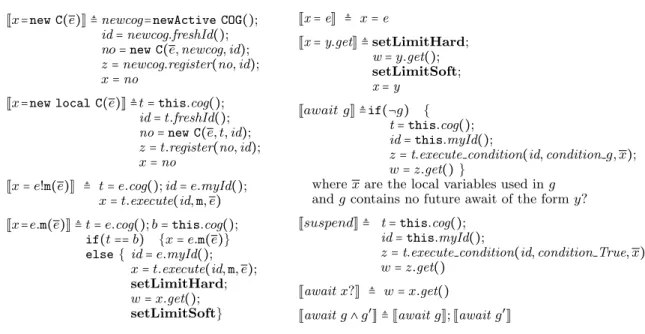
4.1. ProActive Backend and Translational Semantics. One way to execute ABS pro-grams is to use the Java backend. The Java backend translates ABS propro-grams into Java programs according to ABS semantics, but without distribution support. The ProAc-tive backend relies on the Java backend concerning the functional layer of the language, introducing a new translation for the object and concurrency layer, plus distributed notions. First, to translate the object model of ABS into multi-active objects, we put several objects under the control of one active object, which fits the active object group model of ABS. Compared to translating each ABS object into a multi-active object, this solution requires less synchronisation between activities and is more scalable. Indeed to guarantee that a single thread executes in a set of active objects we would need to synchronise the di↵erent active objects and schedule their execution. Implementing such a scheduling pat-tern would not only be difficult and costly (each synchronisation should be performed either by a method invocation or by a future access) but also would not match the active object principles (loose coupling between active objects). In the translation, we introduce a COG class for representing ABS cogs. Only objects of the COG class are multi-active objects. The COG class in MultiASP is shown in Listing 6. UUID represent the type of object iden-tifiers. The COG class has methods to store and retrieve locally the translated ABS objects, and to generically execute a method on them. A special method execute condition is used to execute await conditions. It is a separate method because it does not have the same purpose as execute that serves external asynchronous requests; and the two methods follow di↵erent compatibility rules. We assign to every translated ABS object a unique identifier. Second, all translated ABS classes are extended with two parameters: a cog parameter, storing the cog to which the object belongs, and an id parameter, storing the identifier of the object in that cog. The methods cog() and myId() return those two parameters. A dummy method get() that returns null is also added to each object, it is used to perform synchronisation on future objects.
Concerning statements, the translation only impacts the statements that deal with object creation, method invocation, or future manipulation. The translation of ABS state-ments and expressions into MultiASP is shown in Figure 9, and explained below. The code that is generated by the ProActive backend for ABS is similar to what is shown