
Application of technetium and rhenium carbonyl chemistry to
nuclear medicine. Preparation of [NEt
4
]
2
[TcCl
3
(CO)
3
] from
[NBu
4
][TcO
4
] and structure of [NEt
4
][Tc
2
(l-Cl)
3
(CO)
6
];
struc-tures of the model complexes [NEt
4
][Re
2
(l-OEt)
2
(l-OAc)(CO)
6
]
and [ReBr({-CH
2
S(CH
2
)
2
Cl}
2
)(CO)
3
]
Roger Alberto à, Roger Schibli , Daniela Angst and P. August Schubiger*
Division of Radiopharmacy, Paul Scherrer Institute, CH-5232 Villigen Switzerland, and àInstitute of Inorganic
Chemistry, University of ZuÈrich, Winterthurerstr. 190, CH-8057-ZuÈrich, Switzerland Ulrich Abram and Sonja Abram
Institute of Inorganic Chemistry, University of TuÈbingen, Auf der Morgenstelle 18, D-72076 TuÈbingen, Germany Th. A. Kaden
Institute of Inorganic Chemistry, University of Basel, Spitalstrasse 51, CH-4056 Basel, Switzerland Summary
A detailed investigation of the one-pot synthesis of [NEt4]2[MX3(CO)3] [M = Tc (1a) or Re (1b); X =
Cl), Br)] is presented. The intermediates [NEt 4][Tc2
-(l-Cl)3(CO)6] (2a), [NBu4][Tc3(l3-H)(l-H)3(CO)9] (3)
and [Tc3(l-H)3(CO)12] (4) have been isolated and
characterized. The X-ray structure of (2a) is described. Complex (2a) crystallizes in the monoclinic space group P21/c with a = 19.491(6), b = 18.323(2) and
c = 17.497(9) AÊ, and b = 97.59(2)°. Quantitative con-version of (2a), (3) and (4) into the aqua-ion [M(OH2)3(CO)3]+ [M = Tc (5a) or Re (5b)] is
de-scribed. To evaluate an optimal and simple chelating group for the ``fac-M(CO)3'' moiety, the reaction with
the bidentate thioether ligand Cl(CH2)2S(CH2)2S(CH2)2
-Cl (qyp) has been investigated and the structure of the neutral complex [ReBr(qyp)(CO)3] (6) is described.
Complex (6) crystallizes in the monoclinic space group P21/c with a = 15.935(6), b = 2.788(4) and c =
7.955(10) AÊ, and b = 98.57(1)°. To extend the know-ledge about substitution chemistry of organometallic complexes in aqueous solution, the acetato ligand [OOCCH3])has been reacted with (1b), resulting in the
formation of the dinuclear, acetato-bridged complex [NEt4][Re2(l-OH)2(l-OAc)(CO)6], which converted into
[Re2(l-OEt)2(l-OAc)(CO)6]) (7) after recrystallization
from EtOH. The X-ray structure of (7) has been de-termined. Complex (7) crystallizes in the monoclinic space group P21/c with a = 16.288(3), b = 12.4272(10)
and c = 13.620(3) AÊ, and b = 76.63(1)°. For a future application of the small ``fac-M(CO)3'' moiety, it seems
thus advantageous to combine these two ligand groups in one simple chelating function.
Introduction
The application of metal complexes with a wide variety of radionuclides in the ®eld of nuclear medicine has become a major tool in diagnosis and also more recently in therapy(1±3). Beside the potential for routine
applica-tion of various radioisotopes such as 67Cu, 105Rh or 111Ag, complexes with 99mTc or 186/188Re are in
wide-spread use or have reached the stage of preclinical evaluation. To develop stable tailor made bifunctional chelators, complexes or precursors linkable to small or large biomolecules, retaining their bioactivity, is a challenge to inorganic chemistry. A number of reviews covering this interdisciplinary ®eld have appeared re-cently(4±7). The most successful approaches with Tc or
Re are focused mainly on complexes with the valency +V, typically containing the [Tc@O]3+ moiety and
readily achieved by reducing [99mTcO4]) with, for
ex-ample, [Sn]2+. For [186ReO
4])more vigorous conditions
have to be used. Further attempts to achieve ¯exibility and convenience, based on the [Tc@O]3+ moiety, are
based on the so-called [3+1] strategies(8±11). Three
co-ordination sites around this core are protected, whereas the fourth site is coordinated with the biomolecule. This approach requires only derivatization with one single group and not with a tetradentate ligand. A further at-tractive approach, not based on the [Tc@O]3+moiety, is
the application of hydrazides, which can provide very stable TcN multiple bonds. The monodentate ``hynic'' ligand is a good example of this strategy(12±14).
Whether thermodynamic or kinetically stable com-plexes are preferable for a radiopharmaceutical ap-plication is not yet very clear, but the potential of inertness has impressively been demonstrated with [99mTc(CN±R)
6]+(15,16). The [99mTc(CN±R)6]+
complex-es are rare examplcomplex-es where radioactive organometallic compounds have been applied successfully, and several inactive investigations have demonstrated the potential of homoleptic isocyanide complexes of technetium(I) and rhenium(I)(17±20). Application of organometallics
suers from a drawback, namely that most of potential precursors are prepared form [MBr(CO)5]. To avoid
[MBr(CO)5], we have developed a one-pot synthesis of
the d6 precursor [MX3(CO)3]2) directly from [MO 4])
under ambient conditions. The halides are labilized by the trans standing COs and are easily exchanged by incoming ligands. Both (1a) and (1b) form [M(OH2)3(CO)3]+readily in water. A classical exchange
can occur with ligand groups potentially bearing a bio-molecule (Scheme 1).
0340±4285Ó1997 Chapman & Hall
In order to develop convenient anchor groups or fragments, substitutions with a carboxylic acid and a bidentate thioether ligand have been performed. Experimental
Crystallographic studies
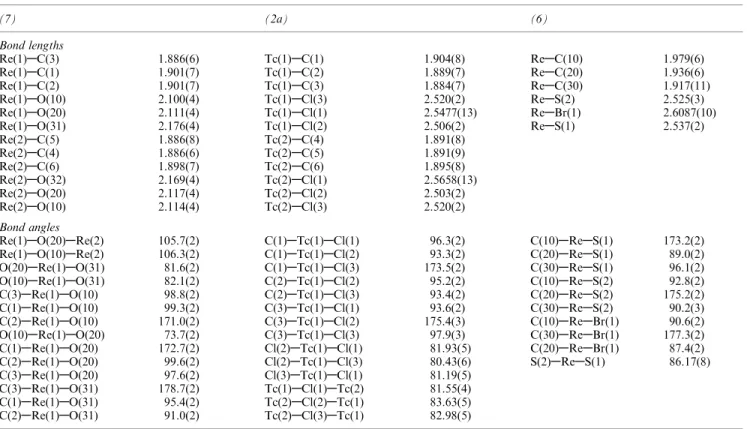
The selected crystals of (6), (2a) and (7) were mea-sured on an Enraf-Nonius CAD-4 diractometer. The unit cells were determined from 25 re¯ections each. During data collection, the crystals were monitored for decay every 100 re¯ections with three controls. No decay was observed in any of the crystals. Absorption corrections were applied from psi-scans. Additional relevant parameters for crystal data, data collection, structure solution and re®nement are given in Table 1, and important bond lengths and angles in Table 2. [NBu4][Tc2(l-Cl)3(CO)6] (2a)
A 1MBH3á THF solution (6 cm3) was added to a THF
solution (15 cm3) of [NBu
4]Cl (0.38 g, 1.36 mmol) under
N2. Subsequently, CO was bubbled and [NBu4][TcO4]
(0.19 g, 0.45 mmol) in THF (2 cm3) was added dropwise
over 15 min. The solution turned yellow after each ad-dition but lost this colour within minutes. Stirring at r.t. for 5 h or boiling under re¯ux for 1 h completed the reaction. THF was removed by evaporation and the oily residue dissolved in CH2Cl2(10 cm3). Water (5 cm3) was
added and the mixture stirred for 4 h. The organic layer was separated and the solvent evaporated. Mixing the residue with H2O caused precipitation of the colourless
product (yield: 0.13 g, 79%). I.r. (KBr/cm)1): 2036, 1940
and 1914 [m(CO)]; 99Tc NMR (d, [TcO
4]) in D2O = 0
p.p.m.): )965 (s, D1/2= 25 Hz).
[NEt4][Re2(l-OC2H5)2(OAc)(CO)6] (7)
Complex (1b) (0.15 g, 0.18 mmol) was dissolved in water (3 cm3) and Ag(OAc) (0.095 g, 0.56 mmol),
dis-solved in H2O, was added. The precipitate (AgBr) was
removed by ®ltration and H2O evaporated in vacuo. The
residue was dissolved in EtOH and slow diusion of Et2O resulted in crystals (yield: 0.063 g) of X-ray quality
within a few days (75%). I.r. (KBr cm)1): 1984, 1864
and 1838 [m(CO)]. [ReBr(qyp)(CO)3] (6)
(1b) (0.123 g, 0.16 mmol) was dissolved in MeOH (5 cm3) and qyp (0.035 g, 0.16 mmol) added. The
solu-tion was stirred over night at r.t., the solvent evaporated in vacuo and the waxy residue obtained stirred with Et2O
to form a crystalline solid. The solvent was separated and the product extracted from [NEt4]Br with THF.
Slow diusion of hexane yielded crystals (78 mg) of Scheme 1. The principle of anchor groups.
Table 1. Crystal data, data collection and solution re®nement parameters for the X-ray structures of [Re2(l-OEt)2(OAc)(CO)6])(7), [Tc2(l-Cl)3
-(CO)6])(2a) and [ReBr(qyp)(CO)3] (6)a
(7) (2a) (6)
Crystal data
Formula C20H33NO10Re2 C22H36Cl3NO6Tc2 C9H12BrCl2O3S2Re
M (g/mol) 819.87 712.87 569.32
Crystal system monoclinic monoclinic monoclinic
Space group (Nr.) P21/c (14) P21/c (14) P21/c (14) a (AÊ) 16.228(3) 19.491(6) 15.935(6) b (AÊ) 12.4272(10) 18.323(2) 2.788(4) c (AÊ) 13.620(3) 17.497(9) 7.955(10) b (°) 76.63(1) 97.59(2) 98.57(1) V (AÊ3) 2672.3(8) 6194(4) 1602(2) Z 4 8 4 qcalc(g cm)3) 2.038 1.529 2.359 l, (mm)1) 9.100 1.184 10.663 F(000) 15600 2880 1064 Data collection 2h range (°) 3.04±28.92 3.06±25.00 3.04±26.98 h,k,l )22/21; 0/16; )18/1 )24/24; )2/0; )1/22 )19/19; )16/0; )1/10 Nr. of re¯ections 7910 12029 4085 Independent re¯ections 7079 10888 3356 Rint(%) 2.24 1.3356 2.43
Observed re¯ections [I>2r(I )] 5877 8553 2860
Structure solution and re®nement
Goodness of ®t (GooF) 1.162 1.076 1.149
R1 (%) 3.4 4.79 2.77
wR2 (%) 8.0 12.48 5.80
Rest electron density (e AÊ)3) 2.125; )1.371 1.273; )0.808 1.297; )1.356
aDetails in common: diractometer, CAD 4 Enraf-Nonius; radiation, MoK
a k = 0.70930 AÊ; graphite monochromator; absorption correction, psi
scans; temperature, 203(2) K.
X-ray quality (86%). I.r. (KBr/cm)1): 2032, 1942, 1908
and 1892 [m(CO)]. Results and discussion Low-pressure carbonylation
The synthesis of (1a) and (1b) is one of the rare ex-amples where a low-valent carbonyl complex is prepared directly from its permetallate(21,22). Although the overall
process includes a 6e)reduction, no de®ned compounds
in the intermediate oxidation states could be trapped. As is evident from reactions with [188ReO
4]), however, the
dierent end-products were convertable into (5) by acid or alkaline hydrolysis. In order to elucidate the nature of these products, similar reactions were performed with [99TcO
4]). Scheme 2 depicts the products characterized
by X-ray structure or chemical analysis.
Performing the reaction in THF in the presence of halide yielded, as a direct precursor of (1a), the di-nuclear complex (2a). Complex (1a) remained in solu-tion due to the presence of the [NBu4]+ counter-ion.
Isolation of (2a) was successful due to its insolubility in H2O. Complex (1a) can be precipitated by addition of
[NEt4]+ and (2a) is slowly converted into (1a) by
cleaving the Cl) bridges and subsequent precipitation
with [NEt4]Cl in EtOH. The structure of (2a) was
elucidated and an ORTEP presentation is given in Figure 1. The Re analogue was already known from the standard approach, starting with [Re2(CO)10](23).
The reaction with [188ReO
4]) gave no unambiguous
evidence for the identity of one of the byproducts with (2a). For this reason the reaction was performed with
99Tc in the absence of halide in order to mimic the very
small halide concentration with188Re. By this approach
the two carbonyl hydride complexes [TcH(CO)4]3 (4)
Table 2. Important bond lengths (AÊ) and angles (°) in the complexes (7), (2a) and (6)
(7) (2a) (6)
Bond lengths
Re(1)AC(3) 1.886(6) Tc(1)AC(1) 1.904(8) ReAC(10) 1.979(6)
Re(1)AC(1) 1.901(7) Tc(1)AC(2) 1.889(7) ReAC(20) 1.936(6)
Re(1)AC(2) 1.901(7) Tc(1)AC(3) 1.884(7) ReAC(30) 1.917(11)
Re(1)AO(10) 2.100(4) Tc(1)ACl(3) 2.520(2) ReAS(2) 2.525(3)
Re(1)AO(20) 2.111(4) Tc(1)ACl(1) 2.5477(13) ReABr(1) 2.6087(10)
Re(1)AO(31) 2.176(4) Tc(1)ACl(2) 2.506(2) ReAS(1) 2.537(2)
Re(2)AC(5) 1.886(8) Tc(2)AC(4) 1.891(8) Re(2)AC(4) 1.886(6) Tc(2)AC(5) 1.891(9) Re(2)AC(6) 1.898(7) Tc(2)AC(6) 1.895(8) Re(2)AO(32) 2.169(4) Tc(2)ACl(1) 2.5658(13) Re(2)AO(20) 2.117(4) Tc(2)ACl(2) 2.503(2) Re(2)AO(10) 2.114(4) Tc(2)ACl(3) 2.520(2) Bond angles
Re(1)AO(20)ARe(2) 105.7(2) C(1)ATc(1)ACl(1) 96.3(2) C(10)AReAS(1) 173.2(2)
Re(1)AO(10)ARe(2) 106.3(2) C(1)ATc(1)ACl(2) 93.3(2) C(20)AReAS(1) 89.0(2)
O(20)ARe(1)AO(31) 81.6(2) C(1)ATc(1)ACl(3) 173.5(2) C(30)AReAS(1) 96.1(2)
O(10)ARe(1)AO(31) 82.1(2) C(2)ATc(1)ACl(2) 95.2(2) C(10)AReAS(2) 92.8(2)
C(3)ARe(1)AO(10) 98.8(2) C(2)ATc(1)ACl(3) 93.4(2) C(20)AReAS(2) 175.2(2)
C(1)ARe(1)AO(10) 99.3(2) C(3)ATc(1)ACl(1) 93.6(2) C(30)AReAS(2) 90.2(3)
C(2)ARe(1)AO(10) 171.0(2) C(3)ATc(1)ACl(2) 175.4(3) C(10)AReABr(1) 90.6(2)
O(10)ARe(1)AO(20) 73.7(2) C(3)ATc(1)ACl(3) 97.9(3) C(30)AReABr(1) 177.3(2)
C(1)ARe(1)AO(20) 172.7(2) Cl(2)ATc(1)ACl(1) 81.93(5) C(20)AReABr(1) 87.4(2)
C(2)ARe(1)AO(20) 99.6(2) Cl(2)ATc(1)ACl(3) 80.43(6) S(2)AReAS(1) 86.17(8)
C(3)ARe(1)AO(20) 97.6(2) Cl(3)ATc(1)ACl(1) 81.19(5)
C(3)ARe(1)AO(31) 178.7(2) Tc(1)ACl(1)ATc(2) 81.55(4)
C(1)ARe(1)AO(31) 95.4(2) Tc(2)ACl(2)ATc(1) 83.63(5)
C(2)ARe(1)AO(31) 91.0(2) Tc(2)ACl(3)ATc(1) 82.98(5)
Scheme 2. General conditions to prepare TcI-carbonyl precursors: (i) CO (1 atm), THF, BH
3á THF, 30±50 °C; (ii) NaOH/MeOH r.t.; (iii) 1MHCl/
and [NBu4][Tc3(l-H)3(l3-H)(CO)9] (3) were isolated.
Complex (4) was characterized by X-ray structure analysis, and (3) by spectroscopic methods(24). Complex
(3) exhibits a single resonance in the 99Tc-n.m.r.
spec-trum at )1006 p.p.m. (relative to [TcO4]) in D2O), a
typical ``fac-M(CO)3'' pattern at 2023 and 1924 cm)1,
two singlets in the 1H-n.m.r. and an additional set of
[NBu4]+signals in the correct ratio. The nature of the
two byproducts containing 188Re allowed us to develop
a strategy for their conversion into (1b) and hence into (5b), which is a base suitable for further coordination chemistry studies. The same procedure, as with188Re, is
also possible with 99mTc. The reaction occurred in the
latter case much faster and radiolysis, as observed with higher 188Re activities, did not lead to decomposition.
We conclude ultimately that this synthesis of low valent Re- and Tc-carbonyls will open the way to their application in nuclear medical ®elds.
Substitution of (5a) and (5b) with acetate and qyp The aquo-ions (5a) and (5b), or the correspondingly solvated complexes, e.g. with methanol, have several distinct advantages over the usual precursors. In contrast to [MO(gluco)], for example, they are stable over a long period without the necessity of multidentate stabilizing ligands such as glucoheptonate or citrate and only monodentate solvent ligands such as H2O or MeOH
have to be substituted, which are additionally labilized by the trans CO ligands. Although a wide variety of complexes containing the ``fac-M(CO)3'' moiety are
known, hardly any resulted from ligand exchange based on solvent equilibrium, but instead from CO release in [MX(CO)5] at high temperature in non-coordinating
solvents. It was thus necessary to study such reactions to investigate the kinetics and thermodynamics of complex formation. We have already described the reaction with thiols, isocyanides and aromatic or aliphatic amines in this respect(21,22,25). For the design of anchor groups, the
two aspects of charge and softness have to be considered. The d6systems of group 7 transition elements are
gen-erally characterized as soft, resulting in a preference for soft ligand atoms, e.g. thioethers or isocyanides. The strong p-backbonding of the CO ligands results in elec-tron de®ciency and an enhanced preference for weak donating ligands such as carboxylic acids or amines can be expected. The concerted donating/accepting proper-ties of dierent atoms is highly important in designing an optimal anchor ligand.
The ligand Cl(CH2)2S(CH2)2S(CH2)2Cl (qyp) has
been chosen since it oers two moderately donating thioether functions that are easily derivatized at the non-coordinating terminal chlorides. The monopositive charge of (5a) or (5b) is expected to be neutralized by Cl)present, in particular, in aqueous solution.
The reaction of qyp with (1b) in methanol, present as [Re(HOMe)3(CO)3]+, was straightforward but slow. As
evident from i.r. spectroscopy, [Re(HOMe)qyp(CO)3]+
formed initially, followed by Br) substitution of the
last MeOH, resulting in the neutral complex [ReBr-(qyp)(CO)3] (6). An ORTEP presentation of the
com-plex molecule is given in Figure 2.
Similar behaviour was observed in water. The ease of product formation with bidentate thioether groups make them versatile as anchor groups for biomolecules, since their preparation and derivatization is also con-venient. The reaction with [Re(HOMe)3(CO)3]+
oc-curred at a reasonable rate (t1/2= ca. 30 min) and
under controlled conditions. Preliminary investigations at the n.c.a. level revealed that ligand concentration can be decreased to an almost stochiometric level, which represents signi®cant progress from the above-men-tioned protocols.
The carboxylato group is a typical anionic ligand, able to provide dierent modes of coordination. Alone or in combination with other groups, it is advantageous for our purposes in two respects. The monopositive charge of [M(Sol)3(CO)3]+is neutralized and additional
electron density is shifted to the metal centre, supporting p-backbonding and inertness in combination with other ligand groups. It is easily included in a potential bi-dentate ligand for the same purposes, thus resulting in a simple, probably even naturally occurring, anchor group. To obtain fundamental information we have in-vestigated the coordinative properties of ethanoic acid in water. The halides were previously precipitated with three equivalents of Ag(OAc). I.r. spectroscopic in-vestigations in water revealed the formation of a neutral or anionic species as evident from the redshift of the CO stretching vibrations. T.l.c. showed the formation of a single species. This complex could be isolated and, after recrystallization from ethanol, structurally character-ized. An ORTEP presentation of [NEt4][Re2(l-OEt)2
-(OAc)(CO)6] (7) is given in Figure 3. The acetato group
Figure 1. ORTEP presentation of the complex anion [Tc2(l-Cl)3
-(CO)6])(2a). Thermal ellipsoids are drawn on the 30% level.
Figure 2. ORTEP presentation of the complex [ReBr(qyp)(CO)3].
acts as a bridging ligand between two Re centres to form a dinuclear complex. Two bridging ethanolato ligands occupy the remaining coordination sites.
After isolation from aqueous media, a sharp OAH stretching vibration could be detected. Recrystallization from ethanol resulted in the substitution of (l-OH) groups by the corresponding alcoholato functions without touching the acetato ligand. Potentiometric ti-tration of (1b) in water yielded the tri- and dinuclear species [Re3(l-OH)3(l3-OH)(CO)9]) and [Re2(l-OH)3
-(CO)6])(26), respectively. It was obvious from those
experiments that the hard 2e) donating ligand [OH])
tends to form bridges between metal centres. The ``fac-M(CO)3'' moiety is not able to accept the provided
high-electron density from a single ligand, but tries to distribute the charge over dierent cations. The same behaviour was found to be true with the much weaker donating acetato group and only bridging allowed co-ordination to the ``fac-M(CO)3'' moiety. Since acetate
can act as a OH) source the remaining positions are
predominantly occupied by this ligand. From these ob-servation carboxylato groups are not very convenient as single ligands. Ligands have to include other groups of backbonding properties that provide chelation to the metal centre. Reaction of (5a) or (5b) in water with picolinic acid, for example, did not result in a bridged species but in the formation of a mononuclear complex of composition [ReBr(pic)(CO)3], exhibiting exceptional
stability towards acid(25).
Conclusion
The synthesis of (1a) or (1b) from [TcO4]) or [ReO4])
under 1 atm of CO at ambient temperature is an im-portant step towards the application of organometallic complexes in nuclear medicine. It is possible to prepare these precursors on the n.c.a. as well as on the macro-scopic level. Since (1a) and (1b) are converted into the ``semi-aquo-ions'' (5a) and (5b), simple ligand ex-change reactions with easily available anchor groups can be performed. Owing to their ``soft'' nature, ligands such as thioethers are preferred as exempli®ed by the syn-thesis of (6). Single carboxylato groups such as acetate were shown to bridge two metal centres. Thus, single
carboxylato groups seemed not to be particularly ad-vantageous since one ``fac-M(CO)3'' moiety can not
accept the high-electron density provided by acetate. The fact that the carboxylate is able to coordinate to the soft ``fac-Re(CO)3'' moiety mirrors, however, its
use-fulness in combination with other ligand groups, i.e. those derived from thioether functions.
Supporting material
Complete information about crystal data, data collec-tion, structure solution and re®nement and tables of bond lengths, bond angles, positional and thermal pa-rameters of compounds (2a), (6) and (7) have been deposited with the Editor.
References
(1)W. A. Volkert, G. J. Goeckeler, and A. R. Ketring, J. Nucl. Med.,
32, 174 (1991).
(2)P. A. Schubiger, R. Alberto and A. Smith, Bioconjugate Chem., 7,
165 (1996).
(3)S. Jurisson, D. Berning, W. Jia and D. Ma, Chem. Rev., 93, 1137
(1993).
(4)E. Deutsch and K. Libson, Commun. Inorg. Chem., 3, 83 (1984). (5)M. J. Clarke and J. Podbielsky, Coord. Chem. Rev., 78, 253 (1987). (6)W. C. Eckelman, The Chemistry of Technetium in Medicine,
National Academic Press, Washington, 1992.
(7)A. M. Verbruggen, Eur. J. Nucl. Med., 17, 346 (1990).
(8)H. J. Pietzsch, H. Spies, S. Homann and D. Scheller, Appl.
Radiat. Isot., 41, 185 (1990).
(9)G. Bandoli, U. Mazzi, H. J. Pietzsch and H. Spies, Acta
Crystallogr., Sect. C, 48, 1422 (1992).
(10)H. J. Pietzsch, H. Spies and S. Homann, Inorg. Chim. Acta, 168,
7 (1990).
(11)H. Spies and B. Johannsen, Analyst, 120, 775 (1995).
(12)M. J. Abrams, S. K. Larsen, J. Zubieta, Inorg. Chim. Acta, 173, 133
(1990).
(13)R. Pasqualini, C. Veronique, E. Bellande, A. Duatti and A.
Marchi, Appl. Radiat. Isot., 11, 1329 (1992).
(14)C. M. Archer, J. R. Dilworth, P. Jobanputra, R. M. Thompson,
M. McPartlin, D. C. Povey and J. D. Kelly, Polyhedron, 9, 1497 (1990)
(15)M. J. Abrams, A. Davison, A. G. Jones, C. E. Costello and
H. Pang, Inorg. Chem., 22, 2798 (1983).
(16)R. Taillefer, L. La¯amme and G. Dupras, Eur. J. Nucl. Med., 13,
515 (1988).
(17)W. H. Soine, C. E. Guyer and F. F. Knapp, J. Med. Chem., 27, 803
(1984).
(18)D. Vichard, M. Gruselle, H. E. Amouri and G. Jaouen, J. Chem.
Soc., Chem. Commun., 46, (1991).
(19)M. Salmain, M. Gunn, A. Gorfti, S. Top and G. Jaouen,
Bioconjugate Chem., 4, 425 (1993).
(20)A. Gorfti, M. Salmain, G. Jaouen, M. J. McGlinchey, A.
Bennouna and A. Mousser, Organometallics, 15, 142 (1996).
(21)R. Alberto, R. Schibli, A. Egli, P. A. Schubiger, W. A. Herrmann,
G. Artus, U. Abram and T. A. Kaden, J. Organometal. Chem., 493, 119 (1995).
(22)R. Alberto, R. Schibli, P. A. Schubiger, U. Abram and T. A.
Kaden, Polyhedron, 15, 1079 (1996).
(23)T. Beringhelli, G. D'Alfonso and M. Zarini, J. Chem. Soc., Dalton
Trans., 2407 (1995).
(24)R. Alberto, R. Schibli, P. A. Schubiger, U. Abram, R. HuÈbener, H.
Berke and T. A. Kaden, J. Chem. Soc., Chem. Commun., 1291 (1996).
(25)R. Alberto, R. Schibli, U. Abram, P. A. Schubiger and T. A.
Kaden, submitted for publication in Inorg. Chem.
(26)R. Alberto, A. Egli, U. Abram, K. Hegetschweiler, V. Gramlich
and P. A. Schubiger, J. Chem. Soc., Dalton Trans., 2815 (1994). (Received 27 March 1997
Accepted 9 May 1997) TMC 3949
Figure 3. ORTEP presentation of the complex anion [Re2(l-OEt)2
![Table 1. Crystal data, data collection and solution re®nement parameters for the X-ray structures of [Re 2 (l-OEt) 2 (OAc)(CO) 6 ] ) (7), [Tc 2 (l-Cl) 3 - -(CO) 6 ] ) (2a) and [ReBr(qyp)(CO) 3 ] (6) a](https://thumb-eu.123doks.com/thumbv2/123doknet/14872654.640620/2.894.79.416.70.152/table-crystal-collection-solution-nement-parameters-structures-rebr.webp)
![Figure 1. ORTEP presentation of the complex anion [Tc 2 (l-Cl) 3 - -(CO) 6 ] ) (2a). Thermal ellipsoids are drawn on the 30% level.](https://thumb-eu.123doks.com/thumbv2/123doknet/14872654.640620/4.894.80.387.75.283/figure-ortep-presentation-complex-anion-thermal-ellipsoids-drawn.webp)
![Figure 3. ORTEP presentation of the complex anion [Re 2 (l-OEt) 2 - -(OAc)(CO) 6 ] )](https://thumb-eu.123doks.com/thumbv2/123doknet/14872654.640620/5.894.75.383.70.308/figure-ortep-presentation-complex-anion-l-oet-oac.webp)
