J. Moll. Stud. (1997), 63,1-8 © The Malacological Society of London 1997
DIFFERENCES IN RESTING-SITE PREFERENCE IN TWO
COEXISTING LAND SNAILS, ARIANTA ARBUSTORUM AND
ARIANTA CHAMAELEON (HELICIDAE), ON ALPINE
SLOPES
STEPHAN LEDERGERBER1, HELMUT BAMINGER2, AGNES
BISENBERGER2, DORIS KLEEWEIN2, HELMUT SATTMANN3 and BRUNO BAUR1
' Conservation Biology Research Group (NLU), University of Basel, St. Johanns-Vorstadt 10, CH-4056 Basel, Switzerland.2 Institute of Zoology, University of Vienna, Althanstrasse 14, A-1090 Vienna, Austria. 3 Natural
History Museum, Burgling 7, A-1014 Vienna, Austria (Received 14 March 19%, accepted 8 July 1996)
ABSTRACT
Resting-site preference and patterns of spatial distri-bution were examined in the sympatric land snails Arianta arbustorum and A. chamaeleon on two opposite slopes in the south-eastern Alps, Austria. The two slopes did not differ in proportion of A. arbustorum and A. chamaeleon (74.4% vs. 25.6% on the NNE-exposed slope and 68.3% vs. 31.7% on the SSW-exposed slope). Individuals of both species showed aggregated dispersion patterns. The nearest-neighbour method indicated that in both species snail aggregations predominantly consisted either of A. arbustorum or A. chamaeleon on the NNE-exposed slope with a mosaic of rocks and distinct patches of different plants. On the SSW-exposed slope, which was less variable in vegetation cover, snail aggregations consisted of conspecific and hetero-specific individuals. Juvenile and adult A. arbusto-rum preferred to rest attached to leaves of Adenostyles alliariae, but avoided rock surfaces and patches of grass on the NNE-exposed slope. In con-trast, juvenile and adult A. chamaeleon preferentially rested on rock surfaces, and also avoided grass patches. Juvenile and adult A. chamaeleon did not differ in resting-site preference, whereas small differ-ences in resting sites were observed between juvenile and adult A. arbustorum. Differences in resting-site preference is one way of niche differentiation which may allow individuals of the two Arianta species to coexist.
INTRODUCTION
Niche differentiation is often the basis for the coexistence of competitors (MacArthur & Levins, 1967; Roughgarden, 1979). Differential resource utilization can be expressed in a number of ways. Species may differ in their food choice and/or microhabitat use.
Further-more, the resources utilized by ecologically similar species can be separated in time or in space. Among gastropods, differential habitat selection has been demonstrated in coexisting Partula species on Moorea (Murray, Johnson & Clarke, 1982). Temporal differences in resource utilization have been found in Cepaea nemoralis (L.) and C. hortensis (Mttller), which differ in their period of maximum activity (Cameron, 1970). The land snail Mesodon thyroidus (Say) shows less restricted weather requirements for activity than the sympatric Triodopsis albolabris (Say) (Emberton, 1981). A separation of food resources has been demonstrated in the coexisting rock-dwelling land snails Chondrina clienta (Westerlund) and Balea perversa (L.) (FrOberg, Baur & Baur, 1993; Baur, Baur & FrOberg, 1994), and in hydroid-eating nudibranchs (Lambert, 1991). However, in many cases ecologically similar species can only coexist when they differ in more than one niche dimension. For example, specific differences in food habits and sub-strate choice allow the coexistence of several Conus species (Kohn, 1959, 1968; Kohn & Nybakken, 1975).
The aim of the present study was to examine the spatial distribution and resting-site prefer-ence of Arianta arbustorum (Linnaeus, 1758) and A. chamaeleon (L. Pfeiffer, 1842). Both species usually occur allopatrically, but coexist in some alpine sites in southern Austria (Klemm, 1974; H. Sattmann, unpubl. data). Intraspecific density effects on juvenile growth, adult shell size, clutch size and incidence of egg cannibalism have been shown in A. arbusto-rum (Reichardt et al., 1985; Baur, 1988). How-ever, very little information on the ecology of
STEPHAN LEDERGERBER ETAL. A. chamaeleon is available. In this paper we
address the following questions: (1) do indi-viduals of A. arbustorum and A. chamaeleon differ in their spatial distribution when they occur in the same habitat? (2) Are there species-specific resting-site preferences? And (3) do juveniles and adults of the same species differ in their resting-site preferences?
MATERIALS AND METHODS Arianta arbustorum is common in moist habitats in north-western and central Europe (Kerney, Cameron & Jungbluth, 1983), occurring at altitudes of up to 2700 m a.s.l. in the Alps (Baur & Raboud, 1988). Arianta chamaeleon lives in the south-eastern Alps (Kerney et al., 1983). Snails of both species have determinate growth, but differ in banding char-acteristics of the shell and in shell shape (ratio shell height/shell breadth) (Bisenberger, 1993). In the populations examined in this study, A. arbustorum has a more globular shell (shell shape 0.80), whereas A. chamaeleon has a flattened, nearly discoidal shell (shell shape 0.57; Baur, Ledergerber & Kothbauer, 1997).
The resting sites of A. arbustorum and A. chamaeleon were recorded in an alpine meadow partly covered with calcareous rocks and rock debris near Lake Wolay at an elevation of 1970 m a.s.l. in south-western Carinthia, Austria (46°37'N, 12°52'E). Two plots were established on the opposite slopes of a small valley. Plot A was a 5-m wide and 38-m long strip that ranged from the bottom of the valley to the middle part of the NNE-exposed slope (range of inclination: 0-30°). Plot B was situated on a SSW-exposed slope (inclination: 55°). It measured 6 x 1 2 m and was 10 m apart from plot A separated by a track. A part of plot B is covered with rock plates and rock walls. Plot B was smaller than plot A because adjacent rock walls made any field work dangerous.
In both plots a grid of 1 mJ units was set up using lines. The plots were carefully searched for A. arbus-torum and A. chamaeleon between 10 a.m. and 1 p.m. by eight persons on 25 July 1995 (plot B) and by 11 persons on 26 July 1995 (plot A). On both days the weather was fine (sunshine with an air tempera-ture ranging from 14.6 to 19.0°C). The snails were inactive and therefore the positions recorded repre-sent their daytime resting sites. For each snail found we recorded the species, age class (juveniles were individuals without a reflected shell lip and adults individuals with a reflected lip), and the type of habi-tat (rock or vegehabi-tation) in which the resting animal was found (see below). The position of each snail was recorded by measuring the distances to the near-est two grid lines. Cartesian coordinates were calcu-lated on the basis of these data. The snails remained at their original positions. In plot A one person mapped the spatial distribution of rocks and stones
and different types of vegetation. In plot B, no distinct patches of different vegetation were recog-nizable. Therefore, we only recorded whether the snails rested on rocky surfaces or in the vegetation in plot B.
RESULTS
Proportion of rocks and vegetation in the plots The two plots did not differ in the percentage of area covered either by rocks or vegetation (Fig. 1; plot A: rocks 40.3%, vegetation 59.7%; plot B: rocks 39.2%, vegetation 60.8%; x2 =
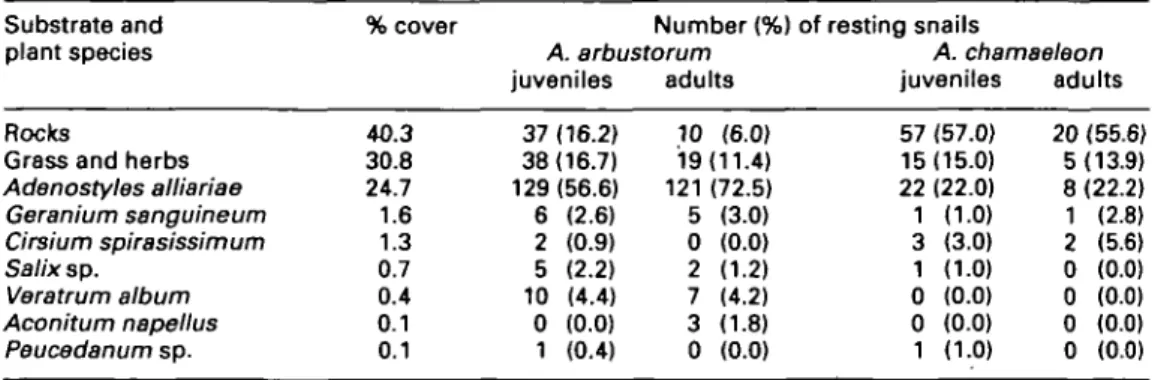
0.03, d.f. = 1, P > 0.9). Table 1 gives a sum-mary of the percentage cover of the different plant species in plot A.
Number and spatial distribution of resting snails
A total of 531 snails were found in plot A (A. arbustorum: 74.4%; A. chamaeleon: 25.6%; Table 1). In plot B, 139 snails were recorded (A. arbustorum: 68.3%; A. chamaeleon: 31.7%). The two plots did not differ in propor-tion of A. arbustorum and A. chamaeleon (x2
= 2.05, d.f. = 1, P > 0.15; Table 2). Further-more, the two plots did not differ in proportion of juvenile and adult A. chamaeleon (x2 = 0.01,
d.f. = 1, P > 0.9; Table 2). However, signifi-cantly more adult A. arbustorum were found in plot A than in plot B (x2 = 11.82, d.f. = 1,
P < 0.001; Table 2).
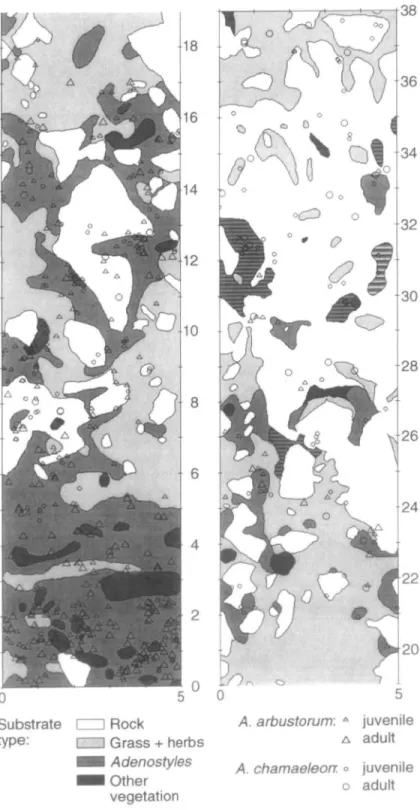
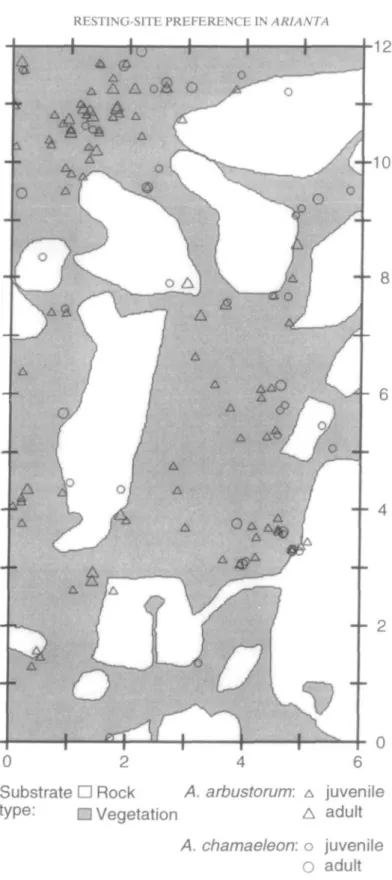
Juveniles and adults of both species were significantly aggregated, except adult A. chamaeleon in plot B (nearest-neighbour method of Clark & Evans (1954); Table 2 and Fig. 1). In plot A, the nearest neighbour was more frequently a conspecific than expected under the assumption that the snails were neighbours in the same proportion as A. arbustorum and A. chamaeleon occurred in the plot (x2 = 139.48, d.f. = 1, P < 0.0001).
This indicates that snail aggregations mainly consisted of conspecifics in plot A which was a mosaic of rocks and patches of different plants (Fig. la). In plot B, however, the nearest neighbour was either a conspecific or an individual of the other species, with frequencies corresponding to the proportions in which they occurred in the area (x2 = 1-25,
d.f. = 1, P > 0.25). In contrast to plot A, plot B contained no distinct patches of different plants (Fig. lb).
RESTING-SITE PREFERENCE IN AR1ANTA 3
Table 1. Cover of rocks and different plant species and number (%) of juvenile and adult A.
arbusto-rum and A. chamaeleon found in patches of different vegetation in plot A.
Substrate and plant species
Rocks
Grass and herbs
Adenostyles alliariae Geranium sanguineum Cirsium spirasissimum Salix sp. Veratrum album Aconitum napellus Peucedanum sp. % cover 40.3 30.8 24.7 1.6 1.3 0.7 0.4 0.1 0.1 Number (%) A. arbustorum juveniles 37 (16.2) 38(16.7) 129 (56.6) 6 (2.6) 2 (0.9) 5 (2.2) 10 (4.4) 0 (0.0) 1 (0.4) adults 10 (6.0) 19(11.4) 121 (72.5) 5 (3.0) 0 (0.0) 2 (1.2) 7 (4.2) 3 (1.8) 0 (0.0) of resting snails A. chamaeleon juveniles 57 (57.0) 15(15.0) 22 (22.0) 1 (1.0) 3 (3.0) 1 (1.0) 0 (0.0) 0 (0.0) 1 d.O) adults 20 (55.6) 5(13.9) 8 (22.2) 1 (2.8) 2 (5.6) 0 (0.0) 0 (0.0) 0 (0.0) 0 (0.0)
Table 2. Number of snails, density and pattern of spatial distribution of A. arbustorum and A.
chamaeleon found on the opposite slopes of an alpine valley in south-western Carinthia, Austria.
Patterns of spatial distribution were analysed using the distance-to-nearest-neighbour method of Clark & Evans (1954). R-values < 1 indicate a tendency towards aggregation. Significance levels: * P < 0.02; * • P < 0.01; • • * P < 0.001.
Species Age class
NNE-exposed slope (plot A):
A. arbustorum Juveniles Adults Juveniles + adults A. chamaeleon Juveniles Adults Juveniles + adults SSW-exposed slope (plot B):
A. arbustorum Juveniles Adults Juveniles + adults A. chamaeleon Juveniles Adults Juveniles + adults Number of snails (%) 228 (57.7) 167 (42.3) 395(100.0) 100 (73.5) 36 (26.5) 136(100.0) 73 (76.8) 22 (23.2) 95(100.0) 32 (72.7) 12 (27.3) 44 (100.0) Density (individuals/m2) 1.20 0.88 2.08 0.53 0.19 0.72 1.01 0.31 1.32 0.44 0.17 0.61 Dispersion coefficient R 0.59 # # 0.55 • * 0.58 • • 0.78 • • 0.80 • • 0.75 # # 0.67 • • 0.50 • * 0.61 ** 0.81 •» 1.15 N.S. 0.80 *
Resting-site preferences on the NNE-exposed slope (plot A)
The position of each snail is shown in relation to rocks and patches of different vegetation on the NNE-exposed slope (plot A) in Fig. la. The percentages of A. arbustorum and A. chamaeleon found attached to rocks or in patches of different vegetation are presented in relation to the percentage cover of the plants and rocks in Fig. 2. In both snail species, the frequencies of different resting sites chosen deviated from the proportion of the
occur-rence of rocks and different plant species (A arbustorum: x2 = 165.39, d.f. = 5, P < 0.0001;
A. chamaeleon: x2 = 12.32, d.f. = 3, P = 0.006).
Individuals of A. arbustorum preferred to rest attached to leaves of Adenostyles, but were scarce on rock surfaces and in patches of grass (Table 1). In contrast, individuals of A. chamaeleon were mainly found on rock surfaces, but were also scarce in grass patches.
Comparing the two species, juveniles and adults of A. arbustorum occurred more frequently on Adenostyles than juveniles and adults of A. chamaeleon, which in turn rested
STEPHAN LEDERGERBER ET AL.
Substrate type:
20
Rock A. arbustorum: A juvenile Grass + herbs A a d u l t
Adenostyles A. chamaeleorr. ° juvenile
o t n e r o adult vegetation
Figure L Maps showing the spatial distribution of rock surface and patches of different plant species and the
RESTING-SITE PREFERENCE IN ARIANTA
Substrate • Rock A arbustorum: A juvenile
type: eg Vegetation A adult
A chamaeleon: o juvenile
O adult
STEPHAN LEDERGERBER ETAL. -20 CD O O (0 (1)
Figure 2. Percentage of resting snails ( • A. arbusto-rum and • A. chamaeleon) attached to different sub-strates, and percentage of area covered by • rocks, patches of • grass and herbs, • Adenostyles, and • other vegetation. Other vegetation includes G. san-guineum, C. spirasissimum, SalLx sp., V. album, A. napellus and Peucedanum sp.
more frequently attached to rock surfaces (juveniles: x2 = 62.88, d.f. = 4, P < 0.001;
adults: x2 = 61.26, d.f. = 3, P < 0.001). Thus,
the two species differed significantly in their resting-site preference.
Comparing the age classes within species, juvenile and adult A chamaeleon did not.differ in resting-site preference (Table 1; x2 = 0.25,
d.f. = 3, P > 0.3). In contrast, juvenile and adult A. arbustorum slightly differed in resting-site preference (Table 1; x2 = 14.33, d.f. = 5,
P < 0.02). This age-specific difference was mainly due to the smaller proportion of juvenile A. arbustorum which rested attached to rock surfaces and to the higher proportion of juveniles found in patches of Adenostyles (Table 1).
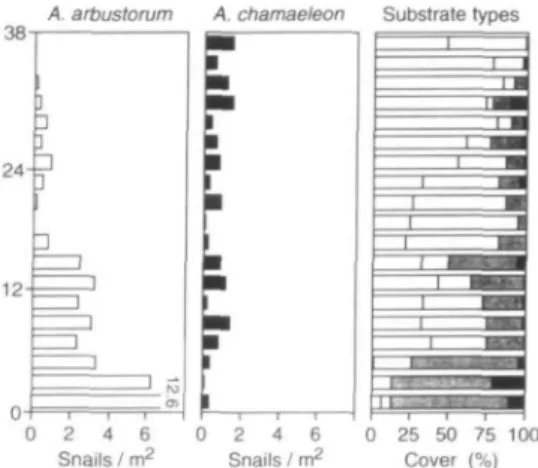
Arianta arbustorum was mainly found at the base of the NNE-exposed slope (in the first 12 m of the 38-m long belt), whereas A. chamaeleon occurred in all parts of the slope (Fig. 3). The difference in the spatial distribu-tion between the two snail species can be explained by the distribution of rocks and patches of different vegetation in the investiga-tion area (Fig. 3). The density of A. arbust-orum was positively correlated with the percentage cover of Adenostyles alliariae (data from 2-m strips combined: r = 0.85, N = 19, P < 0.001) and negatively correlated with the percentage cover of rocks (r = —0.59, N = 19, P = 0.007). In contrast, the density of A.
38
24
12
A. arbustorum A chamaeleon Substrate types
0 2 4 6 Snails / m2 0 2 4 6 Snails / m2 0 25 50 75 100 Cover (%)
Figure 3. Density of A. arbustorum and A. chamaeleon over a 38-m gradient on the NNE-exposed slope (plot A) compared with the percent-age cover of rocks and different types of vegetation ( • rocks, • grass and herbs, • Adenostyles, and • other vegetation). Data on snail density and cover of rocks and different plants were combined for strips of 2 x 5 m.
chamaeleon was positively correlated with the percentage cover of rocks (r = 0.47, N = 19, P = 0.04). The densities of the snail species were uncorrelated (r = -0.24, N = 19, P = 0.33).
Resting-site preferences on the SSW-exposed slope (plot B)
Plot B did not contain distinct patches of different vegetation and was too small to allow a detailed data analysis. However, as in plot A, individuals of A. chamaeleon rested more frequently attached to rock surfaces (20.5%) than individuals of A arbustorum (8.4%; x2 =
4.06, d.f. = 1, P < 0.05). Comparing both plots (slopes), a smaller proportion of A chamaeleon rested attached to rock surfaces in plot B than in plot A (20.5% vs. 56.6%; x2 =
17.43, d.f. = 5, P < 0.001). In contrast, the two plots did not differ in the percentage of A arbustorum resting attached to rock surfaces (plot A: 11.9%; plot B: 8.4%; x2 = 0.95, d.f. =
1, P > 0.3).
DISCUSSION
The present study shows that individuals of both species were aggregated on both slopes. Similar patterns of spatial distribution were recorded in populations of A. arbustorum that
RESTING-SITE PREFERENCE IN ARIANTA lived in uncultivated meadows, alpine pastures
and a field of scree material with a few small vegetation patches (Andreassen, 1981; Baur, 1984,1986). An aggregated pattern of snail dis-tribution could reflect the small-scale hetero-geneity of the environment (patches with different suitability; e.g. soil moisture), and/or it could result from the snails' behaviour to minimize the risk of predation, or in adults to find mating partners. Moreover, juveniles could be found aggregated due to their limited dispersal ability. Experiments are needed to distinguish between these hypotheses. How-ever, the following observations contradict the assumption of limited dispersal in juveniles. Newly-hatched A. arbustorum moved on aver-age 13.8 cm from the place they emerged in the first three days of life (Baur, 1988). The juve-niles considered in the present study had much more time to disperse, because they measured 5 mm or more in shell breadth and thus were at least 1 year old (Baur & Raboud, 1988). It therefore seems unlikely that the aggregated distribution pattern of juveniles was due to their limited dispersal ability.
Baur (1984,1986) found that in alpine popu-lations A. arbustorum preferentially rested in aggregations. The size of the aggregations was partly related to the size of the shelters, while the number of snails found in an aggre-gation seemed to be influenced by weather, season and the animals' behaviour during the mating period (Baur, 1984, 1986). Similarly, Andreassen (1981) observed that juvenile and subadult A. arbustorum were always aggre-gated in a population near Bergen (Norway), whereas adults were only aggregated in their main mating period (May and June). The present study suggests that the aggregated distribution pattern of resting snails might partly be a result of substrate preference. Most probably the aggregated distribution of Arianta cannot be explained by a single factor.
Patterns of spatial distribution may be influ-enced by the proportion of snails found. During the activity season, A. arbustorum frequently rests for periods of up to several days buried in the soil (Baur & Baur, 1993). In many species a proportion of snails remain inactive in the soil even under conditions favourable for activity (Peake, 1978). We might have overlooked individuals buried in the soil and hidden in small fissures or in dense vegetation. This might be particularly true for juveniles. However, we do not assume that snails bury at places where absolutely no indi-viduals were recorded (in that case snails
would have to move large distances between periods of activity and resting).'However, it is also possible that A. arbustorum and A. chamaeleon differed in the proportion of hidden individuals. Mark-release-recapture techniques have to be used to obtain accurate estimates of population size.
The present study shows that a difference in resting-site preference is one of the factors that distinguish the species ecologically. In plot A, A. arbustorum showed a preference for resting attached to leaves of Adenostyles, whereas A. chamaeleon preferred to rest on rock surfaces. Both species tended to avoid patches domi-nated by grass. In food-choice tests, A. arbus-torum rarely consumed grass (Fromming, 1954). Preliminary observations indicate that A. chamaeleon feeds more frequently on algae and lichens than A. arbustorum (Dolt, Baur & Baur, in prep.). Differences in resting-site preference could be due to different utilization of food resources. In northern Greece, five coexisting species of land snails could be differentiated by the plants to which they were attached (Hatziioannou, Eleutheriadis & Lazaridou-Dimitriadou, 1994). In summer and autumn the snails consumed plant material in proportion to the occurrence of these plants, although one of the most abundant plant species (Hedera helix) was not eaten at all. Grime & Blythe (1969) studied the relation-ships between the occurrence of A. arbustorum and plant species at the Winnats Pass in Derbyshire, England, and found that A. arbus-torum was positively associated with Mercuri-alis perennis and Urtica dioica and negatively associated with grass (mainly Festuca rubra). Grime & Blythe (1969) examined resting sites and faeces of A. arbustorum and concluded that the snails fed mainly upon the plant mate-rials to which they were attached during the day. However, this must not always be the case.
Differences in resting-site preference could also be explained by different adaptations against predation and/or insolation. The paler shells of A. chamaeleon might be more cryptic on limestone rock surface's and absorb less thermal radiation than the darker shells of A. arbustorum, which in turn may be better pro-tected against predators when they are attached to the underside of leaves of Adenos-tyles (cf. Abdel-Rehim, 1983; Burla & Gosteli, 1993). Patches of dense vegetation retain more humidity than their surroundings and mitigate extreme temperature fluctuations. It is possible that A. arbustorum exhibits a lower resistance
STEPHAN LEDERGERBER ETAL. to desiccation than A. chamaeleon. However,
experiments are needed to understand the adaptive significance of resting-site preferences in these snail species.
ACKNO WLEDG EMENTS
We thank the 'Amt der Karnter Landes-regierung' for permission (Ro-511/2/1995) to work in the nature reserve 'Wolayersee und Umgebung (Karnische Alpen)' and the students of the field course 'Ecology of Alpine Gastropods' for assistance. A. Baur and H. Kothbauer commented on the manuscript. Financial support was received from the Swiss National Science Foundation (grant No. 31-43092).
REFERENCES
ABDEL-REHIM, A.H. 1983. Differences in habitat selection by different morphs of the snail Ananta arbustorum. Biological Journal of the Linnean Society, 20: 185-193.
ANDREASSEN, E.M. 1981. Population dynamics of Arianta arbustorum and Cepaea hortensis in west-ern Norway. Fauna Norvegica Series A, 2: 1-13.
BAUR, A. & BAUR, B. 1993. Daily movement
patterns and dispersal in the land snail Arianta arbustorum. Malacologia, 35: 89-98.
BAUR, A., BAUR, B. & FROBERG, L. 1994. Herbivory
on calcicolous lichens: different food preferences and growth rates in two co-existing land snails. Oecologia, 98: 313-319.
BAUR, B. 1984. Dispersion, Bestandesdichte und Diffusion bei Arianta arbustorum (L.) (Mollusca, Pulmonata). PhD-Thesis, University of Zurich. BAUR, B. 1986. Patterns of dispersion, density and
dispersal in alpine populations of the land snail Arianta arbustorum (L.) (Helicidae). Holarctic Ecology, 9:117-125.
BAUR, B. 1988. Population regulation in the land snail Arianta arbustorum: density effects on adult size, clutch size and incidence of egg cannibalism. Oecologia, 77: 390-394.
BAUR, B. & RABOUD, C. 1988. Life history of the
land snail Ananta arbustorum along an altitudinal gradient. Journal of Animal Ecology, 57: 71-87.
BAUR, B., LEDERGERBER, S. & KOTHBAUER, H.
1997. Passive dispersal on mountain slopes: shell shape-related differences in downhill rolling m the land snails Arianta arbustorum and Arianta chamaeleon (Helicidae). Veliger, 41: in press. BISENBERGER, A. 1993. Zur phanotypischen
Charak-terisierung verschiedener /Iriama-Populationen (A. arbustorum, A. chamaeleon, A. schmidti; Helicidae, Gastropoda). Annalen des Natur-historischen Museums Wien, 94/95(B): 335-352.
BURLA, H. & GOSTELI, M. 1993. Thermal advantage
of pale coloured morphs of the snail Arianta arbustorum (Helicidae, Pulmonata) in alpine habitats. Ecography, 16: 345-350.
CAMERON, R.A.D. 1970. The effect of temperature on the activity of three species of helicid snail (Mollusca: Gastropoda). Journal of Zoology (Lond.), 162: 303-315.
CLARK, PJ. & EVANS, F.C. 1954. Distance to nearest
neighbor as a measure of spatial relationships in populations. Ecology, 35: 445-453.
EMBERTON, K.C. 1981. Ecological notes on two sym-patric, conchologically convergent polygyrid land snails in Ohio. Bulletin of the American Malaco-logical Union, 1980: 27-30.
FROMMJNG, E. 1954. Biologie der mitteleuropiiischen Landgastropoden. Duncker & Humblot, Berlin.
FROBERG, L., BAUR, A. & BAUR, B. 1993.
Differen-tial herbivore damage to calcicolous lichens by snails. Lichenologist, 25: 83-96.
GRIME, J.P. & BLITHE, G.M 1969. An investigation
of the relationships between snails and vegetation at the Winnats pass. Journal of Ecology, 57:45-66.
HATZIIOANNOU, M., ELEUTHERIADIS, N. &
LAZARJDOU-DIMITRIADOU, M. 1994. Food prefer-ences and dietary overlap by terrestrial snails in Logos area (Edessa, Macedonia, Northern Greece). Journal of Molluscan Studies, 60: 331-341.
KERNEY, M.P., CAMERON, R.A.D. & JUNGBLUTH,
J.H. 1983. Die Landschnecken Nord- und Mittel-europas. Parey, Hamburg.
KLEMM, W. 1974. Die Verbreitung der rezenten Land-Gehause-Schnecken in Osterreich. Denk-schrift der Osterreichischen Akademie der Wissenschaften, 117: 1-503.
KOHN, AJ. 1959. The ecology of Conus in Hawaii. Ecological Monographs, 29: 47-90.
KOHN, AJ. 1968. Microhabitats, abundance and food of Conus on atoll reefs in the Maldive and Chagos Islands. Ecology, 49: 1046-1061.
KOHN, AJ. & NYBAKKEN, J.W. 1975. Ecology of
Conus on eastern Indian Ocean fringing reefs: diversity of species and resource utilization. Marine Biology, 29: 211-234.
LAMBERT, WJ. 1991. Coexistence of hydroid eating nudibranchs: do feeding biology and habitat use matter? Biological Bulletin, 181:248-260.
MACARTHUR, R.H. & LEVINS, R. 1967. The limiting
similarity, convergence and divergence of coexisting species. American Naturalist, 101: 377-385.
MURRAY, J., JOHNSON, M.S. & CLARKE, B. 1982.
Microhabitat differences among genetically similar species of Partula. Evolution, 36: 316-325. PEAKE, J. 1978. Distribution and ecology of the
Stylommatophora. In: Pulmonates, 2A: System-atics, evolution and ecology. (V. Fretter & J. Peake, eds), pp. 429-526. Academic Press, London.
REICHARDT, A., RABOUD, C, BURLA, H. & BAUR, B.
1985. Causes of death and possible regulatory processes in Arianta arbustorum (L., 1758) (Pulmonata, Helicidae). Basteria, 49: 37-46. ROUGHGARDEN, J. 1979. Theory of population
genet-ics and evolutionary ecology: an introduction. MacMillan, New York.